New Book | Winckelmann on Art, Architecture, and Archaeology
From Boydell & Brewer:
Johann Joachim Winckelmann on Art, Architecture, and Archaeology, translated by David Carter (Rochester, NY: Boydell & Brewer, 2013), 280 pages, ISBN: 978-1571135209, $90.
 Johann Joachim Winckelmann (1717–68) has long been recognized as one of the founders of modern art history and a major force in the development of archaeology and the study of ancient Greek architecture. He also exerted an influence on the Weimar Classicism of Goethe and Schiller, for whom his description of Greek sculpture as evoking “edle Einfalt und stille Grösse” (noble simplicity and a calm greatness) became a watchword. He contributed to modern scientific archaeology through his application of empirically derived categories of style to the analysis of classical works of art and architecture, and was one of the first to undertake detailed empirical examinations of artifacts and describe them precisely in a way that enabled reasoned conclusions to be drawn about ancient societies and their cultures. Yet several of his important essays are not available in modern English translation. The present volume remedies this situation by collecting four of Winckelmann’s most seminal essays on art along with several shorter pieces on the topic, two major if brief essays on architecture, and one longer essay on archaeology. Paired with this is an introduction covering Winckelmann’s life and work.
David Carter is retired as Professor of Communicative English at Yonsei University, Seoul, Korea, and is former Lecturer in German Studies at the University of Southampton, UK. Among his recently published translations from German are Klaus Mann’s novel Alexander (2008) and On Cocaine (2011), a collection of Sigmund Freud’s writings on the topic.
C O N T E N T S
1 Translator’s Acknowledgments
2 Introduction
3 Thoughts on the Imitation of Greek Works in Painting and the Art of Sculpture
4 Open Letter on Thoughts on the Imitation of Greek Works in Painting and the Art of Sculpture
5 Explanation of Thoughts on the Imitation of Greek Works in Painting and the Art of Sculpture and Response to the Open Letter on These Thoughts
6 More Mature Thoughts on the Imitation of the Ancients with Respect to Drawing and the Art of Sculpture
7 Description of the Most Excellent Paintings in the Dresden Gallery
8 Reflections on Art
9 Recalling the Observation of Works of Art
10 On Grace in Works of Art
11 Description of the Torso in the Belvedere in Rome
12 Treatise on the Capacity for Sensitivity to the Beautiful in Art and the Method of Teaching It
13 Remarks on the Architecture of the Old Temples at Agrigento in Sicily
14 Preliminary Report on Remarks on the Architecture of the Ancients
15 Open Letter on the Herculanean Excavations
16 Notes
17 Select Bibliography
Exhibition | Ruin Lust
For anyone with Richard Wilson on the mind, he turns up in Tate Britain’s ruin exhibition, too.
Ruin Lust
Tate Britain, London, 4 March — 18 May 2014
Curated by Brian Dillon, Emma Chambers, and Amy Concannon
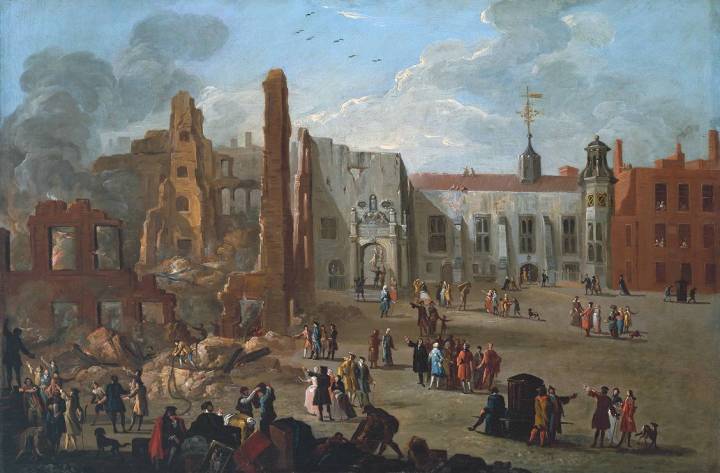
Richard Wilson, The Inner Temple after the Fire of 4 January 1737, oil on canvas, 1737 (Tate Britain). The picture records the devastation caused by a fire that destroyed Crown-Office Row in the Inner Temple. The group in the centre includes Frederick, Prince of Wales (in blue, wearing the Garter star), who had sent fifty soldiers to help the firemen and later came to inspect the scene himself. More information is available here»
◊ ◊ ◊ ◊ ◊
Ruin Lust, an exhibition at Tate Britain from 4 March 2014, offers a guide to the mournful, thrilling, comic and perverse uses of ruins in art from the eighteenth century to the present day. The exhibition is the widest-ranging on the subject to date and includes over 100 works by artists such as J.M.W. Turner, John Constable, John Martin, Eduardo Paolozzi, Rachel Whiteread, and Tacita Dean.
The exhibition begins in the midst of the craze for ruins that overtook artists, writers and architects in the eighteenth century. J.M.W. Turner and John Constable were among those who toured Britain in search of ruins and picturesque landscapes, producing works such as Turner’s Tintern Abbey: The Crossing and Chancel, Looking towards the East Window 1794 and Constable’s Sketch for ‘Hadleigh Castle’ c.1828–29.
 This ruinous heritage has been revisited—and sometimes mocked—by later artists such as Keith Arnatt, who photographed the juxtaposition of historic and modern elements at picturesque sites for his deadpan series A.O.N.B. (Areas of Outstanding Natural Beauty) 1982–84 and John Latham whose sculpture Five Sisters Bing 1976, which was part of a project to turn post-industrial shale heaps in Scotland into monuments. Classical ruins have a continued presence in the work of Eduardo Paolozzi, Ian Hamilton Finlay, and John Stezaker. In works such as Keith Coventry’s Heygate Estate 1995 and Rachel Whiteread’s Demolished—B: Clapton Park Estate 1996, which shows the demolition of Hackney tower blocks, we see Modernist architectural dreams destroyed.
The exhibition explores ruination through both the slow picturesque decay and abrupt apocalypse. John Martin’s The Destruction of Pompeii and Herculaneum 1822 recreates historical disaster while Gustave Doré’s engraving The New Zealander 1872 shows a ruined London. The cracked dome of St Paul’s Cathedral in the distance was a scene partly realised during the Blitz.
Ruin Lust will include work provoked by the wars of the twentieth century, including Graham Sutherland’s Devastation series 1940–41, which depicts the aftermath of the Blitz and Jane and Louise Wilson’s 2006 photographs of the Nazis’ defensive Atlantic Wall. Paul Nash’s photographs of surreal fragments in the 1930s and 40s, or Jon Savage’s images of a desolate London in the late 1970s show how artists also view ruins as zones of pure potential, where the world must be rebuilt or reimagined.
The exhibition will include rooms devoted to Tacita Dean and Gerard Byrne. Dean’s nostalgic film installation Kodak 2006 explores the ruin of the image, as the technology of 16 mm film becomes obsolescent. In 1984 and Beyond 2005–07, Byrne reimagines a future that might have been. The installation presents a re-enactment of a discussion, published in Playboy in 1963, in which science fiction writers—including Isaac Asimov, Ray Bradbury, and Arthur C. Clarke—speculate about what the world might be like in 1984.
This transhistorical exhibition is curated by writer and critic Brian Dillon; Emma Chambers, Curator of Modern British Art; and Amy Concannon, Assistant Curator of British Art, 1790–1850. It will be accompanied by a book and a programme of talks and events in the gallery.
◊ ◊ ◊ ◊ ◊
From Tate Britain’s bookshop:
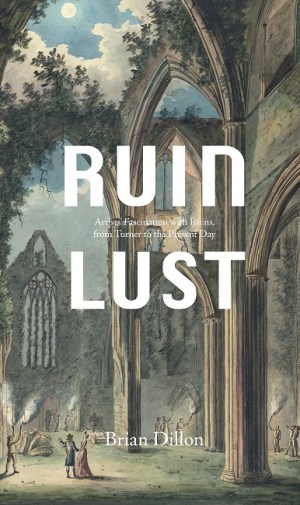
Brian Dillon, Ruin Lust: Artists’ Fascination with Ruins from Turner to the Present Day (London: Tate Publishing, 2014), 64 pages, ISBN: 978-1849763011, £10 / $22.
Why are we fascinated by ruins? They recall the glory of dead civilisations and the certain end of our own. They stand as monuments to historic disasters, but also provoke dreams about futures born from destruction and decay. Ruins are bleak but alluring reminders of our vulnerable place in time and space. For centuries, ruins have attracted artists: among them J.M.W. Turner, Gustave Doré, Paul Nash, Graham Sutherland, Patrick Caulf eld, Tacita Dean, and Jane and Louise Wilson. Ruin Lust explores the history of this obsession, from the art of the picturesque in the eighteenth century, through the wreckage of two world wars, to contemporary artists complex attitudes to the ruins of the recent past.
Brian Dillon is a novelist, critic, and curator who has explored many ancient and modern ruins and written widely on the history of ruination in art and culture. His books include: Objects in this Mirror: Essays; Sanctuary; In the Dark Room; and Ruins, an anthology of artists and critics reflections on ruination. He is UK editor of Cabinet magazine and reader in critical writing at the Royal College of Art.
Exhibition and Lectures | Diverse Maniere: Piranesi, Fantasy and Excess
From the Soane Museum:
Diverse Maniere: Piranesi, Fantasy and Excess
Sir John Soane’s Museum, London, 7 March — 31 May 2014
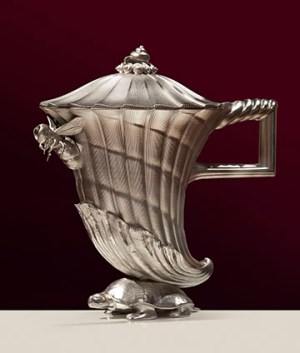
Coffee pot from Piranesi’s Diverse maniere d’adornare i cammini… (1769), cast in silver from digitally modeled elements © Factum Arte.
Sir John Soane’s Museum has one of the richest holdings of graphic work by Piranesi and this exhibition continues the exploration of Soane’s interest in Piranesi. Diverse Maniere will focus upon Piranesi’s engagement with the decorative arts. The displays will consist of meticulous three dimensional reproductions of the objects, such as coffee pots, chairs, chimneypieces and antique candelabra, tripods and altars imagined by Piranesi in such publication as Diverse Maniere or Vasi, Candelabri, Cippi etc…, but never actually realised physically. Now using the latest scanning and 3-dimensional printing technologies Factum Arte has realised Piranesi’s vision as a designer. Bronze Tripods, porphyry altars and marble candelabra will embellish the rooms of No 13 Lincoln’s Inn Fields, whilst in the Soane Gallery a display of Piranesi’s related etchings and explication of Factum Arte’s work will accompany the show. Surely, Sir John Soane, with his love of new technologies, his collections of plaster ‘reproductions’ after the antique, and his fascination with Piranesi’s boundless imagination would find this a particularly appropriate exhibition.
As part of our programme of events, three panel discussions, involving architects, designers, artists and academics, will look at how different disciplines approach these issues and what they might tell us about architectural and design practice in the past and how it has evolved today. All talks will begin at 6pm and take place at the Royal College of Surgeons, WC2A 3PE. Early bird ticket offer: purchase tickets for all three talks for £40. Individual lecture tickets, £15. Click here to find out more or to purchase tickets.
Visualising Design Ideas, 10 March 2014
Speakers: Michele de Lucchi, Ross Lovegrove and Adam Lowe
Using Objects as Evidence of Themselves, 18 March 2014
Speakers: Jerry Brotton, Lisa Jardine and Grayson Perry
Casts, Copies & the Dissemination of Design Ideas, 19 May 2014
Speakers: Adriano Aymonino and Sam Jacob
Display | Art, Revolution and War: France, 1789–1914
From The Fitzwilliam:
Art, Revolution and War: France, 1789–1914
The Fitzwilliam Museum, Cambridge, 4 March — 28 September 2014
 Medals, coins, and banknotes illustrate key moments in the political and artistic history of France. This display focuses on the 1789 revolution, Napoleon, the 1848 revolution, and the artistic triumphs of Art Nouveau. One of the most famous examples of the Art Nouveau style in French medals is Orphée by Marie-Alexandre Lucien Coudray (pictured right). This was exhibited to great acclaim at the 1900 Universal Exhibition in Paris, with thousands of copies sold to art lovers.
Display | From Root to Tip: Botanical Art in Britain
From The Fitzwilliam:
From Root to Tip: Botanical Art in Britain
The Fitzwilliam Museum, Cambridge, 28 January — 11 May 2014
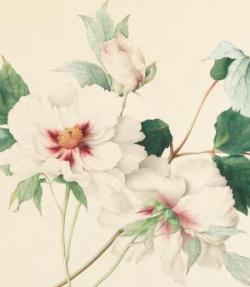 This exhibition brings together a selection of watercolours from the Fitzwilliam’s outstanding collection of botanical art. It draws on over 300 years of work by both professional and amateur artists, tracing a history of flower drawing in Britain. Works on show date from the seventeenth century to present day. See finely executed watercolours by many well-known and influential artists, including Georg Dionusius Ehret, who settled in Britain in 1736, and William Henry Hunt. These are displayed alongside recently acquired pieces by contemporary artists such as Margaret Stones and Rebecca John. The exhibition shows how artists have depicted plants and flowers in glorious detail as both botanical specimens and as part of decorative arrangements.
New Book | The Golden Age of Botanical Art
Published by The University of Chicago Press in September 2013 (having first appeared in Europe in 2012). . .
Martyn Rix, The Golden Age of Botanical Art (Chicago: The University of Chicago Press, 2013), 256 pages, ISBN: 978-0226093598, $35.
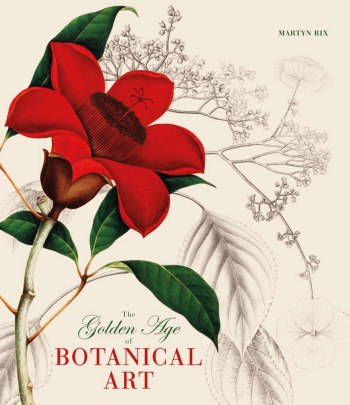 The seventeenth century heralded a golden age of exploration, as intrepid travelers sailed around the world to gain firsthand knowledge of previously unknown continents. These explorers also collected the world’s most beautiful flora, and often their findings were recorded for posterity by talented professional artists. The Golden Age of Botanical Art tells the story of these exciting plant-hunting journeys and marries it with full-color reproductions of the stunning artwork they produced. Covering work through the nineteenth century, this lavishly illustrated book offers readers a look at 250 rare or unpublished images by some of the world’s most important botanical artists.
Truly global in its scope, The Golden Age of Botanical Art features work by artists from Europe, China, and India, recording plants from places as disparate as Africa and South America. Martyn Rix has compiled the stories and art not only of well-known figures—such as Leonardo da Vinci and the artists of Empress Josephine Bonaparte—but also of those adventurous botanists and painters whose names and work have been forgotten. A celebration of both extraordinarily beautiful plant life and the globe-trotting men and women who found and recorded it, The Golden Age of Botanical Art will enchant gardeners and art lovers alike.
Martyn Rix is a botanist and the Editor of Curtis’s Botanical Magazine, and as such has an unrivalled knowledge of botanical art. With a PhD in Botany from the University of Cambridge, he has worked at the University Botanic Garden in Zurich and at the RHS Garden, Wisley and has made many expeditions to different parts of the world, to collect new plants for gardens. He is the author or co-author of a number of books, including the highly acclaimed The Botanical Garden.
C O N T E N T S
Introduction
1 The Origins of Botanical Art / Leonardo da Vinci
2 Early Works of the Sixteenth Century / Jacopo Ligozzi
3 Seventeenth-Century Florilegia / Dutch Flower Paintings
4 North American Plants / Linnaeus and Plant Classification
5 Travellers to the Levant / Maria Sybilla Merian
6 The Exploration of Russia and Japan / Les Vélins du Muséum
7 Botany Bay and Beyond / Sir Joseph Banks
8 The Golden Age in England / Mrs. Delany and Her Paper Mosaicks
9 South American Adventures / Thornton’s The Temple of Flora, or Garden of Nature
10 The Golden Age in France / Empress Joséphine
11 Botanical and Horticultural Illustrated Journals / Henry C. Andrews
12 Early Chinese Plant Drawings / Père David and the French Missionaries
13 The Company School in India / The Story of Flora Danica 1761–1883
14 A New Era at Kew / George Maw
15 Victorian Travellers / Elwes and the Genus Lilium
16 Bringing China to Europe / Modern Florilegia
17 The Flowers of War and Beyond / Exhibiting Botanical Watercolours
18 Carrying on the Tradition
Index
Bibliography
Publishers’ Credits
Call for Papers | Paragone Studies
Paragone Studies
Musée des Beaux-Arts du Québec, 18–20 September 2014
Proposals due by 1 April 2014
Papers are invited for The 3rd Annual International Conference in Paragone Studies, to be held at the Musée des beaux-arts du Québec, just outside of the old quarter of the City of Québec in Canada. The conference’s purpose is to support the scholarly investigation of the paragone, or rivalry in the arts, as it has been manifested in all media across history. The conference will also include a round-table session featuring artists who choose to discuss how competition in the arts, past or present, has impacted their work or their professional lives. To apply, please submit a 300-word abstract using the paper or round-table presenter appropriate form on the conference website and send to paragonestudies@gmail.com. Please include a c.v.
Exhibition | Le Bivouac de Napoléon: Luxe impérial en campagne
From the Palais Fesch:
Le Bivouac de Napoléon: Luxe impérial en campagne
Palais Fesch, Musée des Beaux Arts, Ajaccio, 13 February — 12 May 2014
 Napoléon Ier passe une grande partie de son existence en campagne ou en voyage. Il possède pour ses déplacements et ses bivouacs, une organisation particulière reproduisant pour partie l’étiquette impériale. Ses tentes de campagne sont de véritables palais tissés mobiles, ses bagages, – lit, table, fauteuil, écritoire, nécessaire ou encore chaise d’affaires – constituent un ameublement pliant et luxueux en boite. Les nombreuses voitures qui transportent les effets de l’empereur en campagne, escortées et conduites par un personnel de service nombreux, forment un véritable convoi.
Cet ouvrage, sous la direction de Jehanne Lazaj, conservatrice au Mobilier national, entend montrer l’ingéniosité d’objets prestigieux tout comme la somptuosité de l’artisanat d’Empire à travers l’étude de plus de 70 œuvres qui sont autant d’éléments de campements, de contexte ou de documents iconographiques. Le lecteur s’installe, ainsi, sous le tente de Napoléon pour appréhender une vision la plus
complète possible de la vie des bivouacs, les soirs de
victoire comme de défaite.
Call for Papers | Amateurs: Practices and Representations
From Le Blog de L’ApAhAu:
L’amateurisme dans l’Europe du XVIIIe siècle. Pratiques et représentations
Paris, Université Sorbonne Nouvelle, 3–4 October 2014
Proposals due by 30 April 2014
Le XVIIIe siècle a souvent été décrit comme l’âge d’or de l’amateur. De cette consécration, le signe le plus visible est la création en France du titre d’« amateur honoraire » à l’Académie royale de peinture et de sculpture, dont la personne du comte de Caylus fut l’un des plus brillants représentants. Dans son abstraction, le terme renvoie moins à une fonction déterminée qu’à un goût pour l’art, lequel recouvre concrètement une configuration d’aptitudes ou de rôles (du collectionneur, du mécène, de l’esthète, du savant, du praticien) : parce qu’il combine ces différents usages du goût, le modèle académique constitue un type idéal et accompli de l’amateur, au point qu’on a pu identifier le déclin de ce modèle à la disparition de cette figure au siècle suivant.
Dépassant ce cadre d’analyse centré sur les beaux-arts et le cas français, on se fondera ici sur une compréhension extensive du terme, qui s’étendra aux domaines artistiques autres que les arts plastiques (théâtre, architecture, musique, arts des jardins, etc.) voire au champ esthétique en général (incluant à ce titre le paysage) et l’on abordera cet objet d’étude dans une perspective comparatiste, ouverte sur les particularités lexicales et sémantiques qui caractérisent sa conceptualisation dans les différentes langues et cultures européennes.
On s’interrogera sur les antagonismes et les évolutions qui travaillent la définition de l’amateur, au sein d’un champ de forces où s’affrontent des intérêts divergents. Pour être d’institution récente, la figure de l’amateur académique n’en reste pas moins partiellement tributaire des structures et des valeurs propres à cette sociabilité aristocratique au sein de laquelle s’est constituée une tradition du loisir cultivé et qui définit, depuis le XVIIe siècle, le cadre de la pratique de l’amateur des belles-lettres. Or la campagne que les « gens de lettres », Diderot en tête, vont mener contre Caylus et ses confrères à partir du milieu du XVIIIe siècle, contribue à élargir l’horizon de communication dans lequel se déploie l’activité de l’amateur. Dénonçant la restriction du domaine de juridiction en matière esthétique aux relations entre particuliers à l’intérieur de cercles d’initiés, les critiques d’art revendiquent leur rôle « dans la formation d’un espace public et civique du goût » (Charlotte Guichard, Les amateurs d’art à Paris au XVIIIe siècle, 2008). Ils promeuvent une nouvelle vision de l’amateurisme sous l’espèce du critique d’art, qui prétend former le goût général en s’exprimant en tant que personne particulière, sans être un professionnel ni un praticien. (more…)
Attingham’s French Eighteenth-Century Studies Course
From The Attingham Trust:
The Attingham Trust’s French Eighteenth-Century Studies Course
The Wallace Collection, London, 12–17 October 2014
Applications due by 30 April 2014

François Boucher, Shepherd Piping to a Shepherdess, ca. 1747–50
(London: Wallace Collection)
◊ ◊ ◊ ◊ ◊
French eighteenth-century studies is organised by The Attingham Trust on behalf of the Wallace Collection. Based at Hertford House, this intensive, non-residential study programme aims to foster a deeper knowledge and understanding of French eighteenth-century fine and decorative art and is intended primarily to aid professional development. A day at Waddesdon Manor, Ferdinand de Rothschild’s former country house, will help broaden the scope of the course still further.
The academic programme will provide privileged access to the world-class collections of furniture, paintings, sculpture, textiles, metalwork and porcelain in these two collections. The group will be limited to fifteen people to allow for detailed, object-based study, handling sessions and a look at behind-the-scenes conservation.
Study sessions and lectures will be led by Dr. Christoph Vogtherr, Director of the Wallace Collection, and the relevant curatorial staff; other international authorities and the curators at Waddesdon will provide further specialist teaching. The Course Director is Dr. Helen Jacobsen, Curator of French eighteenth-century Decorative Arts at the Wallace Collection. This course is primarily aimed at curators and other specialists in the fine and decorative arts.
More information is available here»










 Enfilade
leave a comment