Display | Art, Revolution and War: France, 1789–1914
From The Fitzwilliam:
Art, Revolution and War: France, 1789–1914
The Fitzwilliam Museum, Cambridge, 4 March — 28 September 2014
 Medals, coins, and banknotes illustrate key moments in the political and artistic history of France. This display focuses on the 1789 revolution, Napoleon, the 1848 revolution, and the artistic triumphs of Art Nouveau. One of the most famous examples of the Art Nouveau style in French medals is Orphée by Marie-Alexandre Lucien Coudray (pictured right). This was exhibited to great acclaim at the 1900 Universal Exhibition in Paris, with thousands of copies sold to art lovers.
Display | From Root to Tip: Botanical Art in Britain
From The Fitzwilliam:
From Root to Tip: Botanical Art in Britain
The Fitzwilliam Museum, Cambridge, 28 January — 11 May 2014
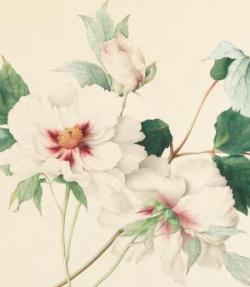 This exhibition brings together a selection of watercolours from the Fitzwilliam’s outstanding collection of botanical art. It draws on over 300 years of work by both professional and amateur artists, tracing a history of flower drawing in Britain. Works on show date from the seventeenth century to present day. See finely executed watercolours by many well-known and influential artists, including Georg Dionusius Ehret, who settled in Britain in 1736, and William Henry Hunt. These are displayed alongside recently acquired pieces by contemporary artists such as Margaret Stones and Rebecca John. The exhibition shows how artists have depicted plants and flowers in glorious detail as both botanical specimens and as part of decorative arrangements.
New Book | The Golden Age of Botanical Art
Published by The University of Chicago Press in September 2013 (having first appeared in Europe in 2012). . .
Martyn Rix, The Golden Age of Botanical Art (Chicago: The University of Chicago Press, 2013), 256 pages, ISBN: 978-0226093598, $35.
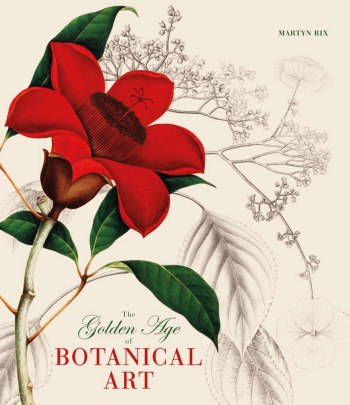 The seventeenth century heralded a golden age of exploration, as intrepid travelers sailed around the world to gain firsthand knowledge of previously unknown continents. These explorers also collected the world’s most beautiful flora, and often their findings were recorded for posterity by talented professional artists. The Golden Age of Botanical Art tells the story of these exciting plant-hunting journeys and marries it with full-color reproductions of the stunning artwork they produced. Covering work through the nineteenth century, this lavishly illustrated book offers readers a look at 250 rare or unpublished images by some of the world’s most important botanical artists.
Truly global in its scope, The Golden Age of Botanical Art features work by artists from Europe, China, and India, recording plants from places as disparate as Africa and South America. Martyn Rix has compiled the stories and art not only of well-known figures—such as Leonardo da Vinci and the artists of Empress Josephine Bonaparte—but also of those adventurous botanists and painters whose names and work have been forgotten. A celebration of both extraordinarily beautiful plant life and the globe-trotting men and women who found and recorded it, The Golden Age of Botanical Art will enchant gardeners and art lovers alike.
Martyn Rix is a botanist and the Editor of Curtis’s Botanical Magazine, and as such has an unrivalled knowledge of botanical art. With a PhD in Botany from the University of Cambridge, he has worked at the University Botanic Garden in Zurich and at the RHS Garden, Wisley and has made many expeditions to different parts of the world, to collect new plants for gardens. He is the author or co-author of a number of books, including the highly acclaimed The Botanical Garden.
C O N T E N T S
Introduction
1 The Origins of Botanical Art / Leonardo da Vinci
2 Early Works of the Sixteenth Century / Jacopo Ligozzi
3 Seventeenth-Century Florilegia / Dutch Flower Paintings
4 North American Plants / Linnaeus and Plant Classification
5 Travellers to the Levant / Maria Sybilla Merian
6 The Exploration of Russia and Japan / Les Vélins du Muséum
7 Botany Bay and Beyond / Sir Joseph Banks
8 The Golden Age in England / Mrs. Delany and Her Paper Mosaicks
9 South American Adventures / Thornton’s The Temple of Flora, or Garden of Nature
10 The Golden Age in France / Empress Joséphine
11 Botanical and Horticultural Illustrated Journals / Henry C. Andrews
12 Early Chinese Plant Drawings / Père David and the French Missionaries
13 The Company School in India / The Story of Flora Danica 1761–1883
14 A New Era at Kew / George Maw
15 Victorian Travellers / Elwes and the Genus Lilium
16 Bringing China to Europe / Modern Florilegia
17 The Flowers of War and Beyond / Exhibiting Botanical Watercolours
18 Carrying on the Tradition
Index
Bibliography
Publishers’ Credits
Call for Papers | Paragone Studies
Paragone Studies
Musée des Beaux-Arts du Québec, 18–20 September 2014
Proposals due by 1 April 2014
Papers are invited for The 3rd Annual International Conference in Paragone Studies, to be held at the Musée des beaux-arts du Québec, just outside of the old quarter of the City of Québec in Canada. The conference’s purpose is to support the scholarly investigation of the paragone, or rivalry in the arts, as it has been manifested in all media across history. The conference will also include a round-table session featuring artists who choose to discuss how competition in the arts, past or present, has impacted their work or their professional lives. To apply, please submit a 300-word abstract using the paper or round-table presenter appropriate form on the conference website and send to paragonestudies@gmail.com. Please include a c.v.
Exhibition | Le Bivouac de Napoléon: Luxe impérial en campagne
From the Palais Fesch:
Le Bivouac de Napoléon: Luxe impérial en campagne
Palais Fesch, Musée des Beaux Arts, Ajaccio, 13 February — 12 May 2014
 Napoléon Ier passe une grande partie de son existence en campagne ou en voyage. Il possède pour ses déplacements et ses bivouacs, une organisation particulière reproduisant pour partie l’étiquette impériale. Ses tentes de campagne sont de véritables palais tissés mobiles, ses bagages, – lit, table, fauteuil, écritoire, nécessaire ou encore chaise d’affaires – constituent un ameublement pliant et luxueux en boite. Les nombreuses voitures qui transportent les effets de l’empereur en campagne, escortées et conduites par un personnel de service nombreux, forment un véritable convoi.
Cet ouvrage, sous la direction de Jehanne Lazaj, conservatrice au Mobilier national, entend montrer l’ingéniosité d’objets prestigieux tout comme la somptuosité de l’artisanat d’Empire à travers l’étude de plus de 70 œuvres qui sont autant d’éléments de campements, de contexte ou de documents iconographiques. Le lecteur s’installe, ainsi, sous le tente de Napoléon pour appréhender une vision la plus
complète possible de la vie des bivouacs, les soirs de
victoire comme de défaite.
Call for Papers | Amateurs: Practices and Representations
From Le Blog de L’ApAhAu:
L’amateurisme dans l’Europe du XVIIIe siècle. Pratiques et représentations
Paris, Université Sorbonne Nouvelle, 3–4 October 2014
Proposals due by 30 April 2014
Le XVIIIe siècle a souvent été décrit comme l’âge d’or de l’amateur. De cette consécration, le signe le plus visible est la création en France du titre d’« amateur honoraire » à l’Académie royale de peinture et de sculpture, dont la personne du comte de Caylus fut l’un des plus brillants représentants. Dans son abstraction, le terme renvoie moins à une fonction déterminée qu’à un goût pour l’art, lequel recouvre concrètement une configuration d’aptitudes ou de rôles (du collectionneur, du mécène, de l’esthète, du savant, du praticien) : parce qu’il combine ces différents usages du goût, le modèle académique constitue un type idéal et accompli de l’amateur, au point qu’on a pu identifier le déclin de ce modèle à la disparition de cette figure au siècle suivant.
Dépassant ce cadre d’analyse centré sur les beaux-arts et le cas français, on se fondera ici sur une compréhension extensive du terme, qui s’étendra aux domaines artistiques autres que les arts plastiques (théâtre, architecture, musique, arts des jardins, etc.) voire au champ esthétique en général (incluant à ce titre le paysage) et l’on abordera cet objet d’étude dans une perspective comparatiste, ouverte sur les particularités lexicales et sémantiques qui caractérisent sa conceptualisation dans les différentes langues et cultures européennes.
On s’interrogera sur les antagonismes et les évolutions qui travaillent la définition de l’amateur, au sein d’un champ de forces où s’affrontent des intérêts divergents. Pour être d’institution récente, la figure de l’amateur académique n’en reste pas moins partiellement tributaire des structures et des valeurs propres à cette sociabilité aristocratique au sein de laquelle s’est constituée une tradition du loisir cultivé et qui définit, depuis le XVIIe siècle, le cadre de la pratique de l’amateur des belles-lettres. Or la campagne que les « gens de lettres », Diderot en tête, vont mener contre Caylus et ses confrères à partir du milieu du XVIIIe siècle, contribue à élargir l’horizon de communication dans lequel se déploie l’activité de l’amateur. Dénonçant la restriction du domaine de juridiction en matière esthétique aux relations entre particuliers à l’intérieur de cercles d’initiés, les critiques d’art revendiquent leur rôle « dans la formation d’un espace public et civique du goût » (Charlotte Guichard, Les amateurs d’art à Paris au XVIIIe siècle, 2008). Ils promeuvent une nouvelle vision de l’amateurisme sous l’espèce du critique d’art, qui prétend former le goût général en s’exprimant en tant que personne particulière, sans être un professionnel ni un praticien. (more…)
Attingham’s French Eighteenth-Century Studies Course
From The Attingham Trust:
The Attingham Trust’s French Eighteenth-Century Studies Course
The Wallace Collection, London, 12–17 October 2014
Applications due by 30 April 2014

François Boucher, Shepherd Piping to a Shepherdess, ca. 1747–50
(London: Wallace Collection)
◊ ◊ ◊ ◊ ◊
French eighteenth-century studies is organised by The Attingham Trust on behalf of the Wallace Collection. Based at Hertford House, this intensive, non-residential study programme aims to foster a deeper knowledge and understanding of French eighteenth-century fine and decorative art and is intended primarily to aid professional development. A day at Waddesdon Manor, Ferdinand de Rothschild’s former country house, will help broaden the scope of the course still further.
The academic programme will provide privileged access to the world-class collections of furniture, paintings, sculpture, textiles, metalwork and porcelain in these two collections. The group will be limited to fifteen people to allow for detailed, object-based study, handling sessions and a look at behind-the-scenes conservation.
Study sessions and lectures will be led by Dr. Christoph Vogtherr, Director of the Wallace Collection, and the relevant curatorial staff; other international authorities and the curators at Waddesdon will provide further specialist teaching. The Course Director is Dr. Helen Jacobsen, Curator of French eighteenth-century Decorative Arts at the Wallace Collection. This course is primarily aimed at curators and other specialists in the fine and decorative arts.
More information is available here»
Exhibition | Richard Wilson
To mark the opening of Richard Wilson and the Transformation of European Landscape Painting, curators Robin Simon and Martin Postle will be in New Haven this evening (5:30, Wednesday, 5 March 2014) for a session entitled “Putting Wilson on the Spot: Landscape, Art, and Location.” Exhibition press release from the YCBA:
Richard Wilson and the Transformation of European Landscape Painting
Yale Center for British Art, New Haven, 6 March — 1 June 2014
National Museum Cardiff, 5 July — 26 October 2014
Curated by Robin Simon and Martin Postle
Richard Wilson, Dinas Bran from Llangollen, 1770–71, oil on canvas,
Yale Center for British Art, Paul Mellon Collection
◊ ◊ ◊ ◊ ◊
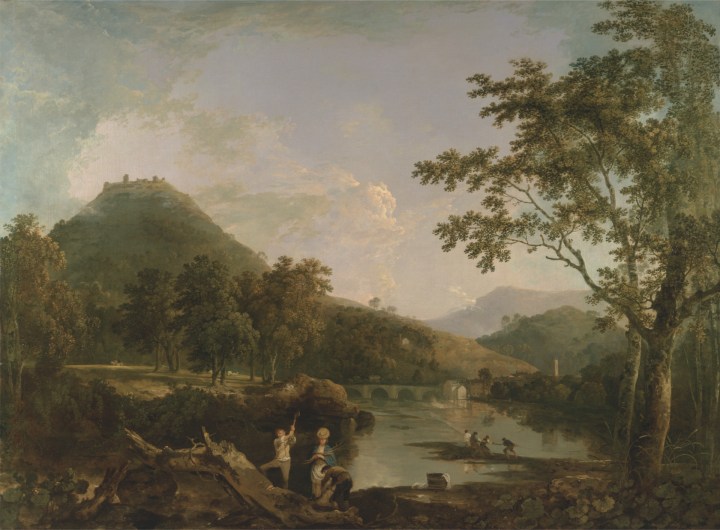
This spring, the Yale Center for British Art presents the first major exhibition in more than thirty years devoted to Welsh painter Richard Wilson (1714–1782), considered by many to be the father of British landscape painting. Richard Wilson and the Transformation of European Landscape Painting, opening on March 6, 2014, will demonstrate the extent of Wilson’s influence throughout Europe and explore his work in its international context. The exhibition will focus on the nearly seven years he spent working in Rome in the 1750s, a transformational period for Wilson and for European landscape art.
The exhibition will feature many of Wilson’s greatest paintings and drawings alongside works by European masters who preceded Wilson, contemporaries whose practice directly influenced his, and artists who were in turn taught or influenced by him. Other artists in the exhibition will include the old masters Claude Lorrain and Gaspard Dughet, as well as many of Wilson’s contemporaries such as Claude-Joseph Vernet, Pompeo Batoni, and Anton Raphael Mengs. Also presented will be works by many of Wilson’s pupils and followers, including the little-known artists Robert Crone and Adolf Friedrich Harper—both of whom studied with Wilson in Italy, as well as major figures such as John Constable and J. M. W. Turner.
As part of a cosmopolitan group of artists in Rome, Wilson pioneered a serious and powerfully original approach to landscape that reflected the nascent neoclassicism being advanced by his friends Anton Raphael Mengs and Johann Winckelmann. Wilson’s pupils in Rome transmitted his style across northern Europe. Setting up in London after his Italian sojourn, he established a large and successful studio and gained a European reputation with grand historical landscapes—such as The Destruction of the Children of Niobe (1760)—which were featured at the new public art exhibitions in London and widely disseminated through popular engravings. His treatment of British landscapes, particularly of his native Wales, borrowed their conceptual framework from the paintings of the seventeenth-century masters Claude Lorrain and Gaspard Dughet, but with a specificity of lighting conditions and weather that was an enduring legacy to the British landscape school.
Wilson’s great success during the 1760s slipped away in the following decade, as there was less demand for his work and his health deteriorated. By the time of his death he was largely forgotten. However, within a few years his critical reputation began to revive, and by the early nineteenth century he was celebrated as a pioneering figure of the British school. His innovations in landscape painting were crucial to the development of the genre during the romantic period, which saw its greatest expression in the work of J. M. W. Turner and John Constable, both profound admirers of Wilson.
This is the first exhibition the Center has co-organized with Amgueddfa Cymru– National Museum Wales. The exhibition has been co-curated by Robin Simon, Honorary Professor of English, University College London, and Editor, The British Art Journal, and Martin Postle, Deputy Director of Studies, The Paul Mellon Centre for Studies in British Art, London. The organizing curator at the Center is Scott Wilcox, Chief Curator of Art Collections and Senior Curator of Prints and Drawings; and, at Amgueddfa Cymru–National Museum Wales, Oliver Fairclough, Keeper of Art.
◊ ◊ ◊ ◊ ◊
From Yale UP:
Martin Postle and Robin Simon, eds., with contributions by Steffen Eggle, Oliver Fairclough, Jason Kelly, Ana María Suárez Huerta, Lars Kokkonen, Kate Lowry, Paul Spencer-Longhurst, Jonathan Yarker, Scott Wilcox, and Rosie Ibbotson. Richard Wilson and the Transformation of European Landscape Painting (New Haven: Yale University Press, 2014), 416 pages, ISBN: 978-0300203851 $80.
 Long known as the father of British landscape painting, Richard Wilson (1713–1782) was in fact at the heart of a profound conceptual shift in European landscape art. This magnificently illustrated volume not only situates Wilson’s art at the beginning of a native tradition that would lead to John Constable and J. M. W. Turner, but compellingly argues that in Rome during the 1750s Wilson was part of an international group of artists who reshaped the art of Europe. Rooted in the work of great seventeenth-century masters such as Claude Lorrain but responding to the early stirrings of neoclassicism, Wilson forged a highly original landscape vision that through the example of his own works and the tutelage of his pupils in Rome and later in London would establish itself throughout northern Europe.
Martin Postle is assistant director of the Paul Mellon Centre for Studies in British Art. Robin Simon is honorary professor of English at University College
London, and editor of The British Art Journal.
Portraits and Other Pictures Return to Osterley
From the UK’s National Trust:
Rare portraits and Other Works of Art Now on Display at Osterley Park and House in West London
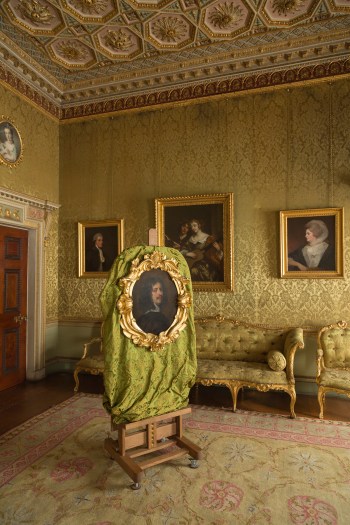
William Dobson’s self-portrait on display at Osterley together with the portraits of Robert and Sarah Child and The Music Lesson by Sir Peter Lely. ©National Trust/Chris Lacey
Once described by Horace Walpole as the ‘palace of palaces’, Osterley Park and House’s spectacular interiors were created in the 18th century by the Child family, the owners of Child’s Bank. But for over sixty years their portraits have been absent. Now a major ten-year loan marks the return of the Child family to the house they so lovingly transformed with rare items of furniture and over twenty paintings including many portraits of family members. Among the most famous artworks to return is a self-portrait by William Dobson (1611–1646), court painter to King Charles I, which was bought by the family in the early 18th century and has not been on public display at Osterley since 1949.
The family portraits
•Francis Child III — He succeeded to Osterley in 1756 and began transforming the house with the help of fashionable architect Robert Adam.
•Robert Child — Francis’ brother, he inherited Osterley Park and House in 1763 and continued to employ Adam who worked at Osterley until 1781.
• Sarah Jodrell — Robert’s wife and a woman of many accomplishments which included her exquisite embroidery, examples of which can be seen at Osterley Park and House.

Alan Ramsay, Portrait of Francis Child III (1735-63). ©National Trust/John Hammond
• Sarah Anne Child — Robert and Sarah’s beloved daughter and a talented musician, whose harpsichord is still on display in the house. She was disinherited from her father’s fortune for eloping to Gretna Green to marry the Earl of Westmorland.
Claire Reed, Osterley’s House and Collections Manager explains: “This is an exciting moment as it really feels as though the family are returning to Osterley. We have beautiful interiors and fascinating objects at the house but until now visitors couldn’t see the faces behind the names of those who made this such a wonderful place.”
Other art works include The Music Lesson by Sir Peter Lely and a large painting of Temple Bar, a detailed London scene depicting the area close to the location of Child’s Bank. Rare pieces of lacquer furniture and other treasured family objects will also be on display, telling stories of the fashions and tastes for collecting in the 18th century.
Osterley Park and House was first opened to the public by the 9th Earl of Jersey in 1939 following a steady stream of requests to see inside the house. It was then transferred to us in 1949. This ten-year loan has been made by the trustee of the Earldom of Jersey Trust, following consultation and backing from the 10th Earl of Jersey.
Also see the posting at Emile de Bruijn’s Treasure Hunt (27 February 2014)»
New Book | Antique Sealed Bottles, 1640–1900
Happy Mardi Gras!
David Burton, Antique Sealed Bottles 1640–1900 and the Families that Owned Them (Antique Collectors’ Club, 2014), 1800 pages (3 volumes), ISBN: 978-1851497553, £250.
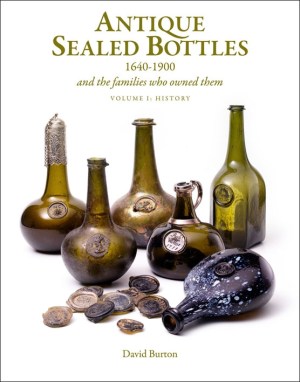 Time in a bottle; this is a collection that explores the unlocking of history through the identification of its unique seals, using crests and coats-of-arms as the ‘keys’ towards identifying the original owner. This three-volume collection examines the evolution of the sealed bottle from the 1640s to the late 1800s and provides a detailed description to accompany each entry, supported by numerous photographs, including the number of examples known, their condition, and the collections where the bottles and detached seals are held.
The laying down of wine to improve its quality and longevity related to the social history of the day, the design of the bottles, their evolution and manufacture, are a reflection of the individuals who ordered and used the bottles at home or in the private gentlemen’s clubs, much influenced by the historic events of the 17th through to the 20th centuries.
Wine consumption has a place in cultural history; these collected bottles existed at times of incredible upheaval and social change. From the early colonial settlements of the New World, into the slave markets of Richmond, VA, New Orleans, Charleston, SC, and Philadelphia, and with the plantation owners who amassed vast wealth and prestige as a result of this trade. In the taverns and coffee houses of London, alongside the bear baiting and cock fighting to be found across the River Thames in Southwark, in the cellars of the Oxford colleges and Inns of Court, these sealed bottles give much information on the early drinking habits of the aspiring and upwardly mobile, and the established aristocracy.
C O N T E N T S
Volume One
Dated Sealed Bottles, 1650–1900
Volume Two
Undated Sealed Bottles, Seventeenth Century; Undated Sealed Bottles, 1700–1900; Crests and Coats of Arms, pre-1700 identified; Crests and Coats of Arms, pre-1700 unidentified; Crests and Coats of Arms, post-1700 identified; Crests and Coats of Arms, post-1700 unidentified
Volume Three
Chapter One: What is a Sealed Bottle? Chapter Two: Sealed Bottles from the Seventeenth Century; Chapter Three: Sealed Bottles from the Eighteenth and Nineteenth Centuries; Chapter Four: Heraldry and Sealed Bottles; Chapter Five: Sealed Bottles from the West Country; Chapter Six: Sealed Bottles from Wales; Chapter Seven: Sealed Bottles associated with the American Colonies; Chapter Eight: Sealed Bottles in Major Public Collections; Chapter Nine: Building a Collection; Chapter Ten: Price Guide and Price Trends











 Enfilade
leave a comment