Call for Applications | Baroque Summer Course: Death
From ArtHist.net:
Baroque — Death / Barock — Tod
24th Baroque Summer Course, Bibliothek Werner Oechslin, Einsiedeln, Switzerland, 22–26 June 2025
Organized by Anja Buschow Oechslin, Axel Christoph Gampp, and Werner Oechslin
Applications due by 23 February 2025
Death is omnipresent. No one can escape it; it is among us and goes about its business as it sees fit. If one takes seriously the “memento mori” that we encounter in droves on tombstones and that is addressed to us, the (still) living, then one can see that this commingling of life and death is of central importance to human culture and has always had a significant impact on its art forms.
This ubiquity and omnipresence of death was summed up in the long-popular Dance of Death: “we all die” according to the biblical saying “Omnes Morimur.” Patritius Wasserburger put this into verse for Count Sporck as “Zuschrift an das sämmtlich-menschliche Geschlecht” (“Letter to the whole human race”):
“You popes! Cardinals!
You bishops! You abbots!
You lappeted gentlemen!
You canons! You prelates!
All manner of priests,
Of high dignity, and also of lower rank. […]”
He records them all, even the “drunkards”:
“Oh you brothers of the wet stream!
Guzzle, dance, sing songs!
You are wild and tipsy, jolly: bluster, sleep around, shack up, rave!
Go on, twirl, feast, roister!
But: woe for eternity.”
Michael Heinrich Rentz illustrated this in his dramatic images and emphasized the direct partnership—and equality—of man and death. The series of images, first printed in 1753, was realized as a perfect baroque book, “full of meaning, instruction, and spirit.” And we are already amid the exuberant baroque pleasure in shaping and designing. Baroque rhetoric, with its astute precepts of “argutezza” or even “cavillatio,” takes particular pleasure in the boundaries, in the contact between life and death. Nothing is alien to this and the desire to transcend such boundaries fires the imagination. In 1774, the Archbishop and Elector of Mainz, who had been blessed with the “temporal right of sovereignty,” was mourned accordingly: “The tombstones may restrict his generous hands, but his heart allows no limits to be set, such as to work immortally in faithfulness to God, thus in love for his needy people.” After the “passing away,” as if only a small disturbance had occurred, it is all about the “denatus”; he has merely changed his condition—for the better, of course.
Glorification of human deeds in light of the future life after death, as the motto of the Duke of Brauschweig, Johann Friedrich, says: EX DURIS GLORIA. The separation through death is followed by reflection and the gain of a “better life.” Death is given this powerful, dialectical function of the historical continuation of “lived reality” by virtue of idealization. It challenges all the arts and the artifices of rhetoric, which “mediate” in all possible tones of a “heroic poem” in an “Imitatio Epica,” whether allegory, or panegyric or in the “Epicedium” particularly assigned to funeral ceremonies.
Those who focus so much on the afterlife, as was the case in the Baroque ecclesiastical world in the most pronounced way, have before their eyes all the glory that is emulated in this world with the greatest artistic effort in order to convey it to people and their sensory perceptions. This is what led someone like Karl Wilhelm Ferdinand Solger to recommend: “He who cannot reach God in his spirit should seek him in images, he will not be led astray.” To “draw God down into his sphere” was the motto and it fit best precisely where the scene is changed, as it were, with death. Friedrich Wilhelm Schelling saw it correctly: “This symbolic view is the church as a living work of art.” And there is more, something fundamental, hidden behind this paradigm of human destiny and the conditions of privileged human existence. Marsilio Ficino states this in the first sentences of his “Cristiana religione” (1474/5). If man could not distinguish between good and bad in the “lume dell’intellecto,” he would be the most miserable creature, as he, unlike other living creatures, also has to dress himself. And at the beginning of “Platonica Theologia” (1482), he formulates its essence: “Si animus non esset immortalis: nullum animal esset infelicius homine.”
Art draws its deeper justification from this and declares that no effort is too great for it, especially when it comes to the furnishings for funeral ceremonies, when entire church interiors are covered with allegorical scenes and high catafalques are erected. The unsurpassable dialectic of life and death calls for the greatest artistic invention, which is particularly desirable in “baroque” times and results in works of art that would give even someone like Wölfflin a headache. When Rudolf Wittkower opened the Guarini Congress in Turin in 1968, he had a whole repertoire of “unorthodox” forms at hand: “Paradossi ed apparenti contraddizioni, volute incongruenze”; it is much more than just “varietà” and—in the tradition of Nicholas of Cusa—also encompasses mathematics: “Famose (!) compenetrazioni di spazi diversi.” He observes the juxtaposition of “morbidi moduli ornamentali manieristici” and “forme cristalline di estrema austerità.” They are “prodigi strutturali.” And Wittkower’s insight was: “intelletto” and “emozione” are not separate, but belong together, just as—in art—life and death appear intertwined and death, if man takes his divinely inspired, spiritual life seriously, is ultimately only a gateway to another world. It is understandable that a cemetery is then described as “the Elysian Fields.” There are no limits to the imagination and to art.
The course is open to doctoral candidates as well as junior and senior scholars who wish to address the topic with short papers (20 minutes) and through mutual conversation. As usual, the course has an interdisciplinary orientation. We hope for lively participation from the disciplines of art and architectural history, but also from scholars of history, theology, theatre and other relevant fields. Papers may be presented in German, French, Italian or English; at least a passive knowledge of German is a requirement for participation. The Foundation assumes the hotel costs for course participants, as well as several group dinners. Travel costs cannot be reimbursed. Please send applications with brief abstracts and brief CVs by email to: anja.buschow@bibliothek-oechslin.ch. The deadline is 23 February 2025.
Concept / Organization: Dr. Anja Buschow Oechslin (Einsiedeln), Prof. Dr. Axel Christoph Gampp (Uni Basel, Fachhochschule Bern), Prof. Dr. Werner Oechslin (Einsiedeln)
New Book | Reading Typographically
From Stanford UP:
Geoffrey Turnovsky, Reading Typographically: Immersed in Print in Early Modern France (Stanford: Stanford University Press, 2024), 328 pages, ISBN: 978-1503637214, $70.
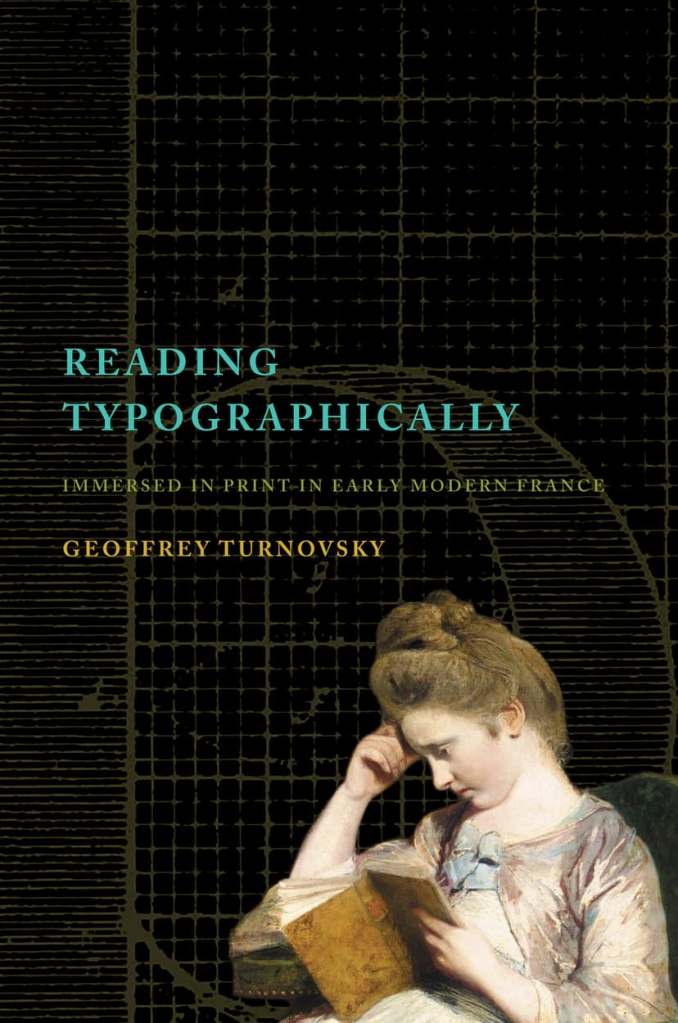 Anxieties about the fate of reading in the digital age reveal how deeply our views of the moral and intellectual benefits of reading are tied to print. These views take root in a conception of reading as an immersive activity, exemplified by the experience of ‘losing oneself in a book’. Against the backdrop of digital distraction and fragmentation, such immersion leads readers to become more focused, collected, and empathetic.
How did we come to see the printed book as especially suited to deliver this experience? Print-based reading practices have historically included a wide range of modes, not least the disjointed scanning we associate today with electronic text. In the context of religious practice, literacy’s benefits were presumed to lie in such random-access retrieval, facilitated by indexical tools like the numbering of Biblical chapters and verses. It was this didactic, hunt-and-peck reading that bound readers to communities.
Exploring key evolutions in print in 17th- and 18th-century France, from typeface, print runs, and format to punctuation and the editorial adaptation of manuscript and oral forms in print, this book argues that typographic developments upholding the transparency of the printed medium were decisive for the ascendancy of immersive reading as a dominant paradigm that shaped modern perspectives on reading and literacy.
Geoffrey Turnovsky is Associate Professor of French at the University of Washington, Seattle. He is the author of The Literary Market: Authorship and Modernity in the Old Regime (2011).
c o n t e n t s
Acknowledgments
Introduction: The Benefits of Reading
1 Typeface: Disappearing Letters from the Romain du Roi to Didot
2 Print Runs: Tender Maps in the Marketplace
3 Format: Appropriations of the Book
4 Editorial Labors: The Typography of Intimate Texts
5 Punctuation Marks: Bringing Speech to Life on the Printed Page
Conclusion: Hybridity and Text Technologies
Notes
Selected Bibliography
Index
Williamsburg Garden Symposium | Influence of Great English Gardens
From the conference website (scholarships are available, with an application deadline of 7 February). . . .
78th Annual Garden Symposium: Celebrating the Influence of Great English Gardens
Online and in-person, Colonial Williamsburg, 10–13 April 2025
 When John Custis IV created his celebrated Williamsburg Garden, it was an English garden. Join us for the 2025 Garden Symposium celebrating the influence of great English gardens with keynote lectures by British garden historian and designer Todd Longstaffe-Gowan and Troy Scott Smith, head gardener at Sissinghurst, one of England’s most romantic and iconic landscapes. Todd Longstaffe-Gowan also joins in conversation with Will Rieley (historic landscape architect on such projects as Monticello, Poplar Forest, Carter’s Grove), Colonial Williamsburg’s executive director of archaeology Jack Gary, and the Margaret Beck Pritchard Curator of Maps & Prints Katie McKinney, to discuss the influence of imported prints on Virginia’s early gardens.
Marta McDowell (acclaimed garden author and avid gardener) explores “New Ideas from English Gardens and English Authors & Their Gardens,” and Brent Heath (naturalist, author, photographer, and award-winning horticulturalist) gives insight into “Bulbs as Companion Plants for Spring Flowering Bulbs.” From the Colonial Williamsburg Department of Landscape and Horticulture, senior manager Jon Lak expands upon colonial ecosystems and what we can learn from them, while horticulturalist Andrew Holland forays into how the Age of Exploration expanded science, gardening, and landscape design in England. Historic Trades master gardener Eve Otmar speaks to a fusion of three cultures that formed a new world.
In-person and virtual attendees have access to all lectures in the Hennage Auditorium, and in-person attendees can also choose from a variety of limited-capacity walking tours and workshops for a small additional fee.
Call for Essays | Laughter and Medicine
From ArtHist.net:
Edited Volume | Laughter and Medicine
Proposals due by 15 March 2025
We invite proposals for contributions to an edited volume exploring the interfaces between laughter and medicine. Developing from a British Academy/Wellcome Trust-funded conference held at the University of Birmingham in November 2024, this volume will put the medical humanities in dialogue with healthcare provision and the medical sciences so as to bridge the divides between the clinic, the laboratory, cultural history, literature, and the arts in Western cultures from the classical period to the present day.
The volume aims to present a transdisciplinary account of the cultural, social, diagnostic, therapeutic, and physiological implications of the laughter that characterizes—and is elicited by—real and fictional interactions among physicians, patients and the general public, inside and outside the clinic. Laughter is not always the ‘best medicine’, nor is laughter linked only to comedy and enjoyment. Without excluding the curative or the comic, this project hopes to uncover the more complex and sometimes darker aspects of the relationship between laughter (both voluntary and involuntary) and medicine that are often obscured by facile idioms and clichés. ‘Healing laughter’ differs markedly in character and effects from pathological laughter; hysterical laughter; forced or bitter laughter; laughter serving to mitigate awkwardness in, or failures of, communication; laughter intended to deceive; or laughter signifying fear, discomfort or aggression. The irony and other double-coded signifiers that abound in comic and parodic representations of medical practitioners and their patients, as well as in medical metaphors and allegories deployed in diverse discursive contexts, often reveal medicine’s paradoxical place in various cultural imaginaries and in individual and collective experience.
Submissions may respond to questions including, but not limited to, the following:
• How and why is laughter represented, elicited, and mobilized in connection with medicine in the temporal and spatial arts (literature, cinema, print and digital media, performing arts, sculpture, etc.) in particular historical and cultural contexts and moments? What ideological, aesthetic, cultural, and other issues are bound up with or thought through the nexus between laughter and medicine?
• What does synchronic and diachronic comparison reveal about the specificity of particular representations of laughter and medicine and about the historical evolution of their cultural construction? How do evolving cultural and artistic representations inform, and how are they informed by, the development of medical science and practice?
• How and why does laughter occur in the context of illness and death, as well as in routine healthcare provision? What is its significance? What functions does it serve?
• What are laughter’s causes and effects from a physiological and psychological standpoint? What does the phenomenon of laughter reveal about the relationships between mind and body and between physical, mental, and emotional health?
• How and with what stakes has the relationship between laughter and medicine been theorized at different moments in intellectual and cultural history? How does the thinking of laughter in medical contexts fit into larger cultural formations and reflect or revise scientific models?
• What are the poetic and ideological effects and stakes of the ludic medicalization, in various discursive contexts, of aspects of life and culture that are not (necessarily or customarily) imagined in medical terms?
• What are the implications of the relationship between laughter and medicine from a philosophical perspective?
• What are the sociological implications of the nexus between laughter and medicine, especially in relation to contexts and patterns of (mis)communication and to the negotiation of social identities linked to profession, class, gender, ethnicity, etc.?
• What roles does laughter play in relation to disability and disability studies?
In order to accommodate the different disciplinary norms corresponding to the diverse fields that will be represented in the volume, we will accept proposals for chapters ranging in length from 3,000 to 10,000 words. Each chapter should make a contribution in its own discipline while making an effort to remain intelligible to an interdisciplinary academic audience.
Chapter proposals should take the form of a 500-word abstract including a title; a brief overview of scholarly or scientific contexts; a concise articulation of the research question and/or aims to be addressed; the tentative theses, conclusions, and/or arguments to be advanced in the chapter; and an estimated word count for the chapter. Authors should also provide an abbreviated CV.
It is hoped that the volume proposal will be submitted in July 2025 to the Proceedings of the British Academy series, which has expressed interest in the project. Contrary to what its name might suggest, this series, currently published through Oxford University Press, produces high-quality, rigorously peer-reviewed themed volumes developing from conference projects that have earned support from very competitive British Academy grants. Following notification of the acceptance of the book proposal, contributors will be asked to submit their completed chapters within six months. Submissions should be sent to both p.barta@surrey.ac.uk and lucas.wood@ttu.edu by 15 March 2025.
Symposium | The Art of the Dolls’ House
 .
.
The Uppark dolls’ house from 1732, currently installed at the Huguenot Museum in Rochester. The Neo-Palladian house was a gift to ten-year-old Sarah Lethieullier from her father, who acquired it fully equipped from the Covent Garden auctioneer Christopher Cock. More information is available from Tessa Murdoch’s December 2023 Apollo article.
◊ ◊ ◊ ◊ ◊
Registration for the symposium is available at Eventbrite:
The Art of the Dolls’ House: The 49th Annual Furniture History Society Symposium
Online and in-person, Victoria & Albert Museum, London, 22 March 2025
Led by Tessa Murdoch
An international roster of speakers will celebrate the earliest surviving European dolls’ houses preserved in The Netherlands and Nuremberg. That tradition developed in Britain where two beautifully furnished ‘baby’ houses treasured by Huguenot heiresses are today curated by the National Trust. The dolls’ house belonging to Petronella de la Court in Utrecht complemented her contemporary art collection. 300 years later, model maker Ben Taggart will speak about making models of historic houses. Architect-designed Queen Mary’s Dolls’ House has just celebrated its centenary whilst the installation of dolls’ houses at the Young V&A by Rachel Whiteread and the curatorial team have contributed to its celebratory position as the 2024 Art Fund Museum of the Year. The symposium will revisit these miniature homes and explore their legacy and creative inspiration as educational tools opening the eyes of successive generations through fascination with miniature worlds.
There will be an opportunity for delegates to visit the exhibition of Sarah Lethieullier’s 1730s dolls’ house at the Huguenot Museum, Rochester, Kent on Friday, 21 March 2025.
p r o g r a m m e
10.00 Registration
10.30 Welcome by Christopher Rowell (FHS Chairman)
10.35 Session 1 | The European Dolls’ House
Moderated by Christopher Rowell
• Revisiting the ‘Nuremberg Houses’: 17th-Century Miniature Households as Imperfect Windows into the Past — Heike Zech, (Deputy Director, Germanisches Museum, Nuremberg)
• At Home in the 17th Century: The Rijksmuseum Dolls’ Houses — Sara van Dijk (Curator of Textiles, Rijksmuseum, Amsterdam)
• Petronella de La Court’s Dolls’ House in Utrecht (1670–1690): Registration, Research, and Re-Installation — Natalie Dubois (Curator of Applied Art and Design, Centraal Museum, Utrecht)
• Kinnaird Castle: A Miniature Mystery — Ben Taggart (model maker of historic properties)
12.45 Lunch — Study Sessions: Demonstration of miniature furniture making by Terence Facey and looking at silver toys with Kirstin Kennedy (curator, V&A Metalwork)
2.00 Session 2 | National Trust Dolls’ Houses
Moderated by Megan Wheeler (Assistant Curator, Furniture, National Trust)
• ‘Deceptively Spacious’: The Dolls’ House and Framing Significance and Story at Nostell — Simon McCormack (Property Curator, Nostell Priory, National Trust)
• The Lethieullier Family Dolls’ House at the Huguenot Museum — Tessa Murdoch
2.55 Break for tea
3.20 Session 3 | Displaying Dolls’ Houses
Moderated by Tessa Murdoch
• Fitted up with Perfect Fidelity’: Lutyens and Queen Mary’s Dolls’ House — Kathryn Jones (Senior Curator of Decorative Arts, Royal Collection Trust)
• Dolls’ Houses from the V&A — William Newton (Curator, Young V&A)
4.25 Closing remarks
Exhibition | Carved Couture: 18th-Century British Wooden Fashion Dolls
Opening in January at the Barry Art Museum:
Carved Couture: 18th-Century British Wooden Fashion Dolls
Barry Art Museum, Old Dominion University, Norfolk, Virginia, 28 January — 31 July 2025
 In 2025, the Barry Art Museum will continue its series of historical doll exhibitions by taking a closer look at English wooden dolls.
Popular among affluent consumers between the seventeenth and eighteenth centuries, these dolls acted as three-dimensional fashion plates for viewers, their simple bodies a backdrop for showcasing elegant clothing in miniature. Centuries before Barbie dazzled the world with her extensive wardrobes and accessories, English wooden dolls modeled the latest fashions for their privileged viewers. In keeping with the Barry’s commitment to showcasing the richness of Hampton Roads’ art and material culture, this show will highlight not only works from our permanent collection but also objects from Colonial Williamsburg and local private collectors.
The full press release is available here»
◊ ◊ ◊ ◊ ◊
Note (added 5 February 2025) — The posting was updated to include a link to the press release.
Exhibitions at the Prado in 2025
From the press release:
The Museo Nacional del Prado has announced an exciting program for 2025, promising a year of rich artistic exploration. From monographic exhibitions of Old Masters to a fascinating look at the impact of Mexican iconography in Spain, and a celebration of women’s contributions to art history, the Prado’s 2025 season offers something for everyone.

Antón Rafael Mengs, Self-Portrait, 1761–69, oil on panel, 63 × 50 cm (Madrid: Museo Nacional del Prado).
Following a 2024 season focused on thematic exhibitions, the Prado is returning to the intimate study of individual artists. Three giants from its collection will be the focus of major solo shows: El Greco and Veronese in the first half of the year, followed by Anton Raphael Mengs in the latter half.
A Reunion for El Greco’s Masterpiece
Kicking off the year is El Greco: Santo Domingo el Antiguo (18 February — 15 June), an exhibition that will reunite, for the first time since 1830, the majority of works El Greco created for the Monastery of Santo Domingo el Antiguo in Toledo. This significant commission, which included a grand altarpiece and two side altarpieces, has seen its components scattered across the globe. Thanks to a special agreement with the Art Institute of Chicago, the breathtaking Assumption of the Virgin will return to the Prado after more than a century, joining other works from the museum’s collection and various other holdings.
Veronese: A Venetian Master in the Spotlight
Next up is Paolo Veronese (1528–1588) (27 May — 21 June), an exhibition that culminates the Prado’s ongoing study and re-evaluation of its world-renowned Venetian Renaissance painting collection. Following successful shows on the Bassanos, Titian, Tintoretto, and Lorenzo Lotto, this exhibition shines a light on Veronese’s importance, particularly his influence on Spanish art during the Golden Age. The exhibition will explore Veronese’s creative process, his workshop’s organization, and his remarkable ability to capture the aspirations of Venetian elites, a style that resonated with European courts.
A Journey Across the Atlantic: Guadalupe in Spain
Shifting gears, the Prado will present So Far, So Close: Guadalupe of Mexico in Spain (10 June — 14 September). This exhibition will trace the remarkable journey of the Virgin of Guadalupe’s image from New Spain (colonial Mexico) to Spain, examining its profound impact on art on both sides of the Atlantic. This exhibition builds on the Prado’s ongoing exploration of the artistic exchange between Spain and the Americas, continuing the work started with the 2021 exhibition Tornaviaje.
The Sculptural World of Juan Muñoz
Later in the year, the Prado will focus on contemporary sculpture with an exhibition dedicated to Juan Muñoz (18 November 2025 — 8 March 2026). Curated by Vicente Todolí, the exhibition will explore Muñoz’s dialogue with art history, particularly his inspirations drawn from Renaissance and Baroque masters like Velázquez and Goya. The exhibition will examine Muñoz’s use of theatricality, illusionism, and architecture, and how he captured fleeting moments in time, echoing the styles of his artistic predecessors.
Mengs: A Major Retrospective
Closing out the monographic exhibitions is Anton Raphael Mengs: The Greatest Painter of the 18th Century (25 November 2025 — 1 March 2026). This will be the most comprehensive exhibition of Mengs’ work to date, featuring approximately 150 pieces, including paintings, watercolors, pastels, drawings, and even his fresco Jupiter and Ganymede. The exhibition promises a complete overview of Mengs’s artistic practice, his influences, and his connections to other great masters like Raphael, Correggio, and Pompeo Batoni.
Celebrating Women’s Contributions to Art History
The Prado remains committed to highlighting the often-overlooked contributions of women to art history. The third edition of The Prado in Feminine will focus on the 18th century, exploring the legacy of influential women who played a crucial role in shaping the museum’s collections. The exhibition will focus on figures like María Luisa Gabriela de Saboya, María Luisa de Parma, and especially Queen Isabel de Farnesio, a key figure in both politics and art collecting in 18th-century Europe.
A Hub for Research and Learning
Beyond the exhibitions, the Prado’s Center for Studies will offer a rich program of lectures and residencies. Lecture cycles like Spanish Intellectual Women and the Museo del Prado will explore the museum’s role in the intellectual and social awakening of Spanish women in the 19th century. The Writing the Prado residency, in partnership with the Loewe Foundation and Granta in Spanish, will host acclaimed writers Helen Oyeyemi and Mathias Énard. There will also be a Pérez-Llorca Conference by Robert Lane Fox on classical antiquity and the Prado Chair led by Astrid Schmidt-Bukhardt on genealogical diagrams in art history. The Prado’s 2025 program promises to be a vibrant and engaging exploration of art from various periods and perspectives.
New Book | Freedom’s Currency
From Penn Press:
Julia Wallace Bernier, Freedom’s Currency: Slavery, Capitalism, and Self-Purchase in the United States (Philadelphia: University of Pennsylvania Press, 2024), 224 pages, ISBN: 978-1512826470, $50.
 The first comprehensive study of self-purchase in the United States from the American Revolution to the Civil War
Enslaved people lived in a world in which everything had a price. Even freedom. Freedom’s Currency follows enslaved people’s efforts to buy themselves out of slavery across the United States from the American Revolution to the Civil War. In the first comprehensive study of self-purchase in the nation, Julia Wallace Bernier reveals how enslaved people raised money, fostered connections, and made use of slavery’s systems of value and exchange to wrest control of their lives from those who owned them. She chronicles the stories of famous fugitives like Frederick Douglass, who, with the help of friends and supporters, purchased his freedom to protect himself against the continued legal claims of his enslavers and the possibility of recapture. She also shows how enslaved fathers like Lunsford Lane and mothers like Elizabeth Keckley tried to secure lives for their families outside of slavery. Freedom’s Currency argues that freedom played a central role in the social and economic lives of the enslaved and in the ways that these aspects of their lives overlapped. This intimate portrait of community illuminates the complexity of enslaved people’s ideas about their place at the intersection of slavery and American capitalism and their attempts to value freedom above all. Given the stakes—liberation or remaining enslaved—it is an account of both triumph and devastating failure.
Julia Wallace Bernier is Assistant Professor of History at Washington & Jefferson College.
Lecture | Beatrice Glow on Speculative Objects
From the BGC:
Beatrice Glow | Speculative Objects
Bard Graduate Center, New York, 5 February 2025, 6pm

Beatrice Glow, Pax Hollandica (Dutch Peace), 2022. VR-sculpted photopolymer 3D print, metallic paint, acrylic paint, enamel coating, chains (Photo: Aertiron).
Responding to archival research on lesser-known public histories, artist Beatrice Glow creates objects that blend digital processes (such as virtual reality sculpting and 3D printing) with meticulous handcrafting to envision speculative futures. In this talk, Glow will introduce two of her recent projects that leverage playful artistry to foster a deeper public understanding of cultural inheritance. First, she will unpack her recent New York Historical solo exhibition, When Our Rivers Meet, in which she collaborated with culture bearers whose heritages were impacted by Dutch colonialism to create an alternative commemoration of the 400th anniversary of the founding of New Amsterdam. This exploration has continued beyond the exhibition and has taken a new form as a board game—Finding Magic Turtle (Unpacking the Four Continents)—commissioned by the Institute of Contemporary Art, San Diego. Glow will also share her current work-in-progress, Gilt/Guilt, a performance-installation imagined as a speculative auction. The hauntingly luxurious collectibles in this project reveal the cascading impacts of colonial violence and environmental extraction.
Beatrice Glow is an American multidisciplinary artist of Taiwanese heritage whose practice includes examinations of archives and collaboration with culture bearers and researchers in the creation of sculpture, installations, textiles, emerging media, and olfactory experiences to envision a more just and thriving world guided by history. Recent solo exhibitions have taken place at the New York Historical and the Baltimore Museum of Art. Her work has been supported by Creative Capital, the National Endowment for the Arts, Rockefeller Brothers Fund, Smithsonian Artist Research Fellowship, Yale-NUS College, Lower Manhattan Cultural Council, the Asian/Pacific/American Institute at New York University, the Fulbright Program, and many more. More information about her work is available here.
Exhibition | Monstrous Beauty: A Feminist Revision of Chinoiserie
Opening in March at The Met:
Monstrous Beauty: A Feminist Revision of Chinoiserie
The Metropolitan Museum of Art, New York, 25 March — 17 August 2025

Monstrous Beauty: A Feminist Revision of Chinoiserie radically reimagines the story of European porcelain through a feminist lens. When porcelain arrived in early modern Europe from China, it led to the rise of chinoiserie, a decorative style that encompassed Europe’s fantasies of the East and fixations on the exotic, along with new ideas about women, sexuality, and race. This exhibition explores how this fragile material shaped both European women’s identities and racial and cultural stereotypes around Asian women. Shattering the illusion of chinoiserie as a neutral, harmless fantasy, Monstrous Beauty adopts a critical glance at the historical style and its afterlives, recasting negative terms through a lens of female empowerment.
Bringing together nearly 200 historical and contemporary works spanning from 16th-century Europe to contemporary installations by Asian and Asian American women artists, Monstrous Beauty illuminates chinoiserie through a conceptual framework that brings the past into active dialog with the present. In demand during the 1700s as the embodiment of Europe’s fantasy of the East, porcelain accumulated strong associations with female taste over its complex history. Fragile, delicate, and sharp when broken, it became a resonant metaphor for women, who became the protagonists of new narratives around cultural exchange, consumption, and desire.
The catalogue is distributed by Yale University Press:
Iris Moon, ed., Monstrous Beauty: A Feminist Revision of Chinoiserie (New York: The Metroplitan Museum of Art, 2025), 256 pages, ISBN: 978-1588397928, $35. With additional contributions by Marlise Brown, Patty Chang, Anne Anlin Cheng, Elizabeth Cleland, Patricia Ferguson, Eleanor Hyun, Cindy Kang, Ronda Kasl, Joan Kee, Pengliang Lu, Lesley Ma, David Porter, Joseph Scheier-Dolberg, Elizabeth Kowaleski Wallace, Chi-ming Yang, and Yao-Fen You.










 Enfilade
leave a comment