Arches Software for Cultural Heritage Sites
Press release (4 December 2013) from The Getty:
Getty Conservation Institute and World Monuments Fund Release Arches Software To Help Safeguard Cultural Heritage Sites Worldwide
The Getty Conservation Institute (GCI) and World Monuments Fund (WMF) today announced the public release of Arches (version 1.0), a user-friendly, open source information management software system built specifically to help heritage organizations safeguard cultural heritage sites worldwide.
Arches has been created to help inventory and manage heritage places, and by incorporating a broad range of international standards, meets a critical need in terms of gathering, making accessible and preserving key information about cultural heritage.
“Knowing what you have is the critical first step in the conservation process. Inventorying heritage assets is a major task and a major investment,” said Bonnie Burnham, President and CEO of World Monuments Fund.
Cultural heritage inventories are difficult to establish and maintain. Agencies often rely on costly proprietary software that is frequently a mismatch for the needs of the heritage field or they create custom information systems from scratch. Both approaches remain problematic and many national and local authorities around the world are struggling to find resources to address these challenges.
The GCI and WMF have responded to this need by partnering to create Arches, which is available at no cost. Arches can present its user interface in any language or in multiple languages, and is configurable to any geographic location or region. It is web-based to provide for the widest access and requires minimal training. The system is freely available for download from the Internet so that institutions may install it at any location in the world.
“Our hope is that by creating Arches we can help reduce the need for heritage institutions to expend scarce resources on creating systems from the ground up, and also alleviate the need for them to engage in the complexities and constantly changing world of software development,” said Tim Whalen, Director of the Getty Conservation Institute in Los Angeles.
In developing Arches, the GCI and WMF consulted international best practices and standards, engaging nearly 20 national, regional, and local government heritage authorities from the US, England, Belgium, France, and the Middle East, as well as information technology experts from the US and Europe. The contributions of English Heritage and the Flanders Heritage Agency have played a particularly important role during the development process. Data provided by English Heritage has been valuable for system development, and it is incorporated as a sample data set within the demonstration version of Arches.
The careful integration of standards in Arches also will encourage the creation and management of data using best practices. This makes the exchange and comparison of data between Arches and other information systems easier, both within the heritage community and related fields, and it will ultimately support the longevity of important information related to cultural sites.
Once the Arches system is installed, institutions implementing it can control the degree of visibility of their data. They may choose to have the system and its data totally open to online access, partially open, accessible with a log-in, not accessible at all, or somewhere in between.
“Shared understanding of cultural heritage sites is essential for their successful management and for their enjoyment, too. English Heritage has been really proud to contribute to the development of Arches, and believes it to offer a fresh and readily applicable solution to the challenges of data management. It’s been a great international partnership, and has overcome real complexities,” said Dr. Gillian Grayson, Head of Heritage Data Management at English Heritage.
The GCI and WMF are committed to providing resources to support the Arches open-source community during its formative period.
Arches is not the first joint initiative for the GCI and WMF. The partners previously developed the Middle Eastern Geodatabase for Antiquities, or MEGA, to help the Kingdom of Jordan manage archeological sites. In 2010, MEGA was deployed as Jordan’s National Heritage Documentation and Management System. Different from MEGA, Arches has taken advantage of new semantic technologies and that it is designed to help inventory and manage all types of cultural heritage information, not only archaeological sites. As well, Arches is intended for application anywhere in the world rather than simply one geographic area.
Arches has been developed by the GCI and WMF in conjunction with Farallon Geographics Inc., who also provided expertise for MEGA.
◊ ◊ ◊ ◊ ◊
From the FAQ page:
Does Arches record movable heritage?
Arches has been designed to record all types of immovable heritage, based on the CIDOC Core Data Standard for Archaeological and Architectural Heritage. In conformance with this standard, Arches provides the ability to record artifacts discovered at a site, but it has not been designed as a collections management tool. For a discussion of this question in greater detail, including ways to achieve additional functionality that may be required for movable heritage, please visit the Arches forum.
New Book | History of Design, 1400–2000
From Yale UP:
Pat Kirkham and Susan Weber, eds., History of Design: Decorative Arts and Material Culture, 1400–2000 (New Haven: Yale University Press for the Bard Graduate Center, 2013), 712 pages, ISBN: 978-0300196146, $80.
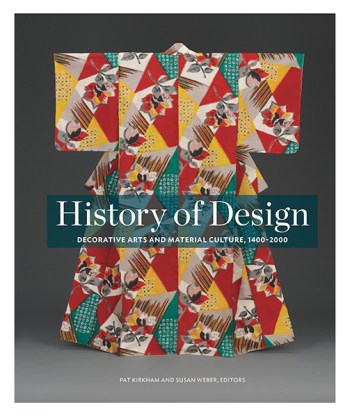 Spanning six centuries of global design, this far-reaching survey is the first to offer an account of the vast history of decorative arts and design produced in Africa, the Americas, Asia, Europe, the Indian subcontinent, and the Islamic world, from 1400 to the present. Meticulously documented and lavishly illustrated, the volume covers interiors, furniture, textiles and dress, glass, graphics, metalwork, ceramics, exhibitions, product design, landscape and garden design, and theater and film design. Divided into four chronological sections, each of which is subdivided geographically, the authors elucidate the evolution of style, form, materials, and techniques, and address vital issues such as gender, race, patronage, cultural appropriation, continuity versus innovation, and high versus low culture.
Leading authorities in design history and decorative arts studies present hundreds of objects in their contemporary contexts, demonstrating the overwhelming extent to which the applied arts have enriched customs, ceremony, and daily life worldwide over the past six hundred years. This ambitious, landmark publication is essential reading, contributing a definitive classic to the existing scholarship on design, decorative arts, and material culture, while also introducing these subjects to new readers in a comprehensive, erudite book with widespread appeal.
Pat Kirkham is a professor at the Bard Graduate Center, where Susan Weber is founder and director.
Exhibition | The Tapestry Collection of the Petit Palais
Now on view in Nancy, as noted at Arachné, a research group blog dedicated to tapestries:
Chefs-d’œuvre de la tapisserie: La collection du Petit Palais, Paris
Nancy, Musée des Beaux-Arts, 25 October 2013 — 27 January 2014
Curated by Charles Villeneuve de Janti and Patrick Lemasson
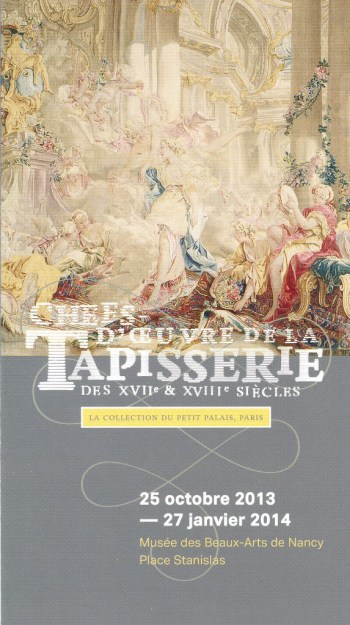 Le Petit Palais, Musée des Beaux-Arts de la Ville de Paris, possède l’une des plus belles collections de tapisseries des XVIIe et XVIIIe siècles. Issues de grandes manufactures européennes, elles furent élaborées et tissées en matériaux précieux d’après les cartons de peintres majeurs tels que Le Brun, Champaigne, Boucher, à l’instar du carton pour La Destruction du Palais d’Armide par Charles Coypel, l’un des chefs-d’œuvre du Musée des Beaux-Arts de Nancy.
Ces œuvres, pouvant mesurer jusqu’à 5 mètres de hauteur, permettront aux visiteurs de découvrir un art de cour spectaculaire faisant écho à celui dévoilé dans l’exposition L’Automne de la Renaissance : d’Arcimboldo à Caravage. Pour des raisons de conservation, ces pièces sont très rarement présentées au public. Ce prêt du Petit Palais constitue donc une faveur exceptionnelle.
Didier Rykner provides a review at La Tribune de l’Art (4 November 2013).
◊ ◊ ◊ ◊ ◊
The catalogue is available from Artbooks.com:
Patrick Lemasson, Chefs d’oeuvres de la Tapisserie: La collection du Petit Palais, Paris (Milan: Silvana, 2013), 72 pages, ISBN: 978-8836627257, $29.
University of Buckingham, MA in Decorative Arts and Historic Interiors
Partial studentships for the MA in Decorative Arts and Historic Interiors at the University of Buckingham
Applications are invited for partial studentships for the MA in Decorative Arts and Historic Interiors at the University of Buckingham to start in September 2014. This unique MA focuses on the development of interiors and decorative arts in England and France in the long eighteenth century (c.1660–c.1830) and their subsequent rediscovery and reinterpretation in the nineteenth and twentieth centuries.
The course is taught by the University of Buckingham, with contributions from leading international experts and curatorial staff from the Wallace Collection. A key element is the emphasis on the first-hand study of decorative arts within the context of historic interiors. There are frequent trips to collections in and around London, as well as a study week in Paris.
The programme provides a vocational and academic training which has enabled students to pursue careers in museums and galleries, auction houses, interior design, and institutions such as the National Trust and English Heritage.
Eligibility: applicants should hold a first or second class honours degree.
Informal enquiries can be made to the course director Jeremy Howard, Jeremy.howard@buckingham.ac.uk; the course tutor Dr Barbara Lasic, Barbara.lasic@buckingham.ac.uk; or Linda Waterman, Linda.waterman@buckingham.ac.uk.
Further details are available here»
New Book | Placing Faces: The Portrait and the English Country House
From Manchester UP:
Gill Perry, Kate Retford and Jordan Vibert, eds., Placing Faces: The Portrait and the English Country House in the Long Eighteenth Century (Manchester: Manchester University Press, 2013), 320 pages, ISBN: 978-0719090394, £70.
 This book explores the rich but understudied relationship between English country houses and the portraits they contain. It features essays by well-known scholars such as Alison Yarrington, Gill Perry, Kate Retford, Harriet Guest, Emma Barker and Desmond Shawe-Taylor. Works discussed include grand portraits, intimate pastels and imposing sculptures. Moving between residences as diverse as Stowe, Althorp Park, the Vache, Chatsworth, Knole and Windsor Castle, it unpicks the significance of various spaces—the closet, the gallery, the library—and the ways in which portraiture interacted with those environments. It explores questions around gender, investigating narratives of family and kinship in portraits of women as wives and daughters, but also as mistresses and celebrities. It also interrogates representations of military heroes in order to explore the wider, complex ties between these families, their houses, and imperial conflict.
Gill Perry is Professor of Art History at the Open University. Kate Retford is Senior Lecturer in History of Art at Birkbeck College, University of London. Jordan Vibert is a freelance researcher
specialising in eighteenth-century art and culture.
◊ ◊ ◊ ◊ ◊
Introduction: Placing faces in the country house
Part 1: A Walk around the House
1. The topography of the conversation piece: A walk around Wanstead – Kate Retford
2. Life in the library – Susie West
3. Marble, memory and theatre: Portraiture and the sculpture gallery at Chatsworth – Alison Yarrington
Part 2: Women’s Space?
4. Dirty dancing at Knole: Portraits of Giovanna Baccelli and the performance of ‘Public Intimacy’ – Gill Perry
5. ‘Necessary, usefull, easy and delightfull’: The production and display of pastel portraits in the English country house – Ruth Kenny
6. Georgiana at Althorp: Spencer family portraits 1755–1783 – Emma Barker
Part 3: Imperial Designs
7. Commemorating Captain Cook in the country estate – Harriet Guest
8. Framing Sir Francis: Lady Anne Stanhope and the corruption of civic masculinity – Jordan Vibert
9. The Waterloo Chamber before the Battle of Waterloo – Desmond Shawe Taylor
Bibliography
Index
Display | Gainsborough and the Landscape of Refinement
As noted at ArtDaily (2 December 2013) . . .
Master Drawings New York | Gainsborough and the Landscape of Refinement
Lowell Libson at Mitchell-Innes & Nash, New York, 24 January — 1 February 2014

Thomas Gainsborough, Figures Resting in Woodland Landscape, signed 1784, 232 x 291 (Lowell Libson)
The exhibition is centered round a group of landscape drawings made by Gainsborough in the last two decades of his life but includes twelve drawings by Gainsborough spanning the full length of his career, from Gainsborough’s earliest recorded landscape study—completed when the artist was only 18—to a preparatory drawing for one of his last ‘Fancy pictures’ A Boy with a Cat, now in the Metropolitan Museum of Art in New York, which was completed the year before his death. Three of the drawings are previously unpublished and exhibited to the public for the first time here.
Thomas Gainsborough (1727–1788) was one of the Britain’s greatest artists, famed for his engaging portraits and evocative landscape paintings, he is also universally acknowledged as one of the finest European draughtsman of the eighteenth century. Despite this reputation, there have been very few exhibitions dedicated to Gainsborough’s drawings. These are not topographical works but imagined landscapes which Gainsborough created by drawing models he created using rocks and wood found in his garden and, as one writer noted, ‘distant woods of broccoli.’
Gainsborough was fascinated by a limited number of landscape features—herds of cattle, serpentine roads, clumps of trees and hilly horizons—often obsessively playing with these features time and time again, each time creating completely new works. This creative repetition—or refinement—was given expression in Gainsborough’s fascination with different techniques.
No two drawings in the exhibition are handled in the same way as Gainsborough explored different combinations of chalks, pencil, ink washes and watercolour in each work. Many of the drawings in the exhibition have provenances stretching back to the eighteenth century, one is inscribed as a present from ‘the ingenious artist’ to the daughter of a friend, another was in the collection of the celebrated surgeon, Dr John Hunter, who treated Gainsborough in his final illness. This group is the largest concentration of Gainsborough drawings to be offered by an art gallery since the celebrated exhibition mounted by Knoedler in 1914. It is accompanied by a fully illustrated catalogue with scholarly entries written by the leading Gainsborough authority, Hugh Belsey.
The exhibition is free and open daily from Friday 24 January to Saturday 1 February, 2014 Mitchell-Innes & Nash, 1018 Madison Avenue, New York. Monday to Saturday, 11–6; Sunday, January 26, 2–6; Tuesday, 28 and Thursday, 30 January, 11–8.
◊ ◊ ◊ ◊ ◊
Press release (15 August 2013) from Master Drawings New York:
Master Drawings New York
New York, 25 January — 1 February 2014

◊ ◊ ◊ ◊ ◊
In a fifteen block stretch of the Upper East Side’s ‘Gold Coast’ in New York, close to 30 of the most acclaimed international dealers in master drawings will show the latest artworks entering the market during the eighth edition of Master Drawings New York, January 25th through February 1, 2014 with a Preview Friday January 24th from 4 to 8pm. Timed to coincide with New York’s major January art-buying events, including the Old Master auctions and The Winter Antiques Show, Master Drawings New York includes top dealers from the US as well as the UK, France, Germany, Spain, and Italy. Originally conceived as an annual walkthrough, Master Drawings New York has grown into a ‘must see’ event with a number of New York dealers making their galleries available to their overseas colleagues for the week. (more…)
Call for Papers | Carlo Fontana (1638–1714), A Celebrated Architect
Carlo Fontana (1638–1714), A Celebrated Architect
Palazzo Carpegna, Accademia Nazionale di San Luca, Rome, 22–23 October 2014
Proposals due by 15 February 2014
The conference is dedicated to the architect Carlo Fontana (Rancate 1638 – Roma 1714) on the occasion of the 300th anniversary of his death. The protagonist of Roman architecture as the Baroque was waning, Fontana—descending from a famous dynasty of Ticinese architects—organized the teaching and the practice of architecture based on the exercise of drawing and geometry. His workshop thus prefigured modern design studios. The propagandistic usage of graphic sheets and printed volumes illustrating and diffusing Fontana’s works and ideas constituted yet another factor of his modernity. In fact, Fontana understood perfectly the dimension of intellectual and creative freedom of print, liberating himself from a dependence on patrons and from morphological and typological conventions of his time.
The projects of Carlo Fontana range from artifacts of domestic use, interiors, civil, religious and military architecture to the most challenging urban and territorial infrastructures (ports, aqueducts, grain warehouses, etc.). These design and entrepreneurial features are comparable, then, to the great architectural studios of the 19th and 20th century, confirming Fontana’s actuality. Such an innovative organization of his workshop attracted students from all over Europe: Johann Bernhard Fischer von Erlach, Nicodemus Tessin, Lucas von Hildebrandt, Filippo Juvarra, Francesco Specchi, and James Gibbs, to name a few. In Fontana’s studio, students could learn innovative typologies, modern and experimental techniques, at the same time measuring themselves up to the great Roman construction tradition, both ancient and modern. Their direct contact with monuments was favored by the works Fontana executed on antique buildings to make them fit for new usages and new representations.
Proposals should thus encompass and explore, but by no means be limited to, the above mentioned aspect always bearing in mind the cosmopolite and European horizon that characterizes the production, the teaching and the thought of architect Carlo Fontana. Abstracts (3000 characters with spaces) together with a short CV (500 characters with spaces) containing principal publications, should be sent by e-mail with the subject CFP-Fontana before 15 February 2014 to Giuseppe Bonaccorso at the following addresses: convegnofontana2014@gmail.com; bonaccorso@ing.uniroma2.it.
Languages: Italian and English
Call for Papers | British Country Houses, CAA in 2014
Historians of British Art Session at CAA 2014 in Chicago
British Country Houses: Architecture, Collections, and Gardens
Chicago, Thursday, 13 February 2014, 12:30–2:00
Proposals due by 10 January 2014
In a spirit of nimble experimentation, the Historians of British Art invite proposals for an informal lunchtime session in Chicago at the 2014 meeting of the College Art Association on the subject of “British Country Houses: Architecture, Collections, and Gardens.” As a midday session, it is open to the public without the usual CAA membership or conference registration requirements. Speakers need belong only to HBA (or become a member soon!). Extended abstracts will be available digitally before the conference to encourage more productive discussion during the 90-minute slot.
Papers might address material aspects as well as larger contextual approaches that situate particular families and houses within narratives of patronage, the history of taste, or British identity. Please email a 200-word proposal and a CV to CraigAshleyHanson@gmail.com by 10 January 2014. In light of the unusually quick turn-around, early responses are encouraged. Questions are most welcome.
Call for Papers | Eighteenth-Century Europe at MAHS in St. Louis
Midwest Art History Society Annual Conference 2014
Open Session: Eighteenth-Century Europe
Saint Louis Art Museum, 3–5 April 2014
Proposals due by 16 December 2013 — extended to 2 January 2014
CAAH members are invited to submit proposals for sessions at the Midwest Art History Society Annual Conference, which will convene in St. Louis, April 3-5, 2014 at the Saint Louis Art Museum. In addition to five thematic sessions, there are seventeen ‘open’ sessions addressing broad periods and general topics. This session on Eighteenth-Century Europe invites papers on all aspects of the art, architecture, and decorative arts of the period. Please email a 200-word proposal and a CV to CraigAshleyHanson@gmail.com by 16 December 2013. Questions are most welcome.
Conference | Persistent Spaces: 18th- and 19th-Century Cities
From the conference website:
Persistent Spaces: Politics, Aesthetics and Topography
in the Eighteenth- and Nineteenth-Century City
Université Paris Diderot, 12–13 December 2013
Keynote speakers: Lynda Nead (Birkbeck College) and Stéphane Van Damme (Sciences Po Paris)
The aim of this two-day postgraduate conference is to bring together young researchers to explore the city and its ideologies from a fully interdisciplinary perspective. We would like to combine approaches from the fields of literature and the arts, sociology, philosophy, law, science and engineering in order to create a dialogue between disciplines and methodologies. This conference would also establish a dialogue between the eighteenth and the nineteenth centuries. We will seek to highlight the individual specificities of these two periods, but also to understand the echoes, continuities and breaks between them. From the Enlightenment to the late nineteenth century and before urbanism was fully established as a discipline, the city was constantly being configured and reconfigured by the joint influences of architects, civil engineers, political organizations, associations and the informal “practices” of inhabitants. Writers and artists also played a major part in this process, both picking up on these developments and changing them through the aesthetics they deployed. We would like to study this topography of struggle. The conference will shed light on the city as a site of conflicting and interpenetrating layers, changing yet also persisting through time and space, and continually shaped by tensions between authority and resistance.
T H U R S D A Y , 1 2 D E C E M B E R
9.00 Registration, welcome, plenary address by Sara Thornton, Professor of Nineteenth-Century English Literature and Cultural Studies, Université Paris Diderot
9.30 Panel 1: Urbanism and urban planning
Chair: Allan Potofsky, Professor of Eighteenth-Century History, Université Paris Diderot
• Simona Gîrleanu (Université de Marne-la-Vallée), ‘Capitals of the Enlightenment: London and Paris Improved’
• Yvonne Rickert (Philipps University of Marburg), ‘The Parisian “Place Louis XV”: The Effect of a Literary Clash on the Architectural Design’
10.30 Tea
11.00 Panel 2: Urban Experiences of poverty and pauperism
Chair: Ariane Fennetaux, Assistant Professor of Eighteenth-Century Cultural Studies, Université Paris Diderot
• Oliver Betts (University of York), ‘Disorderly Spaces: Homes in the Slums of London and Paris’
• George Currie (Queen Mary University of London), ‘Alexis de Tocqueville, Thomas Carlyle and Urban Pauperism’
12.00 Lunch
14.00 Panel 3: Instability of space, instability of self
Chair: Estelle Murail, Lecturer in Nineteenth-Century British Literature and Cultural Studies, Université Paris-Diderot
• Alexandra Logvinova (European Humanities University), ‘The Structure of Urban Daily Life in the Nineteenth Century as the Basis of Subject’s Anxiety’
• Adrian Versteegh (New York University), ‘“Cycle in Epicycle, Orb in Orb”: Navigating the Thresholds, Passages and Nested Interiors of Nineteenth-Century Urban Literature’
15.00 Tea
15.30 Panel 4: Fragmented spaces and writing
Chair: Lynda Nead, Pevsner Professor of History of Art at Birkbeck, University of London
• Alison Annunziata (University of Southern California), ‘Urban De-Enlightenment: A Russian’s Dark Journey through Paris and London at the Start of the French Revolution’
• Ushashi Dasgupta (St John’s College, University of Oxford), ‘“Is this an Hotel? Are There Thieves in the House?”: Dickens, Collins, and the Spatial Contexts of Crime’
• Robert Yeates (University of Exeter), ‘The Destruction of the City in Early Science Fiction’
17.00 Keynote address
Stéphane Van Damme, Professor of History of Science, European University Institute in Florence, ‘Archaeology of Modernity: Making Metropolitan Past Tangible and Persistent: Paris, London, New York’
F R I D A Y , 1 3 D E C E M B E R
9.30 Ariane Fennetaux (Université Paris Diderot), ‘Materializing History: Plebeian Women’s Pockets in Eighteenth- and Nineteenth-Century London’
10.30 Tea
11.00 Panel 5: Disorientating the Orient
Chair: Colin Jones, Professor of Eighteenth-Century French History, Queen Mary College, London, Fellow of the British Academy
• Michael Talbot (University of St Andrews), ‘Shifting Centres: The Political and Topographical Transformations of Ottoman Haifa, 1700–1900’
• Natalia Starostina (Emory University), ‘Paris Oriental, Carnal Pleasures and the Spaces of Desires in Defining the Mental Topography of Paris from Montesquieu to Maupassant and to Paul Morand’
12.00 Lunch
14.00 Panel 6: The city in science
Chair: Stéphane Van Damme, Professor of History of Science, European University Institute in Florence
• Lavinia Maddluno (University of Cambridge), ‘Spaces of Nature and Realms of Civilisation: Pavia between Politics, Scientific Practices and Natural Order in the Late Eighteenth Century’
• Mathieu Fernandez (Conservatoire National des Arts et Métiers), ‘Mapping the Third Dimension: Observing, Representing and Transforming Paris, 1750–1850’
15.00 Tea
15.30 Keynote address
Lynda Nead, Pevsner Professor of History of Art at Birkbeck, University of London, ‘The Tiger in the Smoke: The Fog of Modernity in Post-war London’










 Enfilade
leave a comment