New Book | Printing Colour, 1700–1830
From Oxford UP:
Margaret Morgan Grasselli and Elizabeth Savage, eds., Printing Colour 1700–1830: Histories, Techniques, Functions, and Receptions (Oxford: Oxford University Press, 2025), 448 pages, $185. Proceedings of the British Academy
 Printing Colour 1700–1830 offers a broad-ranging examination of the rich period of invention, experimentation, and creativity surrounding colour printing in Europe between two critically important developments, four-colour separation printing around 1710, and chromolithography around 1830. Its 28 field-defining contributions by 23 leading experts expand the corpus beyond rare fine art impressions to include many millions of colour-printed images and objects. The chapters unveil the explosive growth in the production and marketing of colour prints at this pivotal moment. They address the numerous scientific and technological advances that fed the burgeoning popularity for such diverse colour-printed consumer goods as clothing, textiles, wallpapers, and ceramics. They recontextualise the rise in colour-printed paper currencies, book endpapers and typography, and ephemera, including lottery tickets and advertisements. This landmark volume launches colour printing of the long 18th century as an interdisciplinary field of study, opening new avenues for research across historical and scientific fields.
Elizabeth Savage is Senior Lecturer in Book History and Communications, School of Advanced Study, and Head of Academic Research Engagement, Senate House Library, University of London. In 2020–22, she was an Honorary Fellow at Centre for the Study of the Book, Bodleian Libraries, Oxford University. In 2022–23, she was a Fellow at Linda Hall Library. Her research into pre-industrial European printing techniques, especially for colour, has won awards including the Schulman and Bullard Article Prize. Her latest book is Early Colour Printing: German Renaissance Woodcuts at the British Museum, and she co-edited Printing Colour 1400–1700. She regularly curates and contributes to exhibitions about print heritage, for example at the British Museum and Musée du Louvre. She teaches at London Rare Books School.
Margaret Morgan Grasselli worked for forty years at the National Gallery of Art in Washington, thirty as Curator of Old Master Drawings. Having retired in 2020, she then served as Visiting Lecturer in the department of History of Art and Architecture of the Faculty of Arts and Sciences at Harvard University (2020–22) and Visiting Senior Scholar for Drawings at the Harvard Art Museums (2020–23). An expert on French drawings, she is also an authority on French color prints of the 18th century. She organised the 2003 exhibition at the National Gallery of Art, Colorful Impressions: The Printing Revolution in Eighteenth-Century France, and was the editor and primary author of the accompanying catalogue.
c o n t e n t s
Introduction — Margaret Morgan Grasselli and Elizabeth Savage
Part 1 | Materials and Techniques Printing Colour in 18th-Century Europe
• Tools, Machines, and Presswork for Printing Colour in 18th-Century Europe — Margaret Morgan Grasselli and Elizabeth Savage
• Colour Printing Inks and Colour Inking in 18th-Century Europe — Elizabeth Savage
Part 2 | Relief Techniques: Letterpress, and Colour Woodcut
• Colour Letterpress in Europe in the Long 18th Century — Ad Stijnman
• Elisha Kirkall and His Proposals for Printing in Chiaroscuro, Natural Colours, and Tints, 1720–40 — Simon Turner
• Printing Chiaroscuro and Colour Woodcuts in Paris, Venice, and London c.1725–70 — Tico Seifert
• Bringing Colour to Books and Objects with Decorated Paper in the Long 18th Century — Sid Berger, Michèle Cloonan
• Colour for Commerce: Letterpress-Printed Ephemera in Britain, 1700–1830 — Rob Banham
Part 3 | Mezzotint and Trichromatic Printing
• The Politics of Process Mezzotint: Jacob Christoff Le Blon’s Reputation, 1700–89 — Elizabeth Savage
• From Colour Theory to Colour Practice: Printmakers in Pursuit of the Ideal Pigments in 18th-Century Europe — Dionysia Christoforou, Manon van der Mullen, and Victor Gonzalez
• Colouring the Body: Printed Colour in Medical Treatises during the Long 18th Century — Julia Nurse
• Colour Printing in Late 18th-Century Italy: Édouard and Louis Dagoty, 1770–1800 — Alice Nicoliello
Part 4 | Chalk, Pastel and Watercolour Manner, and Aquatint
• Printed Paintings and Engraved Drawings: Technical Innovations in Colour Printing in 18th-Century France — Margaret Morgan Grasselli
• Coloured Prints in Imitation of Old Master Drawings in 18th-Century Italy: Anton Maria Zanetti the Elder, Benigno Bossi, Francesco Rosaspina and their Contemporaries — Benedetta Spadaccini
• François-Philippe Charpentier and the Development of Aquatint in France in the 1760s — Rena Hoisington
• A Voyage pittoresque in Norway through Colour Prints, 1789–c.1815 — Chiara Palandri
• The Market for Colour Prints in Paris at the End of the 18th Century — Corinne Le Bitouzé
• Multiple-Plate Colour Prints and the Problems of Variant Impressions, Missing Plates, and Disappearing Inks — Margaret Morgan Grasselli
Part 5 | Stipple and a la Poupée
• English Colour-Printed Stipple Engravings, 1774–1800 — David Alexander
• Between Painting and Graphic Arts: Colour Printmaking in Russia, 1750s–1800s — Zalina Tetermazova
• Anne Allen, Jean Pillement, and the Development of à la poupée Printing in France — Geert-Jan Janse
• The Contribution of à la poupée-inked Colour Printing to Natural History Illustration in France, 1800–1870 — Karen Cook
Part 6 | Consumer Goods and Expanding Markets for Colour Printing
• Anatomy to Embroidery: Intaglio Colour-Printed Illustrations in European Books and Periodicals, 1700–1850 — Ad Stijnman
• Early Dye-Patterned Colour on Calico in Europe, 1600–1840 — Susan Greene
• Printed Wallpaper in England in the Long 18th Century — Phillippa Mapes
• Colour Printing on English Ceramics, 1751–70 — Patricia Ferguson
Part 7 | Technical Experimentation and Industrialisation
• William Blake’s Colour Printing: Methods and Materials — Michael Phillips
• Innovation and Tradition in Early 19th-Century Colour Printing — Michael Twyman
• The Beginnings of Commercial Colour Printing in Europe, 1835–40 — Michael Twyman
Conference | Hand-Colouring of Natural History Illustrations, 1600–1850
From ArtHist.net:
The Hand-Colouring of Natural History Illustrations in Europe, 1600–1850
Online and in-person, University of Konstanz, 26–27 February 2025
Organized by Joyce Dixon and Giulia Simonini
This hybrid workshop will explore from different perspectives how and for what purposes printed illustrations of natural history books were hand-coloured. A special focus of the workshop will be the activities and practices of hand-colourers known also as ‘colourists’, ‘afzetters’ (in Dutch) and ‘Illuministen’ (in German), which remain until today understudied. To register, please email lea.stengel@tu-berlin.de.
w e d n e s d a y , 2 6 f e b r u a r y
9.00 Registration
9.30 Introduction / Round table
10.15 Coffee break
10.30 Panel 1 | Colourists
• Stefanie Jovanovic-Kruspel, Leah Karas, Mario Dominik Riedl (Naturhistorisches Museum Vienna) — The Role of Child Labour in Natural History Illustration
• Joyce Dixon (Independent) — ‘A School of Females’: Hand-Colourers in the Edinburgh Studio of William Home Lizars
• Luc Menapace (Bibliothèque Nationale de France) — The Hand-Colouring of Natural History Illustrations in Paris in the First Half of the 19th Century
12.45 Lunch
13.30 Panel 2 | Capturing Changeable Colours
• Cynthia Kok (Mellon Postdoctoral Fellow, Rijksmuseum) —Investigating Iridescence: Mother-of-Pearl in Early Modern Natural Illustrations
• Christine Kleiter (Deutsches Studienzentrum Venice) — How to Represent Iridescent Feathers in Hand-Coloured Prints? Colouring Practices in Pierre Belon’s L’Histoire de la nature des oyseaux (1555)
• Paul Martin (University of Bristol) — Accuracy and Consistency in Colouring of Antiquarian Ichthyology Engravings
15.30 Coffee break
15.45 Panel 3 | Colours in Botanical Illustrations
• Jessie Wei-Hsuan Chen (Royal Netherlands Academy of Arts and Sciences) — Which Color Comes First? Hand-Colouring Gradations on Plants in the 16th and 17th Centuries
• Magdalena Grenda-Kurmanow (Academy of Fine Arts Warsaw) —Ultimate Documentation: Between a Plant Illustration and a Botanical Specimen
• Eszter Csillag (HKBU Jao Tsung I Academy of Sinology) — Michael Boym’s Hand-Coloured Images in Flora sinensis (Vienna, 1656)
19.30 Dinner
t h u r s d a y , 2 7 f e b r u a r y
9.00 Keynote Address
• Alexandra Loske (Curator of the Royal Pavilion, Brighton) — Botanical Illustrator, Flower Painter, and Colour Theorist: Mary Gartside’s Path from the Figurative to the Abstract in Her Early 19th-Century Illustrated Books
10.00 Coffee break
10.15 Panel 4 | Working Processes
• Katarzyna Pekacka-Falkowska (Poznan University of Medical Sciences) — The Colours of Nature in Early 18th-Century Danzig/Gdańsk: Johann Philipp Breyne, Jacob Theodor Klein, and the Hand-Coloured Illustrations
• Cam Sharp Jones (British Library) — Colouring Seba’s Thesaurus
• Giulia Simonini (Technische Universität Berlin) — The Master Plates for August Johann Rösel von Rosenhof’s Insecten-Belustigung: A Family Enterprise
12.15 Lunch
13.00 Closing remarks and discussion
Exhibition | Being There
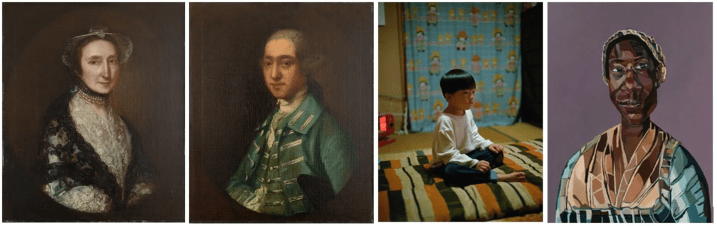
Left to right: Thomas Gainsborough, Portraits of Elizabeth Tugwell and Thomas Tugwell, each ca. 1763, oil on canvas; Paul Graham, Ryo, Japan, 1995, colour coupler print (Courtesy the artist and Anthony Reynolds); Joy Labinjo, She is my wife and truly best part, 2022, oil on canvas (Courtesy Tiwani Contemporary).
◊ ◊ ◊ ◊ ◊
Now on view at No. 1 Royal Crescent:
Being There
No. 1 Royal Crescent, Bath, 14 September 2024 – 23 February 2025
Curated by Ingrid Swenson
Our new exhibition Being There features four recently acquired portraits by Thomas Gainsborough (1727–1788) and eighteen portraits by contemporary artists. The exhibition is the first in The Gallery at No.1 Royal Crescent’s ambitious new programme of contemporary art exhibitions.
The four Gainsborough paintings are presented as key components of a kaleidoscopic group exhibition of portraiture featuring eighteen contemporary British artists selected by guest curator Ingrid Swenson MBE. The title for the exhibition, Being There, is intended to invite visitors to reflect on the experience of artists and their sitters or subject in the act of making the artwork, and to consider what similarities and differences there may be for the role of the artist in Gainsborough’s time and today. Artists in Being There are Michael Armitage, Frank Auerbach, Sarah Ball, Richard Billingham, Glenn Brown, Brian Dawn Chalkley, Kaye Donachie, Paul Graham, Maggi Hambling, David Hockney, Claudette Johnson, Chantal Joffe, Lucy Jones, Joy Labinjo, Melanie Manchot, Celia Paul, Gillian Wearing, and Shaqúelle Whyte.
Painted around 1763, the Gainsborough portraits depict members of the prominent Tugwell family from Bradford on Avon: clothier Humphrey Tugwell and his wife Elizabeth, along with their sons William and Thomas. It is exceptionally rare for a set of four portraits of members of the same family by Gainsborough to survive together. Rarer still is the fact that the sitters are not aristocratic visitors to fashionable Bath, but middle-class manufacturers from a small West Country town.The suite of portraits is remarkable for capturing two generations of a wealthy, upwardly mobile manufacturing family. Housed in their original frames carved by Carlo Maratta, these four portraits must be seen in person to be fully appreciated!
The four Gainsborough portraits were Accepted in lieu of Inheritance tax by HM Government in 2024 and allocated to Bath Preservation Trust.
Fellowships | Royal Museums Greenwich, 2025–26
From Royal Museums Greenwich:
Caird Fellowships, 2025–26
Royal Museums Greenwich, London
Applications due by 29 January 2025
Royal Museums Greenwich (National Maritime Museum, Royal Observatory Greenwich, Cutty Sark, and the Queen’s House) is pleased to announce that applications for the 2025–26 Caird Fellowships programme are now open, with a deadline of 29 January 2025.
The Caird Fellowship programme has for many years facilitated high-quality independent research, providing new perspectives on our sites and collections and supporting our public programmes and displays. We welcome applications from anyone with relevant lived or academic experience who can demonstrate a commitment and ability to undertake independent research. The Museum supports innovative and cross-disciplinary research and is also keen to encourage creative, practice-based, and community-based projects in areas such as the visual arts, heritage, performance, and literature.
We welcome applications within (but not restricted to) a range of areas including art history and creative arts, maritime, social and cultural history, histories of science and technology, conservation studies, museum and heritage studies, material culture studies, historical geography, and literary studies.
An information webinar will be held on 9 January. Details of the webinar and how to apply for the Fellowships can be found here. Please send enquiries to research@rmg.co.uk.
Fellowship | Latin American Art, Curatorial Fellowship, LACMA
From LACMA:
Wallis Annenberg Curatorial Fellowship | Latin American Art
Los Angeles County Museum of Art, two years starting September 2025
Applications due by 30 April 2025
The Los Angeles County Museum of Art (LACMA) announces a search for candidates for the Wallis Annenberg Curatorial Fellowship. This two-year fellowship in the museum’s Latin American Art department will provide general curatorial training, support scholarly research on the permanent collection, and engage the Fellow in the organization of an international traveling exhibition on the connection of Asia and Latin America in the early modern period.
Reporting to the Curator and Department Head of Latin American Art, the Wallis Annenberg Curatorial Fellow will have particular areas of focus in Spanish American/viceregal art and early modern art (with knowledge of Asian art and assets but not required). Striving to combine the strengths of academic art history and the art museum, this Fellowship is designed to attract exceptional emerging scholars to the curatorial field. The Annenberg Curatorial Fellowship supports the highest level of professional development, with opportunities to be fully integrated into all aspects of curatorial work, gain experience in research and cataloguing, exhibition organization, education and publications, acquisitions, conservation, public speaking, and fundraising. The ultimate goal of the Fellowship is to engage the Fellow on all aspects associated with organizing a major international exhibition and achieve a deep understanding of the variety of skills needed to succeed as a curator in an encyclopedic museum; to hone those skills through the mentorship of the department and cross-departmental collaborators; and finally, to be able to confidently apply those skills to a future career as a museum professional. . . .
The position starts 1 September 2025. Applicants must submit a cover letter that addresses interest in the Fellowship; a statement, not to exceed 1,000 words, describing the applicant’s research interests and accomplishments; curriculum vitae; a published paper or other writing sample; three sealed letters of recommendation. All application materials should be submitted directly through our application link and must be received no later than 30 April 2025. Only those candidates selected for an interview will be contacted.
More information is available here»
Exhibition | Keeping Time: Clocks by Boulle

Attributed to André-Charles Boulle, movement by Claude Martinot, Mantel clock with Father Time (detail), ca. 1726
(London: The Wallace Collection)
◊ ◊ ◊ ◊ ◊
From the press release for the exhibition (and note the study day on January 31) . . .
Keeping Time: Clocks by Boulle
The Wallace Collection, London, 27 November 2024 — 2 March 2025
Curated by Alexander Collins
For the first time, the Wallace Collection has brought together its clocks by André-Charles Boulle (1642–1732), one of history’s greatest designers and cabinetmakers, in a display that explores the art and science of timekeeping. Five exceptional timepieces tell the story of how Boulle took advantage of scientific discoveries to create unique clock designs, whose influence spread throughout the world and across the centuries.
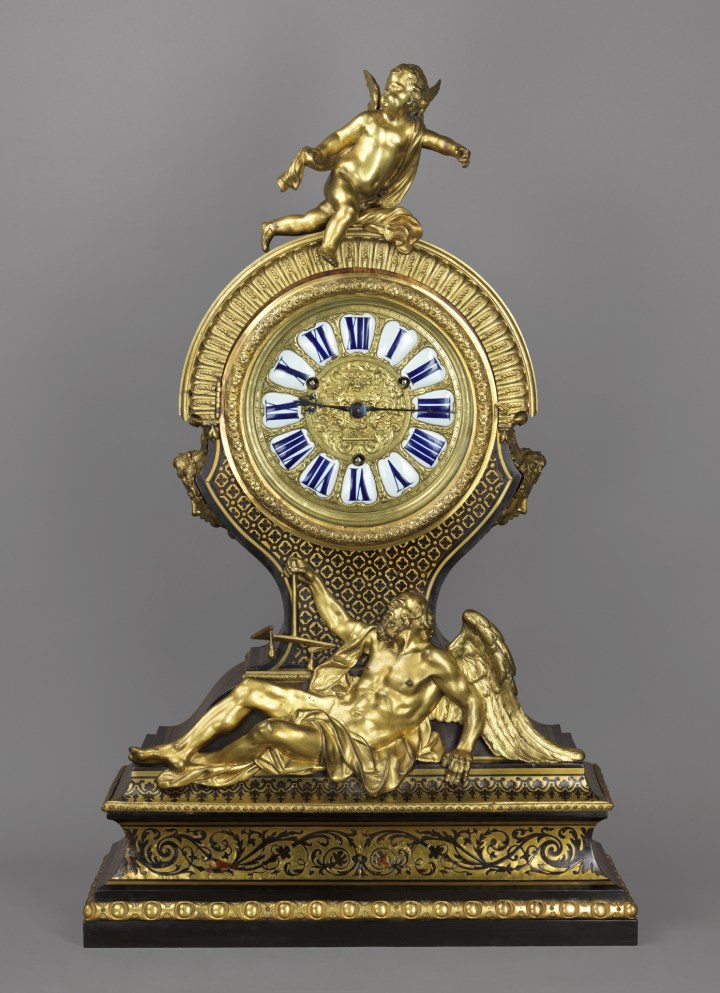
Attributed to André-Charles Boulle, movement by Claude Martinot, Mantel clock with Father Time, ca. 1726 (The Wallace Collection).
As the most famous cabinetmaker working for the court of the Sun King, Louis XIV (1638–1715), Boulle would eventually give his name to the specific style that signified the glittering spectacle of the Baroque—elaborate veneer designs incorporating turtleshell, brass, and other materials. Alongside his work as a royal furniture maker, Boulle also turned his attention to the clock, the accuracy of which had recently been revolutionised through the invention of the pendulum by Dutch scientist Christiaan Huygens (1629–1695) in 1656. As these sweeping weights called for larger clock cases, Boulle saw the opportunity to create bold and sumptuous designs.
Due to his position at court, Boulle was exempted from strict guild regulations, allowing him to work with great creative freedom. This artistic liberty was incredibly important, as the clocks not only had to demonstrate the wealth of their owners through the most luxurious materials available, but also had to show how intellectual they were. Therefore, Boulle infused his designs with narratives that chimed with scientific knowledge. Time and the natural laws of the universe are personified, for example Father Time as a bearded old man, and the Continents as figures from across the world. As well as creating innovative iconography, Boulle also reflected on the history of timekeeping by incorporating motifs such as gothic hourglasses in his clock cases.
The clocks are also products of collaboration involving the multi-disciplinary efforts of artists and craftspeople from all over 18th-century Paris. Each clock has a mechanism by a different leading clockmaker from Boulle’s time: Pierre Gaudron (died 1745), Jean Jolly (active about 1698), Claude Martinot (active about 1718), Louis Mynuël (1675–1742) and Jacques-Augustin Thuret (1669–1739). Some of these were Boulle’s neighbours in the workshops of the Louvre, as well as François Girardon (1628–1715), the king’s official sculptor, who supplied mounts of Father Time for Boulle’s clocks.
The clocks on display show the wide range of objects that Boulle turned his hand to. A monumental wardrobe from 1715 that encloses a clock, crowned with cherubs; two mantel clocks, one from around 1715 featuring Venus and Cupid, and another, from a decade later, with the figure of Father Time; as well as two extraordinary pedestal clocks.
The display opens ahead of an international conference on Boulle, to be held at the Wallace Collection in early 2025. One of the first major research events on the cabinetmaker in recent years, it will bring together specialists and conservators to consider the work of this fascinating artist, all within the same building where some of his greatest artistic achievements can be found.
Many of Boulle’s contemporaries also drew on the concept of time in their work. This will be explored in a complementary display in the museum’s Billiard Room, which is uniting two magnificent artworks: The Dance to the Music of Time (about 1634–36) by Nicolas Poussin (1594–1665), in which the Four Seasons dance to the song of Father Time, the composition of their rhythmic bodies echoing the workings of a clock movement; and The Borghese Dancers (1597–1656), where five female figures masquerade as the Hours, attendants to the goddesses of the Dawn and Moon.
Xavier Bray, Director of The Wallace Collection, says: “I am absolutely thrilled to be bringing great works of art by Boulle together for the first time. These clocks were at the cutting edge of 18th-century technology, combining exquisite artistry and mechanical expertise into a unique and innovative blend. Through Boulle’s clocks and the display, we hope visitors will be able to transport themselves into the world of Louis XIV, where luxury touched every element of the court, including something as essential and practical as timekeeping.”
Alexander Collins, Curatorial Assistant at the Wallace Collection and curator of the display, says: “Our research on these objects has revealed many unknown facets of their history, including bringing to life the multitude of artists and craftspeople who came together to make Boulle’s vision into a reality. The passage of time as a metaphor for life and death has been an important theme for artists since humanity discovered their creativity, and Boulle’s designs are important, and resonate with us today, because of this deep symbolism.”
◊ ◊ ◊ ◊ ◊
Boulle Study Day
Online and in-person, Friday, 31 January 2025
Delve into the world of baroque France and learn more about Boulle’s furniture with leading specialists, including curators and conservators from the Palace of Versailles, the Château de Chantilly, and C2RMF. You’ll explore the evolution of Boulle’s iconic designs, his materials and techniques, and his enduring legacy. This in-person event at the Wallace Collection will also be broadcast live on Zoom. Ticketholders will receive a link to a recording of the event, which will be available for two weeks. Full programme to follow: 10.00–17.00 GMT, with a drinks reception until 19.00.
Registration is available here»
Call for Papers | Mexican Art in Europe, 16th–21st Centuries
From ArtHist.net:
Mexican Art and Its Collections in Europe, 16th–21st Centuries: Interwoven Histories
Online, Institute of Art History at the University of Wrocław, 21 May 2025
Proposals due by 15 February 2025
The Institute of Art History at the University of Wrocław invites submissions for an international online conference examining the presence and reception of Mexican art in the European cultural context from colonial times to the present day. The conference aims to critically reflect on the complex processes of meaning-making, interpretation, and reinterpretation of Mexican art in European collections, museums, and galleries.
We welcome contributions addressing themes such as
• Postcolonial, decolonial, and transnational perspectives in studying Mexican art in Europe
• Methodologies for studying processes of cultural transfer
• Critical revision of European interpretations of Mexican art
• History of acquisition and movement of works
• Exhibition and curatorial strategies in shaping narratives about Mexican art
• Digital presence of Mexican collections
• Reception and hybridization of Mexican art in Europe
• Case studies of selected works in European collections
Selected papers will be published in a peer-reviewed conference volume following the event. The conference will be held online, and participation is free of charge. Please send inquiries and submissions—an abstract in English of approximately 250 words and a brief biographical note (up to 100 words)—to Dr. Emilia Kiecko, emilia.kiecko@uwr.edu.pl, before 15 February 2025.
Exhibition | Luisa Roldán: Royal Sculptor
Adam Busiakiewicz noted the exhibition at Art History News a few weeks ago:
Luisa Roldán: Escultora Real
Museo Nacional de Escultura, Valladolid, 29 November 2024 — 9 March 2025
Curated by Miguel Ángel Marcos Villán and Pablo Amador Marrero
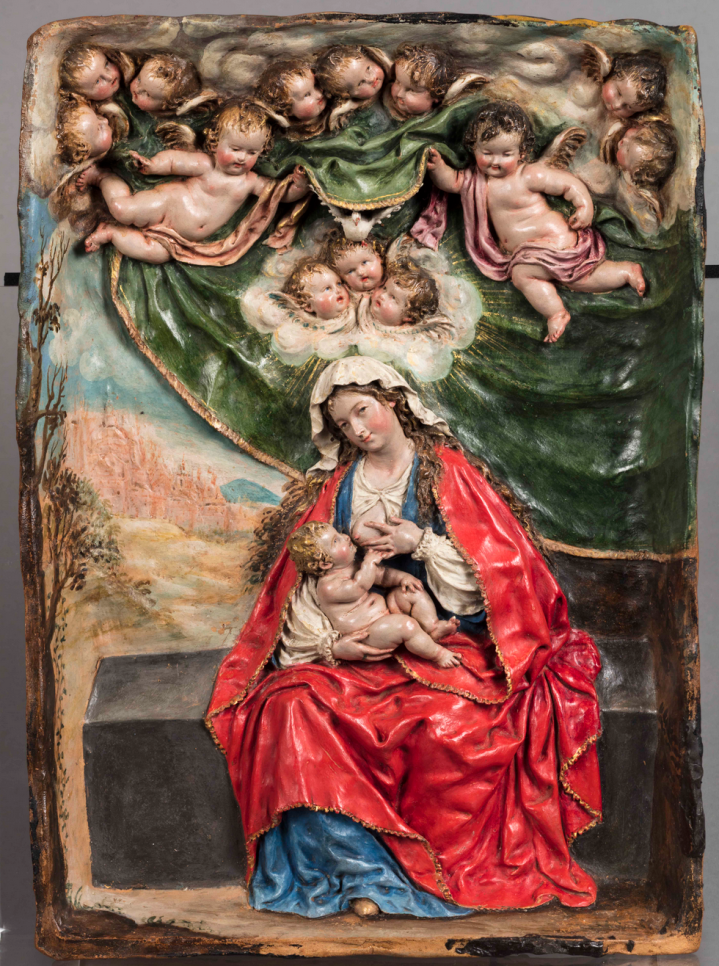
Luisa Roldán, Virgen con el Niño (Sevilla, Convento de San José).
Esta exposición permitirá al visitante adentrarse en una vida apasionante. Luisa Roldán (1652–1706) aunó excelencia, versatilidad y habilidad para romper las barreras de género y llegar a lo más alto como artista: fue nombrada escultora del rey por Carlos II, cargo que mantuvo con Felipe V. Además, fue la primera artista española en ingresar en la Academia de San Lucas en Roma, un hito nunca antes alcanzado por escultores hispanos.
Pero Luisa Roldán: Escultora real también es el producto de una reivindicación y de una necesidad de hacer presente la trayectoria de una de las más destacadas artistas españolas. De hecho, nunca cayó en el olvido y autores como Antonio Palomino (quien la conocería personalmente), Antonio Ponz o Juan Agustín Ceán Bermúdez alabaron su obra. Sin embargo, el hecho de que fuera considerada por muchos como autora de menor calidad que su padre, identificando con él buena parte de su producción, ha pesado en algunos de los estudios que se realizaron sobre su figura. Como también que se le adjudicaran sobre todo obras de devoción, delicadas y de pequeño formato en barro cocido, «más propias de su condición y sexo», según autores como el propio Ceán Bermúdez, dejando en un lugar secundario su rica y extraordinaria producción de obras en madera y de mayor formato.
La dedicación de Luisa Roldán al oficio de la escultura sólo fue posible por su nacimiento en el seno de una familia dedicada a esta disciplina. Su padre, Pedro Roldan fue el gran artista del mercado sevillano y de buena parte del andaluz durante la segunda mitad del siglo XVII. La artista, cuyas dotes para el oficio se desvelaron en época muy temprana, heredó de él la inquietud por el mejor conocimiento del arte. Tras dejar el taller paterno se estableció en Sevilla junto a su marido, Luis Antonio de los Arcos. De allí se trasladaron a Cádiz, metrópoli comercial del momento, y posteriormente el matrimonio y sus hijos fijaron su residencia en Madrid. Allí la escultora pudo entrar al servicio de la Corte, alcanzando el mayor éxito y reconocimiento al que cualquier artista de la época podía aspirar.
Miguel Ángel Marcos Villán and Pablo Amador Marrero, Luisa Roldán: Escultora Real (Valladolid: Museo Nacional de Escultura, 2024), €40.
The Burlington Magazine, December 2024
The long 18th century in the December issue of The Burlington:
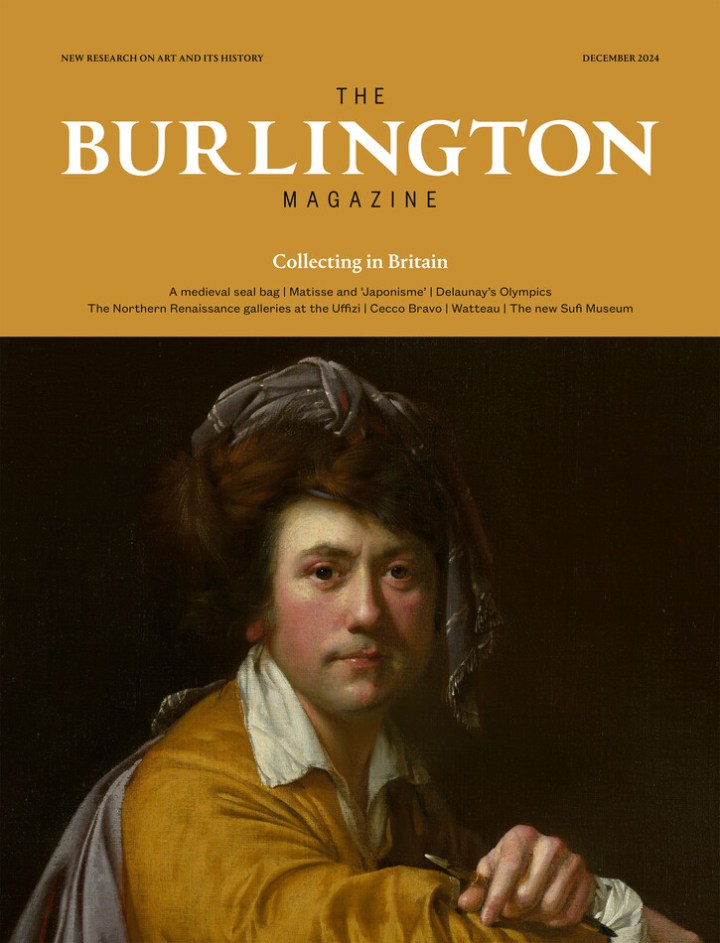
The Burlington Magazine 166 (December 2024)
 e d i t o r i a l
• “A ‘Grand Life’: Belle da Costa Greene,” pp. 1203–04.
New York’s Morgan Library & Museum was founded as a public institution in 1924 and its centenary this year has been celebrated in style. The most substantial project to form part of the anniversary is the exhibition (25th October–4th May 2025) on Belle da Costa Greene (1879–1950), the museum’s inaugural Director. This is an exercise in fascinating institutional storytelling, but at the same time also considerably more, as Greene was an extraordinary and accomplished figure.
l e t t e r
• Elizabeth Cropper, “Further Notes on boîtes à portrait’,” p. 1205.
A response to Samantha Happé’s article in the October issue of The Burlington: “Portable Diplomacy: Louis XIV’s ‘boîtes à portrait’,” pp. 1036–43.
r e v i e w s
• Richard Rand, Review of the exhibition Revoir Watteau: Un comédien sans réplique. Pierrot, dit le ‘Gilles’ (Louvre, 2024–25), pp. 1238–40.
• Gauvin Alexander Bailey, Review of the exhibition Paris through the Eyes of Saint-Aubin (The Metropolitan Museum of Art, 2024-25), pp. 1249–50.
• Denise Amy Baxter, Review of the exhibition The Legacy of Vesuvius: Bourbon Discoveries on the Bay of Naples (Meadows Musem, 2024), pp. 1251–53.
• Camilla Pietrabissa, Review of the exhibition catalogue L’arte di tradurre l’arte: John Baptist Jackson incisore nella Venezia del Settecento, ed. by Orsola Braides, Giovanni Maria Fara, and Alessia Giachery (Biblioteca Marciana, 2024), pp. 1270–72.
The British printmaker John Baptist Jackson was active in Venice from 1731 to 1745.
• Tom Stammers, Review of Oliver Wunsch, A Delicate Matter: Art, Fragility, and Consumption in Eighteenth-Century France (Pennsylvania State University Press, 2024), pp. 1285–86.
o b i t u a r y
• Simon Jervis, Obituary for Georg Himmelheber (1929–2024), pp. 1287–88.
A pioneering historian of furniture and a curator at Karlsruhe and Munich, Georg Himmelheber was also a founder member of the Furniture History Society; although his expertise encompassed many periods and styles, he was perhaps best known for his work on ‘Biedermeier’ furniture.
s u p p l e m e n t
• “Acquisitions by Public Collections across the UK (2013–23) Made Possible by the Acceptance in Lieu of Tax and Cultural Gifts Schemes,” pp. 1289ff.
Exhibtion | John Smart: Virtuoso in Miniature

John Smart | Left: Portrait of a Woman, 1772, watercolor on ivory, framed: 5.1 × 3.8 cm, F65-41/13. Center: Portrait of Muhammad Ali Khan Wallajah, Nawab of Arcot and the Carnatic, 1788, watercolor on ivory, framed: 5.4 × 4.5 cm, F71-32. Right: Portrait of Mr. Holland, 1806, watercolor on ivory, framed: 11.1 × 7.8 cm, F65-41/47.
◊ ◊ ◊ ◊ ◊
From the press release for the exhibition:
John Smart: Virtuoso in Miniature
Nelson-Atkins Museum of Art, Kansas City, 21 December 2024 — 4 January 2026
Curated by Aimee Marcereau DeGalan with Blythe Sobol and Maggie Keenan
A stunning array of jewel-like portrait miniatures by English artist John Smart (1741—1811), including signed and dated examples from nearly every year of his career, are being featured at The Nelson-Atkins Museum of Art in Kansas City in the exhibition John Smart: Virtuoso in Miniature. Included is a rare self-portrait of the artist, one of only nine known examples. It was made in 1793 while the artist was living in India. Timed to coincide with the final launch in spring 2025 of the digital Starr Catalogue of Portrait Miniatures—a groundbreaking resource dedicated to John Smart that reveals fresh discoveries across his career— this exhibition presents his work chronologically, showcasing new additions to the collection for the first time in nearly six decades. Presented to the Nelson-Atkins by Mr. and Mrs. John W. Starr in two major gifts in 1958 and 1965, and numerous additional gifts throughout the years, the Starr Collection of Portrait Miniatures illustrates the history of European miniatures across more than 250 objects.

John Smart, Self-Portrait, 1793, pencil on laid paper, oval image 19.8 × 17.5 cm (Kansas City: Nelson-Atkins Museum of Art, 2024.10).
“Visitors will be able to see Smart’s progression of style and technique and also explore themes of self-presentation,” said Julián Zugazagoitia, Director & CEO of the Nelson-Atkins. “The Starr family’s dedication to collecting the work of John Smart reflects their commitment to preserving the legacy of one of the most skilled portrait miniaturists of the eighteenth-century.”
Martha Jane Phillips and John W. ‘Twink’ Starr assembled one of the most comprehensive collections of works by English artist John Smart, including signed and dated examples from nearly every year of the artist’s career. Despite their persistent efforts, acquiring a self-portrait remained elusive. In 1954, they learned of the potential availability of a self-portrait in private hands, but they were too late; it was sold to the Museum of Fine Arts, Boston. Relentless in their pursuit, they appealed to successive Boston museum directors to sell or trade for the work, but they were unsuccessful. They ultimately acquired an oil painting of Smart by his near-contemporary Richard Brompton (English, 1734–1783), which they later donated to the Philbrook Museum in Tulsa, Oklahoma. The Starrs’ quest for a self-portrait, initiated on their twenty-fifth wedding anniversary, remained unrealized in their lifetime due to the rarity of such works.
“None of John Smart’s contemporaries painted as many self-portraits, which suggests Smart’s conscious understanding of what the vehicle of portraiture played in self-promotion,” said Aimee Marcereau DeGalan, Louis L. and Adelaide C. Ward Senior Curator, European Arts, and co-curator of this exhibition, along with Starr researchers Blythe Sobol and Maggie Keenan. “Smart was incredibly ambitious and self-confident, and this is the largest known self-portrait that he made. We are unbelievably thrilled to have been able to make this strategic acquisition.”
This self-portrait was acquired by a private London collector, who kept it until fall 2023, when it was consigned to a London dealer. With support from Starr family descendants, the Nelson-Atkins purchased this remarkable work in the year marking John and Martha Jane Starr’s 95th wedding anniversary—a fitting tribute to their enduring legacy.
John Smart: Virtuoso in Miniature facilitates a greater understanding of the artist’s stylistic evolution, working methods, and impact across two continents, while exploring the impact of British colonialism and the changing fashions of the eighteenth and early nineteenth centuries.










 Enfilade
leave a comment