Library Research Grants from the Getty
Getty Research Institute Library Research Grants
Applications due by 15 October 2013
The Getty Research Institute invites applications for its Library Research Grants. Getty Library Research Grants provide partial, short-term support for costs relating to travel and living expenses to scholars whose research requires use of specific collections housed in the Getty Research Institute.
Eligibility
Library Research Grants are intended for scholars of all nationalities and at any level who demonstrate a compelling need to use materials housed in the Research Library, and whose place of residence is more than eighty miles from the Getty Center. Projects must relate to specific items in the library collection.
Terms
Library Research Grants are intended to provide partial support for costs relating to travel and living expenses. Grants range from $500 to $2,500, depending on the distance traveled. The research period may range from several days to a maximum of three months, but must take place between February 15, 2014, and January 15, 2015. These terms apply as of June 2012 and are subject to future changes.
Application Availability and Deadline
Complete application materials are now accepted through an online application process only. The next deadline for these grants is 6:00 p.m. PDT, October 15, 2013.
Further information and application forms are available here»
Conference | The Hurt(ful) Body before Diderot: Pain and Suffering
From the conference website:
The Hurt(ful) Body before Diderot: Pain and Suffering
in Early Modern Performance and the Visual Arts, c. 1600–1790
Royal Flemish Academy of Belgium for Science and the Arts, Brusssels, 21–22 November 2013
On the occasion of Diderot’s three-hundredth birthday, the present conference invites papers by historians of both visual arts and performance arts, to address the hurt and hurt-causing body in early modern and eighteenth-century visual culture. The point is better to address spectacles of pain and suffering before Diderot, whereby before is to be understood both physically and chronologically, in terms of images he saw and those that belong to a wider Ancien Régime visual and performance culture.
Seventeenth- and eighteenth-century medicine, philosophy and works of fiction treated pain and suffering as contents of consciousness. Hurt and grief fixed the self in a state of disaffection and refusal, as opposed to the appetites or ‘sociable’ affects of love or admiration. During this time, the hurt body found itself at the apex of art theory (from Lomazzo to Le Brun), informing academic aesthetics, while the genre of tragedy, climaxing in the plays of Racine, was shaping the image of the actor’s craft. Images of saintly suffering were a fixture of post-Trentian Catholic life, but after 1600 they were incrementally visible in both civic theatre and popular imagery as well as aristocratic collecting. All of this culminates in the writings of Diderot, who was an assiduous admirer of spectacles of grief, pest scenes and other sujets de fracas. Such affinities, as present in his criticism as his commentaries on the tableau and the self-possessed actor, seem now more difficult to place, in part because so little is known of the rationale of the spectacle of hurt in the 150 years that preceded him, especially in relation to its socio-historical and performative context. Moreover, accounts of the period tend to segregate semiotic or iconographical developments (explaining continued interest for the Le Brun’s Traité de Passions and its plates) from historical clues that speak to the peculiar positionality of bodies in and of hurt. The disjunctive image of pain and suffering is today too often regarded as simply ‘emotive’, an expression like any other for artists and actors to master.
Through the impact of scholars like Jonathan Sawday, Erika Fischer-Lichte and Amelia Jones, present-day historians are familiar with problems of performativity and ephemerality, of body presence and the spectator’s participative witnessing and intervention. The hurt body can accommodate new diverse and perceptive approaches of the early modern body, as a body in withdrawal, a ‘communicative’ body in flux, or a body split in its desire to escape alterity and a corporeal ‘prison’. Time seems ripe for a self-standing history of the hurt(ful) body, illustrated through staging practices as well as material images (paintings, sculptures, prints), and addressing practices of making, acting and viewing; censorship and divulgation; collecting, directing and interpreting. The conference invites papers that revisit historical forms, practices and pressures of the hurt body, from the staging of blood and the representations of Hercules’ self-immolation to distressed audiences. Maintaining an interdisciplinary focus, speakers might address imaginaries of the hurt body recovered through stage praxis, visual representation and dramatic text. It welcomes papers exploring archival sources documenting (theatrical) communication between audiences and ‘hurt bodies’, or exploring public and elite spaces of performance, urban events and exhibition sites where Diderot and Ancien Régime audiences experienced such encounters.
◊ ◊ ◊ ◊ ◊
T H U R S D A Y , 2 1 N O V E M B E R 2 0 1 3
9.30 Registration and coffee/tea
10:00 Welcome and introduction by Karel Vanhaesebrouck (Université Libre de Bruxelles, Vrije Universiteit Brussel), Tomas Macsotay (Universitat Autònoma de Barcelona) and Kornee van der Haven (Ghent University)
10:30 Keynote Lecture by Jonathan Sawday (Saint Louis University), Three forms of Renaissance Pain: Michel de Montaigne, John Donne, and Robert Burton
11:30 Coffee/tea break
12:00 Session 1: Discourses of Pain I
• Jürgen Pieters (Ghent University), Hurtful Hamlet: The tragedy of consolation
• Christel Stalpaert (Ghent University), We don’t even know what the hurt(ful) body is capable of: Some reflections on Spinoza and the corporeal turn
13:30 Lunch
14:30 Session 2: Discourses of Pain II
• Frans-Willem Korsten (Leiden University), How Injustice Hurts: Physical Pain, Immaterial Grounds and the Cause of Justice
• Inger Leemans (VU Amsterdam), Clashing Bodies: The physicality of the Amsterdam Stock Exchange, 1650–1750
16:00 Coffee/tea break
16:30 Session 3: Acting the Victim
• Stijn Bussels (Leiden University), ‘No knife, no sting is sharper, than this feeling that cuts through the heart’: Performing Pathos in Vondel’s Brethren (1641)
• Charlotte Bouteille-Meister (Paris X-Nanterre), “Flamme qui m’est un doux zéphire, / Parmi l’ardeur de mon martyre” (Céciliade, 1606): Does the martyr’s ambiguous suffering allow any pathetic response?
• Bram Van Oostveldt (University of Amsterdam), Flying, diving and dying bodies: Corneille’s pièces à machines between the marvelous and the sublime
F R I D A Y , 2 2 N O V E M B E R 2 0 1 3
10:00 Keynote Lecture by Christian Biet (Paris X-Nanterre), Bloody suffering, performed suffering and recited suffering in the French 17th and 18th centuries: Spectacle and text
11:00 Coffee/tea break
11:30 Session 4: The Visual Culture of Hurt
• Koen Jonckheere (Ghent University), The meaning of the pose: Hurting the divine body in an age of Iconoclasm
• Jetze Touber (Ghent University), Engineering empathy: Inventions of martyrology in the Confessional Age
13:00 Lunch
14:00 Roundtable Discussion: Early Modern Theatricality and the Hurt Body
15:00 Coffee/tea break
16:00 Session 5: Enlightenment Purifications
• Aris Sarafianos (University of Ioannina), Unable to bear the light: Sore eyes, sensory deprivation, multi-media shows and extraordinary cures in late eighteenth-century Britain
• Tomas Macsotay (Universitat Autònoma de Barcelona), A technology of audience response: Sightlessness, disorientation and corporeal Pathos in the Paris Academy, 1700–1760
17:30 Concluding remarks
Forthcoming Book | New Approaches to Naples, 1500–1800
Scheduled for November publication from Ashgate:
Melissa Calaresu and Helen Hills, eds., New Approaches to Naples c.1500–c.1800: The Power of Place (Aldershot: Ashgate, 2013), 264 pages, ISBN: 978-1409429432, $120.
 Early modern Naples has been characterized as a marginal, wild and exotic place on the fringes of the European world, and as such an appropriate target of attempts, by Catholic missionaries and others, to ‘civilize’ the city. Historiographically bypassed in favour of Venice, Florence and Rome, Naples is frequently seen as emblematic of the cultural and political decline in the Italian peninsula and as epitomizing the problems of southern Italy. Yet, as this volume makes plain, such views blind us to some of its most extraordinary qualities, and limit our understanding, not only of one of the world’s great capital cities, but also of the wider social, cultural and political dynamics of early modern Europe.
As the centre of Spanish colonial power within Europe during the vicerealty, and with a population second only to Paris in early modern Europe, Naples is a city that deserves serious study. Further, as a Habsburg dominion, it offers vital points of comparison with non-European sites which were subject to European colonialism. While European colonization outside Europe has received intense scholarly attention, its cultural impact and representation within Europe remain under-explored. Too much has been taken for granted. Too few questions have been posed.
In the sphere of the visual arts, investigation reveals that Neapolitan urbanism, architecture, painting and sculpture were of the highest quality during this period, while differing significantly from those of other Italian cities. For long ignored or treated as the subaltern sister of Rome, this urban treasure house is only now receiving the attention from scholars that it has so long deserved.
This volume addresses the central paradoxes operating in early modern Italian scholarship. It seeks to illuminate both the historiographical pressures that have marginalized Naples and to showcase important new developments in Neapolitan cultural history and art history. Those developments showcased here include both theoretical or methodological innovation and new empirical approaches. Thus this volume illuminates new models of cultural history designed to ask new questions of Naples and tell new stories that have implications beyond the Kingdom of Naples for the study of early modern Italy and, indeed, early modern Europe.
Melissa Calaresu is Lecturer in History at Gonville and Caius College, Cambridge; Helen Hills is Professor of the History of Art at the University of York.
◊ ◊ ◊ ◊ ◊
C O N T E N T S
Introduction
• Melissa Calaresu and Helen Hills, Between Exoticism and Marginalization: New Approaches to Naples
I: Disaster and Decline
• John Marino, Myths of Modernity and the Myth of the City: When the Historiography of Pre-modern Italy Goes South
• Helen Hills, Through a Glass Darkly: Material Holiness and the Treasury Chapel of San Gennaro in Naples
• Rose Marie San Juan, Contaminating Bodies: Print and the 1656 Plague in Naples
II: Topographies
• Harald Hendrix, Topographies of Poetry: Mapping Early Modern Naples
• Dinko Fabris, The Collection and Dissemination of Neapolitan Music, c.1600–1790
• Helena Hammond, Landed Identity and the Bourbon Neapolitan State: Claude-Joseph Vernet and the Politics of the ‘siti reali’
III: Exceptionality
• Paola Bertucci, The Architecture of Knowledge: Science, Collecting, and Display in 18th-Century Naples
• Melissa Calaresu, Collecting Neapolitans: The Representation of Street Life in Late 18th-Century Naples
• Anna Maria Rao, ‘Missed Opportunities’ in the History of Naples
Bibliography
Index
Seminar | The Uses of Antiquity in European Art, 1300–1800
The following announcement may be of interest for full-time faculty who regularly teach art history at institutions affiliated with the Council of Independent College (there are over 600 member schools). While addressing the eighteenth century, the seminar will focus on previous periods; I imagine it’s ideally suited for dix-huitièmistes who find themselves teaching late medieval and Renaissance courses. Up to 20 individuals will be selected. Details are available from the brochure. -CH
◊ ◊ ◊ ◊ ◊
The Uses of Antiquity: A Seminar on Teaching Pre-Modern European Art in Context
Smart Museum of Art, University of Chicago, 13–18 July 2014
Nominations due by 2 December 2013
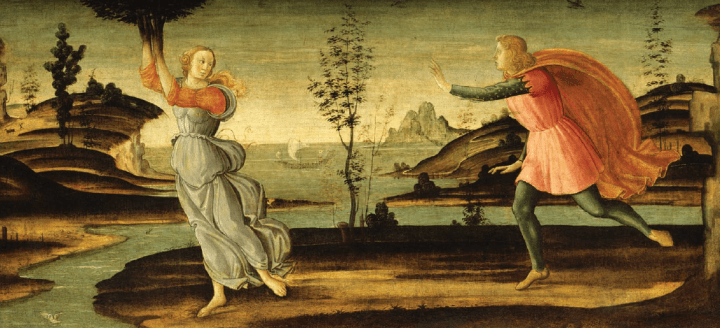
Daphne Fleeing from Apollo, ca. 1500
(Chicago: Smart Museum of Art)
◊ ◊ ◊ ◊ ◊
This seminar will be led by Rebecca Zorach, professor of art history and the college at the University of Chicago, and will be held at the University of Chicago’s Smart Museum of Art. It will take as its starting point European objects spanning the years 1300–1800 at the Smart Museum and participants will have the chance to examine prints and rare printed books in the Regenstein Library’s Special Collections Research Center, principally the very large collection of the Speculum Romanae Magnificentiae and related prints after Roman monuments and antiquities, considering the role of prints, books, and other small objects in disseminating and popularizing classical styles and imagery. Moving beyond the European early modern period, the seminar also will visit other local sites—the Oriental Institute, campus and neighborhood murals, and buildings such as the nearby Museum of Science and Industry—to think about how participants can use their own local resources creatively to discuss with students ways in which artists, architects, patrons, and others have understood and reinterpreted the past. The seminar will examine recent and older scholarship on the uses of the past and draw on the expertise and teaching experience of participants. For many of our students, differences between an ancient Greek temple and a Renaissance church (or a 19th-century Beaux-Arts museum, for that matter) barely register. But the benefits of teasing out the nuances of
references and associations go beyond awareness of the chronology of style. Pedagogical discussions will address close looking, the relationship of texts to objects, and ways faculty members can help students think critically about the texture of history and the practices and decisions of artists.
 Zorach teaches late medieval and Renaissance art, primarily French and Italian; gender studies and critical theory; print culture and technology; and contemporary activist art. Her books include The Passionate Triangle (2011) and Blood, Milk, Ink, Gold: Abundance and Excess in the French Renaissance (which received the Society for the Study of Early Modern Women 2005 Book Award), both published by the University of Chicago Press. In addition, she has created catalogues for several exhibitions, including The Virtual Tourist in Renaissance Rome: Printing and Collecting the Speculum Romanae Magnificentiae produced in conjunction with The Speculum Romanae Magnificentiae Digital Collection, and Paper Museums: The Reproductive Print in Europe 1500–1800, co-edited with Elizabeth Rodini.
New Book | Collecting Chinese and Japanese Porcelain in Paris
Scheduled to appear in November from Getty Publications:
Stéphane Castelluccio, Collecting Chinese and Japanese Porcelain in Pre-Revolutionary Paris (Los Angeles: Getty Publications, 2013), 224 pages, ISBN 978-1606061398, $60.
 This beautifully illustrated volume traces the changing market for Chinese and Japanese porcelain in Paris from the early years of the reign of Louis XIV (1643–1715) through the eighteenth century. The increase in the quantity and variety of East Asian wares imported during this period spurred efforts to record and analyze them, resulting in a profusion of inventories, sales catalogues, and treatises. These contemporary sources—many never published before—provide a comprehensive picture of porcelains: when they were first available; what kinds were most admired during various periods; where and at what price they were sold; who owned them; and how they were displayed and used.
Over the course of these two centuries, a preference for blue-and-white Chinese works arranged in crowded, asymmetrical groupings gave way to symmetrical presentations of polychrome and monochrome Japanese pieces on brackets, tables, and mantelpieces, often mixed with bronzes, marble vases, and paintings. Some porcelains now received elaborate silver or gilt-bronze mounts. The illustrated pieces, which include pitchers, vases, lidded bowls, and writing sets, are drawn from the collections of the J. Paul Getty Museum, the Victoria and Albert Museum, and the Musée des Arts Décoratifs in Paris. Also included are exquisite porcelains from the Musée Guimet in Paris, many published here for the first time.
Stéphane Castelluccio is chargé de recherche at Le Centre National de la Recheche Scientifique (CNRS), Centre André Chastel, Paris. He is the author of Le Commerce du Luxe à Paris aux XVIIe et XVIIIe (Peter Lang, AG, 2009) and Les Fastes de la Galerie des Glaces (Payot, 2007).
Study Day | Art, Animals, and Politics at Knowsley Hall
From the conference programme:
Art, Animals, and Politics: Knowsley and The Earls of Derby
Knowsley Hall, Merseyside, 9 October 2013
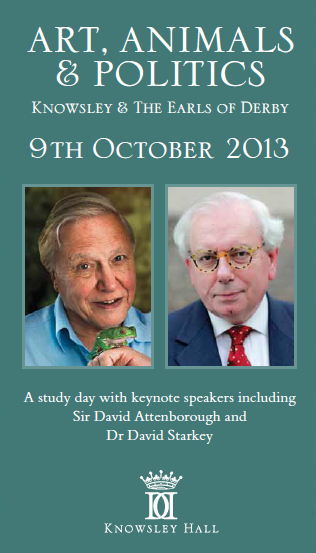 Historians, art historians and natural historians will be presenting exciting new research on three of the outstanding legacies of the Earls of Derby and the Stanley family: the art collection, the natural history library and the political archive. Emphasis will be also be placed on the family’s considerable historical and social influence in the north-west of England, as well as their political impact on the national and international stages, notably throughout the 18th and 19th centuries and the first half of the 20th century. For more information or to register, please email events@knowsley.com.
◊ ◊ ◊ ◊ ◊
Keynote Address
David Starkey, The political and cultural significance of Lady Margaret Beaufort, Countess of Richmond and Derby
Session 1: Art
· Elspeth Graham (Liverpool John Moores University), The Shakespearean stage: Prescot, Lathom and Knowsley
· Richard Stephens (University of York), The 10th Earl as a collector of old master paintings and patron of the arts at Knowsley during the 1720s
· Jonny Yarker (Trinity College, University of Cambridge), Hamlet Winstanley as an artist, copyist and art-agent for the 10th Earl
· Xanthe Brooke (Walker Art Gallery, National Museums Liverpool), Aspects of the old master picture collection at Knowsley during the 18th century
· Gill Perry (Open University), The image of Eliza Farren, Georgian comic actress and Countess of Derby
Session 2: Animals and Edward Lear
· David Attenborough, Edward Lear’s natural history watercolours and prints for the 13th Earl
· Colin Harrison (Ashmolean Museum, University of Oxford), Edward Lear’s landscape watercolours in the Derby Collection
Session 3: Politics
· Angus Hawkins (University of Oxford), The forgotten Prime Minister: The 14th Earl Douglas Hurd, Lord Hurd of Westwell: The 15th Earl’s career as Foreign Secretary
· Bendor Grosvenor (Philip Mould Ltd), The Eastern Question and the 15th Earl’s foreign policy
· Jennifer Davey (University of East Anglia), The Invisible Politician: The political career of the 15th Countess of Derby
Six New Acquisitions at the Meadows Museum
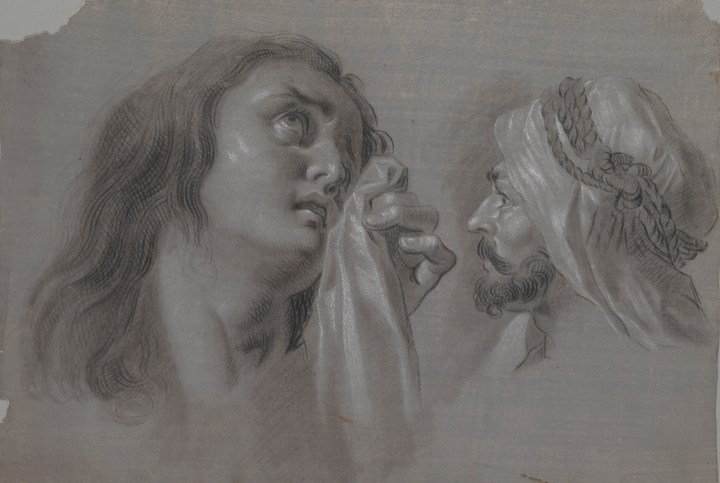
Zacarías González Velázquez, Mary Magdalene and Head of a Moor,
1793. Black chalk, wash and white chalk highlights on grey
tinted paper (Dallas: Meadows Museum, SMU)
◊ ◊ ◊ ◊ ◊
Press release (13 September 2013) from SMU’s Meadows Museum:
Southern Methodist University’s Meadows Museum announces the acquisition of six new paintings and drawings, including important works by influential Spanish artists Alonso Cano, Miguel Jacinto Meléndez, and Juan de Valdés Leal.
“We are thrilled to add six extraordinary works by artists who are so central to the history of Spanish art,” said Mark A. Roglán, the Linda P. and William A. Custard Director of the Meadows Museum and Centennial Chair, Meadows School of the Arts, SMU. “We are particularly excited to acquire such exquisite paintings by Cano and Meléndez as the first examples of works by these two prominent artists to enter the Meadows’ collection.”
The six new works are Alonso Cano’s painting Christ Child (c. 1636–38); pendant paintings by Miguel Jacinto Meléndez, Portraits of Philip V, King of Spain, and his first wife, María Luisa Gabriela of Savoy (c. 1701–03); a sanguine and black chalk drawing by Juan de Valdés Leal, Apparition of Christ to Saint Ignatius on his Way to Rome (c. 1662); a chalk drawing by Zacarías González Velázquez, Mary Magdalene and Head of a Moor (1793); and a pencil drawing by Antonio Carnicero, María Luisa of Parma, Queen of Spain (1789).
“As one of the most comprehensive museums of Spanish art in the world, the Meadows is constantly growing. These works will greatly enhance and help complete the Museum’s distinguished permanent collection,” said Linda Custard, chair of the Meadows Museum Advisory Board.
Earlier this year, the Meadows announced nine significant acquisitions, including five early 20th-century Spanish paintings from the Coleman Collection; a small oil painting by Joaquín Sorolla y Bastida (1904 or 1905); a miniature portrait attributed to Alonso Sánchez Coello (c. 1580), a terracotta sculpture by Juan Alonso Villabrille y Ron (c. 1715); and The Stewart Album, an anthology of cartes de visite, drawings and correspondence compiled by renowned American collector and expatriate William Hood Stewart during the latter half of the 19th century.
Together, these recent additions mark a milestone expansion of the Museum’s premier permanent collection of Spanish art that will be featured under the banner “Launching the Next 50 Years: Continuing the Legacy of Collecting at the Meadows Museum.” The Museum officially celebrates its 50th anniversary in April 2015.
“This has become a landmark year of acquisitions for the Meadows,” said Roglán. “Not only is it remarkable to be adding such extraordinary works by so many artists during a single year, but the breadth and variety of the acquisitions is tremendous — the new paintings, sculpture and drawings range from the 16th century to the 20th century.”
◊ ◊ ◊ ◊ ◊
Alonso Cano, Christ Child (c. 1636–38)

Alonso Cano, Christ Child (Ego dormio, et cor meum vigilat), c. 1628–29. Oil on panel (Dallas: Meadows Museum, SMU)
The exquisite oil painting Christ Child (Ego dormio, et cor meum vigilat) is the first work by the noted Sevillian artist Alonso Cano (1601–1667) to be acquired by the Meadows Museum, and the first time the painting has come to light in some 200 years. Dated to 1636–38, the work is thought to be the tabernacle door for the altarpiece of Saint Theresa of Ávila originally in the church of the former Carmelite monastery of San Alberto de Sicilia in Seville, Spain. The altarpiece was dismantled in the early 1800s, and the painting’s discovery provides new clues into the history of the altarpiece ensemble, of which only two other works are known to exist.
“This is a unique and special work by a very influential Spanish artist,” said Iraida Rodríguez-Negrón, the Meadows/Kress/Prado Curatorial Fellow who conducted extensive research on the history behind Cano’s Christ Child. “Most tabernacle doors are either lost or still located in churches, and the quality of this Cano painting is magnificent.”
Funding for the acquisition of Cano’s Christ Child was generously provided by Friends and Supporters of the Meadows Museum and the Meadows Museum Acquisition Fund.
Miguel Jacinto Meléndez, Portraits of Philip V, King of Spain, and his first wife, María Luisa Gabriela of
Savoy (c. 1701–03)

Miguel Jacinto Meléndez, Portrait of Philip V, King of Spain, c. 1701–03. Oil on copper (Dallas: Meadows Museum, SMU)
Miguel Jacinto Meléndez’s previously unknown oil paintings on copper, Portraits of Philip V, King of Spain, and his first wife, María Luisa Gabriela of Savoy, date to between 1701 and 1703, before he officially began his long career as Philip V’s court painter. The works are now recognized as the earliest known likenesses of the monarchs to be painted by the artist, and they are also the first examples of work by Meléndez (1679–1734) to enter the Meadows Collection.
Although Meléndez painted the two portraits when he was only in his early 20s, the works show the technical mastery and exquisite delicacy that made him one of the greatest Spanish portraitists of the early 18th century. The paintings were previously owned by Lord Mowbray and Stourton and his wife, Jane de Yarburgh-Bateson, and displayed at Heslington Hall in Yorkshire, England and Marcus House in Angus, Scotland.
Funding for this acquisition was generously provided by Richard and Gwen Irwin and the McDermott Foundation.
Juan de Valdés Leal, Apparition of Christ to Saint
Ignatius on his Way to Rome (c. 1662)

Miguel Jacinto Meléndez, Portrait of María Luisa Gabriela of Savoy, c. 1701–03. Oil on copper
(Dallas: Meadows Museum, SMU)
This extremely rare, unpublished drawing by Sevillian artist Juan de Valdés Leal (1622–1690) is a preparatory work for his Jesuit painting series depicting scenes from the life of St. Ignatius of Loyola. The Apparition of Christ to Saint Ignatius on his Way to Rome corresponds to the fourth in the series of at least fifteen canvases commissioned by the Jesuits of Seville for the Cloister of La Casa Profesa de la Compañía de Jesús, where the paintings were installed until the order’s expulsion in 1767.
The work is the first drawing by Juan de Valdés Leal to enter the collection of the Meadows Museum. It joins one Valdés Leal painting in the Museum, Joachim and the Angel (1655–60), as well as a print by the artist depicting the cathedral of Seville created for the canonization of Ferdinand III in 1671. There are only about 13 known drawings by Valdés Leal in the world, and until the Meadows acquired this work, only one drawing was in the United States.
Funding for this acquisition has been generously provided by Friends and Supporters of the Meadows Museum.
Zacarías González Velázquez, Mary Magdalene and
Head of a Moor (1793)

Juan Valdés Leal, Apparition of Christ to Saint Ignatius on the Road to Rome, 1660–64. Black and red chalk on paper (Dallas: Meadows Museum, SMU)
The chalk drawing Mary Magdalene and Head of a Moor by the Madrid painter Zacarías González Velázquez (1763–1834) contains two intricately executed sketches for two distinct González Velázquez paintings commissioned for the Cathedral of Jaén: Calvary and Martyrdom of St. Peter Pascual. In the drawings, González Velázquez depicts only each figure’s face, with concentration given to capturing the emotions of each character. Only minor changes can be found between the drawn figures and their painted counterpart, suggesting that this was one of the artist’s final sketches before beginning work on the canvas.
Mary Magdalene and Head of a Moor joins only one other González Velázquez work in the Museum’s collection, the painting Portrait of a Lady with a Fan (c. 1805–10). The addition of this new drawing into the Meadows collection is part of a planned expansion in holdings of original works on paper.
Funds for this acquisition were generously provided by a Challenge Grant by the Gill Family in honor of their daughter,
Anju Gill.
Antonio Carnicero, María Luisa of Parma, Queen of
Spain (1789)
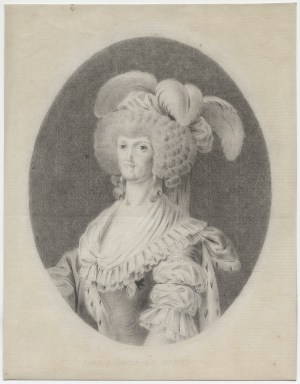
Antonio Carnicero, María Luisa de Parma, Queen of Spain, 1789. Chalk on paper (Dallas: Meadows Museum, SMU)
María Luisa of Parma, Queen of Spain is the first work to enter the Meadows Museum by Madrid painter Antonio Carnicero (1748–1814), who would become court painter to King Charles IV in 1796. This drawing stems from the period well before Carnicero’s royal appointment, which indicates the sovereigns’ awareness of Carnicero’s exceptional talent.
As a propagandistic campaign to disperse the new sovereigns’ images throughout the Spanish kingdom, portraits of Charles IV and María Luisa were commissioned from Carnicero and other painters. In Carnicero’s drawing, a bust-length portrait of María Luisa is set within an oval, and an elaborate headdress of feathers and ribbons sits on the queen’s wig of ringlets. The work is a preparatory drawing for the painted portraits of the queen, but its exquisite, polished lines resemble an engraving more than a sketch made in anticipation of a work on canvas.
Funds for this acquisition were provided by a Challenge Grant by the Gill family in honor of their daughter, Anju Gill.
High resolution images are available here»
Exhibition | A Queer History of Fashion
From The Museum at FIT:
A Queer History of Fashion: From the Closet to the Catwalk
The Museum at FIT, New York, 13 September 2013 — 4 January 2014
Curated by Fred Dennis and Valerie Steele

Man’s three piece silk velvet suit, 1790–1800, France
Museum purchase, 2010.98.1. Photo by Eileen Costa
A Queer History of Fashion: From the Closet to the Catwalk features approximately 100 ensembles, from 18th-century menswear styles associated with an emerging gay subculture to 21st-century high fashion. This is the first museum exhibition to explore in depth the significant contributions to fashion made by LGBTQ (lesbian-gay-bisexual-transgender-queer) individuals over the past 300 years.
Exhibition curators Fred Dennis, senior curator of costume, and Valerie Steele, director and chief curator of The Museum at FIT, spent two years researching and curating the exhibition. They worked with an advisory committee of eminent scholars, including professors George Chauncey (author of Gay New York), Shaun Cole (author of Don We Now Our Gay Apparel), Jonathan Katz (author/curator of Hide and Seek), Peter McNeil (co-editor of The Men’s Fashion Reader), and Vicki Karaminas (co-editor of the forthcoming Queer Style), as well as FIT faculty and fashion professionals.
“This is about honoring the gay and lesbian designers of the past and present,” said Dennis. “By acknowledging their contributions to fashion, we want to encourage people to embrace diversity.”
“We also hope that this exhibition will transform our understanding of fashion history,” added Steele. “For many years, gays and lesbians were hidden from history. By acknowledging the historic influence of gay designers, and by emphasizing the important role that fashion and style have played within the LGBTQ community, we see how central gay culture has been to the creation of modern fashion.”
From Cristobal Balenciaga and Christian Dior to Yves Saint Laurent and Alexander McQueen, many of the greatest fashion designers of the past century have been gay. Organized in roughly chronological order, the exhibition explores the history of modern fashion through the lens of gay and lesbian life and culture, addressing subjects including androgyny, dandyism, idealizing and transgressive aesthetic styles, and the influence of subcultural and street styles, including drag, leather, and uniforms.
The exhibition will trace how the gay vernacular styles changed after Stonewall, becoming increasingly “butch.” Lesbian style also evolved, moving from the ‘butch-femme’ paradigm toward an androgynous, anti-fashion look, which was, in turn, followed by various diversified styles that often referenced subcultures like punk. The AIDS crisis marks a pivotal mid-point in the exhibition. Clothing by a number of designers who died of AIDS, including Perry Ellis, Halston, and Bill Robinson, will be featured, as will a wide range of activist T-shirts for ACT UP, Queer Nation, the Lesbian and Gay Rights March in Washington and the iconic Read My Lips. Emphasizing that gay rights are human rights, the exhibition concludes with a section on gay wedding fashions as the sartorial expression of the issue of marriage equality.
Exhibition design is by Joel Sanders, well-known architect and author of Stud: The Architecture of Masculinity.
◊ ◊ ◊ ◊ ◊
From Yale UP:
Valerie Steele, ed., A Queer History of Fashion: From the Closet to the Catwalk (New Haven: Yale University Press, 2013), 248 pages, ISBN: 978-0300196702, $50.
 From Christian Dior to Yves Saint Laurent and Alexander McQueen, many of the greatest fashion designers of the past century have been gay. Fashion and style have played an important role within the LGBTQ community, as well, even as early as the 18th century. This provocative book looks at the history of fashion through a queer lens, examining high fashion as a site of gay cultural production and exploring the aesthetic sensibilities and unconventional dress of LGBTQ people, especially since the 1950s, to demonstrate the centrality of gay culture to the creation of modern fashion.
Contributions by some of the world’s most acclaimed scholars of gay history and fashion – including Christopher Breward, Shaun Cole, Vicki Karaminas, Jonathan D. Katz, Peter McNeil, and Elizabeth Wilson – investigate topics such as the context in which key designers’ lives and works form part of a broader ‘gay’ history; the ‘archeology’ of queer attire back to the homosexual underworld of 18th-century Europe; and the influence of LGBTQ subcultural styles from the trouser suits worn by Marlene Dietrich (which inspired Yves Saint Laurent’s ‘Le Smoking’) to the iconography of leather. Sumptuous illustrations include both fashion photography and archival imagery.
Valerie Steele is director and chief curator of The Museum at the Fashion Institute of Technology, New York.
New Book | From Marie-Antoinette’s Garden
As noted at Style Court and distributed by Rizzoli:
Élisabeth De Feydeau, edited by Alain Baraton with a foreword by Catherine Pegard, From Marie-Antoinette’s Garden: An Eighteenth-Century Horticultural Album (Paris: Flammarion, 2013), 240 pages, ISBN: 978-2080201423, $50.
 A horticultural tour of Marie-Antoinette’s domain, the lavishly constructed gardens at Versailles, accompanied by eighteenth-century archival illustrations. Plants, flowers, and trees were Marie-Antoinette’s passion; she transformed the Petit Trianon’s gardens into an enchanted escape from the oppressive shackles of Versailles. Based on archival documents, this book meanders through Marie-Antoinette’s estate as the queen herself would have walked it: traversing hyacinths, buttercups, and anemones in the French Gardens, via winding paths in the Anglo-Chinese Gardens, through the conifers of the Belvedere Gardens—where fabulous nocturnal parties were hosted—past the entrancing aromas of the shrubs surrounding the Temple of Love, to the wildflowers of the Garden of Solitude. This fascinating reconstruction includes descriptions of the cosmetic and medicinal uses of the garden’s plants, anecdotes from the royal court, and watercolors of the herbarium.
Historian and perfume specialist Élisabeth de Feydeau has published books on perfume. She teaches at the École des Parfumeurs in Versailles. Catherine Pégard is the president of the Établissement Public du Château, du Musée, et du Domaine National de Versailles.
Exhibition | Royal Paintbox: Royal Artists Past and Present
Press release from Windsor Castle:
Royal Paintbox: Royal Artists Past and Present
Windsor Castle, 22 June 2013 — 26 January 2014

◊ ◊ ◊ ◊ ◊
For generations, Britain’s kings, queens and their families have been inspired to paint, sketch and sculpt. Accompanying the ITV programme Royal Paintbox, an exhibition of the same name at Windsor Castle this summer charts the history of royal artists from the 17th century to the present day. It includes works by George III and his children, Queen Victoria and Prince Albert and their children, King Edward VII and Queen Alexandra and by Her Majesty The Queen. Also on display are a group of watercolours by His Royal Highness The Prince of Wales, who plays a leading role in the film. The Prince, who is Chairman of The Royal Collection Trust, has described how his love of painting was inspired by his early years at Windsor Castle surrounded by great art – so it is fitting that the Castle’s Drawings Gallery provides the backdrop for an exhibition dedicated to his family’s work.
The story told in the exhibition, which brings together works from the Royal Collection and from the collection of The Prince of Wales, begins during the aftermath of the English Civil War. Charles I’s nephew, the military leader Prince Rupert of the Rhine, depicted the execution of St John the Baptist in a magnificent mezzotint entitled The Great Executioner (1658). Mezzotint was a new engraving technique which Prince Rupert introduced to Great Britain at the time of the Restoration in 1660. His subject matter may refer obliquely to the execution in 1649 of his uncle Charles I, who is buried in St George’s Chapel, Windsor Castle. During the reign of Charles I’s son and successor Charles II, Prince Rupert was appointed Governor and Constable of Windsor Castle.

George III, Design for a Corinthian Temple for Kew, ca.1759
Pencil, pen and ink and wash (Royal Collection: RCIN 981419)
By contrast, a century later, the work of George III shows the ordered perfection characteristic of the Georgian style. The King’s drawings, which mostly date from the late 1750s, just before his accession in 1760, include a Design for a Corinthian Temple at Kew and a View of Syon House from Kew Gardens.
A familiar scene for visitors to Windsor is captured by George III’s fifth son, Prince Ernest Augustus, Duke of Cumberland. Aged nine, he painted an accomplished view in gouache of Windsor Town and Castle (1780), presumably under the careful supervision of his art teacher.
George III’s daughters were also tutored in art, and painted and drew throughout their lives. Like The Prince of Wales, the young Princesses were often inspired by the works of art they saw around them. In 1785, George III’s second daughter, Princess Augusta made an etching after a drawing by Leonardo da Vinci from the magnificent group of the artist’s work that entered the Royal Collection during the reign of Charles II. Leonardo’s drawing and the Princess’s etching will be shown side by side in the exhibition. George III’s third daughter, Princess Elizabeth, was particularly creative. One of the rooms at Frogmore House, a favourite royal retreat in Windsor Home Park, is decorated with her floral murals and decorative panels, including intricate cut-paper. Silhouettes and a large floral still life by Princess Elizabeth are included in the exhibition. (more…)










 Enfilade
leave a comment