Exhibition | Robert Polidori, Versailles
Robert Polidori’s Versailles series is currently on view at Galerie de Bellefeuille in Montréal with some images being exhibited for the first time. In 2008, the Edwynn Houk Gallery in New York mounted a similar show, and Polidori’s three-volume Parcours Muséologique Revisité appeared from Steidl in 2009.
Robert Polidori, Versailles
Galerie de Bellefeuille, Montréal, 1-25 June 2013
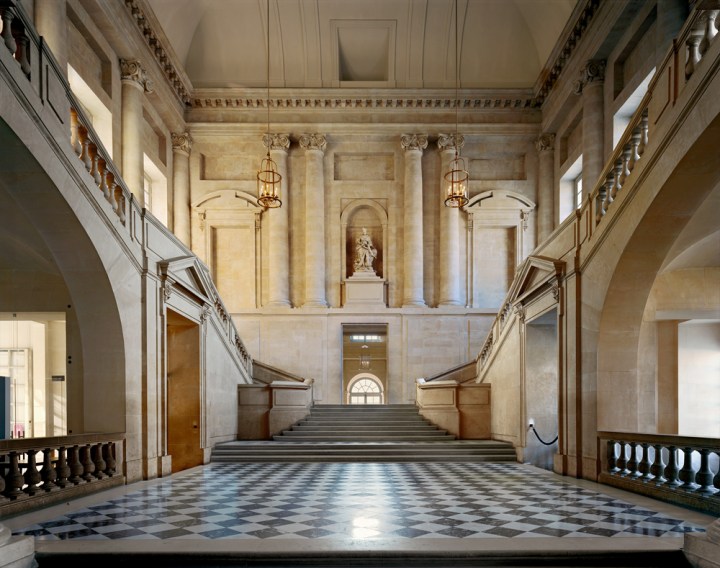
Robert Polidori, Marie Leszczinska en Junon,
MV 6595, by Guillaume Coustou, ca. 1731,
Grand Degré, Escalier Gabriel, 2007.
◊ ◊ ◊ ◊ ◊
Robert Polidori was born in Montréal, Canada, in 1951. At the age of ten he moved to the United States, where he has since remained. From 1970 to 1972 Polidori worked as an assistant to the filmmaker Jonas Mekas at the Anthology Film Archives producing a number of avant-garde films in the early 1970s. The time spent working under Mekas heavily influenced Polidori, helping to shape his unique approach to photography. In 1980 he received an M.A from the State University of New York in Buffalo, where he turned his attention to still photography.
Polidori’s career as a photographer began in earnest in the mid 1980s when he was given permission to document the historic restoration of the Château of Versailles. Since his first visit to Versailles Polidori has returned on a number of occasions, continuing a love affair that endures to this day. Working in opposition to Cartier-Bresson’s notion of the “decisive-moment,” that singular moment in which to capture a truth, Polidori prefers instead to work with the qualities of beauty and stillness of a space effected by its history and its present. As such, his conception of rooms as metaphors and vessels of memory is evident. He produces these interior shots by means of a single long exposure in natural lighting. His tonally rich and seductive photographs are the product of a view camera, long hours waiting for the right light, and careful contemplation of the camera angle. Polidori uses large-format sheet film, which he believes produces superior images to digital photography. While pursuing his career, Polidori also worked as a staff photographer with The New Yorker magazine from 1998 to 2007. (more…)
Call for Papers | Nun Artists in Early Modern Italy
Nun Artists in Early Modern Italy
Biblioteca Domenicana, Florence, 5 October 2013
Proposals due by 31 July 2013
Co-sponsored by the Medici Archive Project’s Jane Fortune Research Program on Women Artists and the Biblioteca Domenicana in Santa Maria Novella, this conference highlights new research on artistic production in female monastic communities since the early Renaissance until the Napoleonic suppression.
Demolishing older notions of enclosure as an absolute barrier between nuns and the world outside, recent research on social and religious aspects has begun to reinsert the convent within the wider networks of patronage and economic life in the early modern state, and to reposition it within larger civic and ecclesiastical discourses.
Presumably this model can also be applied to the study of nun artists. By framing research on nun artists and their activities within broader visions of society and material culture, we hope to arrive at a clearer understanding of the significance of nuns’ artistic production.
We welcome papers on a variety of topics regarding convents and their artistic production, from painting, to needlework, to carta pestata sculpture, to ephemera, to manuscript illumination. Suggested topics include but are not limited to:
• monographic studies on single artists
• studies of artistic practice in one or more female religious communities
• stylistic analysis and attributions of artworks
• studies of the visual culture of nun artists
• the role of art in the economic and patronage strategies of monastic communities
• the teaching of art in female religious communities
• comparisons between nuns’ artistic patronage their artistic production
• investigations of the relations and tensions between piety and artistic production
• historiographic studies of nun artists
Paper presentations, which must feature original research, may be given in Italian or English, and should be no longer than 20 minutes. A publication based on the conference papers is planned. Some support for travel expenses may be available. To apply, please send a one-page abstract and a brief c.v. to Dr. Sheila Barker (barker@medici.org) and Dr. Luciano Cinelli, O.P. (memorie.domenicane@gmail.com). The deadline for applications is July 31, 2013.
Exhibitions | Edward Harley: The Great Collector
Press release from The Harley Gallery:
Edward Harley: The Great Collector
The Harley Gallery, Welbeck, Nottinghamshire, 25 May 2013 — May 2014

From opulence and obsession to debt and despair, the exhibition Edward Harley: The Great Collector follows the fortunes of the 2nd Earl of Oxford (1689-1741). Showing at The Harley Gallery from 25 May 2013, it explores Edward Harley’s background, family and marriage through his spectacular collections of fine and decorative art and books.
Lord Edward Harley was a dedicated but extravagant collector. He bought at inflated prices when the desire to possess overrode any sense of the value of the piece or the extent of his resources. In 1738 he found himself in great debt and had to sell his family home and his collections.
The son of Robert Harley, one of the most powerful politicians in the country, Edward Harley married Henrietta Cavendish-Holles – the wealthiest heiress in Britain. Harley filled his family home at Wimpole Hall with a hubbub of activity – writers, poets, artists, bibliophiles would be regular visitors. He was a dedicated collector; his collections were extensive and extravagant as he passionately sourced the rarest and most beautiful things. Harley was surrounded by the finest thinkers and the finest things.
Besides magnificent silver, curios, paintings, and other works of art, he collected English miniature portraits dating from the early 1500s to his own time. These likenesses were intended as precious, jewel-like treasures to be kept in cabinets, brought out to be admired, and then returned to safety. They could be love tokens and gifts, souvenirs between friends and family members. Being so small, they were easily portable. Some were to be designed to be worn by a loved one as a pendant or bracelet. Many of Harley’s miniatures came from branches of his and his wife’s families; others were purchased because of the distinction of the artist or the importance of the sitter. They are the work of the greatest masters in the medium.
Harley rapidly added to the library started by his father, and his collection included pivotal works such as Shakespeare’s Second Folio and Jonathan Swift’s Gulliver’s Travels. Through Harley’s dedication, the library at Wimpole Hall grew at an astonishing rate, with some 12,000 books in the collection by September 1717. By the beginning of the eighteenth century, books and pictures were needing special accommodation in more and more houses. They were to become an essential part of country-house life. It was not until the second half of the seventeenth century that rooms called libraries became more common in country houses. Informed buying of art and literature was virtually non-existent until Charles I and other members of the court circle built up their collections in the 1620s and 30s. It required leisure, knowledge and money and house design grew to accommodate the collections with libraries, picture galleries and cabinet rooms. By the end of his life in 1741 Edward Harley had amassed the largest private library in Britain, but his passion for collecting ranged far beyond books and manuscripts. Edward Harley’s library contained 50,000 printed books, 7,639 manuscripts, 14,236 rolls and legal documents, 350,000 pamphlets, 41,000 prints: “the most choice and magnificent that were ever collected” (Collins).
His wealth gradually dwindled, yet Harley continued to add to his collections, often driving up the price of objects in his lust for ownership. In this obsessive collecting, Harley bankrupted himself and spent much of his wife’s fortune, eventually selling his family home and his collections to pay his debts. The great library, started by his father and described by Dr Johnson as excelling any offered for sale, was dispersed in 1742, but the celebrated Harleian collection of manuscripts was one of the founding collections of the British Library. Harley was also a patron of contemporary writers, including Alexander Pope and Jonathon Swift and of artists and architects.
The Harley Gallery is situated in the countryside of Welbeck, a ducal estate which has been home to the Cavendish-Bentinck family for more than 400 years. Edward Harley, 2nd Earl of Oxford (1689-1741) married into this family around 1713, when he wed Lady Henrietta Cavendish–Holles, uniting one of the most politically powerful families in the country with one of the richest. Edward Harley: The Great Collector will be accompanied by a full colour publication written by Curator Derek Adlam.
The Harley Gallery has recently announced plans to build a new Gallery which will show objects from The Portland Collections, the fine and decorative art collected by this family over the centuries. These collections include many objects purchased by Edward Harley, 2nd Earl of Oxford.
Conference | 300th Anniversary of Mandeville’s Fable of the Bees
From the conference website:
Eutopia Seated in the Brain: The 300th Anniversary of
Bernard de Mandeville’s The Fable of the Bees
Coimbra University, Portugal, 27-29 November 2013
Proposals due by 5 September 2013
Dutch physician with a literary, humanist formation, Bernard de Mandeville (1670-1733) is known as a portraitist of manners, a satirist and a fine observer of socio-economic behavior. From the perspective of the literary genre, B. Mandeville was a cultivator of the satirical fable, continuing La Fontaine and P. Scarron. His moral and political thought falls into several lines of the development of the European Enlightenment. His originality was only fully recognized many centuries later. One of his criticisms is related to Shaftesbury’s appreciation of virtue and moral sense in the Characteristics. The possibility of the contribution of pleasure and virtue for the formation of the human society, emphasized again in F. Hutcheson’s Remarks upon the Fable of the Bees, was the controversial point in Mandeville’s point of view. From his peculiar idea about the combination of virtue and the pure self-interest in social behavior evolved his idea of society. The modern sense of ‘interest’ had in B. de Mandeville a former inventor. Additionally, B. Mandeville has questioned the meaning of the connection between conscious actions with defined purposes and the objective results in the market of the autonomous individual drives. His depiction of the creation of social wealth reveals the relative independence of the objective results of individual actions regarding the initial purposes of the conscious agents. Luxury was one of the subjects that B. Mandeville addressed clearly. He tried to explain the imaginary mechanisms allied to the formation of luxury in the nations that explain why luxury cannot result from actions motivated solely by virtue or vice. (more…)
Meadows Acquires Work Attributed to Juan Alonso Villabrille y Ron
Press release (29 May 2013) from the Meadows Museum in Dallas:
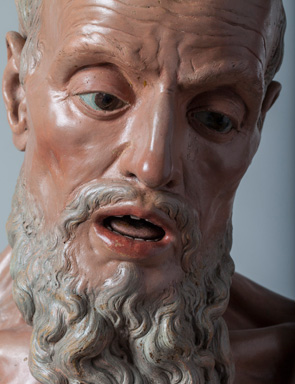
Juan Alonso Villabrille y Ron, St. Paul the Hermit (detail), ca. 1715, terracotta (Dallas: Meadows Museum, SMU)
The Meadows Museum has acquired the first terracotta sculpture attributed to Spanish Baroque master Juan Alonso Villabrille y Ron. In-depth research conducted by museum staff members sheds new light on the identity of the bust-length sculpture’s subject and its historical significance. When the sculpture was initially offered to the Museum it was believed to depict St. Jerome, Doctor of the Church. Meadows curators’ research, however, determined that the subject is in fact St. Paul the Hermit.
Villabrille y Ron is considered one of the most important Spanish sculptors of the Late Baroque period because of his mastery of technique. In addition, he taught another renowned sculptor of the period, Luis Salvador Carmona, and worked for the court in Madrid in the early eighteenth century. The quality of his work was such that he received commissions to create sculptures for some of the most important monuments in the city, such as the Puente de Toledo and the façade of the former Hospicio Provincial (now the Museo Municipal de Madrid). This sculpture is the first terracotta work to be attributed to Villabrille y Ron; not many examples of Spanish terracotta sculptures from the period have survived. Most of the works attributed to Villabrille y Ron are of polychromed wood or stone.
“Villabrille’s sculpture is a work of staggering realism and powerful emotion, and it provides an excellent complement to our already strong collection of works from the Baroque period,” said Mark A. Roglán, director of the Meadows Museum. “The acquisition of this prime example of Late Baroque sculpture will increase our ability to educate our visitors on this rich and versatile era in Spain by using objects that exemplify the style of the period. The students who use our Museum as a learning space and the visitors who come for pleasure will have an enriched experience because of this unique and beautiful example of Spanish sculpture.”
When the sculpture was initially offered to the Museum it was believed to depict St. Jerome, Doctor of the Church, who retired as a hermit to the Syrian Desert for three years’ penance. Meadows’ curators, however, took note of the subject’s prominently positioned woven reed garment, a vestment not present in any of the many other existing depictions of St. Jerome, and concluded the likeness had been misidentified. Their research determined that the subject is in fact St. Paul the Hermit, the first hermit saint of the Christian church, who is always shown as an old man wearing a woven reed garment made of palm leaves sewn together. Various experts in the field of early modern religious iconography, including George Washington University Professor Barbara von Barghahn and Richard P. Townsend, independent art historian, have confirmed the amended identification. (more…)
Updates at The William Blake Archive
30 May 2013
 The William Blake Archive is pleased to announce the publication of an electronic edition of Europe a Prophecy copy A. Only nine copies of Europe printed by Blake are extant. In 1794, the date on its title plate, Blake color printed copies B, C, D, E, F, and G; in 1795 he printed copies A and H, and in 1821 he printed copy K. All are in the Archive except copies C and F, which will be published next year to complete the history of this illuminated book. Europe consists of 18 plates, like its counterpart, America a Prophecy, produced the previous year, but most copies, including copy A, have 17 plates. Only copies H and K contain plate 3, a whimsical prefatory statement about the poem’s origin.
Europe a Prophecy was the second of Blake’s “Continental Prophecies,” followed in 1795 by “Africa” and “Asia,” the two sections of The Song of Los. Important examples of all three books—America, Europe, The Song of Los—are in the Archive. Like the other illuminated books in the Archive, the text and images of Europe copy A are fully searchable and are supported by the Archive’s Compare feature. New protocols for transcription, which produce improved accuracy and fuller documentation in editors’ notes, have been applied to copy A and to all the Europe texts previously published.
Copy A, in the Yale Center for British Art, was printed on large leaves of paper as part of a deluxe set of illuminated books, which included America copy A, The Marriage of Heaven and Hell copy D, and The Book of Urizen copy B, all in the Archive. David Bindman has raised doubts about the coloring in Europe copy A, suspecting that it may have been added by a later hand, perhaps in the twentieth century. In our opinion the coloring was done by Blake and his wife Catherine. The coloring of the frontispiece, with thick dabs of reds and blacks seemingly uncharacteristic of Blake, was probably the result of his experimenting with opaque pigments to create effects similar to his color printing. We see similar opaque reds and blacks applied in like manner in impressions of plate 8 of The Song of Los, especially in copy C. These too were printed and finished in 1795, the year Blake produced his set of 12 large color printed drawings. The color washes of some of the other plates in Europe copy A, however, appear to be by Catherine Blake (see Joseph Viscomi, Blake and the Idea of the Book, 133-34). (more…)
Exhibition | Madame Elisabeth: The Tragic Fate of a Princess
From the exhibition website:
Madame Elisabeth (1764-1794): Une Princesse au Destin Tragique
Domaine de Madame Elisabeth, Versailles, 27 April — 21 July 2013
Curated by Juliette Trey
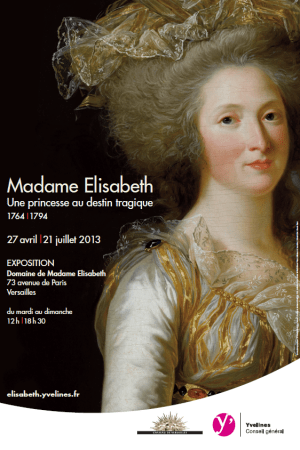 Who was the real Madame Elisabeth, the princess who never married and lived at Versailles with her brother Louis XVI and Marie-Antoinette? When she turned nineteen, the King gave her the estate of Montreuil, a country house very close to the Palace of Versailles. Madame Elisabeth spent her days there in simple pursuits – music, science, painting, embroidery and games – surrounded by her friends. In 1789, when she was twenty-five years old, the age of majority for unmarried women, she was finally entitled to sleep at Montreuil. However, the events of the French Revolution dictated otherwise.
This first major exhibition devoted to Madame Elisabeth is located in two areas of the estate. In the Residence, the furniture and objects with which the Princess surrounded herself have been assembled for the first time, conjuring up the lifestyle at Montreuil. The Orangery traces the life of the princess and the history of the estate.
130 works and objects have been assembled, including paintings, drawings, furniture, objets d’art, costumes, jewellery, and archive plans and documents. They come from the Palace of Versailles and several public and private collections and some exhibits have never previously been displayed. The exhibition space design aims to recreate the intimate atmosphere of Montreuil during the era of Madame Elisabeth. A multi-sensory tour allows visitors to experience this directly via perfumes, music, handling materials, and listening to contemporary accounts.
This tribute to the young princess also offers an opportunity to learn about the art of 18th-century gardens. The grounds are laid out in the English landscape garden style and have retained their original feel, with a grotto and groves of trees. Beds of aromatic and medicinal plants have been recreated in front of the Orangery, conjuring up the figure of Lemonnier, Madame Elisabeth’s physician, who cultivated plants on the estate. The walk between the two exhibition venues is enlivened with topiary representing animals.
◊ ◊ ◊ ◊ ◊
From the Versailles bookstore:
Juliette Trey, ed., Madame Elisabeth (1764-1794): Une Princesse au Destin Tragique (Milan: Silvana Editoriale, 2013), 192 pages, 28€.
 Although she was an obscure princess, Madame Élisabeth had an exceptional destiny. She never married and stayed with her elder brother, Louis XVI, who made her a present of the Montreuil estate on her 19th birthday: a country house only a few hundred metres from the Palace of Versailles.
This matchless horsewoman spent her days pleasantly there, surrounded by her friends who accompanied her on hunting outings or fishing trips. Passionately interested in mathematics and geography, and gifted in drawing, she never really interrupted her studies. Deeply pious, learned and sensible, Madame Élisabeth was also funny, cheerful and incredibly generous to everyone, heaping gifts on her friends and winning the affection of the inhabitants of Montreuil by her many acts of charity.
She showed great courage during the Revolution, refusing to go into exile in order to stay with her family. Imprisoned in the Temple with the royal family, she was guillotined just after reaching the age of thirty. A cult grew up around the memory of Madame Élisabeth which intensified after the Restoration and the return to power of her brothers from 1814 on.
◊ ◊ ◊ ◊ ◊
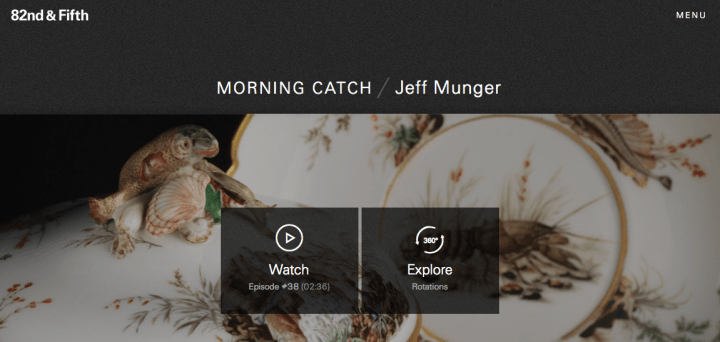
82nd & Fifth: One work. One curator. Two minutes at a time.
As art historians come around to moving pictures and expanding notions of audience, experiments from the Met (smartly packaged under the label 82nd & Fifth) are particularly interesting. -CH
◊ ◊ ◊ ◊ ◊
As introduced by Thomas Campbell:
[Earlier this year, the Metropolitan Museum of Art] launched 82nd & Fifth, a new Web feature that asks one hundred curators from across the Museum to each talk about a work of art from the Met’s collection that changed the way they see the world. One work. One curator. Two minutes at a time.
82nd & Fifth speaks directly to my interest in linking historical art and culture to a broader conversation. The Met is located at 82nd & Fifth but its relevance is global, allowing people to better understand both themselves and the world around them in the broadest sense.
We live in a sea of constant information, and these two-minute, authoritative commentaries are a welcome way to get powerful and compelling content in quick doses. We hope they will intrigue audiences who love the Met and those who are new to art.
◊ ◊ ◊ ◊ ◊
In “Morning Catch” (episode #38), Jeff Munger addresses a broth bowl from Vincennes, ca. 1740-56.
In “Family” (episode #40), Perrin Stein discusses Jacques-Louis David’s Study for The Lictors Bringing Brutus the Bodies of his Sons, 1787.

New Book | Green Retreats
From Cambridge UP:
Stephen Bending, Green Retreats: Women, Gardens and Eighteenth-Century Culture (New York: Cambridge University Press, 2012), 319 pages, ISBN: 978-1107040021, $40.
 Women, Gardens and Eighteenth-Century Culture explores the world of eighteenth-century aristocratic women and the gardens they created, inhabited, visited, and imagined. It examines both the physical spaces created by women and the role of the garden (physical and imagined) in relation to female sociability, scandal, high politics, piety, the erotic, and the powerful but contradictory language of retirement with which women in the country were confronted. Combining a survey of cultural representations of the woman in the garden with case studies of four major women gardeners, it offers comprehensive readings of letters, journals and diaries, novels, poetry and physical landscape to demonstrate the complex cultural negotiations and manipulations women undertook when they gardened on a large scale. Detailed case studies include Elizabeth Montagu and the Bluestocking circle, the gardening neighbours Lady Caroline Holland and Lady Mary Coke, and the scandalous retirement of Henrietta Knight, Lady Luxborough.
C O N T E N T S
Introduction
Part I:
1. ‘Gladly I leave the town’: Retirement
2. ‘No way qualified for retirement’: Disgrace
Part II:
3. Bluestocking Gardens: Elizabeth Montagu at Sandleford
4. Neighbours in Retreat: Lady Mary Coke and the Hollands
5. ‘Can you not forgive?’ Henrietta Knight at Barrells Hall
6. ‘Though very retired, I am very happy’
Symposium | Sculptural Mobilities
From the conference website:
Sculptural Mobilities
University College London, 3 July 2013
 Tracing the flows of sculptural artworks between the Nordic Countries and Europe from the early modern period to the present day
A one-day symposium organised collaboratively by University College London’s Department of Scandinavian Studies, and Kingston University’s Visual and Material Culture Research Centre. This symposium is funded by the Henry Moore Foundation.
This interdisciplinary symposium investigates the cultural mobility of sculptural artworks. Positioning the Nordic Countries as a contact zone of sculptural exchange, the project traces the flows of artworks to and from the Nordic Countries and Europe and examines the impacts these flows generate on both local/regional contexts of display and the nature of the sculptural artwork itself. Histories of sculpture within the Nordic region are arguably under-studied and the region’s influence upon and translation of influences from the wider Europe remain insufficiently traced. Our symposium emphasises the Nordic Countries’ important role as an interstice between the East, West and the North, and to bring to light individual histories of sculptural mobility from the early modern period onwards.
Stephen Greenblatt has defined cultural mobility as ‘the restless process through which texts, images, artefacts, and ideas are moved, disguised, translated, transformed, adapted, and reimagined in the ceaseless, resourceful work of culture.’ The sculptural artwork by contrast is often imagined as static and fixed, stable and immutable. To what extent is the sculptural artwork changed by transcultural recontextualisation? What is the potential for movement to compel a performative response within the moving object itself – what are the ways in which it is materially made to move via this process of transcultural exchange? Conversely, how do sculptures impact their new contexts of display? To what extent do moving sculptures confirm or critique the complexity, interdependence and instability of ‘localised’ cultures?
◊ ◊ ◊ ◊ ◊
T U E S D A Y , 2 J U L Y 2 0 1 3
7.30pm Thorvaldsen (1949) by Carl Theodor Dreyer (Wilkins Gustav Tuck Lecture Theatre, UCL) — Screening and lecture by Claire Thomson (Lecturer in Scandinavian Film and Head of UCL Scandinavian Studies) followed by an informal reception in the Wilkins North Cloisters, UCL.
W E D N E S D A Y , 3 J U L Y 2 0 1 3
9.00 Sara Ayres and Elettra Carbone / Claire Thomson and Fran Lloyd — Introduction and welcome
9.30 Panel 1: Courtly Patronage and Sculptural Mobilities
• Francesco Freddolini (Assistant Professor of Art History at Luther College, University of Regina, Canada), Denmark and the International Mobility of Italian Sculpture, ca. 1709-1725
• Cynthia Osiecki (PhD Fellow, Interdisciplinary Research Training Group ‘Baltic Borderlands’ at the Ernst-Moritz-Arndt-Universität, Greifswald), The Import of Flemish Sculpture into Sweden’s Courts in the Second Half
of the Sixteenth Century
• Kristoffer Neville (Alexander von Humboldt Fellow at the Technical University in Berlin), A Gothic Neptune: Georg Labenwolff’s Sculpture for the Danish Court, 1575-1583
11.00 Coffee break
11.30 Panel 2: Danish Myth, Italian Maestro: The Unveiling of Bertel Thorvaldsen
• Stig Miss (Director of The Thorvaldsen Museum), The Making of Sculptural Awareness in Copenhagen: The Contribution of the Works of Thorvaldsen
• Elettra Carbone (Teaching Fellow in Norwegian, University College London), Reading Sculpture: The Remediation of Thorvaldsen’s Sculpture in Printed Culture
• David Bindman (Emeritus Durning-Lawrence Professor of the History of Art, University College London), The Original Drawings for Thiele’s Biography of Thorvaldsen in the UCL Library
1.00 Lunch break — There will be time to view the one-day exhibition Rediscovered: Unique Thorvaldsen Portfolios held by UCL Special Collections alongside Karin Lowenadler’s Standing Male Nude (1936)
2.00 Panel 3: Post-War Sculptural Exchange between Britain and the Nordic Region
• Frances Lloyd (Associate Dean Research & Enterprise, Faculty of Art, Design & Architecture, Kingston University), ‘Back in from the Cold’: Karin Jonzen’s Commissions for the World Health Organisation
• Christina Brandberg (PhD Candidate, University of Hull), Henry Moore in the Nordic Countries: The First Two One-Man Shows in 1952
• Sara Ayres (Postdoctoral Researcher, Faculty of Art Design and Architecture, Kingston University), Transfiguring Memorials in Norway and Britain
3.30 Coffee break
4.00 Panel 4: Curatorial Mobilities
• Linda Hinners (Curator of Paintings and Sculpture, National Museum, Stockholm), Establishing a Platform for National Sculpture Production: The Recruitment of French Sculptors to Sweden during the Seventeenth and
Eighteenth Centuries
• Liisa Lindgren (Senior Curator, Parliament of Finland, Helsinki), Sculpture Hand in Glove with Architecture: The Sculpture Collection at the Finnish Parliament
• Marjorie Trusted (Senior Curator of Sculpture, V&A), Medieval Scandinavia and Victorian South Kensington
5.30 Concluding remarks and final discussion, chaired by Marjorie Trusted
6.00 Drinks
7.00 Conference dinner for speakers and guests










 Enfilade
leave a comment