Call for Papers | CAA in Chicago 2014
The following represents a selection of panels that might be of interest for scholars of the eighteenth century, though readers are encouraged to consult the full Call for Papers. HECAA members are asked to pay special attention to the session organized by Kevin Chua ‘After the Secular: Art and Religion in the Eighteenth Century’ and the ‘New Scholars Session,’ chaired by Kristel Smentek. Proposals for minor sessions (90-minute panels) typically have a slightly later due date; so stay tuned. -CH
◊ ◊ ◊ ◊ ◊
102nd Annual Conference of the College Art Association
Chicago, 12-15 February 2014
Proposals due by 13 May 2013 (extended from 6 May 2013)
The 2014 Call for Participation for the 101st Annual Conference, taking place February 12–15 in Chicago, describes many of next year’s programs sessions. CAA and the session chairs invite your participation: please follow the instructions in the booklet to submit a proposal for a paper or presentation. This publication also includes a call for Poster Session proposals and describes the seven Open Forms sessions.
◊ ◊ ◊ ◊ ◊
Historians of Eighteenth-Century Art and Architecture
After the Secular: Art and Religion in the Eighteenth Century
Kevin Chua, Texas Tech University, kevin.chua@ttu.edu
Religious art of the eighteenth century has long been framed within a narrative of secularization. It was thought that, with modernization, societies would move away from religious values to embrace secular ones. Yet scholars such as Charles Taylor, Talal Asad, and Hent de Vries have questioned this dominant narrative. Not only has secularization been shown to be not the end point of modernization, it has proven to be, perhaps, the last progress narrative that we need to unbind. This panel seeks papers on religious art, visual culture, and architecture that trouble the old secularization narrative, and come to grips with the paradoxical efflorescence of religion in the eighteenth century. Papers might address the contradictory place of art between the flourishing of marginal religions and the public sphere, engage the various “returns” of religion in and for art, and rethink the supposedly unidirectional shift from “religious” to “secular” worlds in aesthetic media.
◊ ◊ ◊ ◊ ◊
Historians of Eighteenth-Century Art and Architecture
New Scholars Session
Kristel Smentek, Massachusetts Institute of Technology, smentek@mit.edu
The Historians of Eighteenth-Century Art and Architecture (HECAA) invite paper proposals from advanced doctoral students and recent PhDs that present innovative approaches to the interpretation of the art, architecture, and material culture of the global eighteenth century. Presenters selected for this session are expected to become members of HECAA before the conference.
◊ ◊ ◊ ◊ ◊ (more…)
Huguenots of Spitalfields Festival
Thanks to Emma Barker for noting this upcoming festival with events taking place across London:
Huguenots of Spitalfields Festival
London, 8-21 April 2013
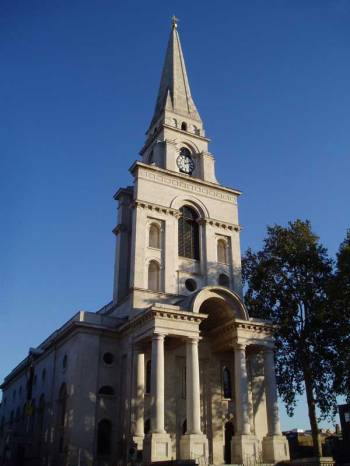
Christ Church, Spitalfields, London
2013 is the year of two significant anniversaries in the intertwined history of the Spitalfields district in London and the silk weaving industry created by Huguenots (French Protestant refugees who fled Catholic France from the 16th century). It is the 250th anniversary of the death of Anna Maria Garthwaite (1690-1763), an outstanding English textile designer who played an important part in the story of the Spitalfields silk weavers. It is also the 415th anniversary of the signing of the Edict of Nantes, on 13th April 1598. This decree by Henry IV of France served as a guarantee to the Protestant Huguenots that their rights to worship would be respected. However, it was revoked by Louis XIV in 1685 with the result that large numbers of French protestants fled to England to escape persecution. Over twenty thousand settled in Spitalfields where there was already an established weaving community.
Come and spend the day in Spitalfield, take a walk and browse around the Market, call in at Christ Church Spitalfields, the finest Baroque church in the country; visit Dennis Severs’ House, drop into the Town House
for coffee and delicious cakes. There is so much to see
and do — you will not be disappointed.
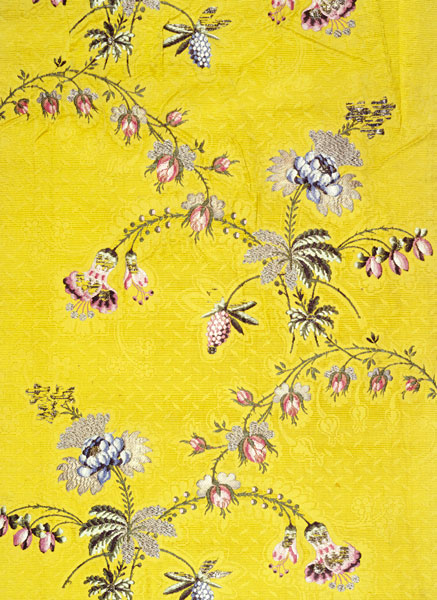
Silk panel, 1748-50 Spitalfields silk (The Museum of London)
Programme of Events
Supported by the Huguenot Society and the Spitalfields Trust
Between 8th and 21st April 2013, a series of activities to commemorate these two anniversaries will take place at different venues in Spitalfields. The celebratory programme will include
Daily Walks – The Immigrants’ Story, Historic Spitalfields, The Silk Weavers of Spitalfields
Talks by experts at the Bishopsgate Institute, Guildhall Library, V&A Museum, London Metropolitan Archives & The Natural History Museum
• Thanksgiving Service on Thursday 11th April at Christ Church, Spitalfields
• Extended opening hours for Dennis Severs’ House
• At Home With Anna Maria: a fundraising soirée on 16th April in Fournier Street with Clare Browne, curator of European textiles at the V&A and Dan Cruickshank
• Tours of Sandys Row Synagogue and Bisopsgate Institute
• The Big Weave: Saturday 13th April, which is an arts & crafts fair in Spitalfields Market. Stitches in Time will be hosting weaving workshops
Exhibition | French Paintings from the Wadsworth Atheneum
It’s interesting to see how this exhibition has been retitled in various venues: from Old Masters to Impressionists, to Old Masters to Monet, to Court to Café. The exhibition appeared in a fuller version at the Wadsworth Atheneum itself as Medieval to Monet: French Paintings, where it was accompanied by a full catalogue. -CH
◊ ◊ ◊ ◊ ◊
Press release (4 December 2012) from the Mississippi Museum of Art:
Old Masters to to Monet: Three Centuries of French Painting from the Wadsworth Atheneum
The Michele and Donald D’Amour Museum of Fine Arts, Springfield, MA, 13 December 2011 — 29 April 2012
Taft Museum of Art, Cincinnati, 18 May — 16 September 20122
Wadsworth Atheneum, Hartford, CT, 19 October 2012 — 27 January 2013 [expanded version of the exhibition]
Mississippi Museum of Art, Jackson, 23 March — 8 September 2013
Denver Art Museum, 27 October 2013 — 9 February 2014
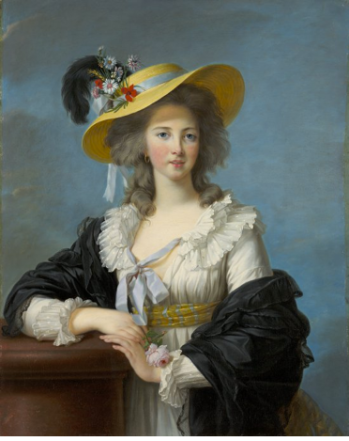
Elisabeth-Louise Vigée Le Brun, The Duchesse de Polignac Wearing a Straw Hat, 1782 (Hartford, CT: Wadsworth Atheneum Museum of Art)
The Mississippi Museum of Art is pleased to present Old Masters to Monet: Three Centuries of French Painting from the Wadsworth Atheneum, on view from March 23 through September 8, 2013. It is the thirteenth presentation in The Annie Laurie Swaim Hearin Memorial Exhibition Series. Established in 1989 to honor the memory of Annie Laurie Swaim Hearin, one of the Museum’s most dedicated patrons and volunteers, the Hearin series showcases exhibitions of world-class art, attracting visitors to Jackson from across Mississippi, the Southeast, and beyond.
Old Masters to Monet features fifty masterpieces from the collection of the Wadsworth Atheneum in Hartford, Connecticut. The outstanding artworks provide a history of French painting, ranging from the seventeenth through the nineteenth centuries and into the beginning of the twentieth century and include religious and mythological subjects, portraits, landscapes, still lifes, and genre scenes.
The Wadsworth Atheneum is America’s oldest public art museum, founded in 1843, and has never presented a full-scale survey of its distinguished collection of French paintings. To honor the recent publication of its
collection catalogue, the Atheneum has launched a tour of fifty of these outstanding masterpieces. “The Mississippi Museum of Art is honored to be one of the select venues to host this important exhibition,” said Betsy Bradley, director of the Mississippi Museum of Art. “In keeping with our mission of engaging Mississippians in the visual arts, this exhibition provides a rare opportunity for our visitors to come face to face with some of the most historically valued French paintings held in any museum collection.”
The exhibition begins with the great seventeenth-century masters, Nicolas Poussin, Claude Lorrain, Simon Vouet, and Jacques Stella, all of whom spent time in Rome and whose work embodies Italianate ideas of beauty, classical sculpture, and ideal landscape. Poussin’s enormous Crucifixion, painted in 1646 for President Jacques-Auguste de Thou, and Lorrain’s Landscape with St. George and the Dragon, commissioned by Cardinal Fausto Poli in 1641, are among the most important French paintings residing in the United States.
The eighteenth-century works present a remarkably rich tapestry of life in France during the rococo age. There are several scenes and portraits of aristocrats, including the Portrait of the Duchesse de Polignac by the era’s leading painter of women, Madame Vigée-Lebrun. Genre scenes rendered during this period exhibit a decidedly risqué bent as well as humorous aspects of life, both of which are evident in paintings on view by Jean Baptiste Greuze, François Boucher, and Louis Leopold Boilly. A more serious approach is evidenced in Still Life by Jean Baptiste Simeon Chardin and in the charming family pictures by Nicolas-Bernard Lépicié and Nöel Hallé. The change in style brought about by the French Revolution is evident in the impressive composition designed by Jacques Louis David, and the creation of a new aristocracy is presented by the two brilliant paintings by Jean Auguste Dominique Ingres. (more…)
Exhibition | Drawing Room: An Intimate Look at French Drawings
This fall, the Denver Art Museum will present Passport to Paris, a trio of exhibitions addressing France. Along with works from the Wadsworth Atheneum, the museum will show Nature as Muse: French Impressionist Landscapes and the following drawing exhibition:
◊ ◊ ◊ ◊ ◊
Drawing Room: An Intimate Look at French Drawings from the Esmond Bradley Martin Collection
Denver Art Museum, 27 October 2013 — 9 February 2014

Antoine Watteau, Standing Woman Holding a Fan, ca. 1719. Red and black chalk with graphite, on paper.
Collection of Dr. Esmond Bradley Martin.
Inspired by the drawings cabinets of gentlemen and connoisseurs, this exhibition will offer a space where visitors can get close to artworks whose intimate nature invites contemplation and close-up viewing. Comprised of approximately 39 works-on-paper, the exhibition includes a range of techniques from rapid sketches to finished pastels. The artworks represent exquisite examples of draughtsmanship by some of the most celebrated French masters and allow an in-depth look into the creative process of artists.
The entire exhibition is drawn from the private collection of Dr. Esmond Bradley Martin. Artists featured include François Boucher, Jacques-Louis David, Théodore Géricault, Jean-Auguste-Dominique Ingres, Henri de Toulouse-Lautrec, Claude Monet, and Alfred Sisley.
New Book | Masters of French Painting at the Wadsworth Atheneum
From Giles:
Eric M. Zafran, Masters of French Painting, 1290–1920: At the Wadsworth Atheneum (London: D. Giles, 2012), 288 pages, ISBN: 978-1904832935, £45 / $65.
 Masters of French Painting, 1290–1920: At the Wadsworth Atheneum presents over 130 of the most significant works of art from this internationally recognized collection of French paintings and pastels.
As the first public art museum in the U.S., the Wadsworth Atheneum paved the way for encyclopaedic museums across the country. Founded by Daniel Wadsworth, the Atheneum opened in 1844 with 79 paintings and three sculptures, and today holds more than 50,000 works of art. These include great 17th-century religious masterpieces by Poussin and Claude, charming 18th-century genre paintings and portraits by Boucher, Robert, Vigée Lebrun, and Trinquesse, and varied and rich examples from the 19th century, with outstanding works by Géricault, Delacroix, Monet, Renoir, Gauguin, and Toulouse-Lautrec.
Masters of French Painting, 1290–1920 fills a major gap in the museum’s series of titles devoted to its collections. It provides scholars and researchers with an entirely new catalogue, with up-to-date references, provenance, exhibition histories and technical/conservation reports, in addition to insightful art historical commentaries on the paintings. The book also includes an introductory essay on the creation of this remarkable collection by curator Eric M. Zafran.
An exhibition of about 100 highlights of the collection, Medieval to Monet, will be on view at the Wadsworth Atheneum, October 19, 2012 – January 27, 2013
Eric M. Zafran is the Susan Morse Hilles Curator of European Art at the Wadsworth Atheneum, where he has worked since 1997. As curator of European Paintings at the Museum of Fine Arts, Boston he wrote volume I of the museum’s Catalogue of French Paintings. He is the author of publications on Rembrandt, Monet, Gauguin, Doré, and Calder.
Call for Papers | Collaborators: Collectors, Critics, and Curators
Collaborators: The Role of Collectors, Critics, Curators in Artistic Practice, ca. 1780-1914
Humanities Research Centre, University of York, 26 June 2013
Proposals due by 26 April 2013
In May 1884 the art critic Marion Harry Spielmann wrote in defence of the often criticised profession of art criticism: “The critic – (I am not now referring to the mere notice writer of daily journalism) – spends his life in devotion not only to art but to artists: and, so far as public recognition is concerned, he reaps his reward in sneers and ‘chaff’: sneers from painters, thoughtless and irresponsible, like Mr Whistler; indifference from others less splenetic and querulous.” Spielmann, a prolific author, editor and arts administrator, was an advocate for and close friend of numerous contemporary artists. Along with the collectors and curators whom he frequently worked with and wrote about, he was an active and influential participant in contemporary art practice in late-Victorian London.
Relationships between artists, collectors, critics and curators are often considered in isolation but rarely in tandem. Drawing upon a diverse range of case studies, covering a variety of local and global contexts, this one day post-graduate workshop aims to unpick consistencies, changes and crossovers in the sometimes fraught but often productive relationships between artists, collectors, critics and curators in the long nineteenth century. By bringing together students, early-career researchers and established academics, we hope the workshop will provide an informal but stimulating forum for conversation, debate and interdisciplinary exchange about the nineteenth-century art world and its constituents.
We invite proposals for twenty-minute papers from postgraduate students, early career researchers and established academics. Papers might explore, but are not limited to, the following topics:
• The advent of professional art critics and curators and its impact on artistic practice
• Patronage and collecting in the long nineteenth century
• Artists as collectors, critics and curators
• The fabrication and decoration of Museum buildings
• Curating contemporary art in the long nineteenth century
• The art press and art publishing
• The Grand Tour/tourists as collectors, critics and curators
• Conversations/collaborations in the studio
• Collectors, critics, curators and local/regional/national identities
• Agency and authorship in artistic practice in the long nineteenth century
• Documents: catalogues, contracts and correspondence
Abstracts of no more than 250 words should be sent to Charlotte Drew (ckd502@york.ac.uk) and Eoin Martin (eoin.martin@warwick.ac.uk) by Friday 26 April. This event is generously supported by the Centre for Modern Studies, University of York.
Chrisman-Campbell, “When Fashion Set Sail” at Worn Through
It’s been too long since I’ve noted offerings at Worn Through, a blog that addresses apparel from an academic perspective. In addition to a Call for Papers for the Annual Meeting of the Costume Society of America (Midwest Region) on the theme of Uncommon Beauty, recent postings include an interesting contribution from Kimberly Chrisman-Campbell on maritime headdresses: “When Fashion Set Sail.” -CH
◊ ◊ ◊ ◊ ◊
Kimberly Chrisman-Campbell, “When Fashion Set Sail,” Worn Through (20 March 2013).

Anonymous, Coëffure à l’Indépendance ou le Triomphe de la liberté, ca. 1778, Musée franco-américain du château de Blérancourt
One of the most iconic images of eighteenth-century extravagance is a fashion plate depicting a lady wearing a miniature ship in her powdered and pomaded hair.
But this much-misunderstood hairstyle was not just an eye-catching novelty. It was one of many ship-shaped headdresses that celebrated specific French naval victories and, more importantly, advertised their wearers’ patriotism and political acumen.
Far from being the whimsical caprice of bored aristocrats, these maritime modes were directly inspired by one of the defining political and philosophical issues of the day: America’s struggle for independence, in which France was a key military and political ally.
The full posting is available here»
Call for Papers | Uncommon Beauty
From The Costume Society of America:
Uncommon Beauty | Annual Meeting of the Costume Society of America, Midwest Region
Chicago, 20-21 September 2013
Proposals due by 10 April 2013
 The Midwest Region of the Costume Society of America seeks original presentations on topics of Uncommon Beauty. Potential presenters will respond with topics that emerge from seeing beauty with an open mind and an open eye. This could include inquiry into the urban, the “fringe,” the utilitarian, the ethnic, the diverse, the modern, and the very individual. Topics are generated by interest in current or historical fashion, the body, and garments. Your original as well as your traditional academic approaches to presentation of information and images will create an uncommonly inspiring weekend of inquiry and exchange. Uncommon methods of presentation are encouraged, including poetic and literary elements. Garment makers are welcome to present applied and three-dimensional research.
Topics are also sought for exploration in the Ideas Theater, which will provide an informal venue to engage attendees in lively discussions about issues that matter to you now. Spotlight-worthy submissions may include research dilemmas, teaching methods, interpretive strategies, and theater costume or fashion design processes. Although poster presentations and slideshows will be considered, topic presenters are encouraged to consider hands-on activities, quick surveys or games, dance or role-playing, and other imaginative scenarios to involve participants.
Requirements: Proposals are invited for 20-minute oral presentations and Idea Theater topics. Abstracts must be no longer than two typed, double-spaced pages, including endnotes. The top of the first page should include only the title (no names). All proposals should include a cover page with working title, name, address, telephone number, email address, and professional affiliation. Please identify your proposal as an oral presentation or Idea Theater topic.
The organizers encourage papers from established professionals, early career scholars, independent researchers, garment makers, and students. Please identify student papers on the cover page. Abstracts are due by April 10, 2013, to Jacqueline WayneGuite at csachicago2013@gmail.com. For more information about the symposium, contact Caroline Bellios at csachicago2013@gmail.com.
New Book | Giambattista Crosato: Pittore del Rococò Europeo
From Artbooks.com:
Denis Ton, Giambattista Crosato: Pittore del Rococò Europeo (Verona: Scripta, 2013), 460 pages, ISBN: 9788896162385, $98.
 Giambattista Crosato (1697-1758) è stato pittore, frescante e scenografo operoso tra la Serenissima e il Piemonte sabaudo, attivo in alcuni dei luoghi simbolo della civiltà settecentesca europea: dalla palazzina di caccia di Stupinigi, al salone di Ca’ Rezzonico, alle ville venete. Autore di pannelli per boiseries come di grandi cicli ad affresco, Crosato è stato, fra i grandi veneziani di quel tempo, colui che meglio ha saputo interpretare in chiave personale lo stile del rococò internazionale, dialogando parimenti con la cultura piemontese negli anni di Beaumont e Giaquinto e proponendo una pittura “risoluta e bizzarra” – per riprendere le parole dei suoi contemporanei, fra le poche a proporsi quale alternativa alla grande maniera del genio del secolo, Giambattista Tiepolo.
Recreated Ceiling of the Gwoździec Synagogue Unveiled in Warsaw
On Tuesday, 12 March 2013, the Museum of the History of Polish Jews in Warsaw (scheduled to open next year) unveiled the newly completed replica of the ceiling from the Gwoździec Synagogue, which was lost when the building was destroyed during World War II. According to the website of Hands House Studio, the synagogue was largely constructed between 1700 and 1731, with some older portions dating to the seventeenth century. As reported by the Agence France-Presse (AFP):
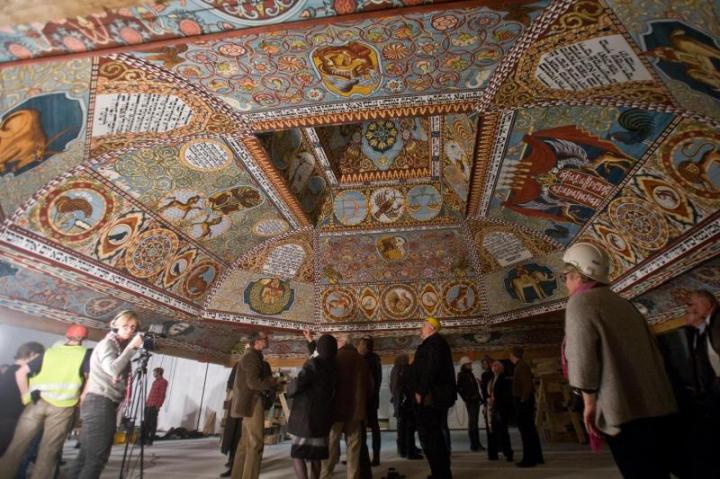
Gwoździec Synagogue Re!construction Project.
Museum of the History of Polish Jews, Warschau
◊ ◊ ◊ ◊ ◊
. . . a life-sized replica of the polychrome ceiling of an 18th-century synagogue inspired awe Tuesday [12 March 2013] as it was unveiled in the Polish capital. Covered in richly coloured Old Testament scenes and lushly stylised floral themes, the original ceiling adorned a wooden synagogue in what was the pre-World War II eastern Polish town of Gwozdziec, near what is now Lviv, western Ukraine. Like thousands of other Jewish religious sites, it was destroyed during the war by Nazi Germany. Its modern replica is the centrepiece of the Polish capital’s new Museum of the History of Polish Jews, due to be formally inaugurated April 19, marking the 70th anniversary of the World War II Warsaw Ghetto Uprising. Its door will open to the public next year. . . .
The replica was handcrafted from wood using traditional tools and techniques and involved nearly 300 craftspeople and artists from around the globe. The new museum is being built in the heart of the Polish capital on the site of the Jewish ghetto that became a symbol of resistance to Nazi Germany’s efforts to eradicate 1,000 years of Jewish presence in Poland. Designed by Finnish architects Rainer Mahlamaeki and Ilmar Lahdelma, the new museum faces the imposing black-stone Warsaw Ghetto Uprising memorial dedicated to those who perished in the doomed 1943 Jewish revolt against the Nazis. . . .
◊ ◊ ◊ ◊ ◊
Note (added 18 January 2023) — More information on the ceiling is available here with Ariel Fein’s essay for SmartHistory (4 April 2022).










 Enfilade
leave a comment