The Met and Crystal Bridges to Share Portrait of Alexander Hamilton
Press release (14 March 2013) from Crystal Bridges:

John Trumbull, Portrait of Alexander Hamilton, 1792. Oil on canvas, 86 x 58 inches (219.1 x 146.1 cm)
An iconic full-length portrait by the celebrated Revolutionary-era painter John Trumbull of Alexander Hamilton, then Secretary of the Treasury under President George Washington, will join the permanent collections of both Crystal Bridges Museum of American Art and The Metropolitan Museum of Art, thanks to a gift from the painting’s owner, the global wealth manager and investment bank Credit Suisse.
Each institution will own a half share of Portrait of Alexander Hamilton (1792), which is currently on view at Crystal Bridges and has been on loan from Credit Suisse and on view since the museum opened. The painting will travel to the Metropolitan Museum in summer 2013 and return to Crystal Bridges in 2014. In subsequent years, each museum plans to exhibit the painting for two-year periods, when it will be integrated into the galleries and, on occasion, included in special exhibitions at each museum.
“We are very grateful to Credit Suisse for the generous gift of this distinguished portrait of Alexander Hamilton, whose political and legal acumen put him at the center of the founding of the new American republic, and whose key contributions to business and banking in Federal-era New York City effectively established the financial marketplace in this country,” stated Thomas P. Campbell, Director and CEO of The Metropolitan Museum of Art. “As the greatest known portrait of Hamilton and one of the finest civic portraits from the Federal period, this painting is a splendid addition to our fine collection of portraits of American political leaders. We are pleased and honored to share this remarkable work with Crystal Bridges.” (more…)
The Met Acquires Work by William Theed
As noted at Art Daily (14 March 2013) . . .
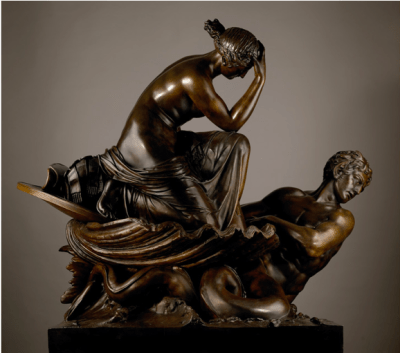
William Theed the Elder (1764-1817), Thetis Returning from Vulcan with the Armour of Achilles. Bronze, cast, chased and patinated, on an integral rectangular plinth. Height: 128 cm; width: 120 cm; length: 143 cm.
For over a year, Tomasso Brothers, the internationally renowned dealers in European sculpture, paintings, furniture and the decorative arts, has been searching for an elegant space in London. Dino and Raffaello are now delighted to announce that from 1 May 2013 they can be found at their new gallery at 12 Duke Street , St James’s. Established in 1993 and based at Bardon Hall, Leeds, Tomasso Brothers is pleased to also have a presence in the heart of London ’s traditional art market where they will showcase exciting pieces from their extensive portfolio.
The two Tomasso brothers are especially renowned for their expertise in European sculpture and boast a number of the world’s greatest museums amongst their clients. Recent sales include a major bronze to the Metropolitan Museum of Art, New York, Thetis Returning from Vulcan with the Armour of Achilles by William Theed the Elder (1764-1817), which was unveiled at the inaugural Frieze Masters in October 2012. This remarkable, almost life-size, bronze depicts the ‘divine Thetis of the silver feet’, most famous of the Nereids in Homer’s Iliad, kneeling by the shield of her son Achilles with the hero’s armour in a giant cockle shell. This spectacular sculpture, described by Sir Timothy Clifford as ‘undoubtedly Theed’s most ambitious work’, was almost certainly originally supplied to the author, philosopher, interior designer and art collector, Thomas Hope (1769-1831) for Duchess Street, London, or his country house Deepdene in Surrey. William Theed was born in London and entered the Royal Academy Schools in 1786. He went to Italy in 1790, returning in 1796. He began his artistic career as a painter but was befriended by the sculptor John Flaxman whilst in Rome and took up sculpture. Flaxman’s designs for Homer’s Iliad clearly made a powerful and lasting impression on the young Theed. Dino Tomasso said: ‘It is hugely gratifying when such a superb sculpture ends up in one of the world’s leading museums’. Dino and Raffaello Tomasso take great pride and pleasure in helping connoisseurs and museums in Europe and America to enhance their collections. In addition the company has promoted and supported through loans and exhibitions major international institutions such as the Fitzwilliam Museum, Cambridge, the Centro Internazionale, Carrara, the National Gallery, Prague, and the Kunsthistorisches Museum, Vienna. Most recently they were one of the sponsors of the landmark show Bronze at the Royal Academy of Arts, London , in 2012.
Tomasso Brothers will be exhibiting at TEFAF, 15 to 24 March 2013, Stand 165, Masterpiece London, 27 June to 3 July 2013, Stand C2, and also joining Master Drawings and Sculpture Week from 28 June to 5 July 2013.
Spring 2013 Issue of ‘Renaissance Quarterly’
The eighteenth century in the current issue of Renaissance Quarterly:
Paula Findlen, “The 2012 Josephine Waters Bennett Lecture: The Eighteenth-Century Invention of the Renaissance: Lessons from the Uffizi,” Renaissance Quarterly 66 (Spring 2013): 1-34.
 This essay explores the role that the eighteenth-century Uffizi gallery played in the invention of the Renaissance. Under the Habsburg-Lorraine rulers, and especially during the reign of Grand Duke Peter Leopold (r. 1765–90), changes to the Medici collections and the gallery’s organization transformed an early modern cabinet of curiosities, paintings, and antiquities into a space in which a historical narrative of art, inspired by rereadings of Giorgio Vasari’s Lives, became visible in a building he designed. A succession of Uffizi personnel was increasingly preoccupied with how to see renaissance, and more specifically Tuscan rinascita, in the collections. The struggles between the director Giuseppe Pelli Bencivenni and his vice-director Luigi Lanzi highlight how different understandings of the Renaissance emerged in dialogue with antiquarianism and medievalism. At the end of the eighteenth century the Uffizi would definitively become a museum of the Renaissance to inspire new forms of historical writing in the age of Michelet and Burckhardt.
Thoughts on Paper: A Blog and a Book
Those of you taken by the materiality of paper may be interested in Lucy Vivante’s blog posting from 15 January 2013 on Paper and Watermarks, in which she interviews Neil Harris and Peter Bower. And if the distance between those traditions of making and our own dependence upon screens leaving you feeling elegiac, you might have a look at Ian Sansom’s new book. -CH
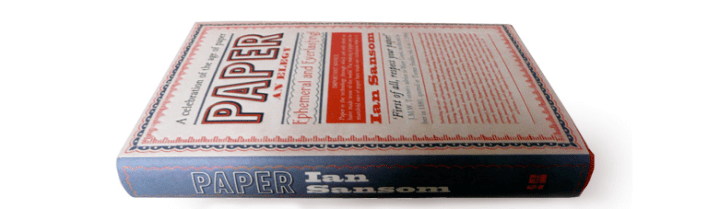
Ian Sansom, Paper: An Elegy (London: Fourth Estate, 2012), 224 pages, ISBN: 978-0007480265, $25.
The history of civilization is bound up with — and bound in — the history of paper. Paper is the technology through which and with which we make sense of the world: knowledge and information is arranged in words, images and numbers on paper; values and ideas are exchanged and transmitted by paper. The making of paper, the trade in it, the use of it, brought about a new era in human civilization.
That era is coming to an end. In 2010, Amazon announced that for the first time it was selling more e-books than paper books. According to Nicholas Negroponte, founder of MIT′s Media Lab, the paper book has five years left to live before becoming extinct. The world we know was made from paper: yet everywhere you look, paper is dying, its influence literally disintegrating.
In Paper: An Elegy Ian Sansom traces the history of paper-making from the 7th-century Chinese workmen who made paper from the inner bark of plants and trees, to the 17th-century vatmen and couchers who dipped and shook and dried paper moulds to make folios and quartos, to today′s billion-dollar paper industry; from papyrus to e-books. Both a cultural overview and a series of warm, personal meditations on the history and meaning of paper in all its forms – as both a means of communication and as an artefact in itself – this book is a lively valediction to the paper it′s printed on.
Free Trial Access to Gale Digital Collections until June 15
ASECS Trial for Gale Digital Collections
Gale Digital Collections is providing a free trial to many of its collections, from now until June 15, 2013. This trial does not require a username or password. Feel free to share this trial with your colleagues. If you find value in any of these collections, please contact your library liaison. Often times, faculty feedback and comments influence library collection development decisions. Here are the digital collections for review in alphabetical order:
British Literary Manuscripts – This extensive digital archive includes hundreds of thousands of pages of poems, plays, essays, novels, diaries, journals, correspondence and other manuscripts from the Restoration through the Victorian era.
Eighteenth Century Collections Online (ECCO) – Consisting of every significant English-language and foreign-language title printed in the United Kingdom during the 18th century, along with thousands of important works from the Americas, Eighteenth Century Collections Online was the most ambitious single scholarly digitization project ever undertaken. Bearing witness to what many scholars consider the three most significant events in world history — The American Revolution, The French Revolution and The Industrial Revolution.
Gale NewsVault – The definitive cross-searching experience for exploring Gale’s range of historical newspaper and periodical collections. Users can simultaneously search or browse across The Times Digital Archive 1785-1985, 17th and 18th Century Burney Collection Newspapers, Financial Times Historical Archive 1888-2006, 19th Century U.S. Newspapers, and many more.
The Making of the Modern World, Parts I&II – This unrivaled online library fully documents the dynamics of Western trade and wealth that shaped the world from the last half of the 15th century to the mid-19th century. Part II adds approximately 5,000 newly scanned titles extends this impressive series into the beginning of the 20th century.
Nineteenth Century Collections Online (NCCO) – The most ambitious scholarly digitization and publication program ever undertaken, this collection is invaluable to research and teaching in one of the most studied historical periods. Rare primary sources, curated by an international team of experts, provide never-before-possible access to important works sourced from leading libraries worldwide.
Sabin Americana, 1500-1926 – This is an online collection of books, pamphlets, serials and other works about the Americas, from the time of their discovery to the early 1900s.
Slavery and Anti-Slavery: A Transnational Archive – The largest and most ambitious project of its kind, this collection is a thematically organized, four-part historical archive devoted to the scholarly study and understanding of slavery from a multinational perspective.
State Papers Online–This collection is the gold standard for anyone conducting research on early modern English politics and culture. Organized in four parts, each cross-searchable and available separately, this online archive of original manuscript documents of British State Papers chronicles domestic and foreign history, from 1509-1714, the period of Henry VIII to Queen Anne.
Exhibition and Resource | French Pamphlets at The Newberry
From The Newberry:
Politics, Piety, and Poison: French Pamphlets, 1600–1800
The Newberry Library, Chicago, 28 January — 13 April 2013
This exhibition displays French pamphlets published during the transitional period from the Ancien Régime to the French Revolution. They served as modes of dissemination and diversion, teaching tools and educational models, and the foundation for current and future scholarly projects. The exhibition focuses on the ways in which these pamphlets complement and enhance the Newberry’s other vast collections of primary sources documenting early modern European culture and the history of printing. The Newberry’s outstanding collection of French pamphlets was recently cataloged through a grant from the Council on Library and Information Resources.
◊ ◊ ◊ ◊ ◊
About The Newberry’s cataloging project:
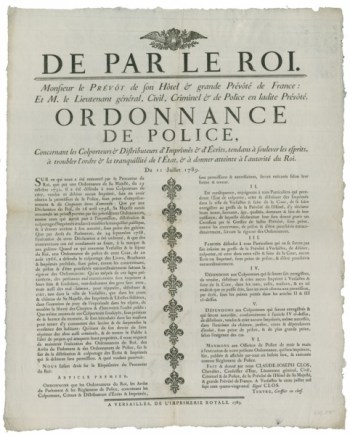
Case Wing Z 144.A1, vol.10 No.87, Ordonance (The Newberry Library)
French Pamphlet Collections at the Newberry Library is a three-year project funded by a Council on Library and Information Resources (CLIR) Cataloging Hidden Special Collections and Archives grant. CLIR administers this national effort with the support of generous funding from The Andrew W. Mellon Foundation. French Pamphlet Collections at the Newberry Library began in January 2010 and will be completed in January 2013. Through the project, the Newberry is creating full, item-level MARC records for 22,000 French pamphlets that date from the 16th to the 19th century.
The Newberry applied for the CLIR grant to support one of its top cataloging priorities of processing hidden collections. A committee comprised of staff with library service, stacks management, curatorial and collection development responsibilities prioritized these uncataloged and undercataloged materials based on its knowledge of researcher requests, scholarship trends, Newberry collection strengths, subject areas in need of development, and strong complementary collections in other institutions. Pamphlet collections were one of the highest priorities. More specifically, the committee identified the French Pamphlet Collections as being an urgent cataloging need. The material complements strengths of the Newberry’s collection and it is in high-demand by researchers. The bulk of the pamphlets date to the period of the French Revolution and are primary sources for legal, social, and cultural history; literary studies; and the history of publishing. These ephemeral documents have often been overlooked and undervalued by past generations of scholars and undercataloged in research collections. They are of particular value to modern scholarship because they move past official histories and contribute to new interpretations. . .
Call for Articles | The Senses of Humour
“The Senses of Humour,” edited by Eugenia Zuroski Jenkins, is a special issue of Eighteenth-Century Fiction that will explore the relationships among various meanings of the term “humour” in the long eighteenth century, from humoral theories of the body to the cultivation and regulation of “senses of humour” in literature, culture, and social interaction. We invite submissions on eighteenth-century legacies of classical humoral theory; the philosophy of laughter; the emergence of modern forms of wit, satire, and other humorous genres in literature and illustration; cul-tural negotiations of body and mind as sites of “humour”; and the role of humour(s) in discourses of feeling, sentiment, sensibility, and sociality. We welcome articles that treat the topic in areas both inside and outside of imaginative prose fiction. Manuscripts (5,000-8,000 words) should reach ECF by 1 May 2013. Electronic submissions are encouraged: visit ECF at Digital Commons & choose “Submit Article.”
Further details about submitting articles can be found at / Les protocoles de la présentation et de la soumission des articles sont consultables à “Editorial Policy.” To submit an article for a special issue, or a call for articles, or a regular issue of the journal, which publishes 4 issues per year, choose “Submit Article.” We encourage electronic submissions at Digital Commons, but if you have any concerns about this online submissions system, you may contact the ECF editors at ecf@mcmaster.ca.
Conference | Peter the Great
From the Fondation Singer-Polignac:
Pierre le Grand et l’Europe Intellectuelle: Contexte, Réseaux, Circulation, Réalisations
Fondation Singer-Polignac, Paris, 28-29 March 2013
 Le règne de Pierre le Grand se scande en deux parties. À son avènement, il comprit les difficultés dues à un certain retard technologique de la Russie. Le transfert (par toutes les filières possibles) et l’acculturation des connaissances venues d’Europe devinrent le leitmotiv de sa politique. De son vivant, le tsar fut comparé à Prométhée. Presque tout était à créer. Le corpus des savoirs nécessaires était insuffisant. Les structures étatiques archaïques, que ce soit dans le domaine diplomatique, militaire ou administratif, ne lui permettaient pas d’affronter les problèmes d’actualité. L’état obsolète de la technique – artillerie, armement, fortifications, mines et métallurgie – freinait les ambitions géopolitiques du monarque. D’autres infrastructures, la marine de guerre par exemple, n’existaient pas. Il manquait également un système d’enseignement et des structures de production scientifiques. Deux décennies durant, Pierre Ier s’efforça à esquiver ou à parer les coups en les anticipant dans la mesure du possible. Il travailla ainsi dans l’improvisation, au gré des nécessités militaires, politiques et sociales. Vers la fin des années 1710, la guerre du Nord touchant à sa fin, il prit conscience d’avoir accumulé suffisamment d’expérience en matière d’appropriation des connaissances européennes ; ses réformes devinrent de plus en plus réfléchies et systématiques. Dans ce nouveau paradigme, les savoirs artistiques, scientifiques et administratifs changèrent de signification et rejoignirent, à titre d’égalité, le transfert des connaissances techniques. Le pragmatisme de Pierre Ier répondait au principe de l’utilité, à une forme d’utilitarisme moral et économique destiné à réaliser un projet sociétal. C’est l’axe majeur de cette rencontre internationale. Les études qui se proposent d’examiner globalement le phénomène de transfert et son impact sur la Russie et l’Europe occidentale restent rares. Dans le cadre de ce colloque, nous nous proposons d’affronter un défi, en réunissant autour de ces grands axes de réflexion des chercheurs ayant mené, depuis une vingtaine d’années, des enquêtes originales et souvent inédites sur les divers aspects des relations entre la Russie et l’Occident à l’époque pétrovienne.
Consulter le programme sur le site de la Fondation Singer-Polignac.
Exhibition | Piranesi, Rome, and the Arts of Design
From the San Diego Museum of Art:
Piranesi, Rome, and the Arts of Design
Giorgio Cini Foundation, Venice, 28 August 2010 — 9 January 2011
Caixa Forum, Madrid, 24 April — 9 September 2012
Caixa Forum, Barcelona, 9 October 2012 — 20 January 2013
San Diego Museum of Art, 30 March — 7 July 2013
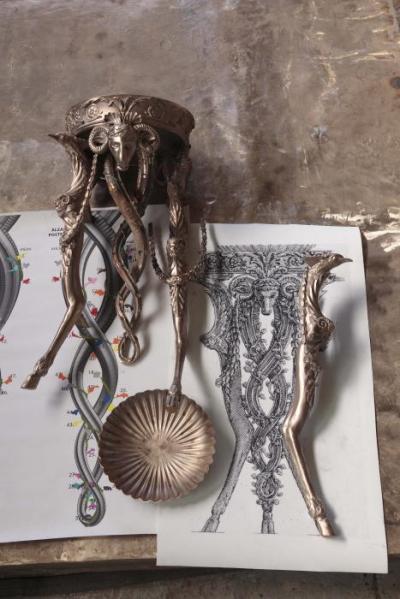 Giovanni Battista Piranesi (1720-1778) was a printmaker, architect, antiquarian, art dealer, theorist, and designer—one of the foremost artistic personalities of the 18th century, whose views of Rome remain the city’s defining image. Fresh, thought-provoking, and innovative, Piranesi, Rome, and the Arts of Design sets out to show the range of the artist’s genius in a 21st-century approach to his creative endeavors. More than 300 original prints have been selected from the world renowned collection of the Fondazione Giorgio Cini in Venice, Italy. These prints are combined with modern-day interpretations in new technologies such as video, photography, and digital modeling. Utilizing the most advanced technologies, the exhibition enables Piranesi’s two-dimensional renderings of a monumental vase, a candelabrum, tripods, a teapot, an altar, and a fireplace to assume their rightful three-dimensional forms. These never-before-seen and never-before-crafted objects take center stage in the exhibition and attest to the creative intellect of Piranesi’s designs. In addition, the exhibition brings to life Piranesi’s most famous works, the Carceri (Prisons), in the form of a virtual reality 3-D installation. The legendary Caffè degli Inglesi is represented as a full scale evocation, and visitors may browse through Piranesi’s sketchbooks using a touchscreen monitor. Strikingly designed by world renowned architect Michele De Lucchi, the exhibition embodies the progressive spirit of Piranesi’s own eclectic visions and his modernity, emphasizing the popular appeal of his work and its continuing relevance to designers and architects. Having previously appeared at the Fondazione Cini in Venice and at the Caixa Forum in Madrid and Barcelona, the show makes its only U.S. stop at The San Diego Museum of Art.
Exhibition conceived by Michele De Lucchi, produced by Fondazione Giorgio Cini, Itatly, together with Factum Arte, Spain, in collaboration with Exhibits Development Groups, USA.
Photos from the installation at the Giorgio Cini Foundation (Le Arti di Piranesi: architetto, incisore, antiquario, vedutista, designer) are available here»
◊ ◊ ◊ ◊ ◊
From Factum Arte:
Michele de Lucchi, Guiseppe Pavanello, John Wilton-Ely, Norman Rosenthal, and Adam Lowe, The Arts of Piranesi: Architect, Etcher, Antiquarian, Vedutista, Designer (Madrid: Caixaforum, 2012), 304 pages, ISBN 978-8461576371, 35€.
 The Arts of Piranesi: Architect, Etcher, Antiquarian, Vedutista, Designer is a catalogue for the homonymous exhibition on the work of Giambattista Piranesi, curated by Michele de Lucchi, Adam Lowe and Giuseppe Pavanello, taking place in CaixaForum Madrid from 25 April to 9 September 2012 and CaixaForum Barcelona from October 2012 to January 2013.
A collaboration between Factum Arte and the Fondazione Giorgio Cini, the exhibition opened in Madrid after receiving great reviews when it was in Venice for the Biennale of Architecture in 2010. In addition to objects realised using traditional and digital modelling from the original designs by Piranesi, the exhibition also contains Gabriele Basilico’s sensitive black and white photographs of the famous Vedute and over 250 etchings by Piranesi.
◊ ◊ ◊ ◊ ◊
From the San Diego Museum of Art:
Symposium: Piranesi, Rome, and the Arts of Design
San Diego Museum of Art, 30 March 2013
Scholars from around the country will offer their insights to contextualize the culture, time period, and artistic concerns of Giovanni Battista Piranesi. Speakers include Christopher M.S. Johns, Norman L. and Roselea J. Golberg, Professor and Chair of the Department of History of Art, Vanderbilt University; John Pinto, Howard Crosby Butler Memorial Professor of Art and Archeology, Princeton University; and Jeffrey L. Collins, Professor and Chair of Academic Programs, Bard Graduate Center; and will be moderated by Dr. John Marciari, Curator of European Art.
◊ ◊ ◊ ◊ ◊
Film | Yo-Yo Ma Inspired by Bach: The Sound of The Carceri
San Diego Museum of Art, 5 April 2013
The Sound of The Carceri explores the deep relationship between music and architecture through a high-tech ‘virtual confrontation’ between Bach and his contemporary, the architect Giovanni Battista Piranesi. Using a striking visual style, director François Girard (The Red Violin and Thirty-Two Short Films about Glenn Gould) places Yo-Yo Ma within a series of computer-generated, three-dimensional recreations of Piranesi’s well-known prison etchings. Through Yo-Yo Ma’s and music producer Steven Epstein’s struggle to recreate and interact with the imaginary space that Ma performs in, the film examines the complexity of illusion, of representation and reality.
◊ ◊ ◊ ◊ ◊
Lecture | Purchasing Piranesi: Buying Art on the Grand Tour
San Diego Museum of Art, 19 April 2013
Buying art was a key element of the British Grand Tour to Italy in the 18th century, and a visit to Piranesi’s workshop was never to be missed. The studio was like a superstore of antiquities where those on the Grand Tour could buy antiquities and prints that recorded them, as well as casts, copies, and forgeries. Making use of unpublished archival research, Dr. John Marciari, Curator, European Art and Head of Provenance Research, will discuss the ways in which travelers set about buying works by Piranesi, Batoni, and others in 18th-century Italy.
◊ ◊ ◊ ◊ ◊
From Factum Arte:
One of the key elements of the exhibition Le Arti di Piranesi: architetto, incisore, antiquario, vedutista, designer (The Art of Piranesi: architect, engraver, antiquarian, vedutista, designer), a 12-minute animation of Piranesi’s Carceri series made by Gregoire Dupond at Factum Arte specifically for the exhibition. This series of 16 visionary images, originally etched by Piranesi when in his late 20s, shows the workings of his imagination, merging his architectural ambitions with his obsessive interest in antiquity. Watching Gregoire Dupond’s animation is literally like entering Piranesi’s mind. A CD containing both high resolution reproductions of the prints and the complete video will be released soon.
Call for Papers | For the Love of Art?
Pour l’amour de l’art ? Les enjeux de la pratique amateur de l’art dans l’Europe des Lumières
Université de Nice Sophia Antipolis, 13 September 2013
Proposals due by 1 April 2013
Appel à communication Pour l’amour de l’art ? Les enjeux de la pratique amateur de l’art dans l’Europe des Lumières — Journée d’études organisée par le Centre de la Méditerranée Moderne et Contemporaine avec le concours de l’Institut Universitaire de France et du projet ANR CITERE Université de Nice Sophia Antipolis Nice, vendredi 13 septembre 2013. Organisateurs scientifiques : David Rousseau et Marie Villion.
Dès leur plus jeune âge, les héritiers de l’aristocratie et de ceux qui dans la haute bourgeoisie aspirent à y parvenir sont sensibilisés aux différentes formes artistiques, tant dans la sphère domestique que dans les institutions d’éducation. Cet engouement pour l’art a bouleversé sa pratique en la diversifiant et en la rendant beaucoup plus personnelle. La forme artistique s’est alors insérée dans les espaces privés et intimes de la vie des élites européennes. Cependant, dans une société où les apparences conditionnent la vie sociale, où les comportements sont réglés par des codes respectant une hiérarchie établie, la pratique désintéressée de l’art semble difficile à concevoir, car ceux qui font vivre l’art pratiquent avec maîtrise et assurance les jeux de distinction sociale que la « vie de société » recèle.
Au-delà des valeurs esthétiques, par quels intérêts sont poussées ces élites dans leur pratique amateur de l’art ? Volonté de se distinguer socialement, désir de sociabilité ? Quelles logiques les conduisent à développer émulation et compétition dans la pratique amateur de l’art ? Que nous apprennent les écrits des protagonistes de ces jeux de société sur leur pratique et celle du monde dans lequel ils rivalisent ? Que nous disent-ils à travers le prisme de la pratique amateur de l’art sur les acteurs qui sont aussi les juges des performances des « sociétés » auxquelles ils appartiennent ? Ces interrogations seront au cœur de la journée d’études du 13 septembre 2013. (more…)










 Enfilade
leave a comment