New Book | A History of Eighteenth-Century German Porcelain
From ACC Distribution:
Christina Nelson with Letitia Roberts, A History of Eighteenth-Century German Porcelain: The Warda Stevens Stout Collection (Hudson Hills Press, 2013), 568 pages, ISBN: 978-1555953881, $95.
 A History of Eighteenth-Century German Porcelain is a descriptive catalog of the remarkable holdings of the Dixon Gallery and Gardens in Memphis—holdings donated by Warda Stevens Stout and considered to be among the most important in the world. The book is one of the first in English to describe in captivating detail the artisans, aesthetics, social and political intrigue, financial arrangements, and courtly ambitions that resided in porcelain factories at Ansbach, Frankenthal, Fürstenberg, Höchst, Ludwigs-burg, Meissen, Nymphenburg, and Thüringen.
Contents: Foreword – Kevin Sharp; Acknowledgments – Christina Nelson; The Collector Warda Stevens Stout – Letitia Roberts; A History of Eighteenth-Century German Porcelain – Christina Nelson; Introduction; Meissen; Ansbach; Berlin; Frankenthal; Fürstenberg; Fulda; Höchst; Ludwigsburg; Nymphenburg; Thuringia; Overview – Closter Veilsdorf; Gotha; Limbach; Volkstedt; Vienna; Selected List of German Porcelain from The Warda Stevens Stout Collection; Bibliography.
Christina H. Nelson is an independent scholar based in Champaign, Illinois. She has been a curator at Greenfield Village and the Henry Ford Museum in Deerfield, Michigan, the Saint Louis Art Museum, and the Nelson-Atkins Museum of Art in Kansas City. She is the author of numerous catalogues, articles, and reviews.
Letitia Roberts is an independent scholar and consultant based in New York City. She was a department head at Sotheby’s for many years and has been a member, director and former president of the American Ceramics Circle. She has written extensively on American and European ceramics.
Exhibition | Redouté’s Roses
If today has you thinking about roses . . . Thanks to Hélène Bremer for noting this exhibition at the Teyler’s Museum:
Redouté’s Roses
Teylers Museum, Haarlem, 19 January — 5 May 2013
 Pierre-Joseph Redouté (1759-1840) is the greatest botanical artist of all time. His drawings and watercolours of flowers and plants are unsurpassed in both scientific precision and beauty. Redouté assuredly earned his nicknames, ‘the Raphael of flowers’ and ‘the Rembrandt of Roses’. Redouté started drawing flowers in Paris’s Jardin des Plantes at the end of the eighteenth century, when European scholarship was in the throes of a real mania for botany. He provided illustrations of rare and exotic plants for books published by prominent scientists. These drawings made him so famous that he was able to publish two masterpieces of printing under his own name: Les Liliacées and Les Roses. Redoubté also gained royal recognition from none other than Queen Marie-Antoinette, and later from Empress Joséphine, Napoleon’s wife. No one could equal Redouté’s pictures of their opulent gardens with their glorious profusion of blooms. This exhibition is the first in the Netherlands to provide a variegated overview of
his work, with, at its heart, the beautiful books that the Teylers Museum
purchased immediately after their publication.
Exhibition | Life and Death in Pompeii and Herculaneum
If today has you thinking about ashes . . . The exhibition includes, incidentally, an exceptional bit of programming: the first live cinema event ever produced by a museum, offering an exclusive private view of the major exhibition on the 18 and 19 of June:
The British Museum will stage two unique live broadcasts to cinema audiences across the UK and Ireland with a special offer to school groups. Introduced by British Museum director Neil MacGregor this event will use a line-up of expert presenters to create a one-off experience including contributions from historian Mary Beard, Rachel de Thame revealing life in the garden, Giorgio Locatelli in the kitchen and Bettany Hughes in the bedroom. . .
◊ ◊ ◊ ◊ ◊
Press release from the British Museum:
Life and Death in Pompeii and Herculaneum
British Museum, London, 28 March — 29 September 2013
 In Spring 2013 the British Museum will present a major exhibition on the Roman cities of Pompeii and Herculaneum, sponsored by Goldman Sachs. This exhibition will be the first ever held on these important cities at the British Museum, and the first such major exhibition in London for almost 40 years. It is the result of close collaboration with the Archaeological Superintendency of Naples and Pompeii, will bring together over 250 fascinating objects, both recent discoveries and celebrated finds from earlier excavations. Many of these objects have never before been seen outside Italy. The exhibition will have a unique focus, looking at the Roman home and the people who lived in these ill-fated cities.
Neil MacGregor, director of the British Museum said “This will be a major exhibition for the British Museum in 2013, made possible through collaboration with the Archaeological Superintendency of Naples and Pompeii which has meant extremely generous loans of precious objects from their collections, some that have never travelled before. I am delighted that Goldman Sachs is sponsoring this important exhibition and am extremely grateful to them for their support.”
“It is a privilege to be partnering with the British Museum for this incredibly exciting exhibition, which offers a fascinating insight into daily life at the heart of the Roman Empire”, said Richard Gnodde, Co Chief executive of Goldman Sachs International. “We recognize the importance of supporting cultural platforms such as this and we are delighted to offer our support to help bring this unique experience to London.”
Pompeii and Herculaneum, two cities on the Bay of Naples in southern Italy, were buried by a catastrophic volcanic eruption of Mount Vesuvius in just 24 hours in AD 79. This event ended the life of the cities but at the same time preserved them until rediscovery by archaeologists nearly 1700 years later. The excavation of these cities has given us unparallelled insight into Roman life.
Owing to their different locations Pompeii and Herculaneum were buried in different ways and this has affected the preservation of materials at each site. Herculaneum was a small seaside town whereas Pompeii was the industrial hub of the region. Work continues at both sites and recent excavations at Herculaneum have uncovered beautiful and fascinating artefacts. These include treasures many of which will be displayed to the public for the first time, such as finely sculpted marble reliefs, intricately carved ivory panels and fascinating objects found in one of the main drains of the city.
 The exhibition will give visitors a taste of the daily life of the people of Pompeii and Herculaneum, from the bustling street to the family home. The domestic space is the essential context for people’s lives, and allows us to get closer to the Romans themselves. This exhibition will explore the lives of individuals in Roman society, not the classic figures of films and television, such as emperors, gladiators and legionaries, but businessmen, powerful women, freed slaves and children. One stunning example of this material is a beautiful wall painting from Pompeii showing the baker Terentius Neo and his wife, holding writing materials showing they are literate and cultured. Importantly their pose and presentation suggests they are equal partners, in business and in life.
The emphasis on a domestic context also helps transform museum artefacts into everyday possessions. Six pieces of wooden furniture will be lent from Herculaneum in an unprecedented loan by the Archaeological Superintendency of Napels and Pompeii. These items were carbonized by the high temperatures of the ash that engulfed the city and are extremely rare finds that would not have survived at Pompeii – showing the importance of combining evidence from the two cities. The furniture includes a linen chest, an inlaid stool and even a garden bench. Perhaps the most astonishing and moving piece is a baby’s crib that still rocks on its curved runners.
The exhibition will include casts from in and around Pompeii of some of the victims of the eruption. A family of two adults and their two children are huddled together, just as in their last moments under the stairs of their villa. The most famous of the casts on display is of a dog, fixed forever at the moment of its death as the volcano submerged the cities.
Follow updates on the exhibition via Twitter on #PompeiiExhibition and the Museum’s Twitter account @britishmuseum.
◊ ◊ ◊ ◊ ◊
Paul Roberts, Life and Death in Pompeii and Herculaneum (New York: Oxford University Press, 2013), 320 pages, ISBN: 978-0199987436, £16 / $45.
Happy Mardi Gras
If today has you thinking about food and drink . . .
From the University of Chicago Press:
E. C. Spary, Eating the Enlightenment: Food and the Sciences in Paris, 1670-1760 (Chicago: University of Chicago Press, 2012), 368 pages, ISBN: 978-0226768861, $45.
 Eating the Enlightenment offers a new perspective on the history of food, looking at writings about cuisine, diet, and food chemistry as a key to larger debates over the state of the nation in Old Regime France. Embracing a wide range of authors and scientific or medical practitioners—from physicians and poets to philosophes and playwrights—E. C. Spary demonstrates how public discussions of eating and drinking were used to articulate concerns about the state of civilization versus that of nature, about the effects of consumption upon the identities of individuals and nations, and about the proper form and practice of scholarship. En route, Spary devotes extensive attention to the manufacture, trade, and eating of foods, focusing upon coffee and liqueurs in particular, and also considers controversies over specific issues such as the chemistry of digestion and the nature of alcohol. Familiar figures such as Fontenelle, Diderot, and Rousseau appear alongside little-known individuals from the margins of the world of letters: the draughts-playing café owner Charles Manoury, the “Turkish envoy” Soliman Aga, and the natural philosopher Jacques Gautier d’Agoty. Equally entertaining and enlightening, Eating the Enlightenment will be an original contribution to discussions of the dissemination of knowledge and the nature of scientific authority.
◊ ◊ ◊ ◊ ◊
From ACC Distribution:
Robin Butler with Noel Riley, Great British Wine Accessories, 1550-1900 (Brown & Brown Books, 2013), 288 pages, ISBN: 978-0956349804, £65 / $125.
 Great British Wine Accessories 1550-1900 covers all domestic wine accessories from corkscrews and bin labels to coasters and decanters – and so much more besides during the period of its title. While there are monographs on decanters, corkscrews and other disciplines within the subject, this book not only gives a good overview of these areas, but also sets the whole subject in context. The easy style of writing belies the in-depth knowledge imparted within this book.
Contents: Bottles; Bin Labels; Corkscrews; Tasters; Coolers and Cisterns; Wine Funnels; Decanters and Carafes; Wine Jugs; Wine Labels; Coasters and Decanter Trolleys; Glasses Goblets & Cups Misc; Fakes & Problems.
Robin Butler has been an antiques dealer and lecturer since 1963. This is his fourth book, following The Arthur Negus Guide to English Furniture (1976), The Book of Wine Antiques (1986), and The Albert Collection (2009). Robin has made antique wine accessories a separate subject within the antiques world, following his exhibition in 1978 as part of the BADA 60 festival of exhibitions. His Internet business, Butler’s Antiques solely deals in antique wine accessories.
Symposium | Architect as Furniture Designer
From RIBA:
Symposium of the Furniture History Society: The Architect as Furniture Designer
The Wallace Collection, London, 9 March 2013
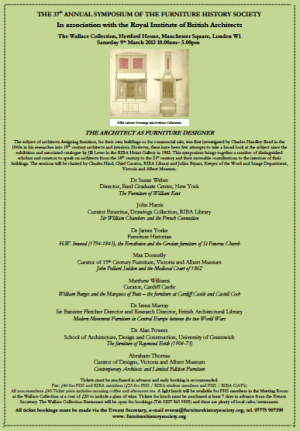 The 37th Annual Symposium of the Furniture History Society in association with the Royal Institute of British Architects
The subject of architects designing furniture, for their own buildings or for commercial sale, was first investigated by Charles Handley-Read in the 1960s in his researches into 19th-century architects and interiors. However, there have been few attempts to take a broad look at the subject since the exhibition and associated catalogue by Jill Lever in the RIBA Heinz Gallery in 1982.
This symposium brings together a number of distinguished scholars and curators to speak on architects from the 18th century to the 21st century and their moveable contributions to the interiors of their buildings. The sessions will be chaired by Charles Hind, Chief Curator, RIBA Library and Julius Bryant, Keeper of the Word and Image Department, Victoria and Albert Museum.
S P E A K E R S
• Susan Weber (Director, Bard Graduate Center, New York), The Furniture of William Kent
• John Harris (Curator Emeritus, Drawings Collection, RIBA Library), Sir William Chambers and the French Connection
• James Yorke (Furniture Historian), H.W. Inwood (1794-1843), the Erectheion and the Grecian Furniture of St Pancras Church
• Max Donnelly (Curator of 19th-Century Furniture, Victoria and Albert Museum), John Pollard Seddon and the Medieval Court of 1862
• Matthew Williams (Curator, Cardiff Castle), William Burges and the Marquess of Bute: The Furniture at Cardiff Castle and Castell Coch
• Irena Murray (Sir Banister Fletcher Director and Research Director, British Architectural Library), Modern Movement Furniture in Central Europe between the Two World Wars
• Alan Powers (School of Architecture, Design and Construction, University of Greenwich), The Furniture of Raymond Erith (1904-73)
• Abraham Thomas (Curator of Designs, Victoria and Albert Museum), Contemporary Architects and Limited Edition Furniture
Tickets must be purchased in advance and early booking is recommended. Fee: £40 for FHS and RIBA members (£35 for FHS / RIBA student members and FHS / RIBA OAP’s) All non-members £45.Ticket price includes morning coffee and afternoon tea. A light lunch will be available for FHS members in the Meeting Room at the Wallace Collection at a cost of £20 to include a glass of wine. Tickets for lunch must be purchased at least 7 days in advance from the Events Secretary. The Wallace Collection Restaurant will be open for bookings (Tel: 0207 563 9505) and there are plenty of local cafes/restaurants. All ticket bookings must be made via the Events Secretary, e-mail events@furniturehistorysociety.org, www. furniturehistorysociety.org.
Conference | Objects in Motion in the Early Modern World
Objects in Motion in the Early Modern World
The Getty Center, Los Angeles, 10-11 May 2013
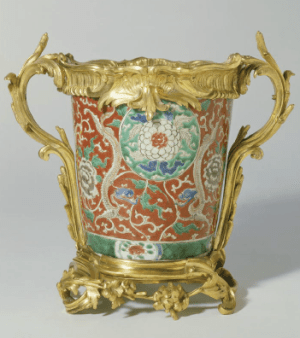
Mounted Vase, Chinese porcelain ca. 1662–1722, French mounts, ca. 1745–49. J. Paul Getty Museum (79.DI.121.1)
The Getty Research Institute and the USC-Huntington Early Modern Studies Institute are co-sponsoring a two-day conference, “Objects in Motion in the Early Modern World,” on Friday, May 10 and Saturday, May 11, 2013, at the Getty Center in Los Angeles, California.
An international group of scholars will examine the circulation of objects across regions and cultures in the early modern period (1500-1800), addressing the ways in which mobility led to new meanings, uses, and interpretations. Break-out sessions will invite the audience to consider these questions as we examine objects from the Getty’s collections. A closing roundtable will provide an opportunity to discuss the methodological and theoretical potential of this line of inquiry for the study and teaching of art history. The symposium is organized by Daniela Bleichmar (University of Southern California), Meredith Martin (Wellesley College), and Joanne Pillsbury (Getty Research Institute).

Vallard Atlas (detail), 1547. Courtesy of the Huntington Library (HM29.f12)
Admission to this event is free. Reservations are required and can be made online when the website goes live in early March. Graduate students writing dissertations on related subjects can apply for a limited number of travel grants to defray the cost of travel to the conference. To request an application, email emsi@usc.edu. Applications will be due March 1, 2013.
The flyer (as a PDF) is available here»
Note (added 6 March) — Confirmed speakers include:
Gauvin Alexander Bailey, Queen’s University, Ontario
Daniela Bleichmar, University of Southern California
Zirwat Chowdhury, University of California, Los Angeles
Chanchal Dadlani, Wake Forest University
Jessica Keating, University of Southern California
Dana Leibsohn, Smith College
Meredith Martin, Wellesley College
Sandy Prita Meier, University of Illinois at Urbana-Champaign
Avinoam Shalem, Institut für Kunstgeschichte, Munich
Mary Sheriff, University of North Carolina, Chapel Hill
Claudia Swan, Northwestern University
Nancy Um, Binghamton University
Gerhard Wolf, Kunsthistorisches Institut, Florence
New Book | Anton Maria Maragliano (1664-1739)
From Sagep:
Daniele Sanguineti, Anton Maria Maragliano (1664-1739): Insignis Sculptor Genue (Genoa: Sagep, 2012), 480 pages, ISBN: 978-8863731989, €100 / $160.
 Il nome di Anton Maria Maragliano, per un caso di eccezionale fortuna critica, è diventato sinonimo di scultura in legno a Genova e in Liguria. La nuova monografia dedicata a questo protagonista del Barocco genovese, attivo tra la fine del Seicento e il 1739, indaga nel dettaglio l’intero percorso artistico, soffermandosi, grazie a numerosi documenti inediti, sulla fase della formazione, sul contesto culturale di riferimento, sulla diversificata committenza (confraternite, famiglie aristocratiche, ordini religiosi) e sulla prassi gestionale di una bottega assai complessa e fitta di allievi. Il corpus delle opere raccoglie, attraverso schede articolate, l’intera produzione nota, suddivisa in quattro sezioni che danno conto delle numerose aggiunte: le opere scolpite dal maestro, i bozzetti (attraverso un nuovo nucleo recentemente scoperto), le opere della bottega e quelle disperse. Il regesto e la trascrizione dei documenti costituiscono un importante approfondimento, mentre una sezione finale è dedicata, nello specifico, agli aspetti della tecnica scultorea e della stesura della policromia. Bellissime immagini a colori accompagnano la lettura del testo.
Daniele Sanguineti è funzionario Storico dell’Arte presso il Ministero per i Beni e le Attività Culturali, con il ruolo di Conservatore del Museo di Palazzo Reale di Genova.
Available from Artbooks.com»
Call for Papers | Artistic and Social Practices, Oslo
Laura Auricchio seeks proposals on the subject of “Artistic and Social Practices,” for an August conference in Oslo: The Eighteenth Century in Practice, the fourth Nordic Conference for Eighteenth-Century Studies.
◊ ◊ ◊ ◊ ◊
Artistic and Social Practices in the 18th Century
Proposed Session at the Nordic Conference for Eighteenth-Century Studies
Oslo, 28-31 August 2013
Proposals due by 15 February 2013
At present, there are plans to include in the session a talk addressing drawing as practice rather than product through consideration of a little-known suite of drawings produced in New York between 1807 and 1814 by a royalist émigré from Napoleonic France, Anne Marguerite-Henriette Rouillé de Marigny, Baroness Hyde de Neuville. A second paper will address artistic and religious practices vis-à-vis artists’ social networks in 18th-century Paris. Please write with ideas or questions to Laura Auricchio, AuricchL@newschool.edu.

Conference | Loyal Subversion: Anglo-Hanoverian Caricature
The third Herrenhausen Symposium addresses caricature within the context of Anglo-Hanoverian relations (with plenty more such observances on the way next year) . . .
Loyal Subversion: Caricatures from the Personal Union between England and Hanover, 1714-1837
Herrenhausen Palace, Hanover, 21-23 February 2013
The political constellation of the personal union between England and Hanover with the figure of a foreign king as a mediator between separate states became a determining factor and was in itself a historical condition for the emergence and the development of caricatures in England after the Glorious Revolution. As a political weapon of the opposition and as a manifestation of public opinion, the caricatures affected the establishment: one the one hand, their visual potential was a threat to the sovereign, on the other hand they helped to stabilize his leadership. What contents do they show? Does the artistic become political? Is there something like an institutionalized form of political perception? Or is this visual criticism nothing else but a loyal subversion of their subjects?
The Herrenhäuser Symposium Loyal Subversion: Caricatures from the Personal Union between England and Hanover 1714-1837 is organized by the Volkswagen Foundation and the Wilhelm Busch – Deutsches Museum für
Karikatur und Zeichenkunst. Please register online at caricature@volkswagenstiftung.de.
◊ ◊ ◊ ◊ ◊
T H U R S D A Y , 2 1 F E B R U A R Y , 2 0 1 3
Wilhelm Busch — Deutsches Museum für Karikatur und Zeichenkunst
7:00 Gisela Vetter-Liebenow (Director, Wilhelm Busch – Deutsches Museum für Karikatur und Zeichenkunst) and Wilhelm Krull (Secretary General, Volkswagen Foundation), Opening Addresses
7:20 Werner Busch (Department of Art History, Free University of Berlin), Keynote Lecture
9:00 Reception
F R I D A Y , 2 2 F E B R U A R Y 2 0 1 3
Herrenhausen Palace
9:30 Images and Caricatures of Kingship
• Ian Haywood (University of Roehampton, London), Milton’s Monsters: Monarchy and Iconoclasm
• Sheila O’Connell (Assistant Keeper, British Prints before 1880, British Museum), Attacks on the Guelph Dynasty: From the Jacobite Caricatures to the London Radicals and Cruikshank
11:00 Coffee
11:30 Images and Caricatures of Kingship, continued
• Christina Oberstebrink (Berlin), James Gillray
• Brian Maidment (John Moores University, Liverpool), The Satirical Image, Politics, and Periodicals, 1830–37
1:00 Lunch
2:30 Royal Representation, Court Culture, and Bourgeois Public
• Sune Schlitte (University of Göttingen), Politics Beyond Caricature: Practices of the Artistic Field in the Long Eighteenth Century
• James Baker (The Paul Mellon Centre for Studies in British Art), The Royal Brat: Making Fun of George Augustus Frederick
4:00 Coffee
4:30 Counterparts
• Karl Janke (Curator, Hamburg), The Republic and the Sovereignty of the People as Antithesis, Anathema, Frightful Vision
• Temi Odumosu (Marie Curie Postdoctoral Fellow, The Natural History Museum, University of Copenhagen), The Image of the Other: The ‘Non-English’ as Identification Marks in the Personal Union
7:00 Conference Dinner
S A T U R D A Y , 2 3 F E B R U A R Y 2 0 1 3
Herrenhausen Palace
9:30 The Reception on the Continent
• Timothy Clayton (Worcester College Oxford), Transfer of Caricatures: The London Printing Trade and the Export of English Graphic Prints
10:30 Coffee Break
11:00 The Reception on the Continent, continued
• Thomas Schwark (Historical Museum Hanover), Johann Heinrich Ramberg (1763-1840): Painter, Borderliner, and
Contemporary with the Nascent Hanover Kingdom
• Christian Deuling (MA, University of Nottingham), The Reception of English and French Caricatures in the German Magazine London und Paris (1798-1815)
12:30 Wilhelm Krull (Secretary General, VolkswagenStiftung), Closing Remarks
12:40 Lunch
At Auction | Recapping Old Masters at Sotheby’s
As Nord Wennerstrom notes at Nord on Art, while it was a fine week for Batoni and Fragonard, “Goya tanked,” and nearly 50 of 104 lots failed to sell at the auction of Important Old Master Paintings and Sculpture. The Sotheby’s press release (1 February 2013), understandably, stresses only the successes:
◊ ◊ ◊ ◊ ◊
Sotheby’s Old Masters Week Sales Bring More Than $80 Million
Important Old Master Paintings & Sculpture sale highlighted by an $11 million record-setting work by Batoni and a painting by French Rococo master Fragonard sold to the Museum of Fine Arts, Boston

Sotheby’s Sale N08952, Lot 73 — Pompeo Girolamo Batoni, Susanna and the Elders. Signed lower left on wall P.B. 1751.
It sold for $11,394,500.
Sotheby’s annual Old Masters Week auctions in New York brought a total of $80,083,199* as of 1 February 2013. Thursday and Friday’s sale of Important Old Master Paintings and Sculpture [Sale N08952] totaled $58,230,315, highlighted by an exceptional work by Pompeo Girolamo Batoni from 1751, Susanna and the Elders, which exceeded the pre-sale estimate of $6-9 million. Five bidders battled for this major work, and two determined phone bidders drove the final price to $11,394,500, a record for the artist at auction. Ten bidders fought for an unrecorded, recently discovered Hans Memling devotional panel, Christ Blessing, which realized $4,114,500, also a record for the artist at auction (est. $1-1.5 million). The panel, which has been in the same New England collection for over 150 years, was
completely unknown to scholars and collectors alike before it
was discovered earlier this year.

Sotheby’s Sale N08952, Lot 84 — Jean-Honoré Fragonard, The Goddess Aurora Triumphing over Night, ca. 1755-56. Selling for $3,834,500, it was acquired by the MFA in Boston.
George Wachter, Co-Chairman of Sotheby’s Old Master Paintings Worldwide, and Christopher Apostle, Head of Sotheby’s Old Master Paintings department in New York, commented: “We were delighted to see that works by major hands like Batoni, Fragonard, and Memling sold incredibly well, and collectors understand that these rare works do not come to the market often. There was tremendous international bidding throughout the week, particularly from Russian collectors, who are extremely interested in French and Italian eighteenth-century work. There was international underbidding for French Rococo master Fragonard’s The Goddess Aurora Triumphing over Night; however, we’re pleased to announce that the Museum of Fine Arts, Boston, was the eventual winner of this wonderful work.”

Sotheby’s Sale N08952, Lot 91 — François Boucher, Sleeping Bacchantes Surprised by Satyrs, 1760.
It sold for $2,098,500.
Heidelberg with a Rainbow, commissioned from Joseph Mallord William Turner in 1840, sold for $4,562,500, while The Goddess Aurora Triumphing over Night by Jean-Honoré Fragonard surpassed its estimate of $1.8/2.5 million, realizing $3,834,500, and was purchased by the Museum of Fine Arts, Boston. An additional record for an artist at auction was made for The Master of the Legend of Saint Barbara with Saint Ursula Protecting the Eleven Thousand Virgins with Her Cloak, selling for $3,050,500, above the high estimate of $2.5 million. A further highlight was Claude-Joseph Vernet’s Mediterranean Harbor at Sunset with the artist, his daughter Emilie Chalgrin, his son Carle Vernet, his daughter-inlaw, Fanny Moreau, and his servant Saint-Jean, on a pier, a lighthouse and a natural arch beyond which fetched $2,546,500, well within estimate. During this sale, Sotheby’s set seven artist records at auction including ones for François Boucher, whose Sleeping Bacchantes Surprised by Satyrs sold for $2,098,500, Gerard van Spaendonck, whose Still life of roses, hyacinth, wallflower and other flowers in a lapis lazuli vase; Still life of narcissus, hyacinth and other flowers in a brown porphyry vase brought $1,650,500, Pietro Longhi whose The Elephant achieved $1,314,500, and Jean-Baptiste Greuze, whose The Hermit, or the Distributor of Rosaries brought $1,082,500.
Sixteen lots from The Metropolitan Museum of Art sold for the Acquisitions Fund achieved strong results, totalling $2.4 million; in particular Portrait of a Young Girl, possibly Clara Serena Rubens by a Follower of Peter Paul Rubens, which sold for 20 times its pre-sale high estimate of $30,000, realizing $626,500. (more…)










 Enfilade
leave a comment