At Auction | Americana Week at Christie’s
Press release (20 December 2012) from Christie’s:
Four Sales Feature American Arts, English Pottery, and Chinese Export Art
Christie’s, New York, 24-28 January 2013
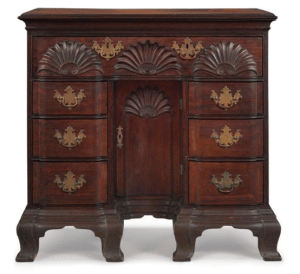
Chippendale carved mahogany block-and-shell bureau table signed by John Townsend (1733-1809), Newport, ca. 1770
Highlights include a newly discovered John Townsend bureau table; an exceptional silver teapot by Paul Revere; a Bartlam teabowl, the earliest porcelain made in Colonial America; and an extremely rare dish from the ‘Lady Martha Washington States China’ tea service.
Christie’s is delighted to announce Americana Week 2013, a series of public viewings and sales devoted to fine and rare examples of American artistry and craftsmanship. Included in the week are sales of Important American Silver (January 24), Important American Furniture, Folk Art and Prints (January 25), English Pottery (January 28) and Chinese Export Art (January 28). The Americana series of sales will offer over 400 lots, including a number of rare survivals from the 18th and 19th centuries and many works never before offered at auction.
◊ ◊ ◊ ◊ ◊
Important American Silver (Sale 2669) — January 24, 10am
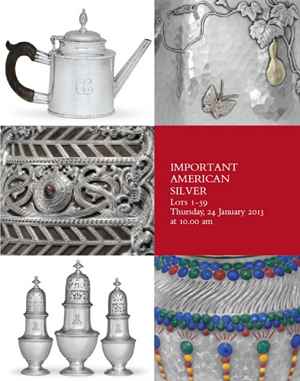 Christie’s is pleased to announce the sale of Important American Silver as the first auction in the Americana Week series. Leading the sale is an extraordinary and rare silver tea pot by patriot and silversmith Paul Revere, Boston, circa 1782 (estimate: $150,000-250,000). This drum-form teapot is fashioned in a classical style, typical of the early Federal period and one of the examples of Revere’s work after his return from the Revolution. There are only four other known drum-form teapots by Revere, with three in public collections− the Metropolitan Museum of Art, Museum of Fine Arts, Boston, and the Yale University Art Gallery.
Since its founding in 1837, Tiffany & Co. has set the standard for American silver designs and has been credited with some of the most important innovations in the field. A superb selection of rare and important pieces include an important silver-mounted and stone-set ebony ‘Viking’ bowl, designed by Paulding Farnham, New York, 1902 (estimate: $100,000-150,000); a silver, mixed-metal and hardstone three-piece tea service, New York, circa 1880, which is one of Tiffany & Co.’s most successful creations in the Japanesque style (estimate: $100,000-150,000); and an important silver and stone-set ‘Aztec’ paper knife, designed by Paulding Farnham, New York, circa 1902, which once belonged by Albert C. Burrage, a mining engineer and owner of a the 256-foot steam yacht Aztec (estimate: $60,000-90,000).
Additional highlights include a rare set of three silver casters, mark of Simeon Soumaine, New York, circa 1740, virtually unknown in American colonial silver with only two other complete sets recorded (estimate: $100,000-150,000); and a rare set of six silver cans with heraldic engraving, mark of Daniel Boyer, Boston, circa 1750, which was originally owned by the Kitchen family, one of the most prominent merchant families in the Salem at the turn of the 18th century (estimate: $50,000-80,000).
◊ ◊ ◊ ◊ ◊
Important American Furniture, Folk Art, and Prints (Sale 2670) — January 25, 10am
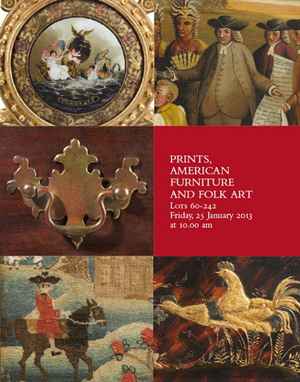 One of the lead highlights of the Americana Week sales is an important Chippendale carved mahogany block-and-shell bureau table signed by John Townsend (1733-1809), Newport, circa 1770 (illustrated above, estimate: $700,000-900,000). The iconic four-shell form displays the height of John Townsend’s talents and the renowned block-and-shell design of 18th-century Newport. One of less than ten known to survive, this newly discovered piece is an exceedingly rare example of the form bearing the signature of arguably colonial America’s greatest cabinetmaker. Written with a flourish in the cabinetmaker’s distinctive hand, Townsend’s signature appears on the underside of the top drawer and demonstrates the pride taken by the cabinetmaker in his most exceptional pieces. The rococo brasses are also a rarity as they retain much of their original coating, which was baked onto the plates at the time of their manufacture in England. The table was likely acquired in the 19th century by the prominent Pell family of New York during their sojourns in Newport, the summer destination for elite society of the period. The bureau table is known to have furnished the Pell House in New York State’s Tuxedo Park, the exclusive enclave founded by Pierre Lorillard IV in 1885 and home to prominent New York collecting families as that of Mr. and Mrs. J. Insley Blair. Property of direct descendants of the Pell and Coster families, the bureau table was recently discovered in New York City and has never before been offered at auction. Several comparable bureau tables attributed to Townsend are housed at the Metropolitan Museum of Art, the Art Institute of Chicago Winterthur Museum, Yale University Art Gallery, and the Museum of Fine Arts, Houston.
A Queen Anne carved maple armchair attributed to John Gaines III of Portsmouth, New Hampshire, 1735-1743 ($200,000–300,000), offered by WEA Enterprises, will also lead Americana week. The chair has been praised extensively by experts in American furniture and was described by legendary dealer Albert Sack in 1950 as “A great masterpiece of pure Colonial design… No price is too great for a chair of this quality.” One of only two armchairs assuredly attributed to Gaines, this example is extraordinarily well preserved and serves not only as an icon of early American regional design but also as a critical evidence of the practices of the Gaines shop. The chair is distinctive in its large, outsweeping ram’s-horn arms that are beautifully complemented and balanced by an archetypal crest and pronounced Spanish feet. Its closest counterpart housed at the Metropolitan Museum of Art, this “robust and gusty” piece has not appeared on the open market since 1974.
The remarkable painting of Penn’s Treaty by Edward Hicks’ (1780-1849) depicts the iconic American legend of William Penn’s treaty with Delaware tribal chiefs (estimate: $600,000-900,000). A Bucks County Pennsylvania native, Hicks worked as a sign painter and coach maker early in life, later becoming a well renowned Quaker minister and painter, who it is said, taught the gospel with his paintbrush. Penn’s Treaty was incorporated as a staple scene for Hicks’ Peaceable Kingdom series, which is a painted sermon depicting the prophecy of Isaiah preaching the theme of peace that still has meaning for us today. Representing in equal measure the artist’s Quaker conviction and his patriotic fervor, Penn’s Treaty is modeled on John Boudell’s 1775 print image of the painting by Benjamin West. The humble craftsman origins visible in Hicks’ painting style are hallmarks of the American folk vernacular painting style that is at once valued for its aesthetic singularity as well as its narrative richness.
The sale also features a superb group of early American needlework samplers from The Stonington Collection. These needleworks were amassed by Dolf Fuchs, a textiles commodities entrepreneur who was born in Switzerland, immigrated to the United States in 1953 and settled in Stonington, Connecticut where he lived in a late 18th-century home. A textile and early American history enthusiast, Fuchs cherished his collection of 18th- and 19th-century needlework samplers for their beauty, rarity, and unique history. Primarily worked by young women as instructive exercises, early American needleworks such as 25 works being offered illustrate the skills of these young women through their technical mastery and whimsical designs. Highlights include an exquisitely crafted needlework pictorial of a prominent ship worked by Nancy Winsor (1778-1850), Providence, Rhode Island, dated December 4, 1786 (estimate: $80,000-120,000) and a wool and silk needlework pictorial of a courting couple famously part of the “Fishing Lady” pictures, Boston, 1750-1760 (estimate: $30,000-50,000).
One of the rarest works at auction is an American (John Bartlam) soft paste porcelain teabowl, circa 1765-70, (estimate: $30,000-50,000). This tiny teabowl has only recently been identified as an example of the earliest porcelain made in Colonial America. Printed with Chinoiserie vignettes that mysteriously include palmetto trees, it is confirmed through archeological evidence and scientific analysis of the clay to have been made at the factory operated by the Staffordshire potter John Bartlam at Cain Hoy, outside of Charleston, South Carolina. Three other such teabowls are known, two in public collections, the decorations on all four corresponding exactly to sherds found at Cain Hoy in what has now been identified as the kiln site of Bartlam’s short-lived production.
◊ ◊ ◊ ◊ ◊
English Pottery (Sale 2671) — January 28, 10am
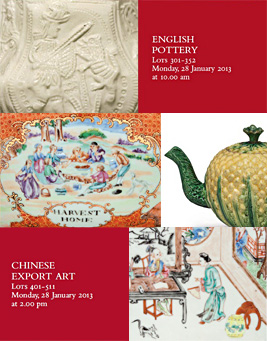 On January 28, Christie’s will offer over 50 lots of English Pottery, including a selection of early English saltglazed stoneware, redware and creamware formed by William Burton Goodwin. Collected mainly in the 1920s and 30s, these rare works were on loan to the Portland Museum of Art, Portland, Maine from 1983 to 2012. Highlights include a Staffordshire saltglazed seated camel teapot and cover, circa 1750 (estimate: $5,000-7,000); and a wonderfully amusing comparison of a Staffordshire glazed redware teapot and cover, circa 1745 (estimate: $6,000-8,000). A rare survival is a Staffordshire saltglazed stoneware enameled ‘Littler’s’ blue puzzle-jug, circa 1755-1760 (estimate: $10,000-15,000). This ‘Littler’s’ blue puzzle-jug is the only example of this form and type extant. Marked with an ‘L’, it is also potentially documentary.
Other highlights include a unique London delft polychrome dish, circa 1660, which is painted with the story of Abraham and Isaac (estimate: $50,000-70,000); and a pair of English delft dated models of shoes dated 1727, London or Bristol (estimate: $15,000-20,000). These two shoes are molded with a left and right buckle indicating that they were intended as a true pair. As shoes were considered symbols of good luck and often given as a token of affection, the initials and date inscribed on the soles of the present pair indicate that it may have been commissioned as a betrothal or wedding gift.
◊ ◊ ◊ ◊ ◊
Chinese Export Art (Sale 2671) — January 28, 2pm
As the grand finale of Americana Week, the sale of Chinese Export Art on January 28 will feature 110 works, a striking selection of Chinese porcelain and works of art made to order for American and European traders in the 17th, 18th, and 19th centuries. A particularly strong group of American market pieces is led by a very rare Chinese export ‘Lady Washington States China’ dish, circa 1795 (estimate: $20,000-40,000), which was presented to Martha Washington by Andreas van Braam Houckgeest in 1796. Van Braam (1739-1801), was a successful director of the Dutch East India Company, and designed the ‘States China’ himself, as an appropriate introductory gift for the First Lady.
The sale also features a rare Chinese export ‘Philadelphia’ punchbowl, circa 1815 (estimate: $20,000-30,000). This apparently unique and unrecorded punchbowl has strong Philadelphia associations and must have been commissioned by a member of one of the leading China Trade families of that city. The finely painted bowl depicts Centre Square, Philadelphia and the sides showing two views of the War of 1812 engagement between the U.S.S. Constitution (‘Old Ironsides’) and the HMS Guerriere. The interior has three delicately rendered grisaille fish, exact duplicates of those on the famed Schuylkill Fishing Company bowl.
Additional highlights include a Chinese export ‘orange Fitzhugh’ armorial dinner service, circa 1805-1810 (estimate: $70,000-100,000); a very rare Chinese export blue and white ‘Mr. No-body’, late 17th-century, inspired by the woodcut frontispiece of the 1606 popular play by Thomas Heywood, No-body and Some-body, (estimate: $40,000-60,000); a rare pair of Chinese export famille rose ‘porcelain production’ fishbowls, mid-18th-century, which displays very rare decoration of highly romanticized views of different stages of manufacturing Chinese porcelain (estimate: $100,000-150,000).
At Auction | Portrait Bust by Houdon at Sotheby’s
Press release from Sotheby’s:
Sotheby’s: Important Old Master Paintings and Sculpture, N08952
New York, 31 January and 1 February 2013
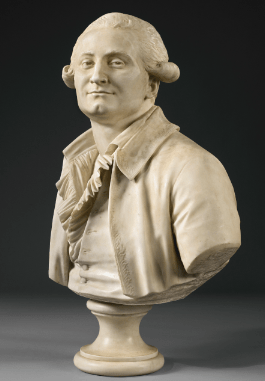
Sotheby’s Sale N08952, Lot 397. Jean-Antoine Houdon, Portrait of Jacques-Antoine-Hippolyte, the Comte de Guibert, 1791
Estimate: 800,000 – 1,200,000 USD
Important sculpture and works of art will be up for offer on 1 February 2013 during the second day of Sotheby’s Old Master Paintings and Sculpture sale in New York and will be highlighted by a commanding French marble bust of one of France’s foremost military tacticians Jacques-Antoine-Hippolyte, the Comte de Guibert. The bust was commissioned on 2 November 1791 from Houdon, the preeminent portrait sculptor of his time, by the sitter’s widow (est. $800/1.2 million). Guibert was a general, a writer and a friend to many of the Enlightenment’s leading intellectuals, and his Essai général de tactique had an enormous impact on the science of military strategy and was admired by George Washington, Frederick the Great, and the young Napoleon Bonaparte. In 1776, the year he was promoted to colonel, he was raised to the nobility as a count of the Holy Roman Empire. In 1781 he was promoted to the rank of brigadier general, and in 1778 he was promoted to the rank of marechal de camp. The work, which exemplifies Houdon’s mastery of the material and his fondness for both naturalistic detail and psychological realism, conveys the sitter’s strength, intelligence and virility. This marble bust remained in the Guibert family through 1918.
A further highlight is a beautifully carved pietra serena frieze by Francesco di Simone Ferrucci (1437-1493), a talented disciple of Verrocchio, which most likely adorned the lintel of a fireplace in the palazzo of a noble Florentine family circa 1460-1470 (est. $500/700,000). The present relief is centered by the coat of arms of the Tuscan counts, Guidi di Bagno, who were one of the largest and most powerful noble families in central Italy in the Middle Ages. The majority of pieces by Ferrucci are preserved in museum collections or in their original church installations, including a similar pietra serena frieze in the Museo Bardini, Florence and another in the Pierpont Morgan Library, New York. The outstanding clarity of form and detail in this frieze is underscored by the material from which it was carved. Pietra serena is a hard and fine-grained stone from Fiesole which was employed by Tuscan sculptors throughout the Renaissance. Here, Ferrucci was able to achieve a sense of depth, with very shallow relief, using of a variety of finely chiseled textures and contours. This impressive pietra serena frieze comes from the Collection of an Italian noble family.
A poignant South German limewood figure of the grieving Saint John from the workshop of Tilman Riemenschneider circa 1490 is estimated at $250/350,000. Riemenschneider was arguably the preeminent medieval German sculptor and this figure was probably carved for an altar. Few sculptures by Riemenschneider and his workshop remain in private hands.
Also included in the sale are nine rare terracotta anatomical sculptor’s models (est. $200/300,000) formerly in Paul von Praun’s famed collection in Nuremberg and attributed to accomplished sculptor Johann Gregor van der Schardt. Dating to the late 16th or early 17th century, the models have been consigned by and will benefit the Museum of Vancouver. Six of the nine models on offer are recognizable as studies after anatomical elements seen in famous monuments sculpted by Michelangelo. These terracottas are rare examples of study-models of Michelangelo’s work by this talented younger artist working within the master’s lifetime or shortly after his death. For decades, the unsigned terracottas were attributed to Michelangelo; however, extensive research and stylistic comparisons led scholars to determine that these Renaissance models were executed by Northern sculptor Johann Gregor van der Schardt who worked extensively in terracotta and was a follower of Michelangelo. Von Praun acquired the contents of van der Schardt’s studio after the artist’s death circa 1580, and these models were most likely among the contents purchased. Only one signed work by van der Schardt survives: a bronze statuette of Mercury probably presented to the Holy Roman Emperor Maximillian II in Vienna circa 1569. The collection of Paul von Praun, a wealthy Nuremberg silk merchant, was one of the most extensive of its time, comprised of works by Leonardo, Raphael and Titian, and it was one of the first to include a comprehensive, international group of contemporary sculpture. He also owned a pair of terracottas of Dawn and Night, after Michelangelo’s marbles for the Medici Chapel at San Lorenzo in Florence, which are now on exhibition at the Victoria and Albert Museum, London. After von Praun’s death in 1616 the collection was kept together by his heirs and displayed in Nuremberg, later known as Praunsche Kabinett. Among its visitors were Goethe and Marie Antoinette before its sale in 1801.
◊ ◊ ◊ ◊ ◊
Viewing Schedule in New York
Friday, 25 Jan | 10:00-5:00
Saturday, 26 Jan | 10:00-5:00
Sunday, 27 Jan | 1:00-5:00
Monday, 28 Jan | 10:00-5:00
Tuesday, 29 Jan | 10:00-5:00
Wednesday, 30 Jan | 10:00-5:00
Thursday, 31 Jan | 10:00-5:00, sculpture only
Friday, 1 Feb | 10:00-12:00, sculpture only
At Auction | Portrait of a Boxer at Bonhams
Press release (8 January 2013) from Bonhams:
Bonhams — Gentleman’s Library Sale (20448)
London, 29 January 2013

Bonhams Sale 20448, Lot 185, Portrait of the Pugilist
George ‘The Coachman’ Stevenson, 1742
Estimate 16,000 – 24,000 USD
An extremely rare early portrait of a boxer, George ‘The Coachman’ Stevenson 1742, whose tragic death led to the first set of rules for boxing, is being sold by Bonhams on January 29th in the Gentleman’s Library Sale in Knightsbridge. The English School Portrait of the Pugilist George ‘The Coachman’ Stevenson, 1742, an oil on canvas, is estimated to sell for £10,000-15,000.
Stevenson died a few days after a bout against the English champion, Jack Broughton, an event that led Broughton to draw up a code of rules in order to prevent a recurrence. Published as ‘Broughton’s Rules’ they were the first boxing rules and were universally used until 1838.
Alistair Laird a specialist in Bonhams Nineteenth-Century Paintings Department says: “I have never seen an eighteenth-century picture to do with boxing in my 30 years in art auctions. This is an extremely rare image.”
The Yorkshireman George Stevenson, had fought the English champion Jack Broughton on the 17th of February 1741 in a fairground booth on Tottenham Court Road. Unfortunately, Stevenson died a few days after his 45-minute fight, an event that triggered Broughton to draw up a code of rules in order
to prevent a recurrence.
Published on 16 August 1743, ‘Broughton’s Rules’ applied to the bare-knuckle Prize Ring and included ‘That no person is to hit his adversary when he is down, or seize him by the ham, the breeches, or any part below the waist; a man on his knees to be reckoned down’. Otherwise much was left to the discretion of referees. Rounds were not of a fixed length but continued until one of the fighters was knocked or thrown to the ground, after which those in his corner were allowed 30 seconds to return him to the ‘scratch’ – the middle of the ring – failing which his opponent was declared the victor.
Broughton’s rules were universally used until 1838. He was buried in Westminster Abbey in recognition of his contribution to English boxing. The sport enjoyed an unprecedented surge in popularity during the Regency period when it was openly patronized by the Prince Regent, (later George IV) and his brothers. Championship boxing matches acquired a louche reputation as the places to be seen by the wealthy upper classes. Thus a match would often be attended by thousands of people, many of whom had wagered money on the outcome.
New Book | Daniela Bleichmar’s ‘Visible Empire’
From The University of Chicago Press:
Daniela Bleichmar, Visible Empire: Botanical Expeditions and Visual Culture in the Hispanic Enlightenment (Chicago: University of Chicago Press, 2012), 288 pages, ISBN: 978-0226058535, $55.
 Between 1777 and 1816, botanical expeditions crisscrossed the vast Spanish empire in an ambitious project to survey the flora of much of the Americas, the Caribbean, and the Philippines. While these voyages produced written texts and compiled collections of specimens, they dedicated an overwhelming proportion of their resources and energy to the creation of visual materials. European and American naturalists and artists collaborated to manufacture a staggering total of more than 12,000 botanical illustrations. Yet these images have remained largely overlooked—until now.
In this lavishly illustrated volume, Daniela Bleichmar gives this archive its due, finding in these botanical images a window into the worlds of Enlightenment science, visual culture, and empire. Through innovative interdisciplinary scholarship that bridges the histories of science, visual culture, and the Hispanic world, Bleichmar uses these images to trace two related histories: the little-known history of scientific expeditions in the Hispanic Enlightenment and the history of visual evidence in both science and administration in the early modern Spanish empire. As Bleichmar shows, in the Spanish empire visual epistemology operated not only in scientific contexts but also as part of an imperial apparatus that had a long-established tradition of deploying visual evidence for administrative purposes.
Daniela Bleichmar holds a joint appointment in the Departments of Art History and History. She received her BA from Harvard University and her Ph.D. in History (History of Science) from Princeton University, where she trained as a cultural historian of early modern science, specializing in the history of visual culture and the natural sciences in Europe and the Spanish Americas in the period 1500-1800. Her research and teaching address the history of the Spanish empire, early modern Europe, visual and material culture in science, collecting and display, and the book, print, and prints.
◊ ◊ ◊ ◊ ◊
C O N T E N T S
Introduction: Natural History and Visual Culture in the Spanish Empire
1: A Botanical Reconquista
2: Natural History and Visual Epistemology
3: Painting as Exploration
4: Economic Botany and the Limits of the Visual
5: Visions of Imperial Nature: Global White Space, Local Color
Conclusion: The Empire as an Image Machine
Acknowledgments
Notes
Bibliography
Index
◊ ◊ ◊ ◊ ◊
“The history of late eighteenth-century Latin America is often told simply as the Creoles’ ever-increasing disenchantment with an unenlightened Mother Spain. Daniela Bleichmar’s remarkable book offers us a different history, one in which an Enlightenment study of natural history takes center stage. She casts before the reader passionate and dedicated men of learning and the arts who under Spanish royal sponsorship were entrusted to perform precise observation of the natural fruits of divine creation and render them into splendid and copious scientific illustrations; the results of ‘artful looking . . . a barometer of Enlightenment thought.’ Bleichmar provides more than just an account of these accomplishments; she wields an interdisciplinary brilliance that melds the best of the history of science, art history, and history and serves up a critical and fascinating examination of Linnean classification, scientific illustration, and their complex intersection, scientific and social, in recording the flora of South America.”—Thomas B. F. Cummins, Harvard University
The Wallace Treasure of the Month for January 2013
January 2013’s Treasure of the Month from The Wallace:
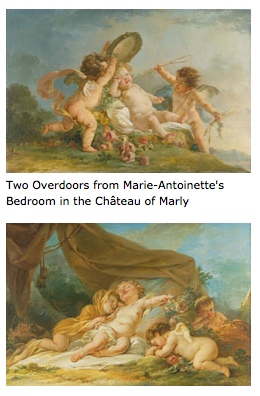
Two Overdoors from Marie-Antoinette’s Bedroom in the Château of Marly
Gallery talks with Christoph Vogtherr, Wallace Collection, London, 11 and 24 January 2013, 1pm
 The château of Marly was situated north of Versailles not far from the river Seine. It had been built for Louis XIV between 1679 and 1684. Together with its spectacular park it served as an exclusive retreat for the French King who bestowed invitations as a particular favour to selected courtiers and the Royal family. Marly consisted of a central building for the King and his immediate family (the Royal Pavilion) and twelve pavilions for guests. For a century, the château was repeatedly modernised until it was sold by the Revolutionary government and demolished in 1806.
The two paintings in the Wallace Collection were part of the remodelling of the Queen’s bedroom for Marie-Antoinette in 1781. At that time a mezzanine was added to the room and as a consequence its overall height reduced. The new decoration of the room took these changes into account and new overdoor paintings were required to react to the changed dimensions of the room.
The commission was given by the Direction des Bâtiment (the building administration) to Nicolas-René Jollain (1732-1804) and Hughes Taraval (1729-1785), two members of the Royal Academy. They have since been almost forgotten, and both their works had been acquired by the 4th Marquess of Hertford as by the much better known Fragonard, an indication that the signatures must have been covered. It is, however, possible to link the two works with the overdoors for the Queen’s bedchamber documented in the sources. Their decorative character is in line with Marie-Antoinette’s preferences whose taste in the Decorative Arts was cutting edge while most of the paintings commissioned for her, except portraits by Elisabeth Vigée-Lebrun, are much more conventional. Equally traditional is the iconography of the two works: Putti are depicted as allegories of Sleep (by Jollain) and Awakening (by Taraval), obvious choices for a bedroom.
The overdoors are beautifully decorative works. The figures are arranged in a triangular composition in both works to visually link the pair. Their pastel-like palette responded to the light colour scheme of the room, the slightly elongated figures to their position high up above the doorways. On closer inspection the works show a smoother and more detailed brushwork typical for the late eighteenth century.
The Queen’s apartment was situated in the North-West corner of the building. The two overdoors were inserted into the South and East walls. The different angles of lighting on the paintings respond to their situation relative to the windows. Taravals painting must have been on the South wall where the light falls in from the right, Jollains on the East side of the room, right next to the Queen’s bed where an allegory of sleep is particularly appropriate.
After the French Revolution, the paintings were sold by the revolutionary government together with the entire contents of Marly. A drop-front desk and a corner cabinet by Jean-Henri Riesener in the Wallace Collection (also in the Study) same room once were part of Marie-Antoinette’s furniture in Marly.
Gallery Talks with Christopher Vogtherr: Friday 11 and Thursday 24 January at 1pm.
Further Reading
John Ingamells, The Wallace Collection Catalogue of Pictures III. French before 1815 (London 1989).
Stéphane Castelluccio, Le château de Marly sous le règne de Louis XVI (Paris 1996).
Exhibition | Peru: Kingdoms of the Sun and Moon
Press release (26 October 2012) from the MMFA:
Peru: Kingdoms of the Sun and Moon: Identities and Conquest
in the Early, Colonial and Modern Periods
Montreal Museum of Fine Arts, 2 February — 16 June 2013
Seattle Art Museum, 17 October 2013 — 5 January 2014
Curated by Victor Pimentel

Mochica, North Coast, possibly La Mina, Forehead ornament with feline head and octopus tentacles ending in catfish heads (100 – 800 A.D.), Gold, chrysocolla, and shells. 28.5 x 41.4 x 4.5 cm (Museo de la Nación, Lima. Photo: Daniel Giannoni)
Organized by the Montreal Museum of Fine Arts, Peru: Kingdoms of the Sun and Moon will display an extensive collection of pre-Columbian treasures and masterpieces from the colonial era to Indigenism, including over 100 pieces that have never before been seen outside of Peru. With more than 350 works of art (paintings, sculptures, gold and silver ornaments, pottery, photograph, works on paper, and textiles) on loan from public and private collections in Peru, Canada, United States, France, and Germany, this exhibition covers roughly 3,000 years of history, including archaeological discoveries in recent decades.
“In conceiving this exhibition on the question of identity in Latin America following our exhibition Cuba! Art and History from 1868 to today presented in 2008, I was fascinated to discover the extent to which archaeology has revealed this birthplace of civilization – one of six such in the world – only recently in the course of the 20th century” explains Nathalie Bondil, Director and Chief Curator of the MMFA. “This exhibition demonstrates how the retrospective view of history shifted from a colonial interpretation to a new nationalist feeling in the course of the modern era. This complex project brings together numerous loans, both public and private, from Peru, some of which have not been exhibited before. Above all, the display features paintings of the era subsequent to the Spanish Conquest and, for the first time outside Peru, of the Indigenist period after independence. The constant elements of a civilization built up over millennia open up perspectives never before opened,” she added.
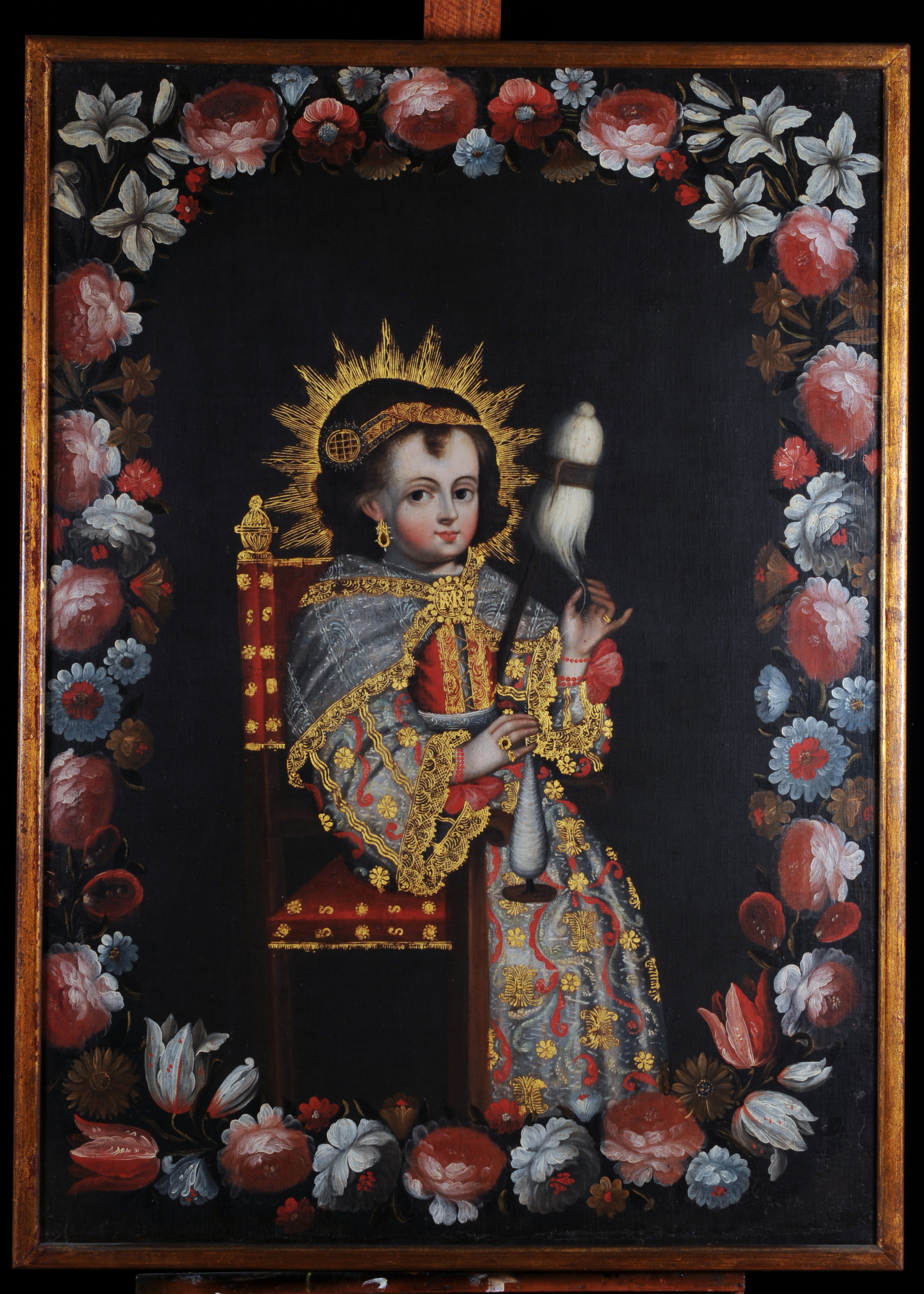
Anonymous, Cuzco School, Virgen Niña Hilando (Young Virgin Spinning), second third of the 18th century, oil on canvas, gold leaf. 112.5 x 80.5 cm
(Lima: Museo Pedro de Osma. Photo: Joaquín Rubio)
Mythical Peru, cradle of Andean civilization, and its pre-Hispanic, colonial and modern history will be examined in the four sections of the exhibition as follows:
• Section 1 (introduction) will explain how archaeology rewrote the national history beginning with the discovery, in 1911, of Machu Picchu to the recent restitution of artworks.
• Section 2 will focus on the myths and rituals of the early civilizations of the Andes, highlighting their role in forming and shaping Peruvian identity during the pre-Columbian era.
• Section 3 will illustrate the perpetuation, concealment, and hybridization of the indigenous culture during the colonial period.
• The last section will highlight the rediscovery of this culture in the 20th century and the revalorization of ancient symbols of identity in contemporary Peruvian iconography.
Adds Exhibition Curator Victor Pimentel, Curator of Pre-Columbian Art at the MMFA, “Through the representation and reinterpretation of myths, rituals and other primordial symbols of identity captured by different artistic traditions, the exhibition will illustrate how the evocative power of images have influenced the history of pre-Hispanic, colonial and modern Peru.”
Illustrating the beliefs and rituals of pre-Columbian societies
The relationship with death, particularly the constant dialogue between the world of the living and the world of the dead, is an essential component of Andean spirituality. Among the Mochicas, ceremonial sacrifices contributed to the perpetuation of the supernatural and social orders, while ancestor worship held significant importance to the Lambayeque and Chimú cultures.
In order to illustrate the beliefs and rituals that dominated the life of pre-Columbian societies, the exhibition will focus on objects associated with the sacrificial ceremony of the Mochica people (200 B.C. to 800 A.D.) and the funerary rites of the Chimú and Lambayeque cultures (11th to 15th century A.D.), by presenting some of the most complete depictions of these rituals. On display will be important objects in gold, silver, and turquoise from the royal tombs of Sipán, discovered in 1987 by archaeologist Walter Alva, constituting the most significant find made in Peru since that of Machu Picchu. They include:
• A gold ear disc depicting the Lord of the place, the Mochica governor
• A Mochica ornament in the shape of a half-feline, half-octopus recently repatriated and exhibited for the first time
outside of Peru
• Funerary jewelry (crown, ear discs, necklace, pectoral and shoulder-pieces) including a masterpiece of Chimú gold work
• A rare headboard of a Lambayeque litter depicting figures officiating at a ceremony, unique in the complexity of its ornamentation
Religion in Many Forms
The Spanish conquest of Peru in the 16th century led to the hybridization of the Peruvian culture expressed through reinterpretations of mostly religious European art. Paintings of the School of Cuzco – established by the Spanish as a means of converting the Incas to Catholicism – showing Christ, miraculous Virgins, archangels and defenders of the Catholic faith, testify to the powerful role played by images in the campaign to evangelize the Native peoples of the Andes. Included among the examples of paintings mainly by Native artists resulted from this hybridization are:
A Nativity Chest dating from the 18th century, painted with a number of Biblical stories including Adam and Eve, the Annunciation, the Nativity and the visit of the Magi. This three-dimensional illustrated catechism was used to spread Catholicism throughout the Andes.
Among the ceremonial objects on view illustrating the importance of imagery relating to the celebration of the Eucharist in the Andes is a silver Eucharistic urn in the shape of a Pelican, a bird traditionally associated with Christ’s sacrifice. It is widely considered a masterpiece of the liturgical metalwork from the Latin-American Baroque period.
A particularly popular image in art during the Viceroyal period is that of the Virgin. Symbolic representations of the virtuous life of the Virgin Mary on view, such as Young Virgin Spinning, recalls the acllas, the Virgins of the Sun in the Inca empire, whose principal occupation was making garments for the Inca and for religious rites.
Processions also played an important role in the elaboration of a Peruvian identity both as a collective expression of Christian faith and as a means of reinforcing the socio-political positions of the participants. An 18th-century depiction of a splendid Corpus Christi procession, one of the first Christian celebrations to be performed in the colony and still performed to this day, attests to the multi-ethnic nature of the city of Cuzco, the ancient capital of the Inca empire. Coinciding with the celebration of the Inti Raymi, an Inca festival dedicated to the Sun God, Corpus Christi was the most important feast day in the colonial liturgical calendar.
Peruvian art in the 19th and 20th centuries
By 1821, Peruvians had achieved their independence and had formed an indigenous collective memory that combined the idealisation of the pre-Hispanic past, particularly the Inca Empire, with an interest in local subjects. A typical work of Peruvian art of the mid-19th century, Habitante de las cordilleras del Perú (Inhabitant of the Peruvian Highlands) by Francisco Laso, portrays the indigenous peasant as a national symbol for the new Peruvian republic, and heralds the direction that Peruvian cultural nationalism was to take in the next century.
At the beginning of the 20th century, Indigenism flourished as an artistic and intellectual movement based on revalorising and reaffirming Peru’s indigenous heritage. Paintings depicting scenes of Native life and the idyllic landscapes of the Peruvian countryside and highlands such as Pastoras (Shepherdesses) by Leonor Vinatea Cantuarias were to transform the visual culture of Peru in the modern era. This movement is represented in the exhibition by a wide selection of works by José Sabogal, Camilo Blas, Julia Codesido, and Enrique Camino Brent. Widely praised for his documentation of indigenous culture, the only Amerindian included among the major artists associated with the movement is the photographer and portraitist Martín Chambi. Works by Chambi on view include Tristeza andina, La Raya (Andean sadness, La Raya).
An exhibition checklist (PDF) is available here»
◊ ◊ ◊ ◊ ◊
From Abrams:
Victor Pimentel, ed., Peru: Kingdoms of the Sun and the Moon (Milan: 5 Continents Editions, 2013), 384 pages, ISBN: 978-8874396290, $65.
 A new publication featuring essays by the foremost experts on the art of Peru The MMFA will produce an accompanying 384-page catalogue co-published in English and in French by the MMFA and 5 Continents Editions in Milan. This fully-illustrated volume (450 illustrations) comprises essays by eminent curators and specialists and interviews with leading figures and experts on Peruvian archaeology, art history, and literature such as the novelist Mario Vargas Llosa.
Victor Pimentel is curator of pre-Columbian art at the Montreal Museum of Fine Arts.
Trying to Think Seriously about Pinterest, Part 2
From the Editor
Open Position: Clerk of the Pinterest Boards

Silivered brass pins, 1620-1800 (London: V&A Museum, given by R. J. Andrews, #123D-1900) Pinned to Cheryl Leigh’s Pinterest Board, 18th-Century Accessories
Last May I invited Enfilade readers to consider how Pinterest might be put to better use for scholars of the eighteenth century. Over the past few months, I’ve grown even more bullish, optimistic about the potential utility of pinning images with texts (organized under headings) and then distributing those pins via a social network (recent stats for Pinterest usage are available here). Pinterest Business accounts were launched in November, and while these may not be precisely the model for establishing scholarly credibility, the offering suggests Pinterest may slowly be growing up. If art historians are well placed to say what’s wrong with most of what happens on Pinterest, it seems to me we might also start contributing models for making a tool like this work better.
For all of these reasons, I’m now accepting applications for a volunteer position I’ve dubbed Clerk of the Pinterest Boards. I’m especially interested in exploring the following problems:
• How and to what extent might Pinterest be used in the production of knowledge, particularly in terms of collecting information (visual and textual information) and presenting that information together?
• How can we make a Pinterest board into something more than merely a collection of ‘pretty’ pictures?
• Are there things Pinterest could do that other digital formats (blogs, Twitter, Facebook, &c.) don’t do or don’t do well?
• How might we increase broad interest in the art and architecture of the eighteenth century via Pinterest?
I’m envisioning this position as extremely flexible and open-ended. As an experiment, it should probably run for at least a year, but the amount of work should be minimal to modest, perhaps an hour or two each week. For the best candidates, you’re probably already spending this much time on exactly the kinds of searches the positions would require; I just need you to start pinning those results and giving some thought to larger questions of organization and goals.
To apply, please send a message of interest and a recent CV to me at CraigAshleyHanson@gmail.com. As always, comments and feedback are welcome.
— Craig Hanson
P.S. — If this talk of pins brings to mind Adam Smith’s example of a “trifling manufacture,” all the better; you’re in the right place.
Exhibition | Italian Tradition of the Quadreria
Now on view at Sperone Westwater:
A Picture Gallery in the Italian Tradition of the Quadreria, 1750-1850
Sperone Westwater, New York, 10 January — 23 February 2013

Francesco Celebrano, Luncheon in the Countryside, 102 x 69 in (260 x 175 cm), ca 1770-80 (New York: Sperone Westwater)
In collaboration with Galleria Carlo Virgilio, Rome, Sperone Westwater is pleased to present A Picture Gallery in the Italian Tradition of the Quadreria, 1750-1850. The exhibition showcases 29 paintings and drawings, all in the Italian figurative tradition, by various European masters created between the mid-18th and mid-19th century.
The exhibition aims to evoke the manner in which collections – known as quadrerie – were formed in Italy in the 18th and 19th centuries, as well as the way in which they were displayed, covering entire walls of the palazzo that housed them. This criterion predates the modern picture gallery, which follows a more scientific idea of classification derived from Illuminism. In addition to satisfying decorative motivations, the arrangement of works within a Quadreria followed the collector’s personal taste, with pictures hung according to related subjects or artistic genres.
Most of the works on view have never been exhibited or published, although many of them are widely documented in literary sources of the time. Firmly grounded in research, the exhibition presents significant works – masterpieces in some cases – by artists who are not widely known beyond specialist academic circles, but who nonetheless have played a key role in art history, with a view to illustrating the progress that research in Italy has made over the past thirty years.
The catalogue accompanying the exhibition groups the works according to artistic or iconographic genre, first with a series of portraits that offer insight into society of the time, followed by history and figure painting – considered the noblest artistic genre in the neoclassical academy tradition – and lastly, landscapes, to illustrate the phenomenon of the Grand Tour with Classical ruins and popular views.
Among the works in the exhibition is a painting by Francesco Celebrano shows members of the aristocracy having a luncheon on a country estate. This painting exemplifies the ancien régime and was likely intended as a model for a tapestry destined for the Neapolitan court. A portrait by Matilde Malechini portrays a French baroness in Rome during the Napoleonic occupation, while Giuseppe Tominz offers an austere, full-length portrait of a member of the new bourgeoisie in Trieste, the founder of the Assicurazioni Generali. The academy nude studies of Francesco Monti and Placido Fabris are followed by two demanding depictions of episodes from Classical history by Gaspare Landi and Pelagio Palagi – influential figures in the artistic circles of Rome and Milan.
The visionary reconstructions of Antiquity in the colored drawings by Giovan Battista Dell’Era counterbalance the series of sentimental mythological evocations by Friedrich Rehberg, Natale Carta and Henry Tresham, who presented his large painting, Sleeping Nymph and Cupid, to the Royal Academy of London in 1797. This section culminates in the romantic Renaissance literary subject by Francesco Podesti. A significant counter-revolutionary allegory by August Nicodemo shows the Dauphin at the tomb of his father, Louis XVI, while another large-format allegory by Francesco Caucig depicts the sentiment/malaise of melancholy with its remedies from Classical medicine.
After the sublime Biblical subject by François Gérard, the monochrome by Bernardino Nocchi of a sculpture by Canova, there follows a series of views of famous buildings of the time such as Hubert Robert’s interior of Palazzo Farnese at Caprarola, and of Classical ruins like the Temple of Diana at Baia in the capriccio by Carlo Bonavia. Two aristocratic travelers admire ruins in the paintings by Andrea Appiani, while an aqueduct is featured in the Roman campagna by Beniamino de Francesco. Volcanoes are the subject of two large-scale paintings by Pierre-Jacques Volaire and Carlo de Paris – the 1771 eruption of the Vesuvius in the Volaire, a virtuoso study of the effects of light caused by the glow of the lava, with lightning and the glare of the moon illuminating the panorama towards Naples and Ischia in the distance. The second volcano is the Pico de Orizaba in Mexico, in a work by a Roman school artist who attempted to document the native customs of Mexico and the grandiose and unspoiled landscapes of that country prior to the imminent transformations that would be brought by civilization. In contrast to this work, there is Antonio Basoli, who produced numerous imaginary views without almost ever leaving his native Bologna.
Curated by Stefano Grandesso, Gian Enzo Sperone and Carlo Virgilio, the exhibition has been produced in collaboration with Galleria Carlo Virgilio in Rome, a gallery that specializes in international art in Italy over the 18th and 19th centuries.
A fully illustrated catalogue will be published on occasion of this exhibition. The book includes an introduction by Joseph J. Rishel, the Gisela and Dennis Alter Senior Curator of European Painting before 1900 and Senior Curator of the John G Johnson Collection and the Rodin Museum, and scholarly entries by Emilie Beck Saiello, J. Patrice Marandel, Fernando Mazzocca, Ksenija Rozman and Nicola Spinosa.
New Book | Modern Antiques: The Material Past in England
From Bucknell UP:
Barrett Kalter, Modern Antiques: The Material Past in England, 1660-1780 (Lewisburg, PA: Bucknell University Press, 2012), 249 pages, ISBN 978-1611483789, $80.
 The recovery and reinvention of the past were fundamental to the conception of the modern in England during the long eighteenth century. Scholars then forged connections between linear time and empirical evidence that transformed historical consciousness. Chronologers, textual critics, and antiquaries constructed the notion of a material past, which spread through the cultures of print and consumption to a broader public, offering powerful–and for that reason, contested–ways of perceiving temporality and change, the historicity of objects, and the relation between fact and the imagination. But even as these innovative ideas won acceptance, they also generated rival forms of historical meaning. The regular procession of chronological time accentuated the deviance of anachronism and ephemerality, while the opposition of unique artifacts to ubiquitous commodities exoticized things that straddled this divide.
Inspired by the authentic products as well as the anomalous by-products of contemporary scholarship, writers, craftsmen, and shoppers appropriated the past to create nostalgic and ironic alternatives to their own moment. Barrett Kalter explores the history of these “modern antiques,” including Dryden’s translation of Virgil, modernizations of The Canterbury Tales, Gray’s Gothic wallpaper, and Walpole’s Strawberry Hill. Though grounded in the ancient and medieval eras, these works uncannily addressed the controversies about monarchy, nationhood, commerce, and specialized knowledge that defined the present for the English eighteenth century. Bringing together literary criticism, historiography, material culture studies, and book history, Kalter argues that the proliferation of modern antiques in this period reveals modernity’s paradoxical emergence out of encounters with the past.
Introduction: The Time Bound and the Modern Antique
Chapter 1 The “Cobweb-Law” and the Fundamental Law: History, Chronology, and Poetic License
Chapter 2 Chaucer Ancient and Modern: Standardization, Modernization, and the Eighteenth-Century Reception of The Canterbury Tales
Chapter 3 DIY Gothic: Thomas Gray and the Medieval Revival
Chapter 4 Horace Walpole’s Fugitive Pieces: Collecting and Ephemerality
Conclusion
Barrett Kalter is Associate Professor of English at University of Wisconsin-Milwaukee.
Things: Material Culture at Cambridge, Lent 2013
Programming from CRASSH at the University of Cambridge:
Things: Material Cultures of the Long Eighteen Century
Centre for Research in the Arts, Social Sciences and Humanities (CRASSH), Cambridge, ongoing series
The seminar meets alternate Tuesdays 12.30-2.30pm in the Seminar Room, Alison Richard Building, West Road. A light lunch will be provided.
 The early-modern period was the age of ‘stuff.’ Public production, collection, display and consumption of objects grew in influence, popularity, and scale. The form, function, and use of objects, ranging from scientific and musical instruments to weaponry and furnishings were influenced by distinct and changing features of the period. Early-modern knowledge was not divided into strict disciplines, in fact practice across what we now see as academic boundaries was essential to material creation. This seminar series uses an approach based on objects to encourage us to consider the unity of ideas of this period, to emphasise the lived human experience of technology and art, and the global dimension of material culture. We will build on our success discussing the long eighteenth century in 2012-13 to look at the interdisciplinary thinking through which early modern material culture was conceived, adding an attention to the question of what a ‘thing’ is, to gain new perspectives on the period through its artefacts.
Each seminar will feature two talks each considering a way of
thinking about objects.
22 January 2013 — Altered Things
Luisa Calè (Birkbeck) and Adam Smyth (Birkbeck)
5 February 2013 — Model Things
Simon Schaffer (Cambridge) and Anna Maerker (Kings College London)
19 February 2013 — Re-materialising Things
Jane Wildgoose (Kingston University and Keeper of The Wildgoose Memorial Library) and Mary Brooks (Durham)
5 March 2013 — Royal Things
Cordula Van Wyhe (York) and Desmond Shawe-Taylor (Surveyor of the Queen’s Pictures)
Visit the external blog or subscribe to the group mailing list.










 Enfilade
leave a comment