Birmingham Acquires Reynolds’s Portrait of Dr. John Ash
Press release from the Birmingham Museum & Art Gallery (2 October 2012) . . .

Sir Joshua Reynolds, Portrait of Dr John Ash, 1788 (Birmingham Museum & Art Gallery)
Director Ann Sumner today announces that Birmingham Museums has been successful in raising funds to acquire Sir Joshua Reynolds’ iconic portrait of Dr John Ash. The magnificent work, currently owned by Queen Elizabeth Birmingham Hospitals Charity, has been on loan to Birmingham Museum & Art Gallery since 1993. This acquisition secures the painting for the city, ensuring that future generations can continue to enjoy the masterpiece.
The portrait of Dr Ash by the celebrated eighteenth-century portrait painter Reynolds is valued at £900,000 but the Queen Elizabeth Birmingham Hospitals Charity has generously agreed to reduce this to £875,000 to enable Birmingham Museums to successfully complete the acquisition. Professor Sumner comments, “”We are delighted to announce that Birmingham Museums will be acquiring this significant work. The portrait is one of Reynolds’ late, great works, and its combined historic and artistic qualities make it one of the most important cultural icons of the city of Birmingham. The acquisition comes at a particularly opportune time for the city, and will be presented as part of a larger celebration of portraiture from Birmingham’s collections in 2013.”
Councillor Ian Ward, deputy leader of Birmingham City Council said: “This painting has real importance for the city’s heritage, and I’m delighted that Birmingham Museums have raised the necessary funds in addition to the lottery fund grant. I would like to thank everyone who played a part in securing this wonderful painting which the people of Birmingham – and visitors to our city – will be able to enjoy and appreciate.”
Birmingham Museums Trust was awarded a grant of £675,000 from the Heritage Lottery Fund and £100,000 from The Art Fund to support the acquisition. The Museums Trust has successfully raised a further £100,000 through grants from organisations including the Museum Development Trust, Public Picture Gallery Fund, the Friends of Birmingham Museum & Art Gallery, William A Cadbury Trust and John Feeney Trust.
Although Birmingham Museums Trusts has successfully raised the money to acquire the portrait, the public appeal will continue in order to raise the funds to undertake minor conservation works to the painting, not least having it reglazed with non-reflective glass so visitors can better appreciate the Reynolds’ masterpiece.
John Ash (1723–98) was an eminent physician who built up a successful medical practice from his house in Temple Row in Birmingham. Ash was a co-founder of the Birmingham General Hospital, and the portrait commissioned by the governors of the Hospital in honour of his services to the people of Birmingham. The first installment of 100 guineas (half payment) was paid to Reynolds by George Birch on behalf of the governors in April 1788. The eleven sittings with Ash are recorded in the artist’s pocket book between 28th April and 7th July the same year.
Billet-Doux from Nelson to Emma Hamilton Exceeds Estimates
Last week a letter sent from Lord Nelson to Lady Emma Hamilton during their affair sold for £20,000 — well above its estimate of £6,000-£8,000. The pre-sale press release from Bonhams (1 November 2012) . . .
Bonhams: Books, Maps, Manuscripts, and Photographs (Auction 20139)
London, 13 November 2012
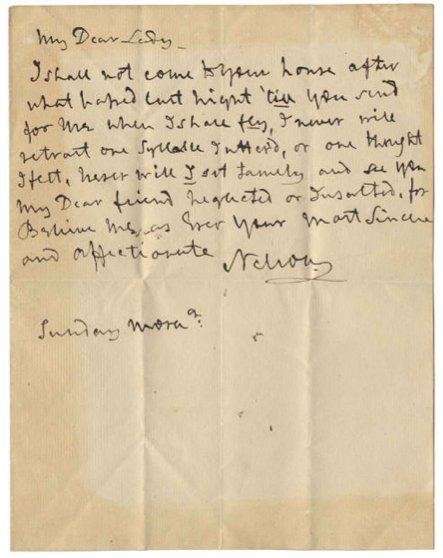 A lasting piece of evidence of the affair between Nelson and Lady Emma Hamilton is for sale with Bonhams in Knightsbridge, on 13th November. In the letter Nelson documents the turbulent love life between himself and his mistress, referring to a disagreement from the previous evening. He takes care to note his devotion to her and vows to defend her integrity amidst the scandal. At the time the letter has been roughly dated, Emma had given birth to their child and their affair was public. Despite Nelson’s wife’s demands, he refused to relinquish Emma as his mistress and eventually he left his wife. In the nineteenth century this was an unthinkable social affront and he aggravated the scandal further by choosing to live with Emma and their daughter upon his return from sea.
During the scandal Nelson urged Emma to destroy the letters sent between them, as he largely did. Emma, however, chose to keep her letters which were eventually published in 1814 contributing to her eventual downfall. Plagued by politics and social disgrace, their affair lasted only six years before Nelson’s death in 1805. After this tragic event, Emma was catapulted into a downward spiral and this letter is a delicate reminder of their love at the height of its devotion and is a rare living testament to their affair.
In June this year a marble chimneypiece from Lord Nelson and Lady Hamilton’s home sold for £25,000 at New Bond Street, and this note is a further glimpse into the private world behind the public façade of one of Britain’s great naval leaders.
◊ ◊ ◊ ◊ ◊
Post-sale press release from Bonhams (14 November 2012) . . .

Bonhams Auction 20139, 13 November 2012
A letter sent from Lord Nelson to Lady Emma Hamilton during their affair sold for twice its estimate today of £6,000-£8,000 for £20,000 at Knightsbridge in the Books, Maps and Manuscripts sale.
In the letter, dated c.1801, Nelson documents his turbulent love life with his mistress, referring to a disagreement from the previous evening. He outlines his devotion to her and vows to defend her integrity amidst the scandal of their affair. After Nelson’s death in 1805, Emma was at the mercy of society’s judgment without his protection and this letter is a rare living testament to their affair.
The top lot for the sale was a first edition of Charles Darwin’s The Origin of the Species (1859) which doubled its estimate of £15,000- £20,000 to sell for £45,650. As one of the most influential publications of the 19th century, this work marked a crucial turning point in modern science and this edition is a veritable collector’s item.
Darwin’s publication was followed closely by a first edition of Izaak Walton’s The Compleat Angler (1653). This work sold for £37,250 and is a very good copy of the most famous work in angling literature. The work is a unique celebration of angling and reflects Walton’s own desires to live a contemplative life.
Postdoctoral Fellowship in ‘Spatial Art History’
ARTL@S Postdoctoral Fellowship in ‘Spatial Art History’
École normale supérieure, Paris, 1 September 2013 — 31 August 2015
Applications due by 7 January 2013
The École normale supérieure (Paris), the LabEx TransferS, and ARTL@S (a digital humanities project sponsored by the Agence Nationale pour la Recherche) are pleased to announce a two-year postdoctoral position in the field of Spatial Art History. The postdoctoral fellow will participate in the activities of ARTL@S (www.artlas.ens.fr) while developing an independent research project pertaining to related questions in this field. Through his or her involvement within the international and transdisciplinary ARTL@S team, the fellow will acquire valuable experience, gain expertise, and develop his or her academic network, thereby increasing potential career prospects within the international academic community.
Qualifications
The successful candidate will have a PhD in art history or in a related field (i.e. History, Geography, Sociology, etc…), received no earlier than 2008, and will specialize in issues related to geography of art, global art history, or cultural heritage in a transnational perspective. He or she may work on any region or period between the 18th and the 21st centuries; however, preference will be given to non-Western European and non-North-American projects, and/or world-art historical or global art-historical projects. Candidates are invited to propose research projects that can benefit from the tools ARTL@S has developed (quantitative and serial analysis, databases, geographical information systems (GIS), digital cartography). The right candidate will also demonstrate a keen interest in digital humanities, especially in databases and cartography.
While previous experience in these fields, along with web development and GIS, is not a prerequisite, basic knowledge and a willingness to acquire expertise in those areas is essential. The postdoctoral fellow will indeed have to work with the ARTL@S’ database, GIS interface and website.
Likewise, fluency in French is not required, but some basic knowledge and a commitment to learn French and become fluent while living in Paris is. Intensive courses can be taken by the successful candidate at École normale supérieure for free. (more…)
New Title | Anatomy and the Organization of Knowledge
From Pickering & Chatto:
Matthew Landers and Brian Muñoz, eds., Anatomy and the Organization of Knowledge, 1500–1850 (London: Pickering & Chatto, 2012), 272 pages, ISBN: 978-1848933217, £60/$99.
 Across early modern Europe, the growing scientific practice of dissection prompted new and insightful ideas about the human body. This collection of essays explores the impact of anatomical knowledge on wider issues of learning and culture. The contributors argue that the study of anatomy directly influenced the way in which emerging disciplines of study were organized.
◊ ◊ ◊ ◊ ◊
C O N T E N T S
Introduction – Matthew Landers
Part I: The Body as a Map
1 Early Modern Dissection and a Physical Model of Organization – Matthew Landers
2 ‘Who Will Not Force a Mad Man to be Let Blood?’ Circulation and Trade in the Early Eighteenth Century – Amy Witherbee
3 Earth’s Intelligent Body: Subterranean Systems and the Circulation of Knowledge, or, The Radius Subtending Circumnavigation – Kevin L Cope
4 ‘After and Unwonted Manner’: Anatomy and Poetical Organization in Early Modern England – Mauro Spicci
5 Subtle Bodies: The Limits of Categories in Girolamo Cardano’s De subtilitate – Sarah Parker
Part II: The Collective Body
6 Mirroring, Anatomy, Transparency: The Collective Body and the Co-opted Individual in Spencer, Hobbes and Bunyan – Nick Davis
7 From Human to Political Body and Soul: Materialism and Mortalism in the Political Theory of Thomas Hobbes – Ionut Untea
8 Visualizing the Fibre-Woven Body: Nehemiah Grew’s Plant Anatomy and the Emergence of the Fibre Body – Hisao Ishizuka
9 Forms of Materialist Embodiment – Charles T Wolfe
Part III: Bodies Visualized
10 Visualizing Monsters: Anatomy as a Regulatory System – Touba Ghadessi
11 Anatomy, Newtonian Physiology and Learned Culture: The Myotomia Reformata and its Context within Georgian Scholarship – Craig Ashley Hanson
12 Art and Medicine: Creative Complicity between Artistic Representation and Research – Filippo Pierpaolo Marino
13 The Internal Environment: Claude Bernard’s Concept and its Representation in Fantastic Voyage – Jérôme Goffette and Jonathan Simon
Early Registration for CAA 2013 Now Open
The best rates — via Early Registration — for CAA in New York are available until December 14. Posted at CAA News (23 October 2012) . . .
◊ ◊ ◊ ◊ ◊
 This week CAA will begin mailing Conference Information and Registration, which provides important details, instructions, and deadlines for attending and participating in the 101st Annual Conference, to all individual and institutional CAA members. Nonmembers and those wanting a digital file now can download a PDF of the booklet. The conference will take place February 13–16, 2013, in New York.
Following sections on registration and CAA membership, Conference Information and Registration describes travel, lodging, and transportation options and explains the basic processes for candidates seeking jobs and employers placing classifieds and renting booths and tables in the Interview Hall. In addition, the publication lists topics for eleven Professional-Development Workshops. If you want to connect with former and current professors and students, consult the Reunions and Receptions page. The booklet includes paper forms for CAA membership, conference registration, workshops, special events, and mentoring enrollment.
The contents of Conference Information and Registration also appear on the conference website, which is being updated regularly between now and the February meeting. You may also choose to join CAA and register online.
The Burlington Magazine, November 2012
The eighteenth century in The Burlington:
The Burlington Magazine 154 (November 2012)
 A R T I C L E S
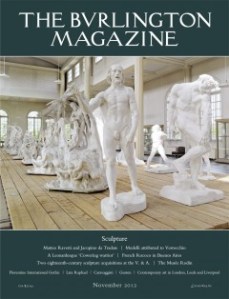
• Marjorie Trusted, “Two Eighteenth-Century Sculpture Acquisitions for the Victoria and Albert Museum, London,” pp. 773-79. Two marble sculptures, a Crouching Venus by John Nost (1702) and a relief of Julius Caesar Invading Britain by John Deare (1796), have been acquired by the Victoria and Albert Museum, London.
• Gauvin Alexander Bailey, “French Rococo Prints and Eighteenth-Century Altarpieces in Buenos Aires,” pp. 780-85. French Rococo designs used in altarpiece decorations in eighteenth-century Buenos Aires.
R E V I E W S
• Philip Ward-Jackson, Review of Stefano Grandesso and Laila Skjøthaug, Bertel Thorvaldsen, 1770–1844 (Milan: Silvana, 2010), pp. 798-99.
• Mark Stocker, Review of Mary Ann Steggles and Richard Barnes, British Sculpture in India: New Views and Old Memories (Kirstead, Norfolk: Frontier Publishing, 2011), pp. 800-01.
• Christopher Baker, Review of the exhibition and catalogue The English Prize: The Capture of the Westmorland, an Episode of the Grand Tour (2012), pp. 817-18.
Conference | Furniture History Society Research Seminar
Furniture History Society Research Seminar
The Wallace Collection, London, 23 November 2012
The concept of this event is to present current studies of research on furniture history, design, construction, conservation and the history of interiors by MA and PhD students, and museum/heritage curators and professionals at an early stage of career development. The seminar will provide useful insights into current trends of research in the educational and museum world. Each talk will last 15 minutes with questions immediately after.
◊ ◊ ◊ ◊ ◊
10.00 Coffee
10.30 Adriana Turpin (Chairman of the Tom Ingram Memorial Fund Committee), Introduction
10.40 Mia Jackson (PhD student Queen Mary, University of London), André-Charles Boulle as a Collector of Prints and Drawings
11.00 Antonia Brodie (PhD student Queen Mary, University of London), A Room of One’s Own? Unlocking the Closet 1650-1730
11.20 Wolf Burchard (PhD student Courtauld Institute of Art/ Curatorial Assistant The Royal Collection), Charles Le Brun: Unity and Hierarchy in the ‘Visite du Roy aux Gobelins’
11.40 Naomi Luxford (post-doctoral research fellow University College London), Has it Changed? Is it Damaged? A Study of Veneer and Marquetry Surfaces
12.00 Elizabeth Bisley (MA, Assistant Curator Furniture Textiles & Fashion, V&A), Painted Decoration and the Cultures of Imitation: Study of an Eighteenth-Century Tyrolean Cupboard
12.20 Shari Kashani (MA, Christies Furniture Department London), Imitation/Presentation: Some Observations on Médalliers and Coquillers in Eighteenth-Century France
12.45 Lunch
2.00 Barbara Lasic (Assistant Curator, Europe: 1600-1800 gallery project, V&A), Salon Tales: A Set of Mid-Eighteenth-Century Panelling Depicting the Fables of Aesop in the Collections of the Victoria and Albert Museum
2.20 Peter Nelson Lindfield-Ott (PhD student University of St Andrews), Georgian Gothic Furniture: A New Pathway to Interpreting British Gothic Furniture, 1740-1840
2.40 David Oakey (MA, Assistant to the Surveyor of the Queen’s Works of Art), Henry Holland and Furniture
3.00 Diana Davis (PhD student the Wallace Collection& University of Buckingham), Wily Brocanteurs: Retailing Curiosity in the Regency
3.20 Christopher Maxwell (PhD student Glasgow University with the Virtual Hamilton Palace Trust), The Dispersal of the Furniture from the Hamilton Palace Collection
3.40 Myriam Tondeur (PhD student, University of Sorbonne), The Architects and Creators of Furniture in the Belgian Modernism Movement of the 1920s
4.00 Closing Remarks from the Chair, followed by tea and coffee
Any ticket booking queries should be addressed to Clarissa Ward, FHS Grants Secretary, 25 Wardo Avenue, London SW6 6RA, tel. 0207 384 4458, email grantsfhs@gmail.com.
Organised by the Tom Ingram Memorial Fund Committee with generous support of the Oliver Ford Trust.
Supporting HECAA: Dues and Contributions via PayPal
From the President
After some remarkable digital wrangling by our treasurer, Jennifer Germann, we are once again able to receive HECAA dues via PayPal! So, if you’re a regular reader, please consider making a contribution to the Historians of Eighteenth-Century Art & Architecture. The organization needs your financial support to pursue its mission, an important part of which includes modest grants for graduate students through the Vidal and Wiebenson Awards. For current members, now is a good time to send in your dues for 2013 (just $20/$5 for graduate students), and if you didn’t pay dues for 2012, please consider making an additional contribution (also easily done via PayPal). You may also pay by mailing Jennifer a check, as directed on the membership page.
Anyone interested in the eighteenth century is welcome as a HECAA member. So if you’re reading, consider joining!
— Michael Yonan
Display | 700th Anniversary of Edward III
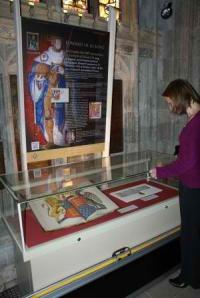
While hardly an obvious inclusion for Enfilade, this small exhibition at Windsor includes several eighteenth-century sources. The coat of arms of Edward on display, for instance, comes from the sketchbook of Henry Emlyn (1729-1815), the architect and supervisor of George III’s restoration of the chapel (SGC M.172). John Anstis’s 1724 Black Book, or Register of the Order (SGC RBK DL.13 volume I) is also on view. These and similar items serve as reminders of the historiographical and antiquarian importance of the period. -CH
◊ ◊ ◊ ◊ ◊
From the College of St George:
King Edward III Anniversary
St George’s Chapel, Windsor, 19 June 2012 — 3 January 2013

St George’s Chapel, Windsor Castle
◊ ◊ ◊ ◊ ◊
2012 marks the 700th anniversary of the birth of Edward III at Windsor Castle. Born on 13 November 1312, the first son of Edward II and Isabella of France, Edward III became King of England at the age of fourteen, in January 1327, on the abdication of his father.
 His reign, lasting fifty years, was dominated by war with Scotland and France, which has led to him being chiefly remembered as a warrior. However, it also saw great building projects, the evolution of the English parliament, the establishment of English as the official language and the longest period of domestic peace in Medieval England. Edward III had a long and close relationship with Windsor. Having been born in the Castle, he was baptised here on 16 November 1312, in St Edward’s Chapel, built by his ancestor Henry III in around 1240 and subsequently rededicated by Edward III to St Mary the Virgin, St George the Martyr and St Edward the Confessor. Several of his children were born at Windsor, and it was here that his Queen Consort, Philippa, died in 1369.
In commemoration of the 70oth anniversary of Edward III’s birth at Windsor, an exhibition of documents, rare books and artefacts from the St George’s Chapel Archives and Chapter Library will be on display in the South Quire Aisle of the
Chapel from 19 June 2012 to 3 January 2013.
The four exhibition cases and explanatory panels cover the following themes:
• Edward III as King
• Edward III and Windsor
• Edward III and St George’s Chapel
• Edward III and the Order of the Garter
Together they illustrate key aspects of the life of this great English king and explore his relationship with Windsor, which he was to make the spiritual home of his new chivalric order, the Order of the Garter, founded here in or shortly before 1348.
Exhibition | Almost Real Art: A Satirical Archaeology of the RA
From the Royal Academy:
Almost Real Art: A Satirical Archaeology of the RA Collections and Library
Royal Academy of Arts, London, 1 November 2012 — 17 February 2013

Mark Hampson, The Remarkably Talented Thomas Gainsborough, 2012, mixed media © Mark Hampson
Since 2010, artist Mark Hampson has been working ‘in residence’ at the Royal Academy and from his studio in Kent on a collaboration with the RA Collections, Library and Archives. Exploring the RA’s holdings during this two-year period, he has created a satirically inspired ‘archaeological’ response to its complexities of information and histories. The resulting work exploits and distorts the ‘official’ biography of the RA, corrupting the apparent facts to produce newly imagined narratives that are rooted in the lives and works of some of the great artists who have been connected with the Academy.
Hampson’s imaginings take concrete form in a series of mock-historical artworks combining image and text, made in collaboration with commercial sign-makers. Alongside these, the artist offers up alternative versions of art societies, unions and academies that encourage us to ask why places like the RA exist, how its history has shaped it, and how different it might have been had it been subjected to other influences and ideas. Registering the enormous impact that individual personalities have had on the institution, he explores the clichéd image of the Romantic artist as eccentric, obsessive and self-mythologising. Throughout, however, Hampson’s satire is balanced by a deep affection for the institution and those who have made it, a feeling which has only grown the deeper he has probed its history.
Bringing together high and folk art, the fairground and the museum, history and anachronism, fact and fakery, Hampson has produced what he describes with characteristic ambiguity as ‘almost real art’.
Artist’s Talks
Tuesday 4 December 2012
Tuesday 5 February 2013
Mark Hampson gives an informal introduction to his work.
Meet at 3:30 pm in the Tennant Gallery. Free with an exhibition ticket.










 Enfilade
leave a comment