At Auction | One of Only Three Original Fahrenheit Thermometers
Christie’s press release for an upcoming sale:
Travel, Science, and Natural History Sale [6911]
Christie’s, South Kensington, London, 9 October 2012

Mercury thermometer, invented by Daniel Gabriel Fahrenheit
◊ ◊ ◊ ◊ ◊
Christie’s is proud to announce that an original mercury thermometer, invented by Daniel Gabriel Fahrenheit in 1714 and the only remaining example in private hands, is to be offered at auction in October 2012. One of only three thermometers ever created by the famous physicist, the others are owned by Museum Boerhaave, in Leiden, the Netherlands, and until recently, these were thought to be the only examples in existence. When offered at auction within Christie’s sale of Travel, Science, and Natural History including the Polar Sale to commemorate the Scott Centenary, 1912-2012 on 9 October 2012 [Sale 6911, Lot 69], the thermometer is expected to fetch between £70,000 and £100,000.
James Hyslop, Scientific Specialist, Christie’s commented, “It is very exciting to be able to offer at auction such an incredibly important scientific instrument, and one which collectors would never have believed would come to market. Inscribed on the back by Fahrenheit himself, this is an exceptional piece which has no precedent, and which I expect to cause a real buzz with connoisseurs and institutions on every continent around the globe.”
Daniel Gabriel Fahrenheit (24 May 1686 – 16 September 1736)
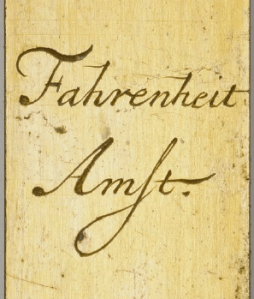 A household name during his lifetime and even more so in the centuries since, Daniel Gabriel Fahrenheit was a physicist, engineer, and glass blower, best known for the temperature scale bearing his name which is still used today in many countries, as well as for his improvements on the mercury thermometer (1714). Born in the Polish-Lithuanian Commonwealth, he spent most of his life in the Dutch Republic. At the age of fifteen, following the death of his parents through mushroom poisoning, Fahrenheit began training as a chemist, and his personal interest in natural science led to his studies and experimentation in the field.
Things: Material Culture at Cambridge, Michaelmas Term 2012
Programming from CRASSH at the University of Cambridge:
Things: Material Cultures of the Long Eighteen Century
Centre for Research in the Arts, Social Sciences and Humanities (CRASSH), Cambridge, ongoing series
The seminar meets alternate Tuesdays 12.30-2.30pm in the Seminar Room, Alison Richard Building, West Road. A light lunch will be provided.
 The early-modern period was the age of ‘stuff.’ Public production, collection, display and consumption of objects grew in influence, popularity, and scale. The form, function, and use of objects, ranging from scientific and musical instruments to weaponry and furnishings were influenced by distinct and changing features of the period. Early-modern knowledge was not divided into strict disciplines, in fact practice across what we now see as academic boundaries was essential to material creation. This seminar series uses an approach based on objects to encourage us to consider the unity of ideas of this period, to emphasise the lived human experience of technology and art, and the global dimension of material culture. We will build on our success discussing the long eighteenth century in 2012-13 to look at the interdisciplinary thinking through which early modern material culture was conceived, adding an attention to the question of what a ‘thing’ is, to gain new perspectives on the period through its artefacts.
Each seminar will feature two talks each considering the same type of object from different perspectives
Tuesday, 9 October 2012 – Thinking Things
Jonathan Lamb (Vanderbilt University) and Elizabeth Eger (King’s College London)
Tuesday, 23 October 2012 – Worshipping Things
Mary Laven (University of Cambridge) and Maia Jessop (University of Cambridge)
Tuesday, 6 November 2012 – Stilling Things
Hanneke Grootenboer (Oxford) and Joserra Marcaida Lopez (Cambridge)
Tuesday, 20 November 2012 – Curing Things
Simon Chaplin (Wellcome Library) and Christelle Rabier (London School of Economics)
Visit the external blog or subscribe to the group mailing list.
Exhibition | Pride and Prejudice: Female Artists in France and Sweden
Press release from Sweden’s Nationalmuseum in Stockholm:
Pride and Prejudice: Female Artists in France and Sweden 1750–1860
Nationalmuseum, Stockholm, 27 September 2012 — 20 January 2013

Constance Marie Charpentier, Melancholy, 1810
(Amiens: Musée de Picardie)
◊ ◊ ◊ ◊ ◊
Pride and Prejudice – Female Artists in France and Sweden 1750–1860 explores conditions for female artists in France and Sweden during a period of revolutionary social change. The exhibition presents works by some of the French and Swedish women who managed to establish themselves as artists and create a name for themselves at this time. Works by amateurs are also on display, since women of higher standing were expected to master skills such as drawing and embroidery.
The exhibition includes six works by Marie Suzanne Giroust. She was married to artist Alexander Roslin and is The Lady with the Veil in his well-known painting of that name. During her lifetime, she was also a recognised figure, but she later came to be omitted from art history, a fate that she shares with many other female artists. Today only 19 of her works can be identified with any certainty. Giroust was one of the few women to be inducted into France’s Royal Academy of Painting and Sculpture in the late 18th century. Its members had the exclusive opportunity to showcase works at the Salon in Paris, the most important exhibition in France at the time. Within the Royal Academy, there was staunch opposition to female artists. In the mid-18th century, a ceiling was introduced that permitted no more than four members of this gender at any one time.

Adélaïde Labille-Guiard, Portrait of a Woman, 1787 (Musée des beaux-arts de Quimper)
During this period, family ties or social relations to male artists were crucial in determining women’s opportunities for training and inclusion in the art establishment. Giroust was accepted into the Royal Academy for her high artistic quality, but her husband’s prominence was no doubt also a significant factor. The same was true for other female members: Anne Vallayer-Coster, Elisabeth Louise Vigée-Lebrun and Adélaïde Labille-Guiard were all under Royal patronage and Marie Thérèse Reboul was married to the director of the French Academy in Rome. In Sweden too, female artists were unable to access the training offered by the Royal Swedish Academy of Fine Arts. Ulrica Fredrica Pasch became the first female member of the Royal Academy in 1773. She was apprenticed to her father, portraitist Lorens Pasch the Elder, and her brother Lorens Pasch the Younger was a professor and director of the Royal Academy. Once again, family ties and relations to established artists were a precondition for admission.
After the French Revolution, the Salon was opened up to all artists. Art was broadened out, enabling women to exhibit on the same terms as men. At the same time, the revolution caused the well-heeled customers to disappear, which affected incomes and the chances of finding good patrons. Women were also still excluded from all public art-related education. Their only chance was to enrol at private art schools such as the studios of Jacques-Louis David and Jean-Baptiste Regnauld. Some of the most eminent female artists had their own students, but these were all women. Soon these exclusively female studios in Paris also began to attract Swedish students.
During the first half of the 19th century, more and more women were able to step out of the shadows and see their career follow an increasingly professional course. In certain areas, such as French miniature painting, women led the field. Portraits were a path to both fame and fortune and, coupled with genre painting, came to form an important area for women artists. Leading figures during the first half of the 17th century include Cécile Hortense Haudebourt-Lescot and Marguerite Gérard in France, and Maria Röhl, Sophie Adlersparre and Amalia Lindegren in Sweden. Women gained the formal right to become fully-fledged students at the Royal Swedish Academy of Fine Arts in 1864, which is why the exhibition has taken this particular decade as its cut-off point.
Pride and Prejudice is a joint venture with Washington’s National Museum of Women in the Arts, where several of the French works have featured in the exhibition Royalists to Romantics. In Stockholm, they will be complemented with key loans from France plus works from Nationalmuseum and other collections. For many of the works, this will be their first appearance before a Swedish audience. The exhibition comprises around 250 objects, from works in oils and pastels to drawings, miniatures and embroidered artworks. The artists on show include Marie Suzanne Giroust, Anne Vallayer-Coster, Elisabeth Louise Vigée-Lebrun, Adélaïde Labille-Guiard, Marie Thérèse Reboul, Cécile Hortense Haudebourt-Lescot, Marguerite Gérard, Ulrica Fredrica Pasch, Maria Röhl, Sophie Adlersparre and Amalia Lindegren.
The exhibition is accompanied by a fully illustrated catalogue containing articles written by various Swedish and international specialists. Magnus Olausson, Eva-Lena Bengtsson, Barbro Werkmäster, Eva-Lena Bergström, Eva-Lena Karlsson and Solfrid Söderlind are among the Swedish authors.
◊ ◊ ◊ ◊ ◊
Theme Day
Sunday, 14 October, 1–3 pm
(Program will be announced later in September)
Lecture
Thursday, 17 January, 6 pm
Royalists and Revolutionaries: Women Artists and the French Revolution, lecture by Laura Auricchio, Associate Professor of Art History, Parsons The New School for Design. In English.
Conference | Attingham Looks to the Future of the Country House
Looking Ahead: The Future of the Country House
The Attingham Trust 60th Anniversary Conference
The Royal Geographical Society, London, 12-13 October 2012

◊ ◊ ◊ ◊ ◊
The Attingham Trust celebrates its sixtieth anniversary with a conference considering the current state of historic houses and house museums across three continents, in the United Kingdom, the Republic of Ireland, the United States and Australia. With the generous support of the Paul Mellon Centre for Studies in British Art speakers from each of those countries discuss successful current developments as well as the varying problems that each country faces – including the rapid decline of the traditional house museum in the USA, the attempts to preserve houses in the Republic of Ireland, and the developing role of the historic house in Australian conservation. The British country house is studied from the point of view of private and public owners including impressive case studies and depressing cuts in funding, and illuminated from an academic, curatorial and dramatic perspective, from Nikolaus Pevsner to Downton Abbey.
This conference is open to all (alumni and non-‐alumni) and promises to be a very stimulating event and we hope to see as many of you there as possible. The cost of the conference is £55 per day, to include all refreshments. The programme, a booking form and our Paypal link (if you wish to pay this way) can be found on the Conference page of our website. Alternative payment methods are detailed on the booking form. NB: Every booking and payment must be accompanied by a fully-‐ completed and returned booking form.
There will be a special rate of £30 per day for students (under-‐graduate and post-‐graduate) studying History of Art, Architecture, Heritage Studies or a related subject. Places are limited. Please apply stating your place of study and subject.
There will be an alumni event on the Friday evening at the House of Lords. A ticket for this event is included with attendance on at least one day of the conference. If you are an alumnus and unable to come to the conference but want to come to the evening event, you are extremely welcome but please note that you will need to purchase a ticket for £55. Places at this event are limited so please apply for a ticket from Rebecca Parker sooner rather than later. For all further enquiries please contact Rebecca Parker at rebecca.parker@attinghamtrust.org or +44 20 7253 9057.
◊ ◊ ◊ ◊ ◊
F R I D A Y , 1 2 O C T O B E R 2 0 1 2
9.00 Registration and coffee
9.45 Welcome
John Lewis, Chairman, The Attingham Trust and Annabel Westman, Director, The Attingham Trust
10.00 Confessions of a Country House Snooper: Tim Knox interviews John Harris
Tim Knox, Director, The Sir John Soane’s Museum John Harris, Architectural Historian
Session – Changing Perceptions of the Country House in Britain
Chair: Martin Postle, Assistant Director, Paul Mellon Centre for Studies in British Art
10.50 Studying the Country House: Views from the Academy
Giles Waterfield, The Attingham Trust
11.25 The Country House in The Buildings of England, 1951-‐2011
Charles O’Brien, Series Editor, Pevsner Architectural Guides
12.00 Country House Collections: What Do They Mean Today?
Christopher Ridgway, Curator, Castle Howard
12.45 LUNCH
Session – New Visions for Old Houses: The Private Perspective
Chair: Edward Harley, President of the Historic Houses Association
14.00 Introduction
Edward Harley, President of the Historic Houses Association
14.15 The Buccleuch Estates
The Duke of Buccleuch and Queensberry, KBE DL
14.50 Burghley House in the Twenty-‐First Century
Miranda Rock, Burghley House
15.45 Perspectives on the Historic House
Julian Fellowes, Writer and broadcaster
17.00 Close
Alumni Drinks at the House of Lords
S A T U R D A Y , 1 3 O C T O B E R 2 0 1 2
9.00 Registration and coffee
Session – Houses in Trust: The Country House in Public/Charitable Ownership
Chair: Giles Waterfield, The Attingham Trust
9.30 The Crisis of the Country House in Local Government Care
Jeremy Musson, Architectural Historian
10.05 The National Trust and Its Country Houses
Lisa White, Chairman of the National Trust Arts Panel
10.40 Presenting the Historic House
Anna Keay, Director, The Landmark Trust
Session – The Irish Country House
Chair: John Redmill, Irish Georgian Society
11.45 “Tombstones of a departed ascendancy”: The Irish Country House since Independence
Terence Dooley, Director of CSHIHE, National University of Ireland, Maynooth
12.20 The Work of the Irish Heritage Trust
Kevin Baird, Director, Irish Heritage Trust
13.00 LUNCH
Session – Time to Rethink? The House Museum in the United States
Chair: Peter Trippi, Editor, Fine Art Connoisseur
14.15 Falling Down: The Current State of the Historic House in America
Sean Sawyer, Executive Director, The Royal Oak Foundation
14.40 Newport: A Case Study in Preserving Great Houses, Great Landscapes and a Great City
John Tschirch, Director of Museum Affairs, Newport Preservation Society
15.15 The American House Museum in Historical Perspective
Craig Hanson, Associate Professor, Calvin College, Michigan
Session – The Australian Country House: Past and Future
Chair: His Excellency Mr John Dauth, High Commissioner for Australia
16.00 The Country House in Australia: Setting the Scene
Gini Lee, Professor, University of Melbourne
16.30 The Country House in Contemporary Australia
Mark Taylor, Professor, University of Newcastle, Australia
Conference | The Trade in Luxury & Luxury in Trade
From the conference programme:
Le Commerce du Luxe – Le Luxe du Commerce: Production, Exposition et Circulation
Musée Gadagne, Lyon, 21-23 November 2012
Le colloque international pluridisciplinaire Le commerce du luxe – Le luxe du commerce, organisé par le LARHRA (UMR 5190 Laboratoire de Recherche Historique Rhône-Alpes), se tiendra aux musées Gadagne, 1 place du petit Collège, à Lyon, les mercredi 21, jeudi 22 et vendredi 23 novembre 2012. Tant par le sujet, la date que le lieu choisis, le colloque prendra place, à part entière, dans les manifestations de l’Automne de la soie 2012. Nous voulons exprimer ainsi, de manière visible, l’engagement des historiens de l’Université de Lyon dans la valorisation de l’héritage des industries de la soie, industrie de luxe s’il en est, une des richesses emblématiques de la métropole rhodanienne.
Ces industries ont en effet fortement participé à la structuration de l’espace régional par les flux de capitaux, de matières et d’hommes qu’elles ont générés autour de la métropole lyonnaise dans une vaste zone couvrant totalement ou partiellement les départements de l’actuelle région Rhône-Alpes et même au-delà. Elles ont contribué à l’adaptation progressive des populations aux exigences de l’industrie, à l’accumulation de savoir-faire et au développement de l’esprit d’entreprise. Enfin, le commerce des soieries et celui des soies, dont les horizons ont très tôt dépassé les limites nationales, ont été des facteurs majeurs de l’ouverture de Lyon et de la région Rhône-Alpes aux horizons internationaux.
ARGUMENTAIRE
Comment se produisent, s’exposent, se diffusent et se consomment les produits du luxe ? Le but du colloque est de revenir sur la question de la spécialisation progressive d’un commerce voué aux objets précieux qui concourent à l’embellissement de la personne ou du cadre de vie. Il entend être une manifestation largement ouverte d’un point de vue chronologique, spatial et disciplinaire, faisant appel à des spécialistes d’horizons différents.
Cette approche interdisciplinaire du marché du luxe sur la longue durée, de la fin du Moyen Age à nos jours, permettra de confronter les expériences et de mettre en relief les permanences et les mutations. Le luxe a souvent été cantonné aux productions des beaux-arts ; il s’agira ici de montrer la richesse et la diversité de ce qui était (et reste) compris sous cette appellation et d’observer comment se sont progressivement mis en place des marchés spécialisés. Ce colloque développera trois approches spécifiques: la circulation spatiale du luxe (marchands et marchandises), l’économie du luxe (concevoir, produire, vendre), les circulations sociales du luxe (luxe et demi-luxe).
◊ ◊ ◊ ◊ ◊
M E R C R E D I , 2 1 N O V E M B R E 2 0 1 2
I — MARCHANDS ET MARCHANDISES. LA CIRCULATION SPATIALE DU LUXE
9:00 Accueil
9:30 Discours introductifs
10:00 Ingrid HOUSSAYE MICHIENZI, (FRAMESPA-UMR 5136, Toulouse Le Mirail) –De L’Afrique Subsaharienne aux Marchés Européens: Les Compagnies Marchandes Florentines et le Commerce des Plumes d’Autruche (Fin XIVe — Début XVe Siècle)
10:30 Wilfried ZEISLER (Université Paris IV) — De New York à Saint-Pétersbourg: Le Commerce International du Luxe à La Belle-Époque
11:00 Pause
11:30 Lavinia MADDALUNO (Université de Cambridge) — Scenarios of Trade: Eighteenth-Century British Watches, Clocks, Telescopes, and the Two ‘Easts’
12:00 Fabienne MOREAU (Veuve Clicquot, Groupe LVMH) — Le Commerce du Champagne au XIXe Siècle: Sur la Piste des Bouteilles de Champagne Veuve Clicquot Découvertes dans une Épave de la Mer Baltique en 2010
12:30 Discussion
13:00 Déjeuner
14:30 Diego DAVIDE (Université de Naples Suor Orsolo Benincasa) — Production, Circulation, and Consumption of Gold and Silver in the XVIIIth Century in the Kingdom of Naples
15:00 Anne MONTENACH (Aix-Marseille Université) — Vendre le Luxe en Province: Circuits Officiels et Réseaux Parallèles dans le Dauphiné du XVIIIe Siècle
15:30 Pause
15:45 Federica VERATELLI (Université Paris-Est Créteil Val de Marne) — Les Marchés du Luxe et Leurs Réseaux à la Renaissance: Le Cas des Hommes d’Affaires Italiens dans les Flandres, 1477-1530
16:15 Nadia MATRINGE (European University Institute) — Le Commerce du Luxe à Lyon au Milieu du XVIe Siècle: Un Monopole Italien?
16:45 Discussion
J E U D I , 2 2 N O V E M B R E 2 0 1 2
II — L’ÉCONOMIE DU LUXE : CONCEVOIR, PRODUIRE, VENDRE
8:30 Accueil
9:00 Eugénie BRIOT (Université Paris-Est Marne-la-Vallée) — La Parfumerie Parisienne du XIXe Siècle: Fabrique d’Une Industrie Delux
9:30 Florence CHARPIGNY (CNRS-LARHRA, Lyon) — Luxe en Images, Images du Luxe: Les Soieries F. Ducharne dans l’Officiel de la Couture et de la Mode, 1921-1972
10:00 Ekaterina BULGAKOVA (Université d’État de Moscou Lomonossov) — Le Commerce de Luxe Français à Moscou et Saint-Pétersbourg du XIXe Siècle: Topographie, Exposition, Perception
10:30 Pause
10:45 Stéphane LEMBRÉ (Université d’Artois-IUFM Nord-Pas de Calais) — Former les Ouvriers du Luxe: La Société d’Encouragement à L’Art et à l’Industrie au Service du Savoir-Faire, 1889-1973
11:15 Anne PERRIN-KHELISSA (Université catholique de l’Ouest, Angers) — De l’Agrément au Goût: Justifier les Manufactures d’État sous la Révolution — Sèvres, Gobelins, Savonnerie
11:45 Discussion
12:30 Déjeuner
14:30 Sophie RAUX (Université Lille 3) — François Verbeelen: Un Entrepreneur Exceptionnel du Loteries d’Oeuvres d’Art et d’Objets de Luxe dans les Flandres à Fin du XVIe Siècle et au Début du XVIIe Siècle
15:00 Barbara FURLOTTI (The Warburg Institute, Londres) — Mapping the Market for Antiquities in Early Modern Italy: Networks and Practices
15:30 Maud VILLERET (Université de Nantes) — Les Confiseurs au XVIIIe Siècle: Les Stratégies de Vente d’Un Luxe Sucré
16:00 Pause
16:15 Anne WEGENER-SLEESWIJK (Université Paris I) — Corruption, Vice et Vin: La Lutte pour un Marché de Luxe Traditionnel aux Provinces-Unies, XVIIIe Siècle
16:45 Philippe MEYZIE (Université Bordeaux 3) — Produits des Terroirs et Marché du Luxe Alimentaire XVIIIe-Début XIXe Siècle
17:15 Discussion
V E N D R E D I , 2 3 N O V E M B R E 2 0 1 2
III — LUXE ET DEMI-LUXE. LES CIRCULATIONS SOCIALES DU LUXE
8:30 Accueil
9:00 Manuel CHARPY (CNRS-IRHIS, Lille 3) — La Rareté Partagée: Commerces et Consommations des Antiquités et des Curiosités au XIXe Siècle — Paris, Londres, et New York
9:00 Sabine PASDELOU (Université Paris-Ouest Nanterre la Défense) — Le Japonisme Popularisé des Manufactures de Céramique: La Diffusion du Demi-Luxe en France entre 1880 et 1950
10:00 Marcia POINTON (Université de Manchester) — The Diamond Engagement Ring and the Relativity of Luxury
10:30 Pause
10:45 Audrey GLÉONEC (Université Paris-Ouest Nanterre la Défense) — La Démocratisation du Mueble de Style au XIXe Siècle
11:15 Camille MESTDAGH (Université Paris IV) — Curiosités et Luxe dans l’Ameublement du XIXe Siècle: Le Commerce et l’Oeuvre des Beurdeley
11:45 Discussion
12:30 Déjeuner
14:30 Katie SCOTT (The Courtauld Institute of Art, Londres) and Hannah WILLIAMS (St John’s College, Oxford) — Everyday Lives and Luxury Objects: François Boucher’s Shells and Charles-Antoine Coypel’s Watch
15:00 Jon STOBART (Université de Northampton) — The Luxury of Learning: Books, Knowledge, and Display in the English Country House, 1730-1800
15:30 Pause
15:45 Amanda PHILLIPS (Institute of Iranian Studies, University of St Andrews in Scotland) — The Sincerest Form of Flattery: Ottoman Furnishing Velvets and Their Imitators, 1600-1800
16:15 George LAZAR (Institut d’Histoire N. Iorga, Bucarest) — Les Marchands de Luxe, Le Luxe des Marchands dans l’Europe Orientale, XVIIe-XVIIIe Siècles
16:45 Discussion
Forthcoming Book | The First Modern Museums of Art
Due out this November from The Getty:
Carole Paul, ed., The First Modern Museums of Art: The Birth of an Institution in 18th- and Early-19th-Century Europe (Los Angeles: J. Paul Getty Museum, 2012), 368 pages, ISBN 9781606061206, $50.
 In the eighteenth and early nineteenth centuries, the first modern, public museums of art—civic, state, or national—appeared throughout Europe, setting a standard for the nature of such institutions that has made its influence felt to the present day. Although the emergence of these museums was an international development, their shared history has not been systematically explored until now. Taking up that project, this volume includes chapters on fifteen of the earliest and still major examples, from the Capitoline Museum in Rome, opened in 1734, to the Alte Pinakothek in Munich, opened in 1836. These essays consider a number of issues, such as the nature, display, and growth of the museums’ collections and the role of the institutions in educating the public.
The introductory chapters by art historian Carole Paul, the volume’s editor, lay out the relationship among the various museums and discuss their evolution from private noble and royal collections to public institutions. In concert, the accounts of the individual museums give a comprehensive overview, providing a basis for understanding how the collective emergence of public art museums is indicative of the cultural, social, and political shifts that mark the transformation from the early-modern to the modern world. The fourteen distinguished contributors to the book include Robert G. W. Anderson, Adrian von Buttlar, Jeffrey Collins, Paula Findlen, Thomas W. Gaehtgens, Andrew McClellan, Magnus Olausson, Bénédicte Savoy, Andrew Schulz, Solfrid Söderlind, Brandon Taylor, Tristan Weddigen, and Michael Yonan.
Carole Paul is a scholar of seventeenth- and eighteenth-century art in Italy, whose recent work concerns the history of museums and collections in the early-modern period. Her publications include Making a Prince’s Museum: Drawings for the Late-Eighteenth-Century Redecoration of the Villa Borghese (Getty Publications, 2000).
Conference | Writing Materials: Women of Letters
Writing Materials: Women of Letters from Enlightenment to Modernity
King’s College London and V&A, 29-30 November 2012
This interdisciplinary colloquium will explore the tools and environments of women’s writing in the eighteenth and nineteenth centuries. It aims to create new connections between texts and material objects, linking intellectual history with its material medium–paper, quills, desks, letter-cases, ink and inkwells.
Speakers and participants:
Pamela Clemit (University of Durham)
Dena Goodman (University of Michigan)
Peter Stallybrass (University of Pennsylvania)
Karen Harvey (University of Sheffield)
Clare Brant (King’s College London)
To make sure of a place register now for this one and a half day conference. The first day at King’s College, London is free and open access to all. To register, please email: k.spiller@Swansea.ac.uk. The full day at the V&A is very reasonably priced at £25 or less so you are advised to book now to avoid disappointment.
◊ ◊ ◊ ◊ ◊
Note (added 30 October 2012) — The final programme is available as a PDF here»
Call for Papers | Alternative Enlightenments
From the conference website:
Alternative Enlightenments: An Interdisciplinary Conference in the Humanities
Bilkent University, Ankara, Turkey, 26-28 April 2013
Proposals due by 1 December 2012
Keynote Speakers
Wijnand Mijnhardt, Professor of History and Director of the Descartes Centre, University of Utrecht
Felicity Nussbaum, Professor of English, UCLA
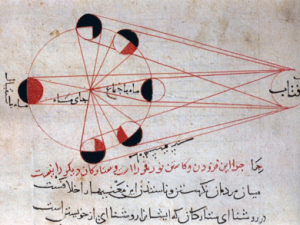 From Kant’s seminal essay “What is Enlightenment?” through the manifold critical responses of the twentieth century, the ambiguity of a term designating both a paradigmatic approach to human intellect or autonomy, and a specific historical period, remains. How distinct is the concept of Enlightenment from the era of European history long taken to have discovered or invented it? This symposium proposes an examination of Enlightenments in the plural, welcoming both revisionary accounts of the Age of Enlightenment and explorations of Enlightenment in other times and places.
With an eye to translating the idea of Enlightenment, scholars have traced its many national and regional varieties. Discussions of an Ionian or an Athenian Enlightenment, of movements of Enlightenment in the medieval caliphate or the Ottoman Empire, share the contemporary intellectual landscape with debates on the continuing relevance of the eighteenth-century Enlightenment to the current global order. We are interested in the way the term has been borrowed and translated, creating a constellation of “Enlightenments” bound together by family resemblances. Is there still a singular project of Enlightenment (i.e. the critique of received ideas and inherited values, in particular religious ones; the promotion of rational or empirical methods; the creation of cosmopolitan and secular spaces), or has the term broken out of its historical mold to designate a more fluid set of cultural projects and practices?
Where do we stand today with regard to the Enlightenment? After all, the continuation of a politics and practice of Enlightenment may depend on the spatial and temporal translations we propose to explore. Such displacements give new life to the idea of Enlightenment, even as the term is contested, criticized and transformed.
Topics of interest include:
• Ionian / Athenian Enlightenment
• Secularism, materialism, the immanent frame
• Literatures of Worldliness in East and West: Renaissance, Tanzimat, Arab and Near Eastern Enlightenments
• Orientalism and Occidentalism
• Diplomacy, correspondence, the figure of the court philosopher
• What is Enlightenment: Kant, Foucault and beyond
• (The) Enlightenment in the Americas
• The public and the private: cross-cultural studies of an Enlightenment distinction
• Travel literature, satire, and utopian fiction
• Nineteenth century national Enlightenments, nationalism vs. internationalism
• Enlightenment and Empire
• The rhetoric of Enlightenment in geopolitics, the claims of the West
• Material culture, exchange, circulation, accumulation, dispersal
• Enlightenment and its others: mysticism, hermeticism and the arcane
• The metaphorics of Enlightenment: illumination, dawn, twilight and dusk
• Where do we stand today with regard to (the) Enlightenment? Critical theory / social and political practice
Please submit an abstract of no more than 300 words to wcoker@bilkent.edu.tr by 1 December 2012.
Jewish High Holidays
On Site
With Yom Kippur (The Day of Atonement) beginning this evening at sundown, it seems like an appropriate time to note an exceptional piece of eighteenth-century English architecture: the Bevis Marks Synagogue in London, the oldest synagogue in Britain, with a history of continuous worship stretching back 311 years. I was one of 2000 fortunate people to visit the building on Sunday in conjunction with London’s annual Open House weekend.
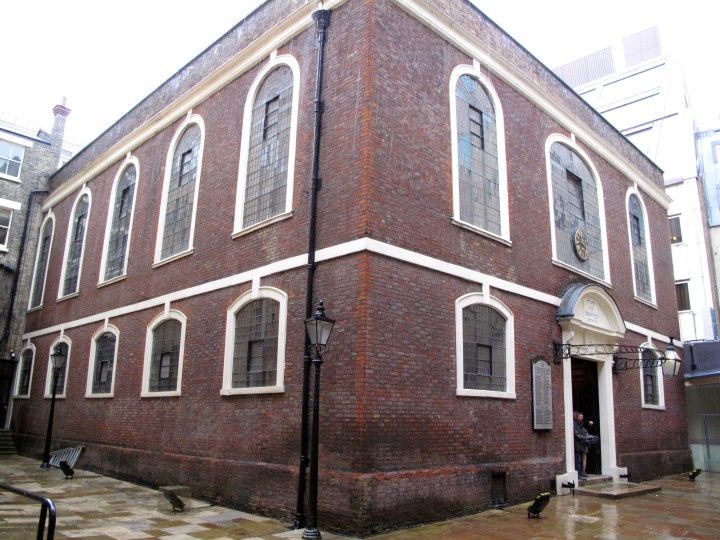
Joseph Avis, The Bevis Marks Synagogue in London, 1701
◊ ◊ ◊ ◊ ◊
A short walk from the Aldgate Tube stop and historically just north of the actual gateway, the Bevis Marks Synagogue was completed in September 1701, the work of Joseph Avis, a Quaker carpenter who had previously worked with Christopher Wren on St Bride’s in Fleet Street. With a few exceptions, the interior and furnishings of this Grade I listed building are original. Some of the benches, in fact, date to the middle of the seventeenth century, when the community met in the upper floor of a house in nearby Creechurch Lane.
It was under Cromwell that these Spanish and Portuguese Jews–many of whom had strong ties to Amsterdam–were legally recognized and allowed to practice their faith openly (in addition to the right to a space for worship, they were granted permission to establish a cemetery). Services today are carried out almost entirely in Hebrew, though there are two exceptions: announcement are made in Portuguese, and prayers for the Queen are said in English.
 Architecturally, the building relates to contemporary dissenting traditions and corresponds to the rebuilding of the fifty-one churches by Wren. One of the points I took away from the visit was simply how easy and useful it would be to include the Bevis Marks Synagogue when teaching Wren and the reconstruction of London following the Great Fire. It would provide a physically tangible way to engage the history of Jews in England, looking both backward and forward. One could, for instance, address the arrival of Jews with William the Conqueror, the expulsion under Edward I in 1290, and the migration of Jews from the Iberian Peninsula after 1492. Looking forward into the eighteenth century, I would like to know more about The Board of Deputies of British Jews, which was formally established on the accession of George III to the throne in 1760. With the synagogue, the character and limits of religious tolerance in the period are nicely introduced. As I’m really just thinking aloud here, I’m sure many of you who teach have already been doing
this and doing it well in your classes–so by all means feel free to chime in
with suggestions.
To all those keeping the fast, G’mar Tov.
-CH
Call for Papers | Temporary Conditions in Architecture
From the Society of Architectural Historians of Great Britain:
Transitory, Transportable, and Transformable: Temporary Conditions in Architecture
London, 18 May 2013
Proposals due by 15 October 2012
Proposals are invited for papers addressing the theme of Temporary Conditions in Architecture to be presented at the 2013 Annual Symposium of the Society of Architectural Historians of Great Britain, to be held at Alan Baxter Associates, 75 Cowcross Street, London EC1M 6EL, on Saturday 18 May 2013.
Architecture is generally regarded as being, for the most part, permanent, static and immutable. However some significant buildings are intended to be temporary, whereas others are designed to be moved from one location to another or even to be flexible enough to alter their form and appearance as the result of changing requirements. This symposium intends to explore the temporary condition in architecture and to question whether architecture needs to be either permanent, static or immutable.
Transitory: Many buildings are short-lived, but few of them are regarded as serious architecture. In 1661, triumphal arches were erected for Charles II’s coronation procession from the City of London to Westminster. Constructed largely of timber, plaster and canvas, they were architecturally elaborate yet intentionally impermanent, only to be soon swept away. Political expediency, no doubt, necessitated their quick erection, otherwise they might have been built in stone and, like Temple Bar (1670-72), still stand today, albeit not in its original location. Modern materials allow for the quick and permanent erection of buildings such as Team 4’s prize-winning Reliance Controls Electronics Factory at Swindon (1967). Yet despite the longevity of its materials, this building was intentionally short-lived and, having served its purpose, was demolished in 1991. Only the ‘thirty-year rule’ saved it from being listed, as it might well have been. Papers could consider whether the lack of permanence in architecture diminishes its value or, on the other hand, whether the permanence which listing building legislation imposes and implies, ultimately benefits it.
Transportable: The Crystal Palace (1851) was first erected, in Hyde Park, as a temporary building but was soon transported to Sydenham where it was re-erected. This was made possible by its pre-fabricated, component-based assembly process. This thinking allowed pre-fabricated buildings to be sent out across the world by the European colonial powers in both the nineteenth and twentieth centuries. Whether these be William Slater’s cast-iron church for the Ecclesiologists (1853-56) or Jean Prouvé’s steel barracks for the French army (1939), the use of transportable architecture to establish and promote religious or military, and therefore political control, was the same. Conversely, the practice of retrieving and displaying spolia as a demonstration of political control, such as Napoleon’s relocation to the Arc de Triomphe, in 1797, of the quadriga from St Mark’s Basilica, Venice, shows that architecture can be as easily brought home as it can be sent out. Papers, therefore, might like to investigate the use of transportable architecture as both a vehicle and an affirmation of colonisation and the influence which these buildings had on the national architecture, culture and society of the colony and the coloniser alike.
Transformable: If the Pyramids are regarded as the ultimate expression of permanence in architecture, then the Pompidou Centre, as originally conceived in 1971, might be the antithesis. For here the floors could move, the envelope could be reassembled, and the exposed services regularly modified. Although the floors, in the end, remained static, the building has been noticeably transformed over the years. Today, ‘Legacy’ is one of the key-words for the London 2012 Olympics. Yet few of the buildings destined to remain will be left in their original condition; many will be transformed. The side wings will be loped off Zaha Hadid’s swimming pool and the upper stage will be removed from Populous’s stadium. In considering legacy, papers might ask whether there is a real architectural legacy in such a situation and whether those few buildings which will emerge unscathed, such as, hopefully, Hopkins Architects’ velodrome, will provide the only true reminder of the Olympics.
Abstracts of not more than 250 words should be sent to Professor Neil Jackson at the School of Architecture, University of Liverpool, Abercromby Square, Liverpool L69 7ZN or e-mailed to neil.jackson@liverpool.ac.uk no later than 15 October 2012. Authors will be advised by 3 December 2012 whether or not their paper has been selected.










 Enfilade
leave a comment