New Book | Lower than the Angels
From Penguin Random House in the UK, with publication forthcoming (2025) in the US:
Diarmaid MacCulloch, Lower than the Angels: A History of Sex and Christianity (London: Allen Lane, 2024), 688 pages, ISBN: 978-0241400937, £35 / $40.
 The Bible observes that God made humanity “for a while a little lower than the angels.” If humans are that close to angels, does the difference lie in human sexuality and what we do with it? Much of the political contention and division in societies across the world centres on sexual topics, and one-third of the global population is Christian in background or outlook. In a single lifetime, Christianity or historically Christian societies have witnessed one of the most extraordinary about-turns in attitudes to sex and gender in human history. There have followed revolutions in the place of women in society, a new place for same-sex love amid the spectrum of human emotions and a public exploration of gender and trans identity. For many the new situation has brought exciting liberation—for others, fury and fear.
This book seeks to calm fears and encourage understanding through telling a 3000-year-long tale of Christians encountering sex, gender, and the family, with noises off from their sacred texts. The message of Lower than the Angels is simple, necessary and timely: to pay attention to the sheer glorious complexity and contradictions in the history of Christianity. The reader can decide from the story told here whether there is a single Christian theology of sex, or many contending voices in a symphony that is not at all complete. Oxford’s Emeritus Professor of the History of the Church introduces an epic of ordinary and extraordinary Christians trying to make sense of themselves and of humanity’s deepest desires, fears, and hopes.
Diarmaid MacCulloch is a fellow of both St Cross College and Campion Hall, Oxford, and emeritus professor of the history of the church at Oxford University. His books include Thomas Cranmer: A Life, which won the Whitbread Biography Prize, the James Tait Black Prize, and the Duff Cooper Prize, and Christianity: The First Three Thousand Years, a New York Times bestseller that won the Cundill Prize in History. He has presented many highly celebrated documentaries for television and radio and was knighted in 2012 for his services to scholarship. He is an ordained deacon of the Church of England. He lives in Oxford.
Call for Papers | Religion, Ancestry, and Identity
From ArtHist.net:
Religion, Ancestry, and Identity: On the Relationship between Theology, Genealogy, and Heraldry in the Early Modern Period
Warburg-Haus, Hamburg, 3–4 April 2025
Proposals due by 13 December 2024
In early modernity, genealogy was a topic of major religious and theological relevance. During the Reformation, genealogical thinking helped to shape new confessional identities, significantly influencing perceptions of family and kinship. References to ancestry served to illustrate religious continuities and the transmission of the ‘true’ faith across generations. Thus, genealogy not only contributed to establishing religious authority, but also shaped confessional identities and served as a tool for resolving theological issues. This interdisciplinary conference proposes to discuss the various interconnections between questions of origin or ancestry and confessional contexts.
The conference takes as its starting point the seemingly surprising observation that numerous theologians were simultaneously active in the fields of genealogy or heraldry. On the Protestant side, Cyriacus Spangenberg (1528–1604), Philipp Jakob Spener (1635–1705), and Johann Ulrich Pregitzer IV (1673–1730) can serve as examples. On the Catholic side, the pronounced engagement of Jesuits in genealogy and heraldry is particularly striking, with Philibert Monet (1566–1643) and Claude-Francois Menestrier (1631–1705) being prominent examples in France.
This phenomenon can be explained through the numerous intersections between the fields of genealogy, heraldry, and theology. Genealogical and heraldic practices served theologians as tools for addressing theological issues, such as resolving the conflicting genealogies of Jesus in the Gospels of Matthew and Luke. Additionally, the merging of secular and sacred fields of knowledge generated iconographic innovations for illustrating and conveying these topics, for instance in the form of printed family trees, which differed from earlier representations. In heraldic literature, there was cross-confessional discussion up until the seventeenth century about the extent to which the origins of coats of arms could be traced back to the 12 tribes of Israel or even to Adam. Christian symbols, such as depictions of saints, were widely used in early modern city coats of arms—a tradition whose traces can still be seen today. At the same time, Jesuits were particularly active in princely genealogy and heraldry. Their studies were initially connected to the education of young nobles in these subjects at their colleges, but they also resulted in extensive heraldic and genealogical compendia.
At least on the Protestant side, theologians engaged in genealogical and heraldic activities often faced pressure to justify their work. Contemporary criticism of genealogical and heraldic studies as vanity or a waste of time must be understood within the context of a broader moral-theological debate about the Christian valuation of family, ancestry, and birth. A central reference point in this debate was Paul’s (seemingly) critical view of the genealogies of ancient Judaism (1 Timothy 1:4 and especially Titus 3:9), around which an antiquarian-theological dispute unfolded in the sixteenth and seventeenth centuries. The influence of this criticism can be traced from Spangenberg to Spener.
While there has been some initial research into the complex and sometimes tense relationship between genealogy, heraldry, and theology during the early modern period, the majority of the field remains largely unexplored. This is especially true regarding Christian discourses on genealogy and heraldry, the use of theological arguments in both fields, and changing perspectives on the family as a result of the Reformation, as well as possible confessional differences regarding these topics. The aim of the conference is to illuminate and discuss the early modern relationship between religion and ancestry in an interdisciplinary way.
Possible topics include:
1 What confessional differences can be identified in the use and discussion of genealogical concepts? How did genealogical concepts help to support or clarify biblical/confessional narratives? To what extent do genealogy and heraldry, as secular fields of knowledge, offer a ‘common ground’ for understanding between different confessions?
2 What media and narrative forms of expressing ancestry can be identified in religious contexts? What temporal and confessional developments can be observed?
3 In what ways and contexts were theological concepts and arguments applied and incorporated in genealogy and heraldry? To what extent did these applications vary according to region or confession within Christianity? What specific theological challenges could be addressed through genealogical and heraldic approaches?
4 How did the contemporary moral pressure to justify their work affect theologians who engaged with genealogy and heraldry? Can confessional differences in these debates be identified? To what extent did societal expectations and norms influence theologians’ approaches to genealogical and heraldic studies? Are there specific examples of conflicts between the outcomes of their research and the doctrinal mandates of the church? What strategies did theologians develop to deal with this pressure and present their research as morally justifiable?
5 How do genealogy and heraldry integrate into the biographies of theological scholars? What motivated theologians to engage in these studies? Was it a matter of personal interest, an exploration of their own family history, a didactic endeavour (for instance, as tutors to princes), or a serious alternative career option?
Contributions from cultural and literary studies, history, art history, and theology are warmly invited. If interested, please send a (working) title and a brief abstract by 13 December 2024, to Kai.Hendrik.Schwahn@uni-hamburg.de.
New Book | Augustus the Strong
From Penguin Random House:
Tim Blanning, Augustus the Strong: A Study in Artistic Greatness and Political Fiasco (London: Allen Lane, 2024), 432 pages, ISBN: 978-0241705148, £30.
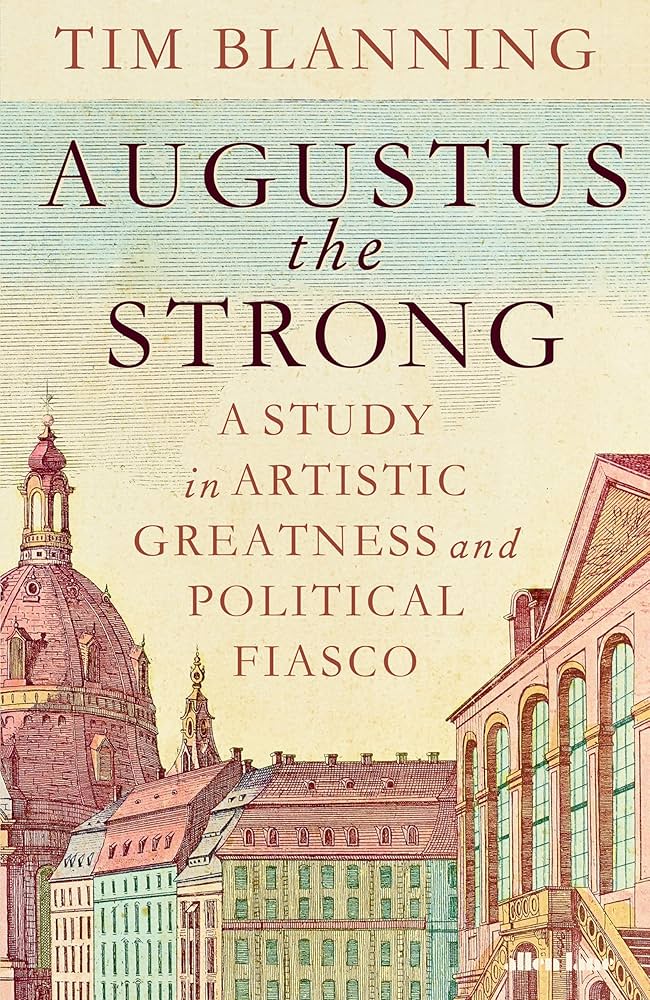 From the acclaimed author of The Pursuit of Glory and Frederick the Great, a riotous biography of the charismatic ruler of 18th-century Poland and Saxony—and his catastrophic reign.
Augustus is one of the great what-ifs of the 18th century. He could have turned the accident of ruling two major realms into the basis for a powerful European state—a bulwark against the Russians and a block on Prussian expansion. Alas, there was no opportunity Augustus did not waste and no decision he did not get wrong. By the time of his death Poland was fatally damaged and would subsequently disappear as an independent state until the 20th century. Tim Blanning’s wonderfully entertaining and original new book is a study in failed statecraft, showing how a ruler can shape history as much by incompetence as brilliance. Augustus’s posthumous sobriquet ‘The Strong’ referred not to any political accomplishment, but to his legendary physical strength and sexual athleticism. Yet he was also one of the great creative artists of the age, combining driving energy, exquisite taste, and apparently boundless resources to master-mind the creation of peerless Dresden, the baroque jewel of jewels. Augustus the Strong brilliantly evokes this time of opulence and excess, decadence, and folly.
Until age-dictated retirement in 2009, Tim Blanning was Professor of Modern History at the University of Cambridge. He remains a Fellow of Sidney Sussex College, Cambridge, and has been a Fellow of the British Academy since 1990. His major works include The French Revolution in Germany, The French Revolutionary Wars, The Power of Culture and the Culture of Power, The Pursuit of Glory: Europe 1648–1815, and The Triumph of Music. He has written biographies of Joseph II, Frederick the Great, and George I.
Exhibition | Furniture by Jean-Pierre Latz at the Dresden Court
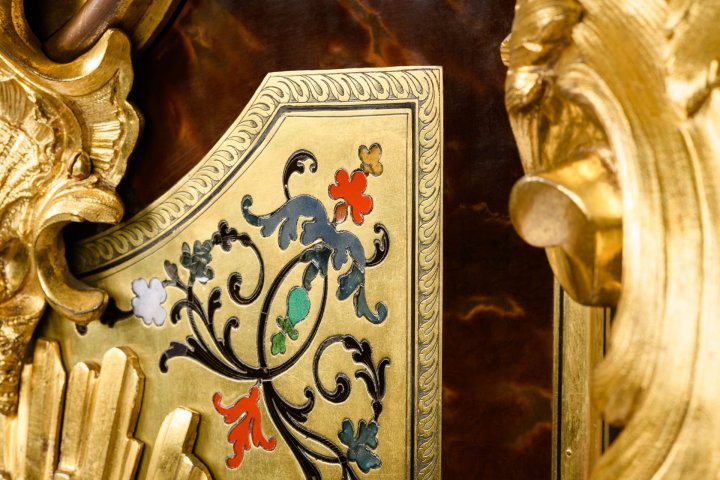
Pedestal detail, signed and dated: Jean-Pierre Latz, Paris, 1739 (Dresden, Inv. No. 37616-2).
◊ ◊ ◊ ◊ ◊
Now on view in Dresden:
Made in Paris: Furniture Creations by Jean-Pierre Latz at the Dresden Court
Fait à Paris: Die Kunstmöbel des Jean-Pierre Latz am Dresdner Hof
Royal Palace, Dresden, 19 October 2024 — 2 February 2025
In the impressive staterooms of the Dresden Residenzschloss (Royal Palace) the collection of Latz furniture shall be presented for the first time in its full extent at the special exhibition of the Kunstgewerbemuseum (Museum of Decorative Arts). This exhibition is the conclusion of the twelve years of comprehensive research and conservation project that the furniture has undergone.

Pendulum clock on pedestal, attributed to Jean-Pierre Latz, Paris, ca. 1739 (Dresden, Inv. No. 37679-1).
The Museum of Decorative Arts Dresden holds the largest and most important collection worldwide of magnificent furniture of the renowned Parisian cabinetmaker Jean-Pierre Latz (1691–1754). The collection contains approximately twenty object ensembles, consisting of thirty individual items. They demonstrate with striking effect the magnificence and representation at the Polish-Saxon court of King Augustus III (1696–1763) and of his prime minister, Count von Brühl (1700–1763).
The Second World War and its aftermath deeply affected the furniture collection of the museum when, apart from destruction, it suffered damages caused by evacuation and transportation. For many years, the necessary conservation and restorations could not be achieved because of a lack of resources; the furniture had to be put into storage and thus lapsed into oblivion. That is until now! For the first time since their wartime storage, eighty years ago, and after years of careful and thoughtful conservation and restoration, the highly important Dresden Latz collection will be shown in the splendour of the staterooms—the very stage where they once enhanced the representation of the Saxon monarchs.
Born in the Electorate of Cologne, an ecclesiastical principality of the Holy Roman Empire, Jean-Pierre Latz followed in the footsteps of many German cabinetmakers and went to Paris in 1719. Latz´s works are striking for a very distinct individual artistic signature and boast opulent, sculpturally conceived corpus forms, technically superb craftsmanship and great sculptural skill in the fashioning of bronze mounts, as well as consummate marquetry work. These high-quality technical aspects were combined in designs that reflect the exquisite taste of the royal and aristocratic customers and patrons in France and abroad. Impressive, elegant and playful as well, his furniture combines mythological themes from the antiquity with their symbolic connotations of the 18th century: monumental, playful and superb, they impressed with their costly materials. Sought after by the royalty in France and abroad, Latz´s furniture is among others still to be found in the former palaces of Augustus III (King of Poland & Elector of Saxony), Frederick the Great (King of Prussia; 1712–1786) and the presidential Quirinal Palace in Rome—originating from the former royal court in Parma.
Important loans from the former royal palaces in Potsdam and from the Palazzo Quirinale in Rom, combined with the splendid collection of Latz furniture of the State Art Collections Dresden, will enable us to present an unprecedented and probably one-time concerted show of outstanding masterpieces by Jean-Pierre Latz. The exhibition will be completed withhighlights from the State Art Collections to throw light on the official representation and demonstration of power at the Saxon Court through the vehicle of French luxury products.
Old artisanship always brings up fascinating issues for today´s museum public: how many different materials and techniques come together as a unity in Latz´s creations? The exhibition will use computer techniques to show how the furniture as a work of art can be digitally disassembled directly before the visitor´s very eyes, so that all its secrets can be penetrated and understood.
New Book | Scottish Furniture, 1500–1914
From National Museums Scotland:
Stephen Jackson, Scottish Furniture, 1500–1914 (Edinburgh: NMSE Publishing, 2024), 272 pages, ISBN: 978-1910682487, £40.
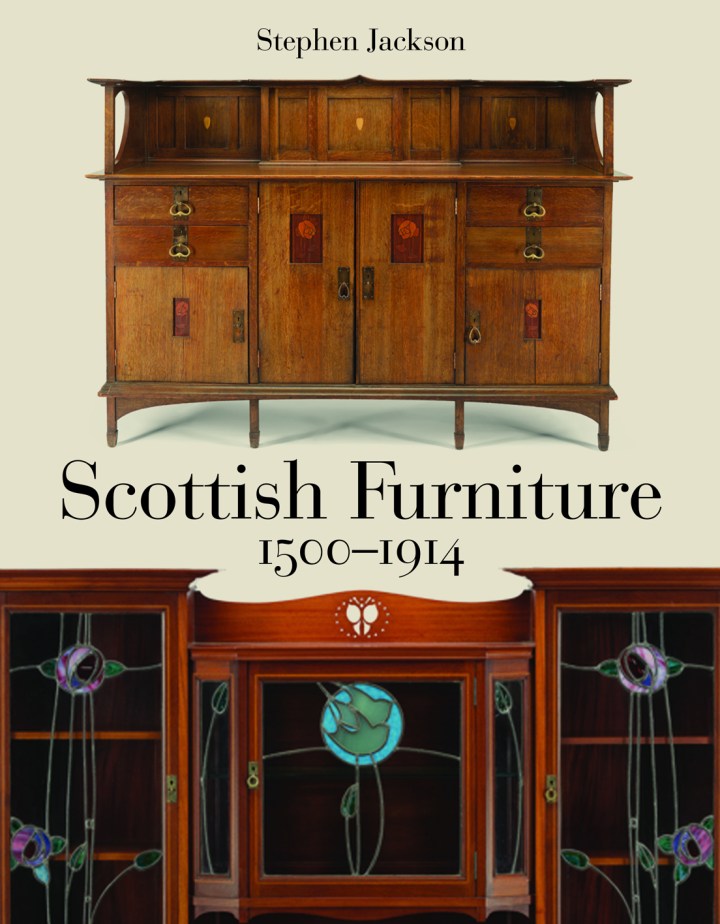 Scotland’s furniture evolved against a background of social and cultural change that included religious reformation, civil war, union with England, and participation in rapidly expanding commercial empire. The contribution of the country’s finest workshops has been overlooked in general histories of British furniture and sever decades of scholarly research is represented here to a wider public for the first time. From the beguiling and fragmentary woodwork of the sixteenth century to the blossoming of new art movements in the years around 1900, Scottish Furniture explores a form of material culture that was central to both everyday life and the expression of status and identity. The careers of prominent cabinet-makers such as Francis Brodie and William Trotter are explored in depth, while over sixty others from all regions of the country are represented among the 340 illustrations. Well-known designers such as Charles Rennie Mackintosh are considered alongside the firms which made their furniture.
Stephen Jackson is Senior Curator, Furniture and Woodwork at National Museums Scotland.
Online Course | British Furniture Abroad in the 18th Century
From British and Irish Furniture Makers Online and The Furniture History Society:
British Furniture Abroad in the Eighteenth Century: Impacts and Influence
BIFMO-FHS Online Autumn Course: 12, 19, and 26 November 2024

Side chair, attributed to Benjamin Randolph, possibly carved by Hercules Courtenay, ca. 1769 (New York: The Metropolitan Museum of Art, 1974.325).
Join us online on three consecutive Tuesdays this November, when curators and historians will explore the influence of British furniture abroad and the ways furniture makers in other countries both copied and transformed these models to suit local traditions and tastes. This series of specialist lectures will look at the diaspora of British furniture in the eighteenth century, providing insights into the traditions of design and furniture making in other countries. Each session will deal with a slightly different stylistic phase in the eighteenth century with three expert speakers dealing with the impact of British furniture design on different countries.
Tickets may be purchased for individual sessions or for the entire course, but you will benefit from a discount if all three sessions are bought together. Don’t worry if you cannot attend the sessions live because they will be recorded and links to the recording will be sent to ticketholders. These recordings will not be available to purchase after the course has ended. FHS members and ECD members will receive a discount on all tickets. For further information and to purchase tickets, please go to the Eventbrite listing. If you have any questions, please email bifmo@furniturehistorysociety.org.
Times each week: 5.30–8pm (GMT) / 12.30–3pm (EST)
Week 1 | Tuesday, 12 November
British Furniture Abroad in the Early Eighteenth Century
• Amy Lim — Daniel Marot and the Influence of His Design
• Henriette Graf — Furniture Design in Germany, 1700–1760
• Alyce Englund — The Influence of Chippendale’s Designs in the Americas
Week 2 | Tuesday, 19 November
British Furniture in Germany, Portugal, and Spain
• Wolfram Koeppe — Abraham and David Roentgen: The Chippendale Connection
• João Magalhães — Portugal and English Furniture
• Mario Mateos Martín — English Influences in Spain: The Royal Collections as a Case Study
Week 3 | Tuesday, 26 November
The Influence of British Furniture in Germany and Italy
• Enrico Colle — British Models for Italian Craftsmen during the Eighteenth Century
• Ulrich Leben — Molitor and English Design
• Daniel Ackermann — Title forthcoming
Call for Papers | Irish Heritage Studies, Volume 2
From Ireland’s Office of Public Works:
Irish Heritage Studies, Volume 2
Proposals due by 1 December 2024
Irish Heritage Studies is the new annual research journal of the Office of Public Works in Ireland, published in association with Gandon Editions. Volume one will be published next spring, and we’re currently inviting abstracts for volume two. The deadline is 1 December 2024.
The journal showcases original critical research rooted in the substantial portfolio of material culture in the care of or managed by the OPW: built heritage; historic, artistic, literary, and scientific collections; the national and international histories associated with these places and objects; and its own long organisational history. Papers contribute to a deeper understanding of this important collection of national heritage, and investigate new perspectives on aspects of its history. The journal is designed for a broad public, specialist, and professional readership. Full details on the journal are available here; and enquires are welcome at IHSjournal@opw.ie.
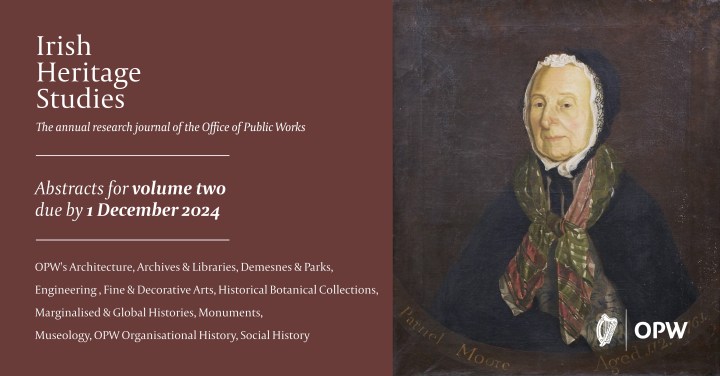
Image: Mrs. Parnel Moore. Aged 112. 1761, by unknown artist, oil on canvas. The sitter was housekeeper at Castletown House, co. Kildare.
New Book | The Irish Country House
From Rizzoli:
Robert O’Byrne, photographs by Luke White, The Irish Country House: A New Vision (Ne York: Rizzoli, 2024), 272 pages, ISBN: 978-0847832835, $65.

A unique presentation of Irish country house interiors, combining well-preserved historic estates with adventurous contemporary restorations, celebrating some of the most characterful houses in Ireland.
Forgoing the criteria of stateliness and opulence, this book is an exploration of the most captivating and unusual interiors in Ireland. Whether in the transformation of a derelict estate, the preservation of an historic hunting lodge, or the re-creation of a Gothic fantasy, each of the homes in this extraordinary book reflects a renewed vitality in the contemporary approach to Irish country houses.
Rich in detail and varied in scope, the houses reveal a refreshing dynamism in their decoration by equally diverse owners—from the ornate refurbishment of a castle by a Mexican financier to the bold palette of a contemporary artist’s renovation to an Elizabethan Revival house. The sparse interiors of a mansion in Westmeath reflect its painstaking restoration by descendants of the original owners, and at Coollattin—Ireland’s largest country house, part restored, part still in disrepair—the building’s baroque splendor is amplified by its raw, unfinished state. Accompanying photography of the houses made specially for the book, the author guides readers through fifteen exceptional spaces, elucidating the remarkable aspects of each—and in doing so celebrates the unexpected eclecticism and reinvigorated spirit of Ireland’s historic interiors.
Robert O’Byrne is a writer and lecturer specializing in the fine and decorative arts. He is the author of more than a dozen books, a former columnist for Apollo magazine, and has written for both The Burlington Magazine and the Irish Arts Review. He authors the award-winning blog The Irish Aesthete. Luke White is a British photographer of portraits, interiors, and architecture.
Mount Vernon Enters Next Phase of $30million Restoration
From coverage of the project by The Washington Post:
Michael Ruane, “George Washington’s Mansion Gets First Major Rehab in More than 150 Years,” The Washington Post (17 October 2024). Much of the historic Mount Vernon home in Virginia will close starting next month for a massive preservation project.
. . . On Nov. 1, the bulk of Washington’s famous home is due to close for several months as it undergoes the next phase of its largest-scale rehabilitation in over 150 years.
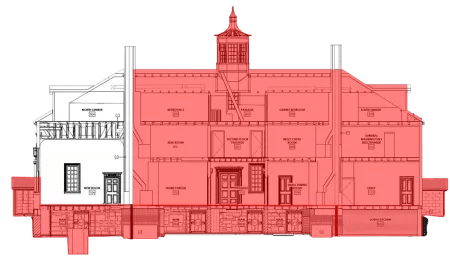
In Phase 2, scheduled to run from November 2024 until January 2025, the New Room, Servants’ Hall, and Kitchen are open; all other rooms will be closed to visitors.
The $30 million project is the most complicated preservation effort since the house was saved from decay in 1860 by the private, nonprofit Mount Vernon Ladies’ Association of the Union, which still owns it, said Douglas Bradburn, president of George Washington’s Mount Vernon. “We’re shutting down a big chunk of it for the next eight months or so,” he said. “I would say that’s two-thirds of the house.”
Other parts of the house, along with the extensive grounds, Washington’s tomb, the quarters for enslaved people and other outbuildings will remain open, Bradburn said in a recent interview. Mount Vernon gets about 1 million visitors a year, and millions more check out the historic estate online, he said.
The historic structure had become loosened from its foundation over time, and the work will resecure it, Bradburn said. There also will be restoration work done in the basement and on flooring, among other things. He said the goal is to complete the project in 2026.
“It’s some of the most important work that’s ever been done at Mount Vernon,” Bradburn said. Earlier repair projects have been piecemeal. At one point, ship masts were used to help support the roof of the crumbling piazza that overlooks the Potomac River. “They’re dealing with problems as they come,” he said. This is a chance for a more complete approach. . .
The full article is available here»
Exhibition | Stan Douglas: The Enemy of All Mankind
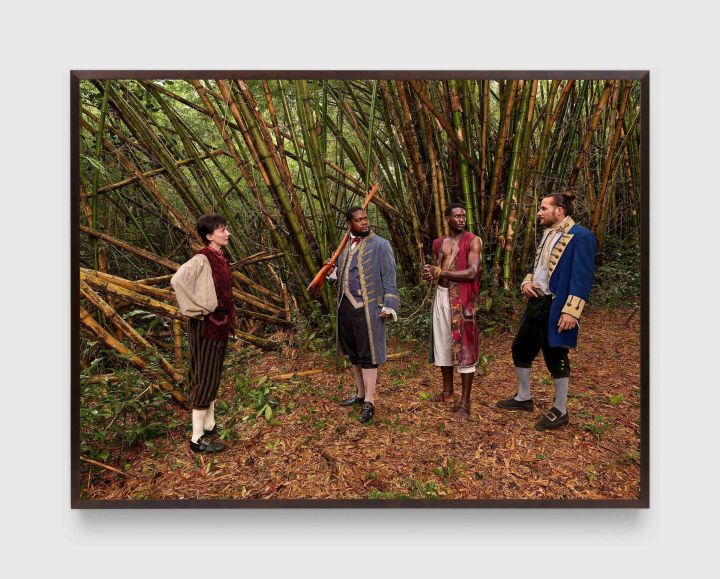
Stan Douglas, Act II, Scene XII: In which Polly Convinces Pirates Laguerre and Capstern to Release their Captive, Prince Cawwawkee, for a Prize Rather than go to War Against His People with Morano, 2024, inkjet print mounted on Dibond aluminum, 150 × 200 cm, edition of 5.
◊ ◊ ◊ ◊ ◊
From the press release for the show, which was covered by Walker Mimms for The New York Times (17 October 2024). . .
Stan Douglas | The Enemy of All Mankind: Nine Scenes from John Gay’s Polly
David Zwirner, New York, 12 September — 26 October 2024
David Zwirner is pleased to announce an exhibition by Stan Douglas, on view at the gallery’s 525 West 19th Street location in New York. Featuring a new photographic series, The Enemy of All Mankind: Nine Scenes from John Gay’s Polly, this will be the artist’s eighteenth solo exhibition with the gallery. In this stand-alone group of nine images, Douglas stages scenes from the eighteenth-century comic opera Polly, written by English dramatist John Gay (1685–1732), using the narrative as a vehicle through which to engage a wide range of themes that remain highly relevant today, including race, class, gender, and media. One work from the series debuted in David Zwirner: 30 Years, on view in summer 2024 in Los Angeles, and this will mark the first presentation of the body of work in its entirety.
Since the 1980s, Douglas has created films, photographs, and other multidisciplinary projects that investigate the parameters of their respective mediums. His ongoing inquiry into technology’s role in image making, and how those mediations infiltrate and shape collective memory, has resulted in works that are at once specific in their historical and cultural references and broadly accessible. Since the beginning of his career, photography has been a central focus of Douglas’s practice, used at first as a means of preparing for his films and eventually as a powerful pictorial tool in its own right. The artist is influenced in particular by media theorist Vilém Flusser’s notion of the photographic image as an encoded language that is determined by a specific set of technological, social, cultural, and political circumstances.
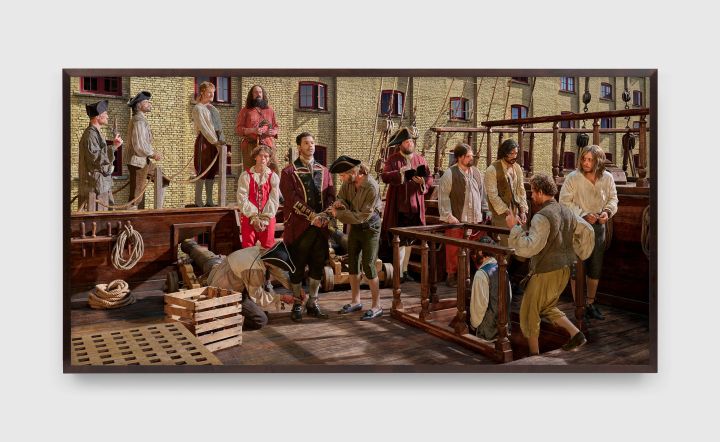
Stan Douglas, Overture: In which Convicted Brigand Captain Macheath is Transported to the West Indies Where He will be Impressed into Indentured Labour, 2024, inkjet print mounted on Dibond aluminum, 150 × 200 cm, edition of 5.
◊ ◊ ◊ ◊ ◊
A sequel to Gay’s well-known The Beggar’s Opera (which was later adapted as The Threepenny Opera), Polly was censored by the British government for its embedded satire and critique, particularly of policies around the parceling out of land; as a result, it was never produced during Gay’s lifetime. Douglas further notes that Polly was ahead of its time, as it “satirizes imperial patriarchal hierarchies of race and class—as well as gender norms, which it depicts as performative” (Douglas, in correspondence with the gallery, March 2024).
Gay’s stage play follows the eponymous Polly Peachum, who travels to the West Indies to search out her estranged husband, Captain Macheath, who has disguised himself as a Black man known as Morano and adopted the life of a pirate. Upon her arrival on the island, Polly is, unbeknownst to her, sold to a wealthy plantation owner as a courtesan. After eventually securing her freedom, she is advised to disguise herself as a young man to ward off unwanted male attention, and as a result becomes entangled in a series of skirmishes between the colonial settlers, the native population, and the pirates.
To create the photographs—which were shot in Jamaica using Hollywood-level production effects—Douglas enlisted a cast of actors to read from a loose script that he adapted for the chosen scenes, modifying certain characters and elements to bring the themes in line with the present day. For example, in Douglas’s version, Captain Macheath was a Black man passing as white in London who, once in the West Indies, drops the disguise and lets his hair grow out. Rather than posing the players, he photographed them continuously as they acted out and improvised the dialogue, then selected as the final images those that best embodied the ideas put forth in the narrative. The resulting large-scale photographs are dynamically realized, taking the form of sweeping tableaux where dramatis personae and setting collide in vivid color. Retaining Gay’s sense of comedic folly and satire as well as the underlying pathos of the story, the images bear traces of the various forms of media through which they have been filtered, employing formal elements drawn from theatrical, cinematic, and photographic conventions alike. Accordingly, Douglas positions the viewer as a spectator—a voyeuristic witness to the various narrative turns and apparent absurdities in which relationships are transactional and enemies expendable.
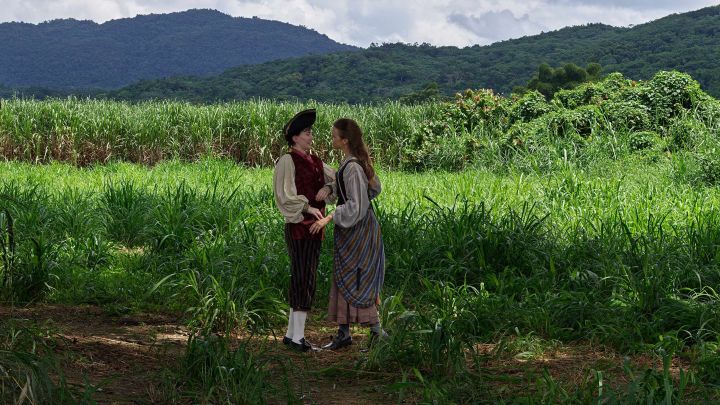
Stan Douglas, Act II, Scene VI: In which the Wife of Pirate Captain Morano, Jenny Diver, Attempts to Seduce Polly, who is Disguised as a Man to Avoid Molestation, detail, 2024, inkjet print mounted on Dibond aluminum, 150 × 150 cm, edition of 5.
◊ ◊ ◊ ◊ ◊
Douglas’s use of Polly as the basis for this project arose out of his long-standing interest in maroon societies, large groups of enslaved persons who banded together to run away and start new, proto-democratic societies. Contrary to their depiction in popular media, pirate ships occasionally functioned as collaborative maroon societies in their own right. The title of the series, The Enemy of All Mankind, is taken from a doctrine of eighteenth-century maritime law (in Latin, hostis humani generis) under which pirates could be attacked by anyone since they fell outside the protection of any nation, but its core notion of defining certain groups as enemies or outsiders resonates broadly today. In Polly, the pirates—in contrast to the settlers and indigenous people—are meant to embody immorality and evil, yet in pulling out specific strands of the narrative, Douglas points to a more nuanced understanding of such sweeping generalities.
Stan Douglas (b. 1960) was born in Vancouver and studied at Emily Carr College of Art in Vancouver in the early 1980s. Douglas was one of the earliest artists to be represented by David Zwirner, where he had his first American solo exhibition in 1993—the second show in the gallery’s history.
Douglas’s work has been the subject of solo exhibitions at prominent institutions worldwide since the 1980s. In 2022, the artist represented his native Canada at the Venice Biennale, where he debuted a major video installation, ISDN (2022)—now in the collection of the National Gallery of Canada, San Francisco Museum of Modern Art, and The Museum of Modern Art, New York—and a related body of photographs. Subsequently, the exhibition Stan Douglas: 2011 ≠ 1848 traveled around Canada with stops at The Polygon Gallery, Vancouver (fall 2022); Remai Modern, Saskatoon (February–April 2023); and the National Gallery of Canada, Ottawa (September 2023–October 2024). A solo exhibition also titled 2011 ≠ 1848 was subsequently staged in 2023 at De Pont Museum, Tilburg, the Netherlands. In 2023, this body of work inaugurated David Zwirner’s new Los Angeles location, and it is currently on view at the Parque de Serralves in Porto, Portugal, through 12 January 2025.
Douglas has been the recipient of notable awards, including the Audain Prize for Visual Art (2019); the Hasselblad Foundation International Award in Photography (2016); the third annual Scotiabank Photography Award (2013); and the Infinity Award from the International Center of Photography, New York (2012). In 2021, Douglas was knighted as a Chevalier of the Ordre des Arts et des Lettres by the French Minister of Culture, and in 2023 he was awarded an honorary doctorate by Simon Fraser University, Greater Vancouver. Work by the artist is held in major museum collections worldwide.










 Enfilade
leave a comment