Announcing: The 18th-Century Common
One aim of Enfilade has been to help bridge the divide between academics and a much larger world also interested in the eighteenth century. While the site is intended to serve scholars, I’ve always hoped to make others welcome here, too. With that spirit of inclusiveness in mind, I’m especially excited to hear about The 18-Century Common. The following announcement from Jessica Richard appeared on the C18-L listserv. -CH
◊ ◊ ◊ ◊ ◊
 I want to announce and solicit contributions to a new public humanities website called The 18th-Century Common which will debut at ASECS. The 18th-Century Common is a joint project of scholars and students of the long eighteenth century at Union College and Wake Forest University and is funded by the Wake Forest University Humanities Institute.
The aim of the website is to present the published work of eighteenth-century scholars to a general audience. Our initial focus is Richard Holmes’ popular book The Age of Wonder: How the Romantic Generation Discovered the Beauty and Terror of Science (2009). This book captured the imagination of the general reader, but it omits the more complex contexts that scholarly accounts offer. We hope to provide general readers an accessible view of those contexts, and to move beyond Holmes’ book to the wide range of eighteenth-century studies. The site will feature short versions of published scholarship written for a general audience, as well as links to related resources, texts, and images around the web for readers who want to explore further.
We think this is the beginning of an exciting opportunity to reach the interested nonacademic, nonstudent readers who made Holmes’ book a bestseller, to “translate” what we do and to reach out beyond the academy as digital platforms in the humanities make particularly possible. We’ll be demonstrating the site near the registration table at ASECS Thursday and Friday; please stop by and chat with us. We encourage you to contact us if you are interested in contributing to the site or have ideas about how it can develop.
–Jessica Richard: richarja@wfu.edu and Andrew Burkett: burketta@union.edu
Exhibition | Royal River: Power, Pageantry, and the Thames
As noted at British Art Research, this summer the Thames is on doubly on display at Greenwich. The museum website is worth visiting for the video promotion alone. From the National Maritime Museum:
Royal River: Power, Pageantry, and the Thames
National Maritime Museum, Greenwich, 27 April — 9 September 2012
Curated by David Starkey

◊ ◊ ◊ ◊ ◊
Magnificent gilded barges, liverymen in their finest uniforms, the splendour of lavish celebrations: the Thames is the ‘royal river’, used for centuries by British monarchs to involve the people in ceremony and festivities displaying their regal status. For hundreds of years this famous river has been host to the pageantry of coronations, processions of boats, and other events which helped tie people closer to the Crown and to London as Britain’s capital.
This spectacular exhibition, a landmark heritage event of the year, brings together nearly 400 beautiful, fascinating and often unique objects, including one of the largest-ever loans of Royal Collection objects to any museum. Created to mark Her Majesty The Queen’s Diamond Jubilee, and guest-curated by historian David Starkey, Royal River presents the historic Thames in all its glory, from British royal and City events to London’s famous watermen, and the river’s transformation after the notorious ‘Great Stink’.
◊ ◊ ◊ ◊ ◊
Image: Detail from The Thames on Lord Mayor’s Day, looking towards the City and St Paul’s Cathedral, before 1752, Canaletto, The Lobkowicz Collections, Czech Republic. Visitors to London Bridge station can now see a 30m-long version of the Canaletto painting gracing a temporary wall at the new station entrance. Find out more
New Gallery at Greenwich | Traders: The East India Company and Asia
From the National Maritime Museum:
Traders: the East India Company and Asia
National Maritime Museum, Greenwich, gallery opened in September 2011

◊ ◊ ◊ ◊ ◊
Established by a group of London merchants, the East India Company was given its first royal charter by Elizabeth I. By the time it was abolished 250 years later, Queen Victoria was on the throne. The East India Company took on pirates, princes and rival traders in its pursuit of profit – changing the world in the process. This new gallery at the National Maritime Museum explores the history and continuing relevance of Britain’s trade with Asia, looking at this compelling story through the lens of the East India Company. Traders: the East India Company and Asia examines the commodities that the company traded, the people that shaped its tumultuous career and the conflicts and rebellions that were its ultimate undoing.
The exotic spices the company imported brought exciting flavours to Britain. The calicos, muslins and silks carried on its ships shaped fashions, clothing rich and poor alike. But its greatest success was tea, which it helped transform from an expensive luxury to a national pastime. However, the British cup of tea had a darker side: opium. This illegal drug trade was interwoven with the company’s business, resulting in war with China on two separate occasions.

ISBN: 9781857596755, $60
The company can be seen as a forerunner of the modern multinational. But its power and global reach were unique. At its height, the company minted its own currency and ruled over a sixth of humanity. It had its own navy, the Bombay Marine, and had 250,000 soldiers at its command. Regarded by the British establishment as too big to fail, the Company was repeatedly bailed out and ended its days shrouded in controversy.
Traders: the East India Company and Asia showcases the museum’s world-famous collection of objects relating to Asia and the Indian Ocean, including: Japanese, Chinese and Burmese swords; beautifully crafted ship models and navigational instruments; Nelson’s Japan-pattern breakfast service; Victoria Crosses awarded during the Indian Mutiny; and journals kept by Company sailors.
The gallery also contains portraits of key figures from throughout the East India Company’s history including: Sir James Lancaster, commander of the first Company voyage; Jamsetjee Bomanjee Wadia, master shipbuilder at Bombay Dockyard; the ship-wrecked and imprisoned Robert Knox, said to be the inspiration for Defoe’s Robinson Crusoe; the appropriately named Money brothers, who made their fortunes in Asia; and Commodore Sir William James, a poor Welsh miller’s son who ran away to sea, and rose to become commodore of the Bombay Marine and Chairman of the Company.
To celebrate the opening of Traders the National Maritime Museum staged a festival of events throughout autumn and winter 2011. Traders Unpacked, sponsored by Sharwood’s, explored the complex legacy of the EIC and its contemporary significance though events including a textile-themed walking tour of London’s East End; an alternative East India Company pub quiz; an evening of Japanese psychedelia; Singaporean deep house and sea shanties; the Curry and a Pint nights, which explored the origins of the great British curry; a series of international tea parties; and a night of nautical games for grown-ups.
The gallery is accompanied by an illustrated history of the Company, which draws extensively on the collections of the Museum. Monsoon Traders: the Maritime World of the East India Company is published by Scala and written by Robert J. Blyth and John McAleer, curators of Imperial and Maritime History at the National Maritime Museum and H. V. Bowen, Professor of Modern History, Swansea University.
◊ ◊ ◊ ◊ ◊
Writing for The New York Times (4 November 2011), Roderick Conway Morris provides a review of the exhibition.
Conference | Desiring Fashion
From the conference website:
Desiring Fashion: The Consumption and Dissemination of Dress 1750-1850
King’s Manor, University of York, 23 June 2012
Convenor: Serena Dyer
 This day conference brings together academic and curatorial work on the desire to dress fashionably in the eighteenth century. From faces to feet, the fashionable men and women of the eighteenth century strove to achieve aesthetic perfection. This series of papers explores the process of fashion dissemination, production and consumption which enabled the fulfilment of these desires, and how this related to the concepts of desire, gender and beauty. The papers to be presented cover subjects such as cosmetics and beauty, fashion plates, silk manufacture and the relationship between dressmaker and client. A small exhibition of fashion plates and accessories from the period will accompany the conference.
Aileen Ribeiro (Courtauld) Desiring Beauty: Women and Cosmetics in the Eighteenth Century
Elisabeth Gernerd (Edinburgh) Pulled Tight and Gleaming: The Stocking’s Position within Eighteenth-Century British Masculinity
Lesley Miller (V&A) Material Marketing: How Lyonnais Manufacturers Sold Their Silks in the 18th Century
Hilary Davidson (Museum of London) Recreating Jane Austen’s Pelisse-Coat
Catherine Flood (V&A) Fashion in Print and the Pleasures of Picturing Modern Life: Fashion Plates and Fashion Satires
Serena Dyer (York) A Beautiful Bargain: Lady Sabine Winn’s Relationship with Fashion
◊ ◊ ◊ ◊ ◊
Registration
The registration fee is £12. This includes a simple sandwich lunch, tea and coffee. Registration is now available via our online store. For Members of the University of York, registration is free, but please email cecs1@york.ac.uk to register; the (optional) lunch is £5.
Gardening at Monticello
The perfect way to launch a book, and this book, in particular? A garden party at Monticello, of course! From Monticello:
Book Party Launch for ‘A Rich Spot of Earth’: Thomas Jefferson’s Revolutionary Garden
Monticello, 23 April 2012
Celebrate the launch of Peter Hatch’s “A Rich Spot of Earth”: Thomas Jefferson’s Revolutionary Gardenat Monticello. Join us for an elegant garden party with the author as he discusses his pioneering new book. This gorgeous volume tells the history of Jefferson’s unique vegetable garden at Monticello and uncovers his lasting influence on American culinary, garden, and landscape history. The book also showcases the 1980s project that restored the garden to its original glory.
◊ ◊ ◊ ◊ ◊
From Yale UP:
Peter J. Hatch, ‘A Rich Spot of Earth’: Thomas Jefferson’s Revolutionary Garden at Monticello (New Haven: Yale University Press, 2012), 280 pages, ISBN: 9780300171143, $35.

"Peter Hatch’s vibrant and enthusiastic passion for preserving Thomas Jefferson's farming legacy at Monticello reminds us all of the time-tested continuity and historical root of this kind of agriculture." - Alice Waters, from the Foreword
Were Thomas Jefferson to walk the grounds of Monticello today, he would no doubt feel fully at home in the 1,000-foot terraced vegetable garden where the very vegetables and herbs he favored are thriving. Extensively and painstakingly restored under Peter J. Hatch’s brilliant direction, Jefferson’s unique vegetable garden now boasts the same medley of plants he enthusiastically cultivated in the early nineteenth century. The garden is a living expression of Jefferson’s genius and his distinctly American attitudes. Its impact on the culinary, garden, and landscape history of the United States continues to the present day.
Graced with nearly 200 full-color illustrations, “A Rich Spot of Earth” is the first book devoted to all aspects of the Monticello vegetable garden. Hatch guides us from the asparagus and artichokes first planted in 1770 through the horticultural experiments of Jefferson’s retirement years (1809–1826). The author explores topics ranging from labor in the garden, garden pests of the time, and seed saving practices to contemporary African American gardens. He also discusses Jefferson’s favorite vegetables and the hundreds of varieties he grew, the half-Virginian half-French cuisine he developed, and the gardening traditions he adapted from many other countries.
As Director of Gardens and Grounds at Monticello since 1977, Peter J. Hatch has been responsible for the maintenance, interpretation, and restoration of its 2,400-acre landscape. He has written several previous books on Jefferson’s gardens and is an advisor for First Lady Michelle Obama’s White House kitchen garden. He lives in Charlottesville, VA.
Exhibition | Goya: Lights and Shadows
From ArtDaily.com (16 March 2012):
Goya: Lights and Shadows / Luces y Sombras
The National Museum of Western Art, Tokyo, 22 October 2011 — 29 January 2012
CaixaForum Barcelona, 15 March — 24 June 2012
Curated by Manuela B. Mena and José Manuel Matilla

Francisco de Goya, The Clothed Maja, ca. 1800
(Madrid: Museo Nacional del Prado)
◊ ◊ ◊ ◊ ◊
Nearly two hundred years after his death, Francisco de Goya continues to exercise a universal attraction that very few others in the history of art have equalled. Not only is Goya enveloped in the greatness of his art and his genius, he is also shrouded in mystery and popular legend in a way that makes him doubly attractive and accessible. Now, almost thirty-five years after the last major exhibition devoted to the Spanish master in Barcelona, Goya. Lights and Shadows brings a large selection of great works the collection of El Prado National Museum, the most important in the world. The show features nearly one hundred pieces – oils, drawings, prints and letters – in a chronological journey through the main periods in the career of this Aragón-born artist. From the early years, in which Goya’s realism contrasted with the over-refined Rococo style favoured by his contemporaries, to the intimate works he produced towards the end of his life in Bordeaux, not forgetting the drama of the Peninsular War, which marked a turning-point in his artistic development. The exhibition is the fruit of a cooperation agreement signed between ”la Caixa” Foundation and the Prado National Museum 2011 under which the Catalan organisation became a Benefactor of the museum. Under the terms of the agreement, three more joint exhibitions will be organised in the coming years. Goya. Lights and Shadows is the first show planned as part of the joint exhibition programme established by ”la Caixa” Foundation and the Prado National Museum, the result of an agreement made between the two institutions in July 2011, under which ”la Caixa” becomes a Benefactor of the Spanish art gallery. . .
The full press release (which includes programming and lectures) is available here»
◊ ◊ ◊ ◊ ◊
Call for Project Participants | Revival: Utopia, Identity, Memory
The format of this project is worth noting: a one-day workshop is planned for June that will in turn shape the program for the November two-day conference. Despite the emphasis on the nineteenth century, perhaps there’s room for the eighteenth century, too; or for that matter, nineteenth-century revivals of key eighteenth-century movements could certainly be interesting. –CH
From The Courtauld:
Revival: Utopia, Identity, Memory
The Courtauld Institute of Art, London, 20 June 2012 and 23-24 November 2012
Proposals due by 16 April 2012
Revivalism in art and architecture is a fundamental though often overlooked aspect of modernity. From the nineteenth century to the present, styles, ideologies, techniques and approaches have been revived and re-framed. Revival: Utopia, Identity, Memory seeks to investigate the diverse dimensions of revivalism, exploring its meanings and impacts across cultures, periods and media. The extent to which revivalism has been harnessed to promote utopian visions, assert aspects of personal or corporate identity, and grant fresh purchase on memorialization and nostalgia are all productive trajectories for investigation. Studies of art and architectural revivals tend to focus on biographical or stylistic approaches. This project, consisting of a workshop and major conference for an international cohort of interdisciplinary scholars, encourages intersecting and broadening views in order to chart the notion of revivalism itself. The phenomenon’s implications for art and architectural history in relation to tradition, repetition, originality, transnationality, patronage, religion, colonialism, historicism, reproduction, authenticity, resistance and power have yet to be intensively investigated.
This project consists of two events at The Courtauld Institute of Art in London. The first, on Wednesday 20 June 2012, will be a day-long workshop. The second, on 23-24 November 2012, will be a two-day conference. The purpose of the workshop is to explore intersections and encourage dialogue between scholars, and to discuss the importance of revivalism in broad terms. Workshop participants will also be invited to contribute research and topics for discussion to the November conference. The conference’s purpose is to crystalize and refine initial workshop conversations, establishing new ways of understanding revivalism. Participants will be drawn from early career and more established scholars, as well as artists and architects who actively engage with revival within their practice. Papers specifically addressing revivalism in relation to utopia, identity or memory are especially encouraged. It is hoped that speakers will attend both the summer workshop and the autumn conference in order to establish cohesion within the project and to create sophisticated collaborative responses to the theme.
The deadline for expressions of interest is 16 April 2012. Please email a CV and 200-word statement of how your work engages with revivalism to the project convener, Ayla Lepine (ayla.lepine@courtauld.ac.uk).
Applause for NGA’s Open Access Policy for Images
This open access announcement from the National Gallery of Art, in Washington, D.C., is, to my thinking, fabulous news! How exciting (and refreshing) to hear the museum articulate the policy in terms of the public good: “The Gallery’s open access policy is a natural extension of its mission to serve the United States of America by preserving, collecting, exhibiting, and fostering the understanding of works of art at the highest possible museum and scholarly standards.” Bravo! In addition to making the images available via open access, the museum provides a useful interface complete with lightbox and intuitive links for finding more information about particular images. -CH
National Gallery press release (16 March 2012) . . .
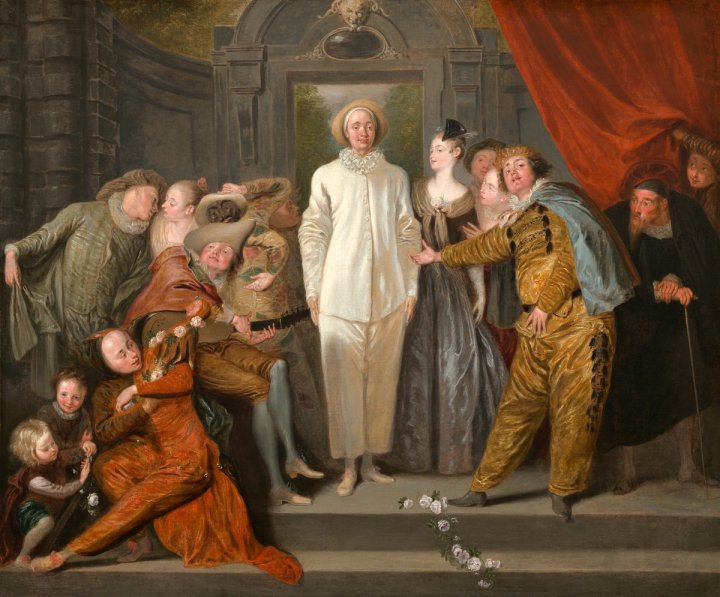
Antoine Watteau, The Italian Comedians, ca. 1720
Washington, D.C., National Gallery, Kress Collection, 1946.7.9
◊ ◊ ◊ ◊ ◊
The National Gallery of Art announces the launch today of NGA Images, a new online resource that revolutionizes the way the public may interact with its world-class collection at http://images.nga.gov. This repository of digital images documenting the National Gallery of Art collections allows users to search, browse, share, and download images believed to be in the public domain.
“As the Gallery marks its 71st anniversary, it is fitting that we introduce NGA Images and an accompanying open access policy, which underscore the Gallery’s mission and national role in making its collection images and information available to scholars, educators, and the general public,” said Earl A. Powell III, director, National Gallery of Art. “In turn this supports research, teaching, and personal enrichment; promotes interdisciplinary research; and nurtures an appreciation of all that inspires great works of art.”
Many of the open access images have been digitized with the generous support of the Samuel H. Kress Foundation.
Designed by Gallery experts to facilitate learning, enrichment, enjoyment, and exploration, NGA Images features more than 20,000 open access digital images, up to 3,000 pixels each, available free of charge for download and use. The resource is easily accessible through the Gallery’s website, and a standards-based reproduction guide and a help section provide advice for both novices and experts. Users may search by keyword in the Quick Search box on the home page of NGA Images, or they may browse the regularly updated “featured” image collections prepared by Gallery staff on topics such as 19th-century French art or frequently requested works. Other features for users include the ability to create one or more “lightboxes,” or images sets, and to save, share, and download multiple images at a time. Users may add individual labels and notes to their lightboxes or to images within them. Links to users’ customized lightboxes may be shared via e-mail or may be copied and pasted to social media sites.
Users may freely browse the NGA Images website and download screen- and lecture-size images without registering an account. Registration is required to use certain features of the NGA Images website, including saving and sharing lightboxes and e-mailing image links to others. Additionally, registration is required to fulfill certain image requests including direct downloads of reproduction-ready images.
With the launch of NGA Images, the National Gallery of Art implements an open access policy for digital images of works of art that the Gallery believes to be in the public domain (those not subject to copyright protection). Under the open access policy, users may download any of these images free of charge and without seeking authorization from the Gallery for any use, commercial or non-commercial. The Gallery’s open access policy is a natural extension of its mission to serve the United States of America by preserving, collecting, exhibiting, and fostering the understanding of works of art at the highest possible museum and scholarly standards. In applying the policy in a global digital environment, the Gallery also expands and enhances its educational and scholarly outreach. The Gallery believes that increased access to high-quality images of its works of art fuels knowledge, scholarship, and innovation, inspiring uses that continually transform the way we see and understand the world of art.
View the full Open Access Policy at http://images.nga.gov/openaccess.
Getty Acquisition | ‘The Italian Comedians’ by Watteau
Press release (15 March 2012) from the Getty:

Antoine Watteau, "The Italian Comedians," ca. 1720 (The J. Paul Getty Museum, 2012.5)
The J. Paul Getty Museum announced today the acquisition of The Italian Comedians (ca. 1720) by Jean-Antoine Watteau (French, 1684–1721). The large oil painting (50 7/8 x 36 3/4 inches) was painted at the height of Watteau’s fame, shortly before his early death at age 36.
“This major, little-known painting is extraordinary. It shows Watteau at the height of his creative genius,” said James Cuno, President and CEO of the J. Paul Getty Trust. “Not only will it enhance our paintings collection, but it complements the Museum’s collection of French decorative arts, which is amongst the finest in the world.”
The Italian Comedians joins 18th-century French paintings already in the Getty Museum’s collection by artists such as Nicolas Lancret (1690 –1743), Jean-Honoré Fragonard (1732–1806), Jean-Baptiste-Siméon Chardin (1699–1779), and Claude-Joseph Vernet (1714–1789), all of which have been acquired in the last decade.
The painting portrays five fairground comedians costumed as characters from the Comédie Italienne. Watteau, who would have seen the travelling performers at fairgrounds on the outskirts of Paris, often depicted members of this popular troupe in his fêtes galantes, small compositions showing conversations or music-making set in a park or landscape. Monumental paintings, in which the performers dominate a larger picture, are extremely rare in Watteau’s oeuvre. His compassionate depictions of the character Pierrot, a white-clad clown, are especially renowned, with one of the most notable being the life-size depiction of him that hangs in the Musée du Louvre in Paris.
In this painting, Pierrot and his troupe have just finished a performance and taken their bows. They have stepped off the makeshift stage and are about to start collecting money. All five of the actors look expectantly at the viewer. The central figure, Pierrot, holds his hat in one hand while his other reaches into a pocket of his baggy white jacket, cueing the audience, and the viewer, that it is time to show their appreciation.
“Watteau was perhaps the greatest French artist of the 18th century,” explains Scott Schaefer, senior curator of paintings at the Getty Museum. “This painting typifies the way that Watteau combined acuity and elegance with poetic powers of description, in equal parts sensitive and humorous.”
The Italian Comedians has been in private collections since the 18th century and has not been publicly exhibited since 1929. Over the last three centuries, its attribution has fluctuated. Until the late 19th century, the painting was attributed to Watteau. It was then assigned to Watteau’s pupil Jean-Baptiste Pater and subsequently to an anonymous painter in the circle of Watteau. Although the attribution has changed over time, the artwork has always been praised for its brilliant composition and emotional power and associated with Watteau’s psychologically profound depictions of the Italian Comedians. (more…)
New Resource at the Bard | Library of Theodore Dell
From the Bard Graduate Center:
BGC Acquires Unique Research Collection on Eighteenth-Century French Decorative Arts
 An extraordinary addition to the BGC’s research capacity will result from the recent acquisition of the private library and archive amassed by Theodore Dell, an art advisor and historian noted for his expertise in eighteenth-century French furniture, porcelain and decorative arts. Beginning in the 1960s while he was based in London, Dell set out to assemble a comprehensive yet highly specialized collection to benefit students and scholars working in the United States. Numbering more than 5,000 volumes, the collection consists of gallery, auction, and museum catalogues; and books, journals, and magazines, all focused on French decorative arts. There are some 1,700 French sales catalogues alone, beginning in 1748, with many rare examples from the eighteenth century. Dell’s own research, particularly in London and Paris, forms the basis for his thorough archives organized by such divisions as makers and their particular types of works. Indeed, the late Charles Ryskamp, former director of the Morgan Library and the Frick Collection, noted that Dell’s library is perhaps the most important of
its type in existence.
The first step in making this invaluable resource accessible for research is to inventory, clean and catalogue each volume. The BGC seeks to raise $60,000 for staff, archival enclosures, and conservation supplies for the initial phase of work commencing this summer. Thanks to the generosity of our lead donors, $13,000 has already been raised. Please consider making a gift to the BGC today in support of this project. Visit www.bgc.bard.edu/about/support-the-bgc/bgc-donation-form.html. Choose Other under Contribute and specify Ted Dell Library in the adjacent box. Your support will help fulfill Ted Dell’s vision of encouraging study in French art and culture and further the BGC’s place as a leading center for research and scholarship. Thank you.










 Enfilade
leave a comment