Research Lunch | London’s Periodical Architecture, 1700–1750
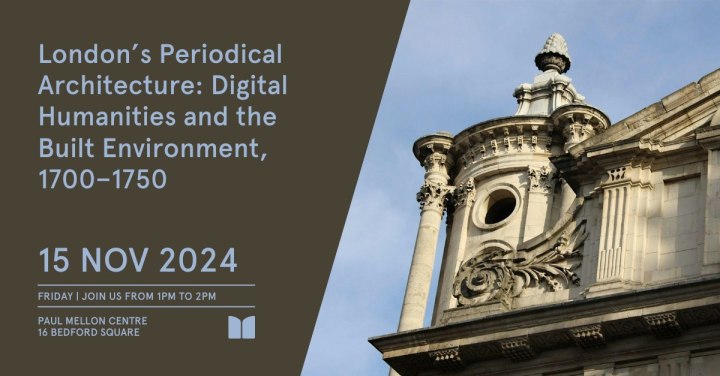
Thomas Archer, St John Smith Square, London, completed in 1728
(Photo: © Matthew Lloyd Roberts)
◊ ◊ ◊ ◊ ◊
Next month at the Mellon Centre:
Matthew Lloyd Roberts | London’s Periodical Architecture: Digital Humanities and the Built Environment, 1700–1750
Paul Mellon Centre, London, 15 November 2024, 1pm
In recent years, large-scale digitisation of early modern periodicals has revolutionised the searchability of collections of ephemeral print culture. Enabled by optical character recognition technology, this shift has transformed the way scholars use databases of primary material, introducing new quantitative approaches to these vast collections. However, this shift also poses epistemological questions within new digital humanities frameworks. The paper will explore this shift by presenting material newly discovered by these methods relating to church building in London in the first half of the eighteenth century. Firstly, looking at the way that the work of the New Churches Commission was represented and debated by the politically factional newspaper culture in the first years of Hanoverian rule, and then recognising the effect this discourse may have had in shaping the way that people experienced the city. By incorporating periodical culture as an important context of the work of the Commission, for the first time this study proposes a substantive media and reception history of these iconic buildings of the English Baroque.
Furthermore, this paper will consider the explosion of architectural publishing in the periodical press of the mid-1730s, in the context of James Ralph’s Critical Review, examining the way that architectural practitioners such as John James were increasingly forced to foray into periodical culture to defend their expertise and reputations. These events will be read towards the political and social meanings of church building and church restoration, and the growing anxiety about the need to disambiguate the meanings of the built environment to the urban public in an age of print culture.
Matthew Lloyd Roberts is a history of art PhD candidate at Downing College, Cambridge and member of the Ax:son Johnson Centre for the Study of Classical Architecture. His PhD research is concerned with the cultural reception of the changing built environment of England in the seventeenth and eighteenth centuries. He studied ancient and modern history at Keble College, Oxford and has an MA in architectural history from the Bartlett, UCL. Complementing his academic work, he is also interested in disseminating academic research to broader audiences and produces and hosts two podcasts concerned with architectural history and culture, the independent About Buildings and Cities and the official podcast of the Society of Architectural Historians of Great Britain. His architectural criticism has also appeared in Tribune (magazine), The New Statesman, and The Critic, and he leads architectural walking tours for a variety of organisations including Open City.
Conference | Sacred Silver in Southeast Europe, 15th–19th Centuries
From ArtHist.net and the conference website:
Southeast European Silversmithing: Artisans, Donors, and Piety in the Early Modern Period
Sofia, Bulgaria, 17–18 October 2024
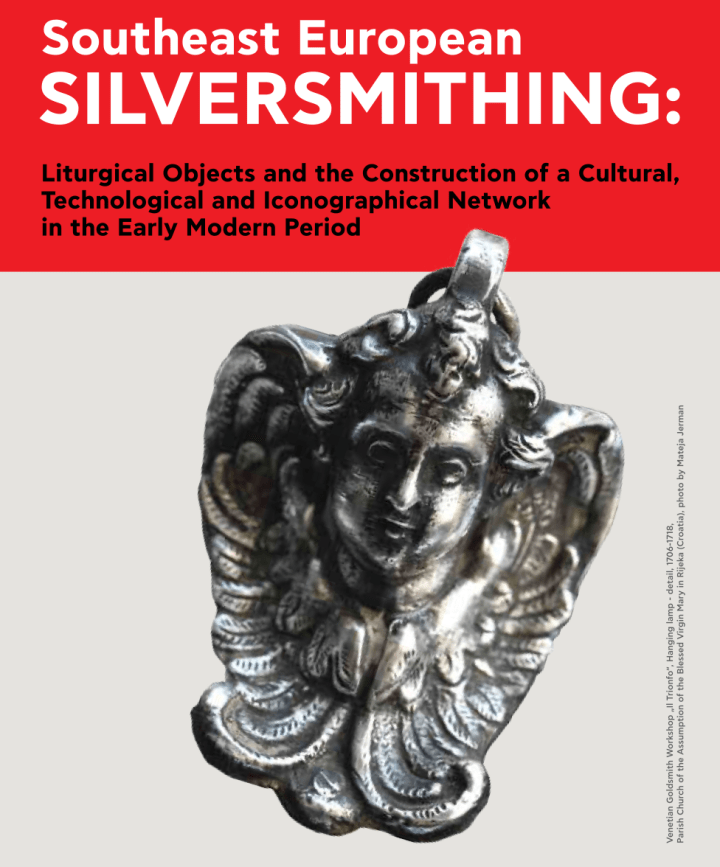 The international conference Southeast European Silversmithing: Artisans, Donors, and the Concept of Piety during the Early Modern Period will gather specialists studying sacral silver objects from the early modern period who, through their research, contribute to the field of applied arts with religious use. The scientific forum will enable the presentation of sacral silver objects still unpublished and unknown to the academic community. It will stimulate the comparative analysis of silversmiths’ works in wide geographic regions, which will also help improve the methodological means of their interpretation. A more meticulous approach to this field will represent a valuable contribution to art historical scholarship and a more comprehensive understanding of the visual culture of the early modern period.
Twenty-six specialists from prestigious organisations, universities, and cultural institutions from Austria, Armenia, Bulgaria, Greece, Italy, the Netherlands, Romania, the USA, Serbia, and Hungary will discuss issues related to the production and circulation of liturgical objects, as well as their role in shaping the pious image of the faithful in Southeastern Europe between the 15th and 19th centuries. The conference is organised within the framework of the project Liturgical Objects in the Context of Silversmiths’ Art during the Ottoman Period (Based on Materials from the Diocese of Plovdiv), funded by the Bulgarian National Science Fund, Ministry of Education and Science of the Republic of Bulgaria (contract No. КП-06-М80/2/7.12.2023).
Academic Committee
• Darina Boykina, PhD, Institute of Art Studies, Bulgarian Academy of Sciences, Bulgaria
• Mateja Jerman, PhD, Ministry of Culture and Media of the Republic of Croatia and Faculty of Humanities and Social Sciences, University of Rijeka, Croatia
• Vuk Dautović, PhD, University of Belgrade, Serbia
t h u r s d a y , 1 7 o c t o b e r
Institute of Ethnology and Folklore Studies with Ethnographic Museum, Bulgarian Academy of Sciences
9.30 Registration
10.00 Welcome
10.15 Constructing Piety
Chair: Vuk Dautović
• Dimitris Liakos — Constructing the Pious Image in Southeastern Europe at the Turn of an Era: Valuable Objects as Gifts to Athonite Monasteries from the 15th to the 16th Century
• Miljana Matić — Monks as Authors and Donors of Applied Art Objects (15th–17th Centuries) from the Serbian Orthodox Church Museum Collection
• Darina Boykina — Artisans’ Patronage: The Case of the Guild of Silversmiths in Tatar Pazardzhik during the Early Modern Period
11.30 Coffee Break
11.50 Personal and Collective Patronage
Chair: Teodor Lucian Lechintan
• Nikolaos Mertzimekis — The Silver Cover of the Gospel of Tsar Alexei Mikhailovich (1645–1676) in the Sacristy of the Iviron Monastery
• Paschalis Androudis — On a Pair of Candlesticks from the Metropolitan Church of Kastoria, 1708
• Nicoleta Bădilă — Donors’ Portraits from the Silver Liturgical Fans from Wallachia
• Nona Petkova — Examples of Faith and Community Belonging: Eucharistic Chalices from the National Church Museum of History and Archaeology in Sofia
13.30 Lunch
15.00 Influential Objects: Appearance and Morphology
Chair: Livia Stoenescu
• Mila Santova — Once Again about the Gospel Covers from the Teteven Monastery of Prophet Elijah (Teteven Gospel Covers from 1675)
• Georgi Parpulov — Two Romanian Ciboria at the Sinai Monastery
• Mariam Vardanyan — Innovative Tendencies in the Art of Armenian Book Binding: Myrophores Gospels Bindings
16.15 Coffee Break
16:30 Silver Objects as Emissary: Circulation, Diplomacy, and Gifts
Chair: Paschalis Androudis
• Mateja Jerman — Goldsmiths’ Works as Gifts to Our Lady of Trsat (Croatia)
• Milena Ulčar — Collective Patronage of St. Tryphon’s Head Reliquary in Venetian Kotor
• Arijana Koprčina — Gifts of Bishop Emerik Esterházy to Zagreb (Arch)diocese
• Francesca Stopper — La Serenissima and the Papal States: Liturgical Objects as Diplomatic Gifts in the 18th Century
f r i d a y , 1 8 o c t o b e r
Institute of Art Studies, Bulgarian Academy of Sciences
9.30 Patrons and Silversmith Creating Visual Culture
Chair: Darina Boykina
• Dragoş Năstăsoiu — Cross-confessional Artistic Negotiation: Transylvanian Saxon Silversmith Masters and Their Orthodox Patrons in 14th to 17th-Century Wallachia and Moldavia
• Teodor Lucian Lechintan — On Some Early Modern Silver Revetments of Romanian Icons: Donors, Techniques, Horizons
• Vuk Dautović — Silver Votive Offerings of 19th-Century Serbian Rulers: Shaping Church Visual Culture and their Role in Changing Cultural Models
10.45 Coffee Break
11.00 Silversmithing Centers and Production of the Liturgical Object
Chair: Mila Santova
• Stavroula Sdrolia, Paschalis Androudis — 17th-Century Goldsmiths’ Enamelled Production in Thessaly
• Barbara Kamler-Wild — Silversmithing in Vienna in the Golden Age of Empress Maria Theresia
• Livia Stoenescu — To Be Worth a Potosí: Mines, Wealth, and Global Crafting of Silver Liturgical Objects in Early Modernity
12.15 Coffee Break
12.30 Silver Embodying Sanctity
Chair: Milena Ulčar
• Konstantinos Dolmas — Like a Second Skin: The Head-Reliquary of St. Kliment of Ohrid
• Simeon Tonchev — The Reliquary from the Church ‘Mother of God the Fountain of Life’ in Svilengrad and Its Context
13.20 Lunch
15.00 Imagery and Iconography
Chair: Mateja Jerman
• Anna Mária Nyárádi — Images Between the Latin and Greek Worlds. Prints and Book Illustrations as Models for Gospel Covers
• Iglika Mishkova — Bread Stamps
• Carmen Tănăsoiu — Behold the Lamb of God: About a Certain Iconographic Type Found on Diskoi from the Collection of the National Museum of Art of Romania
• Ruth Bryant — Analyzing the Torah Shield: Understanding the Abundance of Animal Imagery through the Zohar
16.45 Closing Remarks
Lecture | Jussi Nuorteva on August Philip Armfelt in England, 1790–91
From the Society of Antiquaries:
Jussi Nuorteva | A Swedish-Finnish Antiquarian and Military Officer in England
Online (via YouTube), Society of Antiquaries of London, 14 October 2024, 1.30pm

August Philip Armfelt, ca. 1830 (Wiurila Manor, Halikko, Finland).
Discover the life of Baron August Philip Armfelt (1768–1839), Aide-de-Camp of the Swedish King Gustaf, and hear about his adventures during a trip to England in 1790–1791.
Free poster display on the ground floor of the Society’s Burlington House premises, 10am–4pm each day:
Tuesday, 15 October
Wednesday, 16 October
Thursday, 17 October
Friday, 18 October
During this period, the connection between Sweden and France had been close, but those ties were broken in the French Revolution of 1789. Afterward, new connections arose between Britain and Sweden. Britain was concerned about the rising power of Russia in the Baltic Sea area, crucial for import of tar and iron—essential materials in shipbuilding. Sweden, where Finland had been part of since 12th century, was the most important producer of these goods. Thus, new relations were formed.
While in England, August Philip Armfelt met many interesting people, not only the royals. His autobiography, around which the exhibition is built, tells of his various meetings and conversations with many other areas of the society. Armfelt met people like Goodfellow, the Swedish artist Elias Martin (one of the early academicians of the Royal Academy of Arts), and abolitionists like John Wedgwood and Swedish Carl Bernhard Wadenström. Sadly, Armfelt’s travels lasted only until 1792, when Swedish King Gustaf III was murdered by his opponents and a block of noble men took the power.
Live-streamed and open to anyone to join online, the lecture forms part of a series of events organised by the Embassy of Sweden in London and the Embassy of Finland in London, with the support of Samfundet Ehrensvärd, Medical Counsellor Sakari Alhopuro, Stiftelsen Tre Smeder and the Kalevi Kuitusen Foundation.
The YouTube link is available here»
Jussi Nuorteva was National Archivist of Finland until his retirement in 2022. He is a member of the Finnish Academy of Science and Letters, as well as Chancellor of the Orders of the White Rose of Finland and the Lion of Finland.
New Book | Goya’s Caprichos in Nineteenth-Century France
From CEEH:
Paula Fayos Pérez, Goya’s Caprichos in Nineteenth-Century France: Politics of the Grotesque (Madrid: Centro de Estudios Europa Hispánica, 2024), 544 pages, ISBN: 978-8418760204, €56.
 The impact of Goya’s oeuvre and particularly of the Caprichos (1799) on nineteenth-century French art was immense, long lasting, and multifaceted. Whereas in Spain Goya was associated with the work he produced as court painter, in France he became known as the author of the Caprichos, interpreted by the Romantics as a lampoon of late eighteenth-century Spain. This vision overlooked the fact that the true modernity of Goya’s work lies in its universalism, as a mirror reflecting the essence of humankind, unfettered by patriotism—this is also true of his monsters and witches, which are nothing more than the deformed reflection of humans. It could be argued that this was a two-way influence: Goya contributed to shape French Romantic art—and thus the beginning of modern art—and the Romantics in turn modelled his critical image. This study challenges the established interpretation of the Spanish artist that has dominated the scholarship until recently, based on Romantic stereotypes, many of which have been perpetuated to this day.
Goya became known in the French market—the main receptor of his work—through his graphic oeuvre. This was promoted by artists, critics and collectors such as Charles Yriarte, Paul Lefort, and Eugène Piot, most of them in association with the Spanish artist and dealer Valentín Carderera. Goya’s influence can be divided into two broad categories: aesthetics and politics. On the one hand, artists of the Romantisme noir—focusing on the taste for the grotesque and the literary vision of Spain—saw Goya as the last representative of the Spanish School. On the other, the political impact of his work can be appreciated in the satirical prints produced by artists such as Honoré Daumier and J. J. Grandville, who held him to be a politically engaged caricaturist who fought against censorship and mocked the aristocracy and the clergy. The case of Eugène Delacroix offers the richest example of Goya’s impact on nineteenth-century French art, here backed up by a catalogue of forty of his copies after the Caprichos, some of them hitherto unpublished.
Paula Fayos Pérez received a PhD in History of Art from the University of Cambridge in 2019 with a dissertation on the influence of Goya on nineteenth-century French art and literature. She worked as a researcher in the Duke of Wellington’s private collection at Apsley House (London) and Stratfield Saye House (Hampshire). Before receiving a ‘Leonardo’ scholarship from the BBVA Foundation she held a ‘Margarita Salas’ postdoctoral fellowship to teach and conduct research at the Universities of Strasbourg and Madrid (Complutense). In 2023 she organised the international seminar Goya: grotesco / coleccionismo. She has written articles for The Burlington Magazine (2019, 2020), Boletín del Museo del Prado (2022), and Print Quarterly (2023).
c o n t e n t s
Note to the Reader
Acknowledgements
Introduction
I | The Spread of Goya’s Œuvre in the French Art Market: Presentations, Viewers, and Collectors
• First Period (1799–1828): Goya’s Lifetime
• Second Period (1828–1854): The Dealing of Javier Goya
• Third Period (1854–1870): The Dealing of Valentín Carderera
• Fourth Period (1870–1900): Major Auction Sales and Collections
II | The Caprichos and Romantic Aesthetics: Goyaesque Spain and the Grotesque in Prints and Literature
• The Romantic Interpretation of Goya
• Romantic Literature and Illustration Inspired by Goya
III | Political Bigotry and Social Mœurs: Caricature, Censorship, and Democracy
• Goya as a Political Artist
• Political Caricature, Censorship and Democracy
• From Political to Social Criticism
IV | ‘Tout Goya palpitait autour de moi’: The Case of Eugène Delacroix
• A Self-proclaimed Classicist
• Goya’s Influence on Delacroix
• Delacroix’s Copies after the Caprichos
• Quotations or ‘Inspired Originals’ after the Caprichos
• Original Works Indirectly Influenced by Goya
V | Conclusion
• The Everlasting Influence of Goya
• Censorship and the Power of Caricature
• Future Research Threads
• The Fine Line between Admiration and Fabrication
Appendices
1 Goya’s Etchings and Lithographs: Series and Single Prints
2 Goya Mentions in French Literature (1771–1900)
3 Catalogue of Eugène Delacroix’s Works after Goya’s Caprichos (c. 1819–1827)
4 Copies by Capricho
List of Illustrations
Bibliography
Goya Works
Index
Illustration Credits
Call for Papers | Conservation through the Centuries
From the Call for Papers:
Matters of Knowledge: Paradigms and Practices of Conservation through the Centuries
Les matières du savoir: Paradigmes et pratiques de la conservation à travers les siècles
Université de Neuchâtel, June 5–6 June 2025
Proposals due by 31 October 2024
Preservation and conservation, along with collecting and valuation, are pillars of any institution that holds a collection of cultural heritage. However, conservation is rarely the subject of analytical and reflexive discourse, researched in a historical perspective. Studies in museology, the history of collections, and even the history of science and technology, have offered their perspectives on why and how all kinds of material collections are preserved in institutions dedicated to conservation. Further, the professionals of these institutions are faced with their own questions about the state of their collections and the origins of the practices they execute in their daily work.
Increasingly, questions relating to collecting, the status of objects, how to show them, as well as exhibition devices have been investigated within academia and museums. Over the past two decades, this self-reflection of institutions has become the subject of exhibitions, which incorporate the multiple identities and status of certain objects or collections (and their possible reassignment) in relation to the institution’s history, its constitution, its values and the formulation of its practices. What is the impact of this renewed look on conservation and the professions related to it?
Research into the ways in which collections are built has highlighted both the voluntary and unintentional nature of their constitution. How have ideas and practices of conservation been articulated and perpetuated since the building of institutions and the formalization of occupations related to collecting, whether within disciplinary or thematic museums, cabinets, libraries or even botanical gardens?
As part of the SNSF project Libraries and Museums in Switzerland (https://www.biblios-musees.ch/), a two-day conference will be held on June 5th and 6th, 2025, focusing on all these dimensions of the conservation of important collections since their founding. This event will bring together academic, scientific and professional circles, while providing an opportunity for theoretical reflection and case studies. It will take a global approach to the phenomenon, focusing primarily on the period between the 17th and the end of the 19th century. However, papers focusing on the 20th century will be welcome, if they engage with the past.
The following themes will be explored:
• Object trajectories and typologies: redefinitions and taxonomy; functionality and instruments; hybrid objects
• Genius loci and the diversity of collections: cabinets, museums, libraries, archives, botanical gardens, etc.; the vagaries of material history: moving, finding, relisting, etc.
• Conservation devices and the ‘spectacle of order’: containers, display cases, storage methods
• Nomenclature(s)
• Inventories, catalogues, ‘paper technologies’: When and why are inventories and catalogues drawn up? What classification criteria were applied? How did such systems contribute to conservation?
• Dematerialization of material history: digital measures and databases
• Theorizing conservation: historiography; methods, sources and models; traditions and innovation
• Individuals and institutions: curators (a profession that did not have a name); disciplines, professionalization; weight of politics; organization and evolution of public service
• Loss, sorting, destruction: criteria and challenges of ‘conscious’ conservation
Proposals—in French, German, Italian, or English—should not exceed 300 words. In addition to your abstract, please submit a short CV (1–2 pages). Please email your proposal by 31 October 2024 to Valérie Kobi (valerie.kobi@unine.ch) and Chonja Lee (chonja.lee@unine.ch). Notifications will be sent in November 2024.
New Book | The Dominion of Flowers
From Yale UP:
Mark Laird, The Dominion of Flowers: Botanical Art and Global Plant Relations (London: Paul Mellon Centre for Studies in British Art, 2024), 277 pages, ISBN: 978-1913107451, £35 / $50.
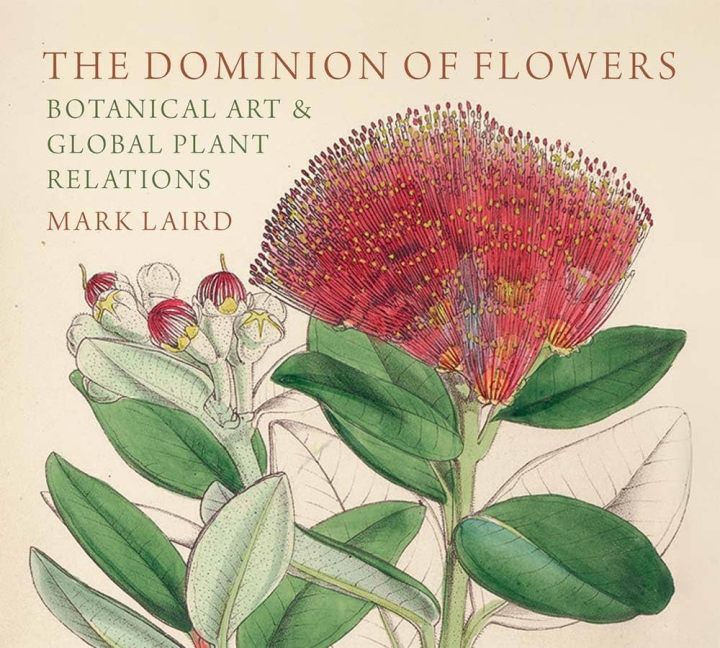 How a wave of exotic botanical imports from across Britain’s empire shaped its gardens and psyche
Between 1760 and 1840, exotic plants were imported from across Britain’s empire and were lavishly depicted in periodicals and scientific treatises as specimens collected alongside other objects of natural history. Mark Laird’s provocative new book—part art history, part polemic—weaves fine art, botanical illustration, and previously unpublished archival material into a political and ethical account of Britain’s heritage, showing how plants were not only integral to English gardens of the Georgian and Victorian eras but also to British culture more broadly. The Dominion of Flowers shines with captivating cross-cultural plant stories. The book opens with the Seymers’ exotic Butterflies and Plants and Pulteney’s catalogue of Dorset’s native wildflowers. It then moves to the German artist John Miller and his illustrations for Lord Bute’s Botanical Tables and concludes by tracing Britain’s fascination with New Zealand’s unique flora, first depicted in Mary Delany’s collages. Copiously illustrated with almost two hundred works, and drawing on Laird’s genealogical research into his own family’s colonial past, this volume foregrounds Indigenous ideas about ‘plant relations’ in a study that brings the trans-oceanic movement of plants and people alive.
Mark Laird is professor emeritus at the University of Toronto and former faculty member at Harvard University. He is the author of The Flowering of the Landscape Garden and A Natural History of English Gardening—recipient of an Elisabeth Blair MacDougall Award. He has been historic planting consultant to Painshill Park Trust, English Heritage, and Strawberry Hill Trust.
Artists in Conversation | Flora Yukhnovich
This evening from YCBA:
Artists in Conversation | Flora Yukhnovich
In-person and online, Hastings Hall, Yale School of Architecture, New Haven, 1 October 2025, 6pm

Flora Yukhnovich, photo by Kasia Bobula.
Flora Yukhnovich will talk to Eleanor Nairne, the Keith L. and Katherine Sachs Curator of Modern and Contemporary Art, the Philadelphia Museum of Art. Watch the livestream here.
The Artists in Conversation series brings together curators and artists to discuss artistic practices and insights into their work.
Born in 1990 in Norwich, UK, Flora Yukhnovich developed her characteristic painting language while studying at City and Guilds of London Art School, where she completed her MA in fine art in 2017. She also studied portraiture at the Heatherley School of Fine Art in London. Yukhnovich’s art boldly explores materiality and process as vehicles for meaning, with cascading and swirling forms that evoke rhythm and energy, flowing between representation and abstraction. Her immersive paintings splice historic styles, from French rococo and Italian baroque to abstract expressionism, with references drawn from contemporary films, music, literature, and consumer culture. Through her work, Yukhnovich addresses dynamics of power inherent in received readings of art-historical subjects and their associated hierarchies. She questions notions of femininity and gender that are hard-wired into the aesthetic language of color and form.
Yukhnovich received the Elizabeth Greenshields Foundation Award in 2013 and 2016. She has participated in group and solo exhibitions worldwide. Her work is included in many collections, including the Hirshhorn Museum, Washington, DC; the Montreal Museum of Fine Arts; the Roberts Institute of Art, London; and the National Gallery of Victoria, Melbourne. She lives and works in London.
Eleanor Nairne is the Keith L. and Katherine Sachs Curator of Modern and Contemporary Art and department head, modern and contemporary art, at the Philadelphia Museum of Art. Previously, she was the senior curator at Barbican Art Gallery, London, where her exhibitions included Basquiat: Boom for Real (2017), Lee Krasner: Living Colour (2019), Jean Dubuffet: Brutal Beauty (2021), Soheila Sokhanvari: Rebel Rebel (2022), Alice Neel: Hot Off The Griddle (2023), and Julianknxx: Chorus in Rememory of Flight (2023–24). She also curated Erotic Abstraction: Eva Hesse / Hannah Wilke (2021) at Acquavella Galleries in New York.
New Book | Carlo Maratta Catalogue Raisonné
From Ugo Bozzi Editore (as noted at Art History News) . . .
Stella Rudolph and Simonetta Prosperi Valenti Rodinò, Carlo Maratti (1625–1713) tra la magnificenza del Barocco e il sogno d’Arcadia. Dipinti e disegni (Rome: Ugo Bozzi Editore, 2024), 2 volumes, 1260 pages, ISBN: 978-8870030693, €480.
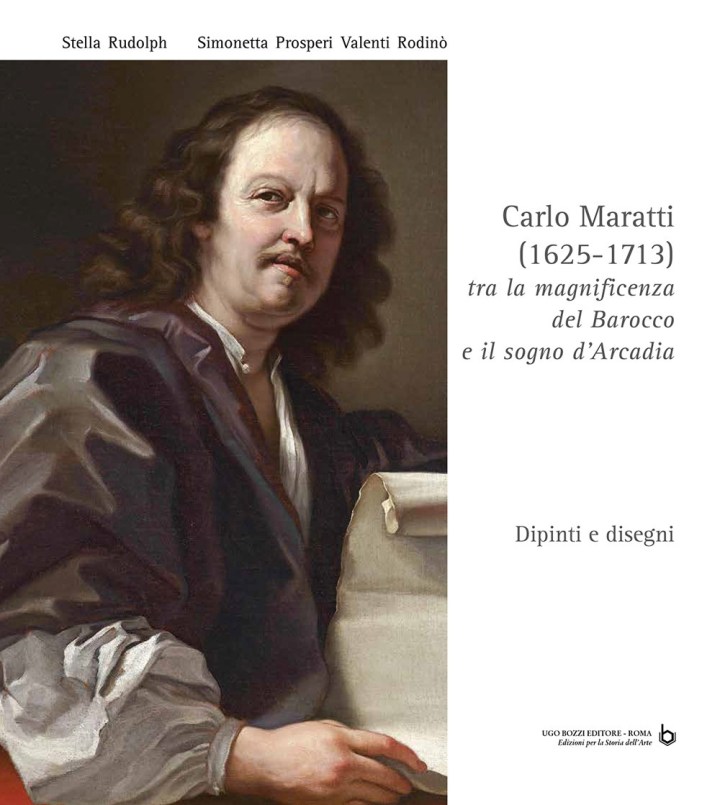 Il noto pittore Carlo Maratti (1625–1713), attivo a Roma per più di 60 anni, raggiunse una grande fama in vita, conteso da papi, cardinali, mecenati, collezionisti, milord venuti in Italia per il Grand tour e regnanti di tutt’Europa. Di contro a questa notorietà, gli studi storico-artistici a lui dedicati sono oggi limitati ad alcuni articoli e a due convegni, tenutisi a Roma nel 2013 e 2014 in occasione della ricorrenza della morte. La monografia a lui dedicata, qui presentata ed avviata da anni, restituisce la posizione di leader raggiunta dal pittore a Roma nella seconda metà del Seicento, mettendo a fuoco il ruolo fondamentale da lui svolto nell’ambiente artistico della città, divenendone protagonista assoluto dopo la scomparsa di Cortona (1669) e Bernini (1680). Artista prediletto di ben sette papi, Maratti fornì numerose pale d’altare in varie chiese romane, affreschi nei palazzi Altieri e del Quirinale, e quadri di soggetto sacro e mitologico inviati in tutta Italia e all’estero su commissione dei re di Francia, di Spagna e degli Absburgo. Maratti fu anche un assiduo ed elegante disegnatore, ne è prova la sua ricchissima produzione grafica, che ammonta a più di duemila fogli autografi, divisi nei nuclei più consistenti nel Kunstpalast di Düssseldorf, nella Real Academia di Madrid, nella Royal Library di Windsor e in molti altri.
In seguito a quattro anni di intenso lavoro, la Redazione della Ugo Bozzi Editore è dunque lieta di annunciare la pubblicazione in due volumi della tanto attesa monografia sull’artista, curata dalle due maggiori esperte sull’argomento, Stella Rudolph per i dipinti e Simonetta Prosperi Valenti Rodinò per i disegni. Oltre 1.000 riproduzioni di cui oltre 900 a colori, oltre 1250 pagine.
Il lavoro di Stella Rudolph, nota studiosa inglese scomparsa nel maggio 2020, che ha dedicato 30 anni a questo progetto senza riuscire a completarlo, ma producendo numerosi saggi su Maratti, è stato ultimato e aggiornato da Simonetta Prosperi Valenti Rodinò, cui si deve la catalogazione dei disegni afferenti ai dipinti e la redazione di ulteriori sezioni sull’attività di Maratti come progettista di statue, oggetti di argenteria, ritratti e caricature, illustrate da disegni di grande qualità esecutiva.
Conference | Marble as Device
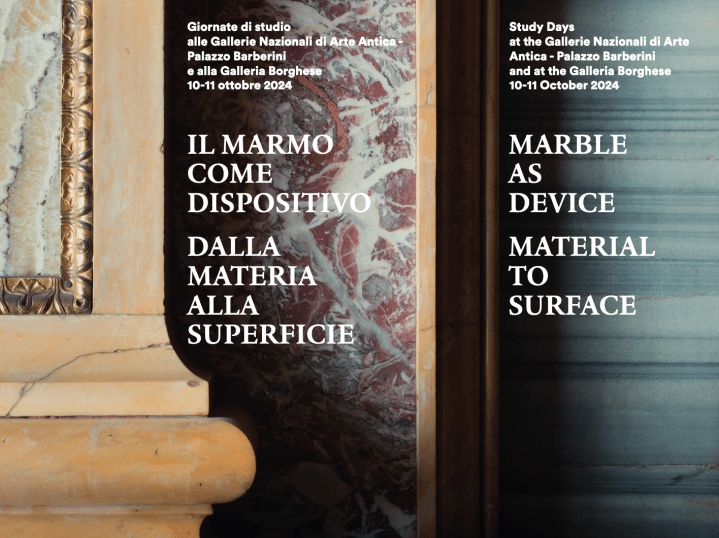
From the conference programme and ArtHist.net:
Marble as Device: Material to Surface / Il Marmo Come Dispositivo: Dalla Materia alla Superficie
Gallerie Nazionali di Arte Antica –Palazzo Barberini / Galleria Borghese, Rome, 10–11 October 2024
Organized by Adriano Aymonino, Geraldine Leardi, and Ariane Varela Braga
DAY 1 | Marble offers the ideal medium to investigate human dexterity in combining materiality and immaterial meanings. Frequently studied from various perspectives—from quarry extraction, distribution networks, and processing techniques, to aesthetic values and socio-cultural or olitical uses—more recently marble has been analysed as a powerful expressive medium straddling iconicity and aniconism, structure and ornament. Following on from the inaugural NeReMa meeting held in Rome in 2021, this study day will bring together international scholars to reflect on the theme of marble as ‘device’, a notion that allows an interdisciplinary approach to the study of this transversal artistic and architectural medium in the Mediterranean-European world: from the more concrete aspects of setting up the material components, to the intrinsic and expressive qualities of marble surfaces.
DAY 2 | ‘Device’ is a complex word, rich in possibilities, which allows broad interpretative approaches. The first part of this second study day will therefore be devoted to two less conventional subjects in the field of marble studies: ‘marbles and stones on paper’, focusing on an analysis of the famous manuscript Study of Many Stones by Pier Leone Ghezzi (1726), along with a discussion of works by contemporary artists who employ marble, or its conceptual bearings, as a ‘device’ for their creativity. The afternoon session will start with a roundtable addressing the launch of the volume La Galleria Borghese nei suoi marmi: Materia Colore Superficie (Allemandi), followed by a presentation of an ongoing digital project on ancient marbles and stones led by the Galleria Borghese. The day closes with a tribute to Raniero Gnoli, the founding father of modern studies on ancient marble, and a tour of the Galleria Borghese.
Registration is available through Eventbrite.
t h u r s d a y , 1 0 o c t o b e r
Gallerie Nazionali di Arte Antica –Palazzo Barberini
9.00 Registration
9.30 Francesca Cappelletti and Geraldine Leardi — Welcome and Introduction
10.00 Struttura e Forma / Structure and Form
Modera: Alessandro Poggio
• Rafael Rosenberg — Book-Matching: Why Are Stone Slabs Laid Symmetrically, and since When?
• Ruggero Longo — Materia e forma: Superfici marmoree nel Mediterraneo medievale
• Silvia Pedone — ‘Le parole e i marmi’: Estetica e colore a Bisanzio
11.30 Pausa Caffè
12.00 Teoria e Percezione / Theory and Perception
Modera: Daniela del Pesco
• Joris van Gastel — Le piume del pavone: Verso un’estetica della ricezione del commesso marmoreo napoletano
• Marthe Kretzschmar — „Je feiner das Korn ist, desto vollkommener ist der Marmor“: Winckelmann’s Description of Marble between Aesthetics and Mineralogy
13.30 Pranzo
15.00 Materia e Superficie / Materiality and Surface
Modera: Sara Bova
• Vitale Zanchettin — Michelangelo, le verità della pietra: Architetture oltre la superficie
• Grégoire Extermann — Importazione o continuità? Il dispositivo ‘romano’ della Casa de Pilatos a Siviglia
16.00 Pausa Caffè
16.30 Trasformazione e Display / Transformation and Display
Modera: Anna Frasca-Rath
• Christine Casey — From Mountainside to Fireside: Supplying and Working Marble for the British Interior, 1700–1770
• Ariane Varela Braga — Il marmo in mostra tra fine Ottocento e inizio Novecento
f r i d a y , 1 1 o c t o b e r
Galleria Borghese
10.00 Registration
10.20 Francesca Cappelletti and Geraldine Leardi — Welcome and Introduction
10.30 Nicola Samorì — Mal di pietra: Il corpo minerale tra geodi e fratture
11:00 Jo Stockham — Fluid Rock, Marble Stilled
11.30 Pausa Caffè
12.00 Adriano Aymonino — Rappresentare le pietre di Roma: Marmi su carta nel Settecento
12.30 Paolo Bertoncini Sabatini — Materia e significato: Il marmo in termini estetici e progettuali nell’allestimento di mostre temporanee
13.30 Pranzo
15.00 Tavola Rotonda | Presentazione del volume La Galleria Borghese nei suoi marmi. Materia Colore Superficie, a cura di Geraldine Leardi
Intervengono: Fabio Barry, Dario Gamboni, Lorenzo Lazzarini, Sophie Mouquin
17.00 Pausa Caffè
17.30 Geraldine Leardi e Adriano Aymonino — Presentazione del progetto di un database su litoteche storiche e marmi antichi
18.00 Proiezione del documentario | Le Pietre e le Parole: Ritratto di Raniero Gnoli, di Adriano Aymonino e Silvia Davoli + Q&A
18.30 Tour per conoscere i marmi della Galleria Borghese con Geraldine Leardi e Lorenzo Lazzarini
Conference | The Roman Drawings of Charles Percier
From ArtHist.net:
The Rome Drawings of Charles Percier and their Afterlife
Online and in-person, Zentralinstitut für Kunstgeschichte, München, 18–19 October 2024
Organized by Georg Schelbert and Sabine Frommel

Charles Percier, Unidentified Villa (Paris: Bibliothèque de l’Institut de France, MS 1008 fol. 2r num. 3).
Charles Percier (1764–1838) was one of the most influential architects and architectural theorists in France in the decades before and after 1800. In addition to his formative role as Napoleon’s architect, together with Pierre François Léonard Fontaine, his influence lies above all in his teaching activities, from which pupils such as J. Hittorf, P. Letarouilly, and A. de Montferrand emerged.
As in the case of many other European architects of the multifaceted 19th century, his personal experience of art and architecture in Italy was fundamental to his work. Honoured with the grand prix of the Académie royale d’Architecture, Percier stayed in Rome from 1786 to 1791, studying important architectural monuments there and in the surrounding area. He used his return journey on foot to Paris to familiarise himself with the architecture of central and northern Italy. During this time, he created a total of around 2000 drawings, a wide-ranging documentation that reflects the influence of new compositional methods and served both for his own training and as model material, and as such fulfilled a didactic function.
This largely unpublished material clearly reveals Percier’s comprehensive view, which encompasses architecture, sculpture, ornament, and gardens and spans a broad chronological horizon from antiquity to contemporary art at his time. These experiences flowed into an architectural theory that he anchored primarily in Roman palace construction. Conference contributions will shed light on various aspects of his oeuvre, primarily on the basis of drawings from his Roman period. Talks will also call attention to Percier’s European significance, which is also reflected in projects in the Polish lands and, not least, in the fact that the visual appearance of the young kingdom in Bavaria was placed in the hands of Napoleon’s architect.
The conference is part of a larger programme of work on the publication of Percier’s drawings made in Italy, most of which are in the Institut de France. The volumes Emilia e Romagna (2016) and Toscana, Umbria e Marche (2021) have already been published in the series I disegni di Charles Percier. Organized by Georg Schelbert (Zentralinstitut für Kunstgeschichte) and Sabine Frommel (EPHE-PSL, Paris), the conference will be held in English, Italian, French, and German. Please send questions to percier@zikg.eu.
The event will be broadcast in parallel via Zoom. Recording of the event or parts of the event as well as screenshots are not permitted. By participating, you accept these terms of use.
f r i d a y , 1 8 o c t o b e r
12.30 Registration
13.00 Introduction
• Sabine Frommel (EPHE-PSL, Paris) and Jean-Philippe Garric (Panthéon Sorbonne, Université Paris 1)
13.30 Section 1 | Percier in Rome — Villas and Gardens: Nature, Ornament, and Architecture
Chair: Christine Tauber (Zentralinstitut für Kunstgeschichte, Munich)
• Sabine Frommel (EPHE-PSL, Paris) — Lo sguardo del Rinascimento nei disegni di Charles Percier
• Alberta Campitelli (Vice President Associazione Parchi e Giardini d’Italia, Rome) — Ville e giardini del Grand Tour: un itinerario d’obbligo
• Alessandro Cremona (Sovrintendenza Capitolina, Rome) — Non solo ‘célèbres maisons de plaisance’: le ville e i giardini ‘minori’ nei taccuini di viaggio di Charles Percier
15.00 Coffee break
• Steffi Roettgen (Ludwig Maximilians-Universität Munich) — Zeichnungen zur Villa Albani und deren Antiken
• Susanna Pasquali (Università La Sapienza, Rome) — Roman Villas and Gardens in the Drawings by Hubert Robert, Pierre Adrien Pâris, and Charles Percier (1750–90)
• Iris Lauterbach (Zentralinstitut für Kunstgeschichte, Munich) — Les jardins de Rome vues par l’Europe: Les dessins de Percier dans leur contexte
18.15 Keynote Lecture
• Jean-Philippe Garric (Panthéon Sorbonne, Université Paris 1) — Learning by Drawing: The Albums of Charles Percier at the Institut de France
s a t u r d a y , 1 9 o c t o b e r
9.00 Section 2 | Percier and Europe
Chair: Sabine Frommel (EPHE-PSL, Paris)
• Mario Bevilacqua (Università La Sapienza, Rome) — Percier Reads and Corrects Piranesi: The Drawings of the Priorato
• Georg Kabierske (Philipps-Universität Marburg) — Drawing, Copying, and Collecting Architectural Ornaments in Rome: The Generation of Percier and Before
• Georg Schelbert (Zentralinstitut für Kunstgeschichte Munich) — Charles Percier and Prussia: Ludwig Theodor Liman
11.00 Coffee break
• Sabina de Cavi / Hélder Carita (Universidade Nova, Lisbon) — The Quinta da Praia: New Drawings by Charles Percier for a Villa in Belèm (1815)
• Pawel Migasiewicz (Instytut Sztuki, Polska Akademia Nauk, Warsaw) — Architectural Drawings by Charles Percier, Pierre François Léonard Fontaine, and Alexandre Dufour for Polish Patrons
• Hans Ottomeyer (Munich) — Das Königreich Bayern: Percier und die Folgen
13.30 End










 Enfilade
leave a comment