Williamsburg Acquires Green Frog Plate and Related Print

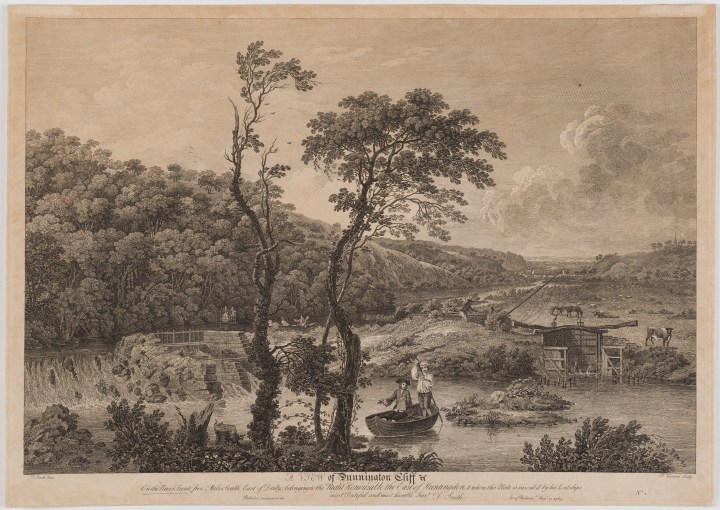
Plate, Wedgwood and Bentley, Etruria, Staffordshire (made in) and Chelsea (decorated in, 1773–74, creamware, OH: 7/8” OH 9-7/8” (Williamsburg: Museum Purchase, The Friends of Colonial Williamsburg Collections Fund, 2024-241). View of Dunnington Cliff on the River Trent, engraved by Francois Vivares after work by Thomas Smith, London, 1745, etching and line engraving on laid paper (Williamsburg: Museum Purchase, The Friends of Colonial Williamsburg Collections Fund, 2024-242).
◊ ◊ ◊ ◊ ◊
From the press release (16 December 2024) . . .
A rare pair of related 18th-century objects were recently acquired by The Colonial Williamsburg Foundation: a creamware plate, made by Josiah Wedgwood in 1773–74 as part of a service commissioned by Catherine the Great to be used at her castle, La Grenouillère or Kekerekeksinen (Frog Marsh); and a fine copy of a 1745 print engraved by François Vivares after work by Thomas Smith. The print depicts Dunnington Cliff on the River Trent in England, which is the motif seen in the center of the plate. By adding the plate to its ceramics collection, the Foundation becomes one of the few American institutions to own a surviving piece from this famous dinner service.
“Colonial Williamsburg’s collection of British-made ceramics is one of the finest in the United States,” said Ronald Hurst, the Foundation’s senior vice president and chief mission officer. “The acquisition of this plate and its printed design source brings new prominence to the collection. We are deeply grateful to the Friends of Colonial Williamsburg Collections for funding both purchases.”

Royal patronage within England and abroad helped Josiah Wedgwood secure a well-respected reputation as a manufacturer of ceramics for all levels of society. Catherine the Great of Russia was a patroness who commissioned two dinner services from his firm; the Frog Marsh service was the second. It encompassed an astounding 952 pieces, each of which was hand painted in monochrome with distinct views of England and bore a splayed frog within a shield to signify the name of the palace for which it was made. To this day, the service remains the most ambitious endeavor by a British ceramics manufacturer. It was more than a mere dinner service; it was a symbol of British diplomacy and shared with the larger world all that England could offer from ancient architectural ruins to imposing country homes in bucolic landscapes to industrial achievements, such as the view of Dunnington Cliff on River Trent shown on this plate. It also symbolizes the importance of the Baltic region in British and American trade in the 18th and early 19th centuries as well as the production of ceramics through the plate’s central image.
“This plate will be very much at home alongside other important Wedgwood-made holdings already in Colonial Williamsburg’s ceramic collection, including a prized Portland vase and a piece from the Husk service, the earlier service commissioned by Catherine the Great,” said Angelika Kuettner, Colonial Williamsburg’s curator of ceramics and glass. “This Green Frog service plate provides so many layers of interpretation for us. Other pieces from the service depicting grand houses are truly lovely, but this example allows us to talk about waterpower in the 18th century and ceramic production, not to mention Wedgwood’s industrial and entrepreneurial influence throughout the world.”
The plate’s molded rim is painted with a meandering oak leaf and acorn border interrupted by a shield enclosing a green painted splayed frog. The cavetto is painted with a neoclassical, scalloped border between concentric lines. The plate’s well is painted with a bucolic scene of a lock on a river, grazing cattle in the background, a sailing vessel on the meandering waterway, and a church spire painted faintly in the distance. The reverse bears a black enamel painted number ‘221’ and an impressed circle.
Of the pieces in the original dinner service, the majority remain in Russia today and have been there since their delivery in the 18th century. A few pieces were not sent and were divided between Wedgwood’s Etruria manufactory and Alexander Baxter, the agent for the purchase. To date, there are 26 extant pieces known that were not delivered to Catherine the Great because, as Wedgwood noted, they were either duplicates or considered by Wedgwood not up to his high standard of quality. Of those, 17 are in museum collections, only 5 of which are in American museums. This acquisition brings that number to 6 in museums in the United States; the remaining 8 pieces are still privately owned.
The view of Dunnington Cliff, located southeast of Derby, is significant as it was the site of King’s Mills, Britain’s largest water-powered manufacturing area in the mid-18th century and home to numerous mills associated with a variety of manufacturers, including flint grinding for the ceramic industry, paper making, iron forging and flour production. The representation of Dunnington Cliff on the plate comes from a 1745 print, View of Dunnington Cliff on the River Trent engraved by François Vivares after the painting on the subject by Thomas Smith. The opportunity for the Foundation to acquire both the source print with the hand-painted ceramic plate from the Frog Marsh service is significant.
“Together they tell an incredible story. Prints like this one were imported in the 18th century from England to decorate the walls of Virginia houses and also served as inspiration for an important dinner service used in a Russian Palace. Being able to show a printed design source alongside the ceramic plate helps us draw connections between mediums within the decorative arts,” said Katie McKinney, Margaret Beck Pritchard Curator of Maps & Prints
The lock at the center of the plate shows the same lock in the print. While the artists painting the plate adapted the print to the circular format, they maintained accuracy with great precision to include even the wispy clouds and a church spire seen faintly in the background.
Print Quarterly, December 2024
The long eighteenth century in the latest issue of Print Quarterly:
Print Quarterly 41.4 (December 2024)
a r t i c l e s
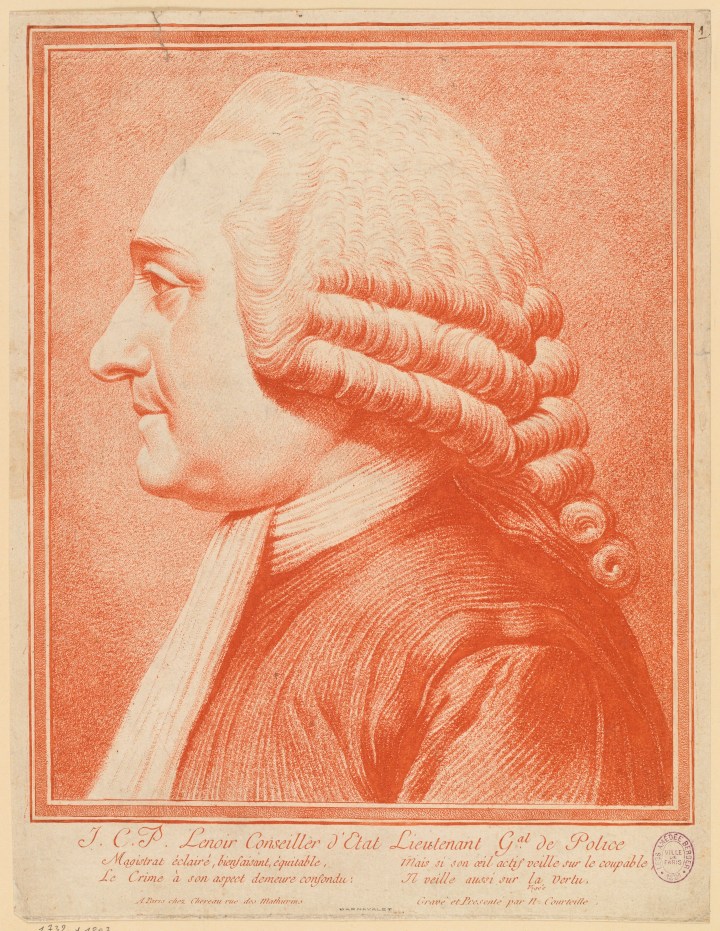
Nicholas de Courteille, presumably after Jean Pierre Bouch, Jean Charles Pierre Lenoir, 1779, soft-ground etching, 308 × 235 mm (Paris, Musée Carnavalet, Histoire de Paris).
• Dorinda Evans, “Jean Pierre Bouch, A Rediscovered Polymath”, pp. 394–407. This article attempts to compile the real identity and life story of the French artist Jean Pierre Bouch (1765–1820), whose diverse career included being a balloonist and pyrotechnician as well as portrait artist.
n o t e s a n d r e v i e w s
• Christian Rümelin, Review of Jean-Gérald Castex, ed., Graver pour le Roi: Collections Historiques de la Chalcographie du Louvre (Louvre éditions and Lienart éditions, 2019), pp. 434–37.
• Evonne Levy, Review of Bettina Wassenhoven, Gravuren nach Skulpturen – Skulpturen nach Gravuren (Konigshausen & Neumann, 2021), pp. 437–38.
• Simon McKeown, Review of Rosa de Marco and Agnès Guiderdoni, eds., Eliciting Wonder: The Emblem on the Stage (Librairie Droz, 2022), pp. 438–41.
• Clarissa von Spee, Review of Anne Farrer and Kevin McLoughlin, eds., The Handbook of the Colour Print in China, 1600–1800 (Brill, 2022), pp. 441–45.
• Nicholas JS Knowles, “The First British Caricature in Aquatint?,” pp. 445–47.
• Bénédicte Maronnie, Reviews of Chiara Casarin and Pierluigi Panza, eds., Giambattista Piranesi: Architetto senza tempo / An Architect out of Time (Silvana Editoriale, 2020); Moritz Wullen and Georg Schelbert, eds., Das Piranesi-Prinzip (E.A. Seeman Verlag, 2020); and Carolyn Yerkes and Heather Hyde Minor, Piranesi Unbound (Princeton University Press, 2020), pp. 469–73.
b o o k s r e c e i v e d
• Jennifer Milam and Nicola Parsons, eds., Making Ideas Visible in the Eighteenth Century (University of Delaware Press, 2021), p. 460.
• Ian Haywood, Queen Caroline and the Power of Caricature in Georgian England (Palgrave Macmillan, 2023), p. 460.
Exhibition | In Slavery’s Wake: Making Black Freedom
From the press release for the exhibition, recently covered by Jennifer Schuessler for The New York Times:
In Slavery’s Wake: Making Black Freedom in the World
National Museum of African American History and Culture, Washington DC, 13 December 2024 — 8 June 2025
Other venues will include museums in Belgium, Brazil, England, Senegal, and South Africa

The Smithsonian’s National Museum of African American History and Culture (NMAAHC) recently unveiled its first international touring exhibition, In Slavery’s Wake: Making Black Freedom in the World. Through powerful forms of artistic expressions, such as quilting, music and ironwork, the exhibition reveals healing traditions rooted in the resilience of enslaved people. Featuring more than 190 artifacts, 250 images, interactive stations, and newly commissioned artworks, In Slavery’s Wake offers a transformative space to honor these legacies of strength and creativity.
“This global exhibition is a profound journey through the African diaspora, reflecting on our shared history and envisioning a future shaped by resilience and freedom,” said Kevin Young, Andrew W. Mellon Director, Smithsonian National Museum of African American History and Culture. “It beautifully intertwines the past and present, inviting visitors to experience our heritage’s multilingual, multinational, and forward-looking spirit. This show reflects not just the impact of slavery but a celebration of the freedom-making efforts of the enslaved and abolitionists, embodying the humane and interconnected world we live in today.”
In Slavery’s Wake reckons with the impact of slavery and colonialism on present-day societies around the world and explores the often-overlooked efforts of the enslaved to force the end of slavery with legal emancipation and abolition as well as to provide a wellspring for descendants to draw upon to help create a better world for themselves and their communities through art, storytelling, music, protest, and communal healing. It delves into key questions about freedom and its expressions across six sections.
Organized by the National Museum of African American History and Culture’s Center for the Study of Global Slavery and the Ruth J. Simmons Center for the Study of Slavery and Justice at Brown University, the exhibition grew out of a decade-long collaboration between international curators, scholars, and community members who were committed to sharing stories of slavery and colonialism in public spaces. The collective worked across geographies, cultures, and languages, connecting the past and the present.
After its close in Washington, the exhibition will travel to museums in Belgium, Brazil, England, Senegal, and South Africa. Curatorial partners from each location contributed stories, objects and oral histories that reflect their local communities within this global history. It also incorporates a new collection of more than 150 oral histories filmed at each partner site, titled Unfinished Conversations. Voices from this international archive of everyday people’s memories and stories are featured throughout.
Paul Gardullo, Johanna Obenda, and Anthony Bogues, eds., with a foreword by Lonnie G. Bunch III, In Slavery’s Wake: Making Black Freedom in the World (Washington, DC: Smithsonian Books, 2024), 240 pages, ISBN: 978-1588347794, $40.
Call for Articles | Spring 2026 Issue of J18: Revolution
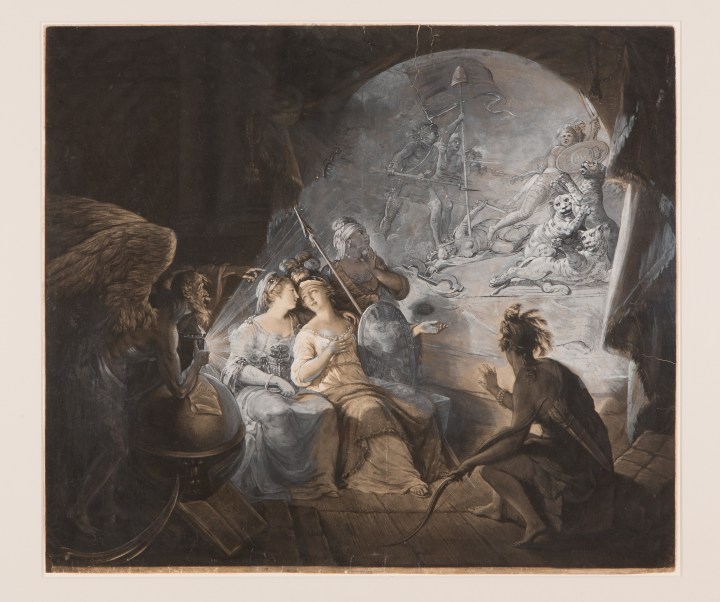
John Dixon, The Tea-Tax-Tempest (The Oracle), 1774, mezzotint with gouache, scratched proof; sheet (trimmed within plate), 52 × 59 cm
(New York: The Metropolitan Museum of Art, 83.2.2083).
◊ ◊ ◊ ◊ ◊
From the Call for Papers:
Journal18, Issue #21 (Spring 2026) — Revolution
Issue edited by Wendy Bellion and Kristel Smentek
Proposals due by 1 April 2025; finished articles will be due by 1 September 2025
July 2026 marks the 250th anniversary of the United States Declaration of Independence, a turning point in the American Revolution (1775–1783). The French Revolution (1789–1799), the Haitian Revolution (1791–1804), and the unsuccessful United Irishmen’s Rebellion (1798) followed in quick succession. For this commemorative year, this issue of Journal18 proposes to examine afresh the material and visual cultures of what historians have termed the ‘age of revolutions’.
Taking a cue from the Declaration itself—a document that interrogated the very practice (and malpractices) of representation—we invite new questions about familiar material. What images and objects, actors and artistic media, have been privileged and marginalized to date in art histories of revolution? How did visual and decorative images purporting to document the American Revolution both foreground and obfuscate the fundamental contradiction of a political freedom that depended on systems of enslavement, colonization, and Indigenous displacement?
The French revolutionary government officially promised liberty and equality for all, yet women were formally excluded from political life (while simultaneously benefiting from new measures that significantly increased their social welfare), and slavery continued until France was forced to end it, temporarily, in 1794. How were the asymmetries and inconsistencies of the French Revolution embedded or elided in its civic performances and its official and unofficial image-making campaigns, production of ephemera, and circulation of luxury goods? What about absences in the visual and material record?
How might new scholarship on the visual history of the Haitian Revolution—the most successful revolt of enslaved peoples in history—interrogate its comparative underrepresentation during the eighteenth century and within the discipline of art history, arguably contributing to what the Haitian scholar Michel-Rolph Trouillot described as its historical “silencing”? How might art history stretch beyond the Atlantic rim to consider the global contexts of the age of revolutions and the manifestations of revolution beyond Euro-America during this period?
We welcome proposals for contributions that engage these questions and related matters of revolutionary memory, violence, justice, absence, and reinvention. Submissions may take the form of full-length articles, shorter pieces focused on single objects, photo essays, interviews, or other formats.
Proposals for issue #21 Revolution are now being accepted. The deadline for proposals is 1 April 2025. To submit a proposal, send an abstract (250 words) and a brief biography to editor@journal18.org and smentek@mit.edu. Articles should not exceed 6000 words (including footnotes) and will be due for submission by 1 September 2025. For further details on submission and Journal18 house style, see Information for Authors.
Issue Editors
Wendy Bellion, University of Delaware
Kristel Smentek, MIT
New Book | Ange Laurent de La Live de Jully
From Lienart:
Marie-Laure de Rochebrune, ed., Ange Laurent de La Live de Jully (1725–1779): Un grand amateur à l’époque des Lumières (Paris: Lienart éditions, 2024), 488 pages, ISBN: 978-2359064186, €55. With contributions by Lionel Arsac, Géraldine Aubert, Colin Bailey (foreword), Vincent Bastien, Mathieu da Vinha, Patricia de Fougerolle, Mathieu Deldicque, Vincent Droguet, Alexandre Maral, Marc-André Paulin, Alexandre Pradère, Yohan Rimaud, and Xavier Salmon.
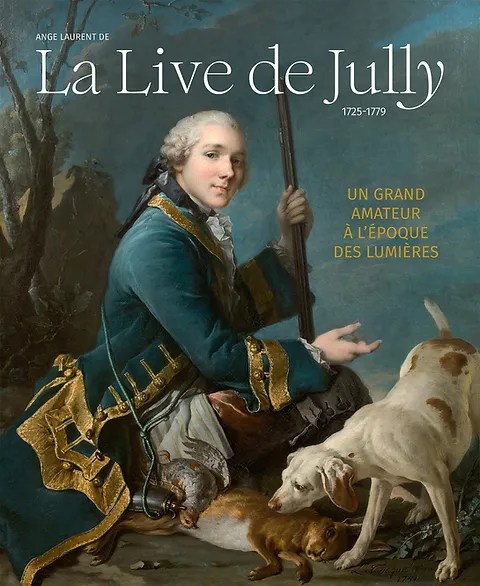 Ange Laurent de La Live de Jully (1725–1779) fut l’une des figures les plus brillantes et les plus attachantes du monde des grands amateurs français de la seconde moitié du XVIIIe siècle. Mécène et ami des artistes de son temps, collectionneur, graveur, musicien et historien, il fut élu, très jeune, membre honoraire ou associé libre de l’Académie royale de peinture et de sculpture, en raison de la qualité des collections qu’il avait réunies et aussi de ses capacités artistiques. Avec le concours des meilleurs spécialistes, cet ouvrage a pour ambition d’embrasser l’ensemble des collections de ce « dénicheur de talents » dans des domaines très divers—peintures, arts graphiques, sculptures, mobilier et objets d’art, livres, coquilles, instruments de musique—collections qui constituent autant de témoignages de son immense curiosité, de son ouverture d’esprit et de sa générosité envers les artistes. Il met également en lumière les milieux familial et intellectuel si stimulants dans lesquels il a baigné et qui expliquent, à bien des égards, la formation de son goût si raffiné et de son extrême sensibilité artistique.
Marie-Laure de Rochebrune est conservateur général au château de Versailles.
New Book | Coade Stone
From Springer:
Howell Edwards and Christopher Brooke, Coade Stone: A History and Analysis (New York: Springer, 2024), 275 pages, ISBN: 978-3031714313, $110.
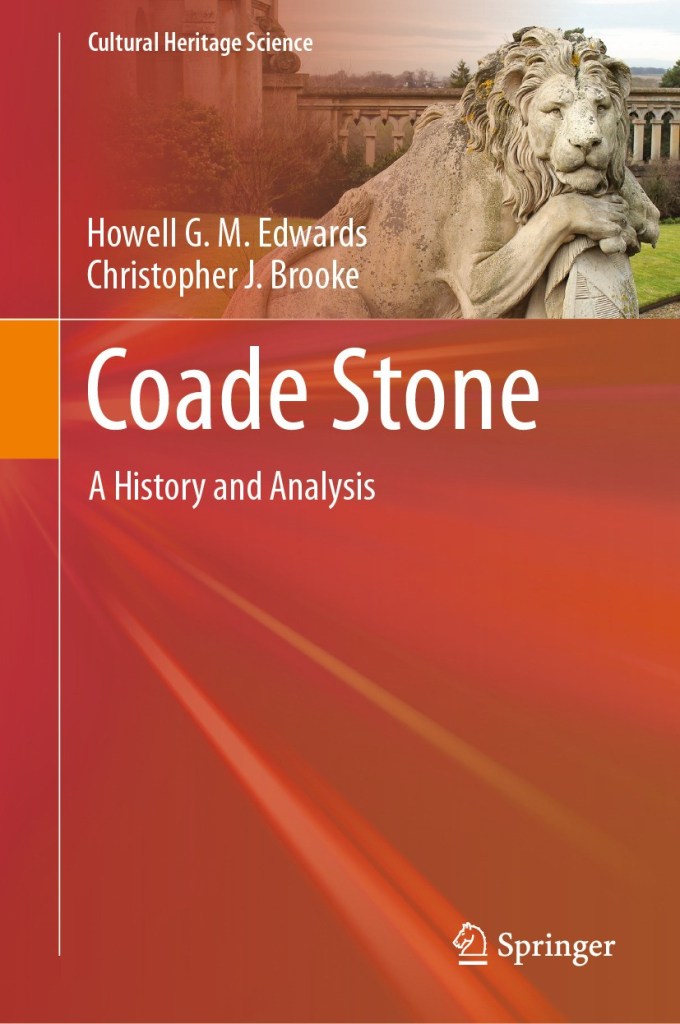 The history and nature of artificial stone for use in architecture is a subject still shrouded in myth and misconception. This book aims to lay bare those misconceptions and present a scientific and architectural account of these materials, and especially Coade Stone, the most successful of all, which found great favour during the Georgian period. Many examples of Coade Stone cast sculpture still exist and several key examples are presented in context and as case studies . Eleanor Coade’s artificial stone was so good that many observers could not distinguish it from the natural stone it replaced: the growth in replication of the neo-classical statuary and building adornment required in the late Georgian and Regency period was well satisfied by the use of Coade stone. A holistic evaluation of Coade stone artefacts is undertaken whereby the use of analytical data, historical documentation, invoices, company records, impressed marks and expert connoisseurship will establishthe attribution of Coade stone artefacts, some of which are currently in the unknown category. Several new scientific analyses are presented that demonstrate the true nature of high temperature fired ceramic Coade Stone and allow comparison with other forms of artificial stone, such as the cold cured cementitious variations, which eventually replaced it in the Victorian period.
Howell G. M. Edwards is Professor Emeritus of Molecular Spectroscopy at the University of Bradford. He read Chemistry at Jesus College in the University of Oxford and after completing his BA and BSc degrees he studied for his doctorate in Raman spectroscopy at Oxford with Dr Leonard Woodward and then became a Research Fellow at Jesus College, University of Cambridge. He joined the University of Bradford as a Lecturer in Structural and Inorganic Chemistry, becoming Head of the Department of Chemical and Forensic Sciences, and was awarded a Personal Chair in Molecular Spectroscopy in 1996. He has published over 1350 research papers in Raman spectroscopy and the characterisation of materials, along with six books on the application of this analytical technique to art, archaeology, and forensic science. He has had a lifelong interest in porcelains and the industrial archaeology, excavation, and the preservation of early porcelain manufactory sites.
Christopher J. Brooke studied for a BSc (Hons.) in Archaeological Sciences at the University of Bradford, specializing in geophysics, environmental archaeology, and palaeopathology, followed by a PhD at the University of Nottingham in the field of archaeological remote sensing for historic buildings analysis. He has worked in a wide range of organizations from central and local government, through university teaching appointments and industry, a major charity, and freelance consultancy. A Fellow of the Society of Antiquaries, a Fellow of the Royal Historical Society, an Associate Fellow of the Remote Sensing and Photogrammetry Society, and a member of many professional organizations both nationally and in the UK East Midlands, he serves on a large number of advisory boards and committees. Dr Brooke’s principal research specializations are in electromagnetic remote sensing, nondestructive archeological site survey, record photography, mathematical image processing, environmental study, spectroscopy, the history and archaeology of churches, and the recording and conservation of historic buildings. He has lectured extensively at academic institutions throughout the UK and is currently Honorary Associate Professor in Medieval History and Church Archaeology at the University of Nottingham, and Visiting Fellow in Remote Sensing at Nottingham Trent University.
c o n t e n t s
1 Introduction: Coade Artificial Stone and Its Marks
2 Factors That Influenced the Success of Coade Stone
3 Artificial Stone: The Precursors, Contemporaries, and Later Variations of Coade Stone
4 Historical Myths and Anomalies Associated with Coade Stone
5 The Mineralogy of Fired Ceramics
6 The Analysis of Coade Stone Artefacts
7 Case Studies: Coade Stone
8 Conclusions
Appendices
Glossary
Index
Exhibition | Gold and Silver Boxes in Dublin, 1662–1830

On view at Dublin Castle:
‘The Metal Stamp’d by Honest Fame’: Gold and Silver Boxes in Dublin, 1662–1830
Dublin Castle, 14 November 2024 — 31 March 2025
This exhibition is the first to present the work of the mostly forgotten artisans who worked in the small streets around Dublin Castle during the Georgian era making beautiful boxes in gold and silver for presentation to dukes, earls, and other luminaries. There are boxes made for heroes and villains alike—Edmund Burke, Henry Grattan, Luke Gardiner, Viscount Castlereagh, naval captains who fought the French, a city merchant who confronted Robert Emmet, and Henry Johnson, the victor in the bloodiest battle of 1798. The exhibition highlights the box makers’ inventiveness and ingenuity, showing the small luxuries they made for their fashionable and prosperous customers. In addition to loans from Irish collections, the exhibition brings sumptuous artefacts not seen here in centuries, such as the bejewelled gold Rathdowne box from 1823— back to Dublin from the US, UK, and continental Europe. The exhibition reveals Georgian Dublin as a vibrant place where hierarchical deference, civic politics, personal ostentation, sentimental attachment, anxieties about invasion, and rebellion all found expression in small, exquisitely made boxes.
SAAM Short-Term Fellowship for American Art History
From the SAAM:
Smithsonian American Art Museum’s Audrey Flack Short-Term Fellowship
Applications due by 11 February 2025
Applications are invited for the Smithsonian American Art Museum’s Audrey Flack Short-Term Fellowship. The application deadline is February 1. The renowned artist Audrey Flack (1931–2024) generously established this short-term award in recognition of her personal journey balancing intensive career demands with raising two daughters, one of whom has autism.
A single Audrey Flack Short-Term Fellowship will be awarded annually in support of a one-month (thirty-day) residency. Residencies must take place between 1 June 2025 and 31 May 2026, and begin on the 1st or 15th of the month. The Audrey Flack Short-Term Fellow will receive a stipend of $5,000 to support travel to and living expenses in Washington, D.C. Housing is not provided.
The Audrey Flack Short-Term Fellowship is open to predoctoral, postdoctoral, and senior scholars researching topics in American art who reside, work, or attend school outside of commuting distance from Washington, D.C. Researchers whose personal circumstances (i.e., financial constraints, employment conditions, care-giving responsibilities, or other limitations) preclude them from participating in longer-term residencies are encouraged to apply. Applicants should submit a statement of need justifying the rationale for a short-term fellowship. More information on submitting an application can be found here.
Applicants must identify a member of SAAM’s research staff to serve as the primary fellowship advisor. Projects that require access to SAAM’s collections and staff expertise are prioritized, although those that utilize other Smithsonian resources are eligible.
Preservation Long Island Receives Curatorial Internship Grant
From the press release (18 November 2024). . .
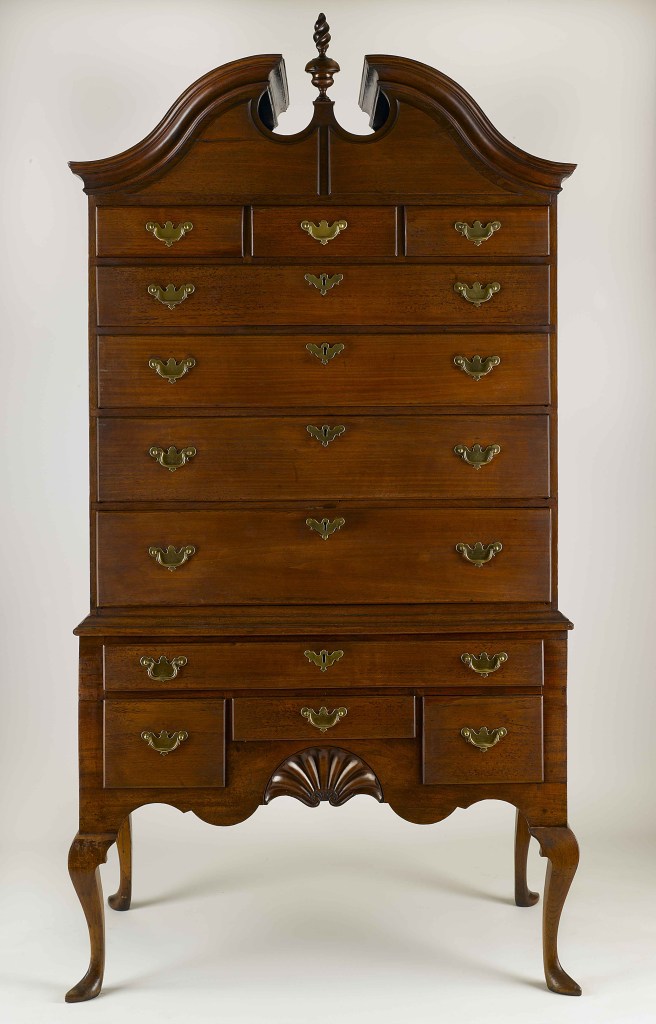
High chest of drawers, Queens County, New York, 1740–70, walnut, tulip poplar, pine (Preservation Long Island purchase, 1961.13.1).
The Decorative Arts Trust is thrilled to announce that Preservation Long Island (PLI) is the recipient of the 2025–27 Curatorial Internship Grant. Headquartered in Cold Spring Harbor, New York, PLI was founded in 1948 as the Society for the Preservation of Long Island Antiquities. PLI advances the importance of historic preservation in the region through advocacy, education, and stewardship. Their program areas include interpreting historic sites, collecting art and material culture pertaining to Long Island history, creating publications and exhibitions, and providing direct support and technical assistance to individuals and groups engaged in local preservation efforts.
In 2026, PLI will celebrate the United States Semiquincentennial as well as the 50th anniversary of their landmark furniture publication, Long Island is My Nation: The Decorative Arts and Craftsmen, 1640–1830. PLI’s Peggy N. Gerry Curatorial Fellow will collaborate with Chief Curator & Director of Collections Lauren Brincat on a series of objectives aimed at cataloging Long Island furniture in public and private collections across the region, reexamining these objects from new perspectives, and enhancing their accessibility to 21st-century researchers and the public. The Fellow will take a leading role in a new initiative building upon previous scholarship towards the creation of a collaborative Long Island furniture digital database, an exhibition, and an accompanying catalogue. Also, the Fellow will coordinate and participate in a Long Island furniture symposium in summer 2025. PLI will post the Peggy N. Gerry Curatorial Fellow position on their website at preservationlongisland.org in spring 2025. For more information about Curatorial Internship Grants, visit decorativeartstrust.org/cig.
Drayton Hall Awarded Decorative Arts Trust Funding Prize
From the press release (25 November 2024) . . .
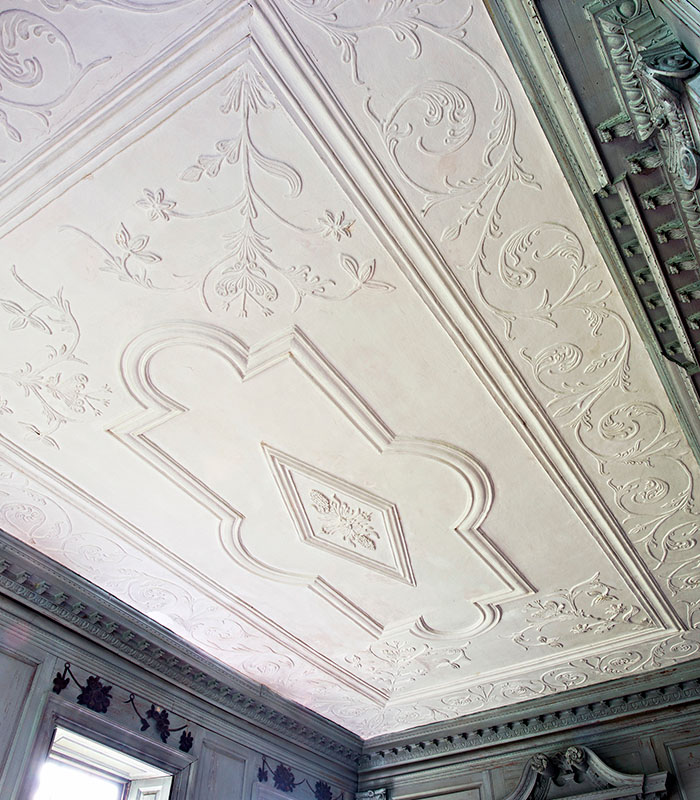
Drawing Room Ceiling, Drayton Hall (Charleston, South Carolina; photo by Willie Graham).
The Decorative Arts Trust is thrilled to announce that the 2024 Prize for Excellence and Innovation will be awarded to Drayton Hall Preservation Trust in Charleston, South Carolina, for projects to include the conservation of the plaster ceiling in the house’s Great Hall, the investigation of the plaster ceiling in the Drawing Room, and digital and in-person access to these spaces during conservation treatment and the results of the interventions. Drayton Hall, built 1738–50, is the earliest example of Palladian architecture in the United States. Surviving in relatively untouched condition, and displayed devoid of furnishings, Drayton Hall offers architectural historians the rare opportunity to study materials and designs from every period in the house’s history.
The Decorative Arts Trust Prize for Excellence and Innovation, founded in 2020, funds outstanding projects that advance the public’s appreciation of decorative art, fine art, architecture, or landscape. The Prize is awarded to a nonprofit organization in the United States for a scholarly endeavor, such as museum exhibitions, print and digital publications, conservation and preservation projects, and online databases. Past recipients include the Concord Museum; Cooper Hewitt, Smithsonian Design Museum; the Black Craftspeople Digital Archive; and Craft in America.
More information about the Prize for Excellence and Innovation is available here»










 Enfilade
2 comments