Exhibition | Satirical Prints in Georgian London and Dublin
The exhibition recently closed in Dublin with the catalogue available from Churchill House Press and Centro Di:
Artists and Pirates: Satirical Prints in Georgian London and Dublin
Irish Architectural Archive, Dublin, 13 November 2025 — 8 January 2026
The Driehaus Museum, Chicago, 15 May — 13 September 2026
Curated by Silvia Beltrametti and William Laffan
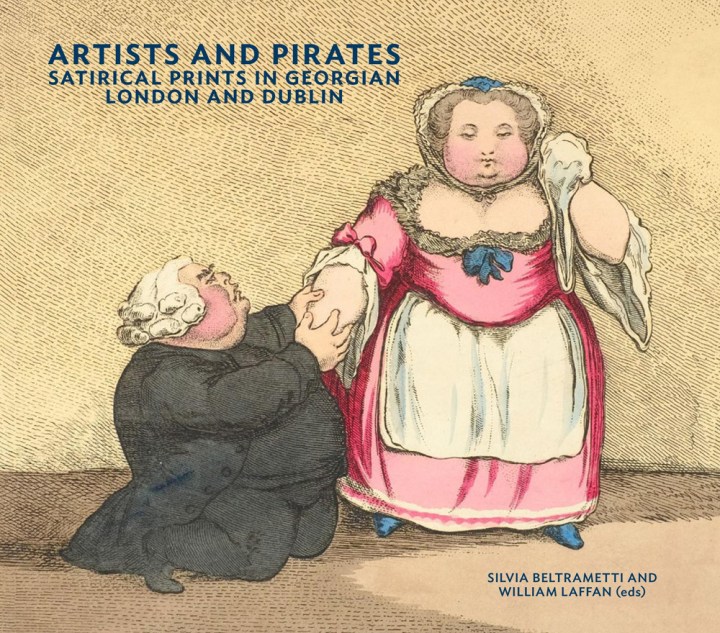 Single-sheet satire emerged in the louche milieu where politics and high society of late Georgian London intersected. Artists such as James Gillray (1756–1815) and Thomas Rowlandson (1757–1827) combined devastating wit with graphic brilliance to lampoon the great and the good, the vain and the vacuous, creating timeless images inspired by moments of fleeting controversy or scandal. Availing of a legal loophole under which copyright law protecting images did not apply to Ireland, a business of pirating caricatures by London satirists also flourished in Regency Dublin. The work of these Dublin plagiarists—which though derivative is paradoxically inventive and vibrant—as well as prints of Irish subject matter by English caricaturists such as Gillray, is the subject of this exhibition and the accompanying publication. Caricature dealt with the great political issues of the day, including religious toleration and contested concepts of liberty, but was also a vehicle to explore less elevated and often risqué (sometimes scatological or pornographic) subject matter. Single-sheet satire, Georgian England’s greatest artistic innovation, and its smaller but still dynamic offshoot in early nineteenth-century Dublin offer a fascinating—and very funny—chronicle of the human comedy.
Silvia Beltrametti and William Laffan, eds., Artists and Pirates: Satirical Prints in Georgian London and Dublin (Fenit, County Kerry: Churchill House Press with Centro Di, 2025), 184 pages, ISBN: 978-8870385939, €30. With additional contributions by James Kelly (Professor of History at Dublin City University), David Fleming (Professor of History at the University of Limerick), and Ben Casey (PhD candidate, University of Maynooth).
◊ ◊ ◊ ◊ ◊
Note (added 15 February 2026) — The original posting omitted the Chicago venue, though a note suggested the possibility, with reference to the Centro Di website. At The Driehaus Museum, the show will be titled Ink and Outrage: 18th-Century Satirical Prints in London and Dublin.
Online Conversation | Reflecting on Turner in 2025
Registration for this HECAA Great Conversation (open to non-HECAA members) is available here:
Turner in 2025: Reflecting on the Anniversary Year’s Exhibitions
With Chloe Wigston Smith, Richard Johns, Lucinda Lax, and Melissa Gustin
Online, 23 January 2026, 12.30 EST / 5.30 GMT
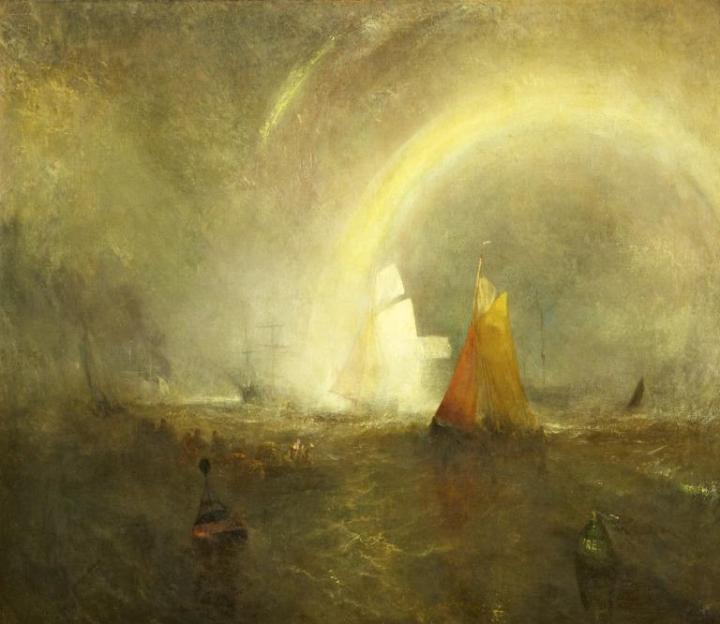
J.M.W. Turner, The Wreck Buoy, first exhibited in 1849, oil on canvas, canvas: 93 × 123 cm (Liverpool: Walker Art Gallery).
Joseph Mallord William Turner was born in 1775. To mark 250 years since his birth, a number of anniversary exhibitions were organized across the United Kingdom and the United States in 2025. Some contextualized Turner with other notable contemporaries; others focused on specific aspects of his career or mined collection holdings. This roundtable will bring together four curators of three Turner anniversary exhibitions to ask them to reflect on their exhibitions and ponder together what it means to exhibit Turner today.
• Melissa Gustin is Curator of British Art at the National Museums Liverpool, and curator of Turner: Always Contemporary at the Walker Art Gallery.
• Lucinda Lax is Interim Head of the Curatorial Division and Curator of Paintings and Sculpture at the Yale Center for British Art, and curator of J.M.W. Turner: Romance and Reality.
• Richard Johns is Senior Lecturer in the Department of History of Art at the University of York. Along with Smith, he was a co-curator of Austen and Turner at Harewood House.
• Chloe Wigston Smith is Professor in the Department of English at the University of York and Director of its Centre for Eighteenth-Century Studies. Along with Johns, she was a co-curator of Austen and Turner at Harewood House.
Join us on Friday, 23 January 2026 at 12.30pm EST / 5.30pm GMT for this HECAA Great (Zoom) Conversation. The event is open to current and prospective HECAA members; so please share widely in your networks.
Conference | Reflections at Work
From ArtHist.net:
Reflections at Work / Le reflet à l’oeuvre
Institut national d’histoire de l’art (INHA), Paris, 22–23 January 2026
Organized by Anne Pillonnet, Marie Thébaut-Sorger, and Romain Thomas
How do reflections (both physical and depicted) and lighting influence our perception of artworks and their presentation? Art historians, physicists, digital specialists and experts in perceptual phenomena will gather to discuss this question at the international conference ‘Reflections at Work’. Jointly organised by the teams of AORUM project (Analyse de l’Or et de ses Usages comme Matériau pictural, XVIe–XVIIe siècles) and FabLight project (La fabrique de l’éclairage dans les arts visuels au temps des Lumières, 1760–1820), this event is part of an interdisciplinary research initiative that aims to promote a collective exploration of reflections, light, and their role in past and present aesthetic experience.
t h u r s d a y , 2 2 j a n u a r y
9.00 Accueil des participants
9.10 Mot de bienvenue — Anne-Solène Rolland (INHA)
9.15 Introduction — Anne Pillonnet (Institut Lumière Matière, université Lyon 1), Marie Thébaud-Sorger (Centre Alexandre-Koyré CAK-CNRS, Paris) et Romain Thomas (INHA)
9.40 Session 1 | Reflection of Matter, Matter of Reflection
Présidence: Christophe Renaud (Laboratoire d’Informatique Signal et Image LISIC, université du Littoral Côte d’Opale) et Romain Thomas (INHA)
• ‘Alle de verwen van een regenboog vertoonend’ (« Montrant toutes les couleurs d’un arc-en-ciel ») : peindre l’iridescence de la nacre dans la nature morte néerlandaise du XVIIe siècle — Clara Langer (Laboratoire de Recherche Historique Rhône-Alpes LARHRA, université Lyon 2 /université de Constance)
• Reflets de matière, ce qu’ils révèlent — Anne Pillonnet (Institut Lumière Matière, université Lyon 1)
• La perception visuelle du brillant et des reflets — Pascal Mamassian (Laboratoire des Systèmes Percerptifs LSP, École normale supérieure PSL)
• Rendu des surfaces brillantes : entre réalisme physique et réalisme perceptuel — Samuel Delepoulle (Laboratoire d’Informatique Signal et Image LISIC, Université du Littoral Côte d’Opale)
• Peindre la lumière : les femmes, le portrait et la luminosité matérielle dans la Gênes du début de l’époque moderne / Painting Light: Women, Portraiture, and Material Luminosity in Early Modern Genoa — Ana Howie (Département d’histoire de l’art et d’études visuelles, université Cornell, Ithaca) (Intervention en anglais)
12.45 Pause déjeuner
14.00 Session 2 | Reflection on the Artwork: The Lighting Atmosphere
Présidence: Christine Andraud (Centre de Recherche sur la Conservation CRC, Muséum national d’Histoire naturelle) et Ralph Dekoninck (Faculté de philosophie, arts et lettres, université catholique de Louvain)
• Du bruit à l’extase, en quête de contemplation — Viviana Gobbato (Département Culture et Education Arc de Triomphe – CMN / Centre d’Histoire Culturelle des Sociétés Contemporaines CHCSC, université Paris-Saclay)
• L’art aux mains de la fée Électricité. Visiter le Salon la nuit (1879–1880) — Agathe Ménétrier (INHA)
• Capter le reflet, sonder la matière : dispositifs d’imagerie pour l’œuvre d’art et le corps humain — Mathieu Hébert (Institut d’Optique, université Jean Monnet Saint-Étienne)
• La lumière du jour comme source lisible pour les contextes spatiaux et visuels de la fin du Moyen Âge : la nef de la cathédrale Notre-Dame de Freiberg (Saxe) / Daylight as a readable Source for Late Medieval Spatial and Visual Contexts: The Hall Nave of St. Mary’s Cathedral, Freiberg (Saxony) (Intervention en anglais) — Lia Bertram (École des Beaux-Arts, Dresde)
• Le calcul des reflets — Christophe Renaud (Laboratoire d’Informatique Signal et Image LISIC, université du Littoral Côte d’Opale)
17.00 Conclusion de la journée
f r i d a y , 2 3 j a n u a r y
9.00 Accueil des participants
9.20 Session 3 | Reflection in the Artwork: Symbol and ‘Off-screen’
Présidence: Martial Guédron (Laboratoire Arts, civilisation et histoire de l’europe ARCHE, université de Strasbourg) et Marie Thébaud-Sorger (Centre Alexandre-Koyré CAK-CNRS, Paris)
• Au miroir de l’armure — Diane Bodart (Département d’histoire de l’art et d’archéologie, université Columbia, New York)
• Quelques dispositifs réflexifs chez Philippe de Champaigne à Port-Royal de Paris : retour sur « une hypothèse saugrenue » de Louis Marin — Frédéric Cousinié (Groupement de Recherche en Histoire GRHis, université de Rouen-Normandie)
• Usages du reflet chez Clara Peeters, Pieter Janssens Elinga et Jean Siméon Chardin — Matthieu Somon (Institut de recherche Religions, Spiritualités, Cultures, Sociétés RSCS, université catholique de Louvain)
• Réfléchir les reflets dans l’emblématique du XVIIe siècle — Ralph Dekoninck (Faculté de philosophie, arts et lettres, université catholique de Louvain)
• « Une journée au XVIIIe siècle. Chronique d’un hôtel particulier » : Lumière sur une exposition — Ariane James-Sarrazin (Musée des Arts décoratifs)
11.55 Discussion
New Book | Let the Oppressed Go Free
From Penn Press:
Nicholas Wood, Let the Oppressed Go Free: Abolitionism in Colonial and Revolutionary America (Philadelphia: University of Pennsylvania Press, 2025), 384 pages, ISBN: 978-1512828320, $45.
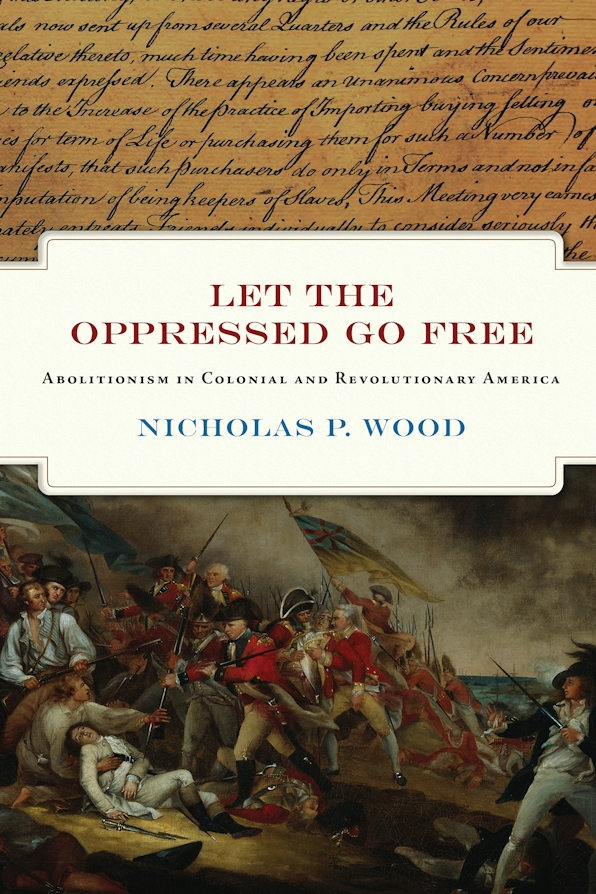 Tenacious activism by Quakers, African Americans, and antislavery evangelicals made antislavery central to the American Revolution.
In Let the Oppressed Go Free, Nicholas P. Wood presents the opponents of slavery who sustained and expanded the antislavery movement during the American Revolution in the face of widespread hostility. These early abolitionists were inspired by antislavery theology: the view that slavery was a sinful form of oppression that would provoke God’s wrath against slaveholding societies. These principles were first advanced by a handful of Quakers and Puritans as early as the 1600s, but they did not become widespread until the second half of the eighteenth century. Quakers embraced antislavery theology during the French and Indian War, which they interpreted as divine chastisement for the sin of colonial slavery. Citing the prophet Isaiah, they pledged to please the Lord by letting the oppressed go free.
Antislavery theology became even more prominent during the American Revolution. When Parliament provoked an imperial crisis in the 1760s, abolitionists argued it was further evidence of God’s anger over slavery. The outbreak of war in 1775 made these arguments increasingly persuasive. Let the Oppressed Go Free demonstrates that antislavery activism during the Revolution by Quakers, African Americans, and evangelical patriots was more sophisticated and influential than historians have recognized. The northern states that began abolishing slavery during the Revolution did so in response to tenacious agitation and generally described their actions as designed to earn God’s blessing.
Let the Oppressed Go Free challenges many common assumptions about abolitionism and the American Revolution. Wood demonstrates that religion remained central to abolitionism rather than being displaced by ‘secular’ arguments about natural rights. And whereas some have argued that the Revolutionary War hindered antislavery progress and fueled racism, Wood shows that the war accelerated reform.
Nicholas P. Wood is Associate Professor of History at Spring Hill College.
New Book | The Centrality of Slavery
From Penn Press:
John Craig Hammond, The Centrality of Slavery: Empire and Enslavement in Colonial Illinois and Missouri (Philadelphia: University of Pennsylvania Press, 2025), 288 pages, ISBN: 978-1512828429, $45. Early American Studies Series.
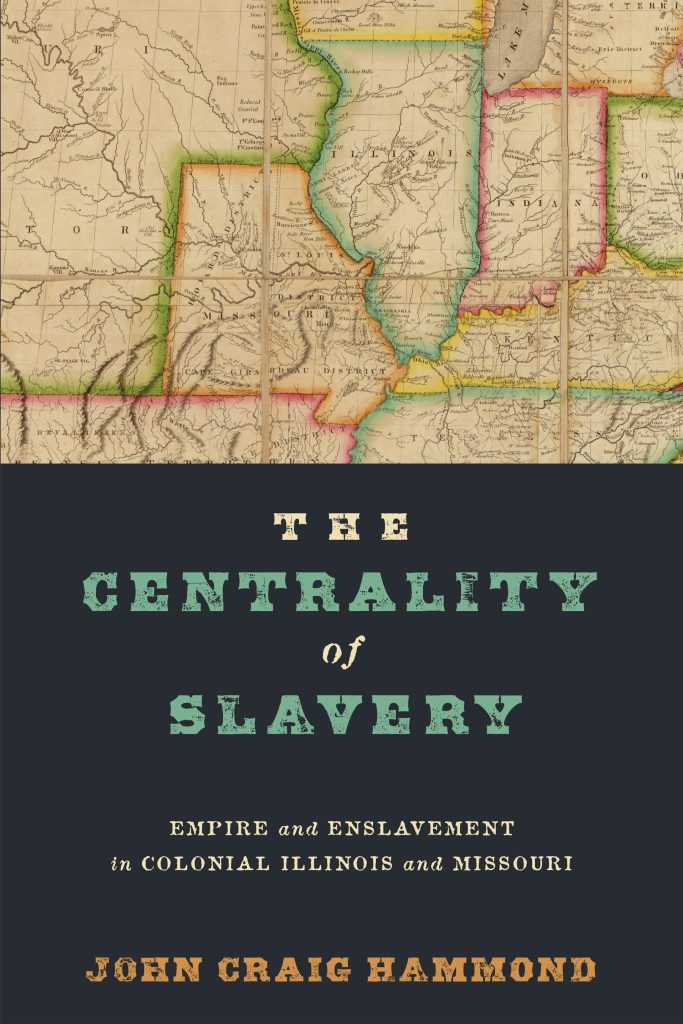 How French and American colonizers created systems of enslavement in the Middle Mississippi Valley.
The Centrality of Slavery examines how French and American colonizers used the powers of various imperial regimes to create slave societies in present-day Missouri and Illinois from the 1720s through the 1820s. The first book-length study of slavery and empire in both Illinois and Missouri, it begins with the origins of Native American and African American enslavement in the region. It then traces how successive French, Spanish, British, and American regimes shaped the development of slavery over the course of a century, examines the significance of the Northwest Ordinance’s ban on slavery in Illinois, and then analyzes the diverging histories of slavery in Illinois and Missouri in the early 1800s. The book concludes with an analysis of the Missouri Crisis and the compromise of 1820, along with the Middle Mississippi Valley’s significance in the road towards disunion and civil war in the late 1850s. More broadly, The Centrality of Slavery argues that the Middle Mississippi Valley sat astride the crossroads of imperial North America. The practices of empire and enslavement forged and fought over there exerted an outsized influence on the history of slavery in North America and the United States. Rather than treating the region’s eighteenth-century past as a prologue to the rise of the United States, John Craig Hammond analyzes the colonial history of the region on its own terms, through the European colonizers, American settlers, and enslaved people of Indigenous and African descent who shaped the development of slavery in the Middle Mississippi Valley.
John Craig Hammond is Associate Professor of History at Penn State University, New Kensington.
New Book | The Household War
From Penn Press:
John Blanton, The Household War: Property, Personhood, and the Domestication of Anglo-American Slavery, 1547–1729 (Philadelphia: University of Pennsylvania Press, 2025), 400 pages, ISBN: 978-1512828306, $55.
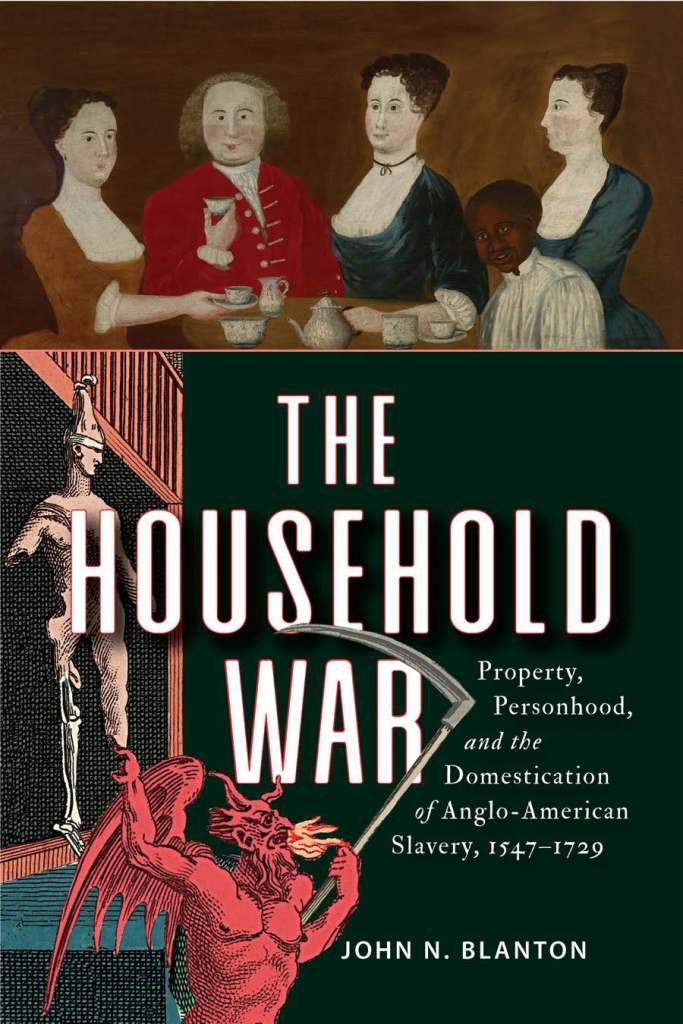 A bold reinterpretation of perennial debates over the origins and development of slavery in colonial English North America.
The Household War offers a bold reinterpretation of perennial debates over the origins and development of slavery in colonial English North America. John N. Blanton argues that the law and practice of slavery in the empire’s earliest American colonies were shaped by a tension between two competing definitions of the institution. One strand of thought, war-slavery ideology, claimed that the power of life and death transformed war captives into chattel slaves. The power to kill defined both war and slavery. But bringing war captives into enslavers’ private households was a dangerous proposition, and so a parallel ‘domestication’ ideology emerged calling for limitations on the power of enslavers and the recognition of the enslaved as persons held to labor in a variant of English servitude.
The Household War examines how the tensions between war-slavery and domestication ideologies, along with crucial political, economic, and cultural differences, shaped the development of slavery in Virginia and Massachusetts from their founding through 1729, creating distinct systems of bondage in England’s flagship mainland colonies. In Massachusetts, where a diversified and dynamic commercial economy afforded opportunities for mobility and access to material resources, the dominance of domestication ideology enabled enslaved people to negotiate their bondage, attain free status, and build free Black households and communities. Virginia, however, committed itself to war-slavery early in its development, with enslaved people defined as articles of property subject to enslavers’ power of life and death while the extreme inequality of plantation society made free Black household formation nearly impossible. Long before American independence highlighted their differences, then, Massachusetts and Virginia were already on distinct trajectories, laying the foundation for a future house divided on the question of slavery.
John N. Blanton is Assistant Professor of History at City College of New York.
Online Talks | Patricia Ferguson, Ivan Day, Neil Buttery, and Paul Crane
From the Museum of Royal Worcester:
Museum of Royal Worcester | Online Winter Talk Series, 2025–26
The Museum of Royal Worcester is thrilled to present another season of fascinating online talks to keep the winter blues at bay. Curl up with a warm drink and join us as we explore art, food, and history with three brilliant speakers.
◊ ◊ ◊ ◊ ◊
Ivan Day | Frozen Delights: A History of Porcelain and Ice Cream
Wednesday, 21 January 2026, 6pm
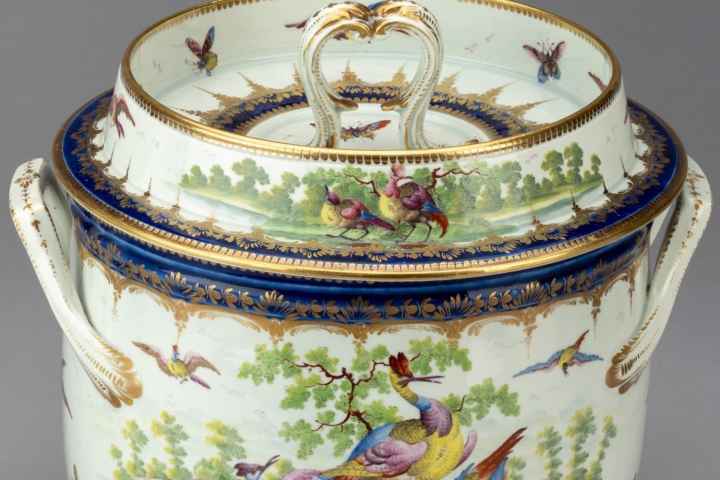
Ice Pail, 1776, William Davis Factory (Museum of Royal Worcester).
During the eighteenth century, ice cream became the ultimate show-off luxury for adorning a fashionable dinner table. As a result, new items for serving this novelty dish started to appear on the market. The challenge was to produce an attractive container which could be displayed centre stage on the sideboard or table, but which was also capable of preventing the ice cream from melting. These specialised three-part vessels first appeared in France in 1720s, where they were called seaux à glace—ice cream coolers. They employed a mixture of ice and salt to refrigerate their contents. By the 1770s the fashion for these beautiful vessels became an aristocratic craze, and nearly every European manufactory was producing them. In England, the Worcester factory played a leading role in developing some of the finest of these vessels. Ivan Day will guide us through the development of ice cream coolers and ice cream cups, with a focus on the marvellous examples produced at Worcester. Book here»
Ivan Day is one of the UK’s most celebrated food historians, broadcasters, writers, and curators, specialising in the reconstruction of period kitchens and historic table displays. His work has been exhibited in many institutions worldwide, including the Museum of London, the Metropolitan Museum of Art, and the Getty Research Institute. His publications include Cooking in Europe, 1650–1850 and Ice Cream: A History.
◊ ◊ ◊ ◊ ◊
Neil Buttery and Paul Crane | Sugar, Slavery and Empire / The Evolution of Worcester Sucriers
Wednesday, 4 March 2026, 6pm

A rare early Dr Wall Worcester Sucrier and Cover with Flame finial, ca. 1753. A unique example retaining its cover, the shape derived from silver. Ex Rous Lench collection Worcestershire.
Join food historian Neil Buttery and ceramics expert Paul Crane in a presentation discussing the role of sugar and the associated enslavement of African peoples in the growth and development of the British Empire and Worcester Porcelain in the eighteenth century. Neil will explore how the reach of the ‘sugar-slave complex’ was all-pervading, influencing the sale and evolution of fancy goods, especially those associated with the tea table, which, of course, included porcelain. As a case study, Paul will focus on the evolution of the sucrier in the first fifty years of Worcester Porcelain. Book here»
Neil Buttery is a multi award-winning food historian, author, podcaster, and chef. He hosts The British Food History Podcast and co-hosts A is for Apple: An Encyclopaedia of Food & Drink. His publications include A Dark History of Sugar, Before Mrs Beeton: Elizabeth Raffald, England’s Most Influential Housekeeper, Knead to Know: A History of Baking, and The Philosophy of Puddings. Dr. Buttery has recently collaborated with the Museum of Royal Worcester on projects to deliver narratives on the history of food and porcelain to wider communities. His permanent display “Dr. Wall’s Dinner” at MoRW recently won the Food on Display Award at the British Library Food Season Awards in 2025.
Paul Crane is an independent historian and consultant to the Brian Haughton Gallery, London. He is a descendant of Dr. John Wall (1708–1776), who founded the Worcester Porcelain Manufactory in 1751. Paul presently sits as a Trustee of the Museum of Royal Worcester, formerly the Dyson Perrins Museum in the city of Worcester. He also is a Fellow of the Society of Antiquaries, an independent historian and researcher, and a Liveryman of the Worshipful Company of Art Scholars.
◊ ◊ ◊ ◊ ◊
Patricia Ferguson | Exploring the Rococo through Chelsea’s Gold Anchor Vases
Tuesday, 2 December 2025, 6pm — A recording is available here»
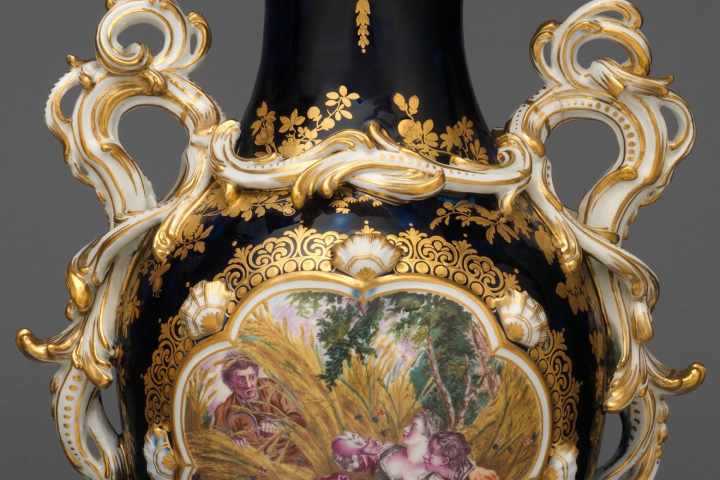
Vase (one of a pair), Chelsea Porcelain Factory, ca. 1762 (New York: The Metropolitan Museum, 1970.313.2a, b).
Of all design styles, Rococo was perhaps the most rebellious—ornate, theatrical, and a true ‘style without rules’. Emerging in France in the 1720s–30s, it featured curved, asymmetrical motifs drawn from nature, especially the acanthus leaf, and marine-inspired forms that gave rise to its name, from rocaille (‘rock’ or ‘shell’). Its greatest achievements appeared in the decorative arts—furniture, silver, and ceramics. By the 1750s–60s, English porcelain factories like Worcester and Chelsea embraced Rococo, even as taste was shifting toward Classical order. Worcester adapted Rococo silver shapes for tablewares, but Chelsea—under Flemish silversmith Nicholas Sprimont—produced some of the boldest Rococo porcelain in Europe, rivaling Meissen and Sèvres. This talk explores Chelsea’s gold anchor period (ca. 1758–64), its spectacular vases, its rivals, and its enduring legacy.
Patricia F. Ferguson is a ceramic researcher, a former curatorial consultant at the Victoria and Albert Museum and the British Museum, she is an advisor on ceramics for the National Trust and other heritage organizations. Her publications include Pots, Prints, and Politics: Ceramics with an Agenda, from the 14th to the 20th Century (2021); Ceramics: 400 years of British Collecting in 100 Masterpieces (2017); and Garnitures: Vase Sets from National Trust Houses (2017).
Exhibition | Savonnerie Carpets of Louis XIV
Opening soon (for just one week) at the Grand Palais:
Le Trésor Retrouvé du Roi-Soleil / The Rediscovered Treasure of the Sun King
Grand Palais, Paris, 1–8 February 2026
Curated by Wolf Burchard, Emmanuelle Federspiel, and Antonin Macé de Lépinay
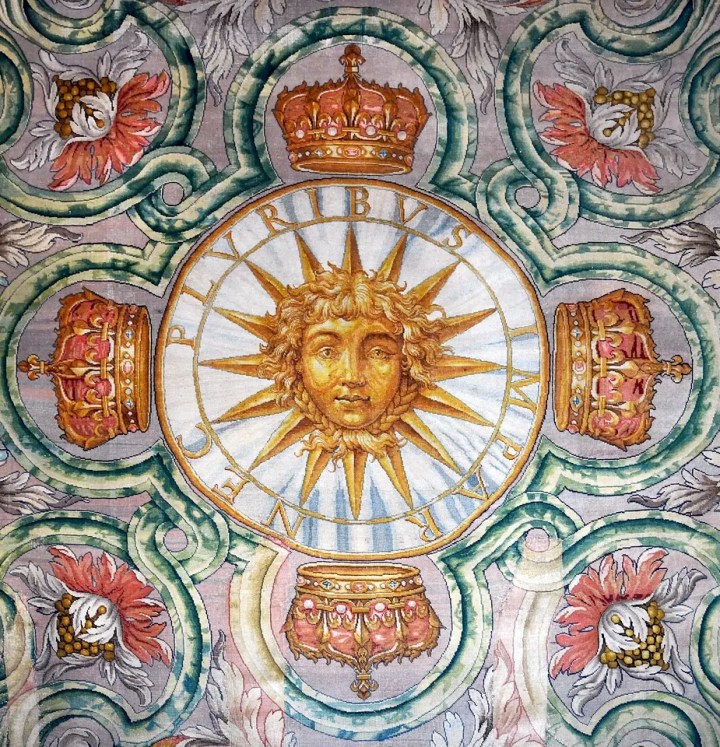 For the first time in history, the monumental carpets commissioned by Louis XIV for the Louvre’s Grand Gallery are brought together and displayed beneath the glass roof of the Grand Palais.
In 1668, as King Louis XIV prepared to make the Louvre his royal residence, he entrusted his First Painter, Charles Le Brun, with a bold and magnificent commission: the creation of 92 carpets, woven at the Savonnerie Manufactory, to adorn the floor of the palace’s most majestic gallery. Each carpet, nine meters wide, was meant to form a spectacular decorative ensemble, one of the most ambitious ever conceived for a royal palace. Fate, however, took a different course. Never installed in the Louvre, these treasures crossed the centuries through revolutions, sales, and dispersals. Today, 41 original carpets remain in the collections of the National Manufactories, 33 of which are complete. Brought together for the first time beneath the glass roof of the Grand Palais, alongside a carpet designed for the Galerie d’Apollon, they offer a display of rare magnificence. A unique and historic event, lasting just one week, inviting visitors to discover these jewels of French heritage in a setting worthy of their splendor.
Exhibition co-produced by the GrandPalaisRmn and Les Manufactures nationales – Sèvres & Mobilier national.
Curators
• Wolf Burchard | Curator, Department of European Sculpture and Decorative Arts, The Metropolitan Museum of Art, New York
• Emmanuelle Federspiel | Conservatrice en chef du patrimoine, inspectrice des collections des Manufactures nationales – Sèvres & Mobilier national
• Antonin Macé de Lépinay | Inspecteur des collections des Manufactures nationales – Sèvres & Mobilier national
Scénographie
• Clément Hado and Anthony Lelonge – Manufactures nationales
Lecture | James Stourton and Hannah Kaye, The British Love for Venice
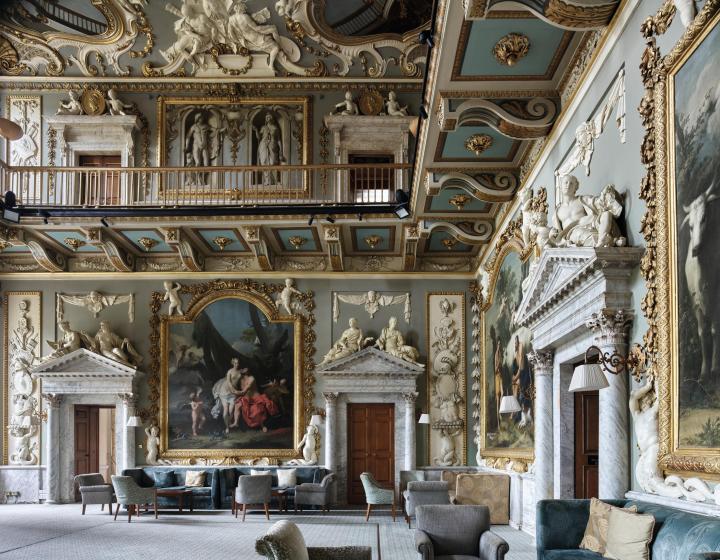
Moor Park, Hertfordshire, England. The estate has housed the Moor Park Golf Club since the 1920s. The 17th-century house was remodelled in the 1720s (with South Sea wealth) to designs by James Thornhill. Jacopo Amigoni was subsequently commissioned to paint the four pictures in the Great Hall. Shown here is Jupiter and Io with Cupid and Attendant Putti.
◊ ◊ ◊ ◊ ◊
From the Venice in Peril Fund:
James Stourton and Hannah Kaye | The British Love Affair with Venice:
Four Centuries of Collecting and Connoisseurship
The Society of Antiquaries, Burlington House, London, 16 March 2026
James Stourton joins Hannah Kaye for a lively conversation exploring the enduring British fascination with Venice and its profound impact on taste and culture. From King Charles I to the present day, they will examine how British connoisseurs, collectors and architects have both shaped—and been shaped by—Venetian art, uncovering the themes and ideas that define this centuries-long cultural exchange.
James Stourton is the award-winning author of thirteen books including Rogues and Scholars, The British as Art Collectors, and Kenneth Clark. He is a Senior Fellow of the Institute of Historical Research of London University and currently a visiting fellow at Oxford University. He started his career as an Old Master paintings specialist with Sotheby’s and rose to become UK Chairman until he stepped down in 2012. He writes regularly on art and architecture for national newspapers and has served on government heritage committees. His first visit abroad was to Venice. Hannah Kaye is a freelance producer and one of the founding creators of Intelligence Squared, the leading forum for agenda-setting debates and discussions around the world. She is a trustee of the World Monument Fund Britain.
Monday, 16 March 2026, 6.30pm. Tickets, £30 / lecture recording, £10. All proceeds will go directly towards the vital conservation work of Venice in Peril Fund.
Lecture | Jane Glover on Mozart in Venice
From the Venice in Peril Fund:
Jane Glover | Mozart in Venice: A Crucial Encounter
The Society of Antiquaries, Burlington House, London, 9 February 2026

Pietro Longhi, A Fortune Teller at Venice, ca. 1756, oil on canvas, 59 × 49 cm (London: National Gallery, NG1334).
In December 1769, the 13-year-old Mozart and his father set out on their first journey to Italy. Over the next fifteen months they would visit all the main cities in the peninsula, absorbing Italian culture and garnering unprecedented attention and accolades. Their final stop, in the spring of 1771, was Venice. And although they came away with little immediate or evident reward, the impact of the city on the now 15-year-old boy was profound and extraordinarily consequential. In this talk, Jane Glover, acclaimed conductor and musician, explores this brief but crucial encounter between a unique prodigy and a unique city.
Jane Glover is currently enjoying her 50th season as a conductor, having made her professional debut at the Wexford Festival in 1975. She has since performed opera and concerts all over the world, including at the Teatro La Fenice in Venice. A Mozart specialist, she has been Music Director of Glyndebourne Touring Opera, Artistic Director of the London Mozart Players, Director of Opera at the Royal Academy of Music, and, since 2002, Music Director of Chicago’s Music of the Baroque. She is the author of Mozart’s Women, Handel in London, and Mozart in Italy.
Monday, 9 February 2026, 6.30pm. Tickets, £30 / lecture recording, £10. All proceeds will go directly towards the vital conservation work of Venice in Peril Fund.










 Enfilade
leave a comment