The Magazine of the Decorative Arts Trust, Summer 2024
The Decorative Arts Trust has shared select articles from the summer issue of their member magazine as online articles for all to enjoy. The following articles are related to the 18th century:
The Magazine of the Decorative Arts Trust, Summer 2024
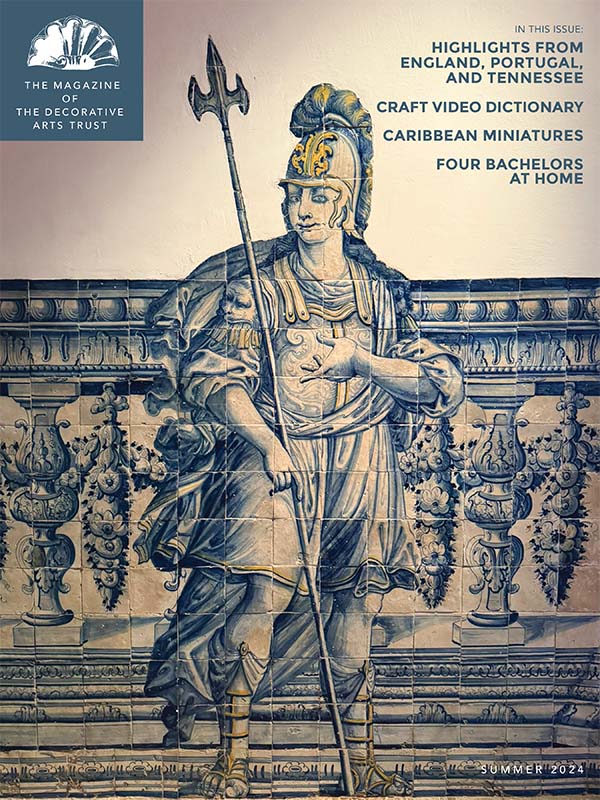 • “A Primer on Portugal” by Matthew A. Thurlow Link»
• “Saltram’s Saloon: Adam, Chippendale, and Reynolds in England’s West Country” by Catherine Carlisle Link»
• “Understanding Craft: A New Digital Tool Debuts” by Emily Zaiden Link»
• “Art and Imagination in Spanish America, 1500–1800: Highlights from LACMA’s Collection” by the Saint Louis Art Museum Link»
• “Painted Walls: New Virtual Museum Offers an Immersive Experience” by by Margaret Gaertner and Kathleen Criscitiello Link»
• “Seafaring Portraits in Bermuda and the Atlantic Basin” by Damiët Schneeweisz Link»
• “Summer Reading Recommendation: Ceramic Art” by Jessie Dean Link»
The printed Magazine of the Decorative Arts Trust is mailed to Trust members twice per year. Memberships start at $50, with $25 memberships for students.
Pictured: The magazine cover features a detail of wall tile from the stair hall of the Palácio Azurara in Lisbon, home of the Fundação Ricardo do Espírito Santo Silva’s decorative arts museum. Bartholomeu Antunes, Tile with the Figure of a Praetorian Guard, 1730–40, Lisbon. Earthenware tile with blue and yellow decoration.
The Burlington Magazine, June 2024
Summer is for falling behind . . . and for catching up . . . The long 18th century in the June issue of The Burlington:
The Burlington Magazine 166 (June 2024)
e d i t o r i a l
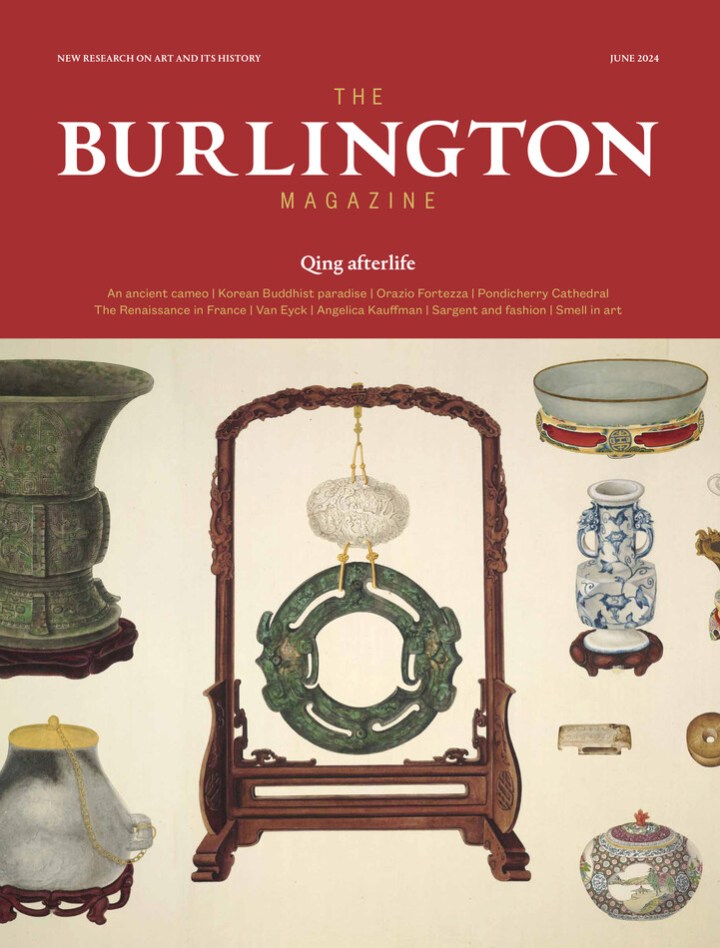 • “La Serenissima,” p, 543.
Henry James famously wrote in his Italian Hours (1909) that there is nothing more to be said about Venice. As so much ink has been spilt over its charms you can see his point. However, James then proceeded to rhapsodise at length about its beauty; and it is imperative that we, similarly, keep talking and writing and championing it, not least because all that it represents seems to be more precious and precarious than ever.
a r t i c l e s
• Ittai Gradel, “Nothing To Do with Menander: A Rediscovered Roman Cameo from the Caylus Collection,” pp. 546–53.
A Roman cameo published in 1752, but since lost, has been rediscovered. It shows actors rehearsing The Pimp by Posidippus, who portrait is included on the cameo. All other identifiable scenes of comedies in Roman art depict plays by Menander, the most popular Greek comic poet on the Roman stage.
• Gauvin Alexander Bailey, “The Cathedral of Notre-Dame-de-la-Conception, Pondicherry,” pp. 580–95.
When the cathedral at Pondicherry, the most ambitious in French India, was begun in 1771, its anonymous designer was obliged to make allowance for separation of the castes, despite a papal edict that they must attend public worship together. The cathedral was completed with the construction of its west facade in 1788–91; its design was based on seventeenth-century Parisian models and is here attributed to the engineer-architect François-Anne-Maire Rapine de Saxy.
• Ricarda Brosch, “The Art of Qing Imperial Afterlife: The Pictures of Ancient Playthings (Guwantu 古玩圖) Revisited,” pp. 596–611.
Two magnificent eighteenth-century handscrolls depict myriad precious objects made of jade, bronze, porcelain, glass, and bamboo. A novel interpretation of their function suggests that the illustrations were originally for wall decorations and remounted as scrolls for the Yongzheng Emperor’s tomb. The paintings’ remediation and repurposing offer a compelling example of the art of Qing imperial afterlife.
r e v i e w s
• Johnny Yarker, Review of the exhibition Angelica Kauffman (London: Royal Academy of Arts, 2024), pp. 620–23.
• William Barcham, Review of Martin Gayford, Venice: City of Pictures (Thames & Hudson, 2023), p. 653.
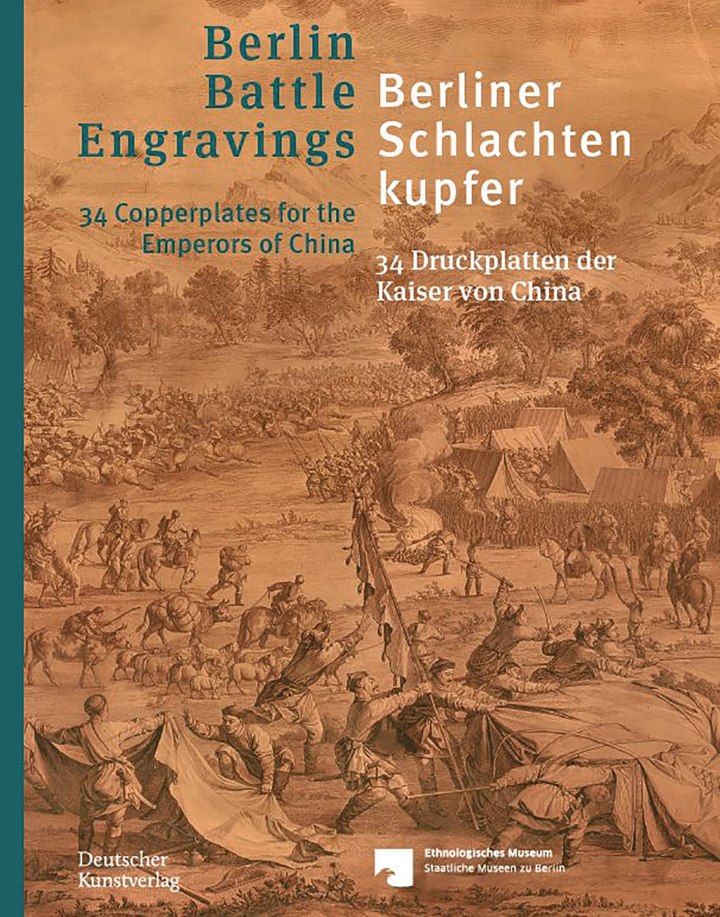
• Lianming Wang, Review of Henriette Lavaulx-Vrécourt and Niklas Leverenz, Berliner Schlachtenkupfer: 34 Druckplatten der Kaiser von China / Berlin Battle Engravings: 34 Copperplates for the Emperors of China (Deutscher Kunstverlag, 2021), pp. 654–55.
• Amina Wright, Review of Frédéric Ogée, Thomas Lawrence: Le génie du portrait anglais (Cohen & Cohen, 2022), pp. 655–56.
• Barry Bergdoll, Review of Didem Ekici, Patricia Blessing, Basile Baudez, eds., Textile in Architecture: From the Middle Ages to Modernism (Routledge, 2023), pp. 662–63.
Exhibition | Living with Sculpture: Presence and Power
From the press release for the exhibition:
Living with Sculpture: Presence and Power in Europe, 1400–1750
Hood Museum of Art, Dartmouth, Hanover, New Hampshire, 23 March 2024 — 22 March 2025
Curated by Elizabeth Rice Mattison and Ashley Offill

The Hood Museum of Art presents Living with Sculpture: Presence and Power in Europe, 1400–1750, on view from 23 March 2024 until 22 March 2025. Drawing on the wealth of the Hood Museum’s permanent collection, the exhibition contributes to the field’s understanding of the role of sculpture in everyday life, historically and today. Whether given as tokens of affection, cast to memorialize important events, designed to promote faith, or used to write a letter, these sculptures engaged their spectators in dialogues of devotion, authority, and intimacy.
Living with Sculpture is curated by two scholars at the Hood Museum of Art: Elizabeth Rice Mattison, Andrew W. Mellon Curator of Academic Programming and Curator of European Art, and Ashley B. Offill, Curator of Collections. It includes 164 objects in two galleries and is accompanied by a major publication of the same title.
Sculpture enlivened private and public spaces in medieval and Renaissance Europe, contributing to presentations of identity, practices of devotion, and promotions of nationhood. Featuring objects made across the continent, this exhibition examines the significance of sculpture between 1400 and 1750, an era of profound cultural and social change. Amid war, colonization, religious conflict, academic upheaval, and social stratification, these works of art ornamented homes, altars, libraries, and collections.
The role of sculpture as a commemorative and connective tool is newly evident in today’s debates about monuments and cultural patrimony. Sculpture manipulates notions of history, forges bonds between distant places, and promotes future actions, as this exhibition shows. Bringing this often-cerebral area of study down to earth, exhibition curators Elizabeth Rice Mattison and Ashley Offill note, “In examining a group of historic objects, this exhibition highlights the way that the material things with which we surround ourselves are critical to developing our personal identities and our relationships with one another. As curators, we lived with these objects during this project, gaining insight into the works and the people who owned them. The choice of a laurel wreath or a cross on a medal was, in many ways, just as informative back then as a social media bio is today.”
Recent examinations of sculpture suggest its singular presence and power for its makers, patrons, and audiences. The dynamism of sculpture became particularly evident in the 15th and 16th centuries with the explosion of interest in purchasing mass-produced objects such as plaquettes and small-scale bronzes. Technological innovations in making sculpture allowed artists to expand their markets and create new types of artwork.
Organized thematically, this exhibition focuses on small-scale sculptures for everyday spaces. With these works, artists could enhance their status and promote their creativity. Meanwhile, useful sculptures like locks and inkwells communicated their owners’ identities and prestige. In collecting sculptures, patrons activated their social connections. Sculpture also facilitated access to the divine, through objects that focused prayer and encouraged tactile connection with God. Similarly, sculptures forged a sense of history, recording contemporary events and promoting ideas about the past. Together, the sculptures presented here attest to how objects in bronze, wood, or stone gave meaning to people’s lives in early modern Europe.
This exhibition and its corresponding catalogue are organized by the Hood Museum of Art, Dartmouth, and generously supported by the Leon C. 1927, Charles L. 1955, and Andrew J. 1984 Greenebaum Fund, and by grants from the Gladys Krieble Delmas Foundation and the Samuel H. Kress Foundation.
The catalogue is distributed by Penn State UP:
Elizabeth Rice Mattison and Ashley Offill, Living with Sculpture: Presence and Power in Europe, 1400–1750 (Hanover: Hood Museum of Art, Dartmouth, 2024), 340 pages, ISBN: 978-0944722558, $50.
The accompanying publication includes five thematic essays, extended catalogue entries for 99 objects, and an illustrated checklist of 114 additional objects from the important collection of early modern sculpture at the Hood Museum of Art, Dartmouth. The book is published by the Hood Museum of Art, distributed by The Pennsylvania State University Press, and produced by Marquand Books, Seattle.
◊ ◊ ◊ ◊ ◊
Exhibition Colloquium | Living with Sculpture
Hood Museum of Art, Dartmouth, 7 September 2024
In connection with the exhibition, this colloquium brings together scholars and curators from around the Northeast to discuss how audiences, patrons, and makers engaged with sculpture in the Middle Ages and early modern period. Ranging from twelfth-century Spain to seventeenth-century Rome, the discussion topics will offer an in-depth examination of making and living with sculpture. The day will include a tour of the exhibition led by its curators, Elizabeth Rice Mattison and Ashley Offill. Check-in opens at 9.30am, and the program will begin at 10.00. The colloquium itself is free, by registration at Eventbrite. A limited number of hotel rooms are available at the Hanover Inn under the block ‘Living with Sculpture’. Please reserve before August 7.
p r e s e n t a t i o n s
• Elizabeth Lastra (Vassar College), Threads of Power and Identity: Exploring Textile Motifs in Sculpture at the Romanesque Monastery of San Zoilo
• Kelley Helmstutler Di Dio (University of Vermont), Seeing Two Sides of the Same Coin: Leone Leoni’s Circle and their Medals in the Hood Museum
• Lara Yeager-Crasselt (Baltimore Museum of Art), François Duquesnoy’s Funerary Monument to the Painter Jacob de Hase: Untangling Flemish Expatriate Networks in Rome
• Laura Tillery (Hamilton College), The Armed Image of Olav Lorenzo Buonanno, University of Massachusetts, Boston, Living with Imaginary Sculptures
• Miya Tokumitsu (Davison Art Center, Wesleyan), Gothic to Grotesque: Sculptural Ornament in the Prints of Lucas van Leyden
• Nicola Camerlenghi (Dartmouth College), Living Sculptures in the Renaissance Streets of Rome
Colonial Williamsburg Acquires Rare Charleston ‘Free’ Badge
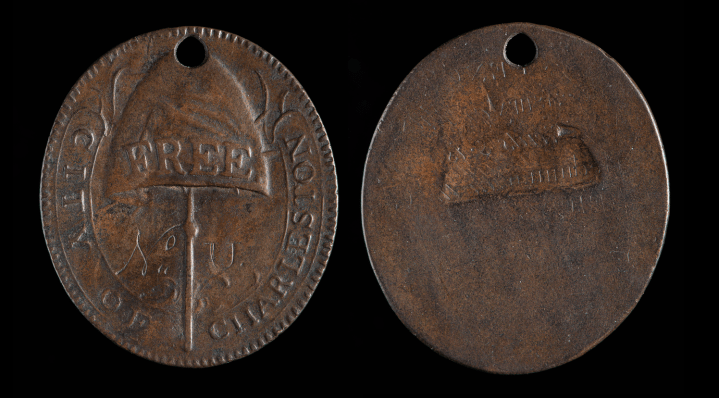
City of Charleston ‘Free’ Badge with Phrygian Cap and Pole, marked ‘No. U’, engraved by Thomas Albernethie, ca. 1787–89, copper
(Colonial Williamsburg: Museum Purchase, The Friends of Colonial Williamsburg Collections Fund and Partial Gift of John Kraljevich, 2024-171).
◊ ◊ ◊ ◊ ◊
From the press release (30 July 2024). . .
Colonial Williamsburg Acquires Rare Charleston ‘Free’ Badge
New research shows the previously unknown numismatic origins of ‘U’ and ‘X’ badges.
Weeks after the Revolutionary War ended by the terms of the Treaty of Paris in 1783, the newly incorporated city of Charleston, South Carolina began to pass laws. The population of the city was overwhelmingly African American with more than 8,000 people in the community, and the vast majority of them were enslaved; only about 600 were living there as free citizens. Ever fearful of insurrection, the city’s administration continued to implement policies designed to constrain the lives of all of its African American residents. An ordinance from 22 November 1783 regulated the employment or ‘hiring out’ of skilled and unskilled enslaved workers in which an individual went to work for an entity other than their enslaver, who was paid a fee for the service provided. An annual fee of five to forty shillings was to be paid to the city by the enslaver for the right of an enslaved person to be hired out, and a badge or ticket was required to be worn by the laborer. [The law also required free African American residents to wear badges.]
While no examples of ‘slave’ badges dating to 1783 are known to exist today, 10 ‘free’ badges from later in the 1780s have been identified in museums and private collections. The Colonial Williamsburg Foundation has recently acquired one of these ‘free’ badges, and it is now on view in the Lowcountry section of the exhibition A Rich and Varied Culture in the Nancy N. and Colin G. Campbell Gallery of the DeWitt Wallace Decorative Arts Museum, one of the Art Museums of Colonial Williamsburg.
“It’s an important piece—and an emotional one,” said J. Grahame Long, The Colonial Williamsburg Foundation’s executive director of collections and deputy chief curator. “Obviously, it’s a terrific addition to Colonial Williamsburg’s permanent collection, but it goes much further than that. It’s a critical component in telling America’s whole story.”
The Charleston ‘hiring out’ law pertained not only to enslaved workers. It went further to affect the free African American population as well, stating that
“…every free negro, mulatto or [mestizo] living or residing within this City, shall be obliged … to register him, her or themselves, in the office of the City Clerk, with the number of their respective families and places of residence … every free negro, mulatto, or mestizo, above the age of fifteen years, shall be obliged to obtain a badge from the Corporation of the City, for which badge every such person shall pay into the City Treasury the sum of Five Shillings, and shall wear it suspended by a string or ribband, and exposed to view on his breast.”
Through these dehumanizing requirements, the city of Charleston levied a fee on the right of free people of color to live and work there—a stinging irony given the root causes of the American Revolution. The penalties for breaking this law were harsh: failure to comply could cause a free person to be fined £3, which if not paid within 10 days could force the person to the workhouse (jail) and work for up to 30 days. Enslaved individuals caught wearing a ‘free’ badge were subject to whipping, by up to 39 lashes, followed by an hour in the stocks.
“I can’t help but see the parallels between these 18th-century ‘free’ badges and the yellow stars worn by Jews during the Holocaust,” said Erik Goldstein, Colonial Williamsburg’s senior curator of mechanical arts, metals, and numismatics. “Both survive as reminders of horrific ideologies, and how humanity must do better going forward.”

City of Charleston ‘Free’ Badge with Phrygian Cap and Pole, marked ‘No. X’, copper (Winston-Salem: Museum of Early Southern Decorative Arts; acquired in 2024, photo by Lea Lane).
Of the 10 known ‘free’ badges, with one exception, all are made of copper. Their iconography is misleadingly uplifting: they featured the ‘Phrygian’ cap and pole, symbolizing the lofty ideals of liberty since ancient times and were rendered in high relief and emblazoned ‘FREE’. Each of these badges carries a unique sequential designator as they were intended to be instruments of tracking, control, and a revenue source. The badge acquired by Colonial Williamsburg is engraved ‘No. U’ and is part of a succession, possibly limited to 26 or fewer badges with letters instead of numbers. To date, the only other badge inscribed with a letter is ‘No. X’, and the other eight examples are numbered between 14 and 341.
Research conducted by Goldstein at Colonial Williamsburg reveals new insights into how these badges were made. What further unites badges ‘U’ and ‘X’ are the copper pieces, or planchets, that they were struck on. Both exhibit portions of text engraved in retrograde or ‘mirror image’ on their backs, showing that they had previously been part of a printing plate relating to money. Once reversed, the readable portions contain words like ‘PENCE’, ‘TREASURY’, ‘DEPOSIT’, and ‘RENTS’. This detail offers a surprising clue to their numismatic origin; the only paper currency circulating in South Carolina in the 1780s that carried these specific terms were the City of Charleston’s emissions of 12 July and 20 October 1786, only current until 21 July 1788. It can therefore be said with certainty that the badges ‘U’ and ‘X’ were made of copper recycled from the out-of-date printing plates for these two issues. As of mid-2024, unique examples of only the ‘Two Pence’ and the ‘Five Shillings & Three Pence’ bills from the 1786 issues of Charleston’s paper money have been recorded. Given that the text engraved on the reverses of badges ‘U’ and ‘X’ match neither, they were for the printing of bills of unknown denominations that are not known to survive.
“The fact that two of the ‘free’ badges were made from re-used copper printing plates is an exciting discovery, since few printing plates from 18th-century American currency issues survive, in any form. But it also makes sense, using governmentally owned material for an official purpose,” said Goldstein.
A law passed on 16 June 1789, eliminated both of Charleston’s badge programs for African Americans. When the city reimplemented a significantly enlarged system of regulation in 1800, it required the purchase and wearing of badges for enslaved people only. Between then and the end of the Civil War in 1865, more than 187,000 ‘slave badges’ were made, sold, and worn by Charleston’s ‘hired out’ enslaved workers. Though ‘free’ badges were never again mandated by the city, the poor condition of some of the surviving examples suggests they may have been worn well past their obsolescence. It is speculated that their owners sought to display their status as dignified, free individuals in an open and proud manner for all to see.
◊ ◊ ◊ ◊ ◊
As reported by Michaela Ratliff for WGHP Fox News 8 (27 July 2024), the Museum of Early Southern Decorative Arts in Winston-Salem, North Carolina, also recently acquired a Charleston ‘free’ badge (as pictured above); theirs is marked ‘No. X’. More information is available at MESDA’s Facebook page.
Exhibition | Worlds Collide: Archaeology and Global Trade
From the press release for the exhibition:
Worlds Collide: Archaeology and Global Trade in Williamsburg
DeWitt Wallace Decorative Arts Museum, Colonial Williamsburg, 7 September 2024 — 2 January 2027

Madeira Decanter, England, ca. 1750, colorless leaded glass, excavated at Wetherburn’s Tavern (Colonial Williamsburg).
We live in an international world where people, commerce, ideas, and traditions cross borders on a daily basis, and this concept is hardly new. As a new exhibition will show at the DeWitt Wallace Decorative Arts Museum, one of the Art Museums of Colonial Williamsburg, these aspects of life were just as evident in the 18th century. Worlds Collide: Archaeology and Global Trade in Williamsburg will reveal the colonial capitol of Virginia to have been a thriving, urban center coursing with people and goods from all over the world as evidenced through approximately 225 archaeological artifacts curated by Colonial Williamsburg’s renowned team of archaeologists. From Spanish coins to Chinese porcelain, punch bowls with political slogans to printer’s type and a dog’s tag, botanicals and glass, the objects vary widely and represent a mere fraction of the over 60 million objects in the collection. Through the opportunity to recover and understand these artifacts, which are the material remains of daily lives of residents from Virginia and abroad, the evidence shows the collision of worlds that defined the town.
“Written documents, works of art, and other sources of information about the past invariably carry the biases of their creators,” said Ron Hurst, the Foundation’s chief mission officer, “but archaeological deposits offer a largely unbiased view of past civilizations. This exhibition illustrates clearly that worldwide commerce is nothing new and touched most parts of the north Atlantic world in the 18th century, even in a place as small as Williamsburg, Virginia.”
Cities such as Williamsburg were hubs where the numerous customs, styles, and tastes of its inhabitants clashed, melded, and evolved through daily interactions. Eighteenth-century Williamsburg was home to people representing a broad mix of economic status, genders, and ages. In addition to Indigenous people and those of European descent, more than half of the town’s population was African or African American, the majority of which was enslaved. The objects seen in Worlds Collide reflect just as much the daily lives of these men, women and children as they do the individuals who enslaved them. To illuminate the diversity of these facets of everyday life, the exhibition is organized around five main themes: material goods, food, ideas, landscapes, and people. When visitors walk through the galleries, they may be surprised to recognize themselves in aspects of the colonial capitol.
“Archaeology provides a tangible connection to the past through the materials we find,” said Jack Gary, Colonial Williamsburg’s executive director of archaeology. “These aren’t abstract ideas but materials that we can all look at together and that can spark discussions about our shared past. Guests will likely see themselves and the modern world in many of these themes.”

Wetherburn’s Tavern in Colonial Williamsburg was especially successful in the 1750s. The exhibition will include cowrie shells and a leaded glass Madeira decanter excavated at the site.
Among the highlighted objects are cowrie shells recovered from Wetherburn’s Tavern. Cowries are the small shells of marine gastropods that make their homes in shallow reef lagoons within the Indian and Pacific Oceans. Harvested in these regions, the shells of these creatures were used as currency throughout the Indo- Pacific and portions of sub-Saharan Africa for centuries, traveling from as far east as the Maldives to the Bight of Benin in western Africa. The value of these shells as money, however, led to their exploitation in the transatlantic slave trade. Purchased and processed in the Pacific, these shells were imported to West Africa by European traders extensively as goods of exchange to fund the forced migration of millions of Africans to the Americas. While these objects played a role in this story of human bondage and suffering, they may also speak to the power of memory and the resilient identity of those who were enslaved. Often recovered from archaeological sites once occupied by enslaved men, women, and children, these shells were also used as items of adornment or keepsakes. This kind of usage may speak to individuals’ attempts to draw on transatlantic memories and traditions to reclaim their identity in the face of the dehumanizing system of enslavement in the 18th century in places such as Williamsburg.
“Whether in the 18th century or today, the objects we use in our daily lives make statements about who we are, what we value, and the connections between ourselves and others in the world. It is exciting to bring so many artifacts that represent a truly diverse set of 18th-century Williamsburg’s population into the public eye,” said Sean Devlin, senior curator of archaeological collections at Colonial Williamsburg.
Another highlighted object to be seen in the exhibition is a fragment of a Chinese export porcelain platter owned by John Murry, Earl of Dunmore, who was the last royal governor of Virginia. It is especially unique as it may have traveled the farthest among the objects included in Worlds Collide. Adorned with the armorial decoration of a Scottish noble, this object was found among the late 18th-century refuse in Williamsburg on the site of Prentis Store. Most likely its story began as part of a written order for a large dinner service of tableware, perhaps accompanied by a drawing of the decoration, issued to a European merchant by Lord Dunmore. The order would have traveled to the Chinese port of Guangzhou where workshops specialized in applying the fine overglaze decoration that was requested. The porcelain pieces themselves, however, had previously been shipped to Guangzhou from the city of Jingdezhen (located 400 miles inland), which was an early factory city that produced nearly all porcelain for both domestic and export markets. Finally translated from text to physical object, this service was packed into the hold of a returning merchant ship before being delivered to Dunmore in Scotland. It then continued its global trek when Dunmore was appointed to governing positions first in New York and then Virginia. On the eve of the Revolution in 1775, Dunmore was forced to flee Williamsburg and left most of the family’s household possessions in the Governor’s Palace. From there, portions of this dinner service, which had literally sailed across most of the globe, ended their journey dispersed about the town.
Excavation at Wetherburn’s Tavern also produced a glass decanter for Madeira wine. In the 18th century, Virginians preferred to drink European wines at home and in taverns, and wines from Spain and Portugal were more prevalent than those from France. Among the favorites of Colonials was Madeira, a sweet, fortified wine produced on the Atlantic Island of the same name that was controlled by Portugal. Most of these wines were shipped in barrels or storage jars, and often needed to be decanted into individual bottles or vessels for serving. In this instance, not only did the contents of the decanter cross the world’s oceans but so did the vessel. Made of leaded glass, the decanter almost certainly was imported to Williamsburg upon a merchant ship from Britain and was of a very fashionable type in the mid-1700s. The body is engraved with a chain on which hangs a label bearing the engraved word ‘MADEIRA’ and surrounded by appropriate decoration, such as grapes, grape leaves, tendrils, and possibly grape flowers.
A broad hoe found at Carters Grove Plantation is an example of the agricultural products that flowed back and forth from the Virginia colony and Britain. Tobacco was the first crop to overtake the countryside in the areas around Williamsburg in the late 17th and early 18th centuries, and the tendrils of this crop reached into every facet of daily life there. The tobacco hoe was a uniquely colonial tool that evolved over the 18th century as did the cultivation of the crop itself; the shape and construction of hoes changed in response to the needs of the agricultural enterprise. By early in the century, hoes were being produced in the tens of thousands in Britain for export to the colonies in North America and the Caribbean. This hoe is stamped with a repeated ‘AD’ mark that likely denoted the shop or individual who made the tool, even though their name is lost to time.
Further exemplifying how the 18th-century economy was truly global is a Tuscan oil jar found at the Anthony Hay House and Cabinet Shop site. Massive jars such as this were produced in northern Italy, particularly in the upper reaches of the Arno River Valley. The jars were brought down river and used to store and ship edible oils from ports such as Livorno. Among the largest buyers of these oils were British merchants and the
British navy. These pots traveled from Italian ports to docksides in London and around the globe in the holds of these ships, being found in such diverse settings as Jamaica, Patagonia, and coastal Australia, as well as Williamsburg.
For anyone fascinated by archaeology, globalization or material culture, Worlds Collide: Archaeology and Global Trade in Williamsburg is certain to fascinate, delight, and educate. It also will serve as an important orientation to Colonial Williamsburg’s Historic Area, as it will expand the visitor’s imagination to the daily lives of all those who lived there in the 18th century.
The exhibition is generously funded by Jacomien Mars.
Information on additional objects can be found here»
Exhibition | Looking Allowed?
Now on view at Ambras Castle in Austria:
Looking Allowed? Diversity from the 16th to the 18th Century
Schloss Ambras, Innsbruck, 20 June — 6 October 2024
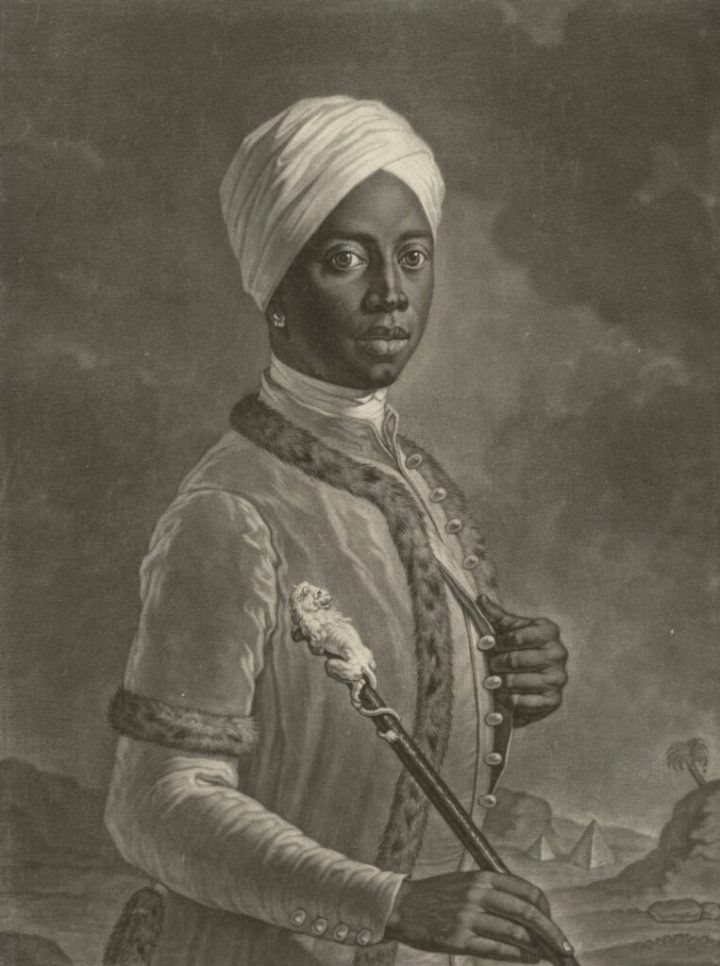
Johann Gottfried Haid after Johann Nepomuk Steiner, Portrait of Angelo Soliman (Mmadi Make), ca. 1750. Born in West Africa, Soliman was enslaved and shipped to Europe before eventually advancing in Austrian society as a successful Freemason and member of court.
Diversity has always existed. In the Renaissance—as humans increasingly took centre stage—it was not only the ideal that was of interest, but also humans’ inexhaustible diversity. The exhibition Looking Allowed? Human Diversity from the 16th to the 18th Century considers diversity in the past from today’s perspective, taking as its point of reference the Ambras collections of Archduke Ferdinand II. Here the whole world was illustrated, as was common in chambers of art and wonders.
Why did the Portrait of a Disabled Man find its way into the Ambras Chamber of Art and Wonders? Who is behind the ‘hair family’? And why do portraits of ‘court giants’ and ‘court dwarves’ move us? Such paintings run the risk of being dismissed as mere curiosities. This exhibition, by contrast, tells the stories of these people who did not fit period norms, taking as its theme the questions of whether, and if so, how encounters with them took place. It invites visitors to reflect on their own perceptions, confronting us with the question: ‘is it permissible to look?’
Current viewpoints are brought into the exhibition through audio and video contributions. Adapted font sizes and objects placed on different levels are aimed at reducing barriers and making it possible for a variety of visitors to experience the exhibition. Furthermore, the installation of a lift in the upper castle offers easy access for the first time to the special exhibition rooms located on the second floor.
Thomas Kuster, Christian Mürner, and Veronika Sandbichler, eds., Schauen erlaubt: Vielfalt Mensch vom 16. bis 18. Jahrhundert (Cologne: Walther König, 2024), 192 pages, ISBN: 978-3753306506, €19. With contributions by Volker Schönwiese, Katharina Seidl, Susanne Hehenberger, Eva Seemann, Anne Kuhlmann-Smirnov, and Rudi Risatti.
With statements, six essays, and over 70 catalog entries, the volume engages human diversity and the tensions between self-empowerment, acceptance, and discrimination.
New Book | The Art of Anna Dorothea Therbusch (1721–1782)
Forthcoming from Amsterdam UP, with a reminder that registration for September’s Therbusch conference in Berlin is due by August 4.
Christina Lindeman, The Art of Anna Dorothea Therbusch (1721–1782) (Amsterdam: Amsterdam University Press, 2024), 212 pages, ISBN: 9789463721486, €117.
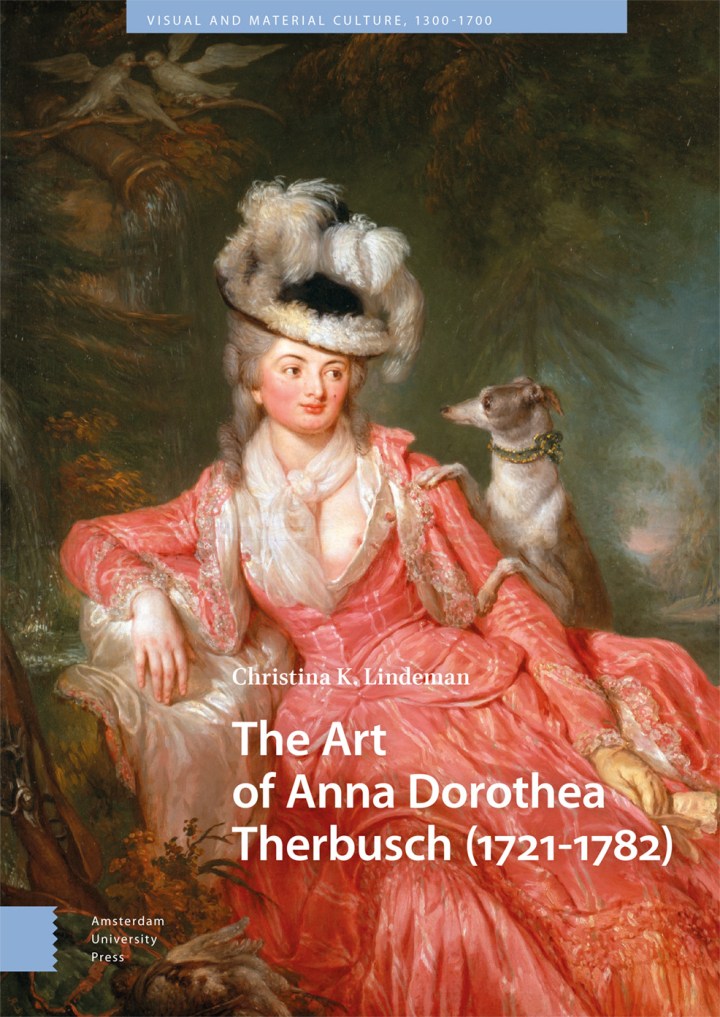 The Art of Anna Dorothea Therbusch (1721–1782) is the first English-language monograph on this exceptional German artist that critically examines Therbusch’s artworks and career as a history and mythological painter, portraitist, and maker of synthetic pigments within the German and international milieu that both condemned and celebrated her accomplishments. Adding to the excellent scholarship on French, British, Italian, and Swiss eighteenth-century women painters, this book showcases the social and cultural practices of court cultures beyond France, with a focus on German-speaking Europe and how a provocative woman painter navigated within them. Meticulous archival and literary research sheds new light on the importance of the family atelier as a place of networking, collaboration, and experimentation in the eighteenth century and provides a fresh perspective on the growing Prussian intellectual and mercantilist cultures and their impact on Therbusch’s artistic production and the unavoidable fluency between painting, the minor or luxury arts, and the laboratory. Therbusch’s life and art enriches our understanding of female artistic agency and the complexities of pursuing a career in the male- and academy-dominated art world of the eighteenth century.
Christina K. Lindeman is Associate Professor of Art History at the University of South Alabama. Her research focuses on the art and material culture of eighteenth-century Germany. Her first book Representing Duchess Anna Amalia’s Bildung: A Visual Metamorphosis from Political to Personal in Eighteenth-Century Germany was published by Routledge in 2017. She has also contributed essays in Intimate Interiors: Sex, Politics, and Material Culture in the Eighteenth-Century Bedroom and Boudoir (2023), Materializing Gender in Eighteenth-Century Europe (2015), Word and Image in the Eighteenth Century (2008), as well as published articles in Source (2013) and Journal 18 (2022).
c o n t e n t s
List of Illustrations
Introduction
1 A Woman Artist Painting Women
2 Collaboration as a Veil
3 Turning Back to the Dutch Masters
4 Arcanum, a New Red
Epilogue
Bibliography
Index
Call for Papers | CAA 2025, New York
I’ve highlighted here a selection of panels related to the eighteenth century; but please consult the Call for Papers for additional possibilities. –CH
113th Annual Conference of the College Art Association
New York Hilton Midtown, 12–15 February 2025
Proposals due by 29 August 2024
The CAA 113th Annual Conference will take place at the New York Hilton Midtown, New York City, 12–15 February 2025. The conference will be held in person with a selection of hybrid sessions and events. To submit a proposal, you’ll need a CAA account—though at this step, membership is not required. Proposals should include a presentation title and an abstract (of no more than 250 words), along with a brief CV (2 pages). Additional information is available from CAA’s website.
◊ ◊ ◊ ◊ ◊
American Art and the Pyrocene (remote session)
Chairs: Thomas Busciglio-Ritter (Joslyn Art Museum) and Annika Kelsey Johnson (Joslyn Art Museum)
Coined by historian Stephen Pyne in 2015, the concept of Pyrocene defines a human-caused fire age in which burning has become synonymous both with fossil energy consumption and lasting environmental damage. In North America, fire has long stood at an ecological, cultural, and political threshold, particularly when considering the long history of Indigenous practices such as controlled burns. With the arrival of Euro-American settlers, fire became a weapon used against Native societies to ensure an unbridled exploitation of natural resources. In turn, the omnipresence of fire within the US colonial project inspired a full-fledged artistic genre as of the early 19th century, and depictions of landscapes set alight became a popular form of disaster spectacle. Fire, however, has acquired new meaning in the 21st century: faced with persistent drought and large-scale blazes exacerbated by climate change, a growing number of communities are, for instance, reconsidering prescribed burns as an ecological practice.
Examining interactions between American art and the Pyrocene across time and media, this session invites submissions from researchers, scholars, and artists at all levels who focus on:
• Visual representations of fire in American Art, from the 18th century to the present
• Material interactions between American art and fire (accidental or intentional destruction, fire as creative fuel or co-participant in artmaking…)
• Artistic involvement in the study of fire and fire management
• Artist-led environmental interventions involving fire
• Artistic approaches to Indigenous ecologies of fire in North America
• Artists’ responses to North American wildfires and the climate crisis in our time
◊ ◊ ◊ ◊ ◊
The Art of Collaboration in the Long 18th Century (HECAA)
Chairs: Yasemin Diba Altun (Duke University) and Tori Champion (University of St Andrews)
The 18th century is an era known for its joint ventures, from sweeping publications like the Encyclopédie to crowd-sourcing spaces like the Enlightenment salon. This panel invites papers that consider the group dynamics and agencies that shaped the production, distribution, and consumption of visual and material art and culture during the long 18th century (ca. 1688–1815). How did 18th-century makers and their art worlds define ‘collaboration’? Scholars have noted that this term (at least in relation to artmaking) did not arise until the 19th century. What then were earlier vocabularies and discourses used to characterize a shared creative process and its participants? Papers could engage with conventional hierarchies of fine and craft arts. They could examine divisions of labor within academic, guild, domestic, and other contexts of production, both local and global. Particularly welcome are contributions that take up the politics and (in)visibilities of collaboration: how has credit been attributed to artworks produced by more than one individual? Whose names have or have not been ascribed to such works, for instance when displayed in exhibitions, sold on the art market, or described in critical writings? How do modern and more recent ideas of authorship fit or conflict with the 18th-century realities of artistic practice, which often involved multiple people working at different sites and stages, whether in concert or competition, to realize products of visual and material culture? Ultimately, this panel seeks contributions that challenge or complicate lingering norms of individual—relatedly, male and white—authorship in 18th-century art history.
◊ ◊ ◊ ◊ ◊
Collecting Her Thoughts: Women Art Collectors across Time
Chairs: Toni Armstrong (Boston University), Danarenae Donato (Boston University), and Ilaria Trafficante (Scuola Superiore Meridionale)
In his introduction to 19’s 2021 issue on women collectors, To Stammers writes that “the renewed study of female collectors promises to reconfigure the history of art and the history of gender alike.” Across time, women’s access to the social and financial resources necessary to collect art has been different from that of their male counterparts and often more limited. Both because of and in spite of these differences, women have served as art patrons, developed ideologically and materially expansive collections, and promoted art in public arenas. Yet, women collectors have been systematically excluded from museum and curatorial studies, perhaps in part because their collections and practices may manifest differently. Discussions of major art collectors continue to prioritize men, even when women were involved as spouses in developing domestic collections, in donating to museums, and in developing legacies for themselves and their partners.
How does the study of female collectors challenge and expand existing scholarship? Who were these women, and how and why did they collect? How and in what ways did women live, work, influence, and collect in community with others? How do women’s philanthropy, art collecting, and collecting as activism intersect in and out of the museum? We invite papers that open conversations about feminist curatorial practice of the past and present, offering new methodologies for the study of collecting and women’s curatorial practice. We encourage scholars who may be early in their careers, those who may come from underrepresented backgrounds, or those who study multiply marginalized women.
◊ ◊ ◊ ◊ ◊
Gender, Sexuality, and Non-Pristine Nature in Northern European Art and Material Culture, 1350–1750 (HNA)
Chairs: Anna-Claire Powell Stinebring (The Metropolitan Museum of Art) and Sarah Walsh Mallory (The Morgan Library & Museum)
How might waste studies (or discard studies), as an emerging strain within eco-critical methodologies, be put into productive conversation with (eco)feminist and queer theory? Such a question is apt in the context of early modern northern European art and material culture, born from an age in which the adage “cleanliness is next to godliness” had a particular resonance: close observation of nature was for artists a spiritual practice, which in turn spurred them to explore new methods for depicting their world, including mundane or unseemly details. This panel will examine notions of gender, sexuality, and non-pristine nature to shed new light on the construction—or playfully subversive deconstruction—of normative social hierarchies in early modern Northern European art and material culture. We build on the work of Mary Douglas, Donna Haraway, Carolyn Merchant and on recent scholarship, including: Francesca Borgo and Ruth Ezra (Wastework conference and edited volume); Emma Capron (The Ugly Duchess: Beauty and Satire in the Renaissance); Lauren Jacobi and Daniel Zolli (Contamination and Purity in Early Modern Art and Architecture); and Vittoria Di Palma (Wastelands: A History). Relevant topics include: gender in depictions of purity and contamination; wastelands; urban or domestic environments; purity in the colonial context; and contemporary curatorial responses. We welcome papers on all artforms and material culture produced in, or in connection with, the Northern Netherlands, Southern Netherlands, or Germany between the l4th and 18th centuries. Please send a proposal and CV to Sarah Mallory (smallory@themorgan.org) and Anna-Claire Stinebring (Anna-Claire.Stinebring@metmuseum.org) by August 29th.
◊ ◊ ◊ ◊ ◊
The Incomplete in the Long 19th Century (Interdisciplinary Nineteenth-Century Studies)
Chair: Nancy Rose Marshall
The theme of our panel is art and imagery related to the concept of ‘INCompleteS’, broadly construed. Possible topics might include: Unfinished sculptures or paintings; the meaning of the sketch; art that thematized ideas of absence, the partial, the fragmented, or the dismembered; fiction or criticism treating the undeveloped or unfinished artwork; or disability studies perspectives that counter 19th-century definitions of deficiency. We are especially looking for interdisciplinary papers that consider how notions of ‘the incomplete’ might in turn shed light on the 19th-century investment in the idea of whole and the totalizing. Topics from the long 19th century of any country or culture welcome.
◊ ◊ ◊ ◊ ◊
Neoclassicism in the Extended Field
Chairs: Rebecca Yuste (Columbia University) and Faraz Olfat (Yale University)
Neoclassicism, the movement that looked to the aesthetic, philosophical and political tradition of Greece and Rome, is one of the central threads of the long 19th century, often associated with state-building projects and the rise of secular modernity. Works by Robert Adam, Jacques-Germain Soufflot, Karl Friedrich Schinkel and Abbé Laugier had a crucial influence on the evolution and theorization of the movement internationally. This was facilitated through the circulation of ideas and the growth of European colonial enterprises as Neoclassical buildings sprung up far beyond the confines of Europe, with examples in the colonial Americas, the Middle East, South Asia, and across the continent of Africa.
This panel asks what happens when Neoclassicism moves outside of its traditionally understood geographies, namely Western Europe. It examines the introduction, promotion and application of Neoclassicism in these non-western geographies in order to construct a global understanding of the movement. This panel also considers how Greco-Roman traditions intersect and interact with local archaeological legacies, as well as the relationship established between Neoclassicism and imperialism across the globe. We welcome papers that expand, complicate and contradict traditional narratives of Neoclassical architecture, from the discovery of Pompeii and Herculaneum until the first decade of the twentieth century. These might explore topics related to the circulation of Neoclassical design through colonial intervention, photography, pattern books, architectural treatises, or the prominence of the École des Beaux-arts. Examples could include but are not limited to governmental buildings, libraries, financial institutions, religious monuments, private residences, unrealized projects, and theoretical writings.
◊ ◊ ◊ ◊ ◊
New Directions in British Art and Architectural History (HBA)
Chairs: Monica Anke Hahn and Laurel Peterson (Yale Center for British Art)
The study and practice of art history in the academy and in in the museum has changed substantially in the last five years. This call invites scholars, researchers, curators, and practitioners to present their work on innovative approaches, emerging themes, and unexplored avenues in the study of British art and architectural history. We define ‘Britain’ and ‘British art’ broadly, and welcome presentations on a diverse range of topics including, but not limited to:
• Reevaluations of overlooked or underrepresented artists, architects, styles, and movements.
• Revised interpretations of established narratives and historical perspectives.
• Explorations of transnational connections and global exchanges shaping British artistic and architectural practices.
• Examinations of the intersections between British art and architecture and issues of identity, memory, and tradition.
• New curatorial approaches and interventions.
• Applications of innovative methodologies, including digital humanities, GIS mapping, and material analysis.
Especially encouraged are projects with interdisciplinary approaches, and those that consider wide geographical, social, and racial contexts. Proposals from scholars in and outside of academia, and at any stage in their programs or careers are welcome.
◊ ◊ ◊ ◊ ◊
Sculpture as a Collective Practice in the Long 19th Century
Chairs: Apolline Malevez (Ghent University) and Marjan Sterckx (Ghent University)
Collaborative practices, shared authorship and the labor of art are gaining recognition in contemporary art research, yet remain under-acknowledged in nineteenth-century art history. Taking inspiration from Howard Becker’s ‘art worlds’ [1982], this session explicitly considers sculpture as the collective practice it has traditionally been, and zooms in on the sculpture studio as a creative ecosystem, in which ‘the sculptor’ is but one of the actors involved.
Most successful sculptors hired collaborators to help with the making of their works. However, this did not mean that collaborative work was valued as such: the (male) sculptor was generally considered as the only ‘real’ creator, while the specialists who helped with the various mechanical aspects of art making (such as the production of plaster moulds, the bronze casting and/or the rough cutting) were perceived as ‘mere assistants’, and their use was sometimes criticized.
Beyond specialist practitioners, this panel also wishes to highlight other forms of hidden labor. We invite papers that draw attention to the domestic, creative and/or technical work of pointers, carvers, moulders, students, models, domestic servants and family members in the sculptor’s studio and household. We will consider questions such as: who made the time-consuming labor of sculpture possible? Who cleaned up all the dust? How should we value the artistic contribution of sculptors’ collaborators? We aim to provoke discussion around the notion of individual authorship, the rethinking of the studio as a space of hybrid (class, gender and race) relations, and the importance of care work within artistic creation.
◊ ◊ ◊ ◊ ◊
Taking and Making: Artistic Reckonings with Cultural Property Theft in the Long 19th Century (AHNCA)
Chair: Nancy Karrels (Independent Scholar and Curator)
The 19th century witnessed a plethora of incidents of cultural property theft accompanied by coercion and violence and often driven by imperial and colonial agendas. From the notorious spoliation of Beijing’s Old Summer Palace during the Opium Wars to the seizure of sacred Native American artifacts under the guise of scientific inquiry, these acts of looting left communities grappling with profound cultural losses that still reverberate today. This panel explores the complex dynamics of artistic exchange and expression engendered by these traumatic events. Drawing inspiration from Bénédicte Savoy’s transnational approach to the cultural exchanges that resulted from the French spoliation of Germanic princely collections in post-Revolutionary Europe, we aim to investigate the ways in which forcible transfers of cultural patrimony globally catalyzed shifts in artistic value and meaning during the long 19th century, and how these contentious processes sparked cross-cultural discourse and innovative avenues of creative expression among artists directly impacted by or complicit in them. From the interplay between looting and artistic production to the evolution of techniques and styles in the aftermath of plunder, we encourage contributions from diverse cultural perspectives and methodological approaches. Proposals are open to all, but once accepted, presenters will need to update their memberships in both CAA and AHNCA by the time of the conference.
◊ ◊ ◊ ◊ ◊
Trajectivity in Art: Toward a Horizontal Art History of Styles
Chair: Julie Codell (Arizona State University)
We call styles grouped by artists ‘movements’, but where do styles go? Art historians constrict movements to ‘centers’ (e.g., Paris, New York) and time periods. Considering styles’ movements in a horizontal art history [from the eighteenth century to the present], we can discover how styles’ canonicity, materiality, their artists’ reputations, and their market values are transformed across borders, oceans, and continents. ‘Trajectivity’ can mean orientation toward (Paul Virilio): artists often orient their styles toward permanence, popularity, universality, and transcendence. It may mean deraciné, ungroundedness (John Rajchman). In a horizontal art history challenging the center-periphery binary and provincializing ‘centers’, ‘peripheral’ artists can transmute, de-and re-territorialize and re-invent styles through their local conventions; peripheries are not passive recipients of styles but recreate them, denying the essentialism and universality ascribed to European styles presumably grounded in centers (Piotr Piotrowski): The Metropolitan Museum’s Surrealism Beyond Borders (2021–22) covering 45 countries and 80 years exhibited Surrealisms that absorbed local visual idioms beyond Europe.
Possible questions are (but not limited to):
• How do styles’ meanings, market values, histories, significations and authority change when styles cross borders?
• What art events (exhibitions, biennales) stimulate styles’ mobility?
• When centers are provincialized, what happens to ‘universality’ and ‘transcendence’ ascribed to centers’ styles?
• Do new traits from places they traverse adhere to styles?
• Do reputations of artists associated with centers change when styles migrate?
• What agency do artworks have to transform styles when introduced into ‘centers’ or ‘peripheries’?
• How can critical museums display and exhibit styles’ cultural exchange transformations?
• Do political events—colonialism, war, emigration—affect styles’ transmissions and transformations?
◊ ◊ ◊ ◊ ◊
Unboxing the Long 18th Century (ASECS)
Chairs: Dani Rebecca Ezor (Kenyon College) and Jennifer Germann
Boxes are objects which at once contain and extend their makers’ and users’ contact with the world. Then as now, they traveled the globe, moving between cultures and amongst sellers, consumers, and collectors. With online shopping and shipping, they have proliferated as symbols of consumerism, as fodder for YouTube and TikTok videos, and as useful nuisances, littering our landscapes. They have not, however, claimed the same space in our scholarly studies. Usually an afterthought or even discarded entirely, boxes could be luxury goods themselves, made by skilled craftspersons with significant care and attention to detail. Boxes contain, store, hide, protect, wrap, package, present, and encase, but they can also reveal, expose, manifest, exhibit, and even release. Here we turn attention to the box as a signifier and site of meaning. As noted in the Encyclopédie, “The number of assemblages that can be called a box is infinite.” (“Le nombre des assemblages auxquels on donne le nom de boîte est infini.”)
This panel invites papers that explore boxes of all kinds, including but not limited to boxes for artist’s materials; snuff boxes; powder boxes; mouche boxes; nécessaires; etuis; tea or coffee canisters; specimen boxes; trunks; coffers; caskets; and cases; as well as their representation. These objects raise issues related to interiority and exteriority, storage and display, the hidden and the revealed. Global topics from the 17th through the early 19th century that address labor, performance, the senses, empire, materiality, gender, race, and other avenues of exploration are welcome.
◊ ◊ ◊ ◊ ◊
The Visual Culture of Festivals in Germany, Scandinavia, and Central Europe (Historians of German, Scandinavian, and Central European Art and Architecture)
Chair: Michelle Oing
Mikhail Bakhtin’s foundational work on carnival has inspired countless studies on festivals around the world, and the idea of the world turned upside down. Though Bakhtin’s focus was on literature, much subsequent work on festivals has been produced by anthropologists, social historians, and theater historians, for whom the inversion of carnival provides a useful framework to consider myriad themes (social hierarchy, humor, reform, etc.).
But what makes a festival a festival? What is often most striking is their rich visual culture. In this panel we are interested in the idea of the festival broadly defined: gatherings religious or secular, parades, protests, organized events and spontaneous celebrations or revolts. From the elaborate ephemeral architecture of early modern royal entries, to Midsummer celebrations involving maypoles and bonfires, and the Krampusnacht parades of Austria and Central Europe, these festivals make full use of the visual impact of masks, puppets, floats, costumes, automata, and the manipulation of architectural and/or natural spaces. Ephemeral live events, records of festivals also often survive only in visual form, whether in photography, painting, engraving, or other forms of visual record-keeping. This panel seeks papers that consider the highly visual and spatial aspects of the festival in Germany, Scandinavia, and Central Europe through an art historical lens. We welcome submissions that blend art historical and other theoretical approaches in order to explore what the tools of art history can bring to the study of the festivals from this region, from antiquity to the present.
◊ ◊ ◊ ◊ ◊
Women and Letters
Chair: Isabel Mehl (Freie Universität Berlin)
Women reading letters is a widespread motif in art history. In the 17th century, the motif was ubiquitous in Dutch painting, became erotically charged in the French Rococo period, and was taken up again in the 19th and 20th century by Pierre-Auguste Renoir and Henri Matisse. Research has mainly focused on male artists depicting female (letter) readers whereas paintings by women artists depicting the same motif have not yet been researched (comparatively). This is surprising since women painters have employed the motif of the letter since the 19th century—prominent examples being Mary Cassatt’s The Letter (1890/1), Harriet Backers Evening, Interior (1896), or Charlotte Berend-Corinths Self-portrait (1941). In addition, the epistolary form as such has regained prominence in works by contemporary women artists working in different mediums, for instance, Sophie Calles installation Prenez-soin de vous (2007), Moyra Davey’s chromogenic prints Subway Writers (2011) or Nicole Tyson’s book Dead Letter Men (2015). This session seeks to bring together scholars whose work addresses the epistolary as motif or form in works by women artists. Artists are also invited to contribute their perspective on this topic. We will discuss issues of class, gender and race in relation to these works. In bringing together current research from different geographical contexts and historical periods this session aims at uncovering the yet untold stories of woman and letters in the visual arts.
◊ ◊ ◊ ◊ ◊
Women Artists and the Politics of Neoclassicism
Chairs: Andrea Morgan and Megan True (Art Institute of Chicago)
The history of 18th-century French painting has long been dominated by the study of canonical male artists like Jacques-Louis David, whose name is synonymous with a Neoclassical aesthetic. However, as recent scholarship has shown, from the end of the French Revolution through the Restoration women artists were more visible than generally acknowledged, such as by exhibiting in increasing numbers at the Salon and the Royal Academy and participating in the commercial market. This panel invites papers investigating how women makers responded to the dramatic social and political upheaval in France and its reverberations across Europe, Great Britain, or more broadly from the late 18th century throughout the 19th. Can any trends in subject matter chosen by women be identified within the broad umbrella that constitutes Neoclassicism? Did Neoclassicism—with its inclination toward the classical body and the genre of history painting—necessarily exclude a number of women artists who often concentrated on more ostensibly neutral subject matter such as still life or portraiture? Or were there more women like Nanine Vallain, a student of David, who actively participated in political conversations? This panel aims to explore reform, revolution, and restoration from the perspective of women—including those who were patrons of the arts—in the hopes of expanding or nuancing our collective interpretation of the Neoclassical movement, broadly defined. Papers that discuss—whether in support or repudiation of—the contested notion that there are specifically feminine or masculine characteristics to artworks are particularly welcome.
◊ ◊ ◊ ◊ ◊
Note (added 29 July 2024) — The original posting was updated to include the session on Trajectivity.
Exhibition | Paris through the Eyes of Saint-Aubin
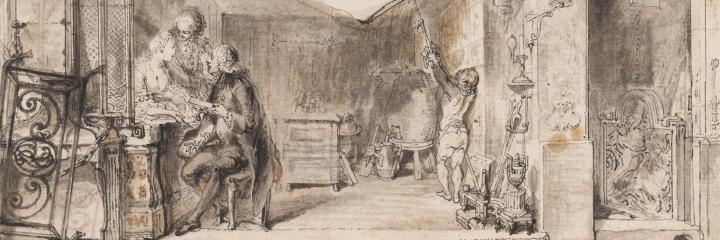
Gabriel de Saint-Aubin, Trade Card for Périer, Ironmonger, 1767, black chalk, pen and black and brown inks, brush and gray and brown wash
(New York: The Metropolitan Museum of Art, New York, Promised Gift of Stephen Geiger)
◊ ◊ ◊ ◊ ◊
Opening in September at The Met:
Paris through the Eyes of Saint-Aubin
The Metropolitan Museum of Art, New York, 26 September 2024 — 4 February 2025
Gabriel de Saint-Aubin (1724–1780) was a prolific and unconventional draftsman whose drawings invite viewers into every corner of the French capital. As an observer and chronicler, he prowled the streets of Paris and recorded the full spectrum of daily life in his sketchbooks, from shop interiors to art auctions and public gardens to rowdy street fairs. Everything he saw was worthy of his attention, wit, and empathy.
Saint-Aubin’s body of work is made up almost entirely of tiny, portable, and intricate works on paper. Taken together, these countless sketches give rise to a deeper view of the city as an organic form. Beyond capturing the tangible, they bring to light the pride and aspirations of Paris in the 18th century, a time when sites were being destroyed, rebuilt, and reimagined.
Marking the 300th anniversary of his birth, the exhibition features a thematic arrangement demonstrating the breadth of Saint-Aubin’s interests. Examples of his drawings and prints, drawn from The Met’s holdings and local private collections, are complemented by a selection of works by his family and contemporaries, offering a context for his career and highlighting the unique nature of his vision.
Call for Papers | Newspapers and Periodicals
From USTC, as hosted by St Andrews:
St Andrews Book Conference: Newspapers and Periodicals
Universal Short Title Catalogue Conference
St Andrews, 19–21 June 2025
Organized by Andrew Pettegree, Arthur der Weduwen, and Zachary Brookman
Proposal due by 13 December 2024
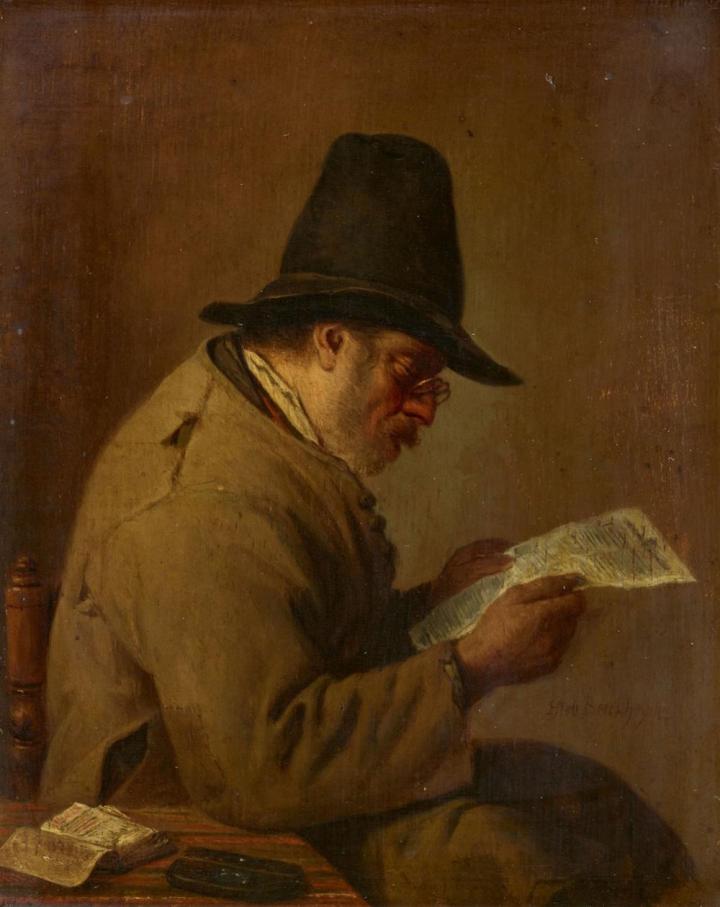
Job Adriaensz Berckheyde, A Man Reading a Newspaper, ca. 1670s, oil on panel, 17 × 14 cm.
While the basic technological underpinnings of print were unaltered from the days of Johannes Gutenberg to the invention of the steam press in the nineteenth century, one type of early modern publishing, pioneered in the early seventeenth century, would alter the printscape decisively. The rise of newspapers and other types of periodical publishing was beset by many failures and missteps, but by 1700, the genre had taken Europe by storm.
In the eighteenth century, newspapers would be at the heart of the expansion of printing presses in provincial Europe and its colonies overseas. At the same time, the range of periodical publishing on offer in Europe’s major cities would expand into every realm of printed information. While periodicals have long been the poor relation of short title catalogues and bibliographical investigations, this conference will seek to place periodical publishing where it belongs, at the heart of early modern print culture.
The conference will engage with the full diversity of periodical literature that appeared in the early modern period, from newspapers and monthly digests of current affairs to periodicals covering science, the book trade, literature, arts, husbandry, philosophy, and more. We welcome proposals for papers on research methodologies and the reconstruction of periodical ventures, key categories of periodical genres, individual titles, or prominent publishers, and other subjects.
Proposals—with a title, an abstract of up to 300 words, and a short biography of up to 150 words—should be addressed to the organisers, Andrew Pettegree, Arthur der Weduwen and Zachary Brookman, by 13 December 2024. The organisers can be reached at admp@st-andrews.ac.uk, adw7@st-andrews.ac.uk, and zb28@st-andrews.ac.uk.










 Enfilade
leave a comment