Call for Papers | Visualizing Antiquity: Fake News? Fantasy Antiquities
From ArtHist.net (which includes the CFP in German). . .
Visualizing Antiquity: On the Episteme of Early Modern Drawings and Prints —
Part IV: Fake News? Fantasy Antiquities
Bildwerdung der Antike: Zur Episteme von Zeichnungen und Druckgrafiken der Frühen Neuzeit — IV: Fake-News? Fantasie-Antiken
München, Zentralinstitut für Kunstgeschichte, 14 February 2025
Organized by Ulrich Pfisterer, Cristina Ruggero, and Timo Strauch
Proposals due by 15 September 2024
The academy project Antiquitatum Thesaurus: Antiquities in European Visual Sources from the Seventeenth and Eighteenth Centuries, hosted at the Berlin-Brandenburg Academy of Sciences and Humanities (thesaurus.bbaw.de/en), and the Zentralinstitut für Kunstgeschichte Munich (zikg.eu) are organizing a series of colloquia in 2023–2025 on the topic Visualizing Antiquity: On the Episteme of Drawings and Prints in the Early Modern Period. The significance of drawings and prints for ideas, research, and the circulation of knowledge about ancient artifacts, architecture, and images in Europe and neighboring areas from the late Middle Ages to the advent of photography in the mid-19th century will be examined.
The three previous colloquia were dedicated to the topics of the ‘unrepresentable’ properties of the depicted objects and the documentation of various states and contexts of ancient objects from their discovery to their presentation in collection catalogues. The fourth and final event will examine the problem of invented or imitated antiquities.
In fact, all types of objects from the arts and crafts of antiquity—aegyptiaca, coins and gems, statuettes and statues, objects of everyday culture from jewellery to weapons and much more —were reproduced as real artefacts and/or in graphic illustrations on all kinds of different occasions over the centuries following antiquity. The father of modern ‘forgeries’ is undoubtedly Giovanni Battista Piranesi (1720–1778), who knew how to create new objects (‘capricci’) from numerous ancient spolia, which were highly sought after, in particular by northern European collectors. But this is not about him.
In addition to the physical ‘fakes’ on the marketplace of the antiquities trade, their pictorial representations or even antiquities ‘invented’ solely on paper often played a decisive role in the dissemination of a partially distorted, tendentious or ‘false’ idea of past cultures and their materiality.
Starting from the counterfeit imitations of the early modern period, our colloquium is interested in a very broad spectrum of ‘fantastic’ antiquities or ‘forgeries’ of antiquities and their motivations. The following aspects are of particular interest, but other suggestions are also welcome:
• ‘Forgeries’ of ancient art in drawings and prints
• Historical backgrounds, intentions, and contexts of the illustrations
• Techniques and methods of ‘forgeries’ in drawing and printmaking
• The influence of ‘fakes’ on the reception of ancient art
• The role of printmaking in the dissemination of ‘fake’ antiquities
• The use of images of ‘forgeries’ in certain lines of argumentation
• The influence of images on the collective imagination of antiquity
• Debates about ‘forgeries’, their quality, and value
Solicited for the fourth colloquium are papers in English, French, German, or Italian, 20 minutes in length, ideally combining case study and larger perspective. Publication in extended form is planned. Proposals (max. 400 words) can be submitted until 15 September 2024, together with a short CV (max. 150 words) to thesaurus(at)bbaw.de keyword ‘Episteme IV’.
Hotel and travel expenses (economy-class flight or train; 2 nights’ accommodation) will be reimbursed according to the Federal Law on Travel Expenses (BRKG).
Call for Applications | Getty Residential Scholars: Repair
From ArtHist.net:
Getty Residential Scholars: Repair
Getty Research Institute, Los Angeles, 2025–26
Applications due by 1 October 2024
The Getty Research Institute is pleased to announce that the 2025–2026 application for residential grants and fellowships for pre-docs, post-docs, and scholars is open as of 1 July 2024. Applications are due by 1 October 2024 at 5pm PT.
For 2025–2026, Getty invites scholars and arts professionals to apply for a residential fellowship on the topic of repair, a theme that bridges time periods, world geographies, and professional practices. Situated between the forces of creation and destruction, the act of repair can be deeply transformative, with the potential to heal, alter, and renew the material environment. Scholars are asked to think critically about repair, questioning interpretive assessments about the ideal state of any object or site, in addition to querying what constitutes damage or whether to repair the ruined or the broken. Beyond such physical interventions, art and sites of commemoration are often mobilized to heal a fractured social fabric. Indeed, art itself may be offered as reparation to address past wrongs or to recuperate loss. The issue of repair has deep bearing for the arts, conceived in the broadest sense, and especially for institutions that aim to preserve and share global cultural heritage.
Under the umbrella of the annual theme, dedicated grants are available via the African American Art History Initiative (AAAHI).
Please find the full call for applications and theme text on the Scholars Program webpage.
Applicants need to complete and submit the online Getty Scholar Grant application form with the following:
1 Project Proposal (not to exceed five pages, typed and double-spaced): Each application must include a description of the applicant’s proposed plan for study and research (not to exceed five pages, typed and double-spaced). The proposal should indicate:
• how the project addresses the annual theme
• if applicable, how it would benefit from the resources at the Getty, including its library and collections.
• Applicants for AAAHI grants should additionally describe how their projects will generate new knowledge in the field of African American art history.
2 Curriculum Vitae
3 Optional Writing Sample
Applicants will be notified of their application outcome approximately six months after the deadline.
Contact
Email: researchgrants@getty.edu
Attn: Getty Scholar Grants
Call for Papers | EAHN 2025: Microhistories of Architecture, Zurich
From ArtHist.net:
Microhistories of Architecture: Conference of the European Architectural History Network
ETH Zurich, 12–15 June 2025
Proposals due by 15 September 2024
What can an idiosyncratic detail tell us about the history of an entire building or the people that built it? What is the importance of a single edifice for the history of a city? Can we rewrite the history of a canonical work of architecture by adopting the viewpoint of an anonymous craftsperson or a passer-by? More broadly, what does the life of one individual—perhaps an anonymous commoner, who lived centuries ago and left only scant evidence—matter for the grand narratives of history?
A few decades ago, such questions were at the centre of a historical method known as Microhistory. Microhistorians devoted their efforts to foregrounding the voices, subjectivities, mentalities and experiences of historical subalterns such as peasants, slaves or women. Around the same time, the Subaltern Studies group, pioneered by Ranajit Guha, sought ways to amplify such “small voices of history” in colonized and post-colonial contexts. The aim of all of these authors was to use marginal evidence and hyper-specific case studies as a lens through which to revisit larger historical narratives: to zoom in, in order to eventually zoom out again.
Carlo Ginzburg’s The Cheese and the Worms, first published in 1976, is often seen as a foundational work of the microhistorical method. The book opens with the evocation of a poem by Bertold Brecht, in which a “literate worker” wonders: “Who built Thebes of the seven gates?” Ginzburg adds: “The sources tell us nothing about these anonymous masons, but the question retains all its significance.” Already from its start, the method of Microhistory offered itself for investigations in architecture: who was it that actually built the famous works of architecture that make up the historical canon? Who inhabited them and how? What did these people think of the famous monuments of antiquity or the works of famed architects? Did they leave their own marks on these monuments?
This EAHN Thematic Conference engages with the methodological tradition of Microhistory as a way to both interrogate our discipline’s capacity to rethink its own canons, and to question the historiographical challenges that come from applying the microhistorical method to architecture. At a time when architectural history joins the rest of the humanities in bringing to the fore marginalized, suppressed or minoritarian voices, such questions acquire new urgency.
Rather than limiting its scope to a particular theme, period, or geography, this conference instead places emphasis on a specific method. We ask historians of architecture, cities, and landscapes to come together to discuss the promise of Microhistory for our field and its particular relevance for the current moment. We invite our participants to bring their trifles, marginalia, and scant evidence and to use these to write architectural histories from perspectives, subjectivities, and mentalities that have hitherto been excluded from our accounts. We welcome papers on any geography and chronology, from antiquity to the very recent past, but we will prioritize those that focus on under-represented geographies and periods of history, or those that shed light on previously unknown aspects of canonical projects and topoi and bring them in contact with broader narratives and historiographical traditions.
Contributions may include
• Close examinations of architectural or material details (which contradict canonical typologies, stylistic and cultural taxonomies, or periodologies).
• Close readings of text sources on architecture beyond canonical architectural discourse: accounting books, minutes of trials, ownership records, correspondence, etc.
• Close readings of marginalized voices that were involved in the making of the built environment or specific buildings, as evidenced through archival sources, but also speculative or counterfactual history and critical fabulation (albeit on the basis of historical evidence and context).
• Histories of dissonant voices or of conflict within an architectural project or the life of a building or city (particularly if they can help de-centre the voice of the architect and the patron by bringing in those of the craftsperson, labourer, servant, etc.).
• Local, vernacular, indigenous and non-academic accounts of specific buildings and cities, including non-canonical archaeologies and uses of the past and its monuments (from vernacular spolia to popular lore).
• Depictions of canonical architecture from a lay-person’s or subaltern perspective, as well as depictions of the subaltern, or of subaltern architecture in canonical works of painting, literature and art in general.
• Histories of Microhistory in architecture: how architectural writers and historians have tried to apply the method of Microhistory to the study of the built environment—whether successfully or not.
Proposals should include an abstract of no more than 400 words and an author bio (ca. 200 words per author). Abstracts will be evaluated primarily on the basis of the suggested method and their relevance to the conference theme, but also in terms of thematic originality and exploration of previously unknown or marginalized topics or perspectives. Contributions should be the result of original research and should not be previously published or in the process of being published elsewhere. Please send your abstracts and bios to gregorio.astengo@gta.arch.ethz.ch and nikolaos.magouliotis@gta.arch.ethz.ch by 15 September 2024. Authors will be notified of the committee’s decision by the end of December 2024.
The Descendants Project Purchases Woodland Plantation House

Woodland Plantation House, LaPlace, Louisiana, the oldest portions of which date to 1793. The Descendants Project purchased the house and four acres of land in January 2024 for $750,000. More information is available here»
◊ ◊ ◊ ◊ ◊
From National Public Radio:
Debbie Elliott, “Louisiana Plantation Where Historic Slave Revolt Started Now under Black Ownership,” NPR Morning Edition (9 July 2024).
Jo Banner is excited to show the newly acquired Woodland Plantation House near the banks of the Mississippi River.
“We have still a lot of work to do, but I think for the home to be from 1793, it looks rather good,” she beams.
The raised creole-style building has a rusty tin roof and a wide front porch. Forest green wooden shutters cover the windows and doors. The site is historically significant because this is where one of the largest slave revolts in U.S. history began. It’s also known as the German Coast Uprising because this region was settled by German immigrants.
“The start of the 1811 revolt happened here, on this porch,” Banner says.
Banner and her twin sister Joy are co-founders of the Descendants Project, a non-profit in Louisiana’s heavily industrialized river parishes—just west of New Orleans. Early this year, the group bought the Woodland Plantation Home, putting it in Black ownership for the first time [in its over 200-year history] . . .
“Our mission is to eradicate the legacies of slavery so for us, it’s the intersection of historic preservation, the preservation of our communities, which are also historic, and our fight for environmental justice,” says Joy Banner.
The full report is available here»
More information on the house is available at the Society of Architectural Historians’ Archipedia site»
◊ ◊ ◊ ◊ ◊
About The Descendants Project:
The Descendants Project is an emerging organization committed to the intergenerational healing and flourishing of the Black descendant community in the Louisiana river parishes. The lands of the river parishes hold the intersecting histories of enslavement, settler colonialism, and environmental degradation.
We are descended from the enslaved men, women, and children who were forced to labor at one or more of the hundreds of plantations that line the Mississippi River from New Orleans to Baton Rouge. Starting in the 1970s, large industrial petrochemical plants began purchasing the land of these plantations still surrounded by vulnerable Black descendant communities. The region is now known as ‘Cancer Alley’ for the extreme risks of cancer and death due to pollution. The community faces many other problems such as food insecurity, high unemployment, high poverty, land dispossession, and health issues that stem from a culture of disregard for Black communities and their quality of life.
Through programming, education, advocacy, and outreach, The Descendants Project is committed to reversing the vagrancies of slavery through healing and restorative work. We aim to eliminate the narrative violence of plantation tourism and champion the voice of the Black descendant community while demanding action that supports the total well-being of Black descendants.
New Book | The Unnatural Trade
Forthcoming from Yale UP:
Brycchan Carey, The Unnatural Trade: Slavery, Abolition, and Environmental Writing, 1650–1807 (New Haven: Yale University Press, 2024), 280 pages, ISBN: 978-0300224412, $65.
 A look at the origins of British abolitionism as a problem of eighteenth-century science, as well as one of economics and humanitarian sensibilities
How did late eighteenth-century British abolitionists come to view the slave trade and British colonial slavery as unnatural, a ‘dread perversion’ of nature? Focusing on slavery in the Americas, and the Caribbean in particular, alongside travelers’ accounts of West Africa, Brycchan Carey shows that before the mid-eighteenth century, natural histories were a primary source of information about slavery for British and colonial readers. These natural histories were often ambivalent toward slavery, but they increasingly adopted a proslavery stance to accommodate the needs of planters by representing slavery as a ‘natural’ phenomenon. From the mid-eighteenth century, abolitionists adapted the natural history form to their own writings, and many naturalists became associated with the antislavery movement. Carey draws on descriptions of slavery and the slave trade created by naturalists and other travelers with an interest in natural history, including Richard Ligon, Hans Sloane, Griffith Hughes, Samuel Martin, and James Grainger. These environmental writings were used by abolitionists such as Anthony Benezet, James Ramsay, Thomas Clarkson, and Olaudah Equiano to build a compelling case that slavery was unnatural, a case that was popularized by abolitionist poets such as Thomas Day, Edward Rushton, Hannah More, and William Cowper.
Brycchan Carey is professor of literature, culture, and history at Northumbria University in Newcastle upon Tyne. He has published numerous books and articles on the cultural history of slavery and abolition.
Oxford Art Journal, March 2024
In the latest issue of the Oxford Art Journal:
Oxford Art Journal 47.1 (March 2024), published June 2024.
a r t i c l e s
 • Matthew C. Hunter and Avigail Moss, “Art and the Actuarial Imagination: Propositions,” pp. 1–12.
Noting insurance’s importance will hardly come as a surprise to curators, artists, conservators, and others concerned with current practices of exhibiting art. “Art insurance,” as one commentator observes, “is huge business and not least now that artworks move around the world in far greater volume and frequency than ever before.”6 Similarly, insurance and its extensive profiteering—from the trade in enslaved peoples to its biopolitical work in capitalist modernity—have been powerfully thematised by Cameron Rowland, Rana Hamadeh, and numerous other contemporary artists (Fig. 1).7 Yet, academic art history has been conspicuously slow to reckon with insurance’s force, functions, and fictions. This special issue is meant less as a reprimand for that blind spot than as a prompt to disciplined conversation. Drawing primarily upon the archive of European and North American art practices from the eighteenth century to the present, we mean to agitate for greater attention to how, when, where, and why insurance has come to penetrate art’s making, moving, showing, selling, storing, and being.
• Nina Dubin, “‘Infidelity, Imposture, and Bad Faith’: Reproducing an Insurance Bubble,” pp. 13–37.
When Grayson Perry commemorated the 2008 financial crisis with an etching titled Animal Spirit, he participated in a longstanding tradition of deploying printed images to satirize and demystify a boom-and-bust economy. More specifically, his print recalls a wave of caricatures that circulated in 1720 amidst a pan-European crash: one precipitated by a bubble in hypothetical commodities, foremost among them shares in joint-stock insurance companies. Produced by a group of Amsterdam-based artists including Bernard Picart, such engravings catered to a public that, already in 1720, viewed the business of insurance as occupying the vanguard of an inscrutable financial culture. Not only do these works exemplify early modern artistic efforts to translate into visual form the abstractions of an increasingly financialized economy. They also critically engage with the insurance operations of print, at a time when engraved reproductions presented themselves as policies that safeguarded works of art from the risks of accident and loss.
• Matthew C. Hunter, “The Sun Is God: Turner, Angerstein, and Insurance,” pp. 39–65.
J. M. W. Turner’s Slavers Throwing Overboard the Dead and Dying—Typhon Coming On (also known as The Slave Ship) is probably the iconic visualization of insurance logic in Western art. Exhibited in 1840, the painting has come to be taken as a meditation on the jettison of one hundred thirty three captives from the slave ship Zong off Jamaica in late 1781, murders notoriously claimed as insurable losses from the ship’s underwriters. Less noted is the pervasive presence of insurance within Turner’s practice and milieu. This article follows the tandem of Turner and John Julius Angerstein (1735–1823), a leading underwriter at Lloyd’s of London and an early patron. It places them within a world of artists’ organizations being remade as political instruments by embracing life insurers’ actuarial tables. It traces the pair into the National Gallery (originally housed in Angerstein’s home) as Turner willed his art to the institution, contingent on the purchase of fire insurance. Revisiting The Slave Ship through this skein of underwriting activity, the article posits the Turner/Angerstein coupling as an instructive moment in insurance’s penetration through the thick of artistic practice.
• Richard Taws, “Charles Meryon’s Graphic Risks,” pp. 67–94.
This article considers the place of risk and fictitious value in the work of French printmaker Charles Meryon. Meryon is best-known for the Eaux-fortes sur Paris, the vertiginous etchings of the city he made between 1850 and 1854. Yet despite his close association with the metropolis, Meryon’s visual world was not limited to the French capital. Previously a sailor, he had travelled widely, notably to the South Pacific, to protect speculative whaling interests in New Zealand. At the peak of his career, in 1855, Meryon designed share certificates for an unrealised Franco-Californian property development company, whose owners commissioned from Meryon a panorama of San Francisco. Meryon’s certificate prints have not been discussed at length in the literature on the artist. In the years following the 1848 Revolution, thousands of French workers emigrated to California, and Meryon’s famous etchings of Paris were made against the backdrop of contemporary enthusiasm for the California Gold Rush; these phenomena should, I suggest, be understood together. Focusing on Meryon’s connections to construction and extraction schemes, lotteries, mass emigration, and insurance, this paper reorients analysis of Meryon’s work away from Paris towards more transnational, transatlantic networks of people and things. Reviewing Meryon’s practice in the light of these works, I argue that they illuminate an actuarial imagination at work.
• Ross Barrett, “Sculpting the ‘Idea of Insurance’: John Quincy Adams Ward’s Protection Group and the Rise of the American Life Sector,” pp. 95–115.
This essay examines John Quincy Adams Ward’s Protection Group (1871), a now-lost sculpture that ornamented the original New York headquarters of the Equitable Life Assurance Society, as a complex cultural response to the array of public relations problems that its patron and the broader life insurance sector faced in the decades after the Civil War. Adopted as a company logo at the very moment that the Equitable took steps to expand its insurance portfolio and extend the geographic range of its operations, the Protection Group outlined an imaginative allegory of indemnification that explained the benefits of the company’s policies, popularized actuarial conceptions of status, risk, and uncertainty, and set the terms for a wave of cultural promotions and rebranding efforts that would be undertaken by American life companies in the decades that followed. Tracing the work that the Protection Group did to smooth the way for the Equitable’s development into a multinational insurer and inure turn-of-the century consumers to the financial products and risk sensibilities of the life sector, this essay sheds new light on the pivotal contributions that academic sculptors made to the development of the modern US life insurance industry.
• Avigail Moss, “Ars Longa,Vita Brevis: The Fine Art & General Insurance Company, Ltd,” pp. 117–40.
In late-nineteenth-century Britain, artworks circulated widely between exhibitions, institutions, and marketplaces, increasing the risks of destruction and loss. Administrators, artists, and collectors offset these risks by turning to a key incidental service in capitalism: insurance. But how did artworks and artifacts test insurance underwriters’ capacities? And how did the insurance world impact the art world? This article introduces the Fine Art & General Insurance Company, Ltd, a firm established in London in 1890. As a unique collaboration between art workers and powerful City merchants and underwriters, the company operated for nearly a century, insuring works that travelled to international and domestic expositions, and underwriting collections like the National Gallery’s Chantrey Bequest. With branches and agents stationed in global metropoles, and with ties to the broader British imperium, the company was a key, if inconspicuous, power broker and proxy on the global cultural stage. As an economic and aesthetic gatekeeper, the company also adjudicated on the artworks it perceived to be acceptable risks, and I argue that by analysing its early activities we gain insight into the ways that art insurance—an inherently collective and even speculative activity—was already affecting art’s ecosystems before the twentieth century.
• Sophie Cras, “Art and Insurance after the Era of Statistics,” pp. 141–57.
This article focuses on two artworks made in 2010 by two French artists of different generations: Christian Boltanski’s The Life of C.B. and Julien Prévieux’s Les connus connus, les inconnus connus et les inconnus inconnus. Both resulted from the collaboration between the artist and an actuary-mathematician, at a time when the theoretical, technical and professional assumptions about statistics-based insurance were deeply shaken by the emergence of so-called ‘big data’ and ‘global catastrophic risks’. This vacillation is perceptible in the artists’ choices to represent—and make use of—quantitative, actuarial knowledge. Boltanksi’s video work stages the transformations of life insurance under the data deluge produced by connected technologies of ‘quantified self’. Prévieux’s sound installation displays the techniques of prospective actuarial imagination, when experts mix fact and fiction so as to quantify global catastrophic risks that exceed our capacities to foresight. Therefore, instead of showcasing the implacable efficiency of data-driven technologies, both artists humorously emphasize their inadequacy in the chain of knowledge, prediction, and action.
b o o k r e v i e w s
• Arie Hartog, “Viewing Broken Things: Review of Stacy Boldrick, Iconoclasm and the Museum (Routledge, 2020),” pp. 159–62.
• Ty Vanover — The Spectacle of Crime: Review of Frederic Schwartz, The Culture of the Case: Madness, Crime, and Justice in Modern German Art (The MIT Press, 2023),” pp. 162–66.
• Jennifer Sichel — A Feminist Queering: Review of Julia Bryan-Wilson, Louise Nevelson’s Sculpture: Drag, Color, Join, Face (Yale University Press, 2023),” pp. 166–68.
Abstracts
Notes on Contributors
Lecture Series | Bénédicte Savoy on Returning Looted Heritage, 1815
This fall at the Prado (as noted by Nina Siegal in The New York Times) . . .
Bénédicte Savoy | Returning Looted Heritage: 1815, The Dismantling of the Louvre and the Rebirth of Museums in Europe
La recuperación del patrimonio saqueado: 1815, el desmantelamiento del Louvre y el renacimiento de los museos en Europa
Online and in-person, Museo Nacional del Prado, Madrid, 7, 14, 21, and 28 November 2024

Bénédicte Savoy (Photograph by Maurice Weiss).
Between 1794 and 1811, successive French governments seized “works of art and science” from different states of Europe. This policy of appropriation, made legitimate by the belief that works of art, the natural by-product of freedom, should be returned to the land of liberty (i.e., France), gave rise to a major flow of cultural objects (paintings, sculptures, manuscripts, exquisite incunabula, etc.) from the countries involved towards France.
The vast majority of these objects, grouped together in the Louvre and the Bibliothèque nationale in Paris, were claimed by and returned to their rightful owners after the fall of the Empire (1814–1815). The restitution of 1815, a major historical and cultural event in Europe, mobilized the European intelligentsia and had a major impact on the cultural geography of the continent. The passions unleashed at the time fueled the European historiography of disentailment and confiscations during the 19th century. Most of the arguments exchanged then continue even now to structure the contemporary debate on restitutions. The lectures seek to identify the transnational concerns and consequences of this important event. Lectures will be given in French with simultaneous Spanish translation.
7 November — Reclaiming Cultural Heritage
The first lecture delves into the concept of restitution, especially from the point of view of those persons who traveled to Paris in 1815 with the intention of demanding the return of the plundered treasures. We shall study the relationship between post-conflict gestures of restitution and processes of reclaiming the objects of value. Among the key ideas to be discussed are the following: What steps are taken to actually reclaim the works of art? Who takes the initiative? In what circumstances? What resistance strategies are carried out by the possessing institutions?
14 November — The Interplay of Law and Morality
This lecture examines the complex relationship between legal principles and moral considerations as evidenced in the 1815 restitution debates. These discussions have profoundly influenced contemporary perspectives on repatriating looted assets. We contrast the legalists, who argue from a legal standpoint against the repossession of goods by Napoleon’s adversaries, with the moralists, who champion the rights of nations to their heritage and advocate for cultural justice. The enduring tension and the relevance of these two-century-old arguments will be critically analysed.
21 November — The Dilemma of Universality
In 1814 and 1815 European intellectuals praised the Louvre’s model for its intellectual, emotional, and historical significance while acknowledging the ethical dilemma it posed: the presence of these treasures in the museums in Paris was possible only because of their absence from other cities. This session explores the paradox of the universal museum concept and the ensuing debate over whether cultural assets should be centralized or dispersed to foster cultural development. The dismantling of the Louvre and the debates it sparked offer insights into museum discourse that echo through subsequent decades.
28 November — Paths to Reconnection
Following the upheaval of 1815, within a drastically transformed geopolitical landscape, there ensued diverse approaches to cultural reappropriation. They varied from nation to nation, community to community, spilling over even to academies and universities. The return of artworks to their places of origin opened up then, as it continues to do now, the possibility of finding a multitude of destinations beyond that of museums, including their reinstatement in original locations such as churches. This lecture will address how societies navigate the post-conflict recovery of their heritage and the time it takes to determine the rightful place for these works of art.
Devoted to the study of the processes of restitution of cultural property to countries looted by France during the Napoleonic period, the 12th Cátedra del Prado is led by Bénédicte Savoy, professor for Modern Art History at the Technische Universität Berlin. Between 2016 and 2021 Savoy also held a professorship at the Collège de France in Paris, where she taught the cultural history of artistic heritage in Europe from the 18th century to the 20th century. Her research focuses on museum history, Franco-German cultural transfer, Nazi looted art, and research on postcolonial provenance. In 2018 Professor Savoy wrote the report On the Restitution of African Cultural Heritage together with Senegalese scholar Felwine Sarr. This report was commissioned by Emmanuel Macron, President of France. She has received numerous awards for her research, academic activities, and teaching, including the 2016 Gottfried Wilhelm Leibniz Prize of the German Research Foundation and, most recently, the Berlin Science Prize. She is a member of the Berlin-Brandenburg Academy of Sciences and Humanities, a Knight of the French Legion of Honor and a member of various other institutions, advisory boards, and committees. Her most recent publications include the book Africa’s Struggle for Its Art: History of a Postcolonial Defeat, which has been translated into several languages, and the joint publication Atlas der Abwesenheit: Kameruns Kulturerbe in Deutschland (Atlas of Absence: Cameroon’s Cultural Heritage in Germany).
Exhibition | Guillaume Lethière
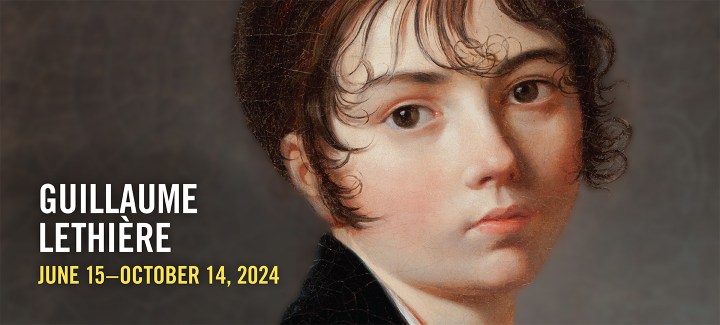
Guillaume Lethière, Woman Leaning on a Portfolio, detail, ca. 1799, oil on canvas
(Worcester Art Museum, Massachusetts, 1954.21)
◊ ◊ ◊ ◊ ◊
Now on view at The Clark:
Guillaume Lethière
The Clark Art Institute, Williamstown, Massachusetts, 15 June — 14 October 2024
Musée du Louvre, Paris, 13 November 2024 — 17 February 2024
Curated by Esther Bell, Olivier Meslay, Sophie Kerwin, and Marie-Pierre Salé
The first monographic exhibition ever presented on the artist
 Born in Sainte-Anne, Guadeloupe, Guillaume Lethière (1760–1832) was a key figure in French painting during the late eighteenth and early nineteenth centuries. The son of a white plantation owner and an enslaved woman of mixed race, Lethière moved to France with his father at age fourteen. He trained as an artist and successfully navigated the tumult of the French Revolution and its aftermath to achieve the highest levels of recognition in his time.
A favorite artist of Napoleon’s brother Lucien Bonaparte, Lethière served as director of the Académie de France in Rome, as a member of the Institut de France, and as a professor at the École des Beaux-Arts. A well-respected teacher, he operated a robust studio that rivaled those of his most successful contemporaries. Despite his remarkable accomplishments and considerable body of work, Lethiere is not well known today. The exhibition, organized in partnership with the Musée du Louvre and featuring some one hundred paintings, prints, and drawings, celebrates Lethière’s extraordinary career and sheds new light on the presence and reception of Caribbean artists in France during his lifetime.
Guillaume Lethière is co-organized by the Clark Art Institute, Williamstown, Massachusetts, and the Musée du Louvre, Paris, and curated by Esther Bell, deputy director and Robert and Martha Berman Lipp Chief Curator; and Olivier Meslay, Hardymon Director; with the assistance of Sophie Kerwin, curatorial assistant, at the Clark; and by Marie-Pierre Salé, chief curator in the Department of Drawings at the Louvre.
For more information, see the exhibition press release»
Esther Bell and Olivier Meslay, eds., Guillaume Lethière (New Haven: Yale University Press, 2024), 432 pages, ISBN: 978-0300275780, $65. With contributions by Alain Chevalier, Natasha Coleman, Darcy Grimaldo Grigsby, Frederic Lacaille, Anne Lafont, Christelle Lozere, Sophie Kerwin, Mehdi Korchane, C.C. McKee, Marie-Isabelle Pinet, Frederic Regent, Marie-Pierre Sale, Aaron Wile, and Richard Wrigley.
New Book | Everyday Politics and Culture in Revolutionary France
From the Oxford University Studies in the Enlightenment series, published by Liverpool UP:
Suzanne Desan, Bryant Ragan, and Victoria Thompson, eds., Everyday Politics and Culture in Revolutionary France: Essays in Honor of Lynn Hunt (Liverpool: Liverpool University Press, 2024), 320 pages, ISBN: 978-1802073812, $99. Also available as a PDF and epublication.
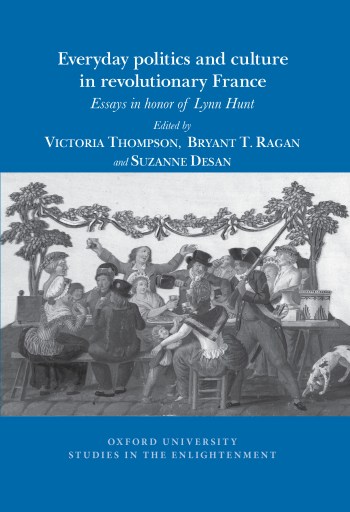 The French revolutionary era produced surprises. Why did the French revolutionaries decriminalize sodomy? How did the Revolution alter fundamental attitudes toward time and progress? How did it change people’s interactions with outdoor spaces and with material objects, from playing cards to holy cards? How did it leave a lasting footprint on personal identity, family relationships, and religious belief? Addressing diverse topics like these, the essays in this volume showcase exciting new research about the revolutionary era. Written to honor the historian Lynn Hunt, the essays rethink our understanding of the French Revolution by exploring three central themes: the multifaceted nature of grassroots politics; the pervasive and personal impact of the Revolution on daily life; and its long-term influence on memory, identity, and sense of self. From the October Days to dechristianization and beyond, the authors probe the precarious invention of democracy, analyze how intimately and intently the French Revolution influenced people’s lives, and examine how it shaped nineteenth-century memory, female religiosity, and political culture. Embracing contingency, diversity of experience and perspective, and the multifarious nature of change, the essays document the power and complexity of the revolutionary era as a lived experience.
Suzanne Desan is Vilas Distinguished Achievement Professor of History Emerita, University of Wisconsin-Madison. She is the author of The Family on Trial in Revolutionary France and co-editor of The French Revolution in Global Perspective. She is currently writing a book on the October Days in the early French Revolution.
Bryant T. Ragan teaches early modern European history and the history of sexuality at The Colorado College. He presently participates on a research team that is developing an interactive website and relational database that focuses on the policing of male sodomy in eighteenth-century Paris.
Victoria E. Thompson is Chair of the School of History and Sociology at the Georgia Institute of Technology. She is completing a book entitled King and Public in the Parisian Royal Square, 1748–89 that examines the relationship between the design, representation, and use of urban space and socio-political transformation.
c o n t e n t s
Introduction: Suzanne Desan and Victoria Thompson
1 Victoria Thompson — A Perpetually Agitated Place: Politics in the Tuileries Garden, 1789–1792
2 Suzanne Desan — Military Men, Violence, and Gender in the October Days of 1789
3 Jeff Horn — Dechristianization and Terror in Champagne
4 Bryant Ragan — Same-sex Sexual Relations and the French Revolution: The Decriminalization of Sodomy in 1789
5 William Max Nelson — Leaping into the Future: Enlightenment Ideas of Progress and French Revolutionary Time
6 Jeff Ravel — ’Plus de rois, de dames, de valets’: Playing Cards during the French Revolution
7 Denise Z. Davidson — ‘Notes et souvenirs … sur la vie politique de mon père’: Memory, Mourning, and Politics in the Revolutionary Era
8 Jennifer Popiel — Martyred Virgins, Embattled Women, and Mass Culture: Sentiment and Authority in Nineteenth-Century Religious Images, 1830–60
Epilogue: Lynn Hunt — Why the French Revolution Continues to Matter
Bibliography
Exhibition | Comment m’habillerai-je?
Now on view at the Museum of the French Revolution (near Grenoble):
Comment m’habillerai-je? Se vêtir sous la Révolution française, 1789–1804
Musée de la Révolution française, Vizille, 28 June — 10 November 2024
 Découvrez une mode en pleine (r)évolution!
Dans la société française de la fin du XVIIIe siècle, marquée par la culture des apparences, dans quelle mesure la rupture que constitue la Révolution française se reflète-t-elle dans la manière de se vêtir ?
L’exposition se propose de répondre à cette question. Véritable marqueur social sous l’Ancien Régime, le vêtement se transforme sous la Révolution française pour devenir le symbole d’une prise de position politique. Face au nouveau contexte politique et social et au nouvel élan de liberté, il devient par la suite un véritable objet de luxe et de mode. L’exposition présentera ces transformations à l’aide de textes, d’objets, d’iconographie et surtout d’estampes, medium de diffusion par excellence des modes, des symboles politiques et des idées.
Dans le cadre de la saison culturelle Des habits et nous, portée par le Département de l’Isère. Une exposition conçue et organisée par le Musée de la Révolution française et la Bibliothèque nationale de France.
Comment m’habillerai-je ? Se vêtir sous la Révolution française, 1789–1804 (Gent: Snoeck Publishers, 2024), 160 pages, ISBN: 978-9461619136, €30.










 Enfilade
leave a comment