New Book | Everyday Politics and Culture in Revolutionary France
From the Oxford University Studies in the Enlightenment series, published by Liverpool UP:
Suzanne Desan, Bryant Ragan, and Victoria Thompson, eds., Everyday Politics and Culture in Revolutionary France: Essays in Honor of Lynn Hunt (Liverpool: Liverpool University Press, 2024), 320 pages, ISBN: 978-1802073812, $99. Also available as a PDF and epublication.
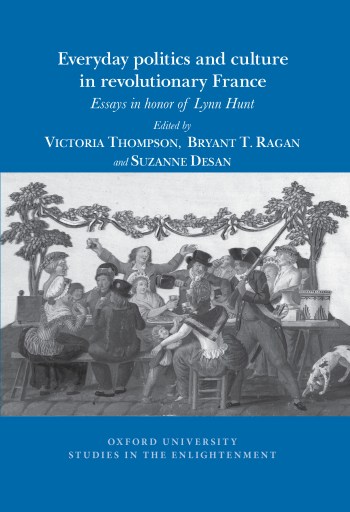 The French revolutionary era produced surprises. Why did the French revolutionaries decriminalize sodomy? How did the Revolution alter fundamental attitudes toward time and progress? How did it change people’s interactions with outdoor spaces and with material objects, from playing cards to holy cards? How did it leave a lasting footprint on personal identity, family relationships, and religious belief? Addressing diverse topics like these, the essays in this volume showcase exciting new research about the revolutionary era. Written to honor the historian Lynn Hunt, the essays rethink our understanding of the French Revolution by exploring three central themes: the multifaceted nature of grassroots politics; the pervasive and personal impact of the Revolution on daily life; and its long-term influence on memory, identity, and sense of self. From the October Days to dechristianization and beyond, the authors probe the precarious invention of democracy, analyze how intimately and intently the French Revolution influenced people’s lives, and examine how it shaped nineteenth-century memory, female religiosity, and political culture. Embracing contingency, diversity of experience and perspective, and the multifarious nature of change, the essays document the power and complexity of the revolutionary era as a lived experience.
Suzanne Desan is Vilas Distinguished Achievement Professor of History Emerita, University of Wisconsin-Madison. She is the author of The Family on Trial in Revolutionary France and co-editor of The French Revolution in Global Perspective. She is currently writing a book on the October Days in the early French Revolution.
Bryant T. Ragan teaches early modern European history and the history of sexuality at The Colorado College. He presently participates on a research team that is developing an interactive website and relational database that focuses on the policing of male sodomy in eighteenth-century Paris.
Victoria E. Thompson is Chair of the School of History and Sociology at the Georgia Institute of Technology. She is completing a book entitled King and Public in the Parisian Royal Square, 1748–89 that examines the relationship between the design, representation, and use of urban space and socio-political transformation.
c o n t e n t s
Introduction: Suzanne Desan and Victoria Thompson
1 Victoria Thompson — A Perpetually Agitated Place: Politics in the Tuileries Garden, 1789–1792
2 Suzanne Desan — Military Men, Violence, and Gender in the October Days of 1789
3 Jeff Horn — Dechristianization and Terror in Champagne
4 Bryant Ragan — Same-sex Sexual Relations and the French Revolution: The Decriminalization of Sodomy in 1789
5 William Max Nelson — Leaping into the Future: Enlightenment Ideas of Progress and French Revolutionary Time
6 Jeff Ravel — ’Plus de rois, de dames, de valets’: Playing Cards during the French Revolution
7 Denise Z. Davidson — ‘Notes et souvenirs … sur la vie politique de mon père’: Memory, Mourning, and Politics in the Revolutionary Era
8 Jennifer Popiel — Martyred Virgins, Embattled Women, and Mass Culture: Sentiment and Authority in Nineteenth-Century Religious Images, 1830–60
Epilogue: Lynn Hunt — Why the French Revolution Continues to Matter
Bibliography
Exhibition | Comment m’habillerai-je?
Now on view at the Museum of the French Revolution (near Grenoble):
Comment m’habillerai-je? Se vêtir sous la Révolution française, 1789–1804
Musée de la Révolution française, Vizille, 28 June — 10 November 2024
 Découvrez une mode en pleine (r)évolution!
Dans la société française de la fin du XVIIIe siècle, marquée par la culture des apparences, dans quelle mesure la rupture que constitue la Révolution française se reflète-t-elle dans la manière de se vêtir ?
L’exposition se propose de répondre à cette question. Véritable marqueur social sous l’Ancien Régime, le vêtement se transforme sous la Révolution française pour devenir le symbole d’une prise de position politique. Face au nouveau contexte politique et social et au nouvel élan de liberté, il devient par la suite un véritable objet de luxe et de mode. L’exposition présentera ces transformations à l’aide de textes, d’objets, d’iconographie et surtout d’estampes, medium de diffusion par excellence des modes, des symboles politiques et des idées.
Dans le cadre de la saison culturelle Des habits et nous, portée par le Département de l’Isère. Une exposition conçue et organisée par le Musée de la Révolution française et la Bibliothèque nationale de France.
Comment m’habillerai-je ? Se vêtir sous la Révolution française, 1789–1804 (Gent: Snoeck Publishers, 2024), 160 pages, ISBN: 978-9461619136, €30.
Exhibition | Point of View
The exhibition developed from the Women of the Rijksmuseum research project:
Point of View: The Collection Seen from a Gender Perspective
Rijksmuseum, Amsterdam, 5 July — 1 September 2024
Did all 17th-century children wear dresses? Why did women have to fight so hard to wear trousers? And what does the size of your desk say about your gender? Point of View explores how ideas around gender have been visualised through the ages and shows they are constantly changing.
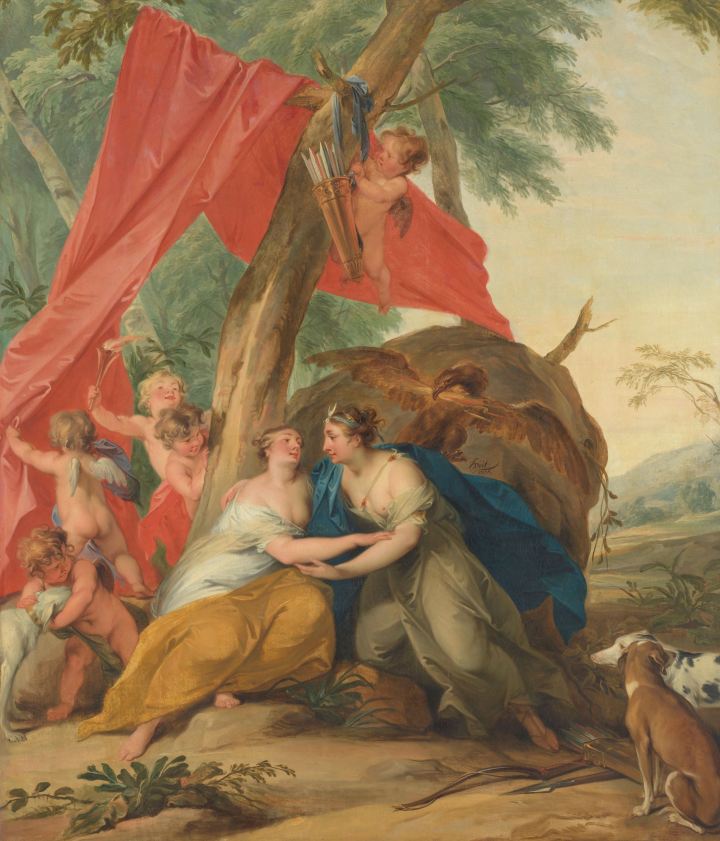
Jacob de Wit, Jupiter, Disguised as Diana, Seducing the Nymph Callisto, 1727, 240 × 205 cm (Amsterdam: Rijksmuseum, SK-A-3885).
These 150 paintings, prints, drawings, costumes, accessories, sculptures, photographs, and furniture items from the Rijksmuseum collection show that gender is everywhere. See the 17th-century portraits in which all the children are wearing dresses. Discover how, in the 18th century, anybody who could afford it was wearing pink—as well as glitter, frills, and floral patterns. Displayed together, these objects show that our ideas about masculinity, femininity, and gender in its broadest sense are defined by their time and place. The exhibition includes artworks by Gesina ter Borch, Marlene Dumas, Bartholomeus van der Helst, Kinke Kooi, Robert Mapplethorpe, Erwin Olaf, Maria Roosen, Charley Toorop, and Sara Troost.
Point of View shows there have always been people whose identity, experiences, and mode of expression didn’t fit the conventions around masculinity and femininity. One example from history is Christina, Queen of Sweden (1626–1689), who had herself portrayed in both female and male form. The exhibition also features portraits of more recent gender-fluid icons including Robert Mapplethorpe and Grace Jones. The exhibition ends with a contemporary perspective on gender; photographer Bete van Meeuwen worked with a group of 10 college students whose photographs show what gender means to them.
New Book | Louis Galloche (1670–1761)
From Silvana Editoriale:
François Marandet, Louis Galloche (1670–1761): Un peintre de poesie au XVIIIe siècle (Milan: Silvana Editoriale, 2023), 112 pages, ISBN: 978-8836656165, €28.
 Oublié par l’histoire de l’art, Louis Galloche (Paris, 1670–1761) fut pourtant l’une des figures majeures de la peinture française au cours de la première moitié du XVIIIe siècle. Il décora des résidences aussi importantes que les châteaux royaux de Versailles, de Fontainebleau et du Trianon. Couronné par le titre de chancelier de l’Académie royale de peinture et sculpture, Louis Galloche eut des élèves voués à devenir célèbres tels François Lemoyne et Charles-Joseph Natoire. Ayant conçu des poesie semblables à celles du Titien, Louis Galloche avait surtout un sens de la beauté particulièrement prononcé. Les tableaux, dessins, et multiples documents d’archives qui ont été retrouvés par François Marandet font ainsi redécouvrir, à travers cette toute première monographie consacrée à Louis Galloche, l’œuvre et l’itinéraire d’un des meilleurs artistes français de sa génération.
c o n t e n t s
Préface
Introduction
Chronologie
Un Élève de Louis de Boullogne, 1690–1711
• Premières études
• Grandes peintures à petits prix
• Un retour du pays des morts
Le Temps des Poesie, 1712–1731
• À la manière du Titien
• Nouvelles études
• Un concours truqué
Le Doyen de l’Académie Royale, 1732–1761
• Des tableaux pour la reine
• Les Salons de la concurrence royale
• Un concours sans vainqueur
• Louis Galloche: stéréotypes et réalité
Bibliographie
Exhibition | Sèvres Extraordinaire! Sculpture from 1740 until Today

From the press release for the upcoming BGC exhibition (note the new dates) . . .
Sèvres Extraordinaire! Sculpture from 1740 until Today
Bard Graduate Center, New York, 10 September — 16 November 2025
Curated by Tamara Préaud, Soazig Guilmin, Charlotte Vignon, and Susan Weber
Sèvres Extraordinaire! Sculpture from 1740 until Today presents the history of the Sèvres Manufactory and its production of extraordinary sculptural objects in various ceramic pastes. Organized by Sèvres, Manufacture et Musée nationaux, and Bard Graduate Center (BGC), the exhibition is the first outside of France to highlight the production of sculpture made at the famed porcelain manufactory.

Etienne-Maurice Falconet, L’Amour menaçant (Threatening Love), 1758/61, Manufacture de Sèvres, soft-paste porcelain biscuit (Manufacture et Musée nationaux, Sèvres, MNC 27724.1).
From extravagant Rococo to restrained Neoclassical, from romantic, neo-Gothic inventions to the elegant curves of the Art Nouveau or the geometries of the Art Deco, and in partnership with artists associated with Surrealism, Abstract Expressionism, and Pop art, Sèvres has continually pushed the boundaries of ceramic production, creating objects that are neither functional nor decorative but rather art that it simply calls ‘sculpture’. One of the main characteristics of the manufactory, from its origins in the disused premises of the Château de Vincennes until the present day, is the unsurpassed variety of its production. The exhibition considers the term ‘sculpture’ in its broadest sense and features three-dimensional vases, centerpieces for a dining table, clocks, inkstands, and rare cups and saucers alongside more expected objects such as busts, figures, and medallions. This approach presents the history of the Sèvres Manufactory through a lesser-known part of its production while highlighting the significant roles of artists, designers, and architects, whose designs represent a microcosm of larger developments in art and culture.
The exhibition reveals the roles of chemical and technological advances as well as artistic innovations in the manufactory’s success, and it presents approximately two hundred works from the collection of Sèvres, Manufacture et Musée nationaux, in ceramic, soft- and hard-paste porcelain, faïence, and stoneware. Other objects highlight the long process of making a sculpture at Sèvres, from initial design to its final painted decoration. These items—sketched, drawn, or engraved sources as well as terra-cotta models and plaster molds—represent the institution’s rich, diverse, and mostly unknown archives.
Situating sculpture produced at the Sèvres Manufactory in the larger context of French history from 1740 through the twenty-first century, the exhibition tells the story of Sèvres’s relationship to French political power. As a royal, imperial, and then a national manufactory, Sèvres was regularly called upon to produce elaborate porcelain dinner, tea, and coffee services, as well as vases and other objects to be used as diplomatic gifts or to adorn the residences of the French elite.
The exhibition is organized chronologically and occupies all four floors of the Bard Graduate Center Gallery. It reflects the manufactory’s history of collaborations with innovative artists and architects to create new forms and designs aligned with the fashions of their time. Featured works from eighteenth-century artists and designers include those of Jean-Claude Duplessis and Louis-Simon Boizot, among others. Alexandre-Évariste Fragonard, Jean-Baptiste Carpeaux, Albert-Ernest Carrier-Belleuse, and Auguste Rodin represent important collaborations of the nineteenth century. Jean Arp, Louise Bourgeois, and Ettore Sottsass are among the artists whose work demonstrates the manufactory’s artistic output in the twentieth century; and creations by Yayoi Kusama, Johan Creten, Jim Dine, Kristin McKirdy, and Betty Woodman reflect Sèvres’s ongoing commitment to working with the most important living artists of the day.
Bard Graduate Center will schedule a number of public events associated with the exhibition. A symposium for scholars and curators is expected to feature Judith Cernogora and Viviane Mesqui, Conservatrices de musée, Sèvres; Tamara Préaud, former archivist of the Sèvres Manufactory; and Linda Roth, Charles C. and Eleanor Lamont Cunningham Curator of European Decorative Arts at the Wadsworth Atheneum Museum of Art.
◊ ◊ ◊ ◊ ◊
Three Centuries of Innovation at Sèvres: A Research Symposium
Friday, 20 September 2024, 1:30–5:30pm
1.00 Introduction by exhibition curator Charlotte Vignon
2.00 Session A
• Tamara Préaud (Manufacture nationale de Sèvres) — Dynasties of Sculptors at Sèvres
• Viviane Mesqui (Manufacture nationale de Sèvres) — Re-editions Serving Heritage at the Sèvres Manufactory: Sèvres Beehive Vases from 1769 to 2024
3.15 Coffee break
3.45 Session B
• Linda Roth (Wadsworth Atheneum Museum) — Taxile Doat: Sculptor, Decorator, and Studio Potter at Sèvres
• Soazig Guilmin (Manufacture nationale de Sèvres) — The Art of Light and Sculpture: A Legacy of the Sèvres Manufactory
• Judith Cernogora (Manufacture nationale de Sèvres) — Luxury and Extravagance: Contemporary Furniture in Sèvres Porcelain
5.15 Concluding remarks
Registration information is available here»
◊ ◊ ◊ ◊ ◊
Tamara Préaud, Sevres Extraordinaire! Sculpture from 1740 Until Today (New Haven: Yale University Press, 2024), 600 pages, ISBN: 978-0300278750, $85.
 The accompanying catalogue is the first large-scale, English-language publication to explore the production of sculpture created by the famed French manufactory from its eighteenth-century origins to the present. Published by Bard Graduate Center and distributed by Yale University Press, this richly illustrated volume is primarily written by Tamara Préaud, who held the position of archivist at the Sèvres Manufactory for more than forty years and today is considered one of the most important historians of the manufactory. Additional texts were written by Guilhem Scherf, curator of sculpture at the Louvre Museum; Soazig Guilmin, head of the registrar’s department and art historian at the Sèvres Museum; Judith Cernogora, curator of contemporary art at the Sèvres Museum; and Florence Rionnet, curator at the Musée des Beaux-Arts in Quimper, Brittany. The volume is edited by Susan Weber and Charlotte Vignon.
c o n t e n t s
Unless otherwise noted, all text by Tamara Préaud
Introduction
• French Sculpture in the Eighteenth and Nineteenth Centuries: Historical Context and Stylistic References — Guilhem Scherf
• Sculpture in France from the Belle Époque to Pop Art — Florence Rionnet
Part I | General Considerations
1 Materials and Production — Tamara Preaud with Soazig Guilmin
2 Salaries and Prices
3 Imitations, Copies, Overmoldings, and Marks
Part II | History
4 The Eighteenth Century
5 The Directorship of Alexandre Brongniart
6 The Second Half of the Nineteenth Century, 1848–91
7 The Twentieth Century
8 Two Decades of Contemporary Art at Sèvres, 2000–20 — Judith Cernogora
9 Sales and Deliveries after 1941 — Soazig Guilmin
◊ ◊ ◊ ◊ ◊
Note (added 9 September 2024) — The posting was updated to include information on the symposium.
Note (added 6 September 2025) — The posting was updated with the exhibition’s new dates. It was originally slated to be on view from 21 September 2024 to 5 January 2025 but closed early due to building maintenance issues.
Call for Papers | Sculpture between Britain and Italy, 1742–1854
From the Call for Papers:
Sculptural Models, Themes, and Genres between Britain and Italy, ca. 1742–1854
Victoria and Albert Museum, London, 16–17 May 2025
Organized by Adriano Aymonino, Albertina Ciani, and Kira d’Alburquerque
Proposals due by 30 September 2024
The University of Buckingham and the Victoria and Albert Museum are organising a two-day interdisciplinary conference on the role played by British-Italian artistic exchanges in shaping sculptural models, themes, and genres in the eighteenth and nineteenth centuries.
The conference adopts a longue durée approach, focusing on the century when these exchanges were most intense: from 1742, when Prince Hoare of Bath the Elder arrived in Rome—the first documented English sculptor to spend a period of study in the city—to the opening of the Crystal Palace in Sydenham in 1854, whose sculptural decoration was directed by the Milanese Raffaele Monti. Throughout this period, the two traditions became interdependent, developing an artistic dialogue that influenced sculptural models and themes not only in Italy and Britain but also across Europe and the territories of the expanding British Empire, from the Indian subcontinent to the Americas.
This conference adopts a typological approach, investigating how academic frameworks and patronage networks influenced the diffusion of sculptural models, themes, and genres, and how market dynamics—along with the industrial production of new materials—either reinforced or challenged these aspects. We are interested in exploring the evolution of established genres such as busts, ideal sculptures, funerary and public monuments, copies, and adaptations after the Antique, as well as the diffusion of models and themes in decorative figurative sculpture, including reliefs, medallions, chimneypieces, and in smaller artworks such as gems, cameos, impressions, ivories, or in objects produced in porcelain, earthenware, and various new artificial ‘stones’. While concentrating on sculpture, the conference embraces an interdisciplinary approach to evaluate how the development of new models, themes, and genres reflected or shaped cultural and national identities, social values, evolving canons, and shifting audiences in the different contexts of Italy and the Anglophone world.
Recent years have witnessed a surge in monographic publications and PhD dissertations by art historians, social historians, and scholars focused on material culture, examining individual artists and themes connected to this trans-national movement. This two-day conference aims to assess the current state of research and explore future directions in the discipline.
We invite proposals for twenty-minute papers on topics that could include, but are not limited to:
• The impact of the academy and academic aesthetic and pedagogical frameworks in shaping sculptural models, themes, and genres, and their diverse manifestations.
• The influence of patronage and collecting in shaping sculptural models, themes, and genres, and their diverse manifestations.
• Industry and the market’s role in the production and dissemination of ‘high art’ models, themes, and genres, as well as commercial, religious, garden, and decorative sculpture.
• The impact of casts, copies, and adaptations on reinforcing or challenging academic canons and establishing new models, themes, and genres.
• The role played by new materials (such as porcelain, biscuit, Wedgwood ‘basalt’ and Jasperware, Coade stone, Parian ware, electrotyping, etc.) in the diffusion and transformation of models, themes, and genres.
• The impact and adaptation of classical or early modern Italian models and themes in the Anglophone world and vice versa.
• The tension/dialogue between themes after the Antique and medieval or early modern themes from literature or history.
• The tension/dialogue between classical and Christian themes.
• The relationship between European and non-European models, themes, and genres.
• The relationship between painting and sculpture, and the links between making and viewing.
• The relationship between sculpture and prints in the diffusion and transformation of models, themes, and genres.
• The changing audiences of sculpture between the eighteenth and nineteenth centuries and the progressive ‘commercialisation’ of models, themes, and genres, exemplified by events such as the 1854 opening of the Crystal Palace (Sydenham).
Please submit a title and abstract of no more than 200 words, along with a short biography (about 100 words – please do not send CVs) to Albertina Ciani (2127054@buckingham.ac.uk) by noon (BST), 30 September 2024. The abstract and biography should be combined in a single Word document and submitted as an email attachment. Incomplete or late submissions will not be considered. Notification of the outcome will be communicated via email by 31 October 2024.
The conference is part of a series of events organised to celebrate the launch of a new edition of Francis Haskell and Nicholas Penny’s Taste and the Antique in October 2024.
Fellowship | PhD Position in Architectural History, Trinity College Dublin
From the Call for Applicants, with apologies for the short notice. –CH
PhD Position in Architectural History: Stone in 18th-Century Architecture
Department of the History of Art and Architecture, Trinity College Dublin, starting September 2024
Applications due by 17 July 2024
Applicants are sought for a funded four-year PhD at Trinity College Dublin, commencing in September 2024, on a topic relating to the ERC advanced grant research project STONE-WORK, led by Professor Christine Casey in the Department of History of Art and Architecture. The successful applicant will be based in the School of Histories and Humanities and enrolled in the Structured PhD Programme. The award comprises the student’s PhD tuition fees and an annual stipend of €25,000.
STONE-WORK challenges the perception of architecture as a primarily conceptual activity by shifting focus from individual to collective achievement. Despite the emphatic materiality of architecture, its history remains dominated by a sequential model which privileges the agency of individuals and ideas. STONE-WORK’s fundamental premise is that architecture results from a cumulative sequence of actions involving an array of actors, great and small. Revealing stone’s hidden trajectory from quarry to wall, floor, column, and chimneypiece will probe the nexus of skills, techniques, and support mechanisms developed by communities in its sourcing, supplying, and fashioning, and the impact of these processes upon building activity. This cross-disciplinary research, combining the history of architecture and craft with geology aims to produce a holistic analysis of architecture and stone production.
The project pursues four main objectives:
• Transform knowledge of interdependence in architectural production.
• Develop a cross-disciplinary interface between geology, craft, and architectural history for the analysis of building stone.
• Reconstruct the trade and labour networks of Anglo-Irish stone production to determine how quarrying and stone-working affected the use of stone in eighteenth-century architecture.
• Discover the qualitative standards in materials and techniques which underpinned the handling of stone in eighteenth-century architectural production.
The PhD dissertation will explore the agency of the consumer and maker in the eighteenth-century stone industry by focusing on the chimney-piece industry in Britain and Ireland. This is an under-studied topic rich in surviving data both material and archival.
We are seeking applicants with the following qualifications:
Essential
• A first-class (or equivalent) undergraduate degree or a master’s degree with distinction in the History of Art or History of Architecture
• Excellent communicative competence in English
• Excellent research and organisational skills
• Knowledge of classical architecture in eighteenth-century Britain and Ireland
Desirable
• Demonstrable experience of using archives and working knowledge of eighteenth-century architecture
• Willingness to contribute to the activities of the STONE-WORK research project
Applications for the award must include
• A personal statement (max. 2 pages), including your motivation for applying for this PhD student position
• A curriculum vitae with educational history, including two academic references
• Transcripts of degree results
Prospective students should send these documents to Melanie Hayes at pghishum@tcd.ie by the deadline on the 17th July 2024. The successful candidate will then make a formal application to TCD via the my.tcd.ie portal and be issued with a formal offer in the same manner as other incoming PhD students. Applications will not be considered complete without academic references. Applicants will be notified of the outcome of their application by early August. If the successful candidate does not have English as a first language, s/he will also be required to submit evidence of English language competence at this stage.
Trinity College Dublin is committed to policies, procedures, and practices which do not discriminate on grounds such as gender, civil status, family status, age, disability, race, religious belief, sexual orientation, or membership of the travelling community. On that basis we encourage and welcome talented people from all backgrounds to join our staff and student body. Trinity’s Diversity Statement can be viewed in full here.
Dr Melanie Hayes, Trinity College Dublin, Department of the History of Art and Architecture, College Green, Dublin 2, Ireland, HAYESM7@tcd.ie.
U of Buckingham | MA in French and British Decorative Arts
From the University of Buckingham:
MA in French and British Decorative Arts and Historic Interiors
University of Buckingham (study based in London), starting September 2024
Bursary applications due by 19 July 2024
Applications are invited for a bursary on the University of Buckingham’s MA in Decorative Arts and Historic Interiors starting September 2024. Generously funded by the Leche Trust, the bursary, worth £8,500, will cover just under 78% of the full-time course fees for UK students and just over 50% of the fees for international students. The deadline for bursary applications is Friday, 19 July, 10am GMT. To be eligible for the bursary, students will need to have applied for and been offered a place on the course.
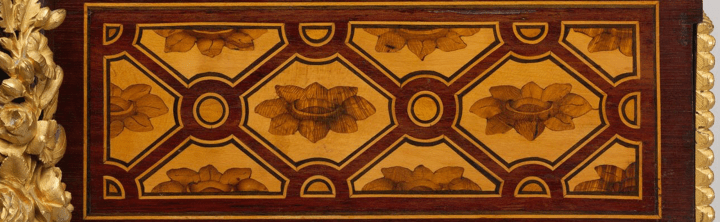
This unique MA in French and British Decorative Arts and Interiors, taught in collaboration with the curatorial and conservation teams at the Wallace Collection, focuses on the development of interiors and decorative arts in England and France in the ‘long’ eighteenth century (c.1660–c.1830) and their subsequent rediscovery and reinterpretation in the nineteenth and twentieth centuries. A key element of the course is the emphasis on the first-hand study of furniture, silver, and ceramics, where possible in the context of historic interiors. Based in central London, it draws upon the outstanding collections of the nearby Wallace Collection and the Victoria and Albert Museum as well as the expertise of leading specialists who participate in the teaching.
Bursary priority will be given to applicants
• with excellent academic qualifications, seeking, or currently pursuing careers in museums, the built heritage or conservation,
• in need of financial assistance,
• have a strong interest in the decorative arts and historic buildings,
• or, for those wishing to go on to pursue academic research in the decorative arts and historic interiors.
The bursary is also open to part-time students commencing their studies in 2024 and for whom the funding would be spread over two years. Find out more here. You also may contact Dr Lindsay Macnaughton lindsay.macnaughton@buckingham.ac.uk and the Admissions Office admissions@buckingham.ac.uk.
Andalusia Acquires Portrait of Adèle Sigoigne by Bass Otis
From the press release from Andalusia Historic House, Gardens & Arboretum:
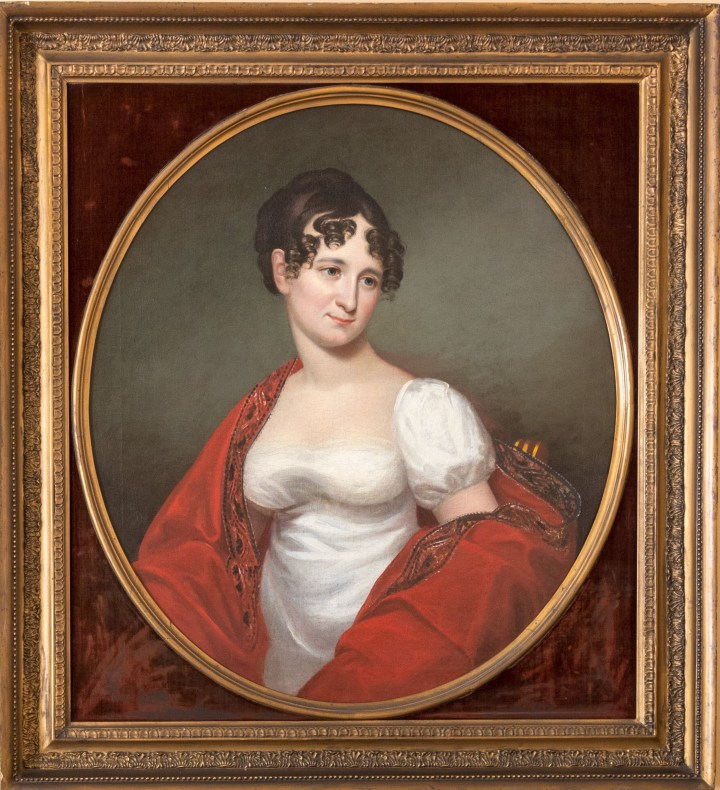
Bass Otis, Portrait of Miss Adèle Sigoine, 1815, oil on canvas (Bensalem, Pennsylvania: The Andalusia Foundation).
An oil painting by Philadelphia artist Bass Otis (1784–1861), Portrait of Miss Adèle Sigoigne (1815)—which has been on view at Andalusia Historic House, Gardens & Arboretum (Andalusia) in Bensalem, Pennsylvania since 2014 as a long-term loan from the Independence Seaport Museum (ISM) in Philadelphia—now joins Andalusia’s permanent collection in an act of collegial partnership. Adèle Sigoigne was a good friend of Jane Craig Biddle (1793–1856) who lived at Andalusia with her husband, Nicholas Biddle (1786–1844). ISM has deaccessioned the painting and transferred its ownership to Andalusia.
“We are overjoyed to have Adèle’s portrait now part of our permanent collection,” said Andalusia’s executive director John Vick. “Every piece of art in the historic house has a unique story to tell about the property and the people who lived here or visited. Adèle was practically family to the Biddles, making this a fitting home for her portrait. We are grateful to our partners at Independence Seaport Museum for recognizing what the painting means to Andalusia and for making this momentous transfer possible.”
“Our staff and Board were unanimous in wanting to transfer this painting permanently to Andalusia,” said Peter Seibert, ISM’s president and chief executive officer. “Its history and associations with the Biddle family are significant, and thus the painting is imminently relevant to their mission. For us, the transfer is a visible reminder of how two museums can come together to ensure that the history and heritage of our community is preserved in public trust for future generations.”
Although it is unclear how or when Jane and Adèle met, their lasting friendship is certain. Close in age and of similar social standing, the two women came from very different backgrounds, however. Jane was a Philadelphian by birth, the only daughter of John and Margaret Craig, the couple who first established Andalusia as a country estate in 1795. Adèle, by contrast, was French-born and had lived in Haiti. After the Haitian Revolution began in 1791, she moved to Philadelphia with her mother, Aimée Sigoigne, who started a school for young women at 128 Pine Street. Adele was one of a few guests who attended Jane’s wedding to Nicholas Biddle, held at Andalusia on 3 October 1811. The Biddles’ three daughters would later attend Madame Sigoigne’s school, including Adèle who was named for her mother’s dear friend. (The name Adèle remained popular for several generations of Biddle descendants.)
Although the portrait is unsigned, its attribution is firm; it is nearly certain that the Biddles commissioned Bass Otis to paint Adèle’s portrait as he also painted Jane’s portrait around 1815. (This painting is in the collection of the Second Bank of the United States Portrait Gallery in Philadelphia.) Both women are shown in fashionable, Empire-style dresses with luxurious fabrics draped over their shoulders: Jane’s is white and sheer while Adèle’s is a vibrant red. Their hair is also similarly styled in an updo with ringlets framing their faces. Nicholas Biddle conveyed his appreciation of Adèle’s portrait to Otis in a letter, which remains with and will be transferred with the painting from ISM.
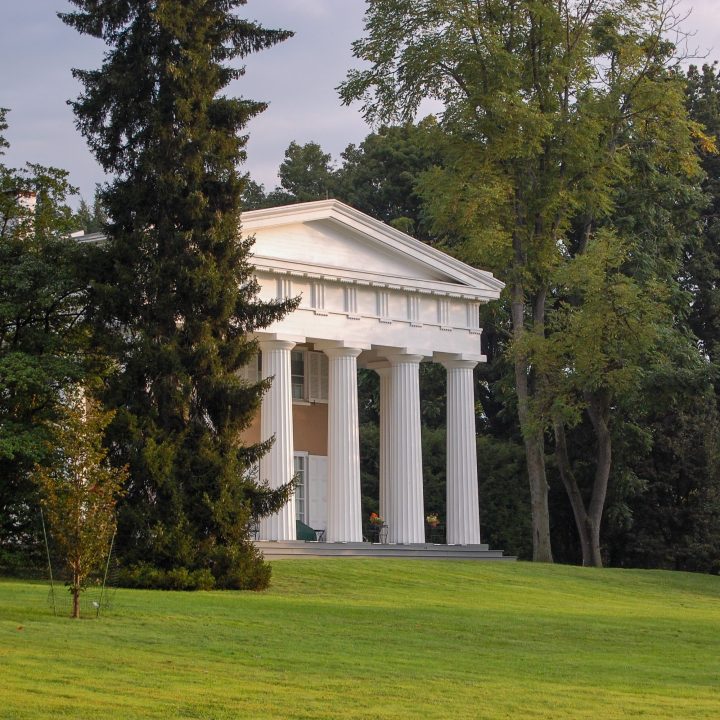
With its oldest portions dating to the 1790s, the house at Andalusia was expanded by Benjamin Latrobe in 1806 and then again in the 1830s, when an addition with a Doric columned porch was constructed according to designs by Thomas Ustick Walter (Walter had trained under William Strickland).
Since the portrait of Sigoigne has been on loan at Andalusia, it has been on view in the historic house’s library, which was part of the 1830s addition designed by architect Thomas Walter. Now in Andalusia’s permanent collection, it will be moved to what is known as the Painted Floor Bedroom. This room is part of the original 1797 construction and could have been where Adèle stayed when she visited Jane around the time that the portrait was made.
The Biddles’ patronage of Bass Otis continued for many years. In 1827, Nicholas Biddle commissioned the artist to paint a copy of Jacques-Louis David’s famous scene Napolean Crossing the Alps (1801). The oil on canvas copy, also on view at Andalusia, was owned by Napoleon’s brother Joseph Bonaparte, who knew the Biddles, lived near them in Philadelphia, and owned a country estate (Point Breeze) near Andalusia. By the 1820s, however, the Biddles began to favor another Philadelphia artist, Thomas Sully, who painted the couple’s portraits in 1826, both of which are on view at Andalusia. In 1829 the Biddles commissioned him to paint another portrait of Adèle Sigoigne, which is in the collection of The Huntington Library, Art Museum and Botanical Gardens in San Marino, California.
◊ ◊ ◊ ◊ ◊
Andalusia Historic House, Gardens & Arboretum is a non-profit organization and a scenic 50-acre property overlooking the Delaware River in Bensalem, Pennsylvania. Established more than 225 years ago, the site is a natural paradise of preserved native woodlands and spectacular gardens, as well as museum with an exceptional collection of paintings, sculptures, decorative art, and rare books and manuscripts.
The Kimbell Acquires Stubbs’s Mares and Foals
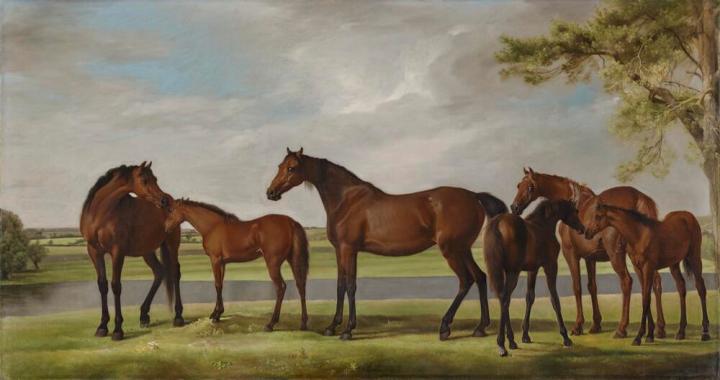
George Stubbs, Mares and Foals Belonging to the 2nd Viscount Bolingbroke, ca. 1761–62, oil on canvas, 99 × 187 cm
(Fort Worth: Kimbell Art Museum, acquired in memory of Ben J. Fortson)
◊ ◊ ◊ ◊ ◊
From the press release (28 June 2024), as noted at Art History News:
The Kimbell Art Museum today announced the acquisition of George Stubbs’s Mares and Foals Belonging to the 2nd Viscount Bolingbroke, painted between about 1761 and 1762. Widely regarded as the finest painter of animals in the history of European art, Stubbs is best known for his paintings of horses, which transcend historical genres to achieve rare pictorial refinement and emotional resonance. The painting entering the Kimbell’s collection is one of the principal, and likely earliest, in a celebrated, innovative series that has been called the artist’s crowning achievement: paintings depicting friezes of brood mares and their offspring. The acquisition, along with that of Thomas Gainsborough’s painting Going to Market, Early Morning (ca. 1773), purchased by the Kimbell in 2023, significantly elevates the Kimbell’s holdings of eighteenth-century British paintings, which Velma and Kay Kimbell favored when initially building their collection. The painting will be on view in the Kimbell’s Louis I. Kahn Building beginning 28 June 2024.
“With a mandate to collect only works of major historical and aesthetic importance, the Kimbell is the natural home for this masterpiece,” said Eric Lee, director of the Kimbell Art Museum. “I am sure that it will become an audience favorite. Visitors to the museum will relish the multidimensional depiction of mares and foals—alive with subtle drama, imbued with tenderness, and fascinating in its expression of the individual personalities of each horse.”
In this picture, which is slightly more than six feet long by three feet tall, a mature bay mare commands the center of a group of two other mares and three foals, who nuzzle close to their mothers. The composition is set within a springtime landscape at what is probably the viscount’s family estate of Lydiard Tregoze, Wiltshire, now Borough of Swindon, with verdant green parkland, cloudy sky, and a broad, dark gray stretch of water providing spatial interest beyond the long, slender legs of the horses. Highly naturalistic, the horses are lifelike in their anatomical forms and poses. While the overall mood is tranquil and domestic as the horses gently commune with each other, the cloudy sky and the wide, sparkling eyes of the mares add an element of drama and nobility to the composition.
The titular 2nd Viscount Bolingbroke, Frederick St. John (1732–1787), was one of Stubbs’s most important early patrons. The Kimbell painting seems to be the earliest commission of this virtually unprecedented subject; it is probably the work that Stubbs exhibited at the Society of Artists in 1762. Soon, other members of Bolingbroke’s circle of aristocratic horse enthusiasts and fellow statesmen of the Whig political party commissioned similar compositions on the theme of brood mares and their offspring, many doubtless depicting the patrons’ own horses. Stubbs’s equestrian paintings—along with his portrayals of rural life and of other animals—were an especially delightful and sophisticated expression of the pastimes of the British nobility and landed gentry. Patrons could hang such works alongside fashionable portraits and Old Master paintings in their town or country houses, where vast fields, parklands, stables, and studs reflected their love of hunting and sporting life.
Stubbs was then, and is today, recognized for his unrivaled understanding of equine anatomy and unsurpassed ability to record not only the appearance of individual animals but also their temperaments. His genius in understanding the horse arose from anatomical study and from his apparent empathy for the character of each horse and his ability to express its exquisite beauty. His skill extended to landscapes that enhanced the mood, composition, and legibility of the animal subjects.
Mares and Foals Belonging to the 2nd Viscount Bolingbroke remained in the family collection at Lydiard Tregoze until it was sold at auction in 1943 and shortly thereafter entered the collection of Mrs. John Arthur Dewar, of the whisky distillery family, who also owned Henry Raeburn’s Allen Brothers (Portrait of James and John Lee Allen), which entered the Kimbell collection in 2002. The Kimbell acquired Mares and Foals Belonging to the 2nd Viscount Bolingbroke from a private collection through London-based art dealers Simon C. Dickinson Ltd. At the museum, the painting joins Stubbs’s Lord Grosvenor’s Arabian Stallion with a Groom, a work acquired by the Kimbell in 1981. Mares and Foals Belonging to the 2nd Viscount Bolingbroke was previously on view at the Kimbell in 2004–05, when it was on loan to the exhibition Stubbs and the Horse.
The Kimbell Art Foundation acquired Mares and Foals Belonging to the 2nd Viscount Bolingbroke in memory of Ben J. Fortson (1932–2024), who passed away in May and whose leadership was instrumental in the Kimbell’s growth. Mr. Fortson served on the Board of Directors of the Kimbell Art Foundation from 1964 until his death and was the Foundation’s longtime Executive Vice President and Chief Financial Officer. He will be forever remembered for stewarding the Kimbell’s investments and finances and for being the driving force behind the building of the museum’s Renzo Piano Pavilion, which opened in 2013 and houses the museum’s temporary exhibitions and permanent collections of Asian, African, and ancient American art.










 Enfilade
leave a comment