New Book | Unsuitable: A History of Lesbian Fashion
From Hurst, with chapters on cross dressing in 18th-century Britain and Anne Lister. . .
Eleanor Medhurst, Unsuitable: A History of Lesbian Fashion (London: Hurst & Company, 2024), 344 pages, ISBN: 978-1805260967, £25 / $35.
 The way we dress can show or hide who we are; make us fit in, make us stand out, or make our own community. Yet ‘lesbian fashion’ has been strangely overlooked. What secrets can it reveal about the lives and status of queer women through the ages?
The lesbian past is slippery: often deliberately hidden, edited, or left unrecorded. Unsuitable restores to history the dazzlingly varied clothes worn by women who love women, from top hats to violet tiaras. This story spans centuries and countries, from ‘Gentleman Jack’ in nineteenth-century Yorkshire and Queen Christina of seventeenth-century Sweden, to Paris modernism, genderqueer Berlin, butch/femme bar culture and gay rights activists—via drag kings, Vogue editors, and the Harlem Renaissance. This book is a kaleidoscope of the margins and the mainstream, celebrating trans lesbian style, Black lesbian style, and gender nonconformity. You don’t have to be queer or fashionable to be enthralled by this hidden history. Unsuitable lights it up for the world to see, in all its finery.
Eleanor Medhurst is a historian of lesbian fashion and author of the blog Dressing Dykes. She has worked on Brighton Museum’s exhibitions Queer Looks and Queer the Pier and been interviewed by Grazia, Cosmopolitan, Cameron Esposito’s Queery, and Gillian Anderson’s What Do I Know?! This is her first book.
New Book | Love and Marriage in the Age of Jane Austen
From Yale UP:
Rory Muir, Love and Marriage in the Age of Jane Austen (New Haven: Yale University Press, 2024), 432 pages, ISBN: 978-0300269604, $35.
 Marriage is at the centre of Jane Austen’s novels. The pursuit of husbands and wives, advantageous matches, and, of course, love itself, motivate her characters and continue to fascinate readers today. But what were love and marriage like in reality for ladies and gentlemen in Regency England? Rory Muir uncovers the excitements and disappointments of courtship and the pains and pleasures of marriage, drawing on fascinating first-hand accounts as well as novels of the period. From the glamour of the ballroom to the pressures of careers, children, managing money, and difficult in-laws, love and marriage came in many guises: some wed happily, some dared to elope, and other relationships ended with acrimony, adultery, domestic abuse, or divorce. Muir illuminates the position of both men and women in marriage, as well as those spinsters and bachelors who chose not to marry at all. This is a richly textured account of how love and marriage felt for people at the time—revealing their unspoken assumptions, fears, pleasures, and delights.
Rory Muir is a visiting research fellow at the University of Adelaide and a renowned expert on British history. His books include Gentlemen of Uncertain Fortune and his two-part biography of Wellington, which won the SAHR Templer Medal.
The Burlington Magazine, May 2024
From the May issue of The Burlington, which is dedicated to French art — and please note that Yuriko Jackall’s important article is currently available for free, even without a subscription.
Burlington Magazine 166 (May 2024)

Jean-Honoré Fragonard, The Swing, 1767, oil on canvas, 81 × 64 cm (London: Wallace Collection).
a r t i c l e s
• Ludovic Jouvet, “A Medal of the Sun King by Claude I Ballin,” pp. 440–45.
• Yuriko Jackall, “The Swing by Jean-Honoré Fragonard: New Hypotheses,” pp. 446–69.
• Thadeus Dowad, “Dāvūd Gürcü, Ottoman Refugee, and Girodet’s First Mamluk Model,” pp. 479–87.
• Humphrey Wine, “The Paintings Collection of Denis Mariette,” pp. 488–92.
r e v i e w s
• Richard Stemp, Review of Ingenious Women: Women Artists and their Companions (Hamburg: Bucerius Kunst Forum / Basel: Kunstmuseum, 2023–24), pp. 501–04.
• Christoph Martin Vogtherr, Review of Louis XV: Passion d’un roi (Château de Versailles, 2022), pp. 508–10.
• Eric Zafran, Review of The Hub of the World: Art in Eighteenth-Century Rome (Nicholas Hall, 2023), pp. 515–18.
• Saffron East, Review of Black Atlantic: Power, People, Resistance (Cambridge: Fitzwilliam, 2023), 523–25.
• Gauvin Alexander Bailey, Review of Marsely Kehoe, Trade, Globalization, and Dutch Art and Architecture:
Interrogating Dutchness and the Golden Age (Amsterdam UP, 2023), pp. 534–35.
• Helen Clifford, Review of Vanessa Brett, Knick-Knackery: The Deards’ Family and Their Luxury Shops, 1685–1785 (2023) pp. 535–37.
o b i t u a r y
• Michael Hall, Obituary for Jacob Rothschild (1936–2024), pp. 538–40.
One of the leading public figures in the arts in the United Kingdom, Lord Rothschild was a major collector of historic art and a patron of contemporary artists and architects. His principal focus was Waddesdon Manor, his family’s Victorian country house and estate in Buckinghamshire.
◊ ◊ ◊ ◊ ◊
Jean-Honoré Fragonard was one of the supreme exponents of the French Rococo style and his painting The Swing in the Wallace Collection, London, is perhaps his most famous work. Yet despite this elevated status, mystery surrounds its origins. New documentary and technical research presented here by Yuriko Jackall may, however, have finally established for whom it was painted and why the painting was hidden away for the first few years of its existence.
The May issue also includes the publication by Ludovic Jouvet of a previously unknown and spectacular medal of the Sun King, Louis XIV, as well as Humphrey Wine’s study of the intriguing collection of the publisher Denis Mariette (the uncle of the more famous Pierre-Jean Mariette). Other articles feature the work of French Romantic painters: Andrew Watson establishes the early history of Delacroix’s The Death of Sardanapalus in the Musée du Louvre, Paris, and Thadeus Dowad identifies Girodet’s first Mamluk model.
Exhibition reviews include Sarah Whitfield discussing Bonnard’s Worlds (Kimbell Art Museum, Fort Worth, and the Phillips Collection, Washington) and Lisa Stein assessing Saul Leiter (MK Gallery, Milton Keynes). Catalogue reviews feature Christoph Martin Vogtherr on Louis XV, Lunarita Sterpetti on Eleonora of Toledo, and Eric M. Zafran surveying art in eighteenth-century Rome. Meanwhile, an impressive and wide range of new books are examined: these feature Megan McNamee on diagrams in medieval manuscripts, Christine Gardner-Dseagu on photographing Pompeii and Richard Thomson on Henry Lerolle.
◊ ◊ ◊ ◊ ◊
Note (added 31 July 2024) — The posting was updated to include additional content.
New Book | Le Château d’Ormesson
The Château d’Ormesson is about 15 miles southeast of Paris. From Lienart:
Xavier Salmon, Le Château d’Ormesson: Tribulations d’un flacon dans un seau à glace (Paris: Lienart éditions, 2024), 160 pages, ISBN: 978-2359064230, €30.

C’est à une saga que nous invite le château d’Ormesson, celle de ses constructeurs et de la famille qui lui a donné son nom, mais aussi celle de l’évolution du goût.
Dissimulée au bout de son allée de grands arbres, la demeure ne se révèle pas facilement. Il faut l’approcher pour découvrir qu’il s’agit d’une « maison narcisse » qui aime à refléter ses façades sur son miroir d’eau. Il faut la contourner pour comprendre qu’elle fut élevée en deux temps. De brique et pierre, le corps de logis principal et ses deux pavillons posés sur trompe fut peut-être construit à la demande du cardinal René de Birague qui posséda la seigneurie entre 1578 et 1583 et sollicita probablement à cette occasion Baptiste Androuet du Cerceau, le fils du célèbre architecte Jacques Androuet du Cerceau. Avec ses lignes classiques, son toit à la Mansart et son fronton triangulaire, le bâtiment adossé au sud en 1759–1760 pour le premier marquis d’Ormesson, Marie François de Paule, est l’œuvre d’Antoine Matthieu Le Carpentier, l’un des architectes les plus en vogue de son temps. À l’intérieur, l’homme remodela les appartements qui avaient été déjà mis au goût du jour au début du XVIIIe siècle. Tout y est demeuré tel que la famille d’Ormesson, grands serviteurs de l’état, l’avait désiré, entre le caractère enjoué des créations de la Régence et la noble élégance du premier néo-classicisme, mais sans désir d’ostentation afin de répondre parfaitement au caractère des générations qui se sont succédées au sein de la demeure. Denis Diderot voyait en d’Ormesson un « flacon dans un seau à glace ». Il faut aujourd’hui y reconnaître, posé au milieu de son parc à vertugadin et dominant son canal, l’une des plus belles maisons privées préservées aux abords de Paris et qui pour la première fois se livre.
Xavier Salmon est conservateur général du patrimoine. Après avoir été responsable des collections de peintures du XVIIIe siècle et d’arts graphiques au château de Versailles, chef de l’inspection générale des musées de France, directeur du patrimoine et des collections du château de Fontainebleau, il est aujourd’hui chargé du département des Arts graphiques du musée du Louvre.
Exhibition | Horse in Majesty
Opening soon at Versailles:
Horse in Majesty: At the Heart of a Civilisation / Cheval en majesté: Au cœur d’une civilisation
Château de Versailles, 2 July — 3 November 2024
Curated by Laurent Salomé and Hélène Delalex

René-Antoine Houasse, Equestrian Portrait of Louis XIV, ca. 1674, oil on canvas (Château de Versailles, Christophe Fouin).
To coincide with the equestrian events at the Paris 2024 Olympic Games—hosted on the Versailles estate—the Château is holding a major exhibition dedicated to horses and equestrian civilisation in Europe—the first exhibition on this theme to be presented on such a scale. Nearly 300 works will highlight the roles and uses of horses in civil and military society, from the sixteenth to the twentieth century, up to the eve of the First World War, which marked the end of horse-drawn civilisation and the relegation of horses to the realm of leisure. This first exhibition dedicated to horses on such a scale will be divided into thirteen sections, leading visitors on a tour through several emblematic areas of the palace: the Africa Rooms, the King’s State Apartment, the Hall of Mirrors, the War and Peace Rooms, Madame Maintenon’s Apartment, and the Dauphine’s Apartment.
Of Horses and Kings
The first part of the exhibition highlights the links between horses and European sovereigns and emperors. In a gallery of princes’ favourite horses, the exhibition presents Charles XI of Sweden’s collection of horse portraits and more intimate portraits such as those of Queen Victoria’s Arabian horses.
Royal Stables: Palaces for Horses
The beauty and sheer scale of the aristocratic and royal stables built in the seventeenth and eighteenth centuries bear witness to the importance attached to horses in representations of power under the Ancien Régime. The Royal Stables at Versailles are also a place for teaching and passing on knowledge and skills. It was at the Royal Arena in Versailles that the art of traditional French horsemanship reached its pinnacle of perfection.
The Horse, King of War
One of the most important aspects of the companionship between man and horse is their shared adventure in war, and often in death. The exhibition explores the motif of the cavalry clash, based on Leonardo da Vinci’s archetype, with horses and riders merging to form a furious and spectacular mass. The exhibition provides an insight into another great slaughter of modern warfare, that of horses. The many corpses littering the foreground of the paintings enable the artists to highlight the violence of the confrontation and its cost.
Festive Horses: The Equestrian Spectacular
Equestrian festivals played a key role in the life of European courts. The exhibition presents some rare examples of these ephemeral festive arts: ceremonial lances, fancy shields and quivers, studies of caparisons, large gouaches of Swedish carousels, drawings, and illuminated manuscripts.
Horses and Luxury: Treasures from the Stables
Following on from the festive arts, the exhibition reveals a set of prodigiously luxurious horse ornaments, crafted in the form of objets d’art. A complete set of equestrian parade armour takes pride of place in the Hercules Room.
Horses and Science
The exhibition also focuses on the relationship between art and science in anatomical studies of horses. The iconic early drawings by Andrea del Verrochio and Leonardo da Vinci are exhibited together here for the first time, in a collaboration between New York’s Metropolitan Museum and the English Royal Collections.
Horses as Models
Horses have always been a favourite subject and source of inspiration for artists. The exhibition features a number of masterpieces of this genre, and examines the unbridled imaginings elicited by the horse’s body in late-nineteenth-century art.
From One Civilisation to Another
The exhibition closes with an evocation of the end of equestrian civilisation, with the advent of the railway and automobile industries transforming a thousand-year-old way of life in a matter of decades.
Curators
Laurent Salomé, Director of the Musée National des Châteaux de Versailles et de Trianon
Hélène Delalex, Heritage Curator at the Musée National des Châteaux de Versailles et de Trianon
Laurent Salomé and Hélène Delalex, eds., Cheval en majesté: Au cœur d’une civilisation (Paris: Lienart éditions, 2024), 504 pages, ISBN: 978-2359064438, €49.
Exhibition | Ramsay and Edinburgh Fashion
Now on view at The Georgian House, from the National Trust for Scotland:
Ramsay and Edinburgh Fashion
The Georgian House, Charlotte Square, Edinburgh, 7 June — 24 November 2024
Bringing together Allan Ramsay’s portraits of women from the National Trust for Scotland’s collection, Ramsay and Edinburgh Fashion explores how vital it was for a painter in the 1700s to be familiar with dress styles, materials, and accessories because fashion was a key signifier of good taste. New research lays out the trades involved in fashion along Edinburgh’s High Street—from the milliners to the mantua-makers—and sets this against the fashion for portraiture in the mid-18th century.

Allan Ramsay, Portrait of Katherine Anne Mure, 1760s, oil on canvas (National Trust for Scotland, Hill of Tarvit Mansion House & Garden).
Katherine Anne Mure was painted by Ramsay in the 1760s wearing the height of French fashion. Katherine lived in Abbeyhill and is pictured wearing a fine laced kerchief over her shoulders, sleeves fitted at the upper arm and trimmed with tiered lace, flowers at her bust, and a stomacher decorated with buttons and ruched strips of expensive blue silk.
Ramsay understood that being well-versed in the language of fashion was one of the keys to social mobility. Being aware of the latest trends was becoming easier for customers in cities like Edinburgh, which was filled with a world of goods and a diverse cross-section of retailers. Fabrics mostly came into the city from textile manufacturing centres like London, Manchester, and Norwich. They were then sold by auction or directly purchased by consumers, merchants, drapers, and milliners.
Foreign textiles were hugely popular. So much so that legislation was introduced throughout the 1700s to protect and encourage domestic production. The encouragement to buy well and buy local fostered a trade in second-hand goods. Wealthier women sold on outdated dresses, in pursuit of the newest trends, while less affluent women searched for the ideal gown that would last and which they could adapt with small alterations.
Conference | Commerce and Circulation of Decorative Arts, 1792–1914

Ignacio de León y Escosura, Auction Sale in Clinton Hall, New York, detail, 1876
(New York: The Metropolitan Museum of Art, Gift of the Artist, 1883, 83.11)
◊ ◊ ◊ ◊ ◊
From the conference programme:
The Commerce and Circulation of Decorative Arts, 1792–1914:
Auctions, Dealers, Collectors, and Museums
Le commerce et la circulation des objets d’art, 1792–1914:
Ventes aux enchères, marchands/es, collectionneurs/ses et musées
Musée des Beaux-Arts de Lyon, 25–27 September 2024
This international three-day colloquium, to be held in Lyon, France, from 25 to 27 September 2024, will investigate the role played by auctions, dealers, collectors, and museums in the circulation of the decorative arts from 1792 until 1914. Beginning with the ‘ventes des biens des émigrés’ in Revolutionary France and ending with the onset of World War I, these were years of seismic political and socio-economic change that revolutionised the art market. Day 1 will start with an introduction by Daniel Alcouffe and an opening lecture by Tom Stammers. Three sessions will follow on the role of auctions, antique dealers, and dealer-decorators in the circulation of the decorative arts. Day 2 will be devoted to the museums, collectors, and networks of exchange across borders. Day 3 will discuss the interplay between the market, expertise, and the tailoring of objects, ending in the afternoon with a round-table discussion on research in the digital age, showcasing several projects, with short presentations by Mark Westgarth, Lynn Catterson, Koenraad Brosens, and Anne-Sophie Radermecker. The conference is free to attend but registration is essential. Your registration will be effective for any session you wish to attend throughout the conference. Accommodation in Lyon is limited; so we suggest that you arrange this as soon as possible. Please see the conference page for updates.
This colloquium forms part of a wider project on the market for decorative arts: OBJECTive – ANR ACCESS ERC / Université Lumière Lyon-2, LARHRA : OBJECTive – ANR Objects through the Art Market : A Global Perspective – LARHRA.
w e d n e s d a y , 2 5 s e p t e m b e r
10.30 Introduction
• Welcome — Camille Mestdagh and Diana Davis (organisers)
• Introductory Comments — Daniel Alcouffe (Conservateur général honoraire au musée du Louvre), Les arts décoratifs : Une ressource pour l’avenir de l’histoire de l’art
• Opening Lecture — Tom Stammers (Reader in the history of the art market, The Courtauld Institute of Art), Dealing with the Decorative Arts: Sources, Paradigms, and Problems
11.30 Session 1 | The Auction: A Window on the Decorative Arts Market
Moderator: Suzanne Higgott (independent scholar, formerly the Wallace Collection)
• Helen Jacobsen (PhD, University of Oxford, Executive Director, The Attingham Trust), The Anatomy of an Auctioneer: Harry Phillips and the Growth of the Decorative Art Market in London, 1796–1839
• Stuart Moss (PhD candidate, University College London), ‘Schöne Kunstsachen aller Art’: Decorative Art at the Munich Secularisation Sales, 1803–1807
• Sabine Lubliner-Mattatia (PhD, Sorbonne Université, independent lecturer), From the Limelight to the Spotlight: The Jewellery Sales of Actresses in 19th-Century Paris (in French)
13.00 Lunch
14.00 Session 2 | Fluid Boundaries: Defining the Antique Dealer
Moderator: Paola Cordera (Associate Professor, Politecnico Milano, School of Design)
• Lucie Chopard (PhD, Ecole Pratique des Hautes Etudes, Saprat), The Sichel Brothers and the Parisian Art Market: Commercial Networks and Strategies
• Servane Rodié-Dumon (PhD candidate, Université d’Artois), Objects in Motion: Emile Peyre’s Collection of Decorative Art and the South Kensington Museum
• Nathalie Neumann (provenance researcher, formerly Johannes Gutenberg-Universität, Mainz), Reconstructing the Art Collection of Felix Ganz (1869–1944): From Constantinople to Northern Europe
15.30 Break
16.00 Session 3 | Dealer Decorators in the Gilded Age: Shaping Taste in the New World
Moderator: Adriana Turpin (Professor, IESA Arts and Culture)
• Justine Lécuyer (PhD, Sorbonne Université), Tapissiers: Interior Decorators as Experts, Antique Dealers, and Collectors: The Example of Rémon and Alavoine
• Flaminia Ferlito (PhD candidate, Scuola Alti Studi Lucca), Stanford White: Italian Baroque Elegance and the Decorative Art Market
• Aniel Guxholli (Lecturer, McGill University, School of Architecture), The Culture Market: American Firms and French Decorative Arts in Montreal
t h u r s d a y , 2 6 s e p t e m b e r
9.00 Session 4 | The Art Market and the Museum: Collecting, Display, and Knowledge
Moderator: Caroline McCaffrey-Howarth (PhD, Lecturer, University of Edinburgh)
• Françoise Barbe (Conservatrice en chef du patrimoine) and Fernando Filipponi (PhD, Chargé de recherche, musée du Louvre), The Commerce and Circulation of Maiolica between Italy and France, 1850–1902: A Case Study of the Argnani Collection in the Musée du Louvre (in French)
• Félix Zorzo (Assistant Curator, National Museums Scotland), The Public Collecting of Spanish Ceramics in 19th-Century Edinburgh
• Maialen Maugars (PhD candidate, University of Warwick), Collecting Italian Renaissance Decorative Arts for the Birmingham Museum and Art Gallery, 1881–1889
• Mirjam Dénes (Curator, Museum of Fine Arts, Ferenc Hopp Museum of Asiatic Arts, Budapest), Crafting Connections, Making Meanings, and Sealing Deals: Jenő Radisics and the International Network of the Budapest Museum of Applied Arts, 1897–1914
11.00 Break
11.30 Session 5 | Collectors and Their Networks of Acquisition
Moderator: Elodie Baillot (Maîtresse de conférences, Université Lumière Lyon-2)
• Armandine Malbois (PhD candidate, Ecole Pratique des Hautes Etudes, Saprat, Ecole du Louvre), The Schlichting Taste: Collecting 18th-Century French Decorative Arts for the Louvre, 1880–1914
• Agnès Bos (Déléguée générale, Comité des Travaux Historiques et Scientifiques, École nationale des chartes-PSL), A Very Special Collection: The Marquise Arconati Visconti (1840–1923), Her Network, and Personal Choices
• Paula Maria de la Fuente Polo (PhD candidate, Universidad Rey Juan Carlos, Madrid), The Formation of the Hispano-Moresque Ceramic Collection of Don Guillermo de Osma y Scull
13.00 Lunch
14.30 Session 6 | Networks and Cultural Exchange across the Oceans
Moderator: Florencia Rodríguez Giavarini (PhD Fellow, Centro de Investigaciones en Arte y Patrimonio, Buenos Aires)
• Gustavo Brognara (PhD candidate, Universidade de São Paulo), Cultural Exchanges: The Circulation of European Decorative Arts in Brazil
• Paolo Coen (Professor of Museology, Università di Teramo), The Export of Art Objects from Rome to Australia and New Zealand, 1884–1904
15.30 Break
16.00 Session 7 | The Middle East and Asia in Europe: Inventing Genres and Forming Taste
Moderator: Elizabeth Emery (Professor, Montclair University)
• Mercedes Volait (Emeritus Research Professor, CNRS), ‘Arab Antiques?’: Scrutinising an Egyptian Collection of Middle Eastern Artefacts Dispersed in the Wake of the Paris 1867 Exposition Universelle
• Akane Nishii (PhD, CRJ-EHESS, CY Cergy Paris Université), The Export of Japanese Decorative Arts from Yokohama in the 1870s
• Maria Metoikidou (PhD candidate, University of Glasgow), Shifting Perspectives on Japonisme Collecting: Exploring the Case of Gregorios Manos in the Market for Japanese Objects
f r i d a y , 2 7 s e p t e m b e r
9.00 Session 8 | Connoisseurship: Framing Objects for the Market
Moderator: Damien Delille (Maître de conférences, Université Lumière Lyon-2)
• Inès Maechler (Master, Ecole Pratique des Hautes Etudes, Saprat), The Paris 1876 Retrospective Exhibition of Tapestries: Institutions, Collectors, and the Development of a Market (in French)
• Pauline d’Abrigeon (Conservatrice, Fondation Baur/ PhD candidate, Ecole Pratique des Hautes Études), Pathways of the ‘Famille Rose’ in the Parisian Art Market during the Second Half of the 19th Century: From the Success of a Term to the Success of the Object
• Nick Pearce (Professor, Richmond Chair of Fine Art, University of Glasgow), A New Taste for the Old: Collecting Chinese Ceramics, 1910
10.30 Break
11.00 Session 9 | From Floor to Ceiling: Reconfiguring Objects for the Market
Moderator: Jérémie Cerman (Professeur, Université d’Artois)
• Kassiani Kagouridi (PhD candidate, University of Ioannina), Tailoring the ‘Baluchistan’ Carpets: Art Market and Art Historiography Interplay in Late 19th- and Early 20th-Century Europe
• Mei Mei Rado (Assistant Professor, Bard Graduate Center), Fragments, Encyclopedia, and Industry: Japanese Silk Samples Collected and Sold by Siegfried Bing and Hayashi Tadamasa
• Roberta Aglio (PhD candidate, Universitat Rovira i Virgili, Tarragona), The Dispersion, Circulation, and Reuse of Ceiling Panels in France in the 19th and 20th Centuries
12.30 Lunch
13.30 Session 10 | Rethinking Research Approaches for the Digital Age
Moderator: Sandra van Ginhoven (Head, Getty Provenance Index, Getty Research Institute)
• Camille Mestdagh (Chercheure, Université Lumière Lyon-2) and Morgane Pica (Ingénieure d’études, ENS Lyon), A Presentation of Project OBJECTive: Objects through the Art Market
Round Table
• Lynn Catterson (Lecturer, University of Columbia, NY), Stefano Bardini: Mapping a Dealer’s Transnational Network
• Mark Westgarth (Professor, University of Leeds), Antique Dealer Archives in the Digital Age
• Anne-Sophie Radermecker (Assistant Professor, Université Libre de Bruxelles), Price-Related Sources in Historical Contexts: The Case of the Val Saint Lambert Crystal Glassware Manufactory
• Koenraad Brosens (Professor, KU Leuven University), Project Cornelia and Slow Digital Art History: A New Path in the Study of Flemish Tapestries
• Pierre Vernus (Maître de conférences, Université Lumière Lyon-2, LARHRA, Head of Project SILKNOW), Concluding Remarks
16.00 Final Words — Natacha Coquery, Igor Moullier, and Paola Cordera
Organising Committee
Natacha Coquery (Professeure, Université Lumière Lyon 2, LARHRA), Camille Mestdagh (Post-doctoral researcher, Université Lumière Lyon 2, LARHRA), Igor Moullier (Maître de conférences, ENS Lyon, LARHRA), Rossella Froissart (Directrice d’études, Ecole Pratique des Hautes Études-PSL, SAPRAT), Diana Davis (Independent researcher, PhD, University of Buckingham)
Scientific Committee
Arnaud Bertinet (Maître de Conférences, Paris 1 Panthéon Sorbonne), Jérémie Cerman (Professeur, Université d’Artois, Arras), Paola Cordera (Associate Professor, Politecnico di Milano), Elizabeth Emery (Professor, Montclair State University, New Jersey), Sandra van Ginhoven (Head, Getty Provenance Index, Getty Research Institute, Los Angeles), Anne Helmreich (Director, Archives of American Art, Smithsonian Institution, Washington), Caroline McCaffrey-Howarth (Lecturer, University of Edinburgh), Johannes Nathan (co-founder of the Centre of Art Market Studies, Technische Universität, Berlin), Anne Perrin-Khelissa (Maître de conferences HDR, Université Toulouse-Jean Jaurès), Florencia Rodríguez Giavarini (Doctoral fellow, UNSAM-CONICET, Buenos Aires), Adriana Turpin (Head of Research, IESA, Paris)
Enfilade turns 15!
From the Editor
This weekend (22 June) Enfilade turns fifteen! No one is more surprised than I am. Thanks to you all for reading. And to celebrate, please buy an art book! It’s also a fine time to renew (or begin) your HECAA membership.
Best for a good summer!
Craig Hanson
Call for Papers | SEASECS 2025, Savannah
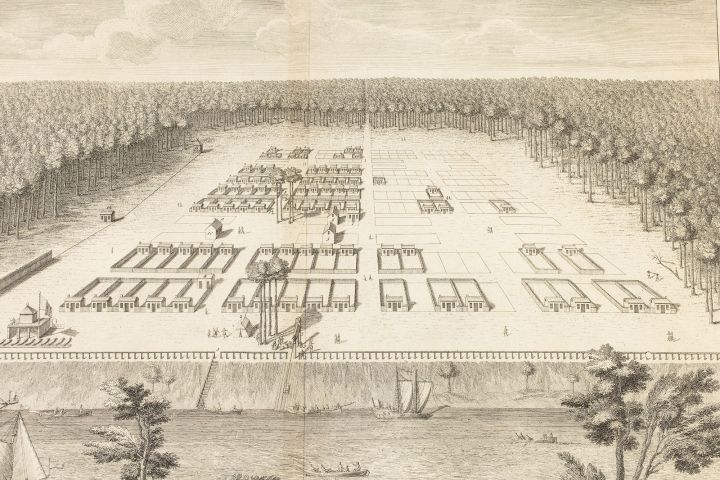
Paul Fourdrinier, after George Jones, A View of Savannah as it stood the 29th of March 1734, detail, ca. 1734, engraving, 20 × 26 inches.
◊ ◊ ◊ ◊ ◊
From SEASECS, with a selection of panels of particular interest for art historians:
51st Annual Meeting of the Southeastern American Society for Eighteenth-Century Studies
The Past is Still Present: Reclaiming the Eighteenth Century
The DeSoto, Savannah, Georgia, 6–8 February 2025
Proposals due by 16 September 2024
Conference Highlights
• Plenaries by Kurt Knoerl (underwater archaeologist and historian) and Celeste Guichard (architectural historian)
• Walking tour of historic Savannah led by Christopher Hendricks
• Reacting to the Past pedagogical workshop led by David Eick
• Writing (and submitting!) a pedagogy article led by Martha Bowden
Three ways to submit proposals
1. For any of the 23 outstanding Panels Seeking Participants, send your paper proposal (230–300 words) directly to the panel organizer by Monday, September 16. Include your full name, your institutional affiliation, and your email address (if possible, your ‘official’ institutional/professional email address).
2. For all other individual paper submissions on any topic related to the long 18th century, send your proposal to Elizabeth Kuipers by Monday, September 16, Elizabeth.Kuipers@asurams.edu. Include your full name, your institutional affiliation and your email address.
3. Send information on fully formed panels (including but not limited to undergraduate research panels) to Elizabeth Kuipers by Monday, September 16. Organizers, please send the title of your panel, your name, your institutional affiliation, and your email address along with the names of each of your participants, the titles of their papers, their institutional affiliations, and their email addresses.
Notifications of acceptances will be sent the first week of October.
Graduate students: We will have extra graduate student travel stipends this year to defray costs, thanks to the generosity of SEASECS members! Application details will be available in the fall.
◊ ◊ ◊ ◊ ◊
Illustrating the Past: The Long 18th Century in Graphic Novels, Comic Books, and Comic Strips
Joe Johnson, joejohnson@clayton.edu
This panel seeks presentations on graphic novels, comic books, and comic strips produced during or after, set in, and/or responding to the long 18th century. These comics can be adaptations of period works (such as renderings of Gulliver’s Travels, Robinson Crusoe, Tristram Shandy, and Frankenstein) or original stories depicting the era, its events, and people, such as Isaac Newton, the noted artist Jacques-Louis David, Napoleon, France’s loss of Canada in 1759, or its Revolution thirty years later.
◊ ◊ ◊ ◊ ◊
Art & Nature: Landscape in the Long 18th Century
Kasie Alt, kalt@georgiasouthern.edu
Ars et natura, art/skill and nature, form a foundational pairing, or tension depending on the source, in Enlightenment thinking. At the intersection of art and nature the concept of ‘landscape’ pervades the 18th century. Beneath what was, in European artistic hierarchies, a relatively lowly genre lies a complex matrix of identities and questions about the nature of the world and one’s place in it. Throughout the 18th century, art, literature, and philosophy, on a global scale, grappled with ideological, aesthetic, and cultural approaches to land in a manner that blurs, tests, and renegotiates the very identity of humans vis à vis nature and each other. Landscape was often used to locate oneself—to develop, negotiate, or reappraise one’s identity, place, and/or relationship to the world in which we live. Leveraging the interdisciplinary nature of the concept, this panel invites presentations examining landscape, broadly defined, in any discipline including visual and material cultures, architecture and design, literature, history, and philosophy, in any geographic area during the long 18th century. Given the theme of this year’s conference, presentations that discuss the lasting presence, effects, or ideological implications of 18th century landscape in today’s world are particularly welcome.
◊ ◊ ◊ ◊ ◊
Teaching Symposium
Martha F. Bowden, mbowden@kennesaw.edu
The teaching symposium invites teachers of the 18th century in all disciplines to contribute their particular strategies for introducing their 21st-century students to the world of the long 18th century. The 18th century offers challenges to our students: it is so near and yet so far, its developing consciousness of race, ethnicity, and gender like ours in its struggles but often so foreign in its approaches and conclusions. You may want to describe a syllabus for a class specifically about the 18th century, or a unit in a survey or freshman seminar that includes the 18th century but is not confined to it. Teachers at all levels, from AP and honors high school courses through graduate courses, are invited to submit proposals.
As time goes on, the challenges to our teaching change; how did the disruptions of the Covid pandemic change the needs of your students? Do you have strategies for dealing with AI, including teaching your students to use AI-powered tools? How has the increased availability of Digital Humanities resources affected your teaching strategies? The symposium takes the form of short, focused presentations about specific strategies, ideally accompanied by handouts that the audience can take home. While the presenters are usually the instructors, we have also had professor/student dialogues; I encourage participants to consider this dialogic approach to the pedagogy of the 18th century. Historically, the sessions have been very well attended, and the audiences not only ask really significant questions but also contribute wisdom of their own. I think of it as a conversation as much as a traditional panel. Send your proposal as a Word attachment containing the description of your teaching strategy.
◊ ◊ ◊ ◊ ◊
From Textile to Fashion and Beyond
Arlene Leis, Aleis914@gmail.com
What histories might emerge when we explore simultaneously textile and fashion practices and examine the possibilities between and beyond the two? Over the past fifty years research into the synergies between textile and dress histories continue to gain momentum. Ground breaking research by Lou Taylor, Evelyn Welch, Peter McNeil, Luca Molà, Rebecca Arnold, and John Styles have studied how dress and textiles were sources of innovation and economic and cross-cultural influences. More recently, Christopher Breward, Beverly Lemire, and Giorgio Riello’s substantial The Cambridge Global History of Fashion presents broader contextualization and investigates a range of key topics pertaining to fashion practice across time and space, including synergies between dress and textile, while also providing sharp analysis of wider visual and material cultures. There is also a continuing interest in how science and technology as seen in photography, conservation, reconstruction, and digitization help us better understand complex textiles and garment histories.
Our panel focuses on the interdisciplinarity between two seemingly separate histories: textile and fashion. Examining closely the relationship between the two, including across diverse media and genres, our goal is to utilize this panel as a way to explore, encourage, and foreground a range of interactions, and it attempts to further grasp and understand, at historical, practical, and theoretical levels, the possible links between these practices. The papers explore the cultural and social histories of apparel and textiles as well as their preservation, with the aim of presenting and making way for new and emerging research on textiles, fashion, and beyond.
◊ ◊ ◊ ◊ ◊
Artist’s Signatures
Sarah Sylvester Williams, willisj@millsaps.edu
During the 18th century, artists did not always sign their artworks. Scholar Charlotte Guichard has written about artists who did, such as Chardin, François Boucher, Hubert Robert, and Jacques-Louis David. These signatures were evidence of the changing status of the artist and art market, as well as political developments. But what about other artists who did not regularly sign their work? This panel seeks papers that deal with rare or infrequent artistic signatures. What do the odd occasions when the artist included their signature tell us about the artist, the artwork, or the circumstances of its commissioning or reception?
◊ ◊ ◊ ◊ ◊
Material Culture of Gender
Lauren DiSalvo, Laurendisalvo4@vt.edu
This is an open session exploring the relationships between material culture and gender in the long 18th century. Of interest are papers that use material culture to explore how social behavior relating to gender might be communicated or reinforced through material objects. For example, Ryan Whyte writes about miniature women’s almanacs as a subversive mode of women’s participation in Enlightenment knowledge. The miniaturizing of paintings in the almanacs’ pages and their decorative covers presented a feminized knowledge, yet the same material object allowed women to participate in the discourse of history painting. Especially welcome are papers that use material culture to challenge or complicate 18th-century understandings of gender. Participants may choose to focus discussions on gendering in relationship to individual objects or their materiality.
◊ ◊ ◊ ◊ ◊
Representations of Indigenous Perspectives
Patty Hamilton, phamilto@uu.edu
To follow up on LeAnne Howe’s plenary presentation at our 2024 conference at Furman, “The Art and Craft of Image Production in Fiction: Depictions of Native Americans in Historical Fiction,” I propose to broaden the conversation from ‘depictions’ (which may or may not be historically accurate depending on who is doing the depicting, as Prof. Howe illustrated) to ‘representations of indigenous perspectives’ in the long 18th century. Spanning genres, these representations may be literary, historical, or artistic, but they should share in common an attempt to accurately represent the perspective (beliefs, values, social fabric, experience) of indigenous peoples (as Olaudah Equiano does in the opening chapter of his autobiography). What insights or re-visioning can such representations yield? For the purposes of the panel, ‘indigenous’ may be broadly construed as the native peoples of North, Central, and South America and the Caribbean as well as West Africa, India, or other sites of European empire in the 18th century. Orientations may be critical or pedagogical.
New Book | Billy Waters is Dancing
From Yale UP:
Mary Shannon, Billy Waters is Dancing: Or, How a Black Sailor Found Fame in Regency Britain (New Haven: Yale University Press, 2024), 384 pages, ISBN: 978-0300267686, $38.
 The story of William Waters, Black street performer in Regency London, and how his huge celebrity took on a life of its own
Every child in Regency London knew Billy Waters, the celebrated ‘King of the Beggars’. Likely born into enslavement in 1770s New York, he became a Royal Navy sailor. After losing his leg in a fall from the rigging, the talented and irrepressible Waters became London’s most famous street performer. His extravagantly costumed image blazed across the stage and in print to an unprecedented degree. For all his contemporary renown, Waters died destitute in 1823—but his legend would live on for decades. Mary L. Shannon’s biography draws together surviving traces of Waters’ life to bring us closer to the historical figure underlying them. Considering Waters’ influence on the London stage and his echoing resonances in visual art, and writing by Douglass, Dickens, and Thackeray, Shannon asks us to reconsider Black presences in nineteenth-century popular culture. This is a vital attempt to recover a life from historical obscurity—and a fascinating account of what it meant to find fame in the Regency metropolis.
Mary L. Shannon is a writer, broadcaster, and senior lecturer in English literature at the University of Roehampton, where her research focuses on nineteenth-century literature and culture. She is author of the award-winning Dickens, Reynolds, and Mayhew on Wellington Street.










 Enfilade
leave a comment