New Book | Life of Adélaïde Labille-Guiard
From Chronicle Books:
Bridget Quinn, Portrait of a Woman: Art, Rivalry, and Revolution in the Life of Adélaïde Labille-Guiard (New York: Chronicle Books, 2024), 224 pages, ISBN: 978-1797211879, $30.
 Discover the story of Adélaïde Labille-Guiard—a long-ignored artist and feminist of eighteenth-century France—in this imaginative and illuminating biography from an award-winning writer.
Summer in Paris, 1783. The Louvre steps, too hot and no breeze, the air electric with the heady anticipation of a coming storm: the year’s Royal Salon. Bewigged and powdered Parisians mill amid pigeons, dogs, and detritus; food and flower sellers; pamphleteers and propagandists. Men and women of every estate (clergy, nobles, commoners) are united under art: to love it, to despise it, to gossip endlessly about it.
Exhibiting at the Royal Salon was not for the faint of heart, and it was never intended for women.
Enter Adélaïde Labille-Guiard . . .
Born in Paris in 1749, Adélaïde Labille-Guiard rose from shopkeeper’s daughter to an official portraitist of the royal court—only to have her achievements reduced to ash by the French Revolution. While she defied societal barriers to become a member of the exclusive Académie Royale and a mentor for other ambitious women painters, she left behind few writings, and her legacy was long overshadowed by celebrated portraitist and memoirist Élisabeth Vigée-Lebrun.
But Adélaïde Labille-Guiard’s story lives on. In this engaging biography, Bridget Quinn applies her insightful interpretation of art history to Labille-Guiard’s life. She offers a fascinating new perspective on the artist’s feminism, her sexuality, and her vision of the world. Quinn expertly blends close analyses of paintings with broader context about the era and inserts delicately fictionalized interpersonal scenes that fill the gaps in the historical record. This is a compelling and inspiring look at an artist too long overlooked. Despite numerous setbacks, Labille-Guiard built a legacy as an accomplished royal portraitist and a mentor to other young women artists of her era. This tale of solidarity, self-belief, and true passion for painting is sure to inspire contemporary creatives and women today.
Bridget Quinn is a writer, art historian, and critic. She is the author of the award-winning Broad Strokes: 15 Women Who Made Art and Made History (in That Order) and She Votes: How U.S. Women Won Suffrage, and What Happened Next. A graduate of New York University’s Institute of Fine Arts and a regular contributor to the arts magazine Hyperallergic, Quinn is a sought-after speaker on women and art. She lives in the San Francisco Bay Area with her family.
At Christie’s | Sale Results for A Park Avenue Collection
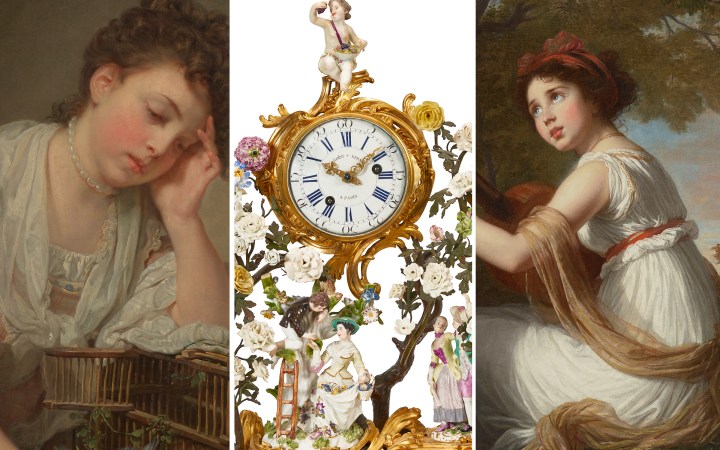
Left: Jean-Baptiste Greuze, A Girl Weeping over Her Dead Bird, detail, 1757, oil on oval canvas, 71 × 60 cm (estimate: $600,000–800,000; sold for $2,470,000). Center: Benoist Gerard, Louis XV Meissen and French porcelain-mounted ormolu and tole peinte mantel clock, 1740, porcelain, ormolu, 54 × 38 × 17 cm (estimate: $50,000–80,000; sold for $75,600). Right: Élisabeth-Louise Vigée Le Brun, Portrait of the Artist’s Daughter, Jeanne-Julie-Louise Le Brun, Playing a Guitar, detail, oil on canvas, 100 × 83 cm (estimate: $300,000–500,000; sold for $441,000).
◊ ◊ ◊ ◊ ◊
From the press release, detailing sale highlights, via Art Daily:
A Park Avenue Collection, Sale #23048
Christie’s New York, 17 April 2024
Christie’s made strong results for a single-owner sale that featured a rich array of 18th-century French furniture, Old Master paintings and drawings, and Chinese works of art. A Park Avenue Collection totaled $8,890,582, which was 130 percent above the low estimate, with 79 percent of lots sold. There were outstanding results across categories. The top lot of the sale was an Old Master painting, Jean-Baptiste Greuze’s Girl Weeping over Her Dead Bird (Une jeune fille qui pleure la mort de son oiseau), which made $2,470,000, setting a new world record for the artist and more than doubling the prior record set in 2013. The top furniture lot was a pair of late Louis XVI ormolu-mounted ebony, ebonized, and boulle marquetry meubles d’appui, which brought $176,400. A Chinese famille verte porcelain rouleau vase of the Kangxi Period (1662–1722) topped the Chinese offerings at $151,200. A drawing by Michelangelo, which received worldwide attention, made $201,600, more than 33 times its low estimate of $6,000.
Deputy Chairman for English Furniture and Works of Art, William Strafford, said, “The outstanding results of today’s sale pay tribute to this collector’s connoisseurship and passionate pursuit of rare treasures in so many fields during over 40 years of collecting.”
Specialist for Old Masters, Joshua Glazer, said, “The superb group of French 18th-century paintings in the collection were universally admired, and we were thrilled to have set a new world auction record for the magnificent Greuze, Girl Weeping over Her Dead Bird.”
More information is available from this preview article from Christie’s»
Exhibition | Works from Notre Dame Restored
The exhibition includes 21 paintings, including some of the ‘May’ pictures commissioned for the cathedral of Notre-Dame de Paris by the goldsmiths’ guild each spring from 1630 to 1707. More information is available from Artnet.

Interior of Notre-Dame at the Transept Crossing, ca. 1780, oil on canvas, 47 × 58 cm
(Société des amis de Notre-Dame de Paris)
◊ ◊ ◊ ◊ ◊
Grands décors restaurés de Notre-Dame
Galerie des Gobelins, Paris, 24 April — 21 July 2024
Curated by Caroline Piel and Emmanuel Pénicaut
À la veille de la réouverture de la cathédrale Notre-Dame de Paris, le 8 décembre prochain, le Mobilier national et la direction régionale des Affaires culturelles d’Île-de-France (ministère de la Culture) s’associent pour présenter au public les chefs-d’œuvre du décor intérieur de l’édifice, soit vingt et un tableaux de grand format, parmi lesquels treize grands « mays », restaurés dans le cadre d’un chantier mené avec l’appui du Centre de recherche et de restauration des musées de France (C2RMF).
D’autres objets remarquables complètent cet ensemble : la tenture de la vie de la Vierge tissée pour orner le chœur au XVIIe siècle, en quatorze pièces, aujourd’hui conservée à la cathédrale de Strasbourg, et l’immense tapis de Savonnerie offert à la cathédrale par le roi Charles X, dont la restauration vient de s’achever au Mobilier national.
 Enfin, en accord avec le diocèse de Paris, sont aussi présentées les maquettes du futur mobilier liturgique actuellement en cours de réalisation. Restauration et création se mêlent ainsi, du XVIIe au XXIe siècle, pour faire de la cathédrale non seulement un fleuron de l’art gothique mais aussi un écrin d’objets d’art et de piété de qualité exceptionnelle.
Depuis l’incendie de 2019, près de 1 000 artisans travaillent au quotidien à la restauration de la cathédrale. Parmi eux, les restaurateurs de peintures ne sont pas les moins actifs. Ce sont eux qui ont redonné vie et couleur aux grands « mays », ces chefs-d’œuvre de peinture religieuse offerts chaque année au mois de mai, entre 1630 et 1707, par la confrérie des orfèvres de la ville de Paris. Leurs auteurs sont les plus grands peintres français de l’époque : Laurent de La Hyre, Aubin Vouet, Charles Le Brun, Eustache Le Sueur…). Accrochés à l’origine côte à côte dans la nef de la cathédrale, ils formèrent une collection unique en France, dispersée à la Révolution, puis partiellement rassemblée et replacée dans l’édifice.
La restauration de ces grands mays et des autres œuvres peintes, françaises et italiennes, conservées dans l’édifice à la veille de l’incendie et restauration, a été confiée par la DRAC Île-de-France confiée à trois groupements de restaurateurs du patrimoine, avec le soutien du Centre de recherche et de restauration des musées de France. Les treize mays restaurés sont présentés dans un ordre qui évoque leur accrochage originel dans la nef de la cathédrale. Des esquisses et des dessins sont aussi présentés, accompagnés de textes, de multimédia et d’explications qui aident à comprendre la richesse propre de chaque œuvre et le savoir-faire exceptionnel des restaurateurs du patrimoine.
Commissaires
• Caroline Piel, inspectrice des patrimoines, collège Monuments historiques (h)
• Emmanuel Pénicaut, directeur des collections du Mobilier national
assistés de
• Marie-Hélène Didier, conservatrice des Monuments historiques, DRAC Île-de-France
• Oriane Lavit, conservatrice du patrimoine, Centre de recherche et de restauration des musées de France (C2RMF)
Caroline Piel and Emmanuel Pénicaut, eds., Grands décors restaurés de Notre-Dame de Paris (Milan: Silvana Editoriale, 2024), 112 pages, ISBN: 978-8836656820, €15.
Note (added 28 January 2025) — The posting was updated to include the accompanying publication.
Lecture | Emmanuelle Chapron on Readers at the Royal Library of Paris
From the School of Advanced Study, University of London:
Emmanuelle Chapron | The Loan Registers of the 18th-Century Royal Library of Paris: A History of Readers, Books, and Institutions
Online, via Zoom, 4 June 2024, 5.30pm
The study of the loan registers of the Royal Library of Paris helps us to understand the use of the library and manuscripts in the 18th century, leading to a history of institutional trust and the library as archive.
In association with the History of Libraries seminar series. All are welcome; those wishing to attend should book a free ticket here.
Emmanuelle Chapron is Professor of Modern History at Aix-Marseille Université and Ecole pratique des hautes études, Paris. She is a specialist of the history of the book and libraries as well as history of scholarship in early modern times, in France and Italy. Among her publications are Ad utilità pubblica : politique des bibliothèques et pratiques du livre à Florence au XVIIIe siècle (Geneva, 2008) and Livres d’école et littérature de jeunesse en France au XVIIIe siècle (Liverpool, 2021). She is the curator of the digital edition of the letters and papers of Jean Jean-François Séguier (1704–1783). She is currently working in archives in libraries from the 17th century onwards.
Lecture | Andrew Foster on Chichester Cathedral Library, 1670–1735
From the School of Advanced Study, University of London:
Andrew Foster | The Restoration and Revival of Chichester Cathedral Library, 1670–1735
Lambeth Palace Library, London, 7 May 2024, 5.30pm
For the redoubtable Dr Mary Hobbs (1923–1998), the return of Bishop Henry King’s Library marked the rebirth of Chichester Cathedral Library post 1671; yet close analysis of The Old Catalogue before 1735 reveals other stories of benefactors and books in what was quite a renaissance for cathedral, city, and the surrounding region at the end of the seventeenth century.
In association with the History of Libraries seminar series. All are welcome; those wishing to attend should book a free ticket here.
Andrew Foster was formerly Director of Research at the University of Chichester and is now an Honorary Research Fellow of the University of Kent, and a Visiting Researcher with ‘Lincoln Unlocked’, Lincoln College, Oxford. He is a Fellow of the Society of Antiquaries, an ecclesiastical historian with a special interest in the history of the Church of England c.1540–1700, a former Vice-President of the Royal Historical Society, founding chair of the Public History Committee of the Historical Association, and Literary Director of the Sussex Record Society for 33 years until 2018.
St Paul’s Cathedral Library Restored
Following a five-year restoration, the 18th-century library at St Paul’s Cathedral is once again open to researchers and tourists (look for the the special Triforium Tour). From Architecture Today (6 November 2023).

Christopher Wren, St Paul’s Cathedral Library, following restoration; completed in 1709, the library is on the Triforium level, behind the southwest tower ((Photo by Graham Lacdao for St Paul’s Cathedral).
◊ ◊ ◊ ◊ ◊
Completed in 1709, the library reaches two stories high and contains more than 13,000 volumes of books and manuscripts, the oldest of which dates back to 1313. Here, Portland stone panelling surround a gallery, with these panels enamoured with deep, ornate carvings. Beneath, an array of brackets supporting the gallery enjoy decoration of equal measure, this time carved out of wood. (Recent research, however, uncovered the fact that the gallery walkway is cantilevered from the wall, with the brackets being purely decorative).

Christopher Wren, Dean’s Staircase, with ironwork by Jean Tijou (Photo by Richard Holltum, from August 2007, from the website of the World Monuments Fund).
Before work began on the restoration in 2018, the most significant changes to the library were the addition of electrical lights and a heating system in the early 1900s. In fact, the cathedral nearly didn’t have a library at all, with its collection almost entirely destroyed by the Great Fire of London in 1666. Following the damage, however, Sir Christopher Wren’s Library chamber was restocked by the cathedral’s Commissioners for rebuilding St Paul’s following the damage.
The £800,000 refurbishment, funded mostly through donations and benefactors of St Paul’s, saw books cleaned, walls re-painted, a new lighting scheme put in place, new desks for readers, as well as a new display case. Work was also done to the cantilevered gallery which was showing signs of sagging. . . .
“The Cathedral Library is a remarkable room, and remains one of Sir Christopher Wren’s great achievements. It is fitting that, as we mark 300 years since his death, his Library is able to reopen after five years of painstaking restoration,” the Dean of St Paul’s Cathedral, the Very Reverend Andrew Tremlett said in a statement. . . .
The full article is available here»
Call for Papers | Hand-Colouring of Natural History Illustrations

◊ ◊ ◊ ◊ ◊
From ArtHist.net:
The Hand-Colouring of Natural History Illustrations in Europe, 1600–1850
In-person and online, University of Konstanz, 26–27 February 2025
Organized by Joyce Dixon and Giulia Simonini
Proposals due by 21 June 2024
From the first instances of coloured engravings depicting botanical and zoological subjects, the usefulness and effectiveness of the printed image was transformed. In the seventeenth century the practice of hand-painting prints in watercolour was pioneered in luxurious and costly works such as Basilius Besler’s Hortus Eytettensis (1613). A century later this technique allowed for the publication of Maria Sibylla Merian’s exquisite Metamorphosis Insectorum Surinamensium (1705), and the first British collection of hand-coloured zoological engravings, A Natural History of English Insects (1714–1720) by Eleazar Albin. Color, pictorially represented, had become crucial to the project of natural knowledge-making: as Mark Catesby commented in 1731, “a clearer Idea may be conceiv’d from the Figures of Animals and Plants in their proper Colours, than from the most exact Description without them.”
The proliferation of hand-coloured impressions continued into the nineteenth century and yielded a highly-productive cottage industry. Even with the advent of colour printing, chromatic details of biological subjects were usually finished by hand (Friedman, 1978). Yet despite their vital role in the formation and dissemination of natural knowledge, the activities of hand-colourers—known also as ‘colourists’, ‘afzetters’ (in Dutch), and ‘illuminist’ (in German)—remain poorly understood (Jackson, 2011; Oltrogge 2000). This workshop aims to shed light on this vital aspect of European image-making and hopes to attract researchers investigating diverse areas of natural history.
The workshop will take place at the University of Konstanz on Thursday–Friday, 26–27 February 2025, with Dr. Alexandra Loske delivering a keynote address. We are accepting proposals for 20-minute papers in English. We welcome contributions on the following themes and topics:
• Materiality: paints and pigments, colouring techniques, equipment
• Semantics: methods of image replication, proofing processes, modes of pictorial translation
• Economy: working conditions and wages, guilds, case studies of individual enterprises
• Afterlife: consumption and circulation, amateur colourers, reception and significance
Please send your title, a 200-word abstract, and a short biography (150 words) to Joyce Dixon, joyce.dixon@ed.ac.uk, and Giulia Simonini, giulia.simonini@tu-berlin.de, by Friday, 21 June 2024. Papers can be given in person or virtually; please indicate your preferred method of delivery when submitting your abstract.
Call for Articles | Casting Art
From ArtHist.net:
Casting Art
Volume published by De Gruyter and edited by Yaëlle Biro and Noémie Etienne
Proposals due by 1 September 2024, with full articles due by February 2025
Plaster casts molded from artworks are ubiquitous in museum and university collections. In the art history department at the university of Vienna, for instance, a small vitrine surrounded by plants displays old plaster casts of medieval ivories. The installation functions simultaneously as an educational tool from the past, an archive of the department history, and a decorative ensemble. The German anthropologist Leo Frobenius had multiple plaster casts made of several terracottas he excavated in 1910 in Ife, Nigeria, marked them with his name and donated them to European ethnographic museums. He thus transformed masterpieces of an ancient West African civilization into his own vanity pieces-carte de visite and subjects of scientific research.
As can be seen in many museum storage and gypsotheques, over centuries, plaster casts have been molded on art works, architectural elements, and even human beings. The Italian Renaissance and the 19th century are two contexts often discussed in the framing of the importance of casting as part of broader creative processes but their presence and impact goes beyond. Since the 1990s and the work by Georges Didi-Huberman (e.g. L’empreinte, 1997), plaster casts have stimulated art historical research and have expanded thinking about heritage.
In this edited volume from De Gruyter (new series Traces), we propose to redefine collectively what plaster casts are across different geographies and time periods, focusing mainly on the reproduction of objects. As the use of 3D printing of works of art is becoming common practice as a tool to the current debate on restitution of cultural patrimony, we would like to interrogate how this replication practice differs conceptually from the earlier one. We will explore what plaster casts were upon production and what they have become, what they enable, and how they impact original productions as well as discourses surrounding them.
Topics of interest can include
1. Past: Plaster copies were highly circulated between institutions and continents. How were they traded, commercialized, and commodified? How did plaster cast enable the forging of specific disciplines, in which context and for whose profit? How were plaster casts used in teaching and study collections? How were they produced, circulated, and exhibited?
2. Present: We believe that plaster casts, and casts in general, need to be better defined in a global theoretical framework. Despite the numerous single studies focusing on specific contexts, in both art history and anthropology, the topic per se lacks broader conceptualization. How should this type of object be defined? What do they convey? How do they transform the casted original, be it an artwork (or even sometimes a human being)? Topics can also include the connection between artistic and anthropological castings, as well as the use of casts in contemporary art.
3. Future: Plaster is a very sensitive material prone to degradation. What are the specific challenges of exhibiting and preserving plaster cast today? Should they be preserved at all as parts of the museums’ collections? Does today’s proliferation of 3D printing of works of art, and their possible use in the context of restitution practices, present similar challenges and should these processes be submitted to better control?
Guest editors: Yaëlle Biro and Noémie Etienne
Publisher: De Gruyter
In the New Series: Traces. Public History and Cultural Heritage Studies
Publication date: 2026
Abstracts expected (c. 300 words): September 1st 2024
Please send your abstracts to: yaellebiro@gmail.com and noemie.etienne@univie.ac.at
Full articles (if abstracts are accepted): February 2025
A peer-reviewed evaluation will take place
Final versions of the articles are expected for April 2025
New Book | John Soane’s Cabinet of Curiosities
Forthcoming from Yale UP:
Bruce Boucher, John Soane’s Cabinet of Curiosities: Reflections on an Architect and His Collection (New Haven: Yale University Press, 2024), 224 pages, ISBN: 978-0300275698, £35 / $45.
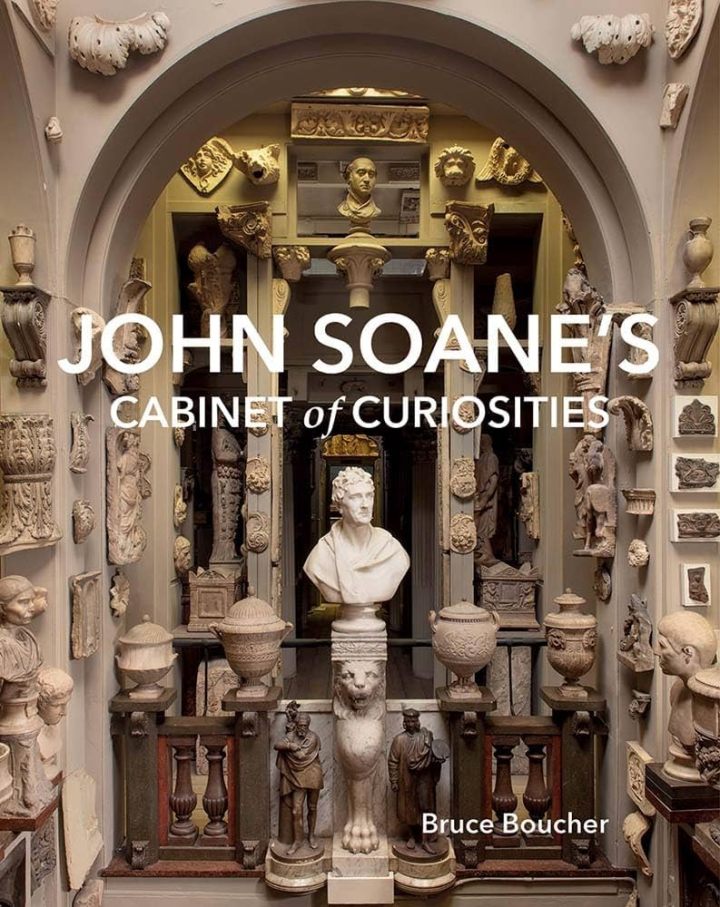 An in-depth study that sheds a fascinating new light on Sir John Soane (1753–1837) and his world-renowned collection
Sir John Soane’s architecture has enjoyed a revival of interest over the last seventy years, yet Soane as a collector—the strategy behind and motivation for Soane’s bequest to the nation—has remained largely unexplored. While Soane referred to the display of objects in his house and museum as “studies for my own mind,” he never explained what he meant by this, and the ambiguity surrounding his motivation remains perennially fascinating. This book illuminates a side of Soane’s personality unfamiliar to most students of his life and work by examining key strands in his collection and what they reveal about Soane and the psychology of collecting. Topics include the display of antiquities; his fascination with ruins, both literal and figurative; his singular response to Gothic architecture; and his investment in modern British painting and sculpture. These aspects are bookended by an introductory biographical chapter that highlights the ways in which his family and career informed his collecting habits as well as an epilogue that analyses the challenges of turning a private house and collection into a public museum.
Bruce Boucher is an art historian and curator who served as director of Sir John Soane’s Museum from 2016 to 2023. Specializing in Italian Renaissance, Baroque, and Neo-classical art and architecture, he is the author of a number of books, including The Sculpture of Jacopo Sansovino, Andrea Palladio: The Architect in his Time, and Earth and Fire: Italian Terracotta Sculpture from Donatello to Canova.
Tour and Talk | Pitzhanger Manor
From Pitzhanger Manor & Gallery:
Collecting in 18th-Century London’s Grand Houses: Pitzhanger Manor, Orleans House, and More
Pitzhanger Manor & Gallery, London, 2 May 2024, 5.30–9pm
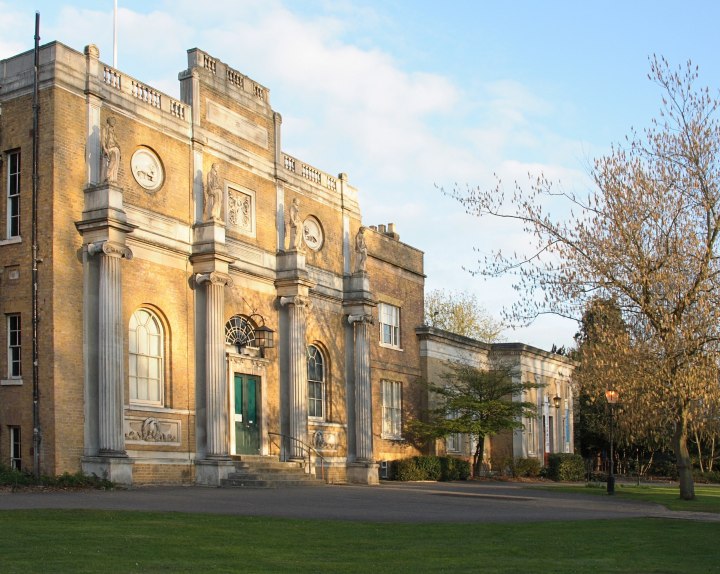
John Soane, Pitzhanger Manor, Walpole Park, Ealing, London, 1800–04 (Photo: Wikimedia Commons, April 2008).
Experience the first-ever in-person event presented by London Luminaries
The evening will include guided tours of Pitzhanger Manor, showcasing Sir John Soane’s architectural marvels, followed by an enlightening talk. Experts in historic estates—Clare Gough, Director of Pitzhanger Manor & Gallery; Tim Corum, Head of Richmond Arts Service; and Emily Burns, Curator of Collections and Interiors for English Heritage—will illuminate the art of collecting in 18th-century London, offering insights into the prestigious collections in Pitzhanger Manor, Orleans House, Marble Hill, Chiswick House, and more. Join us for an evening of history, art, and connectivity.
• Guided tours of the house commence at either 5.30 or 6pm. Guests are welcome to explore freely should they wish to arrive earlier or attend solely for the talk, which starts at 6.45.
• Tickets are £12, with all profits supporting the London Luminaries properties, an initiative born during the COVID lockdown to enhance connections between properties and people.
• Drinks and refreshments will be available for purchase at Soane’s Garden Room until 9pm, not included in the ticket price.
Pitzhanger Manor was the country home of Sir John Soane, one of the most influential architects in British history. Soane designed many extraordinary buildings, but Pitzhanger is unique as a building because it was designed, built and lived in by Soane himself. Following a major three-year conservation project, Pitzhanger reopened in March 2019. The Manor has been revitalised to take it back to Soane’s original designs, its extraordinary architecture restored for the public to see. Pitzhanger Gallery, housed in the 1939 library building, has been improved to allow for major loans and a series of contemporary exhibitions by artists, architects, and designers.
Emily Burns is the Curator of Collections & Interiors (West London) for English Heritage. Properties in her portfolio include Marble Hill, Chiswick House, and the Jewel Tower. Previously, she was a Curator at Watts Gallery – Artists’ Village (2021–23), Vivmar Curatorial Fellow at the National Gallery (2018–20), and Assistant Curator at the National Portrait Gallery (2013–18). Emily’s specialism is in British and Old Master painting and collecting. She holds degrees from the University of Cambridge and UCL and completed her AHRC-funded PhD on art and collecting in England during the Civil Wars and Interregnum, c.1640–1660 (University of Nottingham, 2018). Emily was a contributor to the Paul Mellon Centre’s research project Art and the Country House (2020), and she is the founding Editor of the Jordaens Van Dyck Journal (2021–present).
Tim Corum has worked in the arts for over 30 years, principally in museums and galleries, developing museum exhibitions and festivals at Oldham, Leeds, Bristol, the Horniman in London, and now with Richmond Arts Service. In Leeds and Oldham, he worked on developing international art programmes and a series of major capital projects. In Bristol, Tim led the development of the City Museum and Art Gallery, encouraging artists to intervene in and reframe the museum and art gallery. Though most widely known for the exhibition Banksy versus Bristol Museum, this programme also embraced a diversity of projects with both local and international partners. At the same time, he developed a new international contemporary art collection, building on Bristol’s rich historic art collection. He also led the creative team that developed the new museum, M Shed. In 2015, Tim became a director at the Horniman, where his work focussed on developing participatory programmes, bringing artists and scientists from a wide variety of backgrounds together with communities to create exhibitions and festivals that cast new light on the museum’s internationally significant collections. Tim moved to Richmond during the pandemic to lead the Borough’s Arts Service and direct the development of Orleans House Gallery.
Clare Gough is Director of Pitzhanger Manor & Gallery, architect Sir John Soane’s ‘country’ house in Ealing, West London and its adjacent contemporary gallery. Clare led Pitzhanger through a major conservation project to restore the house to Soane’s innovative design and upgrade the gallery, so it now stages exhibitions with artists ranging from Anish Kapoor to Es Devlin and Rana Begum. Clare is a Trustee of the Art Fund and was previously a Trustee of the Museum of the Home. She formerly worked at the National Gallery and National Gallery Co. Ltd before setting up an art consultancy working with the V&A and other art institutions.
Judith Hawley is Professor of Eighteenth-Century Literature in the Department of English, Royal Holloway, University of London. She frequently appears on BBC radio and TV and is a Trustee of the Pope’s Grotto Preservation Trust. Her research interests range from gin to Grub Street, and she has a particular interest in the history of amateur performance.










 Enfilade
leave a comment