Exhibition | Pocket Luxuries
Now on view at the Cognacq-Jay:
Pocket Luxuries: Small Precious Objects in the Age of Enlightenment
Luxe de poche: Petits objets précieux au siècle des Lumières
Musée Cognacq-Jay, Paris, 28 March — 29 September 2024
Curated by Sixtine de Saint Léger and Gabrielle Baraud
 L’exposition Luxe de poche au musée Cognacq-Jay présente une collection exceptionnelle de petits objets précieux et sophistiqués, en or, enrichis de pierres dures ou de pierres précieuses, couverts de nacre, de porcelaine ou d’émaux translucides, parfois ornés de miniatures. Les usages de ces objets varient, mais ils ressortent tous des us et coutumes d’un quotidien raffiné, signe de richesse, souvenir intime. Au siècle des Lumières comme aux suivants, ils suscitent un véritable engouement en France d’abord puis dans toute l’Europe. Luxe de poche a pour ambition de renouveler le regard que l’on porte sur ces objets, en adoptant une approche plurielle, qui convoque à la fois l’histoire de l’art et l’histoire de la mode, l’histoire des techniques, l’histoire culturelle et l’anthropologie en faisant résonner ces objets avec d’autres œuvres : des accessoires de mode, mais aussi les vêtements qu’ils viennent compléter, le mobilier où ils sont rangés ou présentés et enfin des tableaux, dessins et gravures où ces objets sont mis en scène. Ce dialogue permet d’envisager ces objets dans le contexte plus large du luxe et de la mode au XVIIIe et au début du XIXe siècle.
Point de départ de cette nouvelle exposition, la remarquable collection d’Ernest Cognacq est enrichie de prêts importants—d’institutions prestigieuses comme le musée du Louvre, le musée des Arts décoratifs de Paris, le Château de Versailles, le Palais Galliera, les Collections royales anglaises ou le Victoria and Albert Museum à Londres—afin d’offrir une nouvelle lecture de ces accessoires indispensables du luxe.
Commissariat scientifique
• Vincent Bastien, collaborateur scientifique au Château de Versailles
• Ariane Fennetaux, professeure des universités, Université Sorbonne Nouvelle
• Pascal Faracci, conservateur en chef du patrimoine
Sixtine de Saint-Léger, ed., Luxe de poche: Petits objets précieux au siècle des Lumières (Paris: Musée Cognacq-Jay, 2024), 96 pages, ISBN: 978-2759605798, €19. With contributions by Gabrielle Baraud, Vincent Bastien, Ariane Fennetaux, and Alice Minter.
Exhibition | Silver Treasures from Norway
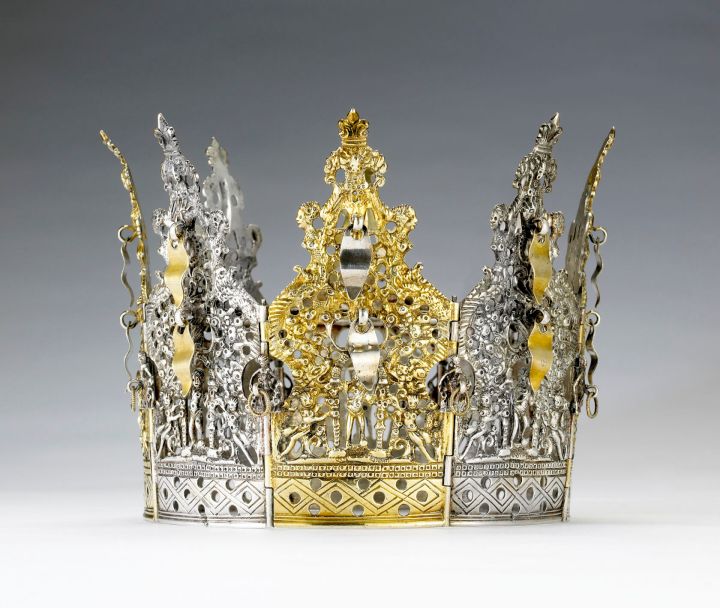
Bridal Crown, 1590–1610, silver and silver- gilt
(Christen Sveaas Collection)
◊ ◊ ◊ ◊ ◊
From the press release (8 January 2024) for the exhibition . . .
Crowning the North: Silver Treasures from Bergen, Norway
Museum of Fine Arts, Houston, 11 February — 5 May 2024
Spanning the 16th to the early 20th century, this exhibition of some 200 objects reveals the evolution of a uniquely Norwegian approach to silversmithing over centuries of global change.
For centuries, Bergen, one of the largest port cities in Scandinavia, was a thriving hub of global commerce, with a burgeoning export of fish, timber, and fur. That trade in turn spurred the development of a uniquely Norwegian approach to a timeless craft: gold and silver smithing. Crowning the North: Silver Treasures from Bergen, Norway explores the art of the Bergen silversmiths from the 16th to early 20th century and examines the evolution of the craft against the backdrop of greater political, social, and economic change in Norway and other parts of the world. Some 200 objects—from spoons, tankards, sugar bowls, and salt cellars, to elaborate ceremonial wedding crowns and fantastical vessels—are on exclusive loan to the U.S. from three public and private Norwegian collections: Kode Bergen Art Museum, the Bergen University Museum, and the private collection of Christen Sveaas.
“This presentation of objects from three prestigious Norwegian collections of art, craft, and design is an exceptional opportunity to discover Nordic history and aesthetics across centuries and across the intersecting forces of global trade, taste, and fashion,” commented Gary Tinterow, director and Margaret Alkek Williams Chair, the Museum of Fine Arts, Houston. “We are pleased to collaborate with the Kode Bergen Art Museum in bringing these remarkable objects to Houston, where they will be seen by U.S. audiences for the first time.”
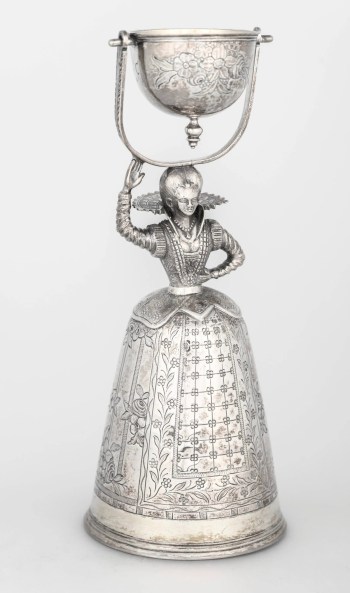
Johan Helmich Hoff, Silver Maiden Beaker, 1782, silver and silver-gilt (Kode Bergen Art Museum).
By the 16th century, Bergen had become a critically important global economic center in the trade of grain and salts for lumber and stock fish from the North. At the time ruled by Denmark, Bergen and its commerce operated under the jurisdiction of the Hanseatic League, a confederation of merchant guilds and market towns across central and northern Europe established by German traders in the 13th century. The league’s dominant global exchange network brought together two factors that fostered what would become a unique artistic heritage in Bergen: the availability of enormous quantities of silver mined from the Spanish Americas, and an influx of immigrants and their craft traditions from Germany and other European countries.
Bergen goldsmiths formed their own Goldsmith’s Guild in 1568. The goldsmith tradition that evolved in the city allowed artisans, both men and women, to craft a range of decorative and functional objects of extraordinary quality. Bergen goldsmiths’ sensibilities in the 16th century reflected the Renaissance and, later, Baroque styles of the time. Over the course of the 18th century, the influx of global commodities like tobacco and coffee from European colonies inspired goldsmiths to craft elegant objects for daily use to meet consumer demand. By the 19th century, with the excavations of three Viking ships and agitation for independence from Sweden, a growing sense of revivalism in art, literature, and popular culture inspired Norway’s goldsmiths to create fantastical objects harkening back to the Viking and medieval era. For centuries, with no banking system in place until 1816 following Norway’s union with Sweden in 1814, these silver and gold items—spoons, tankards, sugar bowls, and salt cellars, along with ceremonial objects such as brides’ wedding crowns—also functioned as a means of building personal wealth.
Crowning the North: Silver Treasures from Bergen, Norway is organized by the Museum of Fine Arts, Houston, in collaboration with the Kode Bergen Art Museum.
Kode Bergen Art Museum is one of the largest museums for art, crafts, design, and music in the Nordic region. Kode offers a unique combination of art museums and composers’ homes, showcasing contemporary art, historical collections, concerts, and parklands. The museum stewards over 50,000 objects, including paintings, works on paper, sculptures, installations, videos, musical instruments, furniture, textiles, ceramics, glass, and metal. These objects can be experienced in four different neighboring art museums in the heart of Bergen and the three beautifully located homes of the composers Ole Bull, Harald Sæverud, and Edvard Grieg.
Call for Papers | Securities of Art: The History of Authentication
From the ArtHist.net announcement, which includes the German:
Securities of Art: On the History of Authentication between Work, Text, and Context
Carl von Ossietzky Universität Oldenburg, 5–7 December 2024
Organized by Tobias Vogt and Lukas Töpfer
Proposals due by 15 June 2024
Workshop as part of the DFG project Wertpapiere der Kunst. Authentifizierung als künstlerisches Konzept in Zeiten von Finanzkrisen, 1720–2020 (Securities of art. Authentication as an artistic concept in times of financial crises, 1720–2020), Prof. Dr. Tobias Vogt and Lukas Töpfer M.A., Institute for Art and Visual Culture, Carl von Ossietzky University Oldenburg.
The workshop Securities of Art: On the History of Authentication between Work, Text, and Context (Wertpapiere der Kunst: Zur Geschichte künstlerischer Authentifizierung zwischen Werk, Text und Kontext) will examine artistically conceived authentications that have become constitutive for the status and value of artworks since the early 18th century. The guiding assumption is that artists in particular interrogate specific methods of authentication—such as signatures and titles, but also certificates, contracts, and other securities in the broadest sense—and integrate them into the structure of their works. Examples range from specially designed subscription tickets for the purchase of prints in the early 18th century to images of real and fake paper money dating from the French Revolution, from designs and caricatures of bonds since 1900 to certificates and contracts in works of contemporary art that comment on or criticize the changing financial system.
The focus is on exploring an art history of authentication in overarching social, economic, and legal-historical contexts on the one hand, and on the other, delineating the theoretical contours of the relationship between the authenticating and the authenticated, between work and parergon, and between text, paratext, and context. We will engage in a historical and theoretical analysis of the shift from the authentication of art to authentication as art and how this led to a corresponding blurring or reorganization of the relationships between ergon and parergon. Another important question is the extent to which authentications are particularly likely to emerge as artistically conceived in the face of radical changes to a prevailing value structure: in times of financial crises.
The presentations should last approximately 25 minutes in English or German and preferably focus on individual case studies of artistically designed authentications. We are particularly (but not exclusively) interested in the following questions:
• What are the pictorial and textual characteristics of a specific artistically conceived authentication?
• What procedures and constellations (of works and parerga) is it integrated into?
• How does authentication generate value not only as an element of economic practice, but also and especially within its own syntax and semantics, materiality, and mediality as determined by visual artistic practice?
• How does it respond in terms of form and function to the contemporary financial world? How does it perhaps even operate inside it?
• How does it specifically place the authenticating and the authenticated in relation to each other?
• What qualifies as an authentic work of art? How is it created—parergonally? How do artists themselves address this question, whether directly or indirectly?
• How does the question of the work relate to the creation, formation and preservation of value in general, where the intersection between art and finance is particularly relevant?
Please send an abstract of approximately 200 words, together with a short biographical note, to tobias.vogt@uni-oldenburg.de and lukas.mathis.toepfer@uni-oldenburg.de by 15 June 2024. Travel and accommodation costs will be covered within reason.
Exhibition | Timeless Beauty: A History of Still Life
From the Staatliche Kunstsammlung Dresden:
Timeless Beauty: A History of Still Life / Zeitlose Schönheit: Eine Geschichte des Stilllebens
Gemäldegalerie Alte Meister, Zwinger, Dresden, 17 November 2023 — 1 September 2024
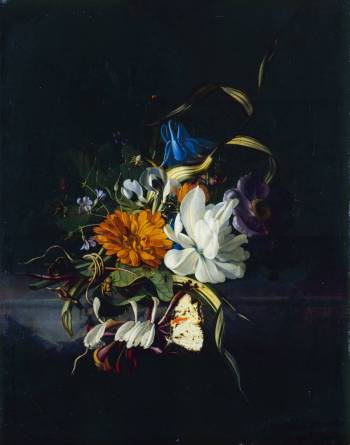
Rachel Ruysch (1664–1750), Floral Still Life, 1690, oil on canvas on oak panel, 35 × 27 cm (Dresden: Museum Gemäldegalerie Alte Meister, 3149).
In the Winckelmann Forum of the Semper Building, the Gemäldegalerie Alte Meister presents around 80 works from its own collection in the exhibition Timeless Beauty: A History of Still Life. The wide-ranging presentation—with masterpieces by painters such as Frans Snyders, Balthasar van der Ast, Jan Davidsz. de Heem, Adriaen van Utrecht, Willem Claesz. Heda, Abraham Mignon, and Rachel Ruysch—comprehensively illuminates the genre ‘still life’. Since when has it existed? What exactly constitutes a still life? What meaning, what content and what function did they have and still have today? What allegories and symbols are hidden in these motifs?
Still lifes were not only showpieces of decorative room furnishings, in which the overall effect was in the foreground. They also bear witness to natural scientific interests: the depicted object is regarded as a scientifically object and ‘document’—today as in the Age of Enlightenment. At the same time, however, still lifes are also an illusion, a game with the eye (trompe-l’œuil), in which the optical effect of the entire motif takes center stage. Through the bravura of painting, the ephemeral is immortalized. Many of the works on display, some of them recently restored, allow visitors to rediscover this fascinating genre, as only a few of the more than 100 still lifes in the Gemäldegalerie Alte Meister are on permanent display.
Konstanze Krüger, ed., Stillleben: Zeitlose Schönheit (Berlin: Hatje Cantz Verlag, 2023), 160 pages, ISBN: 978-3775751131, $50.
Konstanze Krüger, ed., Still Life: Timeless Beauty (Berlin: Hatje Cantz Verlag, 2024), 144 pages, ISBN: 978-3775751148, $40.
Exhibition | Two Masterpieces by Jan Van Huysum
From the press release for the exhibition:
Look Closely, Can You Spot the Butterfly? Two Masterpieces by Jan Van Huysum
Strawberry Hill, Twickenham, 16 May — 8 September 2024

Jan van Huysum, Flowers in a Vase with Crown Imperial and Apple Blossom at the Top and a Statue of Flora, 1731–32 (Private Collection).
Strawberry Hill House continues its acclaimed In-Focus series in 2024–25 with displays of extraordinary objects and artworks that have a connection with its original owner, Horace Walpole (1717–1797). Featuring paintings by Jan Van Huysum, a bronze bust of Caligula, and three mysterious daggers, each of the three exhibitions will tease out the fascinating facts and hidden histories connecting these artworks to this remarkable writer, connoisseur, and collector.
Evocatively demonstrating Jan Van Huysum’s (1682–1749) gift for creating sophisticated still life compositions depicting flowers and fruits, Strawberry Hill House is delighted to present the Dutch 18th-century master’s Flowers in a Vase with Crown Imperial and Apple Blossom at the top and a Statue of Flora and Fruit and Flowers in front of a Garden Vase with an Opium Poppy and a Row of Cypresses, both from 1731–32. On loan from a private collection, the paintings will be on public display for the first time in 10 years.
Art historian Andrew Graham Dixon has described the pair as “the two most brilliant and perfectly preserved paintings by the painter,” and they have remained together ever since leaving Van Huysum’s studio. It is believed that they were conceived as pendants from the outset, one showing mostly fruits, the other flowers. The pictures are in exceptional preservation and vividly showcase Van Huysum’s desired freshness of colour and transparency. They were originally owned by the painter Jeanne Etienne Liotard (1702–1789).
Van Huysum’s work was greatly appreciated during his lifetime, and for half a century afterwards his pictures sold for unprecedented sums and were only collected by the richest collectors in Europe, among which was Horace’s father, Sir Robert Walpole (1676–1745). Although Horace Walpole did not keep any Jan Van Huysums at Strawberry Hill himself—due to their rarity, expense, and difficulty in procurement—he did possess a painting by Jacob Van Huysum, Van Huysum’s brother, who resided at Sir Robert Walpole’s house in Chelsea, as well as numerous pictures by Jean Baptiste Monnoyer (1636–1699), a French-Flemish painter who relocated to Britain in the late 17th century, and works by his son Antoine Monnoyer, (1670–1747) whose compositions were similar to Van Huysum’s but less soft and finished.
Liotard was forced to sell his pair of Van Huysums, and afterwards they were bought by the Landgraf Friedrich II of Hesse-Cassel (1720–1785), only to be appropriated by Napoleon during the wars before remerging in England, in private collections. Strawberry Hill House’s In-Focus exhibition will provide visitors with an immersive experience, inviting them to delve into the intricate details and pictorial brilliance and to celebrate Walpole’s fascination with flowers and his garden at the villa, through Van Huysum’s beautiful paintings.
Rediscovered: The Lost Bronze of Roman Emperor Caligula
6 June — 8 September 2024
Is This a Dagger I See before Me? The Collector, the Actor, and the Mystery of the Ottoman Jewelled Dagger
3 October 2024 — 10 January 2025
More information on these two exhibitions is available here»
New Book | The Garden Against Time
From Pan Macmillan:
Olivia Laing, The Garden Against Time: In Search of a Common Paradise (London: Picador, 2024), 336 pages, ISBN: 978-1529066678, £20 / $28.
 “A garden contains secrets, we all know that: buried elements that might put on strange growth or germinate in unexpected places. The garden that I chose had walls, but like every garden it was interconnected, wide open to the world . . .”
In 2020, Olivia Laing began to restore an 18th-century walled garden in Suffolk, an overgrown Eden of unusual plants. The work drew her into an exhilarating investigation of paradise and its long association with gardens. Moving between real and imagined gardens, from Milton’s Paradise Lost to John Clare’s enclosure elegies, from a wartime sanctuary in Italy to a grotesque aristocratic pleasure ground funded by slavery, Laing interrogates the sometimes shocking cost of making paradise on earth.
But the story of the garden doesn’t always enact larger patterns of privilege and exclusion. It’s also a place of rebel outposts and communal dreams. From the improbable queer utopia conjured by Derek Jarman on the beach at Dungeness to the fertile vision of a common Eden propagated by William Morris, new modes of living can and have been attempted amidst the flower beds, experiments that could prove vital in the coming era of climate change. The result is a beautiful and exacting account of the abundant pleasures and possibilities of gardens: not as a place to hide from the world but as a site of encounter and discovery, bee-loud and pollen-laden.
Olivia Laing is a widely acclaimed writer and critic. She’s the author of seven books, including The Lonely City, Funny Weather, and Everybody. Her first novel, Crudo, was a Sunday Times top ten bestseller and won the 2019 James Tait Memorial Prize. Her work has been translated into twenty-one languages, and in 2018 she was awarded a Windham-Campbell Prize for non-fiction. She lives in Suffolk.
New Book | Charles Bridgeman (c.1685–1738)
From Boydell & Brewer:
Susan Haynes, Charles Bridgeman (c.1685–1738): A Landscape Architect of the Eighteenth Century (London: Boydell & Brewer, 2023), 270 pages, ISBN: 978-1837651177, £75 / $115.
 An examination of the garden plans of eighteenth-century landscape architect Charles Bridgeman, shedding light on his artistic vision and contributions to English garden history.
Charles Bridgeman was a popular and highly successful landscape architect in the first part of the eighteenth century. He was Royal Gardener to George I and George II, designing the gardens at Kensington Palace for them and working for many of the ruling Whig elite, including Sir Robert Walpole at Houghton Hall in Norfolk. His landscapes were audacious and monumental, but he is barely known outside the world of academic garden history; most of his gardens have disappeared, changed out of all recognition to chime with later tastes shaped by Lancelot Brown’s vision of a more ‘natural’ landscape, or buried under housing developments and golf courses; and there is little archaeological or written evidence of his work. This book aims to redress this injustice and rescue his legacy. It draws on the only significant body of evidence which survived him: an extensive but wildly heterogenous corpus of garden plans. Close examination of them reveals an artistic vision heavily influenced by the late seventeenth-century geometric garden but deeply rooted in the ‘genius of the place’, and working methods that include a proto-business model which prefigures the gentleman improvers who followed him. The volume brings Bridgeman from obscurity to demonstrate his skill as an artist, a manipulator of space on a grand scale, and a consummate practitioner, a deserved member of the canon of famous and revered English landscape gardeners.
Susan Haynes is a retired teacher with a PhD in landscape history from the University of East Anglia. Her principal interest is seventeenth- and eighteenth-century garden history.
c o n t e n t s
List of Illustrations
Acknowledgements
List of Abbreviations
Introduction
1 Who Was Charles Bridgeman?
2 Towards A Reliable Corpus
3 A Revised Catalogue
4 Reading The Plans
5 The Art-Historical Context Revisited
6 The ‘Ingenious Mr Bridgeman’
7 Building a Landscape
8 A Commercial Enterprise
Conclusion
Appendices
I A Summary of Willis’s Catalogue from Charles Bridgeman and the English Landscape Garden
II A Revised Catalogue
III Bridgeman’s Projects by Year
IV Bridgeman’s Income
Gazetteer of Bridgeman Sites
Glossary
Bibliography
Index
New Book | Chatsworth: The Gardens
From Penguin Books:
Alan Titchmarsh, with photography by Jonathan Buckley, Chatsworth: The Gardens and the People Who Made Them (London: Ebury Spotlight, 2023), 288 pages, ISBN: 978-1529148213, £35 / $65.
 Follow Alan Titchmarsh into Chatsworth’s irresistible world of visionaries, pioneers, heroes, villains, and English eccentrics and celebrate the men and women who have shaped the history of the estate over five centuries. With his passionate knowledge of both the house and gardens, as well as his long-established relationship with the Cavendish family, Alan is the perfect guide with whom to explore the Palace of the Peaks. Featuring stunning, specially commissioned photography of the gardens and parkland, alongside long-forgotten images and memorabilia newly unearthed in the estate archives, this vivid companion, crowded with character and colour, is a book to treasure and revisit over and over again.
Alan Titchmarsh MBE is an English gardener, broadcaster, and author of over 40 books, many of which have been bestsellers. He has twice been named Gardening Writer of the Year and for four successive years was voted Television Personality of the Year by the Garden Writers’ Guild.
Wentworth Woodhouse Visit
From the York Georgian Society:
Wentworth Woodhouse Visit with the York Georgian Society
24 April 2024
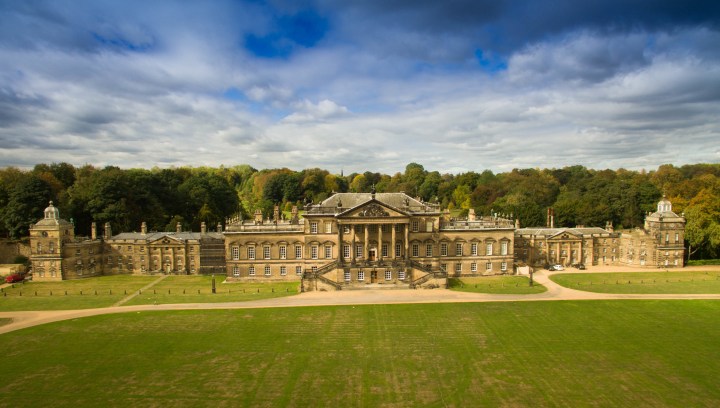
Wentworth Woodhouse, South Yorkshire.
An opportunity to visit one of England’s greatest Georgian country houses—rebuilt by the 2nd Marquess of Rockingham in the mid-18th century—to view the latest developments in its ambitious conservation and restoration programme.
The day will begin with a guided tour of the State Rooms on the main floor. Lunch will be followed by a look at the newly restored Camellia House in the company of Dorian Proudfoot, lead conservation architect for the Wentworth Woodhouse Restoration Project. Originally built in 1738 as an orangery and tea room, the building was later converted to house camellias and other rare plants from China and Japan. After complete restoration from dereliction it is now back in use as a tea room and events venue. Dorian will then take us to the magnificent stable block, originally built in 1782 to house 84 horses and more than 30 staff, together with a riding school, carriage house, and saddlery. The stables and courtyard are being transformed in a £5 million regeneration plan to accommodate a visitors’ centre, kitchen, café, and events venue.
Bookings: YGS members and Friends of York Art Gallery: £43; non-members: £48. Places are limited to 25 persons. The cost includes tea/coffee and biscuits on arrival, lunch, and tours of the State Rooms, Camellia House, and Stables. Book your place here.
Conference | Immanuel Kant and Hull
Immanuel Kant was born this month 300 years ago (April 22). From the conference registration form:
Immanuel Kant and Hull
Hull History Centre, East Yorkshire, 15 June 2024
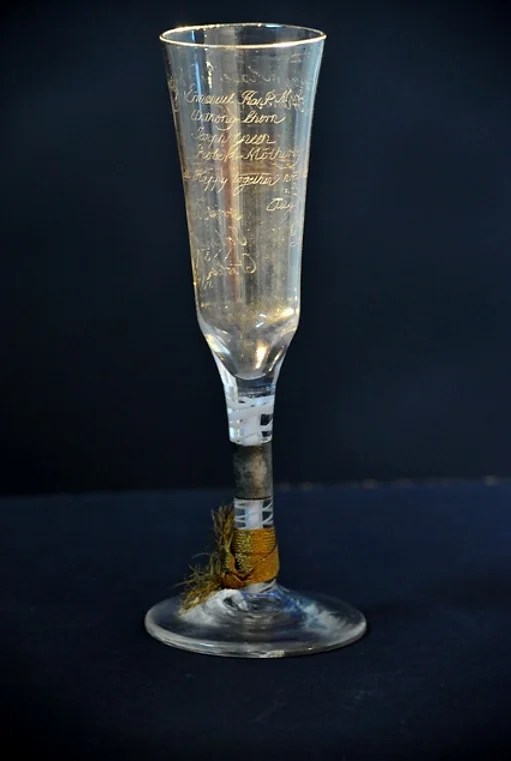
Drinking glass engraved with the names of Immanuel Kant and four men from Hull, 1763 (Lüneburg: East Prussian State Museum).
Presented by the Georgian Society for East Yorkshire and Friends of Kant and Königsberg, in association with Hull History Centre and University of Hull Maritime History Trust
This conference commemorates the tercentenary of the birth of the most important German philosopher, Immanuel Kant (1724–1804), and celebrates his close friendship with Joseph Green and Robert Motherby, merchants from Hull. It has been said that Green’s effect on the philosopher “cannot be overestimated.” The Königsberg firm of Green and Motherby managed Kant’s finances, and Kant had a great influence on the education of Robert Motherby’s children, one of whom, William, founded The Friends of Kant in 1805.
The fee of £30 (Georgian Society for East Yorkshire and Friends of Kant and Königsberg members £25) includes all refreshments. Book early, as places limited. Please direct questions to to Susan Neave, susananeave@gmail.com.
p r o g r a m m e
11.00 Introduction – Gerfried Horst (Chairman, Friends of Kant and Königsberg)
11.15 Morning Session
• Life and Work of Immanuel Kant – Tim Kunze (Curator, Immanuel Kant Department, East Prussian State Museum, Lüneburg)
• Königsberg Kant’s Home – Max Egremont (author of Forgotten Land: Journeys among the Ghosts of East Prussia)
1.00 Lunch
1.45 Afternoon Session
• Kant and Slavery – Judith Spicksley (Wilberforce Institute for the Study of Slavery and Emancipation, University of Hull)
• Hull’s Baltic Trade – Nick Evans (School of Humanties, University of Hull)
• Hull Merchants and Immanuel Kant – David Neave (Georgian Society for East Yorkshire)
• The Motherby Family of Hull and Königsberg – Marianne Motherby (Friends of Kant and Königsberg)
4.00 Tea and Cakes










 Enfilade
leave a comment