Exhibition: Rowlandson on Pleasures and Pursuits
From The Block Museum:
Thomas Rowlandson: Pleasures and Pursuits in Georgian England
The Mary and Leigh Block Museum of Art, Northwestern University, Evanston, IL, 14 January — 13 March 2011
The Frances Lehman Loeb Art Center, Vassar College, Poughkeepsie, NY, 8 April — 11 June 2011
Curated by Patricia Phagan
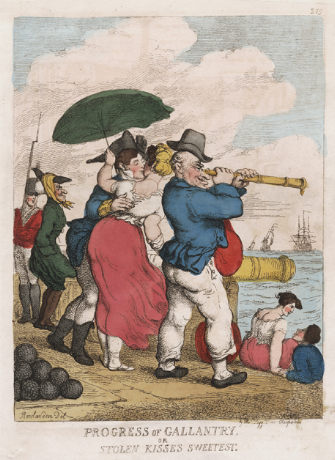
Thomas Rowlandson, “Progress of Gallantry, or Stolen Kisses Sweetest,” 1814, etching with stipple, in black ink with watercolor on cream wove paper (Yale University: Lewis Walpole Library)
Artist Thomas Rowlandson (1757–1827) depicted high society and politics, encounters on the street, camaraderie in clubs and taverns, outdoor entertainments, musings about art, drama, and dance, and romantic and sexual tangles. In other words, the social life of Georgian England. One of the most popular caricaturists of his time, Rowlandson’s work was noted for lighthearted, deft humor and the unmatched flowing line of his drawing.
Organized by the Frances Lehman Loeb Art Center at Vassar College, Thomas Rowlandson: Pleasures and Pursuits in Georgian England presents more than 70 of the artist’s prints, drawings, watercolors, and illustrated books. The exhibition is curated by Patricia Phagan, the Philip and Lynn Straus Curator of Prints and Drawings at the Frances Lehman Loeb Art Center. The first major exhibition of Rowlandson’s work in the United States in 20 years, it will be accompanied by a full-color 184-page catalogue.
◊ ◊ ◊ ◊ ◊
Description of the catalogue, from the publisher’s website:
Patricia Phagan, Vic Gatrell, and Amelia Rauser, Thomas Rowlandson: Pleasures and Pursuits in Georgian England (London: D. Giles Limited, 2011), 184 pages, ISBN: 9781904832782.
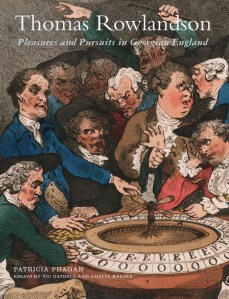 Thomas Rowlandson: Pleasures and Pursuits in Georgian England is a completely new illustrated volume which presents 72 watercolours, drawings, prints, and illustrated books to reassess the legacy of this renowned 18th-century satirist. Published in February 2011 by D. Giles Limited in association with the Frances Lehman Loeb Art Center, it accompanies the first major exhibition of Rowlandson’s work in North America for 20 years, and reflects the growing emphasis on the social and political context of the satirical art of the 18th- and early 19th-centuries. In so doing, it rescues Rowlandson from what co-author Vic Gatrell calls “the immense condescension of posterity.” This catalogue explores Rowlandson’s unique perspective on Georgian social life, and the crossing of class boundaries.
With heavy-handed humour and a low subject matter, the work of Thomas Rowlandson (1757–1827) provides an invaluable insight into the workings and mentality of late Georgian society. He was quite simply a product of his times, who relished recording the street life of London and whose drawings and etchings reveal an attraction to repulsive visions of wickedness and hardship, whilst maintaining a high degree of humanity.
An introduction by curator Patricia Phagan of the Frances Lehman Loeb Art Center relays the impetus for the exhibition and describes Rowlandson’s position within a hierarchical society. Illustrated essays by Vic Gatrell of Cambridge University and Amelia Rauser of Franklin and Marshall College examine Rowlandson’s view of social life and leisure in London and his political satires. The main catalogue is divided into six thematic sections: high society and political campaigning; encounters on the street; gatherings in clubs and taverns; art, dance, and the theatre; outdoor diversions; and romantic trysts, tangles, and attachments. Each section is introduced by a brief overview text.
Patricia Phagan is Philip and Lynn Straus Curator of Prints and Drawings at the Frances Lehman Loeb Art Center and the co-author of The American Scene and the South: Paintings and Works on Paper, 1930–1946 (1996) and Images of Women in Seventeenth-Century Dutch Art: Domesticity and the Representation of the Peasant (1996).
Vic Gatrell is Life Fellow of Gonville and Caius College, Cambridge, and the author of City of Laughter: Sex and Satire in Eighteenth-Century London (2006) and The Hanging Tree: Execution and the English People 1770–1868 (1994).
Amelia Rauser is Associate Professor of Art History at Franklin and Marshall College, Lancaster, Pennsylvania, and author of Caricature Unmasked: Irony, Authenticity and Individualism in Eighteenth-Century English Prints (2008)










 Enfilade
leave a comment