Exhibition: Rowlandson on Pleasures and Pursuits
From The Block Museum:
Thomas Rowlandson: Pleasures and Pursuits in Georgian England
The Mary and Leigh Block Museum of Art, Northwestern University, Evanston, IL, 14 January — 13 March 2011
The Frances Lehman Loeb Art Center, Vassar College, Poughkeepsie, NY, 8 April — 11 June 2011
Curated by Patricia Phagan
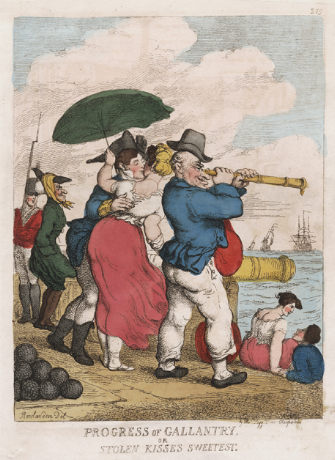
Thomas Rowlandson, “Progress of Gallantry, or Stolen Kisses Sweetest,” 1814, etching with stipple, in black ink with watercolor on cream wove paper (Yale University: Lewis Walpole Library)
Artist Thomas Rowlandson (1757–1827) depicted high society and politics, encounters on the street, camaraderie in clubs and taverns, outdoor entertainments, musings about art, drama, and dance, and romantic and sexual tangles. In other words, the social life of Georgian England. One of the most popular caricaturists of his time, Rowlandson’s work was noted for lighthearted, deft humor and the unmatched flowing line of his drawing.
Organized by the Frances Lehman Loeb Art Center at Vassar College, Thomas Rowlandson: Pleasures and Pursuits in Georgian England presents more than 70 of the artist’s prints, drawings, watercolors, and illustrated books. The exhibition is curated by Patricia Phagan, the Philip and Lynn Straus Curator of Prints and Drawings at the Frances Lehman Loeb Art Center. The first major exhibition of Rowlandson’s work in the United States in 20 years, it will be accompanied by a full-color 184-page catalogue.
◊ ◊ ◊ ◊ ◊
Description of the catalogue, from the publisher’s website:
Patricia Phagan, Vic Gatrell, and Amelia Rauser, Thomas Rowlandson: Pleasures and Pursuits in Georgian England (London: D. Giles Limited, 2011), 184 pages, ISBN: 9781904832782.
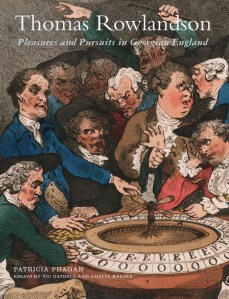 Thomas Rowlandson: Pleasures and Pursuits in Georgian England is a completely new illustrated volume which presents 72 watercolours, drawings, prints, and illustrated books to reassess the legacy of this renowned 18th-century satirist. Published in February 2011 by D. Giles Limited in association with the Frances Lehman Loeb Art Center, it accompanies the first major exhibition of Rowlandson’s work in North America for 20 years, and reflects the growing emphasis on the social and political context of the satirical art of the 18th- and early 19th-centuries. In so doing, it rescues Rowlandson from what co-author Vic Gatrell calls “the immense condescension of posterity.” This catalogue explores Rowlandson’s unique perspective on Georgian social life, and the crossing of class boundaries.
With heavy-handed humour and a low subject matter, the work of Thomas Rowlandson (1757–1827) provides an invaluable insight into the workings and mentality of late Georgian society. He was quite simply a product of his times, who relished recording the street life of London and whose drawings and etchings reveal an attraction to repulsive visions of wickedness and hardship, whilst maintaining a high degree of humanity. (more…)
Domestic Life in England
Upcoming lecture at the University Paris Diderot:
Amanda Vickery — Behind Closed Doors: At Home in Georgian England
University Paris Diderot, 26 November 2010
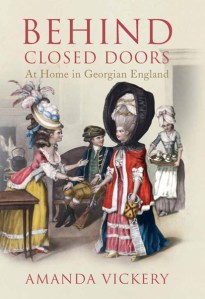 Amanda Vickery (University of Royal Holloway) will present her book, Behind Closed Doors: At Home in Georgian England (Yale University Press, 2009), on Friday, November 26 at 4:30 at the University Paris Diderot, 10 rue Charles V 75004 Paris (Metro St Paul/Sully-Morland/ Bastille).
Professor Vickery, of the Department of History at Royal Holloway, University of London, lectures on British social, political and cultural history from the 17th century to the present. She is the Director of Royal Holloway’s Bedford Centre for the History of Women. Vickery’s first book, The Gentleman’s Daughter (Yale, 1998), won the Whitfield prize, the Wolfson prize, and the Longman-History Today prize and is considered a reference in 18th-century studies. Professor Vickery’s latest monograph, Behind Closed Doors: At Home in Georgian England, was published by Yale University Press in December 2009.
The book unlocks the homes of Georgian England to examine the lives of the people who lived there. She introduces us to men and women from all walks of life: gentlewoman Anne Dormer in her stately Oxfordshire mansion; bachelor clerk and future novelist Anthony Trollope in his dreary London lodgings; genteel spinsters keeping up appearances in two rooms with yellow wallpaper; and, servants with only a locking box to call their own. Professor Vickery makes ingenious use of upholsterer’s ledgers, burglary trials, and other unusual sources to reveal the roles of house and home in economic survival, social success, and political representation during the long 18th century. Through the spread of formal visiting, the proliferation of affordable ornamental furnishings, the commercial celebration of feminine artistry at home, and the currency of the language of taste, even modest homes turned into arenas of social campaign and exhibition.
The book has received rave reviews from critics. Michael Kerrigan from The Scotsman calls it a “beautifully textured exploration of domestic life,” and Frances Wilson from The Sunday Times says: “We see the Georgians at home as we have never seen them before in this ground-breaking book. Behind Closed Doors is both scholarly and terrifically good fun.” The book has been adapted to form a 30-part radio series on BBC Radio 4 on the “history of private life” (aired in autumn 2009) and is soon to be turned into a BBC 2 documentary series (to be broadcast in December 2010).
For further information, please contact: ariane.fennetaux@univ-paris-diderot.fr
Graduate Seminar at YCBA: The Artist’s Studio in Britain
Making Art, Picturing Practice: The Artist’s Studio in Britain ca. 1700–1900
Yale Center for British Art Graduate Summer Seminar
Yale University, New Haven, CT, 6-11 June 2011
Applications due by 21 January 2011
In June 2011 the Yale Center for British Art (YCBA) will offer a week-long graduate seminar, generously supported by the Andrew W. Mellon Foundation, open to doctoral candidates working on topics relating to the artist’s studio and artistic practice in the eighteenth, nineteenth, and early twentieth centuries. It will focus on the studio as understood in its broadest sense, both as site and idea, and will closely examine representations of studios alongside other evidence of their function and appearance. Incorporating a wide range of materials and objects held by the Center, as well as in other collections at Yale and nearby museums, the purpose of the seminar is to interrogate representations and interpretations of the studio through primary visual documents, developing methods for the analysis and critique of the visual and material culture that can inform our understanding of art practices. The instructors for the seminar are Martina Droth, Head of Research and Curator of Sculpture at the YCBA, and Mark Hallett, Professor of Art History and Head of Department, the University of York, UK.
The flyer for the seminar provides further details and application information. Any queries may be addressed to Marinella Vinci, Senior Administrative Assistant, Department of Research: marinella.vinci@yale.edu.
Call for Papers: Art and Ritual of Diplomacy at ISECS
As noted previously here at Enfilade, ISECS meets next summer in Austria. The following session may be of particular interest for HECAA members:
The Art and Ritual of Eighteenth-Century Diplomacy [C Workshop, CW016]
Panel at the Thirteenth International Congress for Eighteenth-Century Studies
University of Graz, Austria, 25-29 July 2011
Proposals due by 31 January 2011
Co-chaired by Meredith Martin and Michael Yonan
“These carnival embassies are extraordinarily expensive and of no real value.” So claimed one European noblewoman in her written observations of eighteenth-century court life. Noble courts expended vast amounts of time, ingenuity, materials, and finances on events such as diplomatic receptions, embassy visits, formal state-sponsored ceremonies, and audiences. This panel seeks new approaches to exploring the art and ritual of diplomacy in eighteenth-century Europe by focusing on new interpretive or methodological approaches, different forms of cross-cultural exchange, and other perspectives on art and the embassy. Topics may include diplomatic gifts, images of ambassadors, rituals and entertainment, the construction and protocol of embassies, the mechanics of travel, literary representations of diplomatic encounters, architecture both permanent and ephemeral, or prints and other illustrations made après coup. One of the more fascinating aspects of this discussion is the level of risk involved in the presentation and exchange of objects, images, and individuals in diplomatic encounters. These cultural and artistic interactions always carried some degree of fluidity or contingency and were continually subjected to alternate interpretations and misreadings. To what extent was this degree of risk (and this potential for reward) managed through art and the politics of display?
The application form can be found online at www.18thcenturycongress-graz2011.at/congressprogramme.html. Applications must first be sent directly to the ISECS conference organizers, who will forward them to the session chairs. The deadline to apply is January 31, 2011.
Exhibition: Samplers at Boston’s MFA
From the MFA website:
Embroideries of Colonial Boston: Samplers
Museum of Fine Arts, Boston, 20 November 2010 — 13 March 2011
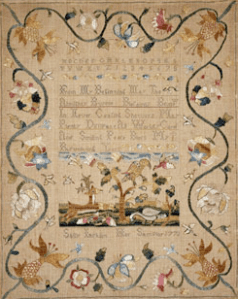 The embroideries of colonial Boston girls and women have long been treasured family possessions and are now much sought after by collectors. The charm and craftsmanship of the Adam and Eve samplers, pastoral pictures with leaping stags and galloping hunters, as well as crewelwork bed hangings and delicately embroidered baby caps bring to mind a warm domesticity; however, as a group they also reveal much about the lives of Boston women and their role within colonial society.
The first of three exhibitions in the Edward and Nancy Roberts Family Gallery in the new wing for Art of the Americas, “Embroideries of Colonial Boston: Samplers” demonstrates the role these schoolgirl exercises played in educating Boston’s genteel young women. The use of samplers was common in Europe, and when the first colonists to New England arrived they brought their samplers with them to help educate their children.
The exhibition will feature a pair of 17th-century samplers brought to Boston as well as two 17th-century American examples clearly illustrating the connection between Great Britain and the colonies. During the 18th century, samplers evolved from their original format as collections of embroidery stitches and designs into more pictorial works that could be proudly hung in the family home. Distinctive sampler styles developed throughout Boston that can be associated with specific neighborhoods. The exhibition will feature many of these styles, including Boston’s most famous samplers—those including the depiction of Adam and Eve at the bottom that were woven by girls from the North End of the city.
Call for Papers: Eighteenth-C Scottish Studies Society (ECSSS)
Eighteenth-Century Scottish Studies Society Conference: The Arts & Sciences of Progress
University of Aberdeen, 7-10 July 2011
Proposals due by 1 December 2010
ECSSS invites proposals from ASECS members for its annual conference, to be held from 7 to 10 July 2011 at the University of Aberdeen, Scotland. Hosted by the Research Institute of Irish and Scottish Studies, the conference will focus attention on the notion of “progress” – and its limitations – in society, literature, science, politics, and the arts. Proposals are welcome on this theme, as well as on relations between Ireland and Scotland, Jacobitism, Highland culture, Scottish Episcopalianism, 18th-century Aberdeen, and any other aspects of 18th-century Scottish thought and culture.
In addition, this conference will commemorate the 250th anniversary of the birth of James Macpherson’s Ossianic poetry in the early 1760s, and papers relating to that theme will be particularly welcome. David Hume’s 300th birthday will also be duly noted, although we will leave the main celebration of that event to the Hume Society/IASH conference in Edinburgh one week afterwards. Plenary lectures will be presented by Professor Colin Kidd of Glasgow University: “Hypocrisy and Dissimulation in the Scottish Enlightenment: The Case of the Rev. Alexander Fergusson of Kilwinning” and Professor Fiona Stafford of Oxford University: “Everything Unreconciled? The Place of Macpherson’s Ossian.”
Please email or fax a title and one-page description of your proposed panel or proposed 20-minute paper, along with a one-page cv containing your contact information (deadline: 1 December 2010) to: Professor Cairns Craig, Director – Research Institute of Irish and Scottish Studies, Humanity Manse, 19 College Bounds, Aberdeen AB24 3UG, Scotland, UK. Fax: (0)1224 273677; email: cairns.craig@abdn.ac.uk.
Graduate Student Conference: Popular Culture in Early America
Popular Culture in Early America
The Fourth James L. and Shirley A. Draper Graduate Student Conference in Early American Studies
Storrs, Connecticut and Worcester, Massachusetts, 24-26 March 2011
Proposals due by 15 December 2010
Popular culture in early America embraced a host of activities and purposes, communities, practices, and sites. From London to Philadelphia, Charleston to Kingston, Quebec to Lima, colonial subjects and then citizens of the United States and other new republics in the Americas frequented taverns and country dances, cock fights and boxing matches, where they relaxed, competed, bonded, shared news, forged political alliances, and defined the meanings and limits of sociability. Couples strolled through pleasure gardens in eighteenth-century cities and privileged women staked claims to gentility with Wedgwood china, while men of all classes patronized brothels and then repented after listening to fiery revival sermons. Museums and theaters advertised new forms of instruction and amusement in the public arena. The respectable home, in turn, took on a new role as an entertainment center, where young ladies performed on the piano and children moved pawns on board games. Meanwhile, in realms of their own, enslaved people played homemade instruments adapting African forms and rhythms to New World surroundings, only to witness their musical culture admired, mocked, and expropriated in the commercialized form of blackface minstrelsy. Popular culture expressed the vitality of the diverse worlds that met and collided in early America and enacted their tensions and conflicts as well. (more…)
Exhibition: Drawings at the Art Institute
The current exhibition of drawings at the Art Institute includes works by Charles de la Fosse, Charles-Antoine Coypel, Panini, Canaletto, Tiepolo, Guardi, Gaetano Gandolfi, Fragonard, Jean-Baptiste Isabey, David, and Ingres. From the museum’s website:
Gray Collection: Seven Centuries of Art
The Art Institute of Chicago, 25 September 2010 — 2 January 2011
Curated by Suzanne Folds McCullagh
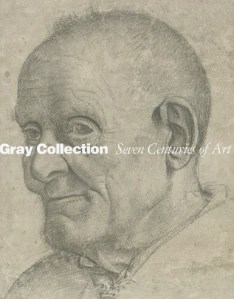 One of America’s foremost art dealers, Richard Gray, and his wife, art historian and author Mary Lackritz Gray, have gathered an unparalleled collection of paintings, drawings, and sculpture spanning the 15th century to the present. This exhibition features more than 120 of the couple’s most dynamic and important works on paper, including Renaissance- and Baroque-era treasures by Guercino, Tiepolo, and Rubens; 19th-century works by masters such as Delacroix, Degas, and Seurat; and stellar examples by acclaimed 20th-century artists Picasso, Matisse, and Miró.
Lifelong Chicagoans deeply involved in the cultural life of city, the Grays have devoted more than half a century—both privately and professionally—to pursuits associated with the visual arts. Their first work on paper was a Paul Klee lithograph received as a wedding present in 1953; ten years later, Richard founded the Richard Gray Gallery, exposing the couple to a much more encyclopedic view of art as he helped major museums and private individuals form collections of real substance and quality. At the same time, the Grays acquired works for their own collection without any specific program, discovering the various pleasures of looking at and living with drawings. This highly personal collection has been shaped by Richard’s informed eye as a dealer—his intuitive sense, willingness to take risks and respond to opportunities—and Mary’s historical and contextual approach enriched by her graduate degree in art history. As the reach of their collecting interests in more recent years extended back in time from the modern and contemporary masters they knew so well, the art of drawing has offered a quality of instantaneity, a means to maintain contact with artistic genius across the centuries. The varied, individually important works collectively combine to create a rich and resonant survey of some of the most accomplished draftsmen of the ages. (more…)
Call for Papers: Art et sociabilité (1715-1815)
A colleague of mine here in Paris, Jessica Fripp from the University of Michigan, is organizing an international conference on art and sociability during the eighteenth century. The call for papers is listed below, and I hope many of you out there will be inspired to submit some ideas for this promising event. – JF.
Art et sociabilité au XVIIIe siècle (1715-1815)
Institut national d’histoire de l’art, Paris, 23-25 June 2011
Proposals due by 31 December 2010
Over the past two decades, sociabilité has become a useful and hotly debated concept for discussing the social, political, and cultural changes during the eighteenth century. The works of Daniel Roche, Dena Goodman, Daniel Gordon, Antoine Lilti, and others have demonstrated that sociabilité can be fruitfully approached from the perspectives of sociology, philosophy and anthropology. In the eighteenth century, the Encyclopédie defined the term as “this inclination we have to do to others all the good that we can, to reconcile our happiness with that of others, and always to subordinate our personal advantage to the overall and communal advantage” (Louis de Jaucourt, 1751-1765) – that is, it was an abstract concept that explained the desire humankind had to participate in society. At the time, it was intricately linked to the social practice of commerce, broadly defined as any reciprocal communication or exchange. The emerging public sphere of the period, constituted by spaces such as academies, literary salons, and Masonic lodges, was the stage on which such exchanges were enacted.
Since the publication of Thomas Crow’s Painters and Public Life in Eighteenth-Century Paris, art historians have taken an interest in the role of artists in the public sphere. These studies tend to take a monographic approach that is more interested in reconstructing the history of an individual artist, salonnière, or collector rather than the role that artworks played in larger systems of practice and exchange. This symposium will examine sociabilité in the eighteenth-century art world through the theme of social practice. By investigating the social practices of artists, amateurs, critics, salonniers, and others we seek to uncover the larger networks of social exchange created by the commerce of material objects through collection practices, the art market and the display of art, and by the commerce of ideas through writing and conversation. To what extent did social practices in the public sphere influence artistic production and the material, economic, and verbal exchanges that took place around that production?
This symposium will take place at the Institut national d’histoire de l’art in Paris, June 23-25, 2011. We welcome papers from a wide range of humanities disciplines such as: history of art, history, anthropology, philosophy, and literature, as well as sociology and cultural studies, as we are interested in bringing together different disciplinary approaches to these topics and exploring connections between them. Please send an abstract of no more than one page, in French or English, and C.V. to colloque.sociabilite@gmail.com before December 31, 2010.
Exhibition: Science at Versailles
From the Palace of Versailles:
Sciences and Curiosities at the the Court of Versailles
Château de Versailles, 26 October 2010 — 27 February 2011
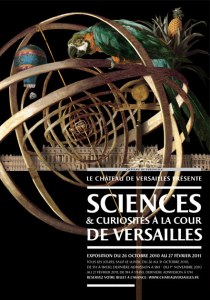 This exhibition reveals a new, unexpected face of Versailles as a place of scientific inquiry in its most various forms: the Hall of Mirrors electricity experiment, Marley Machine on the banks of the Seine, burning mirror solar power demonstration, etc. It brings together works and instruments from the old royal collections, spectacular achievements of beauty and intelligence, for the first time.
Versailles is the place where control over science was exercised. At the urging of Jean-Baptiste Colbert, Louis XIV’s “prime minister,” the royal authority became aware of the benefits of scientific research. In 1666 Colbert founded the Academy of Science, establishing a new contract between the government and scientists. Many “natural philosophers,” as they were known at the time, including some of the most famous, assiduously frequented the Court as physicians, army engineers, tutors, etc. The physicists Benjamin Franklin and Abbot Nollet compared their theories in front of the king and the encyclopaedists Diderot and D’Alembert met in the office of Dr. Quesnay, physician to Madame de Pompadour, Louis XV’s favourite. Some courtiers were real experts.
The Château de Versailles offered many research resources. Anatomists and zoologists could study the menagerie’s ostriches, pelicans, rhinoceroses and other rare animals, botanists and agronomists the plants on the grounds of the Trianon and “hippiatrists,” the forerunners to veterinarians, the horses in the Grand Stables. Educators developed new teaching methods using cutting-edge tools for the royal children and the kings’ personal practice. While Louis XIV considered himself a protector of the arts and sciences without practicing them, his successors, Louis XV and Louis XVI, became true connoisseurs. A presentation to the king or demonstration before the Court was the highest honour, equivalent to winning a Nobel Prize. Many people know about the first hot-air balloon flight, but numerous other events have fallen into oblivion, such as the burning mirror demonstration in front of Louis XIV or the electricity experiment in the Hall of Mirrors under his successor’s reign. The mosaic of places, people and events that Science and Curiosities at the Court of Versailles presents must be perceived not as a conclusion but as a stepping-stone to further research.










 Enfilade
leave a comment