British Art from 1660 to 1735
From The University of York’s Centre for Eighteenth-Century Studies:
Court, Country, City: British Art 1660-1735
 The 3-year research project Court, Country, City: British Art 1660-1735 is funded by the AHRC and represents a major collaboration between the University of York and Tate Britain. Members of the core team are the principal investigator, Professor Mark Hallett (Head of Department of the History of Art, York); co-investigators Professor Nigel Llewellyn (Head of Research, Tate) and Dr Martin Myrone (Curator, Tate); post-doctoral research assistants Dr Lydia Hamlett and Dr Richard Stephens, and PhD students Caroline Good and Peter Moore.
The research project, which was launched in October 2009, is intended to stimulate new approaches to British visual culture from 1660-1735. The period in question saw profound changes in the nation’s character and these included a similarly important period of transformation in the visual arts, beginning with the appointment of Peter Lely as court painter to Charles II and ending with the emergence of the St Martin’s Lane Academy in the mid-1730s. In terms of British art history, the later decades of the eighteenth century – the ‘age of Hogarth and Reynolds’ – have been relatively well explored; however, the art of the preceding period has not been recovered or interpreted in the same depth. It is in order to redress this art-historical imbalance, and to provide a set of fresh perspectives on the art of late-Stuart and early Georgian Britain, that this project has been conceived and developed.
Researchers on the team have a wide range of interests and expertise, which are being focused on three major arenas of the visual arts in this period: the later Stuart and early Hanoverian courts, the country seats of the landed aristocracy and the urban spaces occupied by a mix of social classes. Important cross-cutting themes include the development of art theory and the impact of imperial expansion on the visual arts. As well as generating a wide range of publications – including books, journal articles, conference papers and PhDs – the project also aims to communicate the period to a wider audience through gallery displays of art and online resources.
Research Staff
Principal Investigator: Professor Mark Hallett, Professor of History of Art, the University of York
Co-Investigator: Professor Nigel Llewellyn, Head of Research, Tate Britain
Co-Investigator: Dr Martin Myrone, Curator, Tate Britain
Post-doctoral Research Assistant: Dr Lydia Hamlett
Post-doctoral Research Assistant: Dr Richard Stephens
Research Students
Caroline Good, PhD student: ‘The Making of a National Art History: British Writers on Art and the Narratives of Nation, 1660-1735’
Peter Moore, PhD student: ‘British Art in an Atlantic Economy, 1660-1735’
Forthcoming Events
A six-month display – with the aim of introducing major questions from the research project and relating them to objects in the Tate Collection – will be installed at Tate Britain in autumn 2010.
A one-day conference on new approaches to the period is to be held at Tate Britain in May 2011.
A two-day conference to mark the end of the project and to present its major research findings is to be held in York in 2012.
Past Events
A one-day conference on current art-historical scholarship in the field was held at York on May 7th 2010. For further details, click here.
Blogging in the Eighteenth Century
Robert Darnton, “Blogging, Now and Then (250 years ago)”
Columbia University, New York, 16 November 2010
Long before the Internet, Europeans exchanged information in ways that anticipated blogging. The key element of their information system was the “anecdote,” a term that meant nearly the opposite then from what it means today. Anecdotes, dispensed by “libellistes” and “paragraph men,” became a staple in the daily diet of news consumed by readers in eighteenth-century France and England. They were also pilfered, reworked, and served up in books. By tracking anecdotes through texts, we can reassess a rich strain of history and literature.
This event is free and open to the public. Please note special time & location:
16 November 2010, 8:00PM, 501 Schermerhorn Hall
Map: www.columbia.edu/about_columbia/map/schermerhorn.html
Symposium on William Birch in Philadelphia
From the conference brochure:
The Landscapes of William Birch: Providing a Context
The Athenaeum of Philadelphia, 3 December 2010
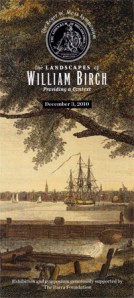 Coming to Philadelphia in 1794, William Russell Birch (1755-1834) would become the first artist successfully to publish engraved view books in the United States. He arrived with a letter from Benjamin West and with a successful 1791 publication, Delices de la Grande Bretagne, a series of 36 engraved views of picturesque settings after such artists as West, Joshua Reynolds, and Thomas Gainsborough. Although Birch immediately found some success as a copyist of portraits, he never lost his desire to create picturesque views based upon the American experience, and in 1800 he published The City of Philadelphia, a series of 28 views which would become the touchstone for future artists, engravers, and architects desiring to present images of the city. The success of this set of large-format prints encouraged Birch to undertake The Country Seats of the United States of North America, published in 1808. Birch’s reputation has chiefly rested on these two publications, but there is much more to learn about his life and career.
Symposium Presentations
- John Dixon Hunt, “Picturesque: ‘The Singular Excellence of Britain for Picture Scenes.’”
- Wendy Bellion, “Expanding the Scope of Painting in the 1790s”
- Michael J. Lewis, “Birch’s Philadelphia: An Architectural Perspective”
- Emily T. Cooperman, “‘Another Fifty Years May Lay a Foundation’: The Legacy of Birch’s Landscape Art”
- Lea Carson Sherk, “The Birch ‘Lives’ and the Carson Collection.”
To register for the conference, please visit The Athenaeum’s website»
The Image of the Black in Western Art
At the appearance of the first four volumes of a ten-volume series on the theme of The Image of the Black in Western Art, Harvard is hosting a symposium next week (largely focused on the sixteenth and seventeenth centuries). Volume III, Part 3: From the “Age of Discovery” to the Age of Abolition / The Eighteenth Century: Court, Enlightenment, Slavery, and Abolition is scheduled to be published next fall.
From the Harvard Art Museums website:
M. Victor Leventritt Symposium: The Image of the Black in Western Art
Harvard University, Cambridge, MA, 15 November 2010

"Portrait of a Black Boy," formerly attributed to Christopher Wren, 1680s (British Museum)
David Bindman, University College London and Harvard University; Paul Kaplan, State University of New York at Purchase; Joseph Koerner, Harvard University; Elmer Kolfin, University of Amsterdam; and Jeremy Tanner, University College London. Henry Louis Gates Jr., Harvard University, will moderate. Held in conjunction with the exhibition Africans in Black and White: Images of Blacks in 16th- and 17th-Century Prints, this symposium will feature five presentations followed by a panel discussion concerning the perception and representation of people of African descent in Western art.
Organized by the W. E. B. Du Bois Institute for African and African American Research and David Bindman, Emeritus Professor of the History of Art, University College London, and a 2010 Sheila Biddle Ford Foundation Fellow, W. E. B. Du Bois Institute, with Anna Knaap, former Theodore Rousseau Postdoctoral Fellow, Division of European and American Art, Harvard Art Museums, and current Visiting Fellow, Jesuit Institute, Boston College. . . .
Dissertation Listings at caa.reviews
From CAA News:
Dissertation Listings
Due by 15 January 2011
Dissertation titles in art history and visual studies from US and Canadian institutions, both completed and in progress, are published annually on the caa.reviews website, making them available through web searches. Dissertations formerly appeared in the June issue of The Art Bulletin and on the CAA website.
PhD-granting institutions may send a list of doctoral students’ dissertation titles to dissertations@collegeart.org. Full instructions regarding the format of listings can be found here. CAA does not accept listings from individuals. Improperly formatted lists will be returned to sender. For more information, please write to the above email address. Deadline: January 15, 2010.
◊ ◊ ◊ ◊ ◊
The index for 2009 lists four eighteenth-century dissertations completed, including:
- Mark Magleby, “Reviewing the Mount of Diana: Henry Hoare’s Turkish Tent at Stourhead” (Ohio State, M. M. Mudrak)
- Tania Solweig Shamy, “Frederick the Great’s Porcelain Diversion: The Chinese Tea House at Sanssouci” (McGill, R. Taws, B. Wilson)
and twenty-five dissertations in progress, including:
- Hillary Brown, “Shaping the Child: Sculpted Portraits of Children in Eighteenth-Century Britain” (USC, M. Baker)
- Lauren Cannady, “Owing to Nature and Art: The Garden Landscape and Decorative Painting in Eighteenth-Century French Pavillons de Plaisance” (IFA/NYU, T. Crow)
- Nicole Cuenot “The Force of Flowers: Bringing the Outdoors in at Versailles” (Columbia, D. Freedberg)
- Christopher Currie, “Art, Illusion, and Social Mobility in Eighteenth-Century France: Rigaud, Largillierre, and the Making of the Marquis de Gueidan” (UNC Chapel Hill, M. Sheriff)
- Emily Everhart, “The Power of Friendship: Madame de Pompadour, Catherine the Great, and Representations of Friendship in Eighteenth-Century Art” (Georgia, A. Luxenberg)
- Victoria Sears Goldman, “‘The Most Beautiful Punchinelli in the World’: A Comprehensive Study of the Punchinello Drawings of Giovanni Battista Tiepolo” (Princeton, T. DaCosta Kaufmann)
- Katie Hanson, “A Neoclassical Conundrum: Painting Greek Mythology in France, 1780–1825” (CUNY, P. Mainardi)
- Heidi Kraus, “David, Architecture, and the Dichotomy of Art” (Iowa, D. Johnson)
- Andrei Pop, “Neopaganism: Henry Fuseli, Theatre, and the Cultural Politics of Antiquity, 1760–1825” (Harvard, E. Lajer-Burcharth)
For the full lists, see the caa.reviews site.
Call for Papers: Book Destruction Conference in London
Book Destruction
University of London, Senate House, 16 April 2011
Proposals due by 10 January 2011
Much attention has been given in recent years to the book as a material, historical object and its possible technological obsolescence in the era of digitization. Such reflections have tended to concentrate on the production and cultural circulation of books, their significance and their power to shape knowledge and subjectivities. But there is another aspect to our interactions with the book which remains relatively unexplored: the history of book destruction. In certain circumstances books are treated not with reverence but instead with violence or disregard. This conference invites reflections on this alternative history of the book, and we welcome papers from a range of historical periods and disciplinary backgrounds. We welcome proposals from postgraduate students, as well as from more established academics.
Why do people destroy books? What are the mechanics of book destruction: the burning, pulping, defacing, tearing, drowning, cutting, burying, eating? What are the cultural meanings that have been attached to book destruction, and what do they reveal about our investments in this over-familiar object? Why should the burning of books have such symbolic potency? Book destruction is often invoked as a symbol of oppressive, despotic regimes; what is our ethical position, now, in relation to such acts? What is the relationship between book destruction and other forms of cutting up (quotation; collage)? When do acts of destruction become moments of creativity? How does destruction relate to recycling and reuse? Do transitions in media (manuscript to print; print to digital) threaten those older forms? How might the current phase of digitization and the gradual disappearance of library stock relate to prior moments of destruction? In the internet age, is it still possible to destroy (that is, completely erase) a text? What does materiality mean in a digital age?
Please send 300-word proposals (for a 20-minute paper) and a brief CV to Dr Gill Partington (g.partington@bbk.ac.uk) and Dr Adam Smyth (adam.smyth@bbk.ac.uk) by 10 January 2011.
CAA Registration Now Open
 The upcoming conference, taking place February 9–12, 2011, at the Hilton New York in midtown Manhattan, begins the celebration of CAA’s one-hundredth anniversary. Online registration is now open, and hotel reservations can be made. Register before the early deadline, December 10, to get the lowest rate and to ensure your place in the Directory of Attendees. You may also purchase tickets for special events, such as the reception at the Metropolitan Museum of Art following the presentation of the annual Awards for Distinction, as well as for professional-development workshops on a variety of topics for artists and scholars. CAA will regularly update the conference website over the next few months, with additional details on the program, awards, tours, and more. Session titles and chairs’ names are available now, and all presenters’ names and papers will follow in the coming weeks.
The CAA Annual Conference is the world’s largest international forum for professionals in the visual arts, offering more than two hundred stimulating sessions, panel discussions, roundtables, and meetings. CAA anticipates more than five thousand artists, art historians, students, curators, critics, educators, art administrators, and museum professionals to attend the Centennial event.
Engraved Portraits on Display in Moscow
From the State Historical Museum website:
Russian Portrait Engravings of the 18th Century
State Historical Museum, Moscow, 6 October — 21 November 2010
For the first time the richest and little-known Museum’s collection of engraved portraits is exhibited. Two hundred works executed by the best Russian and foreign masters permit visitors to see the whole variety of Russian portraits — equestrian, child’s, full-length, and half-length. At the exhibition there are engraved portraits of the epochs of Peter the Great, Empress Anna, Empress Elizabeth, Catherine the Great, and Paul I. Among the exhibits there are unique prints and copper plates. Engraved portrait is a bright phenomenon of Russia’s artistic culture; at the same time it is an invaluable historical source of images of famous Russians of the 18th century: imperial, statesmen, military leaders, court nobility, men of letters, and scientists.
Call for Papers: The Immaterial Eighteenth Century
Joint Meeting of CSECS, NEASECS, and the Aphra Behn Society
McMaster University, Hamilton, Ontario, 27–29 October 2011
‘The Immaterial Eighteenth Century’
Proposals due by 31 January 2011
In response to the sustained scholarly focus on the material aspects of eighteenth-century culture, the core concern of this interdisciplinary, bilingual (English and French) conference will be reactions to instability in the material realm, including but not limited to the emergence of an affective public sphere, a revaluation of labour, cosmopolitanism, sensibility, the new spiritualism, political radicalism and rights discourse, supernaturalism and the rise of the gothic, and anti-slavery and anti-imperial movements. Papers on these and any topics related to the material and the immaterial in the period will be welcomed. Panels dedicated to new theoretical models are particularly encouraged: looking beyond “thing theory” and “interiority,” enquiries that have dominated the field for the last decade, what approaches can raise the ethical and political stakes in the study of eighteenth-century literature and culture? Session and paper proposals should be emailed directly to Peter Walmsley (walmsley@mcmaster.ca) or Eugenia Zuroski Jenkins (zjenkin@mcmaster.ca).
Reviewed: ‘Regulating the Académie’
Recently added to caa.reviews:
Reed Benhamou, Regulating the Académie: Art, Rules and Power in “ancien régime” France (Oxford: Voltaire Foundation, 2009), 308 pages, ISBN: 9780729409728, $100.
Reviewed by Elizabeth C. Mansfield, Department of Art History, New York University; posted 27 October 2010.
Few institutions have influenced the course of European art or the writing of art history as decisively as the French Royal Academy of Painting and Sculpture. Its pulse animated the visual extravagance of Versailles, the popularity of public art exhibitions, the emergence of art criticism, and the codification of an approach to arts instruction that persists to this day. The Academy’s legacy extends even to the enduring assumption that a centralized system of arts administration distinguishes a functioning nation-state. It is no surprise, then, that the Academy should cast a strong shadow in so many histories of post-Renaissance European art. Yet, for all this, art historians rarely allow the Academy to assume more than a vaguely adumbrated role as a monolithic force bent on enforcing conservative artistic values and practices. To be sure, some scholars have succeeded in bringing to life the Academy’s complex institutional operation. Thomas Crow’s ‘Painters and Public Life in Eighteenth-Century Paris’ (New Haven: Yale University Press, 1985) and ‘Emulation: Making Artists for Revolutionary France’ (New Haven: Yale University Press, 1995), for instance, exemplify the capacity for subtle institutional analysis to yield compelling art-historical interpretations. Reed Benhamou’s ‘Regulating the Académie: Art, Rules and Power in ancien régime France‘ offers both a prompt and an aid to scholars who seek to engage in a similarly careful study of the French Royal Academy. Drawing from archival as well as published sources, Benhamou has crafted a satisfyingly detailed account of the administrative history of the Academy. . . .
For the full review, click here» (CAA membership required)










 Enfilade
leave a comment