Call for Book Proposals: British Art, Global Contexts
British Art: Global Contexts, 1700–2000
Series Editors: Jason Edwards, Sarah Monks, and Sarah Victoria Turner
Book proposals are welcomed for Ashgate’s series, British Art: Global Contexts, edited by Jason Edwards, University of York; Sarah Monks, University of East Anglia; and Sarah Victoria Turner, University of York. The series provides a forum for the study of British art, design, and visual culture in the global context from 1700 to the present day. Focusing upon the transport, location and reception of British art across the world; the British reception and exhibition of art from around the globe; and transnational and cosmopolitan art containing significant British components; the series seeks to problematize, historicise and specify the idea of ‘British’ art across the period, as it intersects with local, regional, international and global issues, communities, materials, and environments. Books to be published will include monographs and thematic studies, single authored works and edited volumes of essays, specialising in studies of British art within comparative and interdisciplinary frameworks.
Please send a letter of inquiry, or a formal proposal, to Meredith Norwich, Commissioning Editor for Visual Studies, at mnorwich@ashgate.com, AND to the series editors, Jason Edwards, je7@york.ac.uk; Sarah Monks, s.monks@uea.ac.uk; and Sarah Victoria Turner, svt500@york.ac.uk.
Call for Papers: International Congress in Graz
From the ISECS website:
Thirteenth International Congress for Eighteenth-Century Studies
University of Graz, Austria, 25-29 July 2011
Proposals due by 31 January 2011
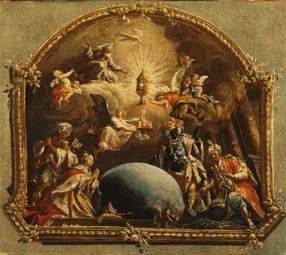 Our last general meeting took place at the 12th International Congress in Montpellier in 2007, and now preparations for the 13th Congress, to be held in Graz (Austria) from July 25th – 29th, 2011, are well underway. (Please consult the website www.18thcenturycongress-graz2011.at for further information). Graz is Austria’s second largest city after Vienna. It is situated in the southeast of the country and can easily be reached by plane, train or car.
The Executive Committee of the ISECS accepted the organisers’ thematic proposals and so the principal overriding theme is confirmed as notions of time (past, present and future) in the eighteenth century. We believe that this topic is likely to be of keen interest not only to Congress participants, but also to the general public, especially as it allows for the possibility of research that can engage with issues of current concern.
The second overriding theme, Central and Eastern Europe in the Age of Enlightenment, has also been confirmed. Not only will this theme provide the opportunity for the discussion of state-of-the-art research on a fascinating range of topics, it will also allow participants the chance to forge new links with this part of the world and meet Central and Eastern European colleagues.
Here, we add a reminder that registration of new sessions and workshops is open until the end of July, 2010. We strongly encourage members take advantage of this opportunity to contribute new session and workshop topics in order that the congress programme is as rich and varied as possible. Once registration has closed, the organisers will draft a preliminary programme which will be posted on the website.
And, finally, we would also like to reiterate our invitation for members to register individual papers within the framework of the sessions and workshops. Please submit papers from October 1, 2010 to January 31, 2011. Papers will be selected on the basis of academic merit, and also with the aim of producing a varied and interesting conference programme with a wide range of contributors so that participants have the chance to make new and valuable contacts. In addition, special attention will be given to the work of young scholars, and this may also include the possibility of us providing additional support in some cases.
We look forward to welcoming you to Graz in 2011!
Yours sincerely,
The Congress Committee
◊ ◊ ◊ ◊ ◊
Panels that might be especially interesting for HECAA members include the following:
Joan DeJean on the Château de Montgeoffroy
In the current issue of The Magazine Antiques, Joan DeJean offers a first-person account of the château de Montgeoffroy, “an exceptionally rare survivor of pre-Revolutionary French style . . . [that] remains much as it was in the 1770s, right down to the tables, chairs, and copper pots—gracious, comfortable, and mad for chintz.” Professor of French at the University of Pennsylvania, DeJean is the author of The Age of Comfort: When Paris Discovered Casual and the Modern Home Began and The Essence of Style: How the French Invented High Fashion, Fine Food, Chic Cafes, Style, Sophistication, and Glamour.
Joan DeJean, “Living with Antiques: Eighteenth-Century Modern,” The Magazine Antiques:

Château de Montgeoffroy, view along the window wall of the grand salon
I first visited the château de Montgeoffroy in the summer of 2006 when I was researching a book about the eighteenth-century French home. I found there something I would not have thought possible: an eighteenth-century residence so perfectly preserved that, as you walk through its rooms, you have the feeling of stepping right into what is often regarded as the golden age of French architecture, interior decoration, and decorative arts. . . .
Today, nearly two and a half centuries after its completion, Montgeoffroy remains almost exactly as in 1777. Its preservation is the result of several remarkable developments. To begin with, it was among the few great houses in France to survive the Revolution of 1789 unscathed. Unlike many aristocrats, the maréchal de Contades refused to emigrate. (Had he done so, the château would have become state property.) Family members lived at Montgeoffroy throughout the Revolution and thereby helped to protect it. . . .
The full article is available here»
Located in the Loire Valley near Angers, the château de Montgeoffroy is open to
the public each year from the end of March through November.
Symposium: New Research on Giuseppe Vasi
Program for the upcoming Vasi symposium, held in conjunction with the Vasi exhibition:
Una Roma Visuale: New Research on Giuseppe Vasi and the Art, Architecture and Urbanism of Eighteenth-Century Rome
Jordan Schnitzer Museum of Art, University of Oregon, Eugene, 12-13 November 2010
 A symposium planned in conjunction with the special exhibition Giuseppe Vasi’s Rome: Lasting Impressions from the Age of the Grand Tour, this two-day event will gather together scholars of national and international reputation, each of whom will present new research on Vasi and eighteenth-century Rome. Sponsored by the Oregon Humanities Center and the Departments of Architecture and Art History, School of Architecture and Allied Arts Organized by the exhibition curators James Harper and James Tice, the symposium will encompass such topics as prints, painting, sculpture, architecture, urbanism and cartography in Vasi’s Rome. A guided tour of the exhibition, with the curators, is included in the program.
F R I D A Y, N O V E M B E R 1 2
Pre-Symposium Presentation (4 p.m.)
Sarah Murray and Molly Taylor-Poleskey (Stanford University), ‘Travelers to Vasi’s Rome: Mapping Eighteenth-Century Mobility’
An introduction to Stanford University’s “Mapping the Republic of Letters” Project’.
Symposium Keynote Lecture (5:30 p.m.)
John Pinto (Princeton University), ‘”The Most Glorious Place in the Universal World”: Architecture and Urbanism in the Rome of Giuseppe Vasi’
This overview of Rome, as defined by architecture, urban design, and city representations in the eighteenth century, addresses the appearance of the papal capital, systematically recorded by Giuseppe Vasi in the Age of the Grand Tour.
S A T U R D A Y, N O V E M B E R 1 3
Morning Sessions (9:45 a.m.–12:00 p.m.)
Mario Bevilacqua (Università degli Studi di Firenze), ‘Etched Towns and Architecture: Vasi and Piranesi in the Italian Eighteenth-Century Print World’
Operating within a tradition of architectural illustration, Vasi and Piranesi were both influenced by scholars and intellectuals who promoted print production as visual documents of a decaying cultural heritage. This paper compares and contextualizes their methods of compiling city views, including their use of texts, indexes and maps to summarize and give order and scope to the individual monuments illustrated in their sheets.
Allan Ceen (Director, Studium Urbis, Rome), ‘Vasi and Urban Space’
This paper examines Vasi’s attitude toward public spaces—the streets and piazzas that appear throughout his Magnificenze—to reveal the artist’s concept of the living city as an urban whole and not merely a collection of discrete monuments.
Katherine Rinne (California College of the Arts, Oakland), ‘The Tiber’s Flow in Mid-Eighteenth Century Rome’
In mid-eighteenth century Rome the Tiber was still the lifeblood of the city, as it had been in antiquity. It was also a site of experimentation, scientific investigation, and the display of wealth, as revealed in the maps and vedute of Vasi and other artists and engineers of his time.
Afternoon Sessions (1:20-4:20 p.m.)
Heather Hyde Minor (University of Illinois, Urbana-Champaign), ‘Piranesi’s Lost City’
This talk will illuminate the precise nature of the scholarly and artistic practices that were used to create Piranesi’s great map of Rome, the “Ichnographiam Campi Martii antiquae urbis,” which appeared in his 1762 book Il Campo Marzio dell’Antica Roma (The Campus Martius of Ancient Rome), accompanied by a sixty-seven page essay and forty-eight figural prints.
Jessica Maier (University of Oregon), ‘Giuseppe Vasi as Cartographer: Influence and Innovation in Early Modern Maps of Rome’
Vasi’s 1778 map of Rome tends to be regarded as derivative by scholars of early modern cartography, overshadowed as it is by the radical innovation of Nolli’s Grande Pianta (1748). This talk proposes a reevaluation of Vasi’s map in light of the practice of cartography in the eighteenth century, when “borrowing” was commonplace and originality a relative term.
Susan Dixon (University of Tulsa), ‘Vasi and Arcadia’
In the 1740s through the 1760s, the Accademia degli Arcadi flourished in Rome, serving as a neutral landscape in which those interested in restoring Italian culture to a position of supremacy gathered to listen to poetic recitations. Those with intense political, theological and social differences flocked pacifically enough to the Bosco Parrasio, the Arcadians’ garden. Vasi found patrons and supporters in Arcadia to help him create the Magnificenze di Roma, among other works.
John Moore (Smith College), ‘Giuseppe Vasi’s “Prospetto dell’Alma Città di Roma”’
First published in December 1765, Vasi’s enormous etched panorama of Rome went together with a guidebook in which one expression unexpectedly provoked complaints from the papal authorities. The resolution of this matter casts light on the diplomatic relationships among the courts of Rome, Naples, and Madrid.
A guided tour of the exhibition with its curators follows at 4:20 p.m.
Call for Papes: Exploding Art History in a Global Context
From The Clark:
In the Wake of the “Global Turn”: Practices for an Exploded Art History without Borders
The Sterling and Francine Clark Art Institute, Williamstown, MA, 28-29 October 2011
Proposals due by 15 January 2011
Conveners: Jill Casid and Aruna D’Souza

Raqs Media Collective, "Escapement," detail, 2009. 27 clocks, high glass aluminium with LED lights, four flat screen monitors, video and audio looped
This Clark conference on art history in the wake of the “global turn” takes up, and yet departs from, decades of the critique of Eurocentric priorities and presumptions of the discipline of art history. What would it mean to understand the global turn as something that does not merely expand but potentially explodes the borders between fields and even the discipline itself? The conference, then, aims to address methodologies, research practices, and models for not just a de-centered but also a reoriented practice of the global, one that reckons with radical difference, unevenness, and even the untranslatable. And it will do so from an eccentric, agonistic position. Rather than seeking a unifying conceptual term or method that merely expands the discipline as we know it, the conference starts from the position that confronting the challenge of developing practices of and for “the global” necessarily involves learning how to engage with a range of irresolvable frictions, disunities, and incommensurabilities. Pushing beyond the questions that have arisen over whether there is or even could be a global art history or histories, the conference is dedicated to developing practices of and for a fractured conception of the global. (more…)
Fellowship Opportunity: Canadian Centre for Architecture
Visiting Scholars Program 2011-2012
Montréal, Canadian Centre for Architecture
Applications due by 15 January 2011
The CCA Visiting Scholars Program encourages and supports innovative research in the history, theory, and criticism of architecture in the broadest sense. The program particularly welcomes historical and critical research proposals that are prompted by, or refer to, the theory and practice of contemporary design culture and related social issues. Candidates engaged in contemporary professional practices are also encouraged to apply. The aim of the program is to foster intellectual exchange; scholars in residence pursue individual research projects and participate in Study Centre seminars. The Program welcomes applications from scholars and architects conducting research at post-doctoral or more advanced academic levels. The Study Centre also offers a limited number of Associate Scholars positions to non-stipendiary residential fellows.
Applicants should submit a research proposal that takes into account the purpose of the Program and the scope of the CCA Collection; no other chronological or thematic restrictions apply. Appointments are made on the basis of an open process of application and selection by an international jury composed of scholars and architects. Criteria for selection are the quality and originality of the project, the scholarly record of the candidate, and the feasibility of the project in light of the resources of the CCA Collection. Residencies are granted for periods of one to six months. Visiting Scholars will receive competitive research stipends, financial support, logistical assistance for relocation, private offices, administrative and research assistance as needed.
The Study Centre welcomes proposals from scholars and architects regardless of nationality or any other non-academic factor. Applicants should have completed a PhD at the time of application (to be conferred by 15 January 2011); alternatively, they should provide evidence of significant scholarly achievements. Applications may be submitted in either English or French. The completed application package should be received by the Study Centre no later than Friday, 15 January 2011. For further information: http://www.cca.qc.ca/en/study-centre/visiting-scholars-application










 Enfilade
leave a comment