UCL Seminar for Early Modern Visual Culture, Spring 2011
From UCL:
University College London, Seminar for Early Modern Visual Culture
UCL Department of History of Art, 20-21 Gordon Square, London, 6pm
Organized in collaboration with the Courtauld Institute of Art
24 January
Mary Sheriff (University of North Carolina at Chapel Hill)
Calypso’s Island and the Lure of Enchantment in the Art of the French Regency
7 February
Miles Ogborn (Queen Mary University of London)
The Freedom of Speech: Talk and Slavery in the Early Modern Caribbean
21 February
Judy Loach (Cardiff University)
Engraving and Printing, Visibility on Matter and Invisibility on Hearts and Souls
14 March
Rose Maria San Juan (University College London)
Unavailable Knowledge: Eve in the Wax Anatomical Cabinet
Magnasco Painting for the Musée d’Art et d’Histoire du Judaisme
Writing for The Art Tribune (14 December 2010), Didier Rykner happily notes that the Musée d’Art et d’Histoire du Judaisme in Paris recently acquired The Jewish Funderal, “a superb painting” by Alessandro Magnasco (1667-1749). The downside is that

Alessandro Magnasco, "Homage to Pluto" (Photo: Galerie Canesso
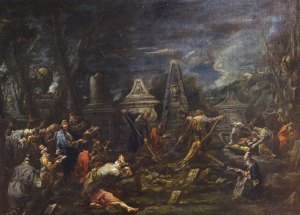
Alessandro Magnasco, "The Jewish Funeral" (Paris, Musée d’Art et d’Histoire du Judaïsme) Photo: Galerie Canesso
this canvas which had been reunited with its companion piece, Homage to Pluto, by the previous owner will once again find itself separated. Understandably, the museum was only interested in the first which was declared ‘a work of major importance to heritage’ by the Commission des tresors nationaux. It was the only one which could thus benefit from a contribution by a patron (who has for the time being remained anonymous), making it possible for it to join the museum collections.
The pairing of the two subjects, one representing a pagan ceremony, the other a Jewish rite, corresponds to the artist’s (and perhaps the person commissioning) wish to illustrate two non-Catholic religious events although their association may seem a bit strange. Despite the fact that this seems to be the only known scene of a Jewish funeral by Magnasco, the painter also represented synagogue interiors on various occasions such as, for example, in a painting held in Cleveland.
The full article is available here»
Exhibition: Paper Dresses of Isabelle de Borchgrave
From the Legion of Honor Museum:
Pulp Fashion: The Art of Isabelle de Borchgrave
Legion of Honor, Fine Arts Museums of San Francisco, 5 February — 5 June 2011
Curated by Jill D’Alessandro
 Belgian artist Isabelle de Borchgrave is a painter by training, but textile and costume are her muses. Working in collaboration with leading costume historians and young fashion designers, de Borchgrave crafts a world of splendor from the simplest rag paper. Painting and manipulating the paper, she forms trompe l’oeil masterpieces of elaborate dresses inspired by rich depictions in early European painting or by iconic costumes in museum collections around the world. The Legion of Honor is the first American museum to dedicate an entire exhibition to the work of Isabelle de Borchgrave, although her creations have been widely displayed in Europe.
Pulp Fashion draws on several themes and presents quintessential examples in the history of costume—from Renaissance finery of the Medici family and gowns worn by Elizabeth I and Marie-Antoinette to the creations of the grand couturiers Frederick Worth, Paul Poiret, Christian Dior, and Coco Chanel. Special attention is given to the creations and studio of Mariano Fortuny, the eccentric early-20th-century artist who is both a major source of inspiration to de Borchgrave and a kindred spirit.
Catalogue: Jill D’Alessandro, Pulp Fashion: The Art of Isabelle de Borchgrave (Prestel, 2011), 104 pages, ISBN: 9783791351056, $29.95.
◊ ◊ ◊ ◊ ◊
From the artist’s website (worth visiting for lots more amazing images). . .
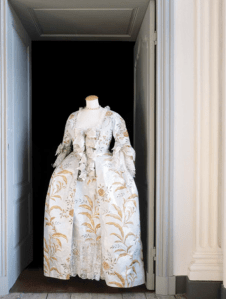
Isabelle de Borchgrave, "Madame de Pompadour paper dress," inspired by a 1755 painting by Maurice Quentin de la Tour, 85 cm x 65 cm x 165 cm, 2001 (Photo: René Stoeltie).
. . . . Following a visit to the Metropolitan Museum in New York in 1994, Isabelle dreamed up paper costumes. While keeping her brushes in hand and her paintings in mind, she worked on four big collections, all in paper and trompe l’œil, each of which set the scene for a very different world. “Papiers à la Mode” (Paper in Fashion), the first, takes a fresh look at 300 years of fashion history from Elizabeth I to Coco Chanel. “Mariano Fortuny” immerses us in the world of 19th century Venice. Plissés, veils and elegance are the watchwords of that history. “I Medici” leads us through the streets of Florence, were we come across famous figures in their ceremonial dress. Figures who made the Renaissance a luminous period. Gold-braiding, pearls, silk, velvet … here, trompe l’œil achieves a level of rediscovered sumptuousness. As for the “Ballets Russes”, they pay tribute to Serge de Diaghilev. Pablo Picasso, Léon Bakst, Henri Matisse, … all designed costumes for this ballet company, which set the world of the 20th century alight. These dancing paper and wire figures play a very colourful and contemporaneous kind of music for us.

Isabelle de Borchgrave, "Madame de Pompadour paper dress," detail
It’s true that, today, Isabelle de Borchgrave has become a name that is readily associated with fashion and paper. But her name is also closely linked to the world of design. By working together with Caspari, the potteries of Gien, Target, and Villeroy and Boch, Isabelle has turned her imagination into an art that’s accessible to anyone who wants to bring festivity into their home. Painted fabrics and paper, dinner services, curtains, sheets, decor with a personal touch for parties and weddings,… All this tells of the world in which she has always loved to move.
But in a 40-year career, she has never put to one side the thing that has always guided her in her life: painting. She still exhibits her paintings and her large folded paper works all over the world. With an imagination increasingly stimulated by her knowledge and interpretation of art, Isabelle, a follower of the Nabis movement, has a fresh perspective of a world that flies around her like a dream.
Reviewing for Enfilade
From the Editor
I recently received three books with requests that I consider publishing reviews of them here at Enfilade. Given that expanding the site’s original content is one goal, I’m certainly open to the idea. Consequently, I’m writing to solicit reviewers. In many ways, Enfilade remains a work-in-progress, and I would imagine this new direction (even if it succeeds) will call for adjustments along the way. I would like to propose the following ideas as a starting point. I welcome any feedback or advice readers might have.
A. Reviewers must be HECAA members in good standing.
B. Given that Enfilade is intended to serve as a newsletter for those interested in eighteenth-century art and architecture — as opposed to serving as an academic journal in its own right — it seems that the goal of a review at Enfilade is different than a review published in an academic journal. Description of contents and assessment of potential audiences are probably more important, for instance, than teasing out the nuances of a particular argument. An informed characterization premised on the scholarly expertise of the reviewer should still be an important goal, but the model for emulation might be more akin to a brief notice in The New York Review of Books or the TLS than The Art Bulletin or Eighteenth-Century Studies.
C. The blog format lends itself to relatively brief postings: 400-800 words might be an appropriate length. Prompt turn-around seems especially important for a newsletter format, and again the brevity should help in this regard.
D. One big problem: HECAA has no budget to fund the logistics of reviewing books (Enfilade costs absolutely nothing to produce). If publishers send me books, I have no money to send out copies to reviewers. In the case of the three books at hand, I’m happy to haul them to New York with me for CAA and distribute copies there (likewise with ASECS in Vancouver). Otherwise, I think the cost of shipping would have to be paid by the reviewer. It’s less than ideal, but given the cost of art books (easily ranging from $50 to 125), paying several dollars for shipping is perhaps not unreasonable.
The three books I presently have address two current exhibitions in the United States and the topic of eighteenth-century furniture. If you would like to be added to the list of potential reviewers, please send me an email outlining your particular areas of expertise (a brief CV would be helpful, too). Graduate students are encouraged to contribute, though any member of HECAA should feel free to volunteer. Again, I welcome your suggestions. -C.H.
YCBA Lecture: Fordham on ‘British Art and the Seven Years’ War’
Lecture and Book Signing: Douglas Fordham, British Art and the Seven Years’ War
Yale Center for British Art, New Haven, 26 January 2011, 5:30pm
 Between the Jacobite Rebellion of 1745 and the American Declaration of Independence, London artists transformed themselves from loosely organized professionals into one of the most progressive schools of art in Europe. In British Art and the Seven Years’ War, Douglas Fordham argues that war and political dissent provided potent catalysts for the creation of a national school of art. Over the course of three tumultuous decades marked by foreign wars and domestic political dissent, metropolitan artists — especially the founding members of the Royal Academy, including Joshua Reynolds, Paul Sandby, Joseph Wilton, Francis Hayman, and Benjamin West — creatively and assiduously placed fine art on a solid footing within an expansive British state. Copies of British Art and the Seven Years’ War signed by the author will be available for purchase.
Conference: The Material Countours of Knowledge
from the ISECS site:
• Inscriptions: The Material Contours of Knowledge, March 10-11 2011, University of California, Riverside. This conference will explore the material dimensions of inscribed knowledge across modern disciplinary lines, featuring talks by scholars in History, Literature, Digital Humanities, Geography, Music and Art History. The speakers will collectively address the role of material inscription in the formation, or deformation, of knowledge from roughly 1660-1850. Kinds of inscription that we will consider include manuscripts, drawings, maps, graffiti, archives, books and other objects. We will also consider the physical circuits and practices (i.e., manual, technological, social, institutional) through which such inscriptions traveled. Free registration is now open on the conference website. “Inscriptions” is part of the international series of six events, “The Disorder of Things: Predisciplinarity and the Divisions of Knowledge,” a collaborative network jointly organized by faculty in the University of California, Riverside and Birkbeck, University of London. Faculty Organizer: Professor Adriana Craciun (adrianac@ucr.edu). [Conference website]
Conference at Versailles: The Sciences at Court
The following conference at Versailles has been organized in conjunction with the current exhibition, Sciences and Curiosities at the the Court of Versailles. From the Château de Versailles website:
La cour et les sciences : naissance des politiques scientifiques dans les cours européennes aux XVIIe et XVIIIe siècles
Galerie basse du château de Versailles, 3-5 February 2011

Henri Testelin, "Colbert présente à Louis XIV les membres de l’Académie royale des sciences crée en 1667," Versailles (MV2074). © RMN (Château de Versailles) / Gérard Blot
La cour, siège du pouvoir et lieu de concentration des capitaux, a toujours soutenu la recherche scientifique tandis que cette dernière devait servir les intérêts généraux du pays et la gloire de son souverain. Dans ce colloque, il s’agira essentiellement d’étudier les politiques scientifiques volontaristes ou non des États européens sous l’Ancien Régime en s’attachant particulièrement à la recherche « fondamentale » et à la recherche « utile » (amélioration de la santé, lutte contre la famine, progrès des techniques, des constructions et des bâtiments, etc.). Volontairement comparatistes, les études engloberont l’ère géographique européenne à travers trois axes : le financement des sciences et des scientifiques, la communauté scientifique
face à la cour et, enfin, la diffusion et la culture scientifique à la
cour.
PROGRAMME (more…)
Curatorial Fellowship at the Indianapolis Museum of Art
Allen Whitehill Clowes Curatorial Fellowship
Indianapolis Museum of Art, 2011-12
Applications due by 31 March 2011
 The Indianapolis Museum of Art is pleased to announce a nine-month curatorial fellowship. The fellowship supports scholarly research related to the Clowes Collection at the IMA and provides curatorial training in the field of European painting and sculpture. The Clowes Fellow is fully integrated into the curatorial division of the Museum and has duties comparable to those of an assistant curator, ranging from collection research and management to exhibition development and the preparation of interpretive materials and programs.
To be eligible for the fellowship, the applicant must be enrolled in a graduate course of study leading to an advanced degree in the history of art or a related discipline, or be a recent degree recipient (within the last two years). Applicants must demonstrate scholarly excellence and promise, as well as a strong interest in the museum profession. U.S. citizenship is not required. The Clowes Fellow will receive a stipend of $18,000 and an educational travel allowance of $2,000. Housing is provided in a scholar’s residence on the grounds of the museum. The nine-month fellowship period will begin September 5, 2011. The appointment is renewable. (more…)
Call for Papers: Conference on Enslavement and Cultural Memory
Enslavement: Colonial Appropriations, Apparitions, Remembrances, 1750-Present Day
University of Portsmouth, Centre for Studies in Literature Annual Postgraduate Symposium, 17 June 2011
Proposals due by 25 February 2011
Keynote Speaker: Professor James Walvin
Harold Bloom, in his critical introduction to Enslavement and Emancipation (2010) does not, as one might expect, lament the monstrous history of the slave trade. Instead, he returns to the second book of Tanakh (Exodus): an original tale of bondage and liberation. For Bloom, it is not merely a matter of re-imagining a theme now largely associated with the transatlantic slave trade, but moreover to consider how ‘[l]iberation movements to come will go on
finding their model in it’. The Hebrews’ bondage in Egypt, here conceptualized as archetypal suffering and liberation, resonates for Bloom throughout history, leaving its trace in subsequent emancipation movements. Recent studies in the slave trade, too, often move beyond the historical moment to consider how cultural events are remembered, appropriated and disseminated. This work has garnered interest in Britain since the bicentenary of abolition in 2007; the issue of remembrance remains somewhat political and contentious in the US today.
This symposium aims to consider the wider connotations of the term ‘enslavement’ as well as its more specific importance in critical studies of slavery, memory and cultural return. We welcome papers that consider ideas of colonial appropriation; fiscal, somatic, or agricultural enslavement and / or indenture in literature from 1750 to the present day. Possible topics may include but are not limited to:
- Slave Trade Literature
- Economies of Colonial Exploitation / Fiscal Enslavement
- Postcolonial Theory
- ‘Hauntology’ / Memory Theory and Slavery
- Psychological Enslavement
- Hegelian Master / Slave Dialectics
We welcome proposals for 20 minute papers. Please send abstracts of approximately 250 words to Lucy Ball and Jane Ford: cslpgconf@port.ac.uk.
Call for Papers: The Deadly Sins of the Baroque across Time
2011 International Conference on Arts, Ideas, and the Baroque: ‘Deadly Sins’
The Institute for the Public Life of Arts and Ideas, McGill University, Montréal, 24-26 June 2011
Proposals due by 5 February 2011
This conference seeks to examine the ‘baroque’ in the early modern world as well as its echoes and resonances across time. Defined differently by different academic traditions, the notion of the baroque remains a point of reference as well as contention, and a signifier of cultural legacy as well as innovation – as in the notion of the ‘neo-baroque’. We propose to investigate the rich artefacts, representations, and influence of the era—particularly around the theme of Deadly Sins (also the theme of the 2011 Montréal Baroque Festival to be held in conjunction with this conference). We invite papers which address interdisciplinary scholarship and make new connections between research fields. Proposals from scholars working in all disciplines might address, but are not limited to, the following fields:
- Musicology and Music Performance
- Law and Legal History
- Social and Cultural History
- Literature
- Architecture and Design
- Theatre and Performance
- Art History
- Religious Studies
- History of Science and Medicine
- Philosophy
Proposals for complete panels as well as for individual papers in English or French are welcome. Researchers are invited to submit abstracts of no more than 250 words, and brief (2 page) cvs to: baroque@mcgill.ca. Deadline for submissions: 5 February 2011.
IPLAI is a new undertaking by McGill University’s Faculties of Arts, Education, Law, Management and Religious Studies and the Schools of Architecture and Music. Its goals are to foster collaborative, interdisciplinary scholarship and teaching in the humanities, to reinvigorate the place of humanities scholarship in public discourse, and to examine the life of ideas across time. The Montreal Baroque Festival is a unique festival celebrating the creativity, expressiveness and inspiration of music-making in the seventeenth and eighteenth centuries. The chapels, crypts, chateaux, cafes, cellars, attics, gardens and streets of Old Montreal are brought to life with operas, oratorios, recitals, improvisations and jam sessions performed by an international roster of brilliant musicians.
Conference Registration Fee: $60 (faculty); $25 (students)
Online registration will open March 2011
www.mcgill.ca/iplai/ | www.montrealbaroque.com










 Enfilade
leave a comment