Exhibition: ‘Rome and Antiquity, Reality and Vision’
From the Fondazione Roma:
Rome and Antiquity: Reality and Vision in the Eighteenth Century
Museo della Fondazione Roma, Palazzo Cipolla, Rome, 30 November 2010 — 6 March 2011
Curated by Carolina Brook and Valter Curzi
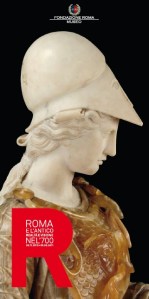
"Orsay Minerva," 2nd century AD (marble replaced late 18th century), Paris: Louvre
Both artistic and archaeological, the exhibition aims to illustrate the way in which ancient monuments, excavations, museums and artistic institutions were able to nourish the arts and education and spread the love for classic art throughout Europe which, at the end of the eighteen century, became an indispensible model. The exhibition, Roma e l’Antico. Realtà e visione nel ’700, intends to bring into focus the major factors that that generated Rome’s cultural wealth and fame: Classic Antiquity. Especially in the second half of the century Rome was an authentic crossroads for artists who came from all over Europe in order to study Antiquity. As investigations today reveal, the Papal capital became the most important centre for culture due to the abundance of classical figurative models which are fundamental for artistic training. The Roman classical heritage, described as an unparalleled resource for the renaissance of Europe, was actually the result of an invariable strategy pursued by Popes and civic authorities during the eighteen century, which the exhibition will explore by illustrating the chief elements. A large section of exhibition will be dedicated to the training syllabus for artists in Rome and the way this model was spread through the Accademia Romana di San Luca, the Academy of San Fernando in Madrid and the Museo Riminaldi in Ferrara. Another section addresses museums of Roman Antiquity
with the aim of illustrating their educational role and power to promote tourism in the
Eternal City.
◊ ◊ ◊ ◊ ◊
A full description of the exhibition is available at View from the Bow, a blog for the arts and music in the early modern period (7 January 2011) and at Deborah Swain’s Living in Rome (7 January 2011).
Lecture Series at the Louvre: Ancients and Moderns
From the Louvre:
Conférences d’histoire de l’art: Pourquoi l’antique chez les modernes?
Musée du Louvre, Paris, January-February 2011
L’antinomie entre Antiquité et Modernité est une question qui préoccupe depuis la Renaissance jusqu’aux grands débats esthétiques des XVIIe et XVIIIe siècles. Elle en implique une autre qui traverse l’histoire des arts et qui est au cœur même de la création artistique : comment réconcilier l’imitation et l’originalité ? Winckelmann, le fondateur de l’histoire de l’art et du paradigme grec, avait donné une réponse à ces questions : « La seule manière pour nous de devenir grands, et même, si cela se peut, inimitables, c’est d’imiter les Anciens » (Histoire de l’art dans l’Antiquité, 1764). Mais ce rêve d’appropriation de l’origine retrouvée est-il possible ? Par ailleurs quelles sont les conditions de la survie et des nombreux retours à l’antique à partir de la Révolution, alors même que les esprits cherchent à se libérer des autorités qui régissent la vie politique, artistique et littéraire de leur temps ? Pourtant, depuis le XVIIIe siècle, tout au long du XIXe et jusqu’au début du XXe siècle, on continue dans ces domaines à explorer l’Antiquité de manière passionnée et les styles formellement plus novateurs, tant en peinture qu’en sculpture, se tournent à nouveau vers ce modèle.
Ce cycle entend répondre à ces questions, en abordant des époques et des contextes différents: le retour à l’antique dans la France monarchique de Louis XV, la postérité du monde classique dans la Rome du XVIIIe siècle, mais aussi l’idéal du « vivre à l’antique » dans l’Europe des Lumières. Pour Ingres, comme pour Rodin, il s’agit plutôt d’une Antiquité sacrée les unissant autour d’un idéal grec qui s’impose comme fondateur, indispensable et catalyseur de modernité. Enfin, le « retour au style » des sculpteurs français au début du XXe siècle annonce les nouveaux styles modernistes.
6 January 2011, 6:30pm
Le retour à l’antique français et la crise de l’image de Louis XV
Marc Fumaroli (de l’Académie française, Collège de France)
13 January 2011, 6:30pm
Rome et l’antique : pour l’amour des Muses au XVIIIe siècle
Carolina Brook (Università degli Studi, Pise) et Valter Curzi (Università degli Studi “La Sapienza”, Rome)
20 January 2011, 6:30pm
Paraître à l’antique. Portraits et fantasmes au XVIIIe siècle
Daniela Gallo (université de Grenoble-II / Pierre-Mendès-France)
3 February 2011, 6:30pm
Ingres et Rodin ou les métamorphoses de l’antique
Pascale Picard (musée de l’Arles et de la Provence antiques, Arles)
10 February 2011, 6:30pm
Le « frein du style » à Paris au début du XXe siècle : la sculpture libérée par la rigueur ?
Édouard Papet (musée d’Orsay, Paris)
Call for Articles: ‘Libidinal Lives’ in the Long Nineteenth Century
Edited Collection — Libidinal Lives: Economies of Desire in the Long Nineteenth Century
Abstracts due by 1 April 2011
In his controversial work Libidinal Economy (1974) Jean-Franҫois Lyotard famously remarked ‘every political economy is libidinal’. With this radical pronouncement, Lyotard identified all hegemonic structures as susceptible to the affective ebb and flow of desire. Forming the cornerstone of the new ‘libidinal materialism’, Libidinal Economy, alongside Deleuze and Guattari’s Anti-Oedipus (1972), saw the desiring body as inextricably bound up with economic, political and fiscal operations. In the decades that followed, a wealth of theoretical work drew on this challenging juxtaposition of the libidinal and the economic. Notably, Lawrence Birkens’s Consuming Desire (1988) postulated a parallel development of sexology and political economy and more recently Regenia Gagnier’s The Insatiability of Human Wants (2000) elaborated on the question of production and reproduction in Victorian Aesthetics.
Building on this important and often contentious body of scholarship, this collection of essays seeks to explore the interrelatedness of desire, sexuality and economic processes in the literary, scientific and cultural worlds of the long nineteenth century. Papers might consider the role of libidinal impulses in social and political formations, or question whether desire functions as a cohesive, communal force. They might examine a spectrum of nineteenth-century debates with reference to how they position sexuality as the central and influencing practice in an ideological matrix. In addition they might consider whether we find an undercurrent of competing desires in the patterns of pleasure, production, reproduction and consumption during the nineteenth century, and ask to what extent these desires influenced twentieth and twenty-first century perceptions of the Victorians.
Suggested topics may include, but are not limited to:
- Production, consumption, creativity and libidinal impulses
- Sexual/textual lives
- Commodity/bodily fetishism and pornography
- Political/social bodies of desire
- Gift theory and eroticism
- Non-‘normative’ libidinal economies of sensation and pleasure: masturbation, fellation, same-sex intimacy
- The gothic, cannibalism, the death drive and desire
- Imperialist desires and ‘other’ economies
- Colonial and post-colonial legacies and heritage
- Theoretical afterlives, ie., Jean-Franҫois Lyotard, Bataille, Deleuze & Guattari, Eagleton, and
- Queer Theory etc.
Please send abstracts of 500 words (for chapters of 6,000-8,000 words) along with a CV to Jane Ford and Kim Edwards Keates to jane.ford@port.ac.uk and kim.edwards@liverpool.ac.uk by 1st April 2011. The deadline for completed essays is 1st October 2011. Any queries are welcomed.
Conference Review: Does the Picturesque Have a Future?
Recently added to caa.reviews:
Conference — Emerging Landscapes: Between Production and Representation (London: University of Westminster, 25-27 June 2010).
Reviewed by Samantha L. Martin-McAuliffe, School of Architecture, University College Dublin; posted 11 January 2011.
. . . When the conference had seemingly reached the point where an obituary for the Picturesque seemed inevitable, Jonathan Hill (The Bartlett, University College London) delivered his keynote address, “Weather Architecture,” in which he called for a redemption of the tradition. Through a considered reflection on John Soane’s house in Lincoln’s Inn Fields and J. M. W. Turner’s London studio, Hill explained how the Picturesque attended to important themes, such as mortality, history, and, notably, the environment. Because this tradition aligned with topics such as the seasons and the senses (and hence the weather), the places it qualified were never static, but always emerging and forever changing. From this stance, the Picturesque is seen not so much as a formal model for construction that is fixed to a particular historical period, but instead as a sensitivity toward the surrounding world and its manifold processes—time, temperature, narrative. Is it possible, therefore, to recast the role of the Picturesque within contemporary landscape studies? Can it help the invisible yet constantly present conditions of the environment rise into notice? . . .
For the full review, click here» (CAA membership required)
Exhibition: The Landscape of Tivoli in the Eighteenth Century
Tivoli: Variations sur un paysage au XVIIIe siècle
Cognacq-Jay Museum, Paris, 18 November 2010 — 20 February 2011

Joseph Vernet, "La cascade," ca. 1748 (Photo: Roger Viollet)
L’exposition Tivoli. Variations sur un paysage au XVIIIe siècle propose une réflexion originale sur l’évolution du paysage, de 1720 à 1830, autour d’un motif particulier : le site de Tivoli et son célèbre temple dit de la Sibylle.
Lieu de villégiature fameux depuis l’Antiquité, Tibur (le nom latin de Tivoli) fut mise à la mode par l’empereur Auguste et par Mécène, le fastueux ami des arts, et célébrée par les poètes Horace et Catulle (Ier s. av. J.-C.). La Sibylle Albunea y exerçait son art divinatoire. Le site est exceptionnel : bâtie sur les premiers contreforts des Apennins, à une trentaine de kilomètres à l’est de Rome, Tivoli se présente comme une ville à flanc de montagne, dominant la plaine qui s’étend de là jusqu’à la mer. Une rivière, l’Aniene, s’y précipite en multiples cascades. Une petite acropole s’élève au bord du gouffre : les ruines de deux temples sont encore conservées, l’un quadrangulaire, l’autre rond. Ce dernier surtout est devenu célèbre, sous le nom de temple de la Sibylle ou de Vesta.

ISBN : 9782759601462, 30€
Au XVIIIe siècle, Tivoli et son temple sont progressivement devenus l’un des motifs les plus représentés dans l’histoire de la peinture, singulièrement dans la peinture française. La perfection architecturale du monument, son emplacement au coeur d’un paysage sublime et terrifiant, la richesse incomparable de son histoire, de ses légendes, en ont fait un motif adulé par les peintres et leurs collectionneurs. C’est aussi l’époque où l’on décline le temple de Tivoli sous forme de fabriques édifiées dans les jardins.
En cinquante oeuvres, peintures, dessins et gravures, l’exposition propose de confronter le regard porté par les plus grands artistes de l’époque sur ce motif : une brève introduction présente l’origine de son succès, au début du XVIIe siècle, dans l’entourage de Paul Bril et de Gaspard Dughet. Pour le XVIIIe siècle, Vanvitelli, Boucher, Vernet, Hubert Robert, Piranèse… se succèdent autour du même motif. Puis Valenciennes, Simon Denis ou Granet qui furent en France les précurseurs du paysage moderne. Composées ou plus spontanées, caprices, variations poétiques, études faites en plein air, les oeuvres présentées posent de manière contradictoire la question du sujet dans la peinture de paysage. Le plus singulier est sans doute qu’un même motif ait intéressé tous les artistes sur une période aussi longue, des plus traditionnels aux plus modernes.
L’exposition sera accompagnée par un catalogue en couleurs. En plus de notices détaillées sur chaque oeuvre, des essais confiés à plusieurs auteurs traiteront notamment du site de Tivoli, de sa fortune dans l’histoire de l’art ou dans les récits de voyageurs, et de l’importance de certains artistes particulièrement associés à Tivoli (Joseph Vernet, Hubert Robert).
◊ ◊ ◊ ◊ ◊
Didier Rykner’s review of the exhibition (in French) for La Tribune de l’Art (30 November 2010) is available here»
New Title: ‘Interior Portraiture and Masculine Identity in France’
From Ashgate:
Temma Balducci, Heather Belnap Jensen, and Pamela Warner, eds., Interior Portraiture and Masculine Identity in France, 1789–1914 (Aldershot: Asghate, 2010), 300 pages, ISBN: 9780754667841, $119.95.
 Focusing specifically on portraiture as a genre, this volume challenges scholarly assumptions that regard interior spaces as uniquely feminine. Contributors analyze portraits of men in domestic and studio spaces in France during the long nineteenth century; the preponderance of such portraits alone supports the book’s premise that the alignment of men with public life is oversimplified and more myth than reality.
The volume offers analysis of works by a mix of artists, from familiar names such as David, Delacroix, Courbet, Manet, Rodin, and Matisse to less well-known image makers including Dominique Doncre, Constance Mayer, Anders Zorn and Lucien-Etienne Melingue. The essays cover a range of media from paintings and prints to photographs and sculpture that allows exploration of the relation between masculinity and interiority across the visual culture of the period. The home and other interior spaces emerge from these studies as rich and complex locations for both masculine self-expression and artistic creativity. Interior Portraiture and Masculine Identity in France, 1789–1914 provides a much-needed rethinking of modern masculinity in this period.
Contents: “Introduction,” Temma Balducci, Heather Belnap Jensen and Pamela J. Warner; “The revolution at home: masculinity, domesticity and political identity in family portraiture, 1789–1795,” Amy Freund; “Picturing paternity: the artist and father-daughter portraiture in post-Revolutionary France,” Heather Belnap Jensen; “Public and private identities in Delacroix’s Portrait of Charles de Mornay and Anatole Demidoff,” Jennifer W. Olmsted; “At home with the camera: modeling masculinity in early French photography,” Laurie Dahlberg; “The artist in his studio: dress, milieu, and masculine identity,” Heather McPherson; “Cézanne, Manet, and the portraits of Zola,” Andre Dombrowski; “At home in the studio: two group portraits of artists by Bazille and Renoir,” Alison Strauber; “In bed with Marat: (un)doing masculinity,” James Smalls; “The competing dialectics of the cabinet de travail: masculinity at the threshold,” Pamela J. Warner; “Anders Zorn’s etched portraits of American men, or the trouble with French masculinity,” S. Hollis Clayson; “Auguste Rodin, photography, and the construction of masculinity,” Natasha Ruiz-Gómez; “Matisse and self, the persistent interior,” Temma Balducci; Selected bibliography; Index.
About the Editors: Temma Balducci is an Assistant Professor of Art History at Arkansas State University. She has published on the gaze and spectacle in nineteenth-century French art and on feminist art of the 1970s. Her manuscript in progress, “Beyond the Flâneur: Gender, Space and the Gaze in Post-Haussmann Visual Culture,” challenges the ubiquity of the Baudelairean flâneur in theorizations of gender and space in early Third Republic Paris.
Heather Belnap Jensen is Assistant Professor of Art History at Brigham Young University. Her research and publications examine women’s contributions to early nineteenth-century culture. She is currently co-editing a volume on women, bourgeois femininity and public space with Temma Balducci, as well as working on a book manuscript titled “Art, Fashion and the Modern Woman in Post-Revolutionary France.”
Pamela J. Warner is Assistant Professor of Art History at the University of Rhode Island. Her research focuses on art criticism in France during the nineteenth century, and she has published articles in Nineteenth-Century Art Worldwide, Studies in the Decorative Arts and the Cahiers Edmond et Jules de Goncourt. Her book in progress focuses on the critical reception of Realism and its ties to materialist philosophy.
Call for Papers: How Geographers Address Collections
Geographies of Collections
Annual International Conference of the Royal Geographical Society-Institute of British Geographers
Royal Geographical Society and Imperial College in London, 31 August — 2 September 2011
Proposals due by 11 February 2011
Collections of diverse types provide rich sources for geographical enquiry. The specific systems of organisation developed within them, along with their contexts of use, can variously form or inform the geographical imagination. The collection is also never static, whether it is aggregated as an archive, a library, a museum collection, a scientific dataset or a twenty-first century digital database. As a result, the knowledges and geographies developed within them are always ripe for re-imagination.
The theme of the 2011 RGS-IBG Conference, The Geographical Imagination, presents an opportunity to adopt what Rebecca Duclos has termed ‘a cultural geography perspective’ towards collections, and to reconsider their geographies at a time of intensified interest in this area. Popular events such as A History of the World in 100 Objects and the British Library Growing Knowledge exhibition show, from opposite sides of the spectrum, how interaction with myriad different collections is changing. This session therefore seeks to question how geographers working within this shifting landscape are engaging with the collection across a range of forms and materialities.
We would be pleased to receive submissions for papers from researchers engaged in a wide variety of ‘collections’ including fine art, natural history, cartographic, photographic, ethnographic, archaeological, and digital. We are particularly interested in papers which address the issues of place, space and imagination in the accumulation and deployment of collections, and in papers which have a historico-geographical focus. Topics might include: (more…)
Settecento Paintings in New York
The following press release comes from Sperone Westwater (as noted at Art Daily) . . .
Italian Paintings from the 17th and 18th Centuries
Sperone Westwater Gallery, New York, 7 January — 19 February 2011
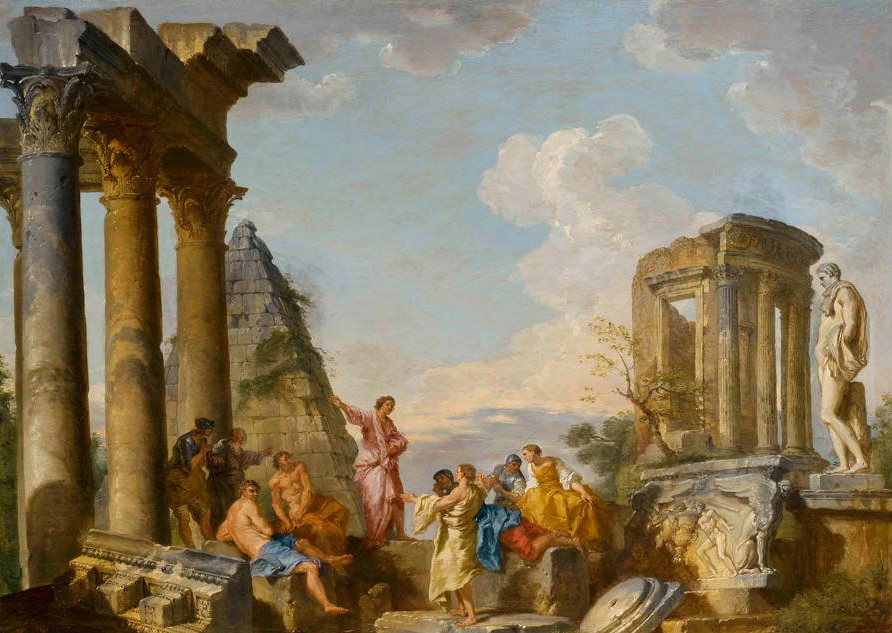
Giovanni Paolo Panini, "Architectural Capriccio with an Apostle Preaching," 1755-60, oil on canvas, 20 7/8 x 28 7/8 inches (52.9 x 73.5 cm). Courtesy Sperone Westwater, NY.
Sperone Westwater is pleased to announce an exhibition of Italian Paintings from the 17th and 18th Centuries in partnership with Robilant + Voena. This survey of Italian Old Master paintings, with notable masterpieces by painters such as Canaletto (1697-1768), Cavalier d’Arpino (1568-1640), Artemisia Gentileschi (1593-1653), and Michele Marieschi (1710-1743), intends to reassert the historical importance of Italian painting in the centuries following the Renaissance – a period which was to become an important foundation for modern art.
The exhibition unveils several new discoveries. One highlight is a very uncommon signed Portrait of an Unidentified Man (1630-1640) by Artemisia Gentileschi, among the most highly regarded female artists of the Baroque. It is exhibited alongside Tiberio Titi’s Portrait of Ferdinando Gonzaga, Duke of Mantua (ca. 1617) – also a new addition to his body of work. An early Francesco Guardi, Piazza San Marco, looking West, from the Campo di San Basso (1757-1758), a newly discovered work from the late 1750s, represents a period when he was still very much under Canaletto’s influence. When comparing this to Guardi’s later and previously unpublished painting, Venice. The Lagoon and the Fort of San Niccolo at Lido (1775-1785), it is possible to see how far the artist took his own individual interpretation of the Venetian veduta. Canaletto’s small and exquisite View of Dolo at the bank of the Brenta (1763) completes this set of important additions.
Other early masterworks will include two rare paintings by Cavalier d’Arpino, who first hosted Caravaggio in his studio after his arrival in Rome. The first, David with the Head of Goliath (1598) is a signed and dated work from the extensive Aldobrandini collection that was treasured by several papal Cardinals since its creation. It contrasts forcefully with d’Arpino’s Venus and Cupid (1602-1603), executed a few years later. Works by Battistello Caracciolo, Angelo Caroselli and Carlo Dolci further exemplify the prominence of religious narrative during the 17th century. Paintings by Marieschi, Panini and Joli also underline the 18th-century fascination with the veduta.
By jointly exhibiting Italian Baroque paintings and vedute from the 17th and 18th centuries in New York, Sperone Westwater and Robilant + Voena inaugurate a closer partnership between the two galleries. In 2011 both galleries will open a new shared space in London, 2nd Floor at 38 Dover Street, W1, with a joint show in 2011.
A fully illustrated, scholarly catalogue is being published on the occasion of the show. There will be an opening reception on 7 January from 6-8 pm. For more information, please visit www.speronewestwater.com or contact Maryse Brand at +1 (212) 999-7337 or maryse@speronewestwater.com.
CAA in New York
The 2011 College Art Association conference takes place in New York, February 9-12, at the Hilton New York. HECAA will be represented by two panels and a reception, as listed here. The following sessions may also be of interest for dix-huitièmistes. A full list of panels is available here»
HECAA EVENTS
New Scholars Session
Thursday, February 10, 12:30–2:00; Beekman Parlor, 2nd Floor, Hilton New York
Chair: Heidi Anne Strobel (University of Evansville)
- Susan M. Wager (Columbia University), “Madame de Pompadour’s Indiscreet Jewels: Boucher, Reproduction, and Luxury in Eighteenth-Century France”
- Heidi E. Kraus (University of Iowa), “Reflections on Civilization: Architecture and Memory in David’s Sabine Women“
- Kristina Kleutghen (Harvard University), “Staging Europe: Theatricality and Painting at the Chinese Imperial Court”
- Sally Grant (University of Sydney), “Garden Chambers and Global Spaces: Giandomenico Tiepolo’s Chinoiserie Room at the Villa Valmarana”
HECAA Reception
Thursday, February 10, 5:30-–8:30; Lincoln Suite, 4th Floor, Hilton New York (note revised time to accommodate the ASECS affiliate session)
◊ ◊ ◊ ◊ ◊
The Global Eighteenth Century
Saturday, February 12, 9:30–12:00; Regent Parlor, 2nd Floor, Hilton New York
Chairs: Kristel Smentek (Massachusetts Institute of Technology) and Meredith Martin (Wellesley College)
- Elisabeth Fraser (University of South Florida), “Miniatures in Black and White: Melling’s Eighteenth-Century Istanbul”
- Daniel McReynolds (Center for Advanced Studies in the Visual Arts), “A Venetian Abroad: Andrea Memmo and the Architecture of Diplomacy in Eighteenth-Century Istanbul”
- Chanchal Dadlani (Columbia University), “Between History, Ethnography, and Autobiography: The Gentil Album (1774) and Artistic Production in Eighteenth-Century India”
- Michele Matteini (Reed College), “The Market for Exotica in Eighteenth-Century Beijing: A View from Liulichang”
- Kevin Chua (Texas Tech University), “Macartney’s Globe, or Cartographic Refusal in 1793”
◊ ◊ ◊ ◊ ◊
OTHER SESSIONS RELATED TO THE 18TH CENTURY
Architecture, Space, and Power in the Early Modern Ibero-American World
Wednesday, February 9, 2:30–5:00; Gramercy B, 2nd Floor, Hilton New York
Chairs: Jesús Escobar (Northwestern University) and Michael Schreffler (Virginia Commonwealth University)
- Barbara Mundy (Fordham University), “Centers and Peripheries in Sixteenth-Century Mexico City”
- Stella Nair (University of California, Riverside), “From Inca Pampa to Spanish Plaza: Theatrical Politics and the Transformation of Imperial Public Space, 1480-1780”
- Catherine Wilkinson Zerner (Brown University), “The Visionary Spatial World of the Ibero-American Retable Altarpiece”
- Sabina de Cavi (Vlaams Academisch Centrum, Brussels), “Natione Italiana: Architecture of the Italian Minorities in Philippine Iberia (1580-1640)”
- Victor Deupi (Fairfield University), “Santissima Trinità degli Spagnoli and Ibero-American Patronage in Eighteenth-Century Rome”
◊ ◊ ◊ ◊ ◊
American Society for Hispanic Art Historical Studies: Rereading Spanish Early Modern Art Theory
Thursday, February 10, 9:30–12:00; Gramercy B, 2nd Floor, Hilton New York
Chairs: Giles Knox (Indiana University) and Carmen Ripolles (Metropolitan State College of Denver)
- Alejandra Giménez-Berger, “Aesthetics of Ideology in Felipe de Guevara’s Comentarios de la Pintura“
- Rebecca J. Long, “Italian Artists within the Spanish System”
- Melody Maxted-Wittry, “Knowing Nature: Artistic Production, Scientific Inquiry, and Catholic Devotion in Seventeenth-Century Spain”
- Ellen Prokop, “The Body of the Artist: An Anatomy of Faith in Early Modern Spain”
- Ray Hernández-Durán (University of New Mexico), “Francisco Pacheco in Sor Juana’s Library: Miguel Cabrera and the Academy in Eighteenth-Century New Spain”
◊ ◊ ◊ ◊ ◊
Representing Gothic
Thursday, February 10, 9:30–12:00; East Ballroom, 3rd Floor, Hilton New York
Chairs: Stephen Murray, Columbia University; Andrew J. Tallon, Vassar College
- Robert Bork (University of Iowa), “Speaking the Un-Speakable: Drawings, Texts, and the Explication of Gothic Design”
- Sarah Guérin (Columbia University), “Micro-Architectural Representation on Gothic Ivories”
- Michèle Hannoosh (University of Michigan), “Michelet and the Gothic: Architecture and the Writing of History in Nineteenth-Century France”
- Matilde Mateo (Syracuse University), “Re-Inventing the Gothic Grove: Recent Metamorphoses in Landscape Art, Science Fiction, and Animated Film”
- Matthew Reeve (Queen’s University), “Queer Gothic: Representing the Gothic at Walpole’s Strawberry Hill”
◊ ◊ ◊ ◊ ◊
Historians of British Art: Seeing through the Medium
Thursday, February 10, 12:30–2:00; Sutton Parlor South, 2nd Floor, Hilton New York
Chairs: Imogen Hart (Yale Center for British Art) and Catherine Roach (Cornell University)
- Holly Shaffer (Yale University), “Ta’ziyeh: Reference and Resemblance in North Indian Ephemeral Shrines, 1770-1830”
- Andrew Stephenson (University of East London), “Ciné-Texts: The Permeability of Modern Art, Film, and Snapshot Cultures in 1920s-1930s London”
- Elyse Speaks (University of Notre Dame), “Dissolution, Disillusion, and Deflation: Damien Hirst’s Double Act”
◊ ◊ ◊ ◊ ◊
Rococo, Late-Rococo, Post-Rococo: Art, Theory, and Historiography
Thursday, February 10, 2:30–5:00; Sutton Parlor Center, 2nd Floor, Hilton New York
Chairs: Melissa Hyde (University of Florida) and Katie Scott (Courtauld Institute of Art)
- Colin Bailey (The Frick Collection), “A Casualty of Style? Reconsidering Fragonard’s Progress of Love from the Frick Collection”
- Satish Padiyar (Courtauld Institute of Art), “Between Early and Late: Fragonard as a Late Rococo Artist”
- Elizabeth Mansfield (New York University), “Rococo Republicanism”
- Marika Knowles (Yale University), “Pierrot’s Periodicity: Watteau, Nadar, and the Circulation of the Rococo”
- Allison Unruh (independent scholar, New York), “Warhol’s Rococo”
◊ ◊ ◊ ◊ ◊
American Society for Eighteenth-Century Studies: Cosmopolitanism and Art in the Eighteenth Century
Thursday, February 10, 5:30–7:00; Petit Trianon, 3rd Floor, Hilton New York
Chair: Jennifer Milam (University of Sydney) — This session is dedicated to Angela Rosenthal
- Jeffrey Collins (Bard Graduate Center)
- Alicia Weisberg-Roberts (The Walters Art Gallery)
- Michael Yonan (University of Missouri)
- Jill Cassid (University of Wisconsin, Madison)
- Mark Cheetham (University of Toronto)
Historians of British Art: Young Scholars Session
Friday, February 11, 7:30-9:00am; Bryant Suite, 2nd Floor, Hilton New York
Chair: Colette Crossman (Blanton Museum of Art, University of Texas at Austin)
- Amanda Lahikainen (Brown University), “‘British Asignats’: Satirical Representation and the Politicization of Paper Currency in 1797”
- Keren Hammerschlag (King’s College London), “Artistic Scientists and Scientific Artists at the British Royal Academy 1860-1900”
- Emily V. Davis (Virginia Commonwealth University), “British Literary Periodicals Transform the Female Form in Turn-of-the-Century Glasgow”
◊ ◊ ◊ ◊ ◊
New Approaches to the Study of Fashion and Costume in Western Art, 1650–1900
Friday, February 11, 2:30–5:00; Clinton Suite, 2nd Floor, Hilton New York
Chairs: Helen Burnham (Museum of Fine Arts, Boston) and Justine De Young (Harvard University)
- Kathleen Nicholson (University of Oregon), “When Isn’t Fashion Fashion? Late Seventeenth-Century French Fashion Prints and Dress in Portraiture”
- Amelia Rauser (Franklin and Marshall College), “Neoclassical Fashion in Art and Life in the 1790s”
- Heather Belnap Jensen (Brigham Young University), “Materializing the Maternal Body in Post-Revolutionary Fashion”
- Jennifer W. Olmsted (Wayne State University), “Fashioning Masculinity: Portraiture, Costume, and the Juste Milieu”
- Alison McQueen (McMaster University), “Empress Eugénie and Representations of Fashion in Second Empire France”
◊ ◊ ◊ ◊ ◊
American Society for Hispanic Art Historical Studies: New Perspectives on Spanish Drawings 1500-1900
Friday, February 11, 5:30–7:00; Gibson Room, 2nd Floor, Hilton New York
Chair: Lisa A. Banner (independent scholar)
- José Manuel Matilla (Museo Nacional del Prado), “Recently Acquired Albums and Sketchbooks at the Prado”
- Zahira Véliz (independent scholar and curator), “Designing the Ensemble: An Altarpiece Drawing by Alonso Cano”
- José Manuel de la Mano (independent scholar, Madrid), “Mariano Salvador Maella: Problems of a Catalogue Raisonné and Exhibition”
◊ ◊ ◊ ◊ ◊
Imitation, Copy, Reproduction, Replication, Repetition, and Appropriation, Part I
Saturday, February 12, 9:30–12:00; Madison Suite, 2nd Floor, Hilton New York
Chairs: Malcolm Baker (University of California, Riverside) and Paul Duro (University of Rochester)
- Maria Loh (University College London), “Time Is Out of Joint: Resetting the Laocoön”
- Lisa Pon (Southern Methodist University), “The Printed Image in the Age of Miraculous Reproduction”
- Ronit Milano (Ben-Gurion University, “Self vs. Collective Identity: The Reproduction of Portrait Busts in Eighteenth-Century France”
- Douglas Fordham (University of Virginia), “The ‘Real Spaces’ of Eighteenth-Century Prints”
- Tom Huhn (School of Visual Arts), “Reflections on the Imitation of Winckelmann”
◊ ◊ ◊ ◊ ◊
Cultural Appropriation, Part II
Saturday, February 12, 9:30–12:00; Concourse G, Concourse Level, Hilton New York
Chairs: Elizabeth K. Mix (Butler University) and Gabriel P. Weisberg (University of Minnesota)
- Annika Johnson (University of Minnesota), “Cahier d’Oiseaux Chinois: The French and Fantastic Appropriation in the Chinoiseries of Jean-Baptiste Pillement”
- Colette Apelian (Berkeley City College), “Bhabha’s Cultural Hybridity and Early Twentieth-Century Modifications of Fez, Morocco”
- Susanne Slavick (Carnegie Mellon University), “Erasure, Eternal Return, and Empathic Restitution”
- Chisato O. Dubreuil (St. Bonaventure University), “A New Look at the Costs of the Cultural Appropriation of Canada’s Traditional Totem Poles”
- A. Joan Saab (University of Rochester), “America Tropical and the Multi-Sited Mural”
◊ ◊ ◊ ◊ ◊
Historians of British Art: Radical Neo: The Past in the Present in British Art and Design
Saturday, February 12, 9:30–12:00; Bryant Suite, 2nd Floor, Hilton New York
Chairs: Jason Rosenfeld (Marymount Manhattan College) and Tim Barringer (Yale University)
- Zirwat Chowdhury (Northwestern University), “The Elephanta in the Room: Indian Antiquity and British Antiquarianism in the Late Eighteenth Century
- Ayla Lepine (Courtauld Institute of Art), “Manifesting the Rule: Designing for Monasticism in Victorian Oxford”
- Katherine Faulkner (Courtauld Institute of Art), “Domestic Dreams and Utopian Idylls: Medieval Dress in the Work of William Reynolds-Stephens”
- Lee Hallman (The Graduate Center, City University of New York), “Unseen Landscapes: Paul Nash and the Geography of History”
- Mark A. Cheetham (University of Toronto), “Yinka Shonibare’s Enlightenment: Revising British Art for the Twenty-First Century”
Watteau and His Circle at The Wallace
From The Wallace:
Esprit et Vérité: Watteau and His Circle
The Wallace Collection, London, 12 March — 5 June 2011

Jean-Antoine Watteau, "A Lady at her Toilet (La toilette)," ca. 1716-18 (London: Wallace Collection)
In two exhibitions of great paintings, the Wallace Collection celebrates Antoine Watteau, the artist who died in his prime yet changed the course of French painting, and Jean de Jullienne, his publisher and one of France’s greatest collectors; a perfect accompaniment to the concurrent exhibition of Watteau drawings at London’s Royal Academy of Arts.
The exhibitions will consist of a redisplay of the great Watteau canvasses in the Wallace Collection, in the intimate setting of the West Gallery at Hertford House; and downstairs, in the Collection’s Exhibition Galleries, significant masterworks of the 17th and 18th centuries by artists, including Rembrandt, Rubens, Greuze and Vernet, drawn from the collection of Watteau’s publisher and most important dealer, Jean de Jullienne.
The relationship between Watteau, the most influential artist of his time, and Jean de Julienne, one of France’s most significant art collectors, represents a key moment in the development of French 18th-century painting and patronage. Within his short career, Watteau (1684-1721) changed the course of painting. He revitalized the Baroque style, and invented the fête galante, a novel category of genre painting depicting pastoral and idyllic compositions where stage characters of the French and Italian comedies mingle with fashionable contemporaries.
Jean de Jullienne (1686-1766), supported 18th-century contemporary artists. His strong interest in French art and Netherlandish painting, led the way for a new generation of rich Parisian collectors who had only loose connections with the French court. As a result, the 18th century saw the establishment of a new cultural avant-garde.
Jean de Jullienne is famous for his role as editor of and dealer in Watteau’s work, but a unique illustrated inventory of his collection from 1756, lent to the exhibition by the Morgan Library & Museum in New York and on display for the first time, demonstrates the breadth of his tastes. ‘Esprit et Vérité: Watteau and His Circle includes works by: Rubens, Rembrandt, Wouwermans, Netscher, Bourdon, Carle Van Loo, Greuze and Claude-Joseph Vernet from Jullienne’s collection; the Wallace Collection’s group of eight Watteau paintings, and two Watteau paintings from the Sir John Soane’s Museum, London and York Art Gallery. The Watteau paintings present a rare opportunity to reassess this artist’s impact on the course of art history.
Watteau’s artistic innovations went beyond his invention of the fête galante. The French tradition of depicting the female nude in a domestic setting, rather than as a goddess or a nymph, began in the 18th century. Watteau’s A Lady at her Toilet in the Wallace Collection is an early example of what might have been considered a controversial painting in its day and is one of only three surviving paintings by the artist in this new erotic genre. Watteau is said to have later repented and ordered that these paintings should be destroyed on this death.
Watteau died of tuberculosis, probably aged thirty-seven, and Jean de Jullienne was responsible for distributing engravings of Watteau’s work after his death, thus ensuring the artist’s longevity.
The exhibition will provide an opportunity to present new research on the Wallace Collection’s Watteau paintings and view them in the context of more recent developments in Watteau studies.










 Enfilade
leave a comment