Call for Papers: 2012 CIHA in Nuremberg, ‘Challenge of the Object’
Note below the opportunity from NCHA for support for U.S. graduate students:
The Challenge of the Object / Die Herausforderung des Objekts
33rd Congress of the International Committee of the History of Art (CIHA)
Nuremberg, 15-20 July 2012
Proposals due 30 April 2011
From July 15 to 20, 2012 the Germanisches Nationalmuseum is hosting the 33rd Congress of the International Committee of the History of Art (CIHA) in Nuremberg and invites art historians from all over the world to attend and discuss The Challenge of the Object. The object and how it is perceived in art history is a question that is currently very highly charged, the result of increasing globalization and digitalization. Art and cultural historians from all over the world, from a vast cross-section of disciplines and fields of professional interest are called upon to discuss together the role and the theory of the object in art history. The topics are divided into 21 sections with up to 20 talks each. The sections should enable a comparison to be made between the different viewpoints and methods. For that reason they are categorized according to how their questions on the object in art history are formulated. This should allow talks on different genres, epochs and countries to be brought together.
The congress will be rounded off with an extensive supporting program with excursions, for example to Documenta in Kassel, and a wide-ranging program for young academics. At the same time the Germanisches Nationalmuseum will be presenting the important special exhibition on The Early Dürer. The Call for Papers ends on April 30, 2011. From November 2011, registration for participation without a presentation is also possible. Detailed descriptions of the individual sections as well as information on the congress and the Call for Papers can be found at the conference website.
◊ ◊ ◊ ◊ ◊
From the the website of the NCHA, the U.S. affiliate of the CIHA:
The National Committee for the History of Art (NCHA) is the U.S. affiliate of the international community of art historians, the Comité International d’Histoire de l’Art (CIHA). Both the NCHA and CIHA aim to foster intellectual exchange among scholars, teachers, students and others interested in art history broadly conceived as encompassing art, architecture, and visual culture across geographical boundaries and throughout history. . .
The National Committee for the History of Art was founded in 1980, in anticipation of the 1986 International Congress of the History of Art, held in Washington. Irving Lavin was the founding NCHA President and was instrumental in shaping the organization as it prepared to conceive and host the International Congress. Under the leadership of Nancy Troy, NCHA organized and hosted a second conference, Past Perfected: Antiquity and its Reinventions, held in Los Angeles in 2006. It currently is concerned with developing global networks of art historians, particularly in areas of the world in which art history is an emerging discipline. With support from the Getty Foundation, NCHA brings together art historians from Africa, Asia, Latin America, the Middle East and Eastern Europe for discussions on the state of the discipline and to help forge communities of scholars around the globe. For each International Congress, NCHA provides support for some twenty-five American Ph.D. students who wish to attend and looks forward to doing so once again for the 2012 International Congress that will be held in Nuremberg.
Exhibition: French Drawings at The Morgan in the Fall
From The Morgan:
David, Delacroix, and Revolutionary France: Drawings from the Louvre
The Morgan Library and Museum, New York, 23 September — 31 December 2011
Curated by Louis-Antoine Prat
This exhibition features the first-ever U.S. showing of some of finest French drawings from the Louvre, covering a period between 1789 and 1848 when France experienced a tremendous political, social, and cultural upheaval. Some 75 drawings by such artists as Jacques-Louis David, J. A. D. Ingres, Eugène Delacroix, J. B. C. Corot, Théodore Gericault, Pierre Paul Prud’hon, and their contemporaries, will be presented. The exhibition will be organized chronologically, with large groups of works by David, Ingres, and Delacroix, serving as major focal points.
◊ ◊ ◊ ◊ ◊
“In the Drawing Room,” a profile by Martin Bailey of curator and collector Louis-Antoine Prat appeared in the September issue of The Art Newspaper (published online on 20 September). Prat is also curating the upcoming Watteau exhibition at the Royal Academy of Arts.
At Sotheby’s: Record Price for Vernet
Charlotte Burns reports in The Art Newspaper (28 January 2011) on Sotheby’s sale of Important Old Master Paintings & Sculpture (No8712), which took in a total of over $90million. . .

Claude-Joseph Vernet, "A Grand View of the Sea Shore Enriched with Buildings, Shipping and Figures," 1776
Sotheby’s strode ahead of rival Christie’s after a bullish 98-lot sale of old master paintings . . . “It was outstanding. I haven’t seen an auction like this for many years,” said Colnaghi director Konrad Bernheimer. The energetic sale set new records for several artists . . . The packed salesroom started to swivel in its seats when a bidding war broke out for Claude-Joseph Vernet’s A Grand View of the Sea Shore . . . , 1776, which tripled its $2m high-estimate to hammer at a record $6.2m (est $1.5m-$2m. Total $7m, with premium). The painting once belonged to the Beaverbrook Art Gallery in Fredericton, Canada and was consigned by the UK-based Beaverbrook Foundation, which gained title to the work in September along with over 40 others in an out-of-court settlement after a lengthy legal battle. It went to New York based art advisor Carol Strone, who said she was buying on behalf of a private US collector. . . .
The full article is available here» Additional coverage is available at ArtInfo.
Exhibition: Tools and Locks in Berlin
From the Staatliche Museen zu Berlin website:
Fine Craftsmen’s Tools and Locks from Three Centuries
Kunstgewerbemuseum (Museum of Decorative Arts), Köpenick Palace, Berlin, 8 January — 15 May 2011
The Museum of Decorative Arts has in its collection numerous magnificent handcrafted works, the products of all manner of trades and crafts, ranging from the middle ages to the present day. However, the tools once used by craftsmen are also often themselves very sophisticated in design. The spectrum of objects on display here ranges from decorated tools once in everyday use up to splendid tools that were hardly ever used, including mere copies of devices, as seen in the symbol of a particular guild or in model tools.
This small exhibition in the museum’s foyer presents a selection of these kinds of ‘fine’ tools, dating from the 16th to the 18th century, found in the museum’s storerooms. Due to the disappearance of many traditional crafts and techniques, often little is known today of their insignia and original functions. This is the case, for instance, in the tap and dies used to cut wooden screws, the cooper’s bung borer, or the quill cutter. The original function of other implements, however, are obvious to us through their form, such as measuring tape, a cobbler’s foot measure or scissor-shaped snuffers; while folding yardsticks, planes and thimbles are still in use today and virtually unchanged in design. Locks and keys are also objects that very often bear such intricate designs that they are raised from being merely functional objects and become valid symbols of the aesthetic sentiment of the age in which they were created.
Exhibition: The Tragic Muse in Chicago
From the Smart:
The Tragic Muse: Art and Emotion, 1700-1900
Smart Museum of Art, University of Chicago, 10 February — 5 June 2011
Curated by Anne Leonard

Noël Hallé, detail of "Joseph Accused by Potiphar’s Wife," c. 1740–44 (Chicago: Smart Museum of Art)
Art is often appreciated for its ability to delight our eyes and refresh our minds. But it can also serve as a powerful vehicle for exploring darker emotions, such as fear, sadness, and grief. And while these themes have a history dating back to the ancients, the ways in which they have been represented in art has changed dramatically over time.
This exhibition examines two centuries of works intertwined with emotion—from the sacrifice of classical heroines to the grief of ordinary people, from martyred saints to actors in tragic roles—and explores how art’s cathartic power grows or fades for new generations of viewers. With over forty paintings, sculptures, and prints, The Tragic Muse combines works from the Smart’s collection—both long-held treasures and new acquisitions—with important loans from the Art Institute of Chicago, Milwaukee Art Museum, National Gallery of Art, and Tate. Together with an accompanying catalogue, the exhibition draws on the scholarship of University of Chicago faculty to offer fresh insight into the visual representation of tragedy and art’s power to express and elicit intense emotions.
This exhibition is one in a series of projects at the Smart Museum of Art supported by an endowment from the Andrew W. Mellon Foundation that fosters interdisciplinary use of the Museum’s collections by University of Chicago faculty and students in both courses and special exhibitions. The Tragic Muse exhibition catalogue has received additional grant support from the Samuel H. Kress Foundation.
◊ ◊ ◊ ◊ ◊
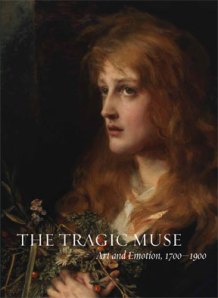 Anne Leonard with contributions by Joyce Suechen Cheng, Glenn W. Most, Erin Nerstad, Sarah Nooter, and Thomas Pavel, The Tragic Muse: Art and Emotion, 1700-1900, exhibition catalogue (Chicago: Smart Museum of Art, 2011), 128 pages, ISBN: 9780935573497, $30.
Published to coincide with the Smart Museum of Art’s exhibition The Tragic Muse, the publication draws on the work of several distinguished scholars to examine the richly varied representation of tragedy in the European artistic tradition over the course of two centuries. This catalogue is generously illustrated with full-color reproductions of all the works contained in the exhibition, and the fascinating contributions offer new insights into the approaches taken by the visual arts, as well as literature and drama, in expressing and eliciting strong emotions.
Study Day at The Wallace: Marquetry Furniture
From The Wallace:
Study Day, Getting to Grips: Magnificent Marquetry
The Wallace Collection, London, 9 February 2011
Join Jurgen Huber, Senior Furniture Conservator, for a detailed tour using some of the world’s finest 18th-century marquetry furniture to explain different techniques, then visit the conservation workshop to see a demonstration of cutting marquetry. Wednesday, 9 February 2011, 2:30-4:00pm, £10.
Exhibition: Baroque Ivory at the Court of Vienna
From the Liebieghaus Skulpturensammlung:
Ivory: Baroque Splendor at the Viennese Court / Elfenbein: Barocke Pracht am Wiener Hof
Liebieghaus Skulpturensammlung, Frankfurt am Main, 3 February — 26 June 2011
Curated by Maraike Bückling and Sabine Haag

Ignaz Bendl (1682–1730) "Medaillon commemorating the erection of the mercy columm," ca. 1692
Ivory has been one of the most popular materials since ancient times. Its origins in unknown faraway lands and its rarity account for its costliness. It was particularly the Baroque era that had an extraordinarily high demand for ivory. In the seventeenth century, ivory work reached its culmination in Vienna in the days of Prince Karl Eusebius of Liechtenstein and Emperor Leopold I. The shimmering appearance of the polished material served princely-imperial claims to prestige, as its possession testified to its owners’ power and wealth. The exhibition Ivory: Baroque Splendor at the Court of Vienna, presented in the Liebieghaus Skulpturensammlung from February 3 to June 26, 2011, will focus on this heyday of ivory art. It will feature thirty-six splendid, virtuoso carvings impressively documenting the artisans’ great skill, among them masterly executed statuettes, pitchers, goblets, tankards, and bowls of ivory, objects created for display in so-called cabinets of curiosities and not intended for any practical use. The show comprises works by the most famous ivory artists of the Baroque period, such as Adam Lenckhardt, Johann Caspar Schenck, and Matthias Steinl. It was prepared together with the Kunsthistorisches Museum in Vienna, whose world-renowned Cabinet of Wonders is closed for the time being because of comprehensive restoration measures. This presented the Liebieghaus with the unique opportunity to show a high-caliber selection of masterpieces from the Kunstkammer of the Kunsthistorisches Museum in Frankfurt before the items will be on display again on a permanent basis in Vienna after the Cabinet’s reopening in late 2012. Eight additional high-carat loans come from the Reiner Winkler Collection.

Matthias Steinl (1643/44–1727) "Allegory of the Elements of Water and Air," ca. 1688
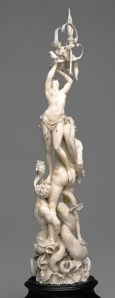
Matthias Steinl (1643/44–1727) "Allegory of the Elements of Water and Air," ca. 1688
In Ancient Greece, Phidias already created large statues of gods whose skin was executed in ivory, and the Bible describes Solomon’s throne as made up of ivory parts. It was above all in the Middle Ages and in the Baroque era that ivory was held in high esteem as a material. The great demand finally resulted in the emergence of new ports of entry in the seventeenth century; both the East India Company and the West India Company furthered the transport of African ivory in particular. The concentration on necessarily small-format ivory works fit in well with the fact that there were hardly any or no commissions at all conferred for large-size church or palace interiors during the Thirty Years’ War and the plague epidemics. Sculptors and their clients increasingly or entirely dedicated themselves to small mobile sculptures.
In the Renaissance and Mannerist periods, bronze was preferred for small sculptures. Yet, ivory outstripped the material in the course of the seventeenth century. People appreciated its combination of elasticity and hardness, as well as its gleaming transparency and delicate veining resembling the tone of flesh. The heyday of the production of ivory works in the seventeenth century was based on sixteenthcentury ivory turnery, on such early examples as those by the Master of the Furies. Besides the major bourgeois towns, the secular and ecclesiastical capitals became centers of ivory production from about 1650 on – a development that did not come to an end before the early eighteenth century. Ivory carvers were to be found mainly in Munich and Augsburg, but also in Schwäbisch Hall, Ulm, Mechlin, Amsterdam, Dresden, and Düsseldorf. (more…)
Call for Papers: Bluestockings
Bluestockings: The Social Network
Swansea University, 3-4 June 2011
Proposals due by 14 March 2011
This colloquium is the first in a series initiated by an AHRC-funded network whose purpose is to set in motion a project to edit Elizabeth Montagu’s letters. The c. 8,000 letters of the ‘Queen of the Bluestockings’ (1718-1800) have been described by Barbara Schnorrenberg as “among the most important surviving collections from the eighteenth century.” The Steering Committee comprises Caroline Franklin (Swansea), Elizabeth Eger (King’s, London), Nicole Pohl (Oxford Brookes), and Michael Franklin (Swansea) and our ultimate aim is a complete critical edition in electronic format, providing unparalleled access to these documents.
Our colloquium Bluestockings: The Social Network will be held on 3-4 June 2011 at Swansea University and the National Waterfront Museum, Swansea, featuring keynote lectures by Professor Betty Schellenberg and Professor Felicity Nussbaum. In attempting to diversify and extend our own network, we invite the contributions of editors and scholars working on aspects of bluestocking culture from a variety of disciplinary approaches, including history, literature, classics, politics, economics, linguistics, art, architecture and women’s studies. Possible themes and topics might include: the chief salonnières and their correspondents and how this interchange effected, in the words of David Hume, “the increase of arts, pleasures, and social commerce”; the distinctions between friendship, patronage and love; the role of letters in bridging distances. Consideration of the mixture of informality, intimacy and rivalry which characterized these overlapping networks of conversation, correspondence, criticism, and patronage will undoubtedly further the social and intellectual progress of our own twenty-first-century network. We welcome proposals for 20-minute papers. Please send abstracts of approximately 200 words to both Caroline Franklin c.franklin@swansea.ac.uk and Elizabeth Eger elizabeth.eger@kcl.ac.uk by 14 March 2011.
Exhibition: 300 Years of Exuberant Menswear
Press release from the Philadelphia Museum of Art:
The Peacock Male: Exuberance and Extremes in Masculine Dress
Philadelphia Museum of Art, 22 January — June 2011
Curated by Kristina Haugland
This lively exhibition contradicts the notion of men’s apparel as staid and restrained, especially when compared to women’s fashions. The Peacock Male: Exuberance and Extremes in Masculine Dress, drawn primarily from the Museum’s collection of Western fashion, examines 300 years of men’s sartorial display and includes flamboyant clothing as well as colorful accessories. It will be on view from January 22 through June 2011. “It’s a pleasure to be able to look at men’s clothing from a different perspective, as it is a subject that is often overlooked, even though menswear is now so creative and diverse,” said Kristina Haugland, Associate Curator of Costume and Textiles and Supervising Curator for the Study Room and Academic Relations. “Most people are surprised to find just how eye-catching men sought to be in the past, sporting extravagant floral embroidery, feathers, and flashy patterns. The exhibition is a great chance to show the wild side of masculine wear, from fur-crested helmets to high-tech sneakers.”
The exhibition opens with a look at the rich clothing worn by the eighteenth-century elite, from lavishly embroidered suits to zigzag-patterned silk stockings. During the nineteenth century, menswear tended to be sober by comparison, but could be accented with colorful accessories such as waistcoats, slippers or suspenders. Thematic sections in the exhibition highlight those occasions when even the most reserved man could don eye-catching clothes. A section dedicated to men’s costumes includes a star-spangled “Uncle Sam” outfit from the early twentieth century, a fuchsia silk satin fancy-dress ensemble from the late nineteenth century, and two mummers’ costumes – an English example from 1829 and a “Handsome Costume” made for Philadelphia’s famous parade in the 1990s, which represents a resplendent peacock with a ten-foot-wide tail. (more…)
Lecture in New York: Robert Adam against Palladio
From the Parsons website:
Erika Naginksi, Contra Palladio
Parsons The New School for Design, New York, 3 February 2011
This talk broaches the question of Palladio’s critical legacy from the vantage of Robert Adam’s repudiation of the prevailing Palladianism of his time. The aim here is two-fold: first, to consider how Classical eclecticism and an interest in what Adam construed as “movement … the rise and fall, the advance and recess” of architectural form might have functioned as correctives to what in his eyes stood as the rigidity, predictability and mimicry of the Palladian system (as laid down by Lord Burlington); and second, to speculate more broadly on the tension between, on the one hand, the architect’s ambition to recodify Palladio, and on the other, to renounce the results that codification inevitably produces.
Erika Naginski is Associate Professor at the Harvard Graduate School of Design. A historian of 17th- and 18th-century art and architecture, Naginski addresses early modern aesthetic philosophy and the critical traditions of architectural history. Her publications include Sculpture and Enlightenment (Getty Research Institute, 2009), a study of commemoration in an age of secular rationalism and revolutionary politics; Polemical Objects (2004), a special issue of Res co-edited with Stephen Melville, which explores the philosophy of medium in Hegel, Heidegger and others; and Writing on Drawing (2000) for the journal Representations, with essays on the collision of semiotics and mimesis in drawing practices. She has been a fellow at the Harvard Society of Fellows, The Radcliffe Institute for Advanced Study, the Clark Art Institute, and the Deutsches Forum für Kunstgeschichte. In 2007, she was awarded a John Simon Guggenheim Memorial Foundation Fellowship for a book project on the intersections of architecture, archaeology and conceptions of history in the late 17th and 18th centuries.










 Enfilade
leave a comment