Open Position: ‘Eighteenth-Century Studies’ Editor
ASECS is seeking a new editor and a new home for Eighteenth-Century Studies. Published quarterly by the Johns Hopkins University Press for ASECS, the journal is dedicated to maintaining and developing the Society’s special mission of interdisciplinarity and publishing the best in eighteenth-century scholarship. The Society will also accept applications from a team of two (and no more than three) editors at the same institution but representing different disciplines. The new editor will begin his/her duties for a five year term effective July 1, 2012.
Eighteenth-Century Studies is an endowed journal and the Society contributes to its support. The journal’s Editor can also rely on the support of an excellent team of book review editors, editorial board, and advisory editors.
Candidates should submit a letter of application describing their interest in and plans for the journal, together with a curriculum vitae for each prospective editor. In addition, the application should include a statement signed by the appropriate institutional officer pledging support for the journal for a term of at least five years. Institutional support shall include space, utilities, custodial services, release time for the editor(s), half-time secretarial support, and one-half the salary and benefits of a full-time managing editor who will, in addition to other duties, work with the Executive Director’s staff in securing and producing advertising revenue. It would be desirable if the host institution would also provide computer equipment and support facilities. The application deadline is November 15, 2011. The Search Committee has been asked to complete its work by February 17, 2012 so that the new editors can be announced at the annual meeting in San Antonio. Members are strongly encouraged to send to the Search Committee their comments on the direction they would like to see Eighteenth-Century Studies take in the future. Please send all applications materials, inquiries, nominations, and comments to the ASECS Business Office at asecs@wfu.edu.
Finally, the officers and Executive Board of ASECS wish to thank Julia Simon for her outstanding service as editor of ECS, and wish her the best of luck on her retirement from the journal.
Exhibition: ‘The First Actresses’ in London
Press release rom the NPG:
The First Actresses: Nell Gwyn to Sarah Siddons
National Portrait Gallery, London, 20 October 2011 — 8 January 2012
Curated by Gill Perry, supported by Lucy Peltz

John Hoppner, "Mrs. Robinson as 'Perdita'," 1782 © Chawton House Library, Hampshire
The first exhibition to explore art and theatre in eighteenth-century England through portraits of women will open at the National Portrait Gallery in October 2011. With 53 portraits, some brought together for the first time and others not previously seen in public, the exhibition will show the remarkable popularity of actress-portraits and provide a vivid spectacle of eighteenth-century femininity, fashion and theatricality. The First Actresses: Nell Gwyn to Sarah Siddons will show large paintings of actresses in their celebrated stage roles, intimate and sensual off-stage portraits and mass-produced caricatures and prints, and explore how they contributed to the growing reputation and professional status of leading female performers.
The exhibition will combine much-loved works by artists such as Joshua Reynolds, Thomas Gainsborough, John Hoppner, Thomas Lawrence, Johann Zoffany and James Gillray, with some newly discovered works such as the National Portrait Gallery’s new acquisition of the Three Witches from Macbeth by Daniel Gardner.
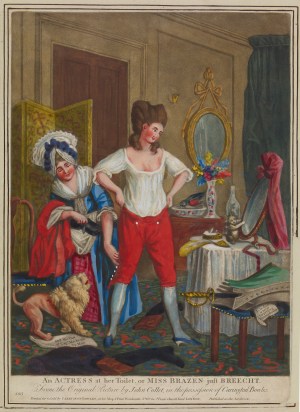
After John Collett, "An Actress at Her Toilet or Miss Brazen just Breecht," ca. 1779
Actresses featured in the exhibition include Nell Gwyn, Kitty Clive, Hester Booth, Lavinia Fenton, Peg Woffington, Sarah Siddons, Mary Robinson, Dorothy Jordan, Elizabeth Farren, Giovanna Baccelli and Elizabeth Linley. Highlights include a little known version of Reynolds’s famous portrait of Sarah Siddons as the Tragic Muse, Hogarth’s The Beggar’s Opera, Gainsborough’s portraits of Giovanna Bacelli and Elizabeth Linley. Important loans include works from the Garrick Club Library, the Royal Shakespeare Company, the National Gallery of Art, Washington, The Fitzwilliam Museum, Cambridge, Tate Britain, the V&A, as well as Petworth, Kenwood and Longleat Houses.
Starting with the emergence of the actress’s profession in the late seventeenth century, The First Actresses: Nell Gwyn to Sarah Siddons will show how women performers, in drama, as well as music and dance, were key figures within a spectacular celebrity culture. Fuelled by gossipy theatre and art reviews, satirical prints and the growing taste for biography, eighteenth-century society engaged in heated debate about the moral and sexual decorum of women on stage and revelled in the traditional association between actress and prostitute, or ‘whores and divines’. The exhibition will also reveal the many ways in which women performers stimulated artistic innovation and creativity and provoked intellectual debate.
As well as focusing on the eighteenth-century actress as a glamorous subject of high art portraits, and the ‘feminine face’ of eighteenth century celebrity culture, the exhibition will look at the resonances with modern celebrity culture and the enduring notion of the actress as fashion icon. As a counterpoint to the exhibition, an accompanying display will show photographic and painted portraits, drawn from the Gallery’s permanent collections, of some of today’s actresses, some of whom have agreed to be the exhibition’s ‘Actress Ambassadors’. A full list will be published prior to opening.
◊ ◊ ◊ ◊ ◊
An exhibition conference will take place on Friday, 11 November 2011.
Exhibition catalogue: Gill Perry with Joseph Roach and Shearer West, The First Actresses: Nell Gwyn to Sarah Siddons (London: National Portrait Gallery, 2011), 160 pages, ISBN: 9781855144118, £30.
Eighteenth-Century Maps: A Fair, a Lecture, and a New Reference Book
Press release from The London Map Fair:
2011 London Antique Map Fair
Royal Geographic Society, London, 11-12 June 2011

Johann Baptist Homann. "Sphærarum Artificialium Typica..." Nuremberg, ca.1730.
The 2011 London Map Fair, taking place in the historic surroundings of the Royal Geographical Society, is the most established and largest antiquarian map fair in Europe: over forty of the leading national and international specialist map dealers will be exhibiting in June. Visitors to the fair will discover a vast selection of original antique maps covering the whole world and printed between the 15th and 19th centuries. Highlights include a map of the universe by seventeenth-century Venetian cartographer Coronelli, revealing the Nine Circles of Hell as described in Dante’s Divine Comedy, as well as a 19th-century curiosity map of Europe depicting each country in the form of a caricature: the United Kingdom
figures as an old crone.
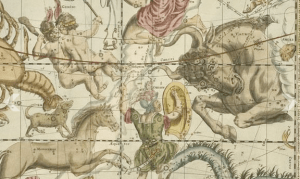
Johann Gabriel Doppelmayr, "Globi Coelestis," 1 of 6 Celestial Charts, Nuremberg, Homann, 1742
Other fine maps offered this year will include: an example of Ogilby’s innovative and incredibly detailed, 17th-century road map, marking all inns, churches and other landmarks on the road from London to Portsmouth – the course of the modern A3; an impression of Braun and Hogenberg’s bird’s-eye view of London; the earliest surviving printed plan of the city, dated 1574; and Christoph Vetter’s rare and beautiful 17th-century depiction of Bohemia stylised as a rose, with Prague at its centre and Vienna, the seat of the Hapsburg Dynasty, at its root. Exhibitors will offer atlases, travel books, globes, sea charts, town plans, celestial maps, topographical prints and
reference books; there are prices to suit all pockets ranging
from a very affordable £10 to over £100,000 for exceptional
pieces.
◊ ◊ ◊ ◊ ◊
2011 London Map Fair Lecture: Laurence Worms and Ashley Baynton-Williams
Royal Geographic Society, London, 11 June 2011
On Saturday, 11 June 2011, at 2:30pm, Laurence Worms and Ashley Baynton-Williams will launch their long-awaited Dictionary of British Map Engravers at the Fair. The product of over twenty years of research, it offers a wealth of fresh material on the map trade and a new insight into the lives of its most important figures, revealing some surprising links and relationships in the process.
◊ ◊ ◊ ◊ ◊
From the International League of Antiquarian Booksellers:
Laurence Worms and Ashley Baynton-Williams, British Map Engravers: A Dictionary of Engravers, Lithographers and Their Principal Employers to 1850 (London: Rare Book Society, 2011), approximately 750 pages, £125.
 The ultimate guide to the identification of British antique maps and their makers: An illustrated dictionary of over 1,500 members of the map trade in England, Ireland, Scotland and Wales, of British-born engravers working overseas and foreign engravers working in the British Isles, from the beginnings until the mid 19th century. Included are all the known engravers and lithographers, globemakers and retailers, the principal map sellers and publishers, key cartographers, makers of map-based games and puzzles, but also the remarkable lives of many artists, dealers and publishers, whose fates have been unknown so far. (more…)
June 2011 Issue of ‘The Art Bulletin’ — In Memory of Anne Schroder

Fragonard, "The Meeting," from the Progress of Love, 1771-73 (NY: The Frick Collection)
The June issue of The Art Bulletin is dedicated to the memory of Anne L. Schroder, who passed away suddenly in December 2010. The issue includes her article, “Fragonard’s Later Career: The Contes et Nouvelles and the Progress of Love Revisited,” pp. 150-177.
◊ ◊ ◊ ◊ ◊
Abstract: Late in his career, which spanned the Revolution and beyond, Honoré Fragonard revived two major projects in limbo since 1773. His unsuccessful effort to have engraved his illustrations for La Fontaine’s Contes et nouvelles (17880-1809) demonstrates the dramatic upheavals in the post-Revolutionary print market and publishing industries and shifting reactions to his art. The unfinished series Progress of Love, expanded and recontextualized by the artist during the late 1790s and early 1800s, reveals Fragonard’s adaptation of his perennial subjects — flirtation, love, and picturesque nature — to changing cultural attitudes regarding the sexual power of women in the aftermath of the Revolution.
Exhibition: ‘Italian Master Drawings’ in Washington
Press release from the National Gallery in DC:
Italian Master Drawings from the Wolfgang Ratjen Collection, 1525–1835
National Gallery of Art, Washington D.C., 8 May — 27 November 2011
Curated by Margaret Morgan Grasselli

Canaletto, "The Giovedì Grasso Festival before the Ducal Palace in Venice," 1763/1766 (Washington DC: National Gallery, Ratjen Collection, Paul Mellon Fund 2007.111.55)
Splendors of Italian draftsmanship from the Wolfgang Ratjen Collection, spanning the late Renaissance to the height of the neoclassical movement, will be showcased at the National Gallery of Art, Washington. On view in the Gallery’s West Building from May 8 to November 27, 2011, Italian Master Drawings from the Wolfgang Ratjen Collection, 1525–1835 will include 65 stunning Italian compositions and study sheets by the most important artists of the period, from Giulio Romano and Pellegrino Tibaldi to Canaletto, all three members of the Tiepolo family, and Giovanni Battista Piranesi.
In 2007, the National Gallery of Art acquired 185 German and Italian works from the Ratjen Collection—one of the finest private European holdings of old master drawings—with the help of 12 generous private donors as well as the Paul Mellon Fund and the Patrons’ Permanent Fund. “We are delighted to celebrate the second part of the Gallery’s acquisition of this exceptional group of German and Italian drawings formed by the great European collector Wolfgang Ratjen,” said Earl A. Powell III, director, National Gallery of Art. “The Italian portion of the collection is an assemblage of works of beauty and power. Italian drawings were in fact Ratjen’s first love, and he worked on this part of his collection with attentive care throughout his years as a collector.”

ISBN: 9781907372216, $50
Wolfgang Ratjen formed his Italian collection of drawings over a period of about 25 years. He grew up with two that had been acquired by his family during his youth—works by Guercino and Giovanni Battista Tiepolo—and he began collecting himself in the early-1970s. He purchased his last Italian drawing, by Giulio Cesare Procaccini, in July 1997. Ratjen’s collection of Italian drawings is best described as a group of single outstanding works, including famous artists as well as artists of lesser renown. For a select few—such as Jacopo Palma il Giovane, Guercino, and Giovanni Battista Tiepolo—he acquired multiple sheets that conveyed different facets of the artists’ styles or represented a variety of media used.
Organized chronologically throughout three galleries, the exhibition will present works that span three centuries, from the last flowering of the Renaissance around 1530 to the height of neoclassicism in the early 19th century. The works represent a dynamic range of techniques, including quick pen and ink sketches, finely nuanced chalk studies, and highly
finished brush drawings. (more…)
Call for Papers: Transnational History of Museums
As noted at Le Blog de L’ApAhAu and at OSK — Onderzoekschool Kunstgeschiedenis (Dutch Postgraduate School for Art History) . . .
Transnational History of Museums
Technische Universität Berlin, 17-18 February 2012
Proposals due by 15 June 2011
 Temple of muses, custodian of cultural heritage, site of memory, space for the mediation of taste and knowledge: The functions of the museum are manifold and are given different emphases, depending on the type of museum and the disciplinary outlook. However, the argument that the institution is a major venue for the construction of national identity has recurred again and again since the first royal collections were opened to the public around the middle of the eighteenth century. Indeed, the number of museum foundations was particularly high in Europe during the nineteenth century, when the modern nation-state was being established. Yet the tight linkage between nation-building and the birth of public collections has increasingly been called into question by recent scholarly work on the history of museums. Instead, local traditions have been stressed or international comparisons have been drawn upon in order to explain policies of collecting, the display of exhibits or the architectural design of individual galleries.
The aim of the planned conference is to go beyond the national framework in analyzing the institution of the museum. It offers an invitation to reflect from a transnational perspective upon the purposes and concepts of museums, museum practices, and the perception of museum culture. Which models from abroad were imported by museum representatives in order to give their own collections a certain profile? To what extent were “foreign” principles of order and hanging appropriated? Can the international networks on which museum experts relied be reconstructed? How can we describe the activities of commissions that were assigned to explore the organisation of museums beyond their geographic borders? Did an internationally inspired taste have any influence on the planning, the architectural settings or the compositions of collections? Do documents such as letters, travelogues or diaries written by museum visitors give concrete indications of a comparative, transnational perception?
Central to the conference is the discussion of the museum as a space of, even product of, cross-border processes of exchange and transfer. Seen from this angle, an examination of the museum of art, in particular, is to be carried out, also taking into account archaeological and historico-cultural collections, arts and crafts museums and the so-called universal museums inside and outside of Europe. Chronologically, the conference sets in around 1750, at that point in history when there was a gathering momentum of the crucial characteristics of the modern museum of art still familiar today: public access, an independent exhibition space or building, the application of scientific principles of order, or didactic aspirations. A second chronological benchmark ? before the caesura of World War II? is the conference that took place in Madrid in 1934. For the first time, museum experts from all over the world came together and thus made the museum, as such, very literally the pivotal subject of intense international discussion.
The conference will be held on Friday, February 17, and Saturday, February 18, 2012 at the Technische Universität Berlin. Please submit proposals of about 1.000 characters for papers not exceeding 30 minutes by June 15, 2011 to Prof. Dr. Bénédicte Savoy (benedicte.savoy@tu-berlin.de) or Dr. Andrea Meyer (andrea.meyer@tu-berlin.de). Languages of the conference are German, English and French.
Exhibition and Conference: ‘Palladio and His Legacy’
This show which was at the Morgan last summer opens at Notre Dame with a full conference this weekend. My sense is that the exhibition functions rather differently in these two venues — one might think not only about the reception of Palladio but also the reception of the exhibition. From the Snite website:
Palladio and His Legacy: A Transatlantic Journey
The Morgan Library and Museum, New York, 2 April — 1 August 2010
National Building Museum, Washington D.C., 2 September 2011 — 30 January 2011
Snite Museum of Art, Notre Dame, 5 June — 31 July 2011
Carnegie Museum of Art, Pittsburgh, 3 September — 31 December 2011
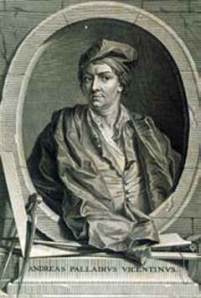
Conjectural portrait of Andrea Palladio, ca. 1715, engraved after Sebastiano Ricci (RIBA British Architectural Library)
This traveling exhibition organized by the Royal Institute of British Architects in association with the Centro Internazionale di Studi di Architettura Andrea Palladio, Vicenza, offers a rare opportunity to see thirty-one drawings by the famous 16th-century architect, Andrea Palladio, along with seven books, fifteen models of related buildings, and eight bas-reliefs of some of the drawings (3-D projections of architectural drawings).
The Late Italian Renaissance master Andrea Palladio (Italian, 1508–1580) is the most influential architect of the last 500 years. His architecture synthesized the lessons of the ancient Romans with the achievements of his predecessors and contemporaries, including Bramante, Raphael, and Michelangelo. Palladio’s mastery of the classical orders, proportion, and harmony was unparalleled. His projects in Venice and the surrounding region set new standards in design and redefined the potential of the art form, especially for domestic structures.
◊ ◊ ◊ ◊ ◊
From Vernacular to Classical: The Perpetual Modernity of Palladio
University of Notre Dame School of Architecture, 10-12 June 2011
Bringing together scholars, practitioners, educators, and students from various disciplines, the conference will explore how the Palladian tradition inspires the evolution of classical architecture. One of the most influential architects in history, 16th-century Italian Andrea Palladio’s impact is evident throughout the United States. Buildings such as the White House, the U. S. Capitol, the U.S. Supreme Court, and the National Gallery of Art bear his imprint. Thomas Jefferson’s Virginia home, Monticello, is modeled after Palladio’s famed Villa Rotonda in Vicenza, Italy. Conference participants will reconnect Palladian ideals to the living tradition that has informed these icons of American democracy and continue to shape vital paradigms for sustainable architecture and urbanism. Two exhibitions, Palladio and His Legacy: A Transatlantic Journey at the University of Notre Dame’s Snite Museum of Art and the New Palladians, an exhibition of 50 international classical architects’ work in the Bond Hall Gallery, also will be held in conjunction with the conference.
C O N F E R E N C E S C H E D U L E (more…)
Turkish Taste at the Frick Opens June 8
In conjunction with the exhibition at the Frick Collection, Turkish Taste at the Court of Marie-Antoinette (opening June 8), the museum is hosting a seminar on Monday, 27 June, 6:00-7:30 p.m. From the Frick’s website:
Carlotte Vignon and Adrienne L. Childs, Turkish Taste at the Court of Marie-Antoinette
The Frick Collection, New York, 27 June 2011
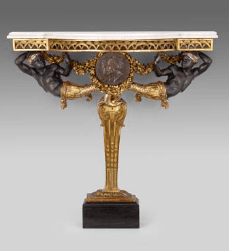
Small Console Table with Supporting Figures of Nubians (one of a pair), c.1780, gilded and painted wood and marble slab (NY: The Frick Collection), photo by Michael Bodycomb
This seminar will offer participants a detailed look at several objects from the special exhibition. Charlotte Vignon will discuss the Frick’s two French console tables, which feature Nubian slaves with pearl-accented turbans, floral garlands, and a frieze of crossed crescents, a symbol of the Ottoman Empire. She will also examine a pair of firedogs from Marie-Antoinette’s Turkish boudoir at Fontainebleau, on loan from the Musée du Louvre, and a pair of wall panels created for the Turkish cabinet of her brother-in-law, the comte d’Artois, from The Metropolitan Museum of Art. Click here to register at the regular rate of $100 per person. Members of The Frick Collection may click here to register at the discounted membership rate of $90 per person. Discounts will be applied upon verification of membership. To register over the phone, please call 212.547.0704.
Conference at York: The Portrait and the Country House
From York’s Centre for Eighteenth-Century Studies:
Placing Faces: The Portrait and the Country House in the Long Eighteenth Century
King’s Manor, York, 11 June 2011
Postgraduate Organisers: Jordan Vibert and Hannah Lyons
This interdisciplinary conference is concerned with the complex relationship between eighteenth-century portraits and the places they were so often ultimately destined for – the country houses of Britain’s landed elites. These grand houses were vast public spaces, used by their owners to systematically showcase their political power and social status. Commissioning and displaying portraits was one way in which a family could aggrandize themselves, whether by making a genealogical link to a military hero or a royal relative, or by making a broader national claim to political allegiance or imperial dominance. But portraits could also interact with country houses in other quite surprising ways, drawing together seemingly disparate contexts and narratives to create new and unexpected meanings. A portrait of a woman, for example, could vastly complicate seemingly confident masculine displays of martial heroism and political power, while a depiction of a dead child might forge unsettling connections between private grief and public narratives of bloody warfare and imperial dominion. It is these complex interactions between the portrait and the wide array of familial and national narratives at work in the country house that this conference sets out to unravel. Our speakers are a mixture of established academics, professional curators and young researchers working in a range of disciplines and environments.
P R O G R A M M E Printer-friendly programme (Word. doc)
10.30 Registration and tea/coffee
11.00 Session 1: The Portrait and the Estate
- Keynote Speaker – Dr Kate Retford (Birkbeck College, University of London) ‘The Topography of the Conversation Piece – A Walk around Wanstead’
- Dr Leslie Johansen (Council for British Archaeology) ‘A Look into the Prospect Beyond: The Portrait and the English Designed Landscape’
12.30 Lunch
1.25 Session 2: Collection and Display
- Desmond Shawe-Taylor (Surveyor of the Queen’s Pictures) ‘George IV as a Collector of full-length Portraits’
- Professor Marcia Pointon (University of Manchester) ‘The Woburn Abbey Portraits’
2.40 Tea/coffee
3.10 Session 3: Gendered Displays
- Professor Gill Perry (Open University) ‘Dirty Dancing at Knole: Portraits of Giovanna Baccelli and the Performance of ‘Public Intimacy’
- Jordan Vibert (University of York) ‘Lady Anne Stanhope and Sir Francis Blake Delaval at Ford Castle: Female Sociability, Military Masculinity and the Seven Years’ War’
The conference fee is £12 (£10 for registrations received before 31st March). This fee includes tea, coffee and a simple sandwich lunch.
For details concerning registration, consult the CECS website.
Exhibition: The Düsseldorf Gallery and Its Catalogue
Press release from the Getty:
Display and Art History: The Düsseldorf Gallery and Its Catalogue
Getty Research Institute, Getty Center, Los Angeles, 31 May — 21 August 2011
Curated by Thomas Gaehtgens and Louis Marchesano
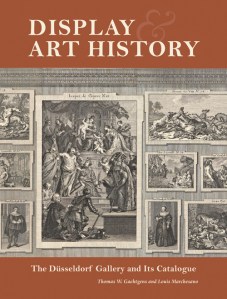
ISBN: 9781606060926, $20
Display and Art History: The Düsseldorf Gallery and Its Catalogue illustrates the making of one of the earliest modern catalogues, La galerie électorale de Dusseldorff (1778), a revolutionary two-volume publication that played a significant role in the history of museums and helped mark the transition from the Baroque to the Enlightenment.
Constructed by Elector Palatine Johann Wilhelm II von der Pfalz between 1709 and 1714, the Düsseldorf gallery is an early example of exhibiting an art collection in a nonresidential structure. It charted the course toward what would eventually become the institution of the public museum. The Düsseldorf gallery featured a new system of display in which the arrangement of objects was determined by art historical principles such as style and school, rather than subject. Published in the second half of the eighteenth century, the Düsseldorf catalogue represented this new display in numerous etchings; the accompanying text sought to educate a broader circle of readers.
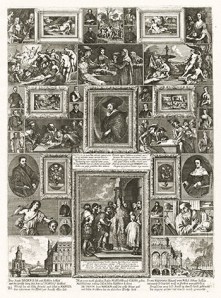
Fictive Wall of Paintings from the Imperial Collection in Vienna, Frans van Stampart and Anton Joseph von Prenner, etching. Prodromus (Vienna, 1735), pl. 21. 88-B2961
Display and Art History: The Düsseldorf Gallery and Its Catalogue, on view at the Getty Research Institute at the Getty Center from May 31 through August 21, 2011, showcases the exquisite watercolors, red chalk drawings, and architectural elevations that were used to produce this revolutionary catalogue. The exhibition explores their role in the printmaking process and underscores their value as precious works of art created by accomplished draftsmen. “We are most fortunate to have an almost complete set of preparatory drawings in our archives, which allows for the reconstruction of this ambitious enterprise and reflects a pivotal moment in the history of art as well as the history of the art museum,” says Thomas Gaehtgens, Director of the Getty Research Institute.
Prince-elector Johann Wilhelm II assembled one of the most important European art collections of the eighteenth century. He constructed a gallery to exhibit his nearly 400 paintings, 46 of which were by Peter Paul Rubens. At the time, many princes were reorganizing their substantial collections in order to convey the message that they not only possessed a wide variety of artistic treasures but were also able to care for them properly and make
them available for study.

Pierre-Louis de Surugue's etching after the "The Night" by Correggio, 1753–1757. Karl Heinrich von Heinecken, Recueil d'estampes d'apres les plus celebres tableaux de la Galerie Royale de Dresde..., vol. 2 (Dresden, 1757), pl. 1.
A generation later, Prince-elector Carl Theodor von der Pfalz, Johann Wilhelm’s nephew and successor, commissioned Lambert Krahe, director of the Düsseldorf Academy and gallery, to rehang the paintings collection following its storage during the Seven Years’ War (1756-63). Krahe broke with the Baroque tradition of decoratively covering entire walls with paintings. Instead, he displayed the paintings in a didactic, symmetrical arrangement ordered by schools, thus introducing a completely new and modern system of organizing art. Rather than hanging paintings frame-to-frame, Krahe integrated space between them, preserving their identity as separate works of art. This new display encouraged viewers to draw comparisons.
The Düsseldorf catalogue similarly fostered learning and education, in addition to celebrating the prestige of the collector. Produced by court architect Nicolas de Pigage, printmaker Christian von Mechel, and linguist Jean-Charles Laveaux, the catalogue illustrates Krahe’s display of paintings on the gallery walls. Unlike earlier catalogues that only provided brief inventories, Pigage’s publication offers an analysis of each painting that was aimed at an educated public. “In this sense, the catalog was very much a work of the Enlightenment, and the princely gallery, accessible to interested visitors,
became more like a museum as we understand it today,” says Gaehtgens.
Louis Marchesano, the GRI’s Curator of Prints and Drawings, adds, “The catalogue no longer simply represented princely magnificence; it now also fostered aesthetic reflection and art historical education.”
◊ ◊ ◊ ◊ ◊
Exhibition catalogue: Thomas W. Gaehtgens and Louis Marchesano, Display and Art History: The Düsseldorf Gallery and Its Catalogue (Los Angeles: Getty Publications, 2011), 104 pages, ISBN: 9781606060926, $20.










 Enfilade
leave a comment