Call for Articles: Special Issue of ‘World History Connected’
Special Issue of World History Connected: Art in World History
Submissions due 1 December 2011
The February 2012 issue of the online journal World History Connected will focus on “Art in World History.” It seeks to offer case studies and effective methodological and/or pedagogical approaches highlighting this important aspect of both research and teaching in the field of world history. The editor of the journal, Marc Jason Gilbert, and the guest editor of this forum, Ralph Croizier, seek five sorts of contributions: (more…)
Exhibition: The Young Tiepolo, The Discovery of Light
Xavier Salomon reviews the exhibition in the October issue of The Burlington (pp. 698-99). From the Udine website:
Il giovane Tiepolo: la scoperta della luce
Civic Museum of Udine, Castello, Udine, 4 June — 4 December 2011
Curated by Giuseppe Pavanello and Vania Gransinigh
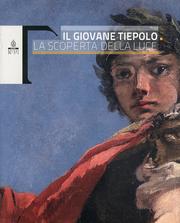
ISBN: 9788895752112
Che cosa caratterizza l’esordio di un giovane pittore di genio? Quali percorsi mentali e creativi presiedono alla formazione di un artista di talento? A questa e ad altre domande proverà a dare risposta la mostra che i Civici Musei di Udine inaugurano il 4 giugno 2011 all’interno della terza edizione delle Giornate del Tiepolo. L’esposizione, dal titolo Il giovane Tiepolo: la scoperta della luce, è rivolta proprio a ricostruire, attraverso le opere più significative, il periodo giovanile dell’attività di Tiepolo, prima del suo soggiorno udinese del 1726.
Se, nel corso del suo apprendistato presso la bottega del pittore accademico Gregorio Lazzarini, l’artista ebbe modo di confrontarsi con i modelli offerti dalla tradizione figurativa veneta del Cinquecento, egli si dimostrò particolarmente attento anche a quanto i suoi contemporanei andavano sperimentando, e alle nuove teorie sulla luce di ispirazione newtoniana. Le opere di Federico Bencovich e Giambattista Piazzetta rappresentarono per il giovane Tiepolo un punto di riferimento ugualmente importante che egli seppe assimilare in maniera originale, in sintonia con il suo essere “tutto spirito e foco,” attraverso un linguaggio pittorico costruito sull’interpretazione luminosa dell’immagine. Ed è proprio su questa peculiare visione tiepolesca della luce che l’esposizione udinese si focalizza, ripercorrendo il tracciato di un’attività che dalle tele dipinte per la chiesa veneziana dell’Ospedaletto si dipana, per il tramite delle decorazioni di Palazzo Sandi, fino al ciclo di affreschi realizzati a Udine nel Palazzo Patriarcale.
I dipinti in esposizione permettono così di documentare il passaggio da una pittura costruita nella luce, secondo precise fonti di illuminazione interne all’immagine, a una pittura costruita dalla luce, nella quale forme e volumi appaiono generati, come vetro soffiato, dall’interna energia luminosa della materia. In mostra sono presentate opere provenienti dai musei di Venezia, Milano, Torino e da alcune delle più prestigiose collezioni pubbliche e private internazionali.
Comitato scientifico: Svetlana Alpers, William L. Barcham, Linda Borean, Caterina Furlan, Peter O. Krückmann, Giuseppe Pavanello e Catherine Whistler.
◊ ◊ ◊ ◊ ◊
Catalogue: Giuseppe Pavanello and Vania Gransinigh, eds., Il Giovane Tiepolo. La Scoperta della Luce (Udine: Civici Musei e Gallerie di Storia e Arte di Udine, 2011), 207 pages, ISBN: 9788895752112, €45 / $87.50.
George Washington Life Mask
With Halloween around the corner, ’tis the season for masks: The Morgan Library and Museum in New York City features an online exhibition where virtual museum-goers can digitally examine the life mask of George Washington. The high- definition zoom technology allow viewers to inspect the details of the mask without having to travel to the brick-and-mortar museum. -AS
Excerpt from the online exhibition:
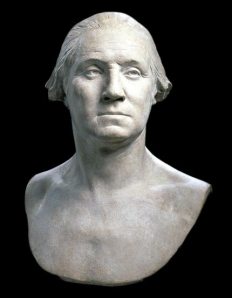
Jean-Antoine Houdon, "Bust of George Washington" clay (Mount Vernon, Virginia)
In 1785 the French sculptor Jean-Antoine Houdon visited George Washington (1732–1799) at his Mount Vernon residence. There he observed the general and made a plaster cast of his face—the Morgan’s life mask. He then used the mask to complete the face on his clay bust of Washington, which he left at Mount Vernon (Fig. 1). Houdon returned with the life mask to Paris, where he sculpted the final marble life-size sculpture of Washington now in the Richmond Capitol (Fig. 2). The statue was commissioned by the Virginia legislature and was erected in 1796, the year Washington issued his farewell address following his second term as president. The Morgan’s life mask of Washington is unique and represents the truest likeness of the country’s first president. Pierpont Morgan likely acquired the mask in Rome from the son of the American sculptor William Wetmore Story.
In order to make a mold of Washington’s face, Houdon had the general lie down. He prepared Washington’s face with a protective layer of grease and covered his eyes before adding a coat of wet plaster, inserting straws in the general’s nose so that he could breathe. Once the plaster hardened, Houdon removed the cast and poured plaster into the mold to make a positive model, destroying the mold in the process. It is this positive model that constitutes the Morgan’s life mask. Because Washington’s eyes were closed, in the final mask Houdon had to sculpt the open eyes based on caliper measurements, as well as retouch the nostrils, which were hampered by the breathing apparatus. The air bubbles in Washington’s cheeks were produced as the plaster settled in the mold.
The life mask recently served as a starting point for a team of forensic anthropologists working at Mount Vernon to re-create effigies of the “real” George Washington at three different moments in his life. Using the Morgan’s cast of the fifty-three-year-old Washington’s face, scientists were able to project the changes in his bone structure and appearance from his youth through old age. . . .
More information is available here»
Call for Papers: Women Artists in Italy, 1500-1750
Women Artists in Early Modern Italy
The Medici Archive Project, Florence, 3 March 2012
Proposals due 1 December 2011
 The Jane Fortune Research Program on Women Artists in the Age of the Medici at The Medici Archive Project is organizing a one-day conference (Florence, March 3, 2012) to highlight new documentary findings on the creative production of women in the visual arts (broadly defined) in the period 1500-1750.
Researchers have been exploiting historical archives to answer such questions as, What were the lives of women artists like in early modern Italy? Did their creative production take its cues from the social, cultural and professional circumstances that characterized their careers? Did they operate workshops similarly to male artists? Did their techniques for attracting patronage and setting prices follow the example of male artists? Where else besides the professional artist’s studio did women engage in the visual arts? Are there works of art by women artists that can be identified, dated or otherwise clarified by means of archival evidence? This conference offers an opportunity for comparing findings on early modern women artists and for examining a range of useful archival strategies and historiographic methodologies.
Although Italian women artists are of primary concern at this conference, papers on women artists of other countries are welcome particularly if they can be linked with the Medici or if their works were collected by any of the Medici (as in the case of Rachel Ruysch for instance). We are also particularly keen to include papers dealing with the collecting and display of works by women artists in the years 1500-1750, as well as papers that characterize the patronage enjoyed by women artists of this period.
To apply, please submit by December 1, 2012, a paper title, a one-page abstract either in English or Italian, and a curriculum vitae. Submissions should be sent via email to Dr. Sheila Barker: barker@medici.org
Lecture: Susan Siegfried on Boilly
At the Dallas Museum of Art:
The Eighth Annual Michael L. Rosenberg Lecture
Louis Léopold Boilly: Between Genre and Portraiture
Dallas Museum of Art, 3 November 2011

Louis-Léopold Boilly, "A Family Admiring a Portrait of a Lady in an Interior," ca. 1790, oil on canvas, 17 1/2 x 21 in. (44.45 x 53.34 cm), The Michael L. Rosenberg Foundation
Focusing on Louis-Léopold Boilly’s Woman Showing her Portrait, this lecture explores the richly imaginative interchange between genre painting and portraiture in the eighteenth century. Join distinguished scholar Dr. Susan L. Siegfried, Denise Riley Professor of the History of Art and Women’s Studies at the University of Michigan, as she describes how the easy exchanges between the real and the fantasy elements of these two categories of subject matter evidently facilitated the imaginative participation of patrons and viewers in ascribing meanings to them.
Thursday, November 3
7:30 p.m., C3 Theater
Included in general admission to the Museum
Call for Papers: Historical Jewish Districts
Jews and Jewish Districts in Europe, 18th to 21th Centuries
11th International Conference on Urban History
Charles University, Prague, 29 August — 1 September 2012
Proposals due by 15 November 2011
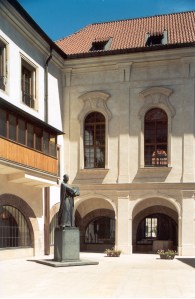
Charles University, Prague
Panel organizers invite paper proposals for the session Jews and Jewish Districts in Europe, 18th to 21th Centuries in conjunction with the 11th International Conference on Urban History, sponsored by The European Association for Urban History. Focusing on ‘Cities & Societies in Comparative Perspective’, the conference will be held in Prague from 29 August to 1 September 2012. More information is available at the conference website. For online submission visit www.eauh2012.com/sessions/call-for-paper-proposals/.
◊ ◊ ◊ ◊ ◊
The European Association for Urban History was established in 1989 with the support of the European Union. Conferences are organised every two years. These biannual conferences provide a multidisciplinary forum for historians, sociologists, geographers, anthropologists, art and architectural historians, economists, planners and all others working on different aspects of urban history. Membership in the Association is free of charge, and is demonstrated
by repeated active participation at the conferences.
The Association supports participation of young scholars by stipends, which cover registration fees, and since 2010 it even offers mobility stipends in a limited number of justified cases. Up to now 10 conferences have been organised. The first one took place in Amsterdam in 1992; twenty years after this first conference, we will meet in Prague. You are sincerely welcome to join us.
Conference: Secularization and the Libraries of Europe
The primary concerns of this Bodleian conference are neither art historical nor even visual, but there are lots of eighteenth-century offerings around a fascinating topic that is, I think, often understood exclusively as a problem for the sixteenth and seventeenth centuries. In addition to providing the following description, the conference website includes a full list of speakers and paper titles. -CH
◊ ◊ ◊ ◊ ◊
How the Secularization of Religious Houses Transformed the Libraries of Europe
St. Anne’s College, Oxford, 22-24 March 2012
 The dissolution of religious houses transformed both the physical and intellectual spaces in which books and manuscripts were held. The process broke the Church’s earlier dominance in learning and libraries. All of Europe felt these changes between the 16th and 19th centuries, but the results were different in each country. In some cases libraries were scattered or destroyed; in other cases books were taken over as state property. This was an epochal change, affecting thousands of libraries and millions of books, and it transformed the shape of libraries and widened access to heritage books. It increased turnover in the book-market, opened a new interest in collecting books, and fostered the growth of public libraries.
This conference draws together international scholars to examine, for the first time in comparative perspective, the impact that the secularization of
libraries had on the intellectual patrimony of Europe. For registration
information and to see the full list of speakers and themes, visit the
conference website.
Call for Papers: Graduate Student Symposium at Boston
Boston University Graduate Student Symposium on the History of Art & Architecture
Boston University, 2-3 March 2012
Proposals due 28 November 2011
The 28th Annual Boston University Graduate Student Symposium on the History of Art & Architecture invites submissions exploring the role of doubles, multiples, and copies in artistic production from antiquity to the present.
Possible topics include, but are not limited to, the following: molds, casts, and replicas; afterimages, mirror images, twinning/tripling, and “mise en abyme”; serial formats and presentations; Janus or Gemini figures, uncanny doubles, doppelgangers, and evil twins; the replication or reappearance of architectural elements and structures; mimicry and mimesis; issues of reproduction in photography, print culture, media, and mass production; copying and emulation in practice and pedagogy; work that problematizes, resists, or elides duplication or multiplication; appropriation, plagiarism, and copyright issues; the re-presentation of works or performances; relationships between facsimiles and originals; and dialogues between final products and sketches or models.
We welcome submissions from graduate students at all stages of their studies, working in any area or discipline. Please email a 500-word abstract and CV as attachments to Leslie K. Brown, Symposium Coordinator, at lkbrown@bu.edu by November 28, 2011. Papers should be 20 minutes in length and selected speakers will be notified before January 1st. The Symposium will be held March 2-3, 2012, with a keynote lecture (TBD) at the Boston University Art Gallery at the Stone Gallery on Friday evening and paper presentations on Saturday in the Riley Seminar Room of the Museum of Fine Arts, Boston.
This event is generously sponsored by The Boston University Center for the Humanities; the Boston University Department of History of Art & Architecture; the Museum of Fine Arts, Boston; the Boston University Graduate Student History of Art & Architecture Association; and the Boston University Art Gallery at the Stone Gallery.
New Acquisition: Gainsborough and the Netherlands
News of this recent acquisition, as noted by Hélène Bremer, is remarkable in itself given the importance of the Dutch for eighteenth-century landscape paintings. That funds were raised in part through crowd funding makes it all the more interesting:
 The Rijksmuseum Twenthe in Enschede, a museum with an emphasis on seventeenth- and eighteenth-century art, has acquired the first painting by Thomas Gainsborough for a Dutch museum. Crowd funding this summer secured the painting for the museum collection. Wooded Landscape (1745-46), an early work made in Suffolk, will be on display in the specially created Landscape Gallery until early January. The addition of this landscape by Gainsborough to the collection will mean that Rijksmuseum Twenthe will be one of the few museums in the world which can show the influence that Dutch seventeenth century artists had on both English and Dutch painters of the eighteenth century.
The Irish Country House
From the Irish Georgian Society:
The Irish Country House: Its Past, Present and Future
Lettsom House, London, 20 October 2011
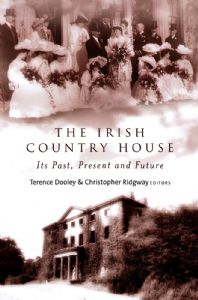
ISBN: 9781846822346
Since the founding of the IGS over fifty years ago, considerable change has taken place in the fortunes of and attitudes to the Irish country house and these changes have been discussed each year at the Annual Historic Houses of Ireland Conference and now published in a book of essays titled The Irish Country House: Its Past, Present and Future, edited by Dr Terence Dooley and Dr Christopher Ridgway and published by Four Courts Press.
Launched earlier this year at the 9th Historic Houses of Ireland Conference, this marvelous collection of essays looks at dozens of houses across a range of time periods, covering a diversity of topics relating to the architecture of these buildings, the people who lived in them, and the position and perception of the Big House in Ireland. Essays include, Terence Dooley – “Social life at Castle Hyde, 1931–88”, Christopher Ridgway – “Making and meaning in the Historic House: new perspectives in England, Ireland and Scotland” and Allen Warren – “The Twilight of the Ascendancy and the Big House.” The London Chapter is delighted to welcome Drs Dooley and Ridgway to discuss these and other aspects of the Irish country house.
Dr Dooley, MA, Ph.D. (NUI), H. Dip. Ed. is senior lecturer at National University of Ireland at Maynooth and Director of the Centre for the Study of Historic Irish Houses and Estates, of which one of its key functions is the organisation of the Annual Historic Houses of Ireland Conference with the aim of promoting focus and recognition for new scholarship and other developments in the field of built heritage studies. Dr Dooley is responsible for the MA in Historic House Studies at Maynooth and author of The Decline of the Big House in Ireland: A Study of Irish Landed Families, 1860-1960 (2001) and A Future For Irish Historic Houses: A Study of 50 Houses (2003) among others. Dr Ridgway, FSA, has been curator at Castle Howard since 1985 and has written and lectured widely on its architecture, gardens and collections. Dr Ridgway is a member of the Board of the National Trust for Scotland and Adjunct Professor in the History Department at the NUI.
The lecture is at Lettsom House, 11 Chandos Street, London W1G 9EB. The nearest tube station is Oxford Circus. Wine will be served from 6.30pm with the lecture commencing at 7pm and costs £12 per person. If you would like to attend, please send your completed application form and cheque to Colm Owens, Apartment 50, Kilner House, Clayton Street, London SE11 5SE. Please note that tickets will not be issued.










 Enfilade
leave a comment