Call for Papers: Women Artists in Italy, 1500-1750
Women Artists in Early Modern Italy
The Medici Archive Project, Florence, 3 March 2012
Proposals due 1 December 2011
 The Jane Fortune Research Program on Women Artists in the Age of the Medici at The Medici Archive Project is organizing a one-day conference (Florence, March 3, 2012) to highlight new documentary findings on the creative production of women in the visual arts (broadly defined) in the period 1500-1750.
Researchers have been exploiting historical archives to answer such questions as, What were the lives of women artists like in early modern Italy? Did their creative production take its cues from the social, cultural and professional circumstances that characterized their careers? Did they operate workshops similarly to male artists? Did their techniques for attracting patronage and setting prices follow the example of male artists? Where else besides the professional artist’s studio did women engage in the visual arts? Are there works of art by women artists that can be identified, dated or otherwise clarified by means of archival evidence? This conference offers an opportunity for comparing findings on early modern women artists and for examining a range of useful archival strategies and historiographic methodologies.
Although Italian women artists are of primary concern at this conference, papers on women artists of other countries are welcome particularly if they can be linked with the Medici or if their works were collected by any of the Medici (as in the case of Rachel Ruysch for instance). We are also particularly keen to include papers dealing with the collecting and display of works by women artists in the years 1500-1750, as well as papers that characterize the patronage enjoyed by women artists of this period.
To apply, please submit by December 1, 2012, a paper title, a one-page abstract either in English or Italian, and a curriculum vitae. Submissions should be sent via email to Dr. Sheila Barker: barker@medici.org
Lecture: Susan Siegfried on Boilly
At the Dallas Museum of Art:
The Eighth Annual Michael L. Rosenberg Lecture
Louis Léopold Boilly: Between Genre and Portraiture
Dallas Museum of Art, 3 November 2011

Louis-Léopold Boilly, "A Family Admiring a Portrait of a Lady in an Interior," ca. 1790, oil on canvas, 17 1/2 x 21 in. (44.45 x 53.34 cm), The Michael L. Rosenberg Foundation
Focusing on Louis-Léopold Boilly’s Woman Showing her Portrait, this lecture explores the richly imaginative interchange between genre painting and portraiture in the eighteenth century. Join distinguished scholar Dr. Susan L. Siegfried, Denise Riley Professor of the History of Art and Women’s Studies at the University of Michigan, as she describes how the easy exchanges between the real and the fantasy elements of these two categories of subject matter evidently facilitated the imaginative participation of patrons and viewers in ascribing meanings to them.
Thursday, November 3
7:30 p.m., C3 Theater
Included in general admission to the Museum
Call for Papers: Historical Jewish Districts
Jews and Jewish Districts in Europe, 18th to 21th Centuries
11th International Conference on Urban History
Charles University, Prague, 29 August — 1 September 2012
Proposals due by 15 November 2011
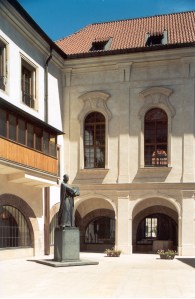
Charles University, Prague
Panel organizers invite paper proposals for the session Jews and Jewish Districts in Europe, 18th to 21th Centuries in conjunction with the 11th International Conference on Urban History, sponsored by The European Association for Urban History. Focusing on ‘Cities & Societies in Comparative Perspective’, the conference will be held in Prague from 29 August to 1 September 2012. More information is available at the conference website. For online submission visit www.eauh2012.com/sessions/call-for-paper-proposals/.
◊ ◊ ◊ ◊ ◊
The European Association for Urban History was established in 1989 with the support of the European Union. Conferences are organised every two years. These biannual conferences provide a multidisciplinary forum for historians, sociologists, geographers, anthropologists, art and architectural historians, economists, planners and all others working on different aspects of urban history. Membership in the Association is free of charge, and is demonstrated
by repeated active participation at the conferences.
The Association supports participation of young scholars by stipends, which cover registration fees, and since 2010 it even offers mobility stipends in a limited number of justified cases. Up to now 10 conferences have been organised. The first one took place in Amsterdam in 1992; twenty years after this first conference, we will meet in Prague. You are sincerely welcome to join us.
Conference: Secularization and the Libraries of Europe
The primary concerns of this Bodleian conference are neither art historical nor even visual, but there are lots of eighteenth-century offerings around a fascinating topic that is, I think, often understood exclusively as a problem for the sixteenth and seventeenth centuries. In addition to providing the following description, the conference website includes a full list of speakers and paper titles. -CH
◊ ◊ ◊ ◊ ◊
How the Secularization of Religious Houses Transformed the Libraries of Europe
St. Anne’s College, Oxford, 22-24 March 2012
 The dissolution of religious houses transformed both the physical and intellectual spaces in which books and manuscripts were held. The process broke the Church’s earlier dominance in learning and libraries. All of Europe felt these changes between the 16th and 19th centuries, but the results were different in each country. In some cases libraries were scattered or destroyed; in other cases books were taken over as state property. This was an epochal change, affecting thousands of libraries and millions of books, and it transformed the shape of libraries and widened access to heritage books. It increased turnover in the book-market, opened a new interest in collecting books, and fostered the growth of public libraries.
This conference draws together international scholars to examine, for the first time in comparative perspective, the impact that the secularization of
libraries had on the intellectual patrimony of Europe. For registration
information and to see the full list of speakers and themes, visit the
conference website.
Call for Papers: Graduate Student Symposium at Boston
Boston University Graduate Student Symposium on the History of Art & Architecture
Boston University, 2-3 March 2012
Proposals due 28 November 2011
The 28th Annual Boston University Graduate Student Symposium on the History of Art & Architecture invites submissions exploring the role of doubles, multiples, and copies in artistic production from antiquity to the present.
Possible topics include, but are not limited to, the following: molds, casts, and replicas; afterimages, mirror images, twinning/tripling, and “mise en abyme”; serial formats and presentations; Janus or Gemini figures, uncanny doubles, doppelgangers, and evil twins; the replication or reappearance of architectural elements and structures; mimicry and mimesis; issues of reproduction in photography, print culture, media, and mass production; copying and emulation in practice and pedagogy; work that problematizes, resists, or elides duplication or multiplication; appropriation, plagiarism, and copyright issues; the re-presentation of works or performances; relationships between facsimiles and originals; and dialogues between final products and sketches or models.
We welcome submissions from graduate students at all stages of their studies, working in any area or discipline. Please email a 500-word abstract and CV as attachments to Leslie K. Brown, Symposium Coordinator, at lkbrown@bu.edu by November 28, 2011. Papers should be 20 minutes in length and selected speakers will be notified before January 1st. The Symposium will be held March 2-3, 2012, with a keynote lecture (TBD) at the Boston University Art Gallery at the Stone Gallery on Friday evening and paper presentations on Saturday in the Riley Seminar Room of the Museum of Fine Arts, Boston.
This event is generously sponsored by The Boston University Center for the Humanities; the Boston University Department of History of Art & Architecture; the Museum of Fine Arts, Boston; the Boston University Graduate Student History of Art & Architecture Association; and the Boston University Art Gallery at the Stone Gallery.
New Acquisition: Gainsborough and the Netherlands
News of this recent acquisition, as noted by Hélène Bremer, is remarkable in itself given the importance of the Dutch for eighteenth-century landscape paintings. That funds were raised in part through crowd funding makes it all the more interesting:
 The Rijksmuseum Twenthe in Enschede, a museum with an emphasis on seventeenth- and eighteenth-century art, has acquired the first painting by Thomas Gainsborough for a Dutch museum. Crowd funding this summer secured the painting for the museum collection. Wooded Landscape (1745-46), an early work made in Suffolk, will be on display in the specially created Landscape Gallery until early January. The addition of this landscape by Gainsborough to the collection will mean that Rijksmuseum Twenthe will be one of the few museums in the world which can show the influence that Dutch seventeenth century artists had on both English and Dutch painters of the eighteenth century.
The Irish Country House
From the Irish Georgian Society:
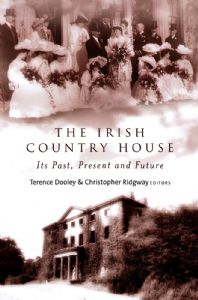
The Irish Country House: Its Past, Present and Future
Lettsom House, London, 20 October 2011
ISBN: 9781846822346
Since the founding of the IGS over fifty years ago, considerable change has taken place in the fortunes of and attitudes to the Irish country house and these changes have been discussed each year at the Annual Historic Houses of Ireland Conference and now published in a book of essays titled The Irish Country House: Its Past, Present and Future, edited by Dr Terence Dooley and Dr Christopher Ridgway and published by Four Courts Press.
Launched earlier this year at the 9th Historic Houses of Ireland Conference, this marvelous collection of essays looks at dozens of houses across a range of time periods, covering a diversity of topics relating to the architecture of these buildings, the people who lived in them, and the position and perception of the Big House in Ireland. Essays include, Terence Dooley – “Social life at Castle Hyde, 1931–88”, Christopher Ridgway – “Making and meaning in the Historic House: new perspectives in England, Ireland and Scotland” and Allen Warren – “The Twilight of the Ascendancy and the Big House.” The London Chapter is delighted to welcome Drs Dooley and Ridgway to discuss these and other aspects of the Irish country house.
Dr Dooley, MA, Ph.D. (NUI), H. Dip. Ed. is senior lecturer at National University of Ireland at Maynooth and Director of the Centre for the Study of Historic Irish Houses and Estates, of which one of its key functions is the organisation of the Annual Historic Houses of Ireland Conference with the aim of promoting focus and recognition for new scholarship and other developments in the field of built heritage studies. Dr Dooley is responsible for the MA in Historic House Studies at Maynooth and author of The Decline of the Big House in Ireland: A Study of Irish Landed Families, 1860-1960 (2001) and A Future For Irish Historic Houses: A Study of 50 Houses (2003) among others. Dr Ridgway, FSA, has been curator at Castle Howard since 1985 and has written and lectured widely on its architecture, gardens and collections. Dr Ridgway is a member of the Board of the National Trust for Scotland and Adjunct Professor in the History Department at the NUI.
The lecture is at Lettsom House, 11 Chandos Street, London W1G 9EB. The nearest tube station is Oxford Circus. Wine will be served from 6.30pm with the lecture commencing at 7pm and costs £12 per person. If you would like to attend, please send your completed application form and cheque to Colm Owens, Apartment 50, Kilner House, Clayton Street, London SE11 5SE. Please note that tickets will not be issued.
Call for Papers: Luxury Trade Conference
Call for Papers as noted at British Art Research:
The Trade in Luxury & Luxury in Trade: Production, Display, and Circulation
Musée Gadagne, Lyon, 22-23 November 2012
Proposals due by 1 January 2012
This Call for papers is for an international interdisciplinary conference, The Trade in Luxury & Luxury in Trade: The Production, Display, and Circulation of Precious Objects from the Middle Ages to the Present Day, organized by the Laboratoire de Recherche Historique Rhône-Alpes (UMR 5190) to take place at the musée Gadagne in Lyon, on Thursday 22 and Friday 23 November 2012.
How were luxury objects produced, displayed, disseminated and consumed? The aim of this conference is to return to the question of progressive specialization in a trade devoted to precious objects. The chronological, spatial and disciplinary boundaries are flexible, open in order to encourage the participation of specialists from different backgrounds – history, art and design history, economics, literature, sociology, etc. The conference’s objective is to reveal the richness and diversity of what the term ‘luxury’ embraced (and embraces) and to consider how specialist markets were gradually created and defined. Two specific approaches will be developed. On one hand, the focus will be on people and goods; on the other, it will be on points of sale and the material and symbolic power deriving from this particular sector of the economy.
The methods of production, display, circulation, and consumption of luxury goods will be the subject of this conference. The aim is to raise questions about growing specialization in a trade devoted to precious objects which are designed to make people and their surroundings more attractive. Specialists from different backgrounds will deal with these questions from many chronological, spatial and disciplinary perspectives. Diverse acadenic fields will thus be represented, among them history, art and design history, economics, literature, sociology, etc.
This interdisciplinary approach to the luxury market across a long period of time, from the Middle-Ages to the present day, will make it possible to contrast different experiences and underline continuities as well as changes. Luxury has often been discussed merely with reference to fine arts production. Here, in contrast, the objective is to reveal the richness and diversity of a phenomenon referred to as ‘luxury’, and the progressive emergence of specialized markets. Two specific approaches will thus be developed in the conference: on the one hand, a focus on people and goods, and on the other hand, a focus on points of sale and the material and symbolic power deriving from this particular sector of the economy. Indeed, luxury does not only derive from the methods and forms of the material economy; it is also a controversial value, a symbolically charged trade, a political argument, a religious controversy. These facets of luxury are either linked with or remote from the circuits of consumption, leading or following consumption practices. The papers, which may refer to French or foreign examples, should contribute to the following topics and perspectives: (more…)
Early Goya at the Prado
As noted at ArtDaily.com (5 October 2011) . . .

Francisco de Goya, "The Victorious Hannibal," 1771
◊ ◊ ◊ ◊ ◊
The display of The Victorious Hannibal at the Museo del Prado offers visitors an exceptional opportunity to see one of the most important and impressive works from Goya’s early career. Painted in the spring of 1771, it falls within a period not previously represented in the Prado’s rich and remarkable collection of the artist’s works. Through an agreement reached between the Museum and the Fundación Selgas-Fagalde to promote and disseminate their respective collections and the artistic heritage that these institutions house, Goya’s work is being shown at the Prado alongside his Italian Notebook, a sketchbook that he acquired during his time in Italy (1769-71). Among numerous other drawings and annotations, it contains sketches for the composition of The victorious Hannibal and its principal figures, namely Hannibal and the bull’s head of the allegorical figure of the River Po, which the Carthaginian general crossed.
The Victorious Hannibal is a work of clearly outstanding technical merit, evident in its harmonious composition, skilled treatment of light, and the deft, firm brushstrokes that model the figures through colour and light.
The painting was first presented as an undoubtedly autograph work by Goya in 1994, a year after it had been identified at the Prado and as part of one of the exhibitions organised to celebrate the Museum’s 175th anniversary. It now returns to the Prado for display in one of the Goya galleries for six years through the present agreement. In return, the Prado will carry out the technical study and restoration of five works in the Fundación Selgas-Fagalde collection and organise two exhibitions to be held at the Fundación in Cudillero (Asturias). . . .
The full article is available here»
Call for Papers: Second Fontainebleau Art History Festival
Call for Papers, noted by Hélène Bremer; from the festival website:
2e Festival de l’histoire de l’art: Voyages (with a focus on Germany)
Fontainebleau, 25-27 May 2012
Proposals due by 2 November 2011
Le Ministère de la Culture et de la Communication, l’Institut national d’histoire de l’art et le Château de Fontainebleau s’associent pour proposer la deuxième édition du Festival de l’histoire de l’art. Conçues comme un carrefour des publics et des savoirs, ces trois journées offrent conférences, débats, concerts, expositions, projections, lectures et rencontres dans le château et dans plusieurs sites de la ville de Fontainebleau.
Le Festival explore chaque année un thème, en 2012 « voyages », et propose trois rendez-vous annuels : le Forum de l’histoire de l’art, rendez-vous de toute l’actualité du monde des arts ; le Salon du livre et des revues d’art et Art & Caméra, panorama et perspectives sur le film et l’art. Le Festival est aussi l’occasion de propositions pédagogiques pour l’enseignement de l’histoire des arts à l’école, à travers une Université de printemps et des ateliers pédagogiques proposés et soutenus par le Ministère de l’Éducation nationale.
L’ensemble des manifestations est placé sous le regard privilégié d’un pays invité : en 2012, l’Allemagne. Les interventions intégrant des recherches allemandes ou concernant en tout ou partie le domaine allemand seront les bienvenues. L’appel à communication s’adresse à des chercheurs français et étrangers, de préférence francophones, confirmés ou débutants. Les propositions de jeunes chercheurs, conservateurs ou encore restaurateurs, seront examinées avec une attention particulière.
The full Call for Papers is available here»










 Enfilade
leave a comment