2011 Berger Prize for British Art History
This year’s long list for the Berger Prize includes several HECAA members. Bravo! From The British Art Blog:
Berger Prize 2011 Long List
Books published 1 January-31 December 2010
The Short List of six will be announced in mid-June 2011, and the Award of the William MB Berger Prize for British Art History (worth £5000 to the winner) will be awarded by A.N. Wilson at a ceremony in London UK on the evening of 5 July 2011.
Assessors Timothy J. Standring, Gates Foundation Curator of Painting & Sculpture, Denver Art Museum; Robin Simon, Editor, The British Art Journal; Katharine Eustace, Editor, Sculpture Journal; Rosemary Hill, Fellow, All Souls’ College, Oxford; Desmond Shawe-Taylor, Surveyor of The Queen’s Pictures; Angus Trumble, Senior Curator of Paintings and Sculpture, Yale Center for British Art
◊ ◊ ◊ ◊ ◊
Of the 38 titles on the long list, here’s an assortment of those dealing with the eighteenth century:
 • David Nolan and Carolyn Starren, On Public View – A Journey around the Sculptures in the Royal Borough of Kensington and Chelsea, NOTE published online. Please visit www.rbkc.gov.uk/onpublicview; Chapters download as pdfs with a video introduction to watch on the site
• Celina Fox, The Arts of Industry In the Age of Enlightenment, [2009] 18 February 2010, YUP, ISBN: 9780300160420, £50, pp576, 200 bw, 60 col
• Cherry Ann Knott, George Vernon 1636-1702 ‘Who built this House’. Sudbury Hall Derbyshire, 1 June 2010 Tun House Publishing, ISBN: 9780956524003, £75 (signed limited edition of 500), pp782, illus bw & col
• Katharine Baetjer, British Paintings in the Metropolitan Museum of Art, 1575-1875, 30 March 2010 Metropolitan Museum/YUP, ISBN: 9781588393487 (Met Mus), ISBN: 9780300155099 (YUP), £55, pp308, 215 bw, 140 col
 • John Ingamells, National Portrait Gallery. Later Stuart Portraits 1685-1714, 8 February 2010 National Portrait Gallery, ISBN: 9781855144101, £125, pp460, 358 bw, 305 col
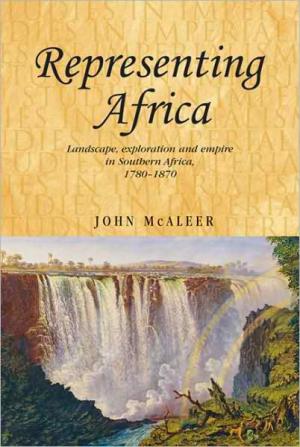
• John McAleer, Representing Africa: Landscape, Exploration and Empire in Southern Africa, 1780-1870, 1 March 2010 Manchester University Press, ISBN: 9780719081040, £60pp, 241, 16 bw, 9 col
• Cassandra Albinson, Peter Funnell & Lucy Peltz, eds, Thomas Lawrence: Regency Power and Brilliance, Exh cat. 21 October 10 YUP, ISBN: 9780300167184, £40, pp280, 20 bw, 160 col
• Cecilia Powell & Stephen Hebron, Savage Grandeur & Noblest Thoughts: Discovering the Lake District 1750-1820, Exh cat. 2010 Wordsworth Trust, ISBN: 9781905256426, £19.95, many illus in colour
 • Mireille Galinou, Cottages & Villas: The Birth of the Garden Suburb, 19 October 2010 YUP, ISBN: 9780300167269, £40, pp480, 55 bw, col 250
• Douglas Fordham, British Art and the Seven Years’ War: Allegiance and Autonomy, 2010 University of Pennsylvania Press, ISBN: 9780812242430, £42.50, pp334, 87 bw
• Charlotte Yeldham, Maria Spilsbury (1776-1820), Artist and Evangelical, 1 February 2010 Ashgate, ISBN: 9780754669913, £65, pp230, 73 bw,
• Bernd W Krysmanski, Hogarth’s Hidden Parts, Georg Holms Verlag, Hildesheim, ISBN: 9783487144719, Euros 48, pp514, 304 bw
• Elisabeth Soulier Detis, Guess at the Rest: Cracking the Hogarth Code, 27 May 2010 James Clarke & Co Ltd, ISBN: 139780718892159, £35, 183 bw, pp233
 • Jason Kelly, The Society of Dilettanti: Archaeology and Identity in the British Enlightenment, [2009] 28 January 2010 YUP, ISBN: 9780300152197, £40, pp366, 100 bw, 20 col
• Julian Mitchell, The Wye Tour and its Artists, Exh cat. 2010 Logaston Press, ISBN: 9781906663322, £12.95, pp168, illus bw & col
• Jennifer Scott, The Royal Portrait. Image and Impact, 2010 Royal Collection Enterprises, ISBN: 9781905686131, £19.95, pp200, 157 col
• Ilaria Bignamini and Clare Hornsby, Digging and Dealing in Eighteenth-century Rome, 25 February 2010 YUP, ISBN: 9780300160437, £45, 2 vols, pp630, 200 bw, 50 col
◊ ◊ ◊ ◊ ◊
Update (added 14 July 2011) — As announced on July 5, this year’s winner is
• Charlotte Gere and Judy Rudoe, Jewellery in the Age of Queen Victoria: A Mirror to the World (London: British Museum Press), 552 pages, ISBN 978-0714128191, £50.
The short list of six titles included these eighteenth-century offerings:
• Celina Fox, The Arts of Industry In the Age of Enlightenment (New Haven: Yale University Press, 2010), ISBN: 9780300160420, £50.
• Cecilia Powell & Stephen Hebron, Savage Grandeur & Noblest Thoughts: Discovering the Lake District 1750-1820 (Wordsworth Trust, 2010), ISBN: 9781905256426, £19.95
• Ilaria Bignamini and Clare Hornsby, Digging and Dealing in Eighteenth-century Rome (New Haven: Yale University Press, 2010), ISBN: 9780300160437, £45.
Exhibition: James Cook et al
From the museum:
Cook, Melville, and Gauguin: Three Voyages to Paradise
Maritime Museum of San Diego, 27 May 2011 — 1 January 2012
 Imagine what treasures one would have seen exploring the Pacific islands in centuries past? The Three Voyages to Paradise exhibit is inspired by those very visions as seen through the eyes of Captain James Cook, author Herman Melville, and painter Paul Gauguin.
Highlighting this extraordinary exhibit are original paintings created by the official expedition artists (William Hodges and John Webber), on James Cook’s second and third Voyages of Discovery. Scientific and navigation instruments from Cook’s time as well as personal effects and Cook memorabilia will also be displayed along with Charts and Pacific artifacts from the period. Paintings, engravings and whaling artifacts representative of Herman Melville’s episodic adventure in the South Seas will be interpreted using select examples of his writings.
Central to the exhibition will be a comprehensive collection of original oil and watercolor paintings, woodblock prints, engravings and sculpture by Paul Gauguin. This exhibit will comprise the largest display of three-dimensional Gauguin masterpieces currently seen anywhere in the world, including a newly discovered Gauguin wood carving on display for the first time in America.
Call for Papers: Eighteenth-Century Scottish Studies Society
Conference of the Eighteenth-Century Scottish Studies Society: Media and Mediation
University of South Carolina, Columbia, 12-15 April 2012
Proposals due 1 December 2011
 ECSSS will celebrate its 25th annual conference in Columbia, South Carolina, in April 2012. The conference will explore the varieties of media through which eighteenth-century Scots articulated or created both individual voices and communal understandings. Papers and sessions may focus on any aspects of cultural mediation or forms of oral and written media in the broadest sense, including manuscript culture journals, letters, notebooks, and marginalia), aural culture (sermons, songs, conversation, and academic lectures), and print culture (from stately folios and elegant octavos, to pamphlets, newspapers, broadsides, and chapbooks). Papers focused on the mediators rather than the media-authors, diarists, scholars, orators, readers and listeners, singers and composers, editors, critics, and members of the book trades-are equally welcome, as are Conference sessions will be held in the new Hollings Special Collections Library, home of the G. Ross Roy Collection of Robert Burns & Scottish Literature, and other Scottish collections. Plenary sessions will include the 2012 W. Ormiston Roy Memorial Lecture by Professor Nigel Leask, Regius Professor of English, University of Glasgow, speaking on the cultural functions of commonplace books. (more…)
This Week’s Romantic Objects Seminar in London: Blake and Varley
Philippa Simpson and Sibylle Erle, Varley’s Visionary Heads and Blake’s The Ghost of a Flea
Institute of English Studies, University of London, 15 June 2011

William Blake, "The Ghost of a Flea," ca. 1819-20, tempera heightened with gold on mahogany support (London: Tate Britain)
Romantic Objects is a seminar series that runs over two terms (Spring and Summer) on Wednesdays 5:30-7:30, as part of the inter-university seminar in Romantic Studies at Senate House, co-organized by Birkbeck and the Open University at the Institute of English Studies. This series of seminars will rethink Romantic period material culture in the tension between Romantic attempts to recenter aesthetic experience as subjective just as a new culture of exhibitions, viewing, and collecting practices defines the centrality of objects. The aim is to provide a forum for graduate students, scholars, and curators working in the period 1750-1850 or on questions relating to objects, exhibitions, material culture.
This week’s seminar features Dr Philippa Simpson (Tate Britain) and Dr Sibylle Erle (Bishop Grosseteste College, Lincoln) on John Varley’s Visionary Heads and William Blake’s The Ghost of a Flea. Erle and Simpson curated the current display of Blake and Physiognomy at Tate Britain. Erle is the author of Blake, Lavater and Physiognomy (2010). Simpson, an expert in late eighteenth-century exhibition culture and the
reception of the old masters, co-curated the exhibition Turner and the
Masters. The seminar takes place Wednesday, 15 June, 17:30-19:30, in
STB8 Stewart House, basement, 32 Russell Square. All are welcome!
Reading:
Alexander Gilchrist, Life of Blake (1863), pp. 249-57, (via Googlebooks)
◊ ◊ ◊ ◊ ◊
Sibylle Erle, Blake, Lavater, and Physiognomy (Oxford: Legenda, 2010), 244 pages, ISBN: 9781906540692, $89.

ISBN: 9781906540692
William Blake never travelled to the continent, and yet his creation myth is far more European than has so far been acknowledged. His early illuminated books, of the 1790s, run alongside his professional work as a copy-engraver on Henry Hunter’s translation of Johann Caspar Lavater’s Essays on Physiognomy (1789-98) — work in which Blake helped to make a likeness of a book about likenesses. For Blake, as for Lavater, Henry Fuseli, Joshua Reynolds, and others of his age, the art of the portrait was to find the right balance between likeness and type. Blake, Lavater, and Physiognomy demonstrates how the problems occurring during the production of the Hunter translation resonate in Blake’s treatment of the Genesis story. Blake takes us back to the creation of the human body, and interrogates the idea that ‘God created man after his own likeness’. He introduces the ‘Net of Religion’, a device which presses the human form into material shape, giving it personality and identity. As Erle shows, Blake’s startlingly original take on the creation myth is informed by Lavater’s pursuit of physiognomy: the search for divine likeness, traced in the faces of their contemporary men.
◊ ◊ ◊ ◊ ◊
Blake and Physiognomy
Tate Britain, London, 8 November 2010 — 17 April 2011
Curated by Philippa Simpson and Sibylle Erle
[There is] not a man who does not judge of all things…by their physiognomy;
that is, of their internal worth by their external appearance.
–Johann Caspar Lavater
Johann Caspar Lavater’s Essays on Physiognomy, translated into English in 1789, catalysed a vogue for the theory that people’s characters could be read in their features. Although this would seem to serve as a model of detached observation and scientific classification, Lavater saw these judgements as stemming from an instinctive understanding of expression and appearance. At the heart of his work was a strongly-held Christian belief, according to which all forms were divinely created, and derived from the one perfect God. Lavater’s ideas were also informed by eighteenth-century codes of racial stereotyping that are deeply troubling to the modern reader.
Many British artists, including William Blake, experimented with physiognomic systems in their work. Blake’s involvement, though, was closer than most. He not only engraved illustrations for the 1789 translation of Lavater’s book but, over thirty years later collaborated with his friend, artist and astrologer John Varley, on a publication entitled Zodiacal Physiognomy. This book sought to attribute character according to time of birth, and Varley used prints after Blake’s works to illustrate different star signs. These enterprises suggest that Blake’s visual language, which often seems highly innovative – even idiosyncratic – may be read in the context of broader pseudo-scientific and artistic trends.
Open Position: ‘Eighteenth-Century Studies’ Editor
ASECS is seeking a new editor and a new home for Eighteenth-Century Studies. Published quarterly by the Johns Hopkins University Press for ASECS, the journal is dedicated to maintaining and developing the Society’s special mission of interdisciplinarity and publishing the best in eighteenth-century scholarship. The Society will also accept applications from a team of two (and no more than three) editors at the same institution but representing different disciplines. The new editor will begin his/her duties for a five year term effective July 1, 2012.
Eighteenth-Century Studies is an endowed journal and the Society contributes to its support. The journal’s Editor can also rely on the support of an excellent team of book review editors, editorial board, and advisory editors.
Candidates should submit a letter of application describing their interest in and plans for the journal, together with a curriculum vitae for each prospective editor. In addition, the application should include a statement signed by the appropriate institutional officer pledging support for the journal for a term of at least five years. Institutional support shall include space, utilities, custodial services, release time for the editor(s), half-time secretarial support, and one-half the salary and benefits of a full-time managing editor who will, in addition to other duties, work with the Executive Director’s staff in securing and producing advertising revenue. It would be desirable if the host institution would also provide computer equipment and support facilities. The application deadline is November 15, 2011. The Search Committee has been asked to complete its work by February 17, 2012 so that the new editors can be announced at the annual meeting in San Antonio. Members are strongly encouraged to send to the Search Committee their comments on the direction they would like to see Eighteenth-Century Studies take in the future. Please send all applications materials, inquiries, nominations, and comments to the ASECS Business Office at asecs@wfu.edu.
Finally, the officers and Executive Board of ASECS wish to thank Julia Simon for her outstanding service as editor of ECS, and wish her the best of luck on her retirement from the journal.
Exhibition: ‘The First Actresses’ in London
Press release rom the NPG:
The First Actresses: Nell Gwyn to Sarah Siddons
National Portrait Gallery, London, 20 October 2011 — 8 January 2012
Curated by Gill Perry, supported by Lucy Peltz

John Hoppner, "Mrs. Robinson as 'Perdita'," 1782 © Chawton House Library, Hampshire
The first exhibition to explore art and theatre in eighteenth-century England through portraits of women will open at the National Portrait Gallery in October 2011. With 53 portraits, some brought together for the first time and others not previously seen in public, the exhibition will show the remarkable popularity of actress-portraits and provide a vivid spectacle of eighteenth-century femininity, fashion and theatricality. The First Actresses: Nell Gwyn to Sarah Siddons will show large paintings of actresses in their celebrated stage roles, intimate and sensual off-stage portraits and mass-produced caricatures and prints, and explore how they contributed to the growing reputation and professional status of leading female performers.
The exhibition will combine much-loved works by artists such as Joshua Reynolds, Thomas Gainsborough, John Hoppner, Thomas Lawrence, Johann Zoffany and James Gillray, with some newly discovered works such as the National Portrait Gallery’s new acquisition of the Three Witches from Macbeth by Daniel Gardner.
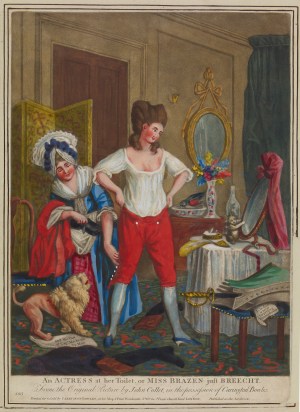
After John Collett, "An Actress at Her Toilet or Miss Brazen just Breecht," ca. 1779
Actresses featured in the exhibition include Nell Gwyn, Kitty Clive, Hester Booth, Lavinia Fenton, Peg Woffington, Sarah Siddons, Mary Robinson, Dorothy Jordan, Elizabeth Farren, Giovanna Baccelli and Elizabeth Linley. Highlights include a little known version of Reynolds’s famous portrait of Sarah Siddons as the Tragic Muse, Hogarth’s The Beggar’s Opera, Gainsborough’s portraits of Giovanna Bacelli and Elizabeth Linley. Important loans include works from the Garrick Club Library, the Royal Shakespeare Company, the National Gallery of Art, Washington, The Fitzwilliam Museum, Cambridge, Tate Britain, the V&A, as well as Petworth, Kenwood and Longleat Houses.
Starting with the emergence of the actress’s profession in the late seventeenth century, The First Actresses: Nell Gwyn to Sarah Siddons will show how women performers, in drama, as well as music and dance, were key figures within a spectacular celebrity culture. Fuelled by gossipy theatre and art reviews, satirical prints and the growing taste for biography, eighteenth-century society engaged in heated debate about the moral and sexual decorum of women on stage and revelled in the traditional association between actress and prostitute, or ‘whores and divines’. The exhibition will also reveal the many ways in which women performers stimulated artistic innovation and creativity and provoked intellectual debate.
As well as focusing on the eighteenth-century actress as a glamorous subject of high art portraits, and the ‘feminine face’ of eighteenth century celebrity culture, the exhibition will look at the resonances with modern celebrity culture and the enduring notion of the actress as fashion icon. As a counterpoint to the exhibition, an accompanying display will show photographic and painted portraits, drawn from the Gallery’s permanent collections, of some of today’s actresses, some of whom have agreed to be the exhibition’s ‘Actress Ambassadors’. A full list will be published prior to opening.
◊ ◊ ◊ ◊ ◊
An exhibition conference will take place on Friday, 11 November 2011.
Exhibition catalogue: Gill Perry with Joseph Roach and Shearer West, The First Actresses: Nell Gwyn to Sarah Siddons (London: National Portrait Gallery, 2011), 160 pages, ISBN: 9781855144118, £30.
Eighteenth-Century Maps: A Fair, a Lecture, and a New Reference Book
Press release from The London Map Fair:
2011 London Antique Map Fair
Royal Geographic Society, London, 11-12 June 2011

Johann Baptist Homann. "Sphærarum Artificialium Typica..." Nuremberg, ca.1730.
The 2011 London Map Fair, taking place in the historic surroundings of the Royal Geographical Society, is the most established and largest antiquarian map fair in Europe: over forty of the leading national and international specialist map dealers will be exhibiting in June. Visitors to the fair will discover a vast selection of original antique maps covering the whole world and printed between the 15th and 19th centuries. Highlights include a map of the universe by seventeenth-century Venetian cartographer Coronelli, revealing the Nine Circles of Hell as described in Dante’s Divine Comedy, as well as a 19th-century curiosity map of Europe depicting each country in the form of a caricature: the United Kingdom
figures as an old crone.
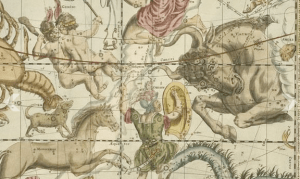
Johann Gabriel Doppelmayr, "Globi Coelestis," 1 of 6 Celestial Charts, Nuremberg, Homann, 1742
Other fine maps offered this year will include: an example of Ogilby’s innovative and incredibly detailed, 17th-century road map, marking all inns, churches and other landmarks on the road from London to Portsmouth – the course of the modern A3; an impression of Braun and Hogenberg’s bird’s-eye view of London; the earliest surviving printed plan of the city, dated 1574; and Christoph Vetter’s rare and beautiful 17th-century depiction of Bohemia stylised as a rose, with Prague at its centre and Vienna, the seat of the Hapsburg Dynasty, at its root. Exhibitors will offer atlases, travel books, globes, sea charts, town plans, celestial maps, topographical prints and
reference books; there are prices to suit all pockets ranging
from a very affordable £10 to over £100,000 for exceptional
pieces.
◊ ◊ ◊ ◊ ◊
2011 London Map Fair Lecture: Laurence Worms and Ashley Baynton-Williams
Royal Geographic Society, London, 11 June 2011
On Saturday, 11 June 2011, at 2:30pm, Laurence Worms and Ashley Baynton-Williams will launch their long-awaited Dictionary of British Map Engravers at the Fair. The product of over twenty years of research, it offers a wealth of fresh material on the map trade and a new insight into the lives of its most important figures, revealing some surprising links and relationships in the process.
◊ ◊ ◊ ◊ ◊
From the International League of Antiquarian Booksellers:
Laurence Worms and Ashley Baynton-Williams, British Map Engravers: A Dictionary of Engravers, Lithographers and Their Principal Employers to 1850 (London: Rare Book Society, 2011), approximately 750 pages, £125.
 The ultimate guide to the identification of British antique maps and their makers: An illustrated dictionary of over 1,500 members of the map trade in England, Ireland, Scotland and Wales, of British-born engravers working overseas and foreign engravers working in the British Isles, from the beginnings until the mid 19th century. Included are all the known engravers and lithographers, globemakers and retailers, the principal map sellers and publishers, key cartographers, makers of map-based games and puzzles, but also the remarkable lives of many artists, dealers and publishers, whose fates have been unknown so far. (more…)
June 2011 Issue of ‘The Art Bulletin’ — In Memory of Anne Schroder

Fragonard, "The Meeting," from the Progress of Love, 1771-73 (NY: The Frick Collection)
The June issue of The Art Bulletin is dedicated to the memory of Anne L. Schroder, who passed away suddenly in December 2010. The issue includes her article, “Fragonard’s Later Career: The Contes et Nouvelles and the Progress of Love Revisited,” pp. 150-177.
◊ ◊ ◊ ◊ ◊
Abstract: Late in his career, which spanned the Revolution and beyond, Honoré Fragonard revived two major projects in limbo since 1773. His unsuccessful effort to have engraved his illustrations for La Fontaine’s Contes et nouvelles (17880-1809) demonstrates the dramatic upheavals in the post-Revolutionary print market and publishing industries and shifting reactions to his art. The unfinished series Progress of Love, expanded and recontextualized by the artist during the late 1790s and early 1800s, reveals Fragonard’s adaptation of his perennial subjects — flirtation, love, and picturesque nature — to changing cultural attitudes regarding the sexual power of women in the aftermath of the Revolution.
Exhibition: ‘Italian Master Drawings’ in Washington
Press release from the National Gallery in DC:
Italian Master Drawings from the Wolfgang Ratjen Collection, 1525–1835
National Gallery of Art, Washington D.C., 8 May — 27 November 2011
Curated by Margaret Morgan Grasselli

Canaletto, "The Giovedì Grasso Festival before the Ducal Palace in Venice," 1763/1766 (Washington DC: National Gallery, Ratjen Collection, Paul Mellon Fund 2007.111.55)
Splendors of Italian draftsmanship from the Wolfgang Ratjen Collection, spanning the late Renaissance to the height of the neoclassical movement, will be showcased at the National Gallery of Art, Washington. On view in the Gallery’s West Building from May 8 to November 27, 2011, Italian Master Drawings from the Wolfgang Ratjen Collection, 1525–1835 will include 65 stunning Italian compositions and study sheets by the most important artists of the period, from Giulio Romano and Pellegrino Tibaldi to Canaletto, all three members of the Tiepolo family, and Giovanni Battista Piranesi.
In 2007, the National Gallery of Art acquired 185 German and Italian works from the Ratjen Collection—one of the finest private European holdings of old master drawings—with the help of 12 generous private donors as well as the Paul Mellon Fund and the Patrons’ Permanent Fund. “We are delighted to celebrate the second part of the Gallery’s acquisition of this exceptional group of German and Italian drawings formed by the great European collector Wolfgang Ratjen,” said Earl A. Powell III, director, National Gallery of Art. “The Italian portion of the collection is an assemblage of works of beauty and power. Italian drawings were in fact Ratjen’s first love, and he worked on this part of his collection with attentive care throughout his years as a collector.”

ISBN: 9781907372216, $50
Wolfgang Ratjen formed his Italian collection of drawings over a period of about 25 years. He grew up with two that had been acquired by his family during his youth—works by Guercino and Giovanni Battista Tiepolo—and he began collecting himself in the early-1970s. He purchased his last Italian drawing, by Giulio Cesare Procaccini, in July 1997. Ratjen’s collection of Italian drawings is best described as a group of single outstanding works, including famous artists as well as artists of lesser renown. For a select few—such as Jacopo Palma il Giovane, Guercino, and Giovanni Battista Tiepolo—he acquired multiple sheets that conveyed different facets of the artists’ styles or represented a variety of media used.
Organized chronologically throughout three galleries, the exhibition will present works that span three centuries, from the last flowering of the Renaissance around 1530 to the height of neoclassicism in the early 19th century. The works represent a dynamic range of techniques, including quick pen and ink sketches, finely nuanced chalk studies, and highly
finished brush drawings. (more…)
Call for Papers: Transnational History of Museums
As noted at Le Blog de L’ApAhAu and at OSK — Onderzoekschool Kunstgeschiedenis (Dutch Postgraduate School for Art History) . . .
Transnational History of Museums
Technische Universität Berlin, 17-18 February 2012
Proposals due by 15 June 2011
 Temple of muses, custodian of cultural heritage, site of memory, space for the mediation of taste and knowledge: The functions of the museum are manifold and are given different emphases, depending on the type of museum and the disciplinary outlook. However, the argument that the institution is a major venue for the construction of national identity has recurred again and again since the first royal collections were opened to the public around the middle of the eighteenth century. Indeed, the number of museum foundations was particularly high in Europe during the nineteenth century, when the modern nation-state was being established. Yet the tight linkage between nation-building and the birth of public collections has increasingly been called into question by recent scholarly work on the history of museums. Instead, local traditions have been stressed or international comparisons have been drawn upon in order to explain policies of collecting, the display of exhibits or the architectural design of individual galleries.
The aim of the planned conference is to go beyond the national framework in analyzing the institution of the museum. It offers an invitation to reflect from a transnational perspective upon the purposes and concepts of museums, museum practices, and the perception of museum culture. Which models from abroad were imported by museum representatives in order to give their own collections a certain profile? To what extent were “foreign” principles of order and hanging appropriated? Can the international networks on which museum experts relied be reconstructed? How can we describe the activities of commissions that were assigned to explore the organisation of museums beyond their geographic borders? Did an internationally inspired taste have any influence on the planning, the architectural settings or the compositions of collections? Do documents such as letters, travelogues or diaries written by museum visitors give concrete indications of a comparative, transnational perception?
Central to the conference is the discussion of the museum as a space of, even product of, cross-border processes of exchange and transfer. Seen from this angle, an examination of the museum of art, in particular, is to be carried out, also taking into account archaeological and historico-cultural collections, arts and crafts museums and the so-called universal museums inside and outside of Europe. Chronologically, the conference sets in around 1750, at that point in history when there was a gathering momentum of the crucial characteristics of the modern museum of art still familiar today: public access, an independent exhibition space or building, the application of scientific principles of order, or didactic aspirations. A second chronological benchmark ? before the caesura of World War II? is the conference that took place in Madrid in 1934. For the first time, museum experts from all over the world came together and thus made the museum, as such, very literally the pivotal subject of intense international discussion.
The conference will be held on Friday, February 17, and Saturday, February 18, 2012 at the Technische Universität Berlin. Please submit proposals of about 1.000 characters for papers not exceeding 30 minutes by June 15, 2011 to Prof. Dr. Bénédicte Savoy (benedicte.savoy@tu-berlin.de) or Dr. Andrea Meyer (andrea.meyer@tu-berlin.de). Languages of the conference are German, English and French.










 Enfilade
leave a comment