Visiting Scholar Program, University of Illinois at Urbana–Champaign
The John ‘Bud’ Velde Visiting Scholar Program
The Rare Book & Manuscript Library at the University of Illinois at Urbana–Champaign
Applications due by 1 April 2011
The Rare Book & Manuscript Library at the University of Illinois at Urbana–Champaign is the University’s principal repository of early printing, rare editions, and manuscripts. Since 2006, the Velde Visiting Scholar program has provided financial support to researchers unaffiliated with the University of Illinois at Urbana-Champaign who wish to further compelling projects utilizing these renowned collections. A gift of the estate of John E. “Bud” Velde, Jr. (1917-2002), a longtime friend of the Library and its rare book collections, funds the award. Among Velde’s many contributions to the Library are the Library’s seven-millionth volume, the 1486 edition of Breydenbach’s Peregrinatio in Terram Sanctam (Journey to the Holy Land) in 1986, and the eight-millionth volume, Frank Lloyd Wright’s The House Beautiful (1896/97). He also made a considerable contribution to the Audubon Folio Restoration Project in 1987 and established a generous endowment fund in 1999.
The research strengths of The Rare Book & Manuscript Library are manifold. Comprehensive collections support studies in printing and printing history, Renaissance studies, Elizabethan and Stuart life and letters, John Milton and his age, emblem studies, economic history, and works on early science and natural history. The library also houses the papers of the modern literary figures Carl Sandburg, H.G. Wells, William Maxwell, and W.S. Merwin.
Two John “Bud” Velde awards are given annually to facilitate a period of extended individual study (usually one month or more) in The Rare Book & Manuscript Library at the University of Illinois at Urbana–Champaign. The program is open to all scholars, from graduate students to retired professors and independent researchers, regardless of nationality. The awards are primarily intended to help defray the costs of travel and living expenses for scholars from outside the region. Each award consists of a stipend of $3,000. Recipients are responsible for making their own travel and housing arrangements, though information about campus housing will be provided. (more…)
Furniture: ‘Inspired by Antiquity’ Highlights Thomas Hope
From a Carlton Hobbs press release:
Inspired by Antiquity: Classical Influences on 18th- and 19th-Century Furniture and Works of Art
Carlton Hobbs, New York, 20 January — 14 February 2011

One of a pair of wall lights in the form of a griffin, related to a design by Thomas Hope, bronze, ca. 1802
The opening night reception, on January 19th, benefited the Sir John Soane Museum Foundation. Tim Knox, the Soane Museum’s eminent director, lectured on the subject of the exhibition and elaborated on some of the highlights on view. “We are honored to have Sir John Soane’s Museum Foundation as the opening night beneficiary,” said Carlton Hobbs. “We are particularly enthusiastic to present forty magnificent pieces inspired by antiquity, including the important group of Thomas Hope pieces from the Philip Hewat-Jaboor collection of Regency furniture and works of art,” he said. “It is the single largest collection of Thomas Hope pieces to come onto the market since the Christie’s auction of the contents of Deepdene, Hope’s country estate, in 1917.” Thomas Hope, the fabulously successful banker, connoisseur collector and designer, revolutionized British taste of the late 18th, early 19th century with his radical, classically inspired design ideas and came to be one of the key figures shaping the Regency taste.
In the continuous effort to deepen our understanding of the decorative arts of the 18th and 19th centuries we wanted to further explore the visual and philosophical inspirations that gave rise to the multitude of fascinating designs, which are now broadly described as Neoclassical,” said Stefanie Rinza. “We are thrilled to collaborate with some of today’s leading academics in identifying the ancient design sources for our pieces and in interpreting the symbolism of the decorative devices used. We hope our clients, colleagues and friends will much enjoy the catalog accompanying the exhibition.
Carlton Hobbs is most grateful for the contributions and collaboration of some of today’s leading experts in the field of decorative arts and in the compilation of the catalog accompanying the exhibition, including Martin Levy, former chairman of the British Antiques Dealers Association, author and specialist in 19th-century furniture and works of art, Tim Knox, Director of the Sir John Soane Museum, Philip-Hewat Jaboor, the authority on Thomas Hope and independent art consultant to private and institutional collectors, and John Hardy, the long-time director of Osterley Park House Museum, who added his insights into the meaning of the symbolism of the classical design elements to every entry.
Wiebenson Prize Deadline Approaching Soon
Note from the President
Dear HECAA members,
Each year HECAA awards the Wiebenson Prize for an outstanding graduate student paper presented during the previous calendar year at a scholarly conference or as a sponsored lecture. Announced at HECAA’s annual luncheon (each spring at ASECS), the prize includes modest remuneration.
The prize is named for Dr. Wiebenson, Professor Emerita at the University of Virginia School of Architecture.
By 15 February 2011, students should submit three copies of their papers — as read, without notes, but with illustrations — to me, and I will then forward the submissions to an ad hoc committee responsible for selecting the winner. Honorable mention is also an option for papers of distinction not chosen for the prize. Recipients must be HECAA members in good standing.
Dr. Julie-Anne Plax
jplax@email.arizona.edu
UCL Seminar for Early Modern Visual Culture, Spring 2011
From UCL:
University College London, Seminar for Early Modern Visual Culture
UCL Department of History of Art, 20-21 Gordon Square, London, 6pm
Organized in collaboration with the Courtauld Institute of Art
24 January
Mary Sheriff (University of North Carolina at Chapel Hill)
Calypso’s Island and the Lure of Enchantment in the Art of the French Regency
7 February
Miles Ogborn (Queen Mary University of London)
The Freedom of Speech: Talk and Slavery in the Early Modern Caribbean
21 February
Judy Loach (Cardiff University)
Engraving and Printing, Visibility on Matter and Invisibility on Hearts and Souls
14 March
Rose Maria San Juan (University College London)
Unavailable Knowledge: Eve in the Wax Anatomical Cabinet
Magnasco Painting for the Musée d’Art et d’Histoire du Judaisme
Writing for The Art Tribune (14 December 2010), Didier Rykner happily notes that the Musée d’Art et d’Histoire du Judaisme in Paris recently acquired The Jewish Funderal, “a superb painting” by Alessandro Magnasco (1667-1749). The downside is that

Alessandro Magnasco, "Homage to Pluto" (Photo: Galerie Canesso
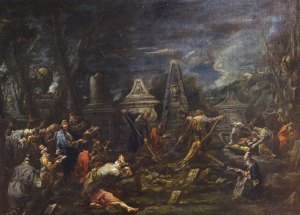
Alessandro Magnasco, "The Jewish Funeral" (Paris, Musée d’Art et d’Histoire du Judaïsme) Photo: Galerie Canesso
this canvas which had been reunited with its companion piece, Homage to Pluto, by the previous owner will once again find itself separated. Understandably, the museum was only interested in the first which was declared ‘a work of major importance to heritage’ by the Commission des tresors nationaux. It was the only one which could thus benefit from a contribution by a patron (who has for the time being remained anonymous), making it possible for it to join the museum collections.
The pairing of the two subjects, one representing a pagan ceremony, the other a Jewish rite, corresponds to the artist’s (and perhaps the person commissioning) wish to illustrate two non-Catholic religious events although their association may seem a bit strange. Despite the fact that this seems to be the only known scene of a Jewish funeral by Magnasco, the painter also represented synagogue interiors on various occasions such as, for example, in a painting held in Cleveland.
The full article is available here»
Exhibition: Paper Dresses of Isabelle de Borchgrave
From the Legion of Honor Museum:
Pulp Fashion: The Art of Isabelle de Borchgrave
Legion of Honor, Fine Arts Museums of San Francisco, 5 February — 5 June 2011
Curated by Jill D’Alessandro
 Belgian artist Isabelle de Borchgrave is a painter by training, but textile and costume are her muses. Working in collaboration with leading costume historians and young fashion designers, de Borchgrave crafts a world of splendor from the simplest rag paper. Painting and manipulating the paper, she forms trompe l’oeil masterpieces of elaborate dresses inspired by rich depictions in early European painting or by iconic costumes in museum collections around the world. The Legion of Honor is the first American museum to dedicate an entire exhibition to the work of Isabelle de Borchgrave, although her creations have been widely displayed in Europe.
Pulp Fashion draws on several themes and presents quintessential examples in the history of costume—from Renaissance finery of the Medici family and gowns worn by Elizabeth I and Marie-Antoinette to the creations of the grand couturiers Frederick Worth, Paul Poiret, Christian Dior, and Coco Chanel. Special attention is given to the creations and studio of Mariano Fortuny, the eccentric early-20th-century artist who is both a major source of inspiration to de Borchgrave and a kindred spirit.
Catalogue: Jill D’Alessandro, Pulp Fashion: The Art of Isabelle de Borchgrave (Prestel, 2011), 104 pages, ISBN: 9783791351056, $29.95.
◊ ◊ ◊ ◊ ◊
From the artist’s website (worth visiting for lots more amazing images). . .
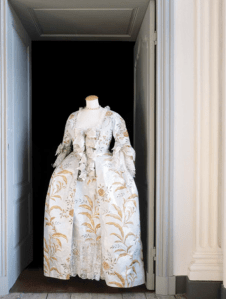
Isabelle de Borchgrave, "Madame de Pompadour paper dress," inspired by a 1755 painting by Maurice Quentin de la Tour, 85 cm x 65 cm x 165 cm, 2001 (Photo: René Stoeltie).
. . . . Following a visit to the Metropolitan Museum in New York in 1994, Isabelle dreamed up paper costumes. While keeping her brushes in hand and her paintings in mind, she worked on four big collections, all in paper and trompe l’œil, each of which set the scene for a very different world. “Papiers à la Mode” (Paper in Fashion), the first, takes a fresh look at 300 years of fashion history from Elizabeth I to Coco Chanel. “Mariano Fortuny” immerses us in the world of 19th century Venice. Plissés, veils and elegance are the watchwords of that history. “I Medici” leads us through the streets of Florence, were we come across famous figures in their ceremonial dress. Figures who made the Renaissance a luminous period. Gold-braiding, pearls, silk, velvet … here, trompe l’œil achieves a level of rediscovered sumptuousness. As for the “Ballets Russes”, they pay tribute to Serge de Diaghilev. Pablo Picasso, Léon Bakst, Henri Matisse, … all designed costumes for this ballet company, which set the world of the 20th century alight. These dancing paper and wire figures play a very colourful and contemporaneous kind of music for us.

Isabelle de Borchgrave, "Madame de Pompadour paper dress," detail
It’s true that, today, Isabelle de Borchgrave has become a name that is readily associated with fashion and paper. But her name is also closely linked to the world of design. By working together with Caspari, the potteries of Gien, Target, and Villeroy and Boch, Isabelle has turned her imagination into an art that’s accessible to anyone who wants to bring festivity into their home. Painted fabrics and paper, dinner services, curtains, sheets, decor with a personal touch for parties and weddings,… All this tells of the world in which she has always loved to move.
But in a 40-year career, she has never put to one side the thing that has always guided her in her life: painting. She still exhibits her paintings and her large folded paper works all over the world. With an imagination increasingly stimulated by her knowledge and interpretation of art, Isabelle, a follower of the Nabis movement, has a fresh perspective of a world that flies around her like a dream.
Reviewing for Enfilade
From the Editor
I recently received three books with requests that I consider publishing reviews of them here at Enfilade. Given that expanding the site’s original content is one goal, I’m certainly open to the idea. Consequently, I’m writing to solicit reviewers. In many ways, Enfilade remains a work-in-progress, and I would imagine this new direction (even if it succeeds) will call for adjustments along the way. I would like to propose the following ideas as a starting point. I welcome any feedback or advice readers might have.
A. Reviewers must be HECAA members in good standing.
B. Given that Enfilade is intended to serve as a newsletter for those interested in eighteenth-century art and architecture — as opposed to serving as an academic journal in its own right — it seems that the goal of a review at Enfilade is different than a review published in an academic journal. Description of contents and assessment of potential audiences are probably more important, for instance, than teasing out the nuances of a particular argument. An informed characterization premised on the scholarly expertise of the reviewer should still be an important goal, but the model for emulation might be more akin to a brief notice in The New York Review of Books or the TLS than The Art Bulletin or Eighteenth-Century Studies.
C. The blog format lends itself to relatively brief postings: 400-800 words might be an appropriate length. Prompt turn-around seems especially important for a newsletter format, and again the brevity should help in this regard.
D. One big problem: HECAA has no budget to fund the logistics of reviewing books (Enfilade costs absolutely nothing to produce). If publishers send me books, I have no money to send out copies to reviewers. In the case of the three books at hand, I’m happy to haul them to New York with me for CAA and distribute copies there (likewise with ASECS in Vancouver). Otherwise, I think the cost of shipping would have to be paid by the reviewer. It’s less than ideal, but given the cost of art books (easily ranging from $50 to 125), paying several dollars for shipping is perhaps not unreasonable.
The three books I presently have address two current exhibitions in the United States and the topic of eighteenth-century furniture. If you would like to be added to the list of potential reviewers, please send me an email outlining your particular areas of expertise (a brief CV would be helpful, too). Graduate students are encouraged to contribute, though any member of HECAA should feel free to volunteer. Again, I welcome your suggestions. -C.H.
YCBA Lecture: Fordham on ‘British Art and the Seven Years’ War’
Lecture and Book Signing: Douglas Fordham, British Art and the Seven Years’ War
Yale Center for British Art, New Haven, 26 January 2011, 5:30pm
 Between the Jacobite Rebellion of 1745 and the American Declaration of Independence, London artists transformed themselves from loosely organized professionals into one of the most progressive schools of art in Europe. In British Art and the Seven Years’ War, Douglas Fordham argues that war and political dissent provided potent catalysts for the creation of a national school of art. Over the course of three tumultuous decades marked by foreign wars and domestic political dissent, metropolitan artists — especially the founding members of the Royal Academy, including Joshua Reynolds, Paul Sandby, Joseph Wilton, Francis Hayman, and Benjamin West — creatively and assiduously placed fine art on a solid footing within an expansive British state. Copies of British Art and the Seven Years’ War signed by the author will be available for purchase.
Conference: The Material Countours of Knowledge
from the ISECS site:
• Inscriptions: The Material Contours of Knowledge, March 10-11 2011, University of California, Riverside. This conference will explore the material dimensions of inscribed knowledge across modern disciplinary lines, featuring talks by scholars in History, Literature, Digital Humanities, Geography, Music and Art History. The speakers will collectively address the role of material inscription in the formation, or deformation, of knowledge from roughly 1660-1850. Kinds of inscription that we will consider include manuscripts, drawings, maps, graffiti, archives, books and other objects. We will also consider the physical circuits and practices (i.e., manual, technological, social, institutional) through which such inscriptions traveled. Free registration is now open on the conference website. “Inscriptions” is part of the international series of six events, “The Disorder of Things: Predisciplinarity and the Divisions of Knowledge,” a collaborative network jointly organized by faculty in the University of California, Riverside and Birkbeck, University of London. Faculty Organizer: Professor Adriana Craciun (adrianac@ucr.edu). [Conference website]
Conference at Versailles: The Sciences at Court
The following conference at Versailles has been organized in conjunction with the current exhibition, Sciences and Curiosities at the the Court of Versailles. From the Château de Versailles website:
La cour et les sciences : naissance des politiques scientifiques dans les cours européennes aux XVIIe et XVIIIe siècles
Galerie basse du château de Versailles, 3-5 February 2011

Henri Testelin, "Colbert présente à Louis XIV les membres de l’Académie royale des sciences crée en 1667," Versailles (MV2074). © RMN (Château de Versailles) / Gérard Blot
La cour, siège du pouvoir et lieu de concentration des capitaux, a toujours soutenu la recherche scientifique tandis que cette dernière devait servir les intérêts généraux du pays et la gloire de son souverain. Dans ce colloque, il s’agira essentiellement d’étudier les politiques scientifiques volontaristes ou non des États européens sous l’Ancien Régime en s’attachant particulièrement à la recherche « fondamentale » et à la recherche « utile » (amélioration de la santé, lutte contre la famine, progrès des techniques, des constructions et des bâtiments, etc.). Volontairement comparatistes, les études engloberont l’ère géographique européenne à travers trois axes : le financement des sciences et des scientifiques, la communauté scientifique
face à la cour et, enfin, la diffusion et la culture scientifique à la
cour.
PROGRAMME (more…)










 Enfilade
leave a comment