Lecture in New York: Robert Adam against Palladio
From the Parsons website:
Erika Naginksi, Contra Palladio
Parsons The New School for Design, New York, 3 February 2011
This talk broaches the question of Palladio’s critical legacy from the vantage of Robert Adam’s repudiation of the prevailing Palladianism of his time. The aim here is two-fold: first, to consider how Classical eclecticism and an interest in what Adam construed as “movement … the rise and fall, the advance and recess” of architectural form might have functioned as correctives to what in his eyes stood as the rigidity, predictability and mimicry of the Palladian system (as laid down by Lord Burlington); and second, to speculate more broadly on the tension between, on the one hand, the architect’s ambition to recodify Palladio, and on the other, to renounce the results that codification inevitably produces.
Erika Naginski is Associate Professor at the Harvard Graduate School of Design. A historian of 17th- and 18th-century art and architecture, Naginski addresses early modern aesthetic philosophy and the critical traditions of architectural history. Her publications include Sculpture and Enlightenment (Getty Research Institute, 2009), a study of commemoration in an age of secular rationalism and revolutionary politics; Polemical Objects (2004), a special issue of Res co-edited with Stephen Melville, which explores the philosophy of medium in Hegel, Heidegger and others; and Writing on Drawing (2000) for the journal Representations, with essays on the collision of semiotics and mimesis in drawing practices. She has been a fellow at the Harvard Society of Fellows, The Radcliffe Institute for Advanced Study, the Clark Art Institute, and the Deutsches Forum für Kunstgeschichte. In 2007, she was awarded a John Simon Guggenheim Memorial Foundation Fellowship for a book project on the intersections of architecture, archaeology and conceptions of history in the late 17th and 18th centuries.
Call for Papers: Literary London
Though primarily a literary conference, organizers are interested in interdisciplinary work that addresses issues of architecture, urban space, &c. From the conference website:
Literary London 2011: Representations of London in Literature, An Interdisciplinary Conference
The Institute of English Studies, University of London, 20-22 July 2011
Proposals due by 31 March 2011
Organised by the University of Northampton, Kingston University, London, and the Institute of English Studies, University of London
The 10th Annual Literary London conference will be hosted by the Institute of English Studies, University of London. The Institute is located in Bloomsbury, at the centre of literary London, and just a few minutes’ walk from such attractions as the British Library, the British Museum, and the clubs, pubs, and restaurants of Soho. It is at the heart of London: one of the world’s major cities with a long and rich literary tradition reflecting both its diversity and its significance as a cultural and commercial centre. Literary London 2011 aims to:
- Read literary and dramatic texts in their historical and social context and in relation to theoretical approaches to the study of the metropolis.
- Investigate the changing cultural and historical geography of London.
- Consider the social, political, and spiritual fears, hopes, and perceptions that have inspired representations of London.
- Trace different traditions of representing London and examine how the pluralism of London society is reflected in London literature.
- Celebrate the contribution London and Londoners have made to English literature and drama.
Proposals are invited for 20-minute papers which consider any period or genre of literature about, set in, inspired by, or alluding to central and suburban London and its environs, from the city’s roots in pre-Roman times to its imagined futures. While the main focus of the conference will be on literary texts, we actively encourage interdisciplinary contributions relating film, architecture, geography, theories of urban space, etc., to literary representations of London. Papers from postgraduate students are particularly welcome for consideration. While papers on all areas of literary London are welcomed, the conference theme in 2011 is ‘Green London’. Topics that might be addressed are: (more…)
New Title: Meredith Martin’s ‘Dairy Queens’
From Harvard University Press:
Meredith Martin, Dairy Queens: The Politics of Pastoral Architecture from Catherine de’ Medici to Marie-Antoinette (Cambridge: Harvard Historical Studies, 2011), 336 pages, ISBN 9780674048997, $45.
 In a lively narrative that spans more than two centuries, Meredith Martin tells the story of a royal and aristocratic building type that has been largely forgotten today: the pleasure dairy of early modern France. These garden structures—most famously the faux-rustic, white marble dairy built for Marie-Antoinette’s Hameau at Versailles—have long been dismissed as the trifling follies of a reckless elite. Martin challenges such assumptions and reveals the pivotal role that pleasure dairies played in cultural and political life, especially with respect to polarizing debates about nobility, femininity, and domesticity. Together with other forms of pastoral architecture such as model farms and hermitages, pleasure dairies were crucial arenas for elite women to exercise and experiment with identity and power.
Opening with Catherine de’ Medici’s lavish dairy at Fontainebleau (c. 1560), Martin’s book explores how French queens and noblewomen used pleasure dairies
to naturalize their status, display their cultivated tastes, and proclaim their virtue as nurturing mothers and capable estate managers. Pleasure dairies also provided women with a site to promote good health, by spending time in salubrious gardens and consuming fresh milk. Illustrated with a dazzling array of images and photographs, Dairy Queens sheds new light on architecture, self, and society in the ancien régime.
Conference at Tate Britain: ‘British Art 1660-1735, Close Readings’
From the University of York:
British Art 1660-1735: Close Readings
Tate Britain, 20 May 2011
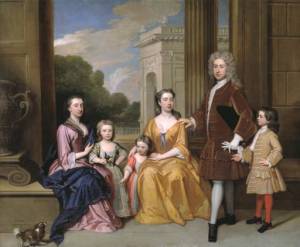
Sir Godfrey Kneller, "The Harvey Family," 1721 (Tate Britain)
This conference will showcase some of the latest scholarship on art and artists in this dynamic period. Focusing on the detailed study of works of art, the event is designed to open up new perspectives on their place within British culture. This is the second of a series of major scholarly events hosted by the AHRC-supported research project Court, Country, City: British Art 1660-1735. This three-year project runs from October 2009 to September 2012, and is led by Professor Mark Hallett of the University of York and Professor Nigel Llewellyn and Dr Martin Myrone of Tate Britain.
- Anthony Geraghty (University of York), Robert Streeter at the Sheldonian
- Helen Pierce (University of Aberdeen), Francis Barlow: The political animal
- Christine Stevenson (Courtauld Institute), Court, city, cosmos: meditations of London’s second Royal Exchange
- Sarah Monks (University of East Anglia), Drawing fire: the van de Veldes, and the imagery and implications of late Stuart naval conflict
- Jacqueline Riding (University of York), Joseph Highmore’s ‘David Le Marchand’ and the search for Kneller’s heir
- Mark Hallett (University of York), Genres and Transformations: Reflections on the first ‘Court, Country, City’ display
The conference is free, but you must register to attend. Please email Clare Bond, at cecs1@york.ac.uk, or write to the Centre for Eighteenth Century Studies, University of York, The King’s Manor, Exhibition Square, York Y01 7EP, with your name, address, and affiliation, if any.
There will be an opportunity at lunch time to see the Court, Country, City Display in Room 3 (see below).
◊ ◊ ◊ ◊ ◊
Court, Country, City: British Art 1660-1735
Tate Britain, November 2010 — November 2011

Edward Collier, "Still Life," 1699 (Tate Britain)
This display introduces a major new research project, Court, Country, City: British Art 1660-1735, which will explore how the visual arts developed in these years. The period 1660-1735 was a dramatic time. Many people’s lives were transformed by the restoration of the monarchy, the establishment of a modern economy and government, and the expansion of global trade and empire. In art historical terms, the period covers the time between the appointment of Peter Lely as court painter to Charles II, and the emergence of a new form of modern British art with Hogarth and the St Martin’s Lane Academy in the 1730s.
The ways in which art was commissioned, practiced, viewed and experienced changed dramatically over these decades, as the balance of power between the Court (centred on the monarch), the Country (the land-owning elite) and the City (the urban middle class) shifted. The display divides paintings into groups according to genre – history, portraiture, landscape and still life. These groups may suggest how the
styles and forms of art changed between 1660 and 1735.
The research team would welcome your comments about the works of art you see here, and what you think they tell us about this key period of British history. Please send comments to cccresearch@tate.org.uk. The display can be seen in Room 3, Tate Britain, London, from November 2010 to November 2011.
Additional information and links to the images included in each genre are available here»
Melissa Hyde on the Saint Aubins at the Bard Graduate Center
From the Bard Graduate Center:
Melissa Hyde, Needling: Embroidery and Satire in the Hands of the Saint-Aubins
Bard Graduate Center, New York, 16 February 2011
This talk will explore the themes of social satire and self-parody that are to be found in the illicit and uncensored drawings of the Livre de caricatures tant Bonnes que mauvaises, a collaborative work produced over several decades of the eighteenth century by the Saint Aubins, a family of artists (and embroiderers). A private, though monumental work comprised of nearly 400 drawings, the Livre engages with a dizzying array of highly topical and often hermetic subjects. This lecture will focus on a few images that satirize “effeminate” men, particularly society men who reputedly practiced embroidery and other forms of needlework. The talk will consider how these images relate to similar thematics in contemporary theater and to broader cultural anxieties about the undue influence of women like Mme de Pompadour – one of the Saint Aubin’s patrons and a favorite target in the Livre de caricatures. Taking into account that the patriarchs of the Saint Aubin family were themselves extremely successful royal embroiderers, this talk will also address some of the ways in which the Livre playfully and self-reflexively parodies the Saint Aubins themselves. (more…)
Royal Academy of Arts: Object of the Month, Kauffman’s ‘Design’
From the Royal Academy of Arts in London:
Royal Academy of Arts, Object of the Month — January 2011
Angelica Kauffman, Design, oil on canvas, 1778-80
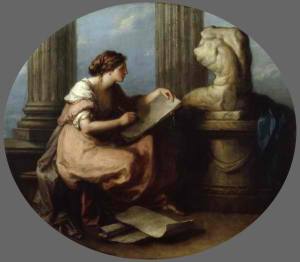
Angelica Kauffman RA, "Design," oil on canvas, 1778-80 ©Royal Academy of Arts, London
. . . This painting is part of a set of the four ‘Elements of Art’ represented by female allegories of Invention, Composition, Design and Colour which were commissioned by the Royal Academy in 1778 to decorate the ceiling of the Academy’s new Council Chamber in Somerset House. The present painting shows the figure of Design as an imposing allegorical female dressed in white and pale red with a purple mantle, seated beside two Roman columns. The figure is copying a fragment of an Antique male nude statue, commonly called the Belvedere torso. The original statue was first documented in Rome in the 1430s and is now in the Vatican Museum, Rome. However a cast of this torso was in the Royal Academy’s collection at the time of Kauffman’s commission and was for the use of the students of the Royal Academy Schools.
This composition alludes to one of the cornerstones of artistic academic training at that period which focused on proportion, scale and form based on antique prototypes. This training was also echoed in Kauffman’s own study, which was based on copying Antique statues and the Renaissance great masters. . . .
The full essay is available here»
◊ ◊ ◊ ◊ ◊
Usually on display in the Front Hall of the Royal Academy, the painting can be seen until 6 March 2011 in the exhibition, Rome and Antiquity: Reality and Vision in the Eighteenth Century at the Museo of the Fondazione Roma.
Royal Academy of Arts: Artist of the Month, John Bacon
From the Royal Academy of Arts in London:
Royal Academy of Arts, Artist of the Month — January 2011
John Bacon RA (1740-1799)
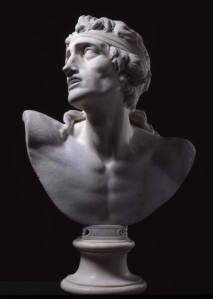
John Bacon, "Sickness," marble, 1778 Diploma Work given by John Bacon, R.A., accepted 1778 © Royal Academy of Arts, London (Photo by Paul Highnam)
Bacon was the son of a cloth-worker, and was originally apprenticed to Nicholas Crispe, the owner of a porcelain factory, in 1755. Here he learnt to create designs for small scale productions in both ceramic and metalwork. In 1759 he was ambitious enough to enter the first of many sculptures into the Society of Arts premium competitions. He was successful in winning 11 premiums as well as being awarded the Society’s gold medal. Bacon went on to work with Josiah Wedgwood, Matthew Boulton and James Tassie. By 1769 the establishment of the Royal Academy Schools provided further opportunities and Bacon enrolled as a student by June of that year. He was again successful in the RA Schools competitions and won a gold medal in his first year there. His rise in the Royal Academy was rapid as he was elected as Associate of the Royal Academy in 1770 and a full Royal Academician in 1778.
His Diploma Work, given to the Royal Academy on his election to full Membership, was Sickness which is a copy of the head of figure which forms part of the monument to Thomas Guy in Guy’s Hospital Chapel, London (1779). Completed in 1779 the founder of the Hospital is depicted life size,
in contemporary dress, bending down to help an emaciated, ailing man. Unlike his contemporary and rival Thomas Banks, Bacon never visited Rome and was not greatly interested in looking to classical prototypes. The tortured expression of Sickness is more naturalistic than the Neo-classical ideal of noble simplicity would allow. . . .
The full essay is available here»
◊ ◊ ◊ ◊ ◊
The bust of Sickness can be seen in the Louvre exhibition Antiquity Rediscovered: Innovation and Resistance in the 18th Century until 14 February 2011.
New Acquisition at The Brooklyn Museum: Painting by Brunias
Press release from the Brooklyn Museum (as noted at ArtDaily) . . .

Agostino Brunias, "Free Women of Color with their Children and Servants in a Landscape," oil on canvas, ca. 1764-96 (Brooklyn Museum)
The Brooklyn Museum has acquired, by purchase from the London Gallery Robilant + Voena, Agostino Brunias’s (1730–96) painting Free Women of Color with Their Children and Servants in a Landscape (circa 1764–96), a portrait of the eighteenth-century mixed-race colonial elite of the island of Dominica in the West Indies. Brunias, a London-based Italian painter, left England at the height of his career to chronicle Dominica, then one of Britain’s newest colonies in the Lesser Antilles. The painting depicts two richly dressed mixed-race women, one of whom was possibly the wife of the artist’s patron. They are shown accompanied by their mother and their children, along with eight African servants, as they walk on the grounds of a sugar plantation, one of the agricultural estates that were Dominica’s chief source of wealth. Brunias documented colonial women of color as privileged and prosperous. The two wealthy sisters are distinguished from their mother and servants by their fitted European dresses.
The painting is a Caribbean version of contemporaneous English works made popular by artists such as William Hogarth and Thomas Gainsborough, whose art often depicts the landed gentry engaged in leisurely pursuits. Free Women of Color with Their Children and Servants in a Landscape and other Caribbean paintings by Brunias celebrate the diversity of European, Caribbean, and African influences in the region. (more…)
Christoph Vogtherr Announced as New Director of the Wallace
From The Wallace:
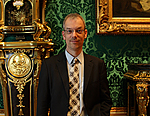 The Chairman, Sir John Ritblat, and the Trustees of the Wallace Collection are most pleased to announce the appointment of Dr Christoph Vogtherr as the next Director of the Collection upon the retirement of Dame Rosalind Savill DBE next October 2011. ‘Having run a fully international competition, it is very satisfying to find the right balance of scholarship and leadership from within the Wallace Collection itself, and that the appointment of Dr Vogtherr has the wholehearted endorsement of the Board of Trustees’ says Sir John Ritblat, Chairman of the Trustees.
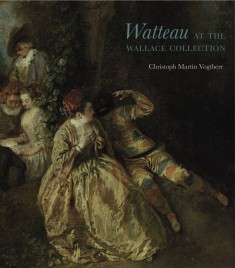 Dr Christoph Martin Vogtherr is a specialist scholar/curator in eighteenth-century French painting. He was born in 1965 and studied Art History, Medieval History and Classical Archaeology at Berlin (Freie Universität), Heidelberg and at Trinity College, Cambridge. He received his Ph.D. from the Freie Universität in 1996 with a thesis on The Early History of the Berlin State Museums (published in 1997). After two years as a Research Assistant at the Akademie der Künste (Academy of Fine Arts), Berlin, he became Curator of French and Italian Paintings at the Stiftung Preußische Schlösser und Gärten (Foundation Prussian Palaces and Gardens) in Potsdam and Berlin in 1997. He curated exhibitions on Chardin, Pater and on the patronage of the Prussian Royal house and initiated an interdisciplinary research project on French paintings in the collection of Frederick II sponsored by the Getty Foundation. His catalogue raisonné of the paintings by Antoine Watteau, Jean-Baptiste Pater and Nicolas Lancret in Berlin and Potsdam appeared in December 2010. Since 2007 he has been Curator of Pictures pre-1800 at the Wallace Collection, from 2008-10 he was Acting Head of Collections, and is the curator of two exhibitions on Watteau which will open at the Wallace Collection in March 2011. He will take up his appointment on 24 October 2011.
Lecture at the Louvre: The Sculpture of Pierre-François Berruer
From the Louvre:
Guilhem Scherf (Department of Sculpture, Louvre)
Louis XV récompense la Peinture et la Sculpture de Pierre-François Berruer
Musée du Louvre, Paris, 9 February 2011
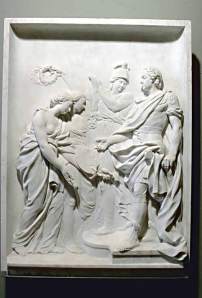
Pierre-François Berruer Paris, "Louis XV récompense la Peinture et la Sculpture." 1770 © Musée du Louvre/P. Philibert
Ce petit bas-relief en marbre fut sculpté en 1770 par Pierre-François Berruer (1733-1797), au moment de son entrée à l’Académie royale de peinture et de sculpture. Par le traitement élaboré des draperies et la gradation subtile des plans dont il fait preuve, ce morceau de réception témoigne d’une réflexion sur l’esthétique du bas-relief dans le contexte académique. Également intitulée parfois Louis XV prenant sous sa protection l’Académie royale, cette œuvre est aussi l’occasion de revenir sur le rôle du souverain et de la politique royale en faveur des arts.










 Enfilade
leave a comment