Lecture: Mark Hallett at the Scottish National Gallery
As reported at the blog for British Art Research:
Mark Hallett, Faces in a Library: Sir Joshua Reynolds’s Streatham Worthies
Scottish National Gallery, Edinburgh, 3 November 2011
 Mark Hallett, Professor of History of Art at the University of York, will be giving this year’s Watson Gordon Lecture at the Scottish National Gallery (Hawthornden Lecture Theatre – Gardens Entrance), which will analyse the remarkable set of thirteen portraits that the celebrated Georgian artist Sir Joshua Reynolds painted for a private library at Streatham Park, just outside London, between the early 1770s and 1781. Professor Hallett’s lecture is entitled Faces in a Library: Sir Joshua Reynolds’s Streatham Worthies, and will take place at 6pm on November 3rd. The lecture, which will be published as a short book in 2012, focuses on Reynolds’s pictures for Streatham, which include portraits of such cultural luminaries as Edmund Burke, Oliver Goldsmith and Samuel Johnson, which will be explored as expressions of friendship, learning and fame, and as works that responded to the social rituals and intellectual ideals of the eighteenth-century library.
Eighteenth-Century Glass at Bonhams
Press release from Bonham’s (as noted at ArtDaily.com) . . .
Important English and Dutch Glass: The Collection of A. C. Hubbard, Jr.
Bonhams, London, 30 November 2011
 Bonhams will be auctioning the internationally renowned glass collection of A C Hubbard Jr. on 30th November 2011 at Bonhams, 101 New Bond Street, London. The important and magnificent Prince William V of Orange Goblet, circa 1766, is the major highlight not only of the sale but of all English glass offered at auction in recent years, and is estimated to sell for £100,000-150,000.
This goblet is signed by William Beilby. The Beilby workshop in Newcastle was renowned for its enamel decoration of glass and produced around 90 recorded heraldic decanters, goblets and wine glasses, mainly with English armorials of which a significant handful depict Royal coats of arms. Simon Cottle, Head of Bonhams Glass Department, comments, “The majority of their fine goblets with Royal armorials now reside in public institutions worldwide. The Prince William V of Orange Goblet in this auction offers a rare opportunity to possess an example, it is one of only four left in private hands. It is also one of only 16 glasses to be signed, and at an imposing 30.2cm in height it is by far the largest of all Beilby goblets. I believe its production may have led William Beilby’s entry to a contemporary valuable Dutch glass market. Its large size and colourful enamel decoration would have been particularly impressive to the Dutch at a time when their craftsmen were producing smaller, engraved pieces.”
Assembled by a discerning Baltimore collector with a passion for fine wines, A C Hubbard Jr.’s collection includes examples of the best of English and Dutch glass from the seventeenth and eighteenth centuries, many previously published in the literature on glass. From majestic early heavy baluster goblets of both large and small size to the attractive colour-twist wine glasses of the later period, this private collection is one of the finest to be offered at auction in recent years.
Iconic eighteenth-century drinking glasses, such as those painted by the Beilby family in Newcastle, also include several further important colourful heraldic goblets and a range of their exquisite wine glasses painted with a variety of subjects in white enamel. Of the colour-twist glasses in the sale several examples feature rare combinations of threads, three of which have highly uncommon canary-yellow stems. Notable English engraved political wine glasses sit happily alongside their Dutch counterparts of which there are numerous light-baluster examples decorated with Royal armorials, VOC ships and political themes such as the patriotic glass by Jacob Sang, dated 1758. Dutch stipple-engraved glass from the hands of David Wolff, Alius and other contemporary eighteenth-century artists represents further classic highlights of this magnificent collection of over 270 lots.
Simon Cottle, comments, “There are few collections of English and Dutch eighteenth-century glass of this quality still in private hands. The Hubbard sale therefore presents a wonderful and rare opportunity to acquire examples from what is now considered to be the Golden Age of lead crystal.”
Exhibition: Monkeys and Dragons at Chantilly
The following press release comes from the Musée Conde. -HB
Singes et Dragons: La Chine et le Japon à Chantilly au XVIIIe Siècle
Musée Conde, Château de Chantilly, 14 September 2011 — 1 January 2012
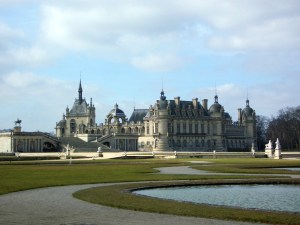
Pour la rentrée de septembre 2011, le musée Condé propose une exposition qui s’inscrit dans la thématique du « voyage » qui sera développée jusqu’à la fin 2011 par le Domaine de Chantilly. En effet, les visiteurs sont invités à remonter le temps, au XVIIIe siècle, quand artistes et artisans réalisaient des œuvres peintes ou d’art décoratif sur commande, afin de combler un goût immodéré pour les décors asiatiques où singes et dragons se mêlaient parfois avec délicatesse aux animaux familiers de nos campagnes.
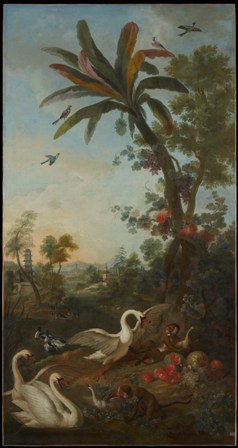 En ce début du XVIIIe siècle, alors que la France se passionne pour l’exotisme, le duc de Bourbon, prince de Condé (1692-1740), collectionne pour son Château de Chantilly les porcelaines, les indiennes – tissus peints ou imprimés fabriqués en Asie entre le XVIIe siècle et le XIXe siècle – et les meubles en laque de Chine et du Japon. Il les fait copier par des artisans français et crée pour ce faire trois manufactures. En mécène entrepreneur passionné, il commande en 1735 au dessinateur Jean-Antoine Fraisse (1680-1739) un album de modèles, gravés en taille-douce, d’après ses collections. Les artisans au service du prince s’en inspirent, notamment pour les porcelaines de Chantilly ; et ce jusqu’en 1740 à la mort du Prince et au tournant de cet engouement pour l’exotisme. C’est à partir de cet ouvrage in-folio rarissime que Nicole Garnier, conservateur général du patrimoine chargée du musée Condé, a conçu son exposition de rentrée où sont présentés outre les deux exemplaires enluminés provenant des collections du Château de Chantilly et de la Bibliothèque nationale de France (Bnf), des gravures de Fraisse (dont deux de plus de trois mètres sont extraites de l’exemplaire enluminé), d’autres de Jean-Baptiste Guélard (1698-1767), des peintures de Christophe Huet (1700-1759) et des pièces d’art décoratif représentatives de cette époque où l’Extrême-Orient était de mise à la Cour et dans les plus belles demeures. . . .
The full press release is available here»
◊ ◊ ◊ ◊ ◊
Catalogue: Manuela Finaz de Villaine and Nicole Garnier-Pelle with assistance from Eléonore Follain, Singes et Dragons: La Chine et le Japon à Chantilly au XVIIIe siècle (Chantilly: Édité par la Fondation pour la Sauvegarde et le Développement du Domaine de Chantilly, 2011), 64 pages, ISBN: 9782953260335, 12€.
Lecture: Sisterhood as Alternative to Fraternité
From Sciences Po (as noted at Le Blog de L’ApAhAu). . .
Anne Lafont — Sororités, ou l’alternative au motto de 1789: liberté, égalité, fraternité
Sciences Po, salle de conférences, 56 rue Jacob, Paris, 2 November 2011

Henriette-Lorimier, "Self-Portrait," 1801
Il est au moins deux registres où la question de la sororité peut faire sens dans un séminaire consacré à la passion égalitaire de la société post-révolutionnaire et de ses implications dans la vie culturelle. La sororité des arts, de la peinture et de la poésie, fut le leitmotiv de la théorie artistique à l’époque moderne. De même, le sort public des femmes engagées dans la création fut autant considéré, pendant la Révolution française, par les femmes artistes que par les femmes de lettres, à l’instar de Germaine de Staël, qui n’est pas étrangère, d’ailleurs, à la constitution de la pensée tocquevillienne. Par ailleurs, la sororité désigne le processus de communautarisation des artistes femmes en 1800, face au tout masculin initié par la société révolutionnaire des clubs et des assemblées, comme l’ont bien montré les nombreux travaux sur le genre depuis le livre pionnier de Geneviève Fraisse, Muse de la Raison Démocratie et exclusion des femmes en France (1989). Néanmoins, nombreuses furent celles qui saisirent l’opportunité de l’abolition de la censure à l’exposition publique annuelle du Louvre : le Salon, en 1791, pour investir l’espace public de la création et risquer la professionnalisation à une époque de redéfinition radicale du marché de l’art, de la commande privée et de la commande publique. En un mot, ces femmes artistes s’employèrent à suivre des stratégies de subsistance à un moment d’instabilité, où les rivalités entre artistes, en général, s’étaient accrues. Quelles furent alors les solutions imaginatives de ces sœurs de plumes et de pinceaux? En quoi leurs expériences inaugurales forment un paradigme propice à comprendre l’avènement de l’artiste moderne?
Conference: The First Actresses at the NPG
The National Portrait Gallery exhibition, The First Actresses, opened last week in London. Here’s information on the exhibition conference:
The First Actresses: Gender, Representation, and Performance
National Portrait Gallery, London, 11 November 2011
Tickets: £35/£30/£20

John Hoppner, "Mrs. Robinson as 'Perdita'," 1782 © Chawton House Library, Hampshire
This one-day conference is organised by the National Portrait Gallery in partnership with The Open University to accompany the exhibition The First Actresses: Nell Gwyn to Sarah Siddons (20 October 2011-8 January 2012). The event brings together the research skills of an international group of academics working in the different disciplines of theatre and performance studies, literature, music and art history and provides a forum in which to address the role of visual and material culture in the formation, promotion and reception of women performers in this period. With its emphasis on the visual culture of the eighteenth-century actress, we hope that the conference will generate stimulating discussions around the exhibition and its themes.
The First Actresses will explore the vibrant yet controversial relationship between art, gender and the theatre in eighteenth-century England. It will chart the emergence of the profession of actress after 1660 by examining the public lives, reputations and representations of female performers during the long eighteenth century. The exhibition will explore the ways in which ambitious portraits and more intimate works, and a growing market for prints and mass-produced objects, were central to the eighteenth-century struggle to professionalize and expand the theatre and develop its close relationship with fine art. The show will argue that the remarkable visibility of portraits of women players, sometimes replete with symbolic and allegorical functions, was crucial to this process. Nevertheless, the public spectacle of these women on display (on stage and in paint) provoked passionate debates on moral and sexual decorum. Commissioned portraits by leading artists, satirical prints and commemorative objects fed these concerns and contributed to the growth of a lively celebrity culture, which has been seen to anticipate the modern ‘star system’. The exhibition will explore some of the aesthetic, gender and class questions which are raised by portraits of actresses, including performers such as Peg Woffington, Sarah Siddons, Dorothy Jordan, Frances Abington, Elizabeth Linley and Giovanna Baccelli.
The exhibition explores the ways in which visual images and written biographies combined to create popular myths, ambiguous histories and sexual scandals. It explores how theatrical portraits can provide traces, fragments and reconstructions of lives and performances. Given its chronological range, it also explores historical shifts in the structure and culture of the theatre, the evolution and popularity of particular roles for women, their creative ambitions and their representations through visual imagery. This is also one of the first exhibitions to explore the roles of music and dance in the repertoire of female performers, considering the close relationship between these genres in eighteenth century theatre and their visual representation.
Combining some well-known paintings and little-known works by artists such as Johann Zoffany, Francis Hayman, William Hogarth, Joshua Reynolds, Thomas Gainsborough, John Hoppner, Samuel de Wilde and Thomas Lawrence such as , this exhibition will also examine the ways in which actresses and artists used portraiture to enhance their reputations and increase their popularity and professional status.
Taking the exhibition as its starting point, the conference will develop the following research themes through individual papers, Q&As and a roundtable:
• What was the role of visual representation in the construction of eighteenth-century celebrity culture and ‘star actresses’?
• How did actress portraits contribute to ideas of ‘public intimacy’ and imagined offstage personalities?
• How did the representation of female roles contribute to eighteenth-century definitions of femininity in the public sphere, and how did actresses use visual imagery to gain cultural authority and earning power?
• What was the relationship between the performance culture of the patent theatres and so-called ‘amateur theatricals’, and how did these associations inform perceptions and representations of women players?
• How did the British taste for Eastern ‘otherness’ and ‘oriental’ plays in the Georgian theatre affect perceptions of women players, their roles and representations?
• How was the eighteenth-century rage for musical theatre (such as operettas, pantomimes, musical comedies) represented through visual representation?
• How were political and cultural issues and concerns with British national identity mediated through women’s roles and their visual representations?
• How did the close relationship between the fine, applied and dramatic arts inform contemporary ideas of spectacle, performance and ‘character’?
◊ ◊ ◊ ◊ ◊
C O N F E R E N C E P R O G R A M M E (more…)
Small Exhibition at the V&A: Venetian Visions
From the V&A:
Venetian Visions: The Art of Canaletto, Tiepolo, Carlevarijs, and Their Contemporaries, 1700–1800
Victoria & Albert Museum, London, 7 October 2011 — 1 April 2012

Giambattista Tiepolo, "Apollo and Marsyas,"ca. 1725 (V&A)
The eighteenth century was possibly the last great period of Venetian art. It witnessed a wealth in artistic production from paintings, drawings and prints to porcelain, lace and glass. This display will draw from the V&A collections of prints, drawings, textiles, ceramics and glass to showcase Venetian arts during this age of stylistic splendour.
◊ ◊ ◊ ◊ ◊
Complementing our permanent collections, there are many free temporary displays around the V&A. They range in size from a single case to a room.
Call for Papers: Material Matters for Emerging Scholars
From the University of Delaware:
Tenth Annual Material Culture Symposium for Emerging Scholars: Material Matters
Winterthur Museum, Garden & Library, Delaware, 14 April 2012
Proposals due by 16 November 2011
Focus: Object-based research has the potential to expand and even reinvent our understanding of culture and history. In honor of the tenth anniversary of the MCSES, we seek a broad range of papers from emerging material culture scholars. Whether exploring the latest theories, viewing existing material through a new lens, or reinterpreting standing historical conversations with an object-based focus, proposed papers should exemplify the possibilities in material culture research. In exploring these material matters, we hope to promote an interdisciplinary discussion on the state of material culture studies today. Disciplines represented at past symposia include American studies, anthropology, archaeology, consumer studies, English, gender studies, history, museum studies and the histories of art, architecture, design and technology. We welcome proposals from graduate students, postdoctoral scholars, and those just beginning their teaching or professional careers.
Format: The symposium will consist of nine presentations divided into three panels. Each presentation is limited to twenty minutes, and each panel is followed by comments from established scholars in the field. There will be two morning sessions and one afternoon session, with breaks for discussion following each session and during lunch. Participants will also have the opportunity to tour Winterthur’s unparalleled collection of early American decorative arts and to engage in a roundtable discussion on Friday, April 13. Travel grants of up to $300 will be available for presenters.
Submissions: The proposal should be no more than 300 words and should clearly indicate the focus of your object-based research, the critical approach you take toward that research, and the significance of your research beyond the academy. While the audience for the symposium consists mainly of university and college faculty and graduate students, we encourage broader participation. In evaluating proposals, we will give preference to those papers that keep a more diverse audience in mind. Send your proposal, with a current c.v. of no more than two pages, to emerging.scholars@gmail.com.
Deadline: Proposals must be received by 5 p.m. on Wednesday, November 16, 2011. Speakers will be notified of the vetting committee’s decision in January 2012. Confirmed speakers will be asked to provide symposium organizers with digital images for use in publicity and are required to submit a final draft of their papers by March 5, 2012.
Call for Articles: Special Issue of ‘World History Connected’
Special Issue of World History Connected: Art in World History
Submissions due 1 December 2011
The February 2012 issue of the online journal World History Connected will focus on “Art in World History.” It seeks to offer case studies and effective methodological and/or pedagogical approaches highlighting this important aspect of both research and teaching in the field of world history. The editor of the journal, Marc Jason Gilbert, and the guest editor of this forum, Ralph Croizier, seek five sorts of contributions: (more…)
Exhibition: The Young Tiepolo, The Discovery of Light
Xavier Salomon reviews the exhibition in the October issue of The Burlington (pp. 698-99). From the Udine website:
Il giovane Tiepolo: la scoperta della luce
Civic Museum of Udine, Castello, Udine, 4 June — 4 December 2011
Curated by Giuseppe Pavanello and Vania Gransinigh
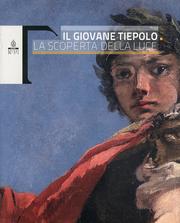
ISBN: 9788895752112
Che cosa caratterizza l’esordio di un giovane pittore di genio? Quali percorsi mentali e creativi presiedono alla formazione di un artista di talento? A questa e ad altre domande proverà a dare risposta la mostra che i Civici Musei di Udine inaugurano il 4 giugno 2011 all’interno della terza edizione delle Giornate del Tiepolo. L’esposizione, dal titolo Il giovane Tiepolo: la scoperta della luce, è rivolta proprio a ricostruire, attraverso le opere più significative, il periodo giovanile dell’attività di Tiepolo, prima del suo soggiorno udinese del 1726.
Se, nel corso del suo apprendistato presso la bottega del pittore accademico Gregorio Lazzarini, l’artista ebbe modo di confrontarsi con i modelli offerti dalla tradizione figurativa veneta del Cinquecento, egli si dimostrò particolarmente attento anche a quanto i suoi contemporanei andavano sperimentando, e alle nuove teorie sulla luce di ispirazione newtoniana. Le opere di Federico Bencovich e Giambattista Piazzetta rappresentarono per il giovane Tiepolo un punto di riferimento ugualmente importante che egli seppe assimilare in maniera originale, in sintonia con il suo essere “tutto spirito e foco,” attraverso un linguaggio pittorico costruito sull’interpretazione luminosa dell’immagine. Ed è proprio su questa peculiare visione tiepolesca della luce che l’esposizione udinese si focalizza, ripercorrendo il tracciato di un’attività che dalle tele dipinte per la chiesa veneziana dell’Ospedaletto si dipana, per il tramite delle decorazioni di Palazzo Sandi, fino al ciclo di affreschi realizzati a Udine nel Palazzo Patriarcale.
I dipinti in esposizione permettono così di documentare il passaggio da una pittura costruita nella luce, secondo precise fonti di illuminazione interne all’immagine, a una pittura costruita dalla luce, nella quale forme e volumi appaiono generati, come vetro soffiato, dall’interna energia luminosa della materia. In mostra sono presentate opere provenienti dai musei di Venezia, Milano, Torino e da alcune delle più prestigiose collezioni pubbliche e private internazionali.
Comitato scientifico: Svetlana Alpers, William L. Barcham, Linda Borean, Caterina Furlan, Peter O. Krückmann, Giuseppe Pavanello e Catherine Whistler.
◊ ◊ ◊ ◊ ◊
Catalogue: Giuseppe Pavanello and Vania Gransinigh, eds., Il Giovane Tiepolo. La Scoperta della Luce (Udine: Civici Musei e Gallerie di Storia e Arte di Udine, 2011), 207 pages, ISBN: 9788895752112, €45 / $87.50.
George Washington Life Mask
With Halloween around the corner, ’tis the season for masks: The Morgan Library and Museum in New York City features an online exhibition where virtual museum-goers can digitally examine the life mask of George Washington. The high- definition zoom technology allow viewers to inspect the details of the mask without having to travel to the brick-and-mortar museum. -AS
Excerpt from the online exhibition:
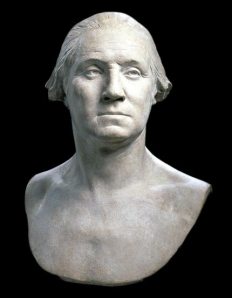
Jean-Antoine Houdon, "Bust of George Washington" clay (Mount Vernon, Virginia)
In 1785 the French sculptor Jean-Antoine Houdon visited George Washington (1732–1799) at his Mount Vernon residence. There he observed the general and made a plaster cast of his face—the Morgan’s life mask. He then used the mask to complete the face on his clay bust of Washington, which he left at Mount Vernon (Fig. 1). Houdon returned with the life mask to Paris, where he sculpted the final marble life-size sculpture of Washington now in the Richmond Capitol (Fig. 2). The statue was commissioned by the Virginia legislature and was erected in 1796, the year Washington issued his farewell address following his second term as president. The Morgan’s life mask of Washington is unique and represents the truest likeness of the country’s first president. Pierpont Morgan likely acquired the mask in Rome from the son of the American sculptor William Wetmore Story.
In order to make a mold of Washington’s face, Houdon had the general lie down. He prepared Washington’s face with a protective layer of grease and covered his eyes before adding a coat of wet plaster, inserting straws in the general’s nose so that he could breathe. Once the plaster hardened, Houdon removed the cast and poured plaster into the mold to make a positive model, destroying the mold in the process. It is this positive model that constitutes the Morgan’s life mask. Because Washington’s eyes were closed, in the final mask Houdon had to sculpt the open eyes based on caliper measurements, as well as retouch the nostrils, which were hampered by the breathing apparatus. The air bubbles in Washington’s cheeks were produced as the plaster settled in the mold.
The life mask recently served as a starting point for a team of forensic anthropologists working at Mount Vernon to re-create effigies of the “real” George Washington at three different moments in his life. Using the Morgan’s cast of the fifty-three-year-old Washington’s face, scientists were able to project the changes in his bone structure and appearance from his youth through old age. . . .
More information is available here»










 Enfilade
leave a comment