Exhibition: Piranesi at the Hermitage
From the Hermitage:
Ruins, Palaces and Prisons: Piranesi and Italian Eighteenth-Century Architectural Fantasies
State Hermitage Museum, St Petersburg, 7 December 2011 — 25 March 2012
Curated by A.V. Ippolitov, M.F. Korshunova, and V.M. Uspenskiy
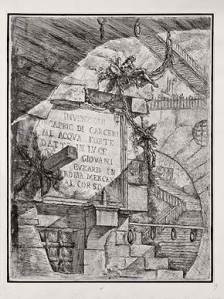
Piranesi, Title page of the 'Carceri' series, 1749-1750
On December 7th, 2011, Saint Catherine’s day, the State Hermitage Museum welcomed an exhibition entitled Ruins, Palaces and Prisons: Giovanni Battista Piranesi and Italian Eighteenth-Century Architectural Fantasies, dedicated to the early period of Piranesi’s work. This exhibit is being held as part of the Year of Italy in Russia and Year of Russia in Italy 2011 program, which continues tradition of partnership and cooperation between the two countries in the fields of art and culture.
This exhibition, presenting about 100 drawings and prints from the collection of the Hermitage, is divided into two parts: the first is dedicated to Piranesi and will present the series entitled Prima Parte (“Prima Parte “), Grotteschi (“Grotesques”) and Carceri (“Dungeons”) in their rare original condition, which have never been published in Russia before. All of them are from the 1750 album Opere Varie, which was acquired by the Empress Catherine the Great in 1768 as part of the collection of Count Bruhl and became the basis of the graphic arts collection of the Hermitage. The Carceri is presented in two conditions; the early one, from the Bruhl
collection, and a later one which was extensively revised. This is the first
time this sort of juxtaposition has been presented in Russia.

Piranesi, "Drawbridge," A page from the 'Carceri' series, 1749-1750
The second part consist of drawings by Italian artists of the 18th century who worked as scene decorators, designers and architects and created the unique genre of imaginative Veduta, which is important for understanding the style of the settecento, as the 18th century is called in Italian, a unique and complex phenomenon. Imaginative Veduta is represented by the work of the Galli Bibiena family, G. Valeriani, Pietro Gonzaga, G. Barbari, G. Mannocchi, many of which are being published for the first time. The phenomenon of Piranesi’ early fantasies is put in the context of a unique genre, and is examined at this exhibit as original sources, as is the influence of the Piranesi phenomenon on the later development of imaginative Veduta.
Giovanni Battista Piranesi (1720-1778) has an enduring place in the history or art as an artist who defined European art in the mid 18th- early 19th century. Piranesi is acknowledged as a reformer of public taste and one of the progenitors of neoclassicism, which might be called the Avant Garde of the 18th century, and as such his name is associated with this movement. However, while the series of etching entitled Carceri (dungeons), a procession of frightening, inexplicable and obscure images was not well known in the artist’s life, was many decades ahead of its time. Carceri become of the works of art most beloved by modernism. This series, which was not particularly popular during Piranesi’s life, a rediscovery of Romanticism attracted writers, architects, directors then and continues to do so now not only with its unusual subject matter, but also with its unusual spatial construction, which reminds one not of real architecture, but of the unreal space of a dream or hallucination.
Thomas De Quincey included the Carceri series in the novel “Confessions of an English Opium Eater,” so centrally in the opium-induced visions of an “artificial heaven” produced by the intoxicated brain of an intellectual aesthete that the artist’s fantasies began to be discussed as a breakthrough into the art of the future. This novel, which was unbelievably popular among aesthetes, including Gautier and Baudelaire, gave Piranesi a reputation as one of the first artists to penetrate the world of a sick subconscious. In Russia, V.F. Odoevsky wrote a story entitled “Opere del Cavaliere Giambattista Piranesi”, transforming this primary “representative of Roman neoclassicism” into a despairing and gloomy Romantic figure. Piranesi’s dungeons amazed Victor Hugo, who created a whole series of drawings under the influence of these etching, which in their turn influenced the symbolism of Odilon Redon, from whom these is a direct progression to expressionism and surrealism. Sets for Shakespeare’s Hamlet and Beethoven Fidelio were inspired by Piranesi’s engravings. Aldous Huxley and Sergei Eisenstein wrote essays about Piranesi, and Edgar Allan Poe also dwelt upon the artist’s dark fantasies. Nicolas de Stael and Hans Hartung created abstract compositions dedicated to Carceri. M.C. Escher used Piranesi for his experiments in the construction of spatial labyrinths, which have had some much influence on computer graphics. Piranesi’s etchings became the starting point for many directors: Sergei Eisenstein and Fritz Lang used them in their films. His architectural ideas inspired the architects of totalitarian regimes, Mussolini’s Italy, Stalin’s Soviet Union and Hitler’s Third Reich, and at the same time he became perhaps the most beloved architect of Postmodernism. In terms of the number of references and citations in the art of the 20th century, Piranesi occupies the first place among the artists of his time who are considered part of Modernism.
In the 1740’s, the young Venetian, who was at that time a nearly unknown artist, having found himself in Rome, took his first steps towards glory. Piranesi had neither fame nor money, but it was precisely then that he created most of his fantastic compositions. These works did not become famous in his life, but afterwards, these strange and original works of art, the Prima Parte, Grotteschi and Carceri series, were recognized as the most paradoxical and groundbreaking of his creations.
Many Italian artists created drawings with images of ideal architectural compositions, which were often pure fantasy. This exhibit includes drawing by the masters of the first half of the 18th century, which had a direct influence on Piranesi, as well as works by masters from the end of that century who were inspired by his engravings. The stylistic peculiarities of the settecento, like the style of Piranesi himself, cannot be reduced to one single style: be it baroque, baroquetto, rococo or neoclassicism. Italian imaginative is just as unique as the early fantasies of the Roman genius, and in order to investigate both the sources of this paradoxical master’s work, as well as its influence on the artist’s own time, this exhibit will feature Piranesi’s engravings in the context of this particular genre.
The creator of the concept behind this exhibit and catalogue is A.V. Ippolitov, the senior academic associated of the Department of Western European Fine Arts at the State Hermitage Museum. The curators of the exhibit are M.F. Korshunova, head academic associate, V.M. Uspenskiy, junior academic associate of the Department of Western European Fine Arts at the State Hermitage Museum.
An illustrated academic catalogue has been prepared for this exhibited (published by the State Hermitage Museum, 2011). The authors of the articles are A.V. Ippolitov, M.F. Korshunova and V.M. Uspenskiy. In the first part of the catalogue, Piranesi is considered against the panorama of the artistic life of Rome and Venice, and the influence of his architectural fantasies on culture is traced up to our own time. The second section is dedicated to the Venetian roots of the artist’s early works. Separate articles describe the origins of Count Bruhl’s album, a unique artifact of 18th century collection, and of the Hermitage’s collection of Italian architectural fantasies, which is one of the richest in the world. The commentary included in the catalogue contains a detailed analysis of the installments, the condition and date of every page by Piranesi, as well as an iconographic interpretation. The attachments to the catalogue include a chronological tablet as well as the first Russian translation, with commentary, of the famous biography of Piranesi, written by J. Legrand, based on the words of Piranesi’s son, Francesco.










 Enfilade
leave a comment