Call for H-ALBION Book Review Editor: Ireland
Call for H-ALBION Book Review Editor: History of Ireland, 1500 to 1800
Applications due by 1 February 2012
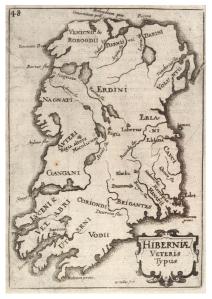
Wenceslaus Hollar, "Ireland," state 2, seventeenth century (Toronto: Thomas Fisher Rare Book Library)
H-Albion is looking for candidates who would like serve as our Book Review Editor for Ireland. Applications are invited from scholars specializing in the early modern period. The successful candidate will serve as book review editor for two years and will be responsible for commissioning and editing book reviews. Please send a cover letter and CV to Jason M. Kelly at jaskelly@iupui.edu.
Call for Papers: NORDIK Conference, Art Theory & Visual Epistemology
This is one panel at the NORDIK conference. Conference organizers welcome paper proposals for the 21 sessions spanning a wide range of topics. More information: http://nordicarthistory.org/conference
Art History Conference NORDIK 2012
Stockholm, Sweden, 24-27 October 2012
Proposals due by 15 January 2012
Call for Papers: Art Theory as Visual Epistemology
How can we know? What does knowledge mean? These were the fundamental questions of epistemology in the 17th century. In response to continental rationalism the British empiricist John Locke proposed that the only knowledge humans can have is acquired a posterior. In a discussion of the human mind, he argues, the source of knowledge is sensual experience – mostly vision. With the central claim of epistemology, art became a question of truth and sound knowledge: Is the artist able to identify truth just like a scientist does? How can the artist contribute to a collective search for truth? Can pictures and statues represent knowledge about the world? Joshua Reynolds, the president of the Royal Academy in London, answered clearly: Yes, it is the task of the artist to see and compare nature in order to abstract the idea behind the mere visual. He stated that this “mental labour” is central to the artist’s occupation. Moreover, the artist is able to give those seen and imagined truths a representation on canvas and, thus, communicate ideas and add to the collective knowledge by visual means. (more…)
Exhibition: Piranesi at the Hermitage
From the Hermitage:
Ruins, Palaces and Prisons: Piranesi and Italian Eighteenth-Century Architectural Fantasies
State Hermitage Museum, St Petersburg, 7 December 2011 — 25 March 2012
Curated by A.V. Ippolitov, M.F. Korshunova, and V.M. Uspenskiy
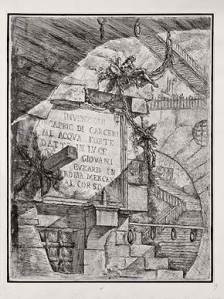
Piranesi, Title page of the 'Carceri' series, 1749-1750
On December 7th, 2011, Saint Catherine’s day, the State Hermitage Museum welcomed an exhibition entitled Ruins, Palaces and Prisons: Giovanni Battista Piranesi and Italian Eighteenth-Century Architectural Fantasies, dedicated to the early period of Piranesi’s work. This exhibit is being held as part of the Year of Italy in Russia and Year of Russia in Italy 2011 program, which continues tradition of partnership and cooperation between the two countries in the fields of art and culture.
This exhibition, presenting about 100 drawings and prints from the collection of the Hermitage, is divided into two parts: the first is dedicated to Piranesi and will present the series entitled Prima Parte (“Prima Parte “), Grotteschi (“Grotesques”) and Carceri (“Dungeons”) in their rare original condition, which have never been published in Russia before. All of them are from the 1750 album Opere Varie, which was acquired by the Empress Catherine the Great in 1768 as part of the collection of Count Bruhl and became the basis of the graphic arts collection of the Hermitage. The Carceri is presented in two conditions; the early one, from the Bruhl
collection, and a later one which was extensively revised. This is the first
time this sort of juxtaposition has been presented in Russia.

Piranesi, "Drawbridge," A page from the 'Carceri' series, 1749-1750
The second part consist of drawings by Italian artists of the 18th century who worked as scene decorators, designers and architects and created the unique genre of imaginative Veduta, which is important for understanding the style of the settecento, as the 18th century is called in Italian, a unique and complex phenomenon. Imaginative Veduta is represented by the work of the Galli Bibiena family, G. Valeriani, Pietro Gonzaga, G. Barbari, G. Mannocchi, many of which are being published for the first time. The phenomenon of Piranesi’ early fantasies is put in the context of a unique genre, and is examined at this exhibit as original sources, as is the influence of the Piranesi phenomenon on the later development of imaginative Veduta.
Giovanni Battista Piranesi (1720-1778) has an enduring place in the history or art as an artist who defined European art in the mid 18th- early 19th century. Piranesi is acknowledged as a reformer of public taste and one of the progenitors of neoclassicism, which might be called the Avant Garde of the 18th century, and as such his name is associated with this movement. However, while the series of etching entitled Carceri (dungeons), a procession of frightening, inexplicable and obscure images was not well known in the artist’s life, was many decades ahead of its time. Carceri become of the works of art most beloved by modernism. This series, which was not particularly popular during Piranesi’s life, a rediscovery of Romanticism attracted writers, architects, directors then and continues to do so now not only with its unusual subject matter, but also with its unusual spatial construction, which reminds one not of real architecture, but of the unreal space of a dream or hallucination. (more…)
Exhibition: Herculaneum at the Hermitage
From the Hermitage:
Herculaneum Antiquities
State Hermitage Museum, St. Petersburg, 16 December 2011 — 12 February 2012
Curated by Stefano de Caro, Anna Trofimova, and Elena Borisovna Ananich

"Architectural Landscape," fresco from the Augusteum in Herculaneum, 65-79 (National Archaeological Museum of Naples)
On 17 December 2011, as part of the Year of Italy in Russia and Year of Russia in Italy, an exhibit entitled Herculaneum Antiquities opened in the State Hermitage Museum in the General Staff Building; it was jointly organized by the State Hermitage Museum, the Ministry for the Preservation of the Cultural Heritage of Naples and Pompeii with the support of the Italian embassy in Moscow, and Consulate General in St. Petersburg. This is the first exhibit to give the Russian public a chance to view these world-famous works of classical sculpture, discovered at the ancient city of Herculaneum, which like Pompeii and Stabia, perished during the eruption of Vesuvius in 79 AD, and was also well preserved.
All of these artifacts, which once decorated the so-called Basilica or Augusteum (a building for ceremonies of the Imperial cult), are now held in the National Archaeological Museum of Naples. At this exhibit, they have been brought together in one place, as a united whole, with additional cartographic materials, reconstructions, data from archaeological and historical research, which make it possible to get a sense of how Augusteum might have looked two thousand years ago and in what sequence and part of the building the exhibit items were placed. (more…)
Exhibition: Eighteenth-Century Verona — Tiepolo, Cignaroli, Rotari
The following comes from the Comune di Verona website. There’s also a fine site dedicated to the exhibition.
Il Settecento a Verona: Tiepolo, Cignaroli, Rotari
Palazzo della Gran Guardia, Verona, 26 November 2011 — 9 April 2012
Curated by Fabrizio Magani, Paola Marini, and Andrea Tomezzoli
 La mostra è incentrata sulle peculiarità che la cultura e la tradizione pittorica assunsero nel Settecento a Verona, città che riuscì a mantenere sempre autonomia e originalità rispetto alle correnti dominanti nella vicina Venezia.
Sono esposti 150 capolavori tra dipinti, disegni, stampe e documenti, provenienti da importanti musei stranieri come l’Ermitage di Pietroburgo, il Prado di Madrid, il Victoria and Albert di Londra, la Gemäldegalerie di Dresda, il Kunsthistorisches di Vienna, lo Szépmuvészeti di Budapest, oltre che dai principali musei italiani.
Ampio spazio sarà dedicato a due importanti artisti veronesi: Pietro Antonio Rotari, definito il “pittore della corte russa” per aver lavorato a lungo a servizio degli zar e dell’imperatrice Elisabetta, e Giambettino Cignaroli, fondatore dell’Accademia di Pittura che porta il suo nome. I due furono emblemi di un classicismo di grande innovazione e modernità che, grazie al patrocinio di un altro grande veronese, Scipione Maffei, ha dominato la pittura dell’intero secolo.
Le sezioni della mostra daranno conto anche della ricchezza e della varietà dei risultati conseguiti a Verona nell’età dei Lumi, nonché della rete di committenti prestigiosi – anche internazionali (del calibro di Stanislao Augusto Poniatowsky di Polonia, dei principi di Sassonia, di Clemente Augusto di Baviera o Carlo Firmian, plenipotenziario di Maria Teresa) – che richiesero opere veronesi.
 Nell’esposizione avrà un posto speciale la sezione dedicata ai vedutisti come Bernardo Bellotto, così come il nucleo di opere realizzate per la città scaligera da Giambattista e Giandomenico Tiepolo. Con modalità assolutamente innovative, grazie all’ausilio delle nuove tecnologie, il pubblico avrà il privilegio esclusivo di scoprire il lavoro di recupero che ha portato alla restituzione virtuale del soffitto dipinto da Giambattista Tiepolo per Palazzo Canossa a Verona, andato in parte distrutto al termine della seconda guerra mondiale.
La mostra sarà integrata da itinerari che guideranno il visitatore alla scoperta, da un lato, di opere d’arte sacra conservate nelle chiese di Verona, dall’altro, di straordinari interventi pittorici realizzati per palazzi e ville signorili della città e della provincia che sveleranno il secolo d’oro della decorazione delle ville venete.
◊ ◊ ◊ ◊ ◊
Three of the five lectures associated with the exhibition took place in October and November. Two more take place in January and February. Click on the image to the right for more information.
31 January 2012, 5:30
Giuseppe Pavanello (Fondazione Giorgio Cini), Il “Monumento funerario di Maria Cristina d’Asburgo-Lorena” di Antonio Canova: dal patetismo alla compassione
28 February 2012, 5:30
Catherine Whistler (Ashmolean Museum), Fantasia e realtà: Giambattista Tiepolo a Würzburg, Verona e Madrid
Happy New Year!
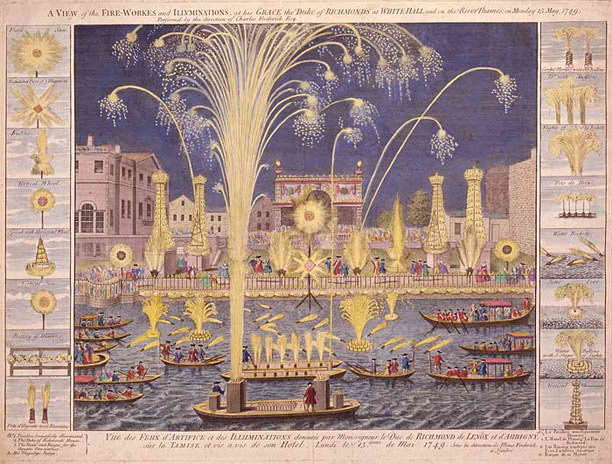
A VIEW of the FIRE-WORKES and ILLUMINATIONS at his GRACE the Duke of RICHMOND’S at WHITEHALL and on the River Thames on Monday 15 May 1749. Performed by the direction of Charles Fredrick Esq.
◊ ◊ ◊ ◊ ◊
This image was used for Simon Werrett’s article “Fireworks: The Power of Pyrotechnics,” which appeared in History Today, volume 60 (November 2010).
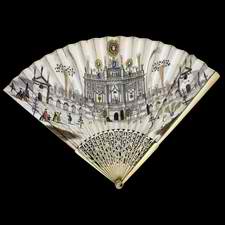
Souvenir fan of the Royal Fireworks, hand-coloured etching on paper, with ivory sticks, 1749 (London: British Museum)
Organized to mark the signing of the treaty at Aix-la-Chapelle in 1748, which ended the War of Austrian Succession, a fireworks display in Green Park on 27 April 1749 proved disastrous as a stray rocket set ablaze one of the pavilions and killed a number of spectators. Far more successful was Handel’s musical contribution.
The print shown above documents fireworks from the following month. Pictorially, it fixes in time these bursts of color that are otherwise so fleeting. It asks us to hover just a bit longer in these moments of temporal suspension — and with such vibrant joy. Perhaps an appropriate way to usher one year out and another in. And if the print piques your curiosity about the history of fireworks, you’ll just need to get a copy of Werrett’s book, Fireworks: Pyrotechnic Arts and Sciences in European History. All the best for a magnificent 2012! -CH










 Enfilade
leave a comment