Exhibition | On the Edge of Reason, Works on Paper in Berlin
From the National Museums in Berlin:
On the Edge of Reason: Cycles of Works on Paper in the Age of the Enlightenment
Am Rande der Vernunft: Bilderzyklen der Aufklärungszeit
Kupferstichkabinett, Berlin, 16 March — 29 July 2012

Giovanni Battista Piranesi, "Carceri. The Giant Wheel" © Staatliche Museen zu Berlin, photo: Volker-H. Schneider
The exhibition whisks visitors to the murky edges of the Age of Reason. The creative and fantastical visual world of the capriccio thrived all the way through the 18th century, existing beyond the intellectual, socially critical and emancipatory endeavours of the Enlightenment. Stock themes of myth and reality, of antiquity and the modern day, of arcadias and Commedia dell´Arte, of ornament and decay all merge, piece-by-piece to form a kaleidoscope of playfully vivid imaginings. The pictures on display here depict the fancifully capricious but equally dark, irrational sides of nature, architecture and humankind.
Many form the theme of several extensive series of prints that are impressive for the breadth and variety of their vision. Scenes, as found in the Capricci and Scherzi di Fantasia series by Giovanni Battista Tiepolo and Bacchanales by Jean-Honoré Fragonard, remain enigmas even today. The strangeness of these images often leaves the viewer confused, as in the case of the sinister, brooding architectural fantasies of Giovanni Battista Piranesi’s Carceri or Goya’s Caprichos. For while several of their individual sheets reflect core Enlightenment themes, they also seem to contradict them, revealing visual and moral discrepancies, conveying a sense of entrapment and making the unreal appear real. The most famous sheet from the Caprichos, The Sleep of Reason Produces Monsters (El sueño de la razón produce monstruos) has become an emblem of this dark underbelly of the enlightened, illuminated world of reason and the Enlightenment.
The age of the Enlightenment is couched in a symbolism that revolves around the contrast between lumiéres (light) and tenèbres (shadow), between black and white – a set of oppositions that also defines the very essence of printmaking as a medium. Thanks to the technical refinement of various printmaking techniques attained to gain the upper edge over other art forms, the sheets and series of great artists from this epoch became prized collector’s items. In the artistic principle of the Caprice, not only does the artist’s imaginative spirit reveal itself, but also his virtuosity in his handling of the medium. This exhibition sees treasures from the Kupferstichkabinett’s rich holdings of works in this genre go on display together for the first time, giving visitors the chance to appreciate the outstanding aesthetic value of these works on paper. The exhibition invites the public to discover the artistic richness of a visual world that hovered on the edge of reason in an epoch that hovered on the threshold of modernity.
The exhibition is being held as part of a wider series of events called Art – King – Enlightenment, coordinated by the Prussian Cultural Heritage Foundation in honour of the 300th anniversary of the birth of Frederick the Great on 24 January 2012.
Exhibition | Taking Time: Chardin’s ‘Boy Building a House of Cards’
From Waddesdon Manor:
Taking Time: Chardin’s Boy Building a House of Cards and Other Paintings
Waddesdon Manor, Buckinghamshire, 28 March — 15 July 2012
Curated by Juliet Carey
 This exhibition brings together some of the greatest works to come out of eighteenth-century France. Prompted by Waddesdon’s recent acquisition of Boy Building a House of Cards (1735) by Jean-Siméon Chardin (1699-1779), the exhibition will unite all four of the artist’s paintings of the subject for the first time ever.
Loans from the UK, France and the USA will demonstrate how Chardin paired these works with other compositions to explore themes of childhood, adolescence and play. A group of Chardin’s images of servants – again, never seen together before – will provide a contrast with these images of children playing.
◊ ◊ ◊ ◊ ◊
From Paul Holberton Publishing:
Juliet Carey, with essays by Pauline Prévost-Marcilhacy, Pierre Rosenberg and Katie Scott, Taking Time: Chardin’s Boy Building House of Cards and Other Paintings (London: Paul Holberton, 2012), 160 pages, ISBN: 9781907372339, £30.
Recently acquired by Waddesdon Manor, Jean-Siméon Chardin’s early masterpiece Boy Building a House of Cards has a self-contained stillness that contrasts with the splendour of its new setting. Yet, it resonates with existing apspects of the collection from games and the representation of childhood to the influence of North European genre painting on French art. A child playing – with cards, bubbles, spinning-top or shuttlecock – was a favourite subject of Chardin’s. Such scenes, with their intimations of the transitory nature of human life, were derived from 16th- and 17th-century Dutch and Flemish vanitas, but display a delight in childhood for its own sake.
 Full of repetition, pendants and series, this catalogue allows the reader to scrutinize some of Chardin’s greatest works, and to follow the artist’s exploration of some of his most arresting subjects. Prints by Pierre Filloeul, Antoine Marcenay de Ghuy and others demonstrate the shifts in appearance and meaning that Chardin’s card-house compositions underwent through transposition from painting to engraving. The prints also help reconstruct some of the occasional pairings in which Chardin’s figure paintings were staged, whether on the walls of the Salon or in the cabinets of private collectors. The pendants include two of the most famous of all Chardin’s figure paintings, Lady Taking Tea and Girl with a Shuttlecock. Essays in self-containment and stillness, these works invite us to consider the nature of attention – the attention of the painter, his human subjects and ourselves.
This richly illustrated catalogue accompanies the exhibition at Waddesdon Manor, Buckinghamshire (28 March – 15 July 2012) that will unite Chardin’s four paintings of a boy with a house of cards for the first time (loans come from the Musée du Louvre, Paris; the National Gallery, London; the National Gallery of Art, Washington), allowing us to examine Chardin’s treatment of the subject in the context of his fascination with themes of play, childhood and adolescence. Pierre Rosenberg, former director of the Musée du Louvre and the pre-eminent scholar of Chardin’s work, considers the Rothchilds as collectors of Chardin; Pauline Prévost-Marcilhacy, an independent scholar and Rothschild specialist, gives an insight into Charlotte de Rothschild’s collecting; Katie Scott, lecturer at The Courtauld Institute of Art, specializing in French art and architecture of the early modern period, explores Chardin’s paintings of games; and Juliet Carey, Curator of Paintings, Drawings and Sculpture at Waddesdon Manor and curator of the exhibition, writes on repetition and meaning in Chardin’s houses of cards and their pendants.
2011 Edition of CAA’s ‘Graduate Programs in Art History’
From CAA:
 CAA has published new editions of Graduate Programs in Art History: The CAA Directory and Graduate Programs in the Visual Arts: The CAA Directory. As comprehensive resources of schools across the United States, Canada, the United Kingdom, Australia, and New Zealand, these guides list 650 programs in fine art and design, art and architectural history, curatorial studies, arts administration, and more.
The directories provide prospective graduate students with information they need prior to beginning the application process. The directories are also key professional references for career-services representatives, department chairs, graduate and undergraduate advisors, librarians, professional-practices educators, and professors interested in helping emerging generations of artists and scholars find success.
Graduate Programs in Art History covers four program types: History of Art and Architecture, Arts Administration, Curatorial and Museum Studies, and Library Science. This directory integrates programs in visual studies into History of Art and Architecture. . . .
More information is available here»
New Title | ‘Pygmalion in Bavaria’
From Penn State UP:
Christiane Hertel, Pygmalion in Bavaria: The Sculptor Ignaz Günther and Eighteenth-Century Aesthetic Art Theory (University Park: Penn State University Press, 2011), 344 pages, ISBN: 9780271037370, $100.
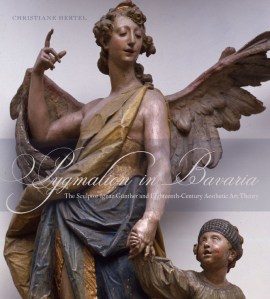 In Pygmalion in Bavaria, Christiane Hertel introduces the sculptor Ignaz Günther, placing him in the historical context of Bavarian Rococo art and Counter-Reformation religious visual culture. She also considers the remarkable aesthetic appeal of Günther’s oeuvre—and connects it to the eighteenth-century art theory that focused on sculpture and the creative paradigm of Pygmalion. Through this interweaving of contexts and discourses, Hertel offers insights into how Rococo art’s own critical dimension positions it against the Enlightenment and introduces a particular notion of subjectivity.
◊ ◊ ◊ ◊ ◊
“This is an extraordinary book. Extraordinary is Hertel’s command of eighteenth-century aesthetic art theory, extraordinary her command of Bavarian Rococo art, especially the art of Ignaz Günther, and extraordinary the depth of her understanding of the religious culture of eighteenth-century Bavaria. Pygmalion in Bavaria may seem to be a book for a small number of specialists. But the spell of Ignaz Günther’s art should ensure that this unusually engaging text will find the readers that it deserves and will help secure, in the English-speaking world, Günther’s place among the major artists of the eighteenth century.” —Karsten Harries, Yale University
Call for Papers | Graduate Student Conference on Travel
Transporting Bodies and Minds: 18th- and 19th-Century Travel
University of Michigan, Ann Arbor, 15 September 2012
Proposals due 1 May 2012
Throughout the eighteenth and nineteenth centuries, travelers of all kinds documented their experiences in private letters and diaries, official correspondence, life writing, spiritual and religious narratives, and ethnographic accounts. Furthermore, these experiences were often transformed into works of art, with real and imagined moments of contact serving as the inspiration for painting, music, poetry, prose fiction, photography, and other creative ventures. These aesthetic productions transformed the foreign into the national, the known into the unknown, appearing to expand access to other cultures–a model of cultural transportation that recent criticism is troubling.
Scholarship drawing on theories of post-colonialism, gender, material and visual culture, cognitive studies, posthumanism, and other critical paradigms has challenged our understanding of the impact–not just aesthetic, but also commercial, martial, and religious–of travel in the eighteenth and nineteenth centuries. This work has made strides in elucidating a more dynamic picture of the way travel and cultural encounter could transform (or fail to transform) prior understandings of both time and space. Moreover, it has allowed for a more capacious appreciation of how influence happens, extending beyond more uni-directional, Eurocentric approaches.
Continuing this work, the University of Michigan’s Eighteenth-Century Studies Group and Nineteenth-Century Forum will co-host an interdisciplinary graduate student conference on these topics, to take place in Ann Arbor, MI, on September 15, 2012. We are pleased to announce that Kate Flint, Provost Professor of English and Art History (University of Southern California), will be our keynote speaker.
Graduate students are encouraged to submit papers that explore the implications of travel, tourism, boundary crossing, exploration, and other related topics–from a wide range of disciplinary perspectives. Submissions of either individual papers or full panels are welcome. Please send abstracts of no more than 300 words to Karen McConnell (mcconnka@umich.edu) by May 1, 2012.
Suggested paper topics include (but are not limited to): (more…)
ASECS 2012, San Antonio
2012 American Society for Eighteenth-Century Studies Conference
San Antonio, 22-24 March 2012

Mission San Francisco de la Espada at San Antonio, ca. 1750s
Photo by Travis Witt, 2010, Wikimedia Commons
◊ ◊ ◊ ◊ ◊
The 2012 ASECS conference takes place in San Antonio, March 22-24, at the Hyatt Regency San Antonio Riverwalk. This year’s annual HECAA luncheon and business meeting will be held on Friday at nearby Boudro’s restaurant. In terms of sessions, HECAA will be represented by two panels, also on Friday, chaired by Melissa Hyde and Heidi Kraus and Heidi Strobel and Amber Ludwig, with Christopher Johns serving as a respondent. In addition to these, a wide selection of sessions are also included below (there are, of course, lots of others that will interest HECAA members). For the full program, see the ASECS website. Elle Decor, incidentally, featured San Antonio in its March 2012 issue.
◊ ◊ ◊ ◊ ◊
HECAA New Scholar’s Open Session
Friday, 23 March 2012, 11:30-1:00, Bowie C
Chair: Melissa HYDE, University of Florida, and Heidi KRAUS, University of Iowa
1. Katherine ARPEN, University of North Carolina, Chapel Hill, “Touch, Sensation, Imagination: Étienne-Maurice Falconet’s Bather”
2. Zirwat CHOWDUHRY, Northwestern University, “Incongruously Indian: The Joke behind George Dance the Younger’s Guildhall Façade”
3. Amanda STRASIK, University of Iowa, “Portraying the (Future) Queen: Le Portrait de Marie-Joséphe de Saxe et Le Duc de Bourgogne”
4. Hyejin LEE, University of North Carolina, Chapel Hill, “The Language of Magic in Jean-Baptiste-Siméon Chardin’s Food Still Lifes”
◊ ◊ ◊ ◊ ◊
HECAA Luncheon and Business Meeting
Friday, 23 March 2012, 1:00
Boudros, 205 Presa St. at Charles Court (between Market and Commerce) — ask for the event space at Charles Court; see comments below for directions.
◊ ◊ ◊ ◊ ◊
Exoticisms: Global Commodity Exchange in the Long Eighteenth Century, (HECAA)
Friday, 23 March 2012, 4:15-5:45, Bowie C
Chairs: Heidi STROBEL, University of Evansville, and Amber LUDWIG, Honolulu Academy of Arts
1. Dana LEE, Art Institute of Atlanta, “Between Worlds: Performing Gender and Class through Exoticism in Madame de Pompadour’s Boudoir Turq”
2. Adrienne CHILDS, Independent Scholar, “The Taste for Blackness: Coffee, Race, and Exoticism in Eighteenth Century Luxury Objects”
3. Alden GORDON, Trinity College, “A Golden ‘Chinese’ Interior in Italy made of Imported Rock Crystal and Lacquer: The Commodities and Language of Global Exoticism in the Decorative Arts and in Engraving”
4. Elizabeth WILLIAMS, Los Angeles County Museum of Art, “Familiarizing the Foreign: Chinoiserie and Eighteenth-Century English Silver”
Respondent: Christopher JOHNS, Vanderbilt University
◊ ◊ ◊ ◊ ◊
OTHER SESSIONS RELATED TO THE VISUAL ARTS
T H U R S D A Y , 2 2 M A R C H 2 0 1 2
8:00-9:30
Audiences, Observers, Spies, & Witnesses: Types of Attention in the Eighteenth Century, Bowie A
Chair: Cheryl WANKO, West Chester University
1. Kathleen E. URDA, Bronx Community College, CUNY, “Theatrical Spectatorship and Jane Austen’s Mansfield Park”
2. Fiona RITCHIE, McGill University, “Sentimental Attention: Women Watching Shakespeare in the Mid-Eighteenth Century”
3. David Francis TAYLOR, University of Toronto, “Spectators at the Print Shop Window: Caricature and the Corporate Gaze”
◊ ◊ ◊ ◊ ◊
9:45-11:15
Aesthetic Reception, Sensibility, and Social Engineering: Interrogating the Effects of the Work of Art in the Long Eighteenth Century, Pecos
Chair: Julia SIMON, University of California, Davis
1. Jean MARSDEN, University of Connecticut, “Sentimental Drama as Social Engineering”
2. Philipp SCHWEIGHAUSER, Universität Basel, “Sympathy Control: Sentimental Literature and Early European Aesthetics”
3. Peter ERICKSON, University of Chicago, “Conversion in the Museum: Friedrich Schlegel at the Louvre, 1802-1804”
4. Laurence LEMAIRE, University of California, Davis, “Rousseau, Writing and Aesthetics: a Moral Agent at Work”
◊ ◊ ◊ ◊ ◊
Directing Light and Adjusting Outlooks: Mirrors, Lenses, Windows, Reflections, Refractions, Translucencies, (South Central Society for Eighteenth-Century Studies) Frio
Chair: Kevin L. COPE, Louisiana State University
1. Robert CRAIG, Independent Scholar, “Zur Farbenlehre- Goethe’s Theory of Colors: Goethe versus Newton – and the Winner Is . . . ?”
2. Laura MILLER, University of West Georgia, “Light, Space, and Masculinity in Newtonian Optical Experiments”
3. William STARGARD, Pine Manor College, “Scientific and Divine Light in Bernard Vittone’s Architecture for the Poor Clares”
4. Jeremy WEAR, University of Illinois at Urbana-Champaign, “Lilbertine Philosophy and the Error of the Eyes in Aphra Behn’s The Emperor of the Moon”
◊ ◊ ◊ ◊ ◊
The Aesthetics of Science and the Science of Aesthetics – I, Rio Grande Center
Chair: Peter MESSER, Mississippi State University
1. Bryan HURT, University of Southern California, “Laurence Sterne and the Science of True Feeling”
2. Paula BROWN, Louisiana Tech, “Edmund Burke’s Philosophical Enquiry into the Origin of Our Ideas of the Sublime and the Beautiful: Ethics and Empiricism ‘Confounded’”
3. Jessica DECKARD, Indiana University, “The Lily Adeline: Botany and Botanical Knowledge in Radliffe’s The Romance of the Forest”
◊ ◊ ◊ ◊ ◊
Home Away from Home: Transient Artists in the Eighteenth Century, Bowie A
Chair: Christina LINDEMAN, Pima Community College
1. Catherine M. SAMA, University of Rhode Island, “‘On the Road’: Rosalba Carriera in Paris, Modena, and Vienna (1720-30)”
2. Wendy Wassyng ROWORTH, University of Rhode Island, Benjamin West’s First Tour of England: Speculations on an Anonymous Sketchbook”
3. Jennifer VAN HORN, Towson University, “‘Straggling Adventurers of the Brush’: Transatlantic Artists and the Making of the British Empire”
4. Elisabeth FRASER, University of South Florida, “Mediterranean Self-Fashioning: Louis-François Cassas, Itinerant Artist in the Ottoman Empire”
◊ ◊ ◊ ◊ ◊
11:30-1:00
The British Grand Tour, Pecos
Chair: Alison O’BYRNE, University of York
1. Alistair DURIE, University of Stirling, “The Home Tour Revisited”
2. Denys VAN RENEN, University of Illinois, Urbana-Champaign, “Salvaging British Identity in Johnson’s Journey to the Western Islands of Scotland”
3. Gordon TURNBULL, Yale University, “Boswell’s Jaunts: A Britain ‘Yet Minutely Diversified’”
4. Susan EGENOLF, Texas A&M University, “‘There’s a View in My Soup’: Wedgwood’s Green Frog Service and the Promotion of the British Picturesque”
◊ ◊ ◊ ◊ ◊
Roundtable: Demystifying the Academic Journal (Professionalization Panel Sponsored by the Graduate Student Caucus) Live Oak
Chair: Nicholas E. MILLER, Washington University in St. Louis
1. Cristobal SILVA, Columbia University, The Eighteenth Century: Theory and Interpretation
2. Marion L. RUST, University of Kentucky, Early American Literature
3. Downing A. THOMAS, University of Iowa, Studies in Eighteenth-Century Culture
4. Hazel GOLD, Emory University, PMLA
5. Julia SIMON, University of California, Davis, Eighteenth-Century Studies
6. Jonathan Beecher FIELD, Clemson University, Common-place: The Interactive Journal of Early American Life
◊ ◊ ◊ ◊ ◊
The Aesthetics of Science and the Science of Aesthetics – II, Rio Grande Center
Chair: Peter G. DEGABRIELE, Mississippi State University
1. Tili Boon CUILLÉ, Washington University in St. Louis, “From Scientific Principle to Aesthetic Practice: The Natural Laws of Artistic Composition”
2. Peter MESSER, Mississippi State University, “Jeremy Belknap’s Sublime Science of Natural History”
◊ ◊ ◊ ◊ ◊
Art and Life: Cultural Practices of Animation in the Eighteenth Century (The Role of the Viewer/Reader/Observer) – I, Regency East
Chair: Amelia RAUSER, Franklin and Marshall College
1. Sarah R. COHEN, University at Albany, State University of New York, “Expert Brutes: Animating Artistry in Eighteenth-Century Painting”
2. Keith BRESNAHAN, OCAD University, “Parallax Views: Animating Architecture in Eighteenth-Century France”
3. Hannah Vandegrift ELDRIDGE, University of Chicago, ‘“No time there is, no power, can decompose /The minted form that lives and living grows’: Goethe’s Animated Forms”
4. Sarah BETZER, University of Virginia, “Shadow Play: Ingres, Sculpture, and Spectacle”
◊ ◊ ◊ ◊ ◊
2:30-4:00
Art and Life: Cultural Practices of Animation in the Eighteenth Century (The Life Force as Spark) – II, Bowie C
Chair: Amelia RAUSER, Franklin and Marshall College
1. Wendy BELLION, University of Delaware, “Speaking Statues”
2. Erin M. GOSS, Clemson University, “Animated Dialogue: Bentham’s Corpse Play”
3. Bendta SCHROEDER, Brandeis University, “Erasmus Darwin’s ‘Amorous Ocean’: Organic Sexuality in The Loves of the Plants”
4. Emily Hodgson ANDERSON, University of Southern California, “Animating Perfection: Sarah Siddons’s Hermione”
◊ ◊ ◊ ◊ ◊
The Wit and Wisdom of Eighteenth-Century Thought, (Northwest Society for Eighteenth-Century Studies – NWSECS), Llano
Chair: Ken ERICKSEN, Linfield College
1. Pamela PLIMPTON, Warner Pacifi c College, “Laughing on the Dark Side: Theory of Mind [Reading] in Matthew Lewis’s The Monk”
2. Johann REUSCH, University of Washington. “Wit Lies in Brevity: Christoph Georg Lichtenberg’s Aphorisms as Cosmopolitan Wisdom”
3. Robert MODE, Vanderbilt University, “Juxtapositions and Parodies in Hogarth’s The Enraged Musician”
4. Marvin LANSVERK, Montana State University, “The Comedy in Blake’s Divine Comedy Illustrations”
◊ ◊ ◊ ◊ ◊
The Medical Gothic, (Western Society for Eighteenth Century Studies), Rio Grande East
Chair: Lisa Forman CODY, Claremont McKenna College
1. Sara LULY, Kansas State University, “A Gothic Science: Gothic Motifs in the Medical Texts of Eighteenth-Century German Magnetists”
2. Dana Gliserman KOPANS, State University of New York, Empire State College, “Nymphomania, or the Horrors of Female Desire”
3. Kevin CHUA, Texas Tech University, “Fuseli and Gothic Preformation”
4. Christine CROCKETT, Claremont McKenna College, “Dreadful Portraits: Medical Gothic and the Regulation of Desire”
◊ ◊ ◊ ◊ ◊
4:15-5:45
Innovative Course Design, Pecan
Chair: Paula LOSCOCCO, Lehman College, City University of New York
1. Susan LANSER, Brandeis University AND Jane KAMENSKY, Brandeis University, “London in the Long Eighteenth Century: People, Culture, City”
2. Janie VANPÉE, Smith College, Re-Membering Marie Antoinette”
3. Zach HUTCHINS, Brigham Young University, “American Love Letters”
◊ ◊ ◊ ◊ ◊
F R I D A Y , 2 3 M A R C H 2 0 1 2
8:00-9:30
Life and Luxury: Material Culture and Decorative Arts, Blanco
Chair: Denise Amy BAXTER, University of North Texas
1. Kevin JUSTUS, Independent Scholar/University of Phoenix Humanities, “The Chime of a Clock and the Scratch of a Pen: Louis XV’s Astronomical Clock and Roll Top Desk –A King of Art, Science and Industry Decorative Art as Portrait”
2. Chloe NORTHROP, University of North Texas, “Colonial Exchanges of Material Goods: The Case of Pauline Bonaparte Leclerc and Maria Nugent”
3. Dana LOUGHLIN, University of British Columbia, “Laughing at Gilded Butterfl ies: Essai de Papilloneries Humaines and the Ornamentation of Social Spaces in Eighteenth-Century France”
4. Heidi STROBEL, University of Evansville, “Portraiture and the Art of Mary Linwood”
◊ ◊ ◊ ◊ ◊
9:45-11:15
Pompeii and Herculaneum in the Eighteenth Century, Bowie C
Chair: Julie-Anne PLAX, University of Arizona
1. Bernadette FORT, Northwestern University, “The Discoveries at Herculaneum and the Debate on Ancient Painting”
2. Sandra BARR, Independent Scholar, “A Spot of Bother! Naples and the Grand Tour Penchant for Disaster Imagery”
3. Amelia RAUSER, Franklin and Marshall College, “Performing Antiquity: Emma Hamilton’s ‘Attitudes’ and the Fragments of Pompeii and Herculaneum”
4. Leslie REINHARDT, Independent Scholar, “The Endurance of the Literary: A Cestus of Venus in Anglo-American Art”
◊ ◊ ◊ ◊ ◊
11:30-1:00
New Scholar’s Open Session, (Historians of Eighteenth-Century Art and Architecture), Bowie C
Chair: Melissa HYDE, University of Florida, AND Heidi KRAUS, University of Iowa
1. Katherine ARPEN, University of North Carolina, Chapel Hill, “Touch, Sensation, Imagination: Étienne-Maurice Falconet’s Bather”
2. Zirwat CHOWDUHRY, Northwestern University, “Incongruously Indian: The Joke behind George Dance the Younger’s Guildhall Façade”
3. Amanda STRASIK, University of Iowa, “Portraying the (Future) Queen: Le Portrait de Marie-Joséphe de Saxe et Le Duc de Bourgogne”
4. Hyejin LEE, University of North Carolina, Chapel Hill, “The Language of Magic in Jean-Baptiste-Siméon Chardin’s Food Still Lifes”
◊ ◊ ◊ ◊ ◊
The Cultural Life of Things: Material Culture in the Long Italian Eighteenth-Century, (Italian Studies Caucus), Rio Grande East
Chair: Sabrina FERRI, University of Notre Dame
1. Rebecca MESSBARGER, Washington University in St. Louis, “Anatomy of the Venus de Medici in Peter Leopold’s Science Museum”
2. Paola GIULI, Saint Joseph’s University, “The Rare and the Marvelous: Leone Strozzi’s Cabinets of Natural and Artistic Curiosities”
3. Francesca SAVOIA, University of Pittsburgh, “Window Shopping in Eighteenth-Century London: Giuseppe Baretti and Alessandro Verri”
4. Irene ZANINI-CORDI, Florida State University, “Natural Wonders and Ingenious Inventions in Margherita Sparapani Gentili Boccapadule’s Viaggio d’Italia”
◊ ◊ ◊ ◊ ◊
4:15-5:45
Exoticisms: Global Commodity Exchange in the Long Eighteenth Century, (Historians of Eighteenth-Century Art and Architecture), Bowie C
Chairs: Heidi STROBEL, University of Evansville, and Amber LUDWIG, Honolulu Academy of Arts
1. Dana LEE, Art Institute of Atlanta, “Between Worlds: Performing Gender and Class through Exoticism in Madame de Pompadour’s Boudoir Turq”
2. Adrienne CHILDS, Independent Scholar, “The Taste for Blackness: Coffee, Race, and Exoticism in Eighteenth Century Luxury Objects”
3. Alden GORDON, Trinity College, “A Golden ‘Chinese’ Interior in Italy made of Imported Rock Crystal and Lacquer: The Commodities and Language of Global Exoticism in the Decorative Arts and in Engraving”
4. Elizabeth WILLIAMS, Los Angeles County Museum of Art, “Familiarizing the Foreign: Chinoiserie and Eighteenth-Century English Silver”
Respondent: Christopher JOHNS, Vanderbilt University
◊ ◊ ◊ ◊ ◊
S A T U R D A Y , 2 4 M A R C H 2 0 1 2
8:00-9:30
Deep in the Art of Texas, Llano
Chair: Amy FREUND, Texas Christian University
1. Heather MACDONALD, Dallas Museum of Art, “Stormy Weather: Joseph Vernet’s A Mountain Landscape with an Approaching Storm at the Dallas Museum of Art”
2. C.D. DICKERSON, Kimbell Art Museum, “Bringing the Eighteenth Century to Texas: Bertram Newhouse and the Kimbells”
3. James CLIFTON, Museum of Fine Arts, Houston, “Paolo de Matteis and the Artist’s Profession: On Two Paintings in Houston”
4. Nicole ATZBACH, Meadows Museum, “Richard Worsam Meade: Vicente López’s Portrait of an American Entrepreneur and Collector in Spain”
5. Iraida RODRIGUEZ-NEGRON, Institute of Fine Arts, New York University and Meadows Museum, ‘“Quiere un retrato de S.M. para Sortija:’ Introducing the Portrait Miniatures at the Meadows Museum by Francisca Meléndez, Portraitist at the Court of Charles IV”
◊ ◊ ◊ ◊ ◊
9:45-11:15
Publishing the Past: History and Eighteenth-Century Print Culture – II, Frio
Chair: Hannah DOHERTY, Stanford University
1. Mark TOWSEY, University of Liverpool, “ ‘A Table of the Human Passions’: Learning to Read the Past in Eighteenth-Century Britain”
2. Jeff STRABONE, Connecticut College, “The Middle Scots Poets in the Eighteenth Century: Creating a Usable Past for Scotland”
3. Crystal B. LAKE, Wright State University, “Surrounded by the Congenial Elements of Books and Dirt: Women Antiquaries in the Long Eighteenth Century”
4. Adam BUDD, University of Edinburgh, “History of India in the Scottish Enlightenment: Methods and Vision”
◊ ◊ ◊ ◊ ◊
2:00-3:30
Théâtre et actualité(s) avant la Révolution- I, Blanco
Chair: Yann ROBERT, Stanford University AND Logan J. CONNORS, Bucknell University
1. Pannill CAMP, Washington University in St. Louis, “‘Belle Horreur:’ Hubert Robert’s Architectural Fantasies and the Paris Opera Fire of 1781”
2. Olivier FERRET, Université Lyon 2, “Faire des ‘applications’ au théâtre sous l’Ancien Régime”
3. Jack IVERSON, Whitman College, “Performing Beaumarchais’s Benevolence: Norac et Javolci and the Institut de bienfaisance pour les mères-nourrices”
4. Jennifer TAMAS, Stanford University, “De l’alcôve à la tribune: déclaration des sentiments et déclaration des droits”
◊ ◊ ◊ ◊ ◊
3:45-5:15
Roundtable: Disciplinary Approaches to Eighteenth-Century Material Culture, Frios
Chair: Michael YONAN, University of Missouri
1 Denise Amy BAXTER, University of North Texas
2. Barbara M. BENEDICT, Trinity College
3. Jennifer GERMANN, Ithaca College
4. Karen HILES, Muhlenberg College
5. Chloe WIGSTON SMITH, University of Georgia
Exhibition | Princes and Painters in Mughal Delhi

Press release from the Asia Society Museum:
Princes and Painters in Mughal Delhi, 1707–1857
Asia Society Museum, New York, 7 February — 6 May 2012
Curated by William Dalrymple and Yuthika Sharma
Princes and Painters in Mughal Delhi, 1707–1857 brings together 100 masterpieces created during an artistically rich period in India’s history. This major international loan exhibition provides a new look at an era of significant change during which the Mughal capital in Delhi shifted from being the heart of the late Mughal Empire to becoming the jewel in the crown of the British Raj. The exhibition includes jewel-like portrait paintings, striking panoramas, and exquisite decorative arts crafted for Mughal emperors and European residents alike, as well as historical photographs. The exhibition is curated by William Dalrymple and Yuthika Sharma. It is accompanied by a 264-page illustrated book with essays by William Dalrymple, Yuthika Sharma, Jean Marie Lafont, Malini Roy, Sunil Sharma, and J.P. Losty, published by Asia Society Museum in association with Yale University Press, New Haven and London.

(Yale University Press, 2012), ISBN: 9780300176667, $60
“Princes and Painters in Mughal Delhi, 1707–1857 is a reappraisal of a transitional era in India that provided unprecedented impetus for artistic innovation and experimentation,” says Melissa Chiu, Asia Society Museum Director and Vice President for Global Art Programs. “We’re pleased to be taking a new approach to this magnificent and vibrant work with notable author William Dalrymple and art historian Yuthika Sharma as curators.”
The exhibition focuses on the reigns of the last four Mughal emperors: Muhammad Shah (reigned 1719–1748), Shah Alam II (reigned 1759–1806), Akbar Shah II (reigned 1806–1837) and Bahadur Shah II Zafar (reigned 1837–1857). Having lost military, political and economic power to the newlyarrived British in Calcutta, Delhi continued to maintain its extraordinary cultural, literary, and artistic patronage networks. Artists were supported by the Mughal court in Delhi and the city’s ascendant European residents, creating an environment of extraordinary interaction and influence between them and the new world of the British East India Company.
As the British took over the reign of a dispersed empire from the Mughals in 1803, they were enamored of its courtly elegance and sought to participate in its culture as patrons and enthusiasts. Company painting, involving artistic commissions undertaken by Indian artists for officers of the British East India Company, was practiced alongside Mughal court painting, with both patrons utilizing the services of a common group of artists.
The exhibition looks at recognized works by Delhi-based court artists Nidha Mal and Chitarman, and less familiar works by artists such as Ghulam Murtaza Khan, Ghulam Ali Khan, and Mazhar Ali Khan. In addition to Mughal miniatures produced under later emperors, this exhibition highlights a selection of so-called Company School paintings produced for Delhi-based personalities such as William Fraser, James Skinner, and Thomas Metcalfe. The exhibition also chronicles the rise in genre portraiture during this era, epitomized by character studies of urban and rural residents of Delhi.
◊ ◊ ◊ ◊ ◊
From Yale UP:
William Dalrymple and Yuthika Sharma, Princes and Painters in Mughal Delhi, 1707–1857 (New Haven: Yale University Press, 2012), 224 pages, ISBN: 9780300176667, $60.
. . . Sumptuous color illustrations of such works illuminate the pages of this book, painting a vivid portrait of this important city and its art, artists, and patrons. Masterworks by major Mughal artists, such as Nidha Mal and Ghulam Ali Khan, and works by non-Mughal artists demonstrate the dynamic interplay of artistic production at this time. This largely overlooked period is explored in thought-provoking essays by a panel of distinguished scholars of Indian art, history, and literature to present an engaging look at this dynamic artistic culture in the midst of rapid change.
William Dalrymple is an award-winning writer, historian, and co-director of the Jaipur Literature Festival. Yuthika Sharma received a PhD in South Asian art and architecture from Columbia University and a doctorate in design from Harvard University.
Exhibitions | Ottomania at the Rijksmuseum
From the Rijksmuseum:
Ottomania: The Turkish World through Western Eyes
Rijksmuseum, Amsterdam, 7 March — 7 May 2012

Joseph-Marie Vien, fantasy costume from the Bacha de Caramanie, illustration 7 from "Caravane du sultan à la Mecque," 1748.
In observance of the 400-year anniversary of diplomatic relations between Turkey and the Netherlands, the Rijksmuseum presents two special exhibitions. Ottomania: The Turkish World through Western Eyes presents the Turkey of old, depicted in over 35 special prints from the Rijksmuseum collection. The presentation Ahmet Polat: Modern Turkey paints a picture of Turkey today, with 10 impressive portraits of young Dutch-born Turkish people, trying their luck in Turkey.
With Ottomania, the Rijksmuseum shows how the Turkish world of the 16th to 18th centuries was seen through Western eyes. Exotic travel stories, exquisite costume books, and prints by artists such as Albrecht Dürer, Rembrandt and Tiepolo demonstrate the fascination of artists with charming Eastern figures and oriental attire, although the powerful Ottoman Empire also instilled fear and inspired awe. In addition to well-known masterpieces, various new discoveries and acquisitions are also on display, including a unique 16th-century etching of Turkish oil wrestlers. A number of pithy cartoons also depict the often strained
relations between the Ottoman empire and the West. The presentation
consists of over 35 prints and illustrated books.
Call for Papers | The Rake’s Progress
The Rake’s Progress: Stravinsky, Hogarth, Hockney, Auden, and Kallman
The University of Colorado at Boulder, 26-27 October 2012
Proposal due by 1 May 2012

William Hogarth, "A Rake's Progress," plate 3, 1735
This conference will be held in conjunction with the CU-Boulder Opera’s performances of The Rake’s Progress and the CU Art Museum’s exhibit, Hockney and Hogarth: Selections from the CU Art Museum’s Collection of British Art (featuring Hockney’s A Rake’s Progress, 1961-63). The program committee for the conference seeks papers relating to Stravinsky’s music, Hogarth and Hockney’s art, and/or Auden’s and Kallman’s libretto to The Rake’s Progress. The conference seeks to be interdisciplinary, and will consider relevant papers from the standpoint of music history, musical analysis, art and art history, aesthetics, literary studies, and stagecraft. Papers will be limited to 20 minutes, with ten minutes for further discussion. Those interested in participating are asked to submit a 500-word proposal in
MSWord or pdf format. E-mail by May 1, 2012 to
CBISassistant@gmail.com
Delftware at Maastricht from Aronson Antiquairs
Press release (29 January 2012) from Aronson Antiquairs:
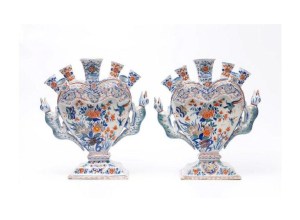
Cashmire palette flower vases Delft, ca. 1700-20, attributed to Lambertus van Eenhoorn
At The 25th Annual European Fine Art Fair, TEFAF in Maastricht (16-25 March), Robert Aronson of Aronson Antiquairs of Amsterdam is showcasing a wonderful and diverse collection of Dutch Delftware, accompanied by a new publication. Aronson says, “Among my favorites is a unique pair of massive Cashmire Palette Flower Vases that I am doubly delighted to have now as they had been on the ‘wish list’ of my late Father, Dave Aronson, who died in 2007. In fact, we had eagerly sought to acquire them in the mid-90s. Now they are here, and we are thrilled to be able to offer them at TEFAF.”
Dave Aronson headed the now 130 year old Aronson firm since his own Father died in 1990. He also was chairman of the Executive Committee of The European Fine Art Fair (TEFAF) in Maastricht from 1999 through his passing in 2007. His son, Robert, joined the firm twenty two years ago, following a tradition that began with his great-great grandfather, Leon, who founded the specialist firm in 1881. Robert Aronson is both a member of the Executive Committee of TEFAF and Chairman of the Dutch Antique Dealers Association.

Blue and White Delft ‘rijsttafel’ or ‘sweet meat’ set, ca. 1695-1705
Robert says that the 17 years he spent working side by side with his Father gave him both his passion for Dutch Delftware and a deep appreciation of the great collectors who became good friends to the Aronson family during those years. Now the younger Aronson has added a modern twist to a business that has served generations of the world’s most esteemed connoisseurs and curators. In fact, Robert Aronson is overseeing a truly 21st-century business that has embraced technology and e-commerce in ways his forebears could never have imagined.
“I’ve given Aronson Antiquairs a contemporary outlook that best serves both new collectors and old, using the latest tools, from Facebook and Twitter to You Tube video. Now, in whatever way that is most convenient for them, they can learn about Dutch Delft, examine our unrivaled collections, and come to understand the unique qualities of Delftware — more easily than at any time in our company’s 130 year history.”
Robert Aronson says the excitement of a TEFAF opening day still gives him a moment of pause. “I know I am going to see the most sophisticated and knowledgeable collectors, curators and dealers enjoying the finest artworks on the planet. Plus – You never lose the thrill of showing a truly rare or previously unknown object to a true Delft connoisseur,” he says. (more…)










 Enfilade
leave a comment