TEFAF Opens in Maastricht March 16
A this year’s art fair at Maastricht, Moretti Fine Art will be offering a terracotta lion, a model likely produced in conjunction with a monument intended to celebrate the ascension of Queen Anne, which took place on this date 310 years ago (8 March 1702). Press release from Sue Bond:
The European Fine Art Fair (TEFAF)
Maastricht, 16-25 March 2012
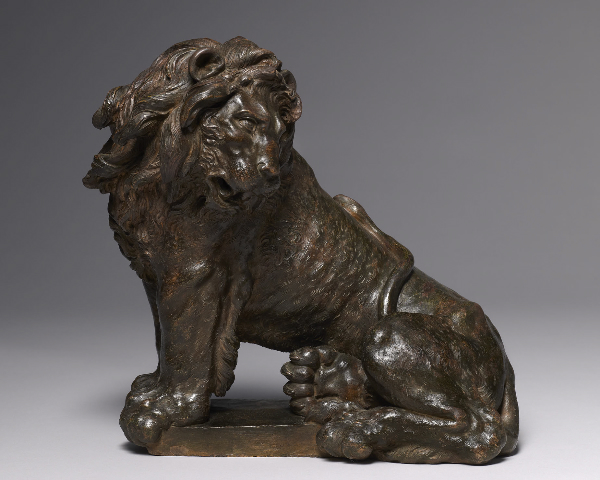
Giovan Battista Foggini (Florence, 1652-1725) "Lion," ca. 1715 Modelled hollow terracotta; original bronze patina imitation Base: 18.5 x 9.6 cm Lion: 26 x 24.4 x 17.6 cm
Moretti Fine Art will mark ten years at TEFAF Maastricht with some exceptional Medieval, Renaissance and Baroque Italian paintings and works of art. The fair, which is the world’s leading art and antiques event, is celebrating its Silver Jubilee and will take place at the Maastricht Exhibition and Congress Centre (MECC) from 16 to 25 March 2012. Stand 384.
One of the rarities Moretti will be offering is a terracotta figure of a lion dating from around 1715 by Giovan Battista Foggini (Florence, 1652-1725), almost certainly a model produced by this great Tuscan sculptor for a commemorative monument to England’s Queen Anne. Foggini was the court sculptor and architect to the Medici from 1687 until his death. In 1711 the British Parliament decided to celebrate their monarch Queen Anne who had ascended the throne in 1702. Initially they
planned to build fifty new churches but the cost was too high,
so in 1714 it was decided to build just one, Saint Mary-le-Strand,
and commission a statue of the sovereign.

Giovan Battista Foggini (Florence, 1652-1725) "Lion," ca. 1715 Modelled hollow terracotta; original bronze patina imitation Base: 18.5 x 9.6 cm Lion: 26 x 24.4 x 17.6 cm
John Talman, British Consul, scholar and collector of Italian art and antiquities, commissioned Foggini to build the monument which, had it been completed, would have been one of the most important accomplishments of public statuary in 18th-century Europe as illustrated by the surviving Foggini drawings in the Uffizi in Florence. One of these drawings depicts two lions seen from the back, one of which closely follows this model as it crouches, back arched and powerful, twisting its head with jaws open wide. These drawings, together with this recently-identified terracotta model, represent the only figurative evidence of this extraordinary commission. The modeling of the lion is especially skilled and vigorous, capturing the innate power, pride, majesty and monumentality of the animal even in this small scale. The figure, which retains its original patina simulating bronze,
is priced at €380,000.
Call for Nominations | Marc Raeff Book Prize
Marc Raeff Book Prize for Outstanding Work on Imperial Russia
Nominations due by 30 June 2012
The Eighteenth-Century Russian Studies Association, an affiliate organization of the Association for Slavic, East European, and Eurasian Studies (ASEEES), is now accepting submissions for the second annual Marc Raeff Book Prize. The prize is awarded annually for a publication that is of exceptional merit and lasting significance for understanding Imperial Russia, particularly during the long eighteenth-century. The recipient of the award will be recognized with a cash prize, which will be presented in November 2012, during the ASEEES annual convention. The award is sponsored by the ECRSA and named in honor of Marc Raeff (1923-2008), historian, teacher, and dix–huitièmiste par excellence. (more…)
Cinema Returns to Marie Antoinette

◊ ◊ ◊ ◊ ◊
Les adieux à la reine (Farewell, My Queen). Directed by Benoit Jacquot. Based on the 2002 novel by Chantal Thomas. With Lea Seydoux, Diane Kruger, Virginie Ledoyen, Xavier Beauvois, Noemie Lvovsky, Michel Robin, Julie-Marie Parmentier, Lolita Chammah, Marthe Caufman, Vladimir Consigny. French, English dialogue. 99 mintues, 2012.
◊ ◊ ◊ ◊ ◊
As reviewed by Geoffrey Macnab for The Independent (15 February 2012). . .
The French Revolution has been portrayed many times before on screen but never in quite oblique a way as in Benoit Jacquot’s film. This is a very well observed study of social breakdown and decay set over four days in July 1789, seen from the perspective of palace servant Sidonie Laborde (the pouting young French actress Lea Seydoux.)
There are no tumbrels or guillotines. Court life in Versailles is carrying on just about as normal but we are always aware of the mounting sense of panic. Even as they adhere to courtly rituals, the courtiers can smell and feel that their way of life is coming to end. The costume and production design deliberately show the cracks beginning to appear. Versailles is magnificent but under director Benoit Jacquot’s close-up gaze, we see that everything is past its best. Even Marie Antoinette (played with a winning mix of haughtiness and vulnerability by Diane Kruger) has to fuss about her dresses and wigs. . .
The full review is available here»
New Title | ‘Icons of Longevity’
 Icons of Longevity appeared at the end of 2010, but I learned of it only recently, at the book fair for the College Art Association conference in Los Angeles. The University Press of Southern Denmark wasn’t at the meeting, but this curious title was represented by The Scholar’s Choice, a company specializing in book displays at academic conferences (over 160 each year). During the past few years, I’ve gotten to know the company’s founder, Tom Prins, who usually attends CAA and often ASECS. It seems to me that at a time when academic publishing faces one new obstacle after another, The Scholar’s Choice provides a valuable service for the humanities. If you’re an author, you might consider having the company represent you when your publisher won’t be attending a conference (check with your publisher), and the next time you see The Scholar’s Choice table at a book fair, buy something! I was delighted to pick up a copy of Icons of Longevity. I told Tom I was buying it out of a spirit of wishful thinking. . . wishful thinking for myself and for the book business generally. -CH
◊ ◊ ◊ ◊ ◊
Lise-Lotte B. Petersen and Bernard Jeune, Icons of Longevity: Luxdorph’s Eighteenth Century Gallery of Long-Livers (University Press Of Southern Denmark, 2010), 330 pages, ISBN: 9788778387417, $65.
 Bolle Willum Luxdorph, who lived from 1716-1788, was the first Dane known to have studied the phenomenon of old age. Luxdorph was a high-ranking Danish civil servant, a leader of the Danish Chancellery, as well as a scholar and poet. In the last years of his life, Luxdorph created an art collection of paintings of older people (“long-livers”). The exact date at which Luxdorph began taking an interest in the phenomenon of old age is not known, but it must have happened sometime in the late 1770s. At this point, Luxdorph began systematically collecting data concerning very old people (i.e. persons who had reached the age of 80 and over). This book examines Luxdorph’s collection, which has a triple-source value in terms of the history of art, the history of civilization, and the history of science. Both the reconstruction and the availability of the collection hold specific contemporary and general importance for: the illustration of very old men and women, the development of research on aging, and the associated socio-cultural topics. Moreover, the collection represents an encyclopedic interest, the passion to collect, and the origin of science-orientated collections, as they became characteristic in 18th-century Europe.
◊ ◊ ◊ ◊ ◊
Note (added 7 March): The Scholar’s Choice works directly with publishers to coordinate displays. While they’re happy to speak with individual authors, that’s not typically how decisions are made about what gets included at the table. So talk to your publisher!
Exhibition | ‘Waxing Eloquent: Italian Portraits in Wax’
From the Fondazaione Musei Civici Venezia:
Avere una Bella Cera: Le Figure in Cera a Venezia e in Italia
Fortuny Museum, Venice, 10 March – 25 June 2012
Curated by Andrea Daninos
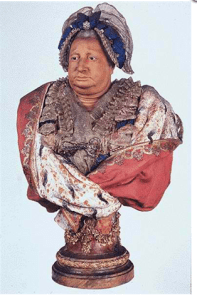
Francesco Orso, "Vittoria di Savoia Soisson," ca. 1785 (Castello di Agliè)
The exhibition aims to analyse a field that is little explored in the history of art, that of life-size wax figures; it is a fascinating subject and one that in recent years has stimulated interest from many contemporary artists, but until now no exhibition had been dedicated to this theme. The exhibition project arises from two fortunate coincidences: the existence of a series of wax portraits in the public collections and churches of Venice, and the centenary of the first study dedicated to the history of waxwork portraiture, Geschichte der Porträtbildnerei in Wachs, written by the famous Viennese art historian, Julius von Schlosser. The first Italian edition of this work has recently been published, edited by Andrea Daninos.
The exhibition will for the first time bring together the few existing examples of this genre in Italy, presenting them in an itinerary that begins with the theme of the cast and funeral mask. The first section will display a series of wax funeral masks of Venetian doges (eighteenth century), an all but unique example of the use of wax “doubles” in funeral ceremonies. The visitor will then be able to admire the only visual example to have survived of life-size votive figures, Vincenzo Panicale’s Libro dei miracoli, an early seventeenth-century manuscript documenting the votive figures in the Sanctuary of S. Maria della Quercia in Viterbo.
This is followed by the faces of saints and criminals, two recurrent subjects in the tradition of wax portraiture. The former are represented by 12 busts of Franciscan saints dating from the eighteenth century; made of wax, with glass eyes and real hair, these works constitute a complete group in this unusual religious iconography. In contrast, the visitor will also come face to face with a series of portraits of criminals made at the end of the nineteenth century by the pupil of Cesare Lombroso, Lorenzo Tenchini.
The central section of the exhibition is dedicated to the tradition of wax portraiture in Italy. It is introduced by two life-size portrait figures of eighteenth-century Venetian children. These two works, mentioned by Schlosser and Mario Praz, who compared them to the protagonists in Henry James’s Turn of the Screw, are kept in the storerooms of Palazzo Mocenigo and have not been put on public display for decades. They will certainly astonish the visitor for the quality of the execution and their disturbing realism.
The school of Bologna, the only town in Italy in which the art of life-size wax portraiture became widespread, will be represented by some of the specialists in the genre, including Anna Morandi Manzolini, Luigi Dardani and Angelo Gabriello Piò. In its last section, the exhibition will present the works of two artists who worked outside Italy, and who specialised in waxwork exhibitions. The first of these is Joseph Müller-Deym, a mysterious Austrian aristocrat who owned a famous waxworks museum in Vienna in the eighteenth century, and who will be represented here by his portrait of Maria Carolina of Austria. The other is a Piedmontese artist, Francesco Orso, who opened an analogous waxworks show in Paris during the years of the French Revolution. The present exhibition will display the works he produced for the Savoy court.
The rich and exceptional nature of the works on show is the result of the generosity of the loans from churches, scientific universities and museums, including the Museo del Dipartimento di Anatomia Umana, Farmacologia e Scienze Medico-Forensi of the Università di Parma, and the Palazzo Reale in Naples.
◊ ◊ ◊ ◊ ◊
From ACC Distribution:
Catalogue: Andrea Daninos, ed., Waxing Eloquent Italian Portraits in Wax (Officina Libraria, 2012), 160 pages, ISBN: 9788889854839, $28.
 This catalogue analyses a field of art history that only recently has been given renewed attention with the translation in French (1997), English (2008) and Italian (2011) of Julius von Schlosser’s History of Portraiture in Wax, originally published in German a century ago. The exhibit and the catalogue will present all life-size figures in wax present in Italy starting with the death masks in wax of the Venetian dogi (XVIII century), which were used as funeral effigies. The Book of Miracles, a XVII century manuscript illustrated in watercolours, documents the use of wax statues as ex-voto in churches. The heads of saints (12 Franciscan saints from the church of the Redentore in Venice) and criminals (8 manufactured in the late XIX century in Turin) will constitute another section. But the main section is dedicated to portraiture in wax and will see the presence of 7 busts and 2 full-size portraits of children, all from the XVIII and XIX century.
C O N T E N T S
Andrea Daninos, Wax Figures in Italy: A Brief History
Guido Guerzoni, Aureae Cerae: Production, Distribution and Consumption of Wax Artefacts in Modern Europe
Giovanni Ricci, Masks of Power: Funeral Effigies in Early Modern Europe
Emanuele Trevi, Written Waxes: Figures in Wax as Inspiration in Modern Literature
Catalogue Entries
Index of Names
Andrea Daninos has studied ceroplastic – the art of modelling in wax – for many years. He recently held a course on the subject at the University of Milan and he has edited and annotated the Italian translation of Julius von Schlosser’s History of Portraiture in Wax (Milan: Officina Libraria 2011), the seminal book on the argument.
Guido Guerzoni teaches Cultural Heritage and Art Markets at the Università Lugi Bocconi in Milan. His research interests are focused on the cultural and arts markets and his latest book has been translated into English in 2011 (Apollo and Vulcan: The Art Markets in Italy, 1400-1700, Michigan State University Press).
Giovanni Ricci is professor of Modern History at the University of Ferrara. He is the author of several books on urban history, the real and perceived presence of the Turks in Europe, marginal strata of society and social mobility, and funereal rites and their political use.
Emanuele Trevi is a literary critic and writer. He writes on a number of daily newspapers and has collaborated with RAI-3 Radio, one of Italy’s national radio stations. He lives in Rome.
Forthcoming Title | ‘William Burton Conyngham’
From Yale UP:
Peter Harbison, William Burton Conyngham and His Irish Circle of Antiquarian Artists (London: Paul Mellon Centre for Studies in British Art, June 2012), 288 pages, ISBN: 9780300180725, $85.
 In the midst of a resurgence of pride in Ireland’s history during the 18th century, William Burton, later Conyngham (1733-1796), strove to emulate his British counterparts in producing albums of engravings illustrating the beauties of the country’s heritage. To further his aims, he formed the Hibernian Antiquarian Society, which lasted only four years due to internal strife. Nevertheless, Burton Conyngham began acquiring drawings of antiquities, and then commissioned Gabriel Beranger and his fellow artists Angelo Bigari and John James Barralet to make sketches of dolmens, churches, abbeys, and castles in areas which were not represented in existing works.
In its day, Burton Conyngham’s was regarded as the most significant collection of such drawings in Ireland. This volume reconstructs that collection, cataloguing more than 600 drawings, which he was known to have secured by about 1780. Also presented in this monograph is the considerable number of copies that were made of the original works as security against damage to the collective whole or the death of its owner.
Peter Harbison is a member of the Royal Irish Academy and its honorary academic editor.
The Burlington Magazine, February 2012
The eighteenth century in The Burlington:
The Burlington Magazine 154 (February 2012)
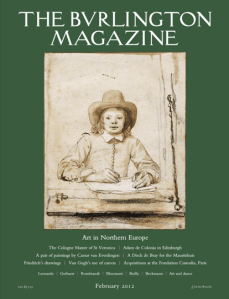 • Sophie Raux, “Carel Fabritius in Eighteenth-Century Paris,” pp. 103-06. This article establishes, among other things, that Carel Fabritius’s Mercury and Argus (c.1645–47; Los Angeles County Museum of Art) was in the collection of François Boucher, where it was seen by Fragonard.
Reviews
• Christian Tico Seifert, Review of Vadim Sadkov, The Pushkin State Museum of Fine Arts: Netherlandish, Flemish, and Dutch Drawings of the XVI-XVIII Centuries. Belgian and Dutch Drawings of the XIX-XX Centuries (Amsterdam: Foundation for Cultural Inventory, 2010), pp. 128-29.
• Xander Van Eck, Review of Lyckle de Vries, How to Create Beauty: De Lairesse on the Theory and Practice of Making Art (Leiden: Primavera Pers, 2011), pp. 129-30.
• Kate Retford, Review of the exhibition The First Actresses: Nell Gwyn to
Sarah Siddons (London: National Portrait Gallery), pp. 134-35.
• Xavier F. Salomon, Review of the exhibition Il Settecento a Verona: Tiepolo,
Cignaroli, Rotari — La Nobilità della Pittura (Verona: Palazzo della Gran
Guardia), pp. 146-48.
Call for Papers | Art of Death and Dying
From the symposium website:
The Art of Death and Dying
University of Houston, 25-27 October 2012
Proposals due by 1 May 2012
The University of Houston Libraries, in partnership with the Blaffer Art Museum, the Cynthia Woods Mitchell Center for the Arts, the Department for Hispanic Studies, the Honors College and School of Art, will host a three day symposium titled “The Art of Death and Dying.” We welcome scholars in all disciplines to submit paper proposals on
literary, visual, and performing arts topics related to death and dying. Topics of the symposium include, but are not limited to:
– Literary, performing, or visual depictions or interpretations of death and dying
– Commemoration of the dead in art and performance
– Artifacts of death and dying as represented in archival or museum collections
– Artistic depictions of the after life
– Cultural death rituals
– Cultural expressions of mourning
– Death and dying in Latin American arts and culture
– Readings of original creative material on the subject
– Performances of material on the subject
– Presentation of visual material on the subject
– Memorial architecture
– Cemetery design
– Analysis of an artist’s, performer’s, filmmaker’s or writer’s work related to the subject
– Depictions of death and dying in film, radio, and television
Proposals related to death in Latin American art and visual culture are encouraged. The organizers will accept presentations in both Spanish and English. Papers will be selected based upon the quality of the proposal (including merit of the topic, clarity of expression, and relevance to the conference theme), the proposal’s ability to provoke critical exchange and debate, and opportunities for interaction between participants that will enable attendees to engage in a truly interdisciplinary exchange of ideas and viewpoints. Presenters will be afforded the opportunity for their symposium paper/presentation to be published in the Texas Digital Library. Papers will be twenty minutes in length and will be followed by ten minutes of discussion. Abstracts of no more than 300 words should be submitted on the symposium website.
Now Accepting Nominations for HECAA’s Next President
From the President
My term as president will be coming to a close this year, and we will need to elect a new president. I hope to accomplish this efficiently so we can introduce the new president at our HECAA business luncheon in San Antonio. (Note that we will NOT be having the $60.00 cold cuts buffet in the hotel but a $40.00 lunch at nearby Boudro’s restaurant, I’ll send a map!). Please send nominations, including self nominations, to me at:
Thanks,
Julie-Anne Plax










 Enfilade
leave a comment