Call for Papers | ASECS 2013 in Cleveland
2013 American Society for Eighteenth-Century Studies Conference
Cleveland, 4-7 April 2013
Proposals due by 15 September 2012
The 2013 ASECS conference takes place in Cleveland, 4-7 April. Along with our annual luncheon and business meeting, HECAA will be represented by two panels chaired by Christopher Johns and Heather McPherson. In addition to these, a wide selection of sessions that might be relevant for HECAA members are also included below. A full list of panels is available here.
◊ ◊ ◊ ◊ ◊
Anne Schroder New Scholar’s Session (Historians of Eighteenth-Century Art and Architecture)
Christopher M.S. Johns, 1112 Wildwind Ct., Nashville, TN 37209; Tel: (615) 516 9337; Christopher.Johns@vanderbilt.edu
Named in honor of the late Anne Schroder, this seminar will feature outstanding new research by emerging scholars.
◊ ◊ ◊ ◊ ◊
Interiors as Space and Image (Historians of Eighteenth-Century Art and Architecture)
Heather McPherson, Dept. of Art and Art History, 113 HUM , 900 13th St. South, U. of Alabama at Birmingham, Birmingham, AL 35294; Tel: (205) 934-4942, Fax: (205)-996-6986; hmcphers@uab.edu
In recent years scholars have reconsidered the significance of the eighteenth-century interior as a complex site of social interaction and nexus of display associated with daily life, exhibition practices, and conspicuous consumption. This session invites papers on eighteenth-century interiors as actual spaces experienced in multiple ways (socially, aesthetically, temporally, etc.) OR as represented in paintings, prints, or other art forms. Topics might include functions of different types of interior spaces, furnishings, decorative arts, display of artworks or other objects, etc. in any geographical area during the long eighteenth century.
◊ ◊ ◊ ◊ ◊ (more…)
Exhibition | Expanding Horizons: Lusieri and the Panoramic Landscape
From the National Galleries of Scotland, as noted by Hélène Bremer:
Expanding Horizons: Giovanni Battista Lusieri and the Panoramic Landscape
Scottish National Gallery, Edinburgh, 30 June — 28 October 2012
Curated by Aidan Weston-Lewis

Giovanni Battista Lusieri, The Monument to Philopappos, Athens, ca. 1805-07
Giovanni Battista Lusieri (1754–1821) was hailed during his lifetime as one of the most gifted of all living landscape artists and his exquisitely crafted works were eagerly sought by collectors. But within a few years of his death his reputation descended into an obscurity from which it has only recently begun to re-emerge. His name will still be unfamiliar to all but a few specialists, a neglect which this exhibition, the first ever devoted to the artist, aims to redress.
Lusieri was one of very few Italian artists to have adopted watercolour as their favoured medium. From the outset his work exhibits the meticulous detail, precision and faultless perspective that remained the hallmarks of his style throughout his career, combined with a panoramic breadth of vision and an astonishing ability to render brilliant effects of light. The latter part of Lusieri’s career was spent mainly in Athens as Lord Elgin’s resident artist and agent. In that capacity he was closely involved in supervising the removal and shipping of the celebrated marbles from the Acropolis, now in the British Museum.
◊ ◊ ◊ ◊ ◊
Catalogue: Aidan Weston-Lewis with Fabrizia Spirito, Kim Sloan, and Dyfri Williams, Giovanni Battista Lusieri and the Panoramic Landscape: Expanding Horizons (Edinburgh: National Galleries of Scotland, 2012), 236 pages, ISBN: 9781906270469, £25 / $63 — available from Artbooks.com in August
 This is the first publication in English devoted to the extraordinary work of the Italian landscape watercolourist Giovanni Battista Lusieri (1754-1821). His career took him from his native Rome to Naples, then to Sicily and finally to the eastern Mediterranean, where he spent twenty years in the service of the 7th Earl of Elgin as his resident artist and agent in Athens. In that capacity he was closely involved in the removal of the celebrated marbles from the Parthenon and other monuments in Greece. Lusieri’s watercolours combine a broad, panoramic vision, an uncanny ability to capture brilliant Mediterranean light and a meticulous, almost photographic attention to detail. He was widely acclaimed as one of the most accomplished landscape artists of his day, and his works were eagerly sought by British Grand Tourists, but after his death he was soon forgotten, and only recently have his exceptional gifts begun to be recognised once again.
Contents
Foreword
Acknowledgements
Aidan Weston-Lewis — ‘The most exact and eloquent transcriptions of nature I ever saw’: Giovanni Battista Lusieri, Life, and Work
Fabrizia Spirito — Lusieri and his Contemporaries | Drawing on the Spot around Rome and Naples
Aidan Weston-Lewis — Rome | An Early Patron: Philip Yorke; entries 1-13
Kim Sloan — Naples | ‘Naples, where the landscape painter is most truly in his element’; entries 14-59
Fabrizia Spirito — Sicily | Lusieri in Sicily; entries 60-66
Dyfri Williams — Greece | Lusieri in the Eastern Mediterranean, 1800-1821; entries 67-92
Bibliography
Notes and References
◊ ◊ ◊ ◊ ◊
Aidan Weston-Lewis is Chief Curator at the Scottish National Gallery with responsibility for the Italian and Spanish collections. He has organised numerous exhibitions at the Gallery and been closely involved with many major acquisitions. He has a particular interest in north Italian painting and drawing of the sixteenth and seventeenth centuries and has published widely in this area.
CAA International Travel Grant Program for 2013
International Travel Grant Program for the 2013 CAA Conference
New York, 11-16 February 2013
Applications due by 15 August 2012
CAA invites individuals to apply to the International Travel Grant Program, generously supported by the Getty Foundation. This program provides funding to twenty art historians, museum curators, and artists who teach art history to attend the 101st Annual Conference, taking place February 13–16, 2013, in New York. The grant covers travel expenses, hotel accommodations, per diems, conference registrations, and one-year CAA memberships. For 2013, CAA will offer preconference meetings on February 11 and 12 for grant recipients to present and discuss their common professional interests and issues.
The goal of the program is to increase international participation in CAA and to diversify the organization’s membership (presently seventy-two countries are represented). CAA also wishes to familiarize international participants with the submission process for conference sessions and to expand their professional network in the visual arts. As they did last year, members of CAA’s International Committee and the National Committee for the History of Art have agreed to host the participants.
Are You Eligible? (more…)
Versailles 3D
Thanks to David Pullins for sharing news of this collaborative project between Versailles and Google:
◊ ◊ ◊ ◊ ◊
Palace History Gallery at Versailles
Château de Versailles, opened 14 June 2012
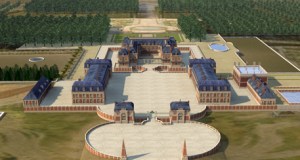 What did Versailles look like before Louis XIV? How did the small hunting lodge of Louis XIII become the largest Palace in Europe? What embellishments did the young Sun King want in his Palace of festivities and amusements? Did you know that the Hall of Mirrors was originally a terrace overlooking the gardens?
The palace of Versailles is a unique place, a royal residence, a history museum and a Republican palace. The complexity of the site needs to be explained to the over 6 million visitors from all over the world who come to Versailles each year. The Palace of Versailles, in partnership with Google, opens the Palace History Gallery on 14 June 2012. As a prologue to the visit to the State Apartments, eleven rooms explain to visitors the richly varied functions of the places they are about to explore. The visit combines the presentation of the collections of Versailles with physical scale models and striking 3D reconstructions.
Google / Versailles Partnership
The technological programme rolled out to accompany the opening of the Palace History Gallery is the fruit of close collaboration over more than a year between the teams of the Palace and those of Google. An ambitious technological policy has been implemented in Versailles for several years now to back up its scientific and cultural communication, disseminate knowledge about it more widely and develop new links with the visitors and with new audiences. From the origin of the project, the exhibition curators decided on the role and the scope of the multimedia in each exhibition and online. The partnership with Google provided the opportunity for a more in-depth approach to the use of technologies to develop, enliven and make more incisive its scientific and cultural communication. 3D technology, in particular, is used extensively in different media (in the rooms, on the Internet, on mobile terminals). Google’s Cultural Institute develops technological solutions for viewing, hosting and digitising materials to favour the creative presentation, protection and promotion of culture online.
Thanks to its dedicated team of engineers, Google’s Cultural Institute has already collaborated with organisations in several countries on different projects, notably for putting online thousands of artworks in the framework of the Art Project, the digitisation of the archives of Nelson Mandela and the Dead Sea Manuscripts.
Iza Wojciechowska on Polish Palaces for The NY Times
From The NY Times:
Iza Wojciechowska, “Palace Hopping in Poland,” The New York Times (15 June 2012). . .
 WHEN I was a little girl living in Texas and visited my family in Poland, my grandfather would always take us to palaces. He had been an art historian and curator of a couple of the palaces around Warsaw during some of Poland’s bleakest years of Communism, and even though I was too young to understand that era, or much of Poland’s complicated history, I knew that through these palaces, something about Poland and its once-luxurious glory had been preserved. My imagination conjured images of princesses running through lavishly decorated hallways and grand, echoing rooms.
There are about 250 palaces in the province that surrounds Warsaw and about 2,800 throughout all of Poland. Most were built for kings or aristocrats in the 17th and 18th centuries; since then, government ministries have restored many of them, which now serve as museums. . .
The full article is available here»
Forthcoming | French Funerary Arts and Tomb Cult, 1750-1870
Due out in September from Ashgate:
Suzanne Glover Lindsay, Funerary Arts and Tomb Cult: Living with the Dead in France, 1750–1870 (Aldershot: Ashgate, 2012), 260 pages, ISBN: 9781409422617.
Even before the upheaval of the Revolution, France sought a new formal language for a regenerated nation. Nowhere is this clearer than in its tombs, some among its most famous modern sculpture-rarely discussed as funerary projects. Unlike other art-historical studies of tombs, this one frames sculptural examples within the full spectrum of the material funerary arts of the period, along with architecture and landscape. This book further widens the standard scope to shed new and needed light on the interplay of the funerary arts, tomb cult, and the mentalities that shaped them in France, over a period famous for profound and often violent change. Suzanne Glover Lindsay also brings the abundant recent work on the body to the funerary arts and tomb cult for the first time, confronting cultural and aesthetic issues through her examination of a celebrated sculptural type, the recumbent effigy of the deceased in death. Using many unfamiliar period sources, this study reinterprets several famous tombs and funerals and introduces significant enterprises that are little known today to suggest the prominent place held by tomb cult in nineteenth-century France. Images of the tombs complement the text to underline sculpture’s unique formal power in funerary mode.
Contents
Introduction: Revisiting 18th- and 19th-Century French Tombs
1. Reforming Funerary Cult in France, 1750–1870
2. 18th-Century France: Rethinking Sculpture and the Body
3. The Bonchamps Project: Reinventing the Effigy Tomb
4. Louis-Philippe’s Tombs: Burying a Modern Royal Family
5. The Poetics of the Exhumed Corpse I: A Tomb for Napoléon
6. The Poetics of the Exhumed Corpse II: The Cavaignac Tomb
Bibliography
Index
New Title | Treasures of Chinese Export Ceramics
From Yale UP:
William R. Sargent, with an essay by Rose Kerr, Treasures of Chinese Export Ceramics from the Peabody Essex Museum (New Haven: Yale University Press), 568 pages, ISBN: 9780300169751, $65.
 Beginning in the sixteenth century when Portuguese traders started importing blue and white porcelain to Europe, Chinese ceramics manufacturers produced goods specifically for export to the West. The industry flourished through the early twentieth century as the market for fine porcelain expanded in Europe and the Americas. Among the Peabody Essex Museum’s founders in 1799 were sea captains and supercargoes involved in extensive trade with Asia, and many of the remarkable examples of export wares they brought back provided a foundation for the Museum’s world-renowned collection of Chinese export ceramics.
Written by William R. Sargent, a leading expert in the field, Treasures of Chinese Export Ceramics is one of the most authoritative sources on this topic. Its scholarly entries on 287 representative objects that date from the fifteenth to the twentieth century are divided into sections by type of ware. Although these examples only hint at the Museum’s vast holding, together they encompass its broad range of Chinese export ceramics. An essay on Jingdezhen, the “Porcelain City,” by Rose Kerr, a glossary of ceramics terminology, and appendix on armorials, and an extensive bibliography all contribute to making this an invaluable resource.
William R. Sargent is the former H. A. Crosby Forbes Curator of Asian Export Art at the Peabody Essex Museum. Rose Kerr is Curator Emeritus of the Far Eastern Collection of Chinese Ceramics at the Victoria and Albert Museum, London.
Workshops on Sloane’s Treasures: A Plan for Reconstructing Sloane
I was lucky enough to attend the second workshop for the Sloane’s Treasures Project, held on 31 May at The British Museum, and I’m thrilled at the prospects of this massive research programme. The benefits will be enormous for a wide range of audiences. In addition to the following description from the BM’s website, see the advertisement for two collaborative doctoral awards. -CH
◊ ◊ ◊ ◊ ◊
Sloane’s Treasures
The Natural History Museum, The British Museum, The British Library, London, 2012
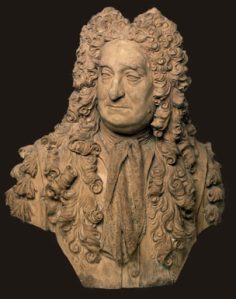 From the time of his voyage to Jamaica in the 1680s, Sir Hans Sloane (1660-1753), physician, natural historian and man of letters, began to gather together one of the largest and most comprehensive collections of ‘natural and artificial rarities’ ever formed. Sloane was later Physician to Queen Anne, George I and II, President of both the Royal College of Physicians and the Royal Society, and his manor in Chelsea included the Apothecaries’ Garden (now the Chelsea Physic Garden). At the centre of a worldwide network, he created an encyclopaedic collection of mineral, botanical, and zoological specimens, ethnographic objects, antiquities, prints, drawings, books and manuscripts, often inheriting or purchasing entire collections formed by others.
On his death in 1753 Sloane’s collection was acquired for the nation by an Act of Parliament which created the British Museum. But as the Museum re-organized its collections and acquired further objects, Sloane’s collection was dispersed among different departments and eventually also to the Natural History Museum in 1881 and to the British Library in 1973. This dispersal has hindered the study and understanding of ‘Sloane’s Treasures’, their sources, and their historical relationships with each other. This project will begin to address these problems.
Between February and September 2012, an Advisory group will be formed, workshops with invited attendees will be held (Natural History Museum, April, British Museum, May and British Library, July) and reports created, including recommendations for a larger project. The constitution of the Advisory group, summaries and videos of parts of the workshops, and updates on their outcomes will be made available, and news of project developments, including information on other research and public events related to Sloane and his collections, will be published here. If you are working on a Hans Sloane-related project or have an associated research or public engagement idea, contact a member of the project team.
Project Team
• Kim Sloan, Curator of British Drawings and Watercolours before 1880, The British Library, Department of Prints and drawings
• JD Hill, Research Manager
• Arnold Hunt, Curator of Modern Historical Manuscripts, The British Library
• Julie Harvey, Manager, Centre for Arts and Humanities Research, The Natural History Museum
Collaborative Doctoral Awards | Reconstructing Sloane
Collaborative Doctoral Award Studentships: Reconstructing Sloane
Applications due 29 June 2012; must be available for interview on 19 July 2012
 Applications are invited for two Collaborative Doctoral Award studentships, available under the rubric Reconnecting Sloane: Texts, Images, Objects, to commence in Autumn 2012. The first CDA will be at King’s College London/The British Library and will focus on the correspondence (i.e. ‘texts’) of Sir Hans Sloane. The second will be at Queen Mary University London/The Natural History Museum and will focus on Sloane’s vegetable substances (i.e. ‘objects’). A third has already been awarded and will be at King’s College London/The British Museum and will focus on Sloane’s natural history drawings (i.e. ‘images’).
Together the CDAs will explore and develop our understanding of Sir Hans Sloane and his contribution to eighteenth-century intellectual life through his activities as a physician, collector, natural philosopher and man of letters. The Research Programme aims to examine the role of a major early Enlightenment collection, and its collector, in the making of knowledge about nature. Sir Hans Sloane’s (1660-1753) extensive collection of texts (in print and manuscript), images (paintings, drawings and prints) and objects (including specimens and herbaria) formed the founding collection of the British Museum (BM) in 1753, but was subsequently dispersed, primarily to the British Library (BL) and the Natural History Museum (NHM). For Sloane and his contemporaries, the collection would have been understood as a whole, and its uses would have involved working between texts, images and objects. The programme’s three linked studentships – each of which will be conducted with the partner organization that now holds the part of Sloane’s collection that will be studied – will aim to ‘Reconnect Sloane’ by examining the making and use of this collection in terms of the specific material within it – texts, images and objects – and also the connections between materials. Working across the separate collections in the way this will provide new insight into Sloane’s role in the making of natural knowledge.
The deadline for applications is 29th June, and you must be available for interview on 19th July. For more information on how to apply, please see the attached documents included below. Please note, the AHRC has strict residential eligibility criteria governing the students that can be nominated for this award. If you are not a British citizen and/or not usually resident in the UK (and have not been for the past three years), please check your eligibility and discuss this with the project supervisors so that your eligibility can be determined.
Catalogue of Cleveland’s Portrait Miniatures Published Online
Press release from The Cleveland Museum of Art:
◊ ◊ ◊ ◊ ◊
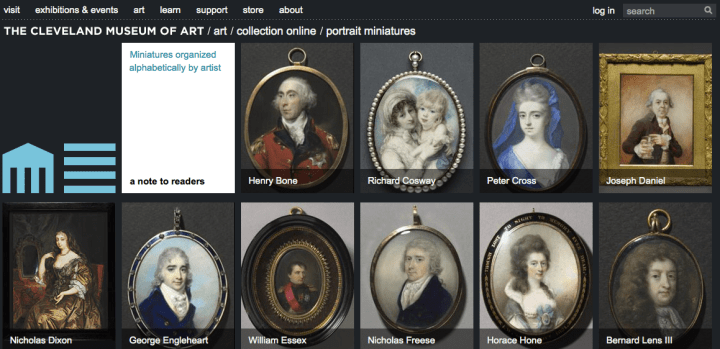
The Cleveland Museum of Art announces its pilot project in digital publishing, British Portrait Miniatures from the Cleveland Museum of Art. This catalogue showcases a substantial portion of the museum’s internationally known collection of around 170 portrait miniatures, one of the most significant in the country. The first stage of this searchable online catalogue includes 54 British portrait miniatures from the 17th, 18th, and 19th centuries, with publication of the remaining British works ongoing though out the year. The catalogue presents new research on the individual miniatures, explores the museum’s collection holistically and incorporates comparative images of works from other public and private collections. The miniatures catalogued online can be viewed at actual size, from the front and the back, and in unprecedented detail.
Authored by Cory Korkow, PhD, a Paintings and Drawings Society curatorial fellow whose initial research was funded by grants from the Samuel H. Kress Foundation, the catalogue includes new research about the artists, sitters, and successive owners of these miniatures, while incorporating conservation photographs and allowing the collection be studied in great detail for the first time. “This innovative project illustrates not only our deep commitment to original scholarly research on our collection, but our creativity in the presentation and dissemination of that knowledge,” said David Franklin, the Sarah S. and Alexander M. Cutler director.
Access to the British Portrait Miniatures catalogue is available here» (more…)










 Enfilade
1 comment