New Title | ‘London in the Eighteenth Century’
From the Random House Group:
Jerry White, London in the Eighteenth Century: ‘A Great and Monstrous Thing’ (London: Bodley Head, 2012), 704 pages, 9781847921802, £25.
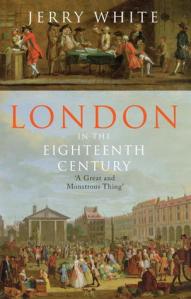 London in the eighteenth century was very much a new city, risen from the ashes of the Great Fire. With thousands of homes and many landmark buildings destroyed, it had been brought to the brink. But the following century was a period of vigorous expansion, of scientific and artistic genius, of blossoming reason, civility, elegance and manners. It was also an age of extremes: of starving poverty and exquisite fashion, of joy and despair, of sentiment and cruelty. Society was fractured by geography, politics, religion and history. And everything was complicated by class. As Daniel Defoe put it, London really was a ‘great and monstrous Thing’.
Jerry White’s tremendous portrait of this turbulent century explores how and to what extent Londoners negotiated and repaired these open wounds. We see them going about their business as bankers or beggars, revelling in an enlarging world of public pleasures, indulging in crimes both great and small – amidst the tightening sinews of power and regulation, and the hesitant beginnings of London democracy.
In the long-awaited finale to his acclaimed history of London over 300 years, Jerry White introduces us to shopkeepers and prostitutes, men and women of fashion and genius, street-robbers and thief-takers, as they play out the astonishing drama of life in eighteenth-century London.
Exhibition | Measuring the Universe and the Transit of Venus
The last transit of Venus was in 2004, but the next one won’t occur until 2117. From Captain Cook’s first voyage to the construction of the Kew Observatory, these celestial events were enormously important in the eighteenth century: 1761 and 1769 (click on either date for details at the Royal Society’s website). For a sense of just how important, see the eighteenth-century bibliography compiled by Utrecht’s Institute for History and Foundations of Science. -CH
◊ ◊ ◊ ◊ ◊
From Royal Museums Greenwich:
Measuring the Universe: From the Transit of Venus to the Edge of the Cosmos
Royal Observatory Greenwich, London, 1 March — 2 September 2012

Royal Observatory, Greenwich, photographed on 24 July 2006 (Wikimedia Commons)
On 5-6 June 2012 a very rare astronomical event takes place: the planet Venus will pass directly between the Earth and the Sun, appearing as a small black dot against the face of our parent star. These transits of Venus occur in pairs eight years apart, but each pair is separated by more than a century. The last one was in 2004 and, after June 2012, the next won’t be until December 2117.
Historically, transits of Venus were used by astronomers to give the first accurate measure of the distance between the Earth and the Sun. To be sure of observing these twice-in-a-lifetime events expeditions were sent around the world in the 18th and 19th centuries and the story involves many famous characters. Captain Cook was sent to Tahiti to observe the transit of 1769, and King George III had Kew Observatory built so that he could view the transit himself (the telescope he used will be on display in the Royal River exhibition at the National Maritime Museum).
By the 21st century the distance to the Sun was well-established, with confirmation by radar studies and space missions. But the 2004 transit still excited the interest of the press and public and was even the subject of a series of photographs by Turner Prize-winning artist Wolfgang Tillmans, some of which can be seen in the Royal Observatory’s free exhibition Measuring the Universe. And now the idea of transits has acquired a new significance for astronomers as they are used to discover new planets orbiting distant stars.
◊ ◊ ◊ ◊ ◊
As Paul Cockburn writes for Time Out London (28 May 2012) . . .
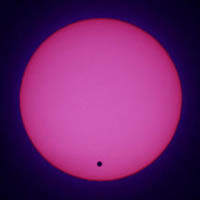
2004 transit of Venus taken from the Royal Observatory
‘This one really is your “last chance to see”,’ explains Dr Marek Kukula, public astronomer at the Royal Observatory, Greenwich. ‘The next one is not until December 2117 – very few, if any, people alive today are going to see that.’
‘When watching a planet slide in front of the Sun, the mechanics of the heavens are laid open for anyone to see,’ Kukula says. And, as the exhibition Measuring the Universe, currently running at the Royal Observatory, explains, the transit of Venus has played an important historical role in helping astronomers calculate the size of the solar system.
‘In the eighteenth century, the transits were among the first examples of international big science collaborations,’ says Kukula. ‘Despite a lot of national tensions within Europe, scientists were communicating with each other across borders. These were also early examples of government-sponsored science; Captain Cook’s first voyage to the South Seas was funded so that he could observe the 1769 transit from Tahiti.’ On the way back, of course, he went on to discover New Zealand and Australia.
There were practical considerations in all this. ‘By measuring the transit accurately, you gained a new level of understanding in how the heavens worked, and that actually was very useful for navigation,’ says Kukula. ‘Even in the eighteenth century, though, the observations were not quite good enough to really nail it. For the nineteenth-century transits – in 1874 and 1882 – you have Greenwich sending out numerous expeditions around the world. Armed with photography, they can at last make accurate observations.’ . . .
The full article, with directions for safe viewing, is available here»
‘Gloriana’ to Lead the Flotilla for the Diamond Jubilee in London

The Gloriana launched in April 2012; from Leon Watson’s
story for the Mail Online, 19 April 2012; Photo by David Parker
◊ ◊ ◊ ◊ ◊
From The BBC (19 April 2012)
The £1m boat that will the lead the Thames Diamond Jubilee Pageant has been launched on the river. The 94ft (28.6m) royal barge Gloriana was escorted through the streets of London on the back of a truck. It had been transported from a unit in Brentford to Isleworth, west London, where it was placed in the Thames. A pageant of more than 1,000 boats involving some 20,000 people will sail down the river on 3 June to mark the Queen’s 60 years on the throne. . . .
Lord Sterling said: “I became enamoured with the idea of building something timeless and got inspiration from Canaletto’s paintings that showed the great barges of the 18th Century and decided to build one. If we had to give it a style, it would be Regency. Including 18 rowers, it will carry 52 people. No-one’s really built anything like this for 200 years and the way we’ve built it, it will last for 200 years if looked after” . . .
◊ ◊ ◊ ◊ ◊
From the official event website:

Photo from ‘Luxatic’; click image to access the article.
On Sunday 3rd June 2012, over one thousand boats will muster on the River Thames in preparation for Her Majesty The Queen to take part in the Thames Diamond Jubilee Pageant. The formal river procession will be between 2pm and 6pm, starting upriver of Battersea Bridge and finishing downriver of Tower Bridge. The boats will muster between Hammersmith and Battersea and disperse from Tower Bridge to West India Docks.
It will be one of the largest flotillas ever assembled on the river. Rowed boats and working boats and pleasure vessels of all shapes and sizes will be beautifully dressed with streamers and Union Flags, their crews and passengers turned out in their finest rigs. The armed forces, fire, police, rescue and other services will be afloat and there will be an exuberance of historic boats, wooden launches, steam vessels and other boats of note.
The flotilla will be bolstered with passenger boats carrying flag-waving members of the public placed centre stage (or rather mid-river) in this floating celebration of Her Majesty’s 60 year reign. The spectacle will be further enhanced with music barges and boats spouting geysers. Moreover, there will be specially constructed elements such as a floating belfry, its chiming bells answered by those from riverbank churches.
The opening ceremony of London’s Olympic Games will be just six weeks away and the public that crowd the riverbanks and bridges will give a rousing reception to the many boats that have travelled from far and wide to represent UK port cities, the Commonwealth countries and other international interests. Downriver of London Bridge, there will be a gun salute and the flotilla will pass through a spectacular Avenue of Sail made by traditional Thames sailing boats, oyster smacks, square riggers, naval vessels and other impressive ships.
The Thames Diamond Jubilee Pageant celebrates Her Majesty’s 60 years of service by magnificently bringing the Thames to life; making it joyously full with boats, resounding with clanging bells, tooting horns and sounding whistles; recalling both its royal heritage and its heyday as a working, bustling river.










 Enfilade
leave a comment