Symposium | In Circulation: John Singleton Copley and Benjamin West
In addition to the topic, the format of this symposium looks interesting on several counts: the webinar format, the time (Friday afternoon and evening with a light supper and drinks between presentations), and the trans-Atlantic component (which presumably explains the timing). In the digital age, it seems fair to ask what a symposium should look like. I’m glad to see experiments like this one. -CH
From The Paul Mellon Centre:
In Circulation: John Singleton Copley and Benjamin West in England, France, and America
The Paul Mellon Centre, London, 28 March 2014
 This symposium and webinar follows on from the international loan exhibition American Adversaries: West and Copley in a Transatlantic World, held at the Museum of Fine Arts Houston between 5 October 2013 and 20 January 2014.
It explores aspects of the work and careers of the American-born artists Benjamin West and John Singleton Copley, focussing in particular on the ways in which they engaged with the exhibition and print cultures of their day, particularly in Britain, but also in France and America. The paintings of both artists moved between and across very different spaces of display, and were increasingly geared to satisfying the demands of a growing exhibition-going public. Just as importantly, Copley and West’s paintings were regularly translated into graphic form. Engravings as well as exhibitions promoted their work to audiences in Britain, France and America, and helped give both artists an international reputation.
The symposium and webinar will investigate the ways in which these forms of display and dissemination shaped both artists’ practice and reputations across transnational visual cultures. This event will be filmed and live-streamed to a group of scholars, students and curators at the MFA in Houston, who will be invited to ask questions of the speakers. It will also be live-streamed online, enabling an international audience to watch and respond to proceedings as they take place in London and submit questions to the speakers via an interactive website. A full symposium programme, with details of papers and ticketing, is available at The Paul Mellon Centre’s website.
P R O G R A M M E
15.15 Mark Hallett (The Paul Mellon Centre), Introduction
15.30 Emily Neff and Kaylin Weber (The Museum of Fine Arts, Houston), Introduce video of American Adversaries
16.00 Tea
16.15 Jane Kamensky (Brandeis University), Copley’s Revolutions
17.00 Stephane Roy (Carleton University), West’s General Wolfe in Eighteenth-Century France
17.45 Drinks and Light Supper
18.45 Rosie Dias (University of Warwick), Copley, West, and John Boydell: New Mechanisms of Patronage in
Late Eighteenth-Century London
19.30 Kaylin Weber (The Museum of Fine Arts, Houston), Displaying History: West’s Gallery and the Great Room
20.15 Drinks
20.30 Sarah Monks (University of East Anglia), Out of Time, Out of Place: Copley’s Last Pictures
21.15 Wendy Bellion (University of Delaware), West and Shakespeare in Early Nineteenth-Century Philadelphia
22.00 Mark Hallett and Emily Neff, Concluding Remarks
MoMA Appoints First Director of Digital Content and Strategy
Arriving at MoMA from the Royal Museums Greenwich, Fiona Romeo steps into a position that will, I imagine, become increasingly common if not essential for museums in the years ahead. Given her role, it’s especially interesting to see what her own web presence looks like. -CH
From the press release (7 February 2014). . .
 The Museum of Modern Art has appointed Fiona Romeo as Director of Digital Content and Strategy, a newly created position in which Ms. Romeo will provide vision and leadership across the organization to enable the Museum to build on its existing digital initiatives and refine its strategic direction and goals. Under the direction of Peter Reed, Senior Deputy Director for Curatorial Affairs, she will actively work with senior leadership to develop and grow digital engagement with MoMA’s diverse audiences, both on site and online. She will lead the Digital Media Department, overseeing a team of digital producers, developers, and designers. Ms. Romeo will join the Museum in April.
In her new role, Ms. Romeo will create a clear and achievable strategy that will connect all areas of the Museum and build upon the success of existing programs. Her purview will include MoMA’s website, MoMA.org, including the online collection and exhibition subsites; and digital tools and resources, such as mobile applications, digital in-gallery displays, and live-streamed events.
“Fiona’s appointment builds upon the Museum’s pioneering work in the digital realm, and is a reflection of the dynamic and vital role that digital content plays in the way people can participate in the life of the Museum,” said Glenn D. Lowry, Director of The Museum of Modern Art. “Her extensive museum experience and her background in social and interactive digital platforms makes her particularly well suited to lead MoMA’s innovative and multifaceted initiatives, which engage individuals with the richness of our collection and programs.” (more…)
Valentine’s Day at the Museum of London
As reported by Nick Clark for The Independent (30 January 2014). . .
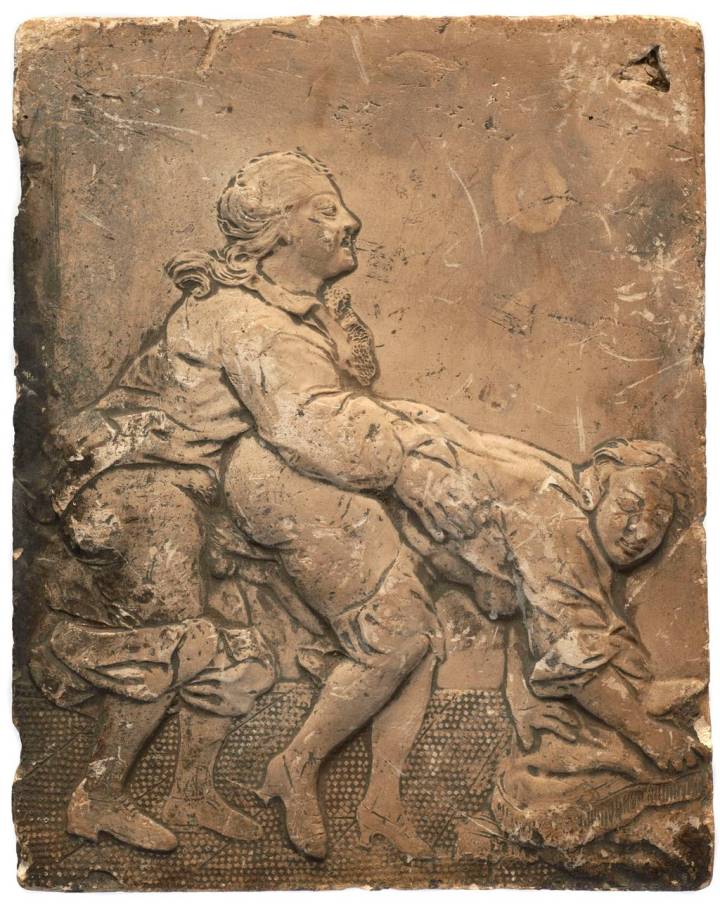
Detail of one of eight eighteenth-century plaster tiles discovered in 1962. Click on the image for the full view of another tile (with usual warnings about sexually explicit images).
For one night only. . . amorous visitors to the Museum of London will have the chance to see the steamy side of the 18th century. A series of erotic tiles, detailing various sexual positions and even spanking, will go on display for the first time at a late-night Valentine’s Day event at the site in the heart of the City. The eight tiles were discovered in 1962 after a fire in an upper room of one of London’s most memorable old pubs and remain shrouded in mystery.
Jackie Keily, curator at the museum, said: “We can’t normally display them because they are so graphic. It is a fascinating glimpse into the sexual history of London; so few of these artefacts survive.”
They will be part of an evening event called Late London: City of Seduction which is open to over 18-year-olds only. The tiles were discovered in 1962 following a fire at Ye Old Cheshire Cheese pub on Fleet Street and were handed to the museum shortly after.
The full article, with additional photos, is available here»
Details of Late London: City of Seduction are available here»
« Livraisons d’histoire de l’architecture » 26 (2013)
From the Centre André Chastel:
“Les Ministres et les arts,” numéro thématique des Livraisons d’histoire de l’architecture 26 (2013), €23.
 Basile Baudez, “Le comte d’Angiviller, directeur de travaux : le cas de Rambouillet”
Alexandre Burtard, “Sur la piste des orientations artistiques de Nicolas Frochot, premier préfet de la seine sous le Consulat et l’Empire”
Rose-Marie Chapalain, “L’abbé Terray, seigneur de la Motte-Tilly”
Marie-Claude Chaudonneret, “Les ministres de l’intérieur et les arts sous le Directoire”
Hélène Drutinus, “Jean Naigeon, conservateur du Luxembourg sous le Consulat : les rapports d’un conservateur avec le Sénat et le ministre de l’intérieur”
Dominique Massounie, “Philibert Orry et l’embellissement du territoire autour de l’Instruction de 1748 : genèse d’un paysage routier et urbain”
Gabriele Quaranta, “Deux générations à côté du pouvoir : quelques remarques sur les arts chez les de Fourcy”
Aleth Tisseau des Escotais, “Finances et arts pendant la Révolution et le Premier Empire : l’exemple du Garde-Meuble”
Summaries for a selection of the articles are available as a PDF file here»
Call for Papers | Art as Cultural Diplomacy: Eastern and Western Europe
Art as Cultural Diplomacy: (Re)Constructing Notions of Eastern and Western Europe
Berlin, 28–29 March 2014
Proposals due by 25 February 2014
Panel Organizer: Cassandra Sciortino, University of California, Santa Barbara
As part of the Third Euroacademia International Conference Re-Inventing Eastern Europe to be held in Berlin, the panel Art as Cultural Diplomacy seeks papers that explore the function of art (in its broadest definition) as an instrument of cultural diplomacy by the state and, especially, by nongovernmental actors. The main theme of the session is the question of art and diplomacy in Europe before and after the fall of the Berlin Wall. Papers are welcome that explore issues related to the role of art, diplomacy and the politicization of the European Union and its candidate countries, as are those which consider how the arts have pursued or resisted East-West dichotomies and other narratives of alterity in Europe and worldwide. The panel seeks to combine a wide range of interdisciplinary perspectives to explore how art—its various practices, history, and theory—are an important area of inquiry in the expanding field of cultural diplomacy. Selected papers will be invited for publication in a book.
Some examples of topics include:
• How can art serve as a neutral platform for exchange to promote dialogue and understanding between states?
• How can art, including organized festivals (i.e. film, art, music), cultivate transnational identities that undermine dichotomies of East and West, and other narratives of alterity in Europe and beyond it?
• The implications for art as an instrument of diplomacy in a postmodern age where geopolitics and power are increasingly mobilized by image-based structures of persuasion
• How has/can art facilitate cohesion between European Union member states and candidate states that effectively responds to the EU’s efforts to create ‘unity in diversity’?
• The politics of mapping Europe: mental and cartographic
• Community-based art as a social practice to engage issues of European identity
• The difference between art as cultural diplomacy and propaganda
• The digital revolution and the emergence of social media as platforms for art to communicate across social, cultural, and national boundaries?
• Diplomacy in the history of art in Europe and Eastern Europe
• Artists as diplomats
• Art history as diplomacy—exhibitions, post-colonial criticism, global art history, and other revisions to the conventional boundaries of Europe and its history of art
• The international activity of cultural institutes
If interested in participating, please send an abstract (maximum of 300 words) together with the details of your affiliation until 25th of February 2014 to cassandra.sciortino@berkeley.edu and application@euroacademia.eu. More information is available here
Call for Papers | Family Patronage in Genoa, Rome, and Venice
Family Patronage in Early Modern Genoa, Rome, and Venice, 1500–1750
Bibliotheca Hertziana—Max-Planck-Institut für Kunstgeschichte, Rome, 8 September 2014
Proposals due by 15 April 2014
Among the increasingly monarchic arena of Early Modern Europe, the powerful Italian cities of Genoa, Rome, and Venice are exceptional. Genoa and Venice, the largest remaining republics in Italy, predominated the financial, mercantile, and military spheres of the Mediterranean. Rome’s religious authority and historical cachet, along with its sizable territory, were the foundations of its leading position. All three of these cities stand out for their oligarchic
power structures; while Genoa and Venice were led by governments elected from a restricted book of families, Rome fostered an aristocracy both parallel to and participating in the electoral principle of the Papal court. Therefore, in the absence of hereditary lords, power and prestige was shared among the ruling families. As a result, in all of these cities, the families could remain powerful even as the government changed.
Central challenges for these cities’ aristocratic families were how to figure their relationships to local power structures and balancing their own interests against those of the communal state. The particular social-political contexts nurtured different forms and strategies of representation than those deployed in monarchic and ducal societies. The oligarchic aristocracy had to submit to an abstract concept shaped by values and virtues such as equality and liberty rather than to a dynastic authority. Each of these societies experienced turning points when their political structures shifted and opened to new families—be they from outside the city or from non-noble stock—and their ruling classes sought new methods of representation and patronage to assert their role in the changed social scene. The reforms of 1576 to Genoa’s oligarchic government, the rising status of papal families in seventeenth-century Rome, and the opening of the Libro d’Oro in the context of Venice’s wars against the Ottoman Turks in the late seventeenth century were all moments from which such changes arose.
Against this background, this study day seeks to compare the demands and strategies of art and architectural patronage among these non-dynastic aristocratic groups. Although Genoa and Venice have often been mentioned in chorus, they have never been directly and critically compared. Because of their diverse political alliances and statuses, the differences in their governmental structures, as well as their differing territorial dispositions, two distinct types of an early modern republic developed. Furthermore, the exemplary role of Rome for the non-monarchic sphere—its permeable system of social ascension—still asks for a more differentiated view. While scholarship often focuses on the Papacy of Rome and likens it to a monarchy, we seek to understand the strategies of the ruling class while not in power.
We invite abstracts from scholars in all stages of their careers addressing key aspects and questions such as the following:
– How did individual families present themselves vis-a-vis rival families or the state?
– How and when did these representations take place?
– What were the spaces used for representation and how were they marked?
– How did these strategies change or shift through time or across political changes?
– Can we identify instances of collective patronage or patterns of patronage?
– Are there collective representations or patterns of representation?
– Did strategies differ between sacred and secular contexts? If so, how?
– How do we conceive of the dialectic of public / private in these societies?
Proposals for 25-minute papers should include the title of the paper, a 250– to 300-word abstract, the author’s institutional affiliation, a one-page CV, and full contact information. Papers may be submitted in English, French, German, and Italian. Proposals should be sent to both: Benjamin Eldredge (Bibliotheca Hertziana) eldredge@biblhertz.it and Bettina Morlang-Schardon (Bibliotheca Hertziana), morlangschardon@biblhertz.it.
Summer Institute | Rebuilding the Portfolio: Digital Humanities
This brings the number of summer institutes devoted to the digital humanities announced here at Enfilade up to three (with one in Los Angeles and one in Middlebury, Vermont). Try a keyword search (available to the right) for other opportunities.
Rebuilding the Portfolio: Digital Humanities for Art Historians Summer Institute
George Mason University, Fairfax, Virginia, 7–18 July 2014
Applications due by 15 March 2014
◊ ◊ ◊ ◊ ◊
Applications are now open for Rebuilding the Portfolio: Digital Humanities for Art Historians, a summer institute at the Roy Rosenzweig Center for History in New Media, George Mason University, supported by the Getty Foundation, July 7–18, 2014. The program is designed for 20 art historians, from different stages of their careers and from varied backgrounds, including faculty, curators, art librarians, and archivists who are eager to explore the digital turn in the humanities. We seek applications from individuals who have had very limited or no training in using digital methods and tools, or in computing. A tentative schedule is available here. We will accept applications until March 15, 2014.
Sheila Brennan and Sharon Leon
Co-Directors, Rebuilding the Portfolio: DH for Art Historians
Roy Rosenzweig Center for History and New Media, George Mason University
At CAA 2014 | British Country Houses and Gardens
Historians of British Art
British Country Houses: Architecture, Collections, and Gardens
Thursday, 13 February, 12:30–2:00, Hilton Chicago, 3rd Floor, Williford A&B
As late as last December, I announced a Call for Papers for a session at this week’s conference of the College Art Association. As one of Thursday’s lunch panels, the session had already been reserved for the Historians of British Art, and in my announcement I referenced “a spirit of nimble experimentation.” Well I’m thrilled to have three promising papers, the abstracts of which are available below (they obviously won’t be available through CAA). For anyone in Chicago this week, please turn up. The session is intended to be a productive opportunity for feedback and discussion. And as a midday session, it is open to the public without the usual CAA membership or conference registration fees (it’s entirely free). For easier printing, a PDF file of the abstracts is also available here.
Many thanks,
Craig Hanson
◊ ◊ ◊ ◊ ◊
William L. Coleman (University of California, Berkeley), ‘Both instructive and pleasant’: The Country House Garden in Vitruvius Britannicus
The Scottish architect Colen Campbell is best known not for any of his buildings nor for the influential offices he held during his lifetime but for his collection of engraved views of British country houses: Vitruvius Britannicus, or the British Architect. This project, issued in three volumes from 1715 to 1725 with nearly 300 folio plates has been called “the most ambitious publication of engraved material yet attempted in Britain.”1
While the mission of Vitruvius Britannicus is clear enough—the advancement of Palladian architecture in Great Britain as an alternative to Roman ecclesiastical influence through a direct appeal to those in a position to commission new country houses—there are major differences between the contents of the volumes of the book. In contrast to the first two entries in the series, which consist exclusively of plans, elevations, and occasional sections of noteworthy buildings, the 1725 third volume of also includes birds-eye views and elaborate perspectives of country-house gardens. Here, for the first time in the book, Campbell shows detailed information about the form of the grounds of the country houses he celebrates, often to the detriment of the architectural representation that has been central until this point. The garden images have rarely been commented upon in the literature on Vitruvius Britannicus despite the fact that Campbell alerted his audience to the significance of this material in an advertisement for Volume III, in which he wrote “the Author has made a great Progress in a Third Volume containing the Geometrical Plans of the most considerable Gardens and Plantations with large Perspectives of the most Regular Buildings, in a Method intirely new, and both instructive and pleasant.”2 If these plates are not merely “pleasant” but “instructive,” in what do they instruct?
This paper will argue that Campbell’s garden views should be understood as integral to his overarching goal of reforming British taste, rather than as decorative adjuncts to it, and that these plates suggest a new way of understanding a period in garden history that has proven problematic in the past. Christopher Hussey and John Harris, among others, have recognized that many English gardens built from about 1715 to 1730 differ from the Anglo-Dutch style that came before in their gradual departure from bi-lateral symmetry and their embrace of elaborate, classicizing outbuildings to create interesting perspectives, but do not yet reject geometric construction in the way the better known work of Capability Brown would later in the century.3 Rather than treating the gardens Campbell describes and represents in his book as aberrant or merely transitional, it will be productive to consider how they relate to his architectural project. Just as Volumes I and II of Vitruvius Britannicus argue for a British Palladianism to counter perceived Catholic decadence, so does Volume III make a case for what can be called the Neopalladian garden. While damning others with faint praise, Campbell held up as exemplary gardens that, by means of their citations of Palladio in buildings and their allusions to laborless Arcadian bounty, constituted an alternate horticultural modernity.
1. E. Harris, “Vitruvius Britannicus before Colen Campbell,” The Burlington Magazine 128 (May 1986), p. 340..
2. Campbell, Vitruvius Britannicus II, p. 8.
3. C. Hussey, English Gardens and Landscapes: 1700–1750 (New York, 1967), p. 132; J. Harris, “The Artinatural Garden” in C. Hind ed. The Rococo in England: A Symposium (London, 1986), pp. 8–9.
◊ ◊ ◊ ◊ ◊
Jocelyn Anderson (Courtauld Institute of Art), From Stowe to Mount Edgcumbe: Touring Collections in Gardens
In the eighteenth and early nineteenth centuries, as country-house tourism became increasingly popular, guidebooks for specific houses and gardens were published. Indicative of houses having thoroughly established themselves as destinations for polite tourists, these guidebooks provide critical evidence as to how these sites were presented to and remade for visitors. Many guidebooks focus on the art collections of houses, cataloguing pictures and sculptures and explaining them for readers. Several guidebooks, however, describe gardens, and close examination of these texts sheds new light on the public significance of these places. While garden historians have usefully analysed these cultivated landscapes from the perspective of designers and owners, guidebooks demonstrate that tourists’ experiences of these places would often have been quite different. This paper explores the guidebooks for three gardens and considers the significance of how these texts describe and comment on these sites.
By the middle of the eighteenth century, Viscount Cobham’s gardens at Stowe (Buckinghamshire) spread over 200 acres and contained over forty temples. They were among the most famous in Britain, and they had become a popular tourist attraction, complete with an inn for tourists’ convenience. Stowe’s first guidebook was published in 1744, and over the following sixty years, over twenty editions appeared. The gardens at Hawkstone (Shropshire) were not as famous, but the estate also had an inn for visitors, and ten guidebooks to its grounds were published between 1766 and 1811. It was known for its rugged natural landscape, which included a sharp ridge of sandstone hills and a deep ravine, along with an exceptionally eccentric collection of ornamental features. In the former aspect it was similar to Mount Edgcumbe (Devon), whose coastal site had inspired a garden which incorporated panoramic views of the ocean and walks along cliffs. Mount Edgcumbe was celebrated in the later eighteenth century, but it wasn’t until the early nineteenth century that its first guidebooks were published.
What these three gardens have in common is the approach guidebook authors took when they described them for visitors. The first, and most prominent, device adopted was the circuit, which organized both the guidebook and the garden itself. The circuit was the itinerary tourists were meant to follow while visiting the garden, leading them through both locations in space and descriptions on the page (depending on the garden, it was not necessarily circular). The circuit in all three of these guidebooks is constructed by a progression of entries about specific temples and locations; these are, in effect, descriptions of gardens written as chains of descriptions about destinations within them. Within this structure, the guidebooks provide detailed entries about each place where visitors were expected to pause during their tour. Many of these entries are extraordinarily attentive to detail, supplying information about everything from the architect who designed a temple to what might be visible on the distant horizon. Through these guidebooks’ approach, visits to these gardens are constructed as collections of close examinations and responses, similar to those which might be had touring the art collection inside a country house.
◊ ◊ ◊ ◊ ◊
Laurel O. Peterson (Yale University), Art, War, and Politics in William Kent’s North Hall at Stowe
In the late 1720s, Richard Temple, viscount Cobham, commissioned William Kent to design and decorate the interior of his north entrance hall at Stowe House. Kent had established himself as a leading artist in Britain, and he created a room for Cobham in the latest fashion. While only the grisaille and gold ceiling remains of Kent’s scheme, it is the oldest surviving interior at Stowe. This paper considers Kent’s and Cobham’s intertwining artistic, social, and political aims in the decoration of the North Hall, and argues for an interpretation of this space as representative of a vital artistic culture found in the early eighteenth-century country house.
The North Hall celebrates Cobham’s military career. The central allegorical ceiling panel portrays the young Cobham receiving a sword from Mars, and commemorates the date in 1702 when he received his own army regiment from William III. Cobham rose through the ranks, eventually serving as a lieutenant general under John Churchill, first duke of Marlborough, in the War of Spanish Succession. Cobham’s military career enabled his political and social rise; he served in the ministries of George I and ultimately was elevated to a viscountcy in 1718. While the expression of Cobham’s Whig ideologies through garden architecture is well known, this paper draws attention to the interior as a central part of his project. By representing a moment that celebrates his connection to William III, Cobham chose to emphasize his commitment to the Glorious Revolution of 1688, a political statement that aligned with his Opposition Whig politics. Other parts of Kent’s original decorative scheme, such as Christophe Veyrier’s marble relief of the Family of Darius before Alexander (c. 1680), reinforced the military theme.
The North Hall—the point of entry for any guest to Stowe House—formed one part of a larger temporal and spatial viewing experience. This paper suggests ways in which Kent’s decoration worked in dialogue with other spaces and works of art in various media in the building, such as the set of the Art of War tapestries (ca. 1706–12), woven by Judocos de Vos after designs by Lambert de Hondt.
This paper not only explores how the North Hall was invested with political meaning, but also examines the stakes in play with this aesthetic project. Contextualizing this space within a larger continuum of other interiors highlights the specific aims of both Cobham and Kent. Blenheim, the preeminent contemporary military palace, built for and decorated in honor of the Duke of Marlborough, Cobham’s former commander, is a particularly salient comparison. In addition, examining Kent’s ceiling in relation to his work at Kensington Palace and at Houghton Hall, as well as in relation to continental models, situates the artist’s work both within ambitious and distinguished artistic traditions and on the forefront of innovative design. Artistic production and ambition within the country house must be understood as concomitant with developing political roles of the landed elite. This paper suggests how a space such as Stowe’s North Hall must be considered a key site of artistic production, part of a dynamic artistic culture thriving in early eighteenth-century country houses.
Exhibition | Capturing the Castle: Watercolours of Windsor
From the exhibition press release (18 December 2013). . .
Capturing the Castle: Watercolours of Windsor by Paul and Thomas Sandby
The Drawings Gallery, Windsor Castle, 7 February — 5 May 2014
Curated by Rosie Razzall

Paul Sandby, The Lower Ward Seen from the Base of the Round Tower,
ca. 1760 (The Royal Collection)
◊ ◊ ◊ ◊ ◊
Twenty views of Windsor Castle by the great 18th-century watercolourists Paul and Thomas Sandby go on display at the Castle from 7 February. Created from the 1760s to the 1790s, they provide a fascinating insight into life at Windsor during the reign of George III (1760–1820), who used the Castle as an occasional country retreat for his growing family. The drawings will be displayed alongside a number of early guidebooks, showing what visitors to Windsor would have experienced some 250 years ago. 21st-century visitors can use a free app to explore the 18th-century views and compare them with the appearance of the Castle today.
 ‘The father of English watercolour’, Paul Sandby (1730–1809) and his older brother Thomas (1721–98) were among the founding members of the Royal Academy under the patronage of George III in 1768. They sometimes worked together, with Paul Sandby adding figures to his older brother’s landscapes.
Thomas Sandby was Draughtsman to William Augustus, Duke of Cumberland, and came to Windsor in 1746 following the Duke’s appointment as Ranger of Windsor Great Park. After Paul’s arrival in Windsor a few years later, the brothers set about producing views of the Castle from numerous angles and viewpoints, creating an unrivalled visual record of the building and surrounding area.
During this period the Castle became a popular tourist destination—the Precincts were open to the public, and access to the State Apartments was granted upon application to the Housekeeper. The Sandby watercolours show the informality of daily life around the Castle in the mid-18th century. They record soldiers chatting idly with the townsfolk, street traders hawking their wares, and elegantly dressed visitors strolling on the North Terrace, from where they could admire the views across the Thames Valley. The watercolours also document the appearance of the Castle before the major remodelling of the building by George III’s son, George IV, in the 1820s. In Paul Sandby’s View of the Quadrangle, from around 1765, the Round Tower appears significantly lower than it is today. Sixty-five years later it was heightened by some nine metres (30ft), and given Gothic-style battlements and a flag turret, creating Windsor’s now world-famous skyline.
◊ ◊ ◊ ◊ ◊
The Royal Collection Acquires Rare Portrait of Paul Sandby

Paul Sandby, The Quadrangle Looking West, ca. 1765
(The Royal Collection)
◊ ◊ ◊ ◊ ◊
Press release (4 February 2014) . . .
He is known for his beautiful views of Windsor, providing a fascinating insight into life at the Castle during the reign of George III (1760–1820). Now, 250 years later, a portrait miniature of Paul Sandby (1731–1809), ‘the father of English watercolour’, will go on display in a new exhibition at Windsor Castle and return the artist to the royal residence where he made his name. One of only a few known images of the artist, the miniature has been acquired by The Royal Collection Trust for the Royal Collection, which holds one of the world’s largest groups of work by Paul Sandby and his older brother Thomas. The miniature will be shown alongside some of Paul Sandby’s most famous views. The exhibition, Capturing the Castle: Watercolours of Windsor by Paul and Thomas Sandby, includes 20 works produced from the 1760s to the 1790s by the two brothers. They reveal the informality of daily life at Windsor during the reign of George III, who used the Castle as an occasional country retreat for his growing family.
 Despite his successful career as one of the founding members of the Royal Academy, Paul Sandby was rarely painted himself. A half-length portrait, the miniature shows Sandby at the age of 56 against a landscape with Windsor Castle in the background. He wears a blue coat, white waistcoat and cravat, and holds a porte-crayon, used for drawing with pieces of chalk, and an open sketchbook. The miniature was painted in 1787 by the Jersey-born artist Philip Jean (1705–1802), who also produced portraits of the British royal family, including George III and his consort Queen Charlotte.
Born in Nottingham, Paul Sandby arrived at Windsor in the early 1750s, following Thomas’s employment as Draughtsman to William Augustus, Duke of Cumberland (uncle to George III), who had been appointed the Ranger of Windsor Great Park in 1746. The brothers set about producing views of the Castle from numerous angles and viewpoints, creating an unrivalled visual record of the building and surrounding area.
The watercolours record soldiers chatting with the townsfolk, street traders hawking their wares, and elegantly dressed visitors strolling along the North Terrace and admiring the views across the Thames Valley. One particularly noticeable difference between the 18th-century Castle and that today is documented in the Sandbys’ watercolours: in The Quadrangle, Windsor Castle, looking west, c.1765, the iconic Round Tower appears significantly lower. It was heightened by some nine metres (30ft) 65 years later, as part of the George IV’s remodelling of the Castle. Gothic-style battlements and a flag turret were added, creating Windsor Castle’s now world-famous skyline. (more…)
Call for Papers | Houses as Museums / Museums as Houses
Call for Papers from the Museums and Galleries History Group:
Houses as Museums / Museums as Houses
Wallace Collection, London, 12–13 September 2014
Proposals due by 17 February 2014
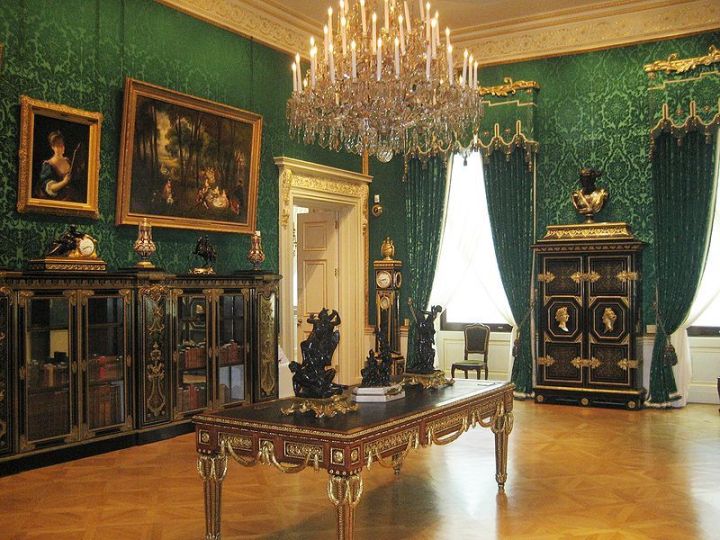
Back State Room, Wallace Collection, London
◊ ◊ ◊ ◊ ◊
The relationship between museums and domestic spaces is a long and complex one. Museums were born in the houses of collectors, while the reconstruction of the house or domestic room—of ‘home’, effectively—continues to be an influential if controversial model for museum display. On the other hand, museums have at times invested heavily in the idea of their spaces as public, scientific and definitively non-domestic. The line between house and museum is therefore also one between public and private, scientific and domestic; and house-museums/museum-houses have acted both to confirm, to alter, and to undermine this line completely.
The 2014 MGHG conference seeks to understand the historical development of this relationship by investigating the ways in which museums have acted as houses, and houses have acted as museums. It will also explore the ways in which house-museums/museum-houses have been positioned in boundary zones of space and time, and what effect they have had on those boundaries. The conference will take place at the Wallace Collection, London, on Friday 12 and Saturday 13 September 2014, itself an illustration of the ways in which houses may become museums, or are (re)designed as museums by their owner, as Hertford House was by Sir Richard Wallace.
We also encourage papers on aspects as diverse as the growth of the celebrity house museum, cabinets of curiosity, curatorial practices of the homeowner in contrast to those of the professional curator, and the development of open air museums and their approach to house reconstruction. Our focus is on the historical development of these themes, but papers which consider the interaction of historical and contemporary practice will also be considered. We encourage papers from museum professionals, researchers, and students from multiple disciplines.
Keynote speakers confirmed so far: Helen Rees Leahy, Professor of Museology at the University of Manchester.
Possible topics for papers include, but are not limited to:
•Country houses as museums
• Artist/writer/scientist house museums
• Houses converted into museums
•Museums in houses: cabinets of curiosity, children’s museums, amateur museumss
•Museums in other domestic settings such as ‘inn parlour’ museums
•Museums as places to live, for curators, caretakers and others
•Owners, custodians and curators
•Subjective and eccentric taxonomies
Please send proposals for papers, of no more than 250 words, with brief biographical information, to secretary@mghg.org, by Monday 17 February 2014.










 Enfilade
leave a comment