Exhibition | Arlene Shechet: Meissen Recast
From the exhibition press release (20 November 2013). . .
Arlene Shechet: Meissen Recast
RISD Museum, Providence, Rhode Island, 17 January — 6 July 2014
Organized by Judith Tannenbaum

Arlene Shechet, Asian Vase, 2013.
In the first U.S. exhibition of her one-of-a-kind Meissen sculptures, Arlene Shechet presents works she produced during a recent artist residency at the world-renowned German porcelain manufacturer. Arlene Shechet: Meissen Recast is a two-part exhibition on view at the RISD Museum from January 17 to July 6, 2014. It is the utilitarian factory casts behind fine porcelain production, rather than the ornate ceramic confections, that inform Shechet’s ‘Meissen’ series. Her range of sculpture brings to the fore the seams, plate impressions, indentations, inventory numbers, and other evidence of the industrial process that an 18th-century Meissen craftsman would have sought to erase. Almost every sculpture on view in the Museum’s Upper Farago Gallery is derived from one or more of 47 historic Meissen mold patterns, reconceived in unanticipated combinations of forms and scale. Shechet’s complete reinstallation of the Museum’s historic Meissen collection of figurines and tableware in the Porcelain Gallery completes the two-part show, connecting the past and present, fine arts, and decorative arts.
“The Museum is excited to present this compelling new work by RISD alumna Arlene Shechet,” says John W. Smith, director of the RISD Museum. “Meissen Recast extends the Museum’s long and groundbreaking tradition of encouraging artists to use the collection, dating from Andy Warhol’s Raid the Icebox (1970) to Spencer Finch’s Painting Air exhibition (2012). By moving some of RISD’s Meissen figures, including the famous Monkey Band, from their normal location in the Porcelain Gallery to the contemporary Upper Farago Gallery and, conversely, inserting her own porcelain sculptures into the cases of the more traditional, wood-paneled room, she heightens our awareness and appreciation for the refined historical pieces and her own more organic, intuitive approach.” (more…)
New Book | French Bronze Sculpture: Materials and Techniques
Published by Archetype and available from ACC Distribution:
David Bourgarit, Jane Bassett, Francesca Bewer, Geneviève Bresc-Bautier, Philippe Malgouyres, and Guilhem Scherf, eds., French Bronze Sculpture: Materials and Techniques, 16th–18th Century (London: Archetype Publications, 2014), 256 pages, ISBN: 978-1909492042, £65 / $140.
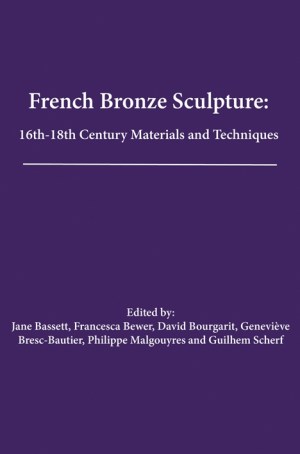 The papers in this volume examine the origins and cross-fertilization of ideas and technology related to the making of bronzes in France between the Renaissance and the 18th century from the perspectives chronology, geography and typology. The production of specific sculptors and founders, or of specific works of art are considered in terms of the technology, the documentation of both the processes and the persons involved e.g. sculptors, founders, merchants, etc. and how these may have impacted the stylistic and technical outcome.
Also presented are state-of-the-art research methods and their application to multi-disciplinary studies—including historical and archeological investigations, analytical studies of materials (e.g. metal, core and patina), as well as experimental reconstructions of metallurgical processes.
C O N T E N T S
Part 1: From Primaticcio to Houdon
I.1 Francesco Bordoni: spécificités techniques chez un sculpteur-fondeur du 17e siècle D. Bourgarit , G. Bresc, F. Bewer
I.2 Barthélemy Prieur fondeur, son atelier, ses méthodes de travail R. Seelig, F. Bewer, D. Bourgarit
I.3 De Dame Tholose au Mercure volant: fondre en Languedoc aux 16e et 17e siècles P. Julien, A. de Beauregard
I.4 Casts after the antique by Hubert Le Sueur J. Griswold, C. Hess, J. Bassett, G. Bresc, M. Bouchard, R. Harris
I.5 Keller et les autres: les fondeurs des jardins de Versailles ou les cent-un bronzes de Louis XIV A. Maral, A. Amarger, D. Bourgarit
I.6 Keller and his alloy: copper, some zinc and a little bit of tin J.-M. Welter
I.7 Jean-Antoine Houdon: sculptor and founder J. Bassett, G. Scherf
Part 2: Small castings and multiples
II.1 The Dresden bronze of the Bath of Apollo: a model, not a copy F. Moureyre, U. Peltz
II.2 Les bronzes décoratifs à Paris autour de 1700: A propos des groupes de François Lespingola Ph. Malgouyres
II.3 Bronzes Dorés: A technical approach to examination and authentication A. Heginbotham
II.4 A Prussian manufactory of gilt bronzes à la française: Johann Melchior Kambly (1718–84) and the adoption of Parisian savoir-faire T. Locker
II.5 Les mortiers, objets méconnus des bronziers français B. Bergbauer
Part 3: Casting techniques: transmission and evolution
III.1 Casting Sculpture and Cannons in Bronze: Jehan Barbet’s Angel of 1475 in The Frick Collection J. Day, D. Allen
III.2 The cut-back core process in late 17th- and 18th-century French bronzes J. Bassett, F. Bewer
III.3 Témoins archéologiques d’un atelier de bronzier travaillant à Saint-Denis à la fin du 16e siècle O. Meyer, N. Thomas, M. Wyss
III.4 The Foundry at the Hippodrome: a French foundry for monumental sculpture in Stockholm around 1700 L. Hinners
III.5 Boffrand’s and Mariette’s descriptions of the casting of Louis XIV and Louis XV on Horseback A.-L. Desmas
III.6 Cire perdue moule carapace: à travers les recherches et les réalisations de la fonderie de Coubertin J. Dubos
Conference | Hanover and England: German and British Garden Culture
From the symposium programme:
Hanover and England: A Garden and Personal Union?
German and British Garden Culture between 1714 and Today
Leibniz Universität Hannover, 26–27 February 2014
Registration due by 14 February 2014
When George I, Elector of Hanover, was enthroned in England in 1714 he established a personal union that existed until 1837 leaving many cultural and political marks. Its 300th anniversary will be celebrated in the conference Hanover and England: a garden and personal union? German and British garden culture between 1714 and today. The symposium will not only focus on questions of garden history but also consider furthermore the contemporary background on which ideas on art, agriculture, commerce, technology, literature and politics were
exchanged.
In view of the encyclopaedic interest of the late 18th century, it is self-evident to invite several academic disciplines to describe and to discuss the cultural transfer between Great Britain and Hanover. The transfer of horticultural and artistic ideas very often flourished in the 19th century at different places. This gives reason to focus the conference on two key parts: the Hanoverian-British exchange between 1714 and 1837 (the period of the actual personal union) and the Anglo-German relations that open perspectives even into the present age.
In cooperation with the Technische Universität Dresden and funded by Niedersächsisches Ministerium für Wissenschaft und Kultur. The symposium will be conducted in English. Registration information is available online.
◊ ◊ ◊ ◊ ◊
W E D N E S D A Y , 2 6 F E B R U A R Y 2 0 1 4
Hanover and England: The Period of the Personal Union, 1714–1837
Welcome and Introduction
10.00 Klaus Hulek (Vice-President for Research, Leibniz Universität Hannover)
Simon McDonald (British Ambassador to Germany)
Stefan Schostok (Lord Mayor of Hannover)
Annette Schwandner (Ministry of Science and Culture, Lower Saxony)
10.30 Marcus Köhler (Hochschule Neubrandenburg, TU Dresden) and Joachim Wolschke-Bulmahn (Leibniz Universität Hannover)
I. Historical Introduction
11.00 Arndt Reitemeier (Universität Göttingen, Institut für Historische Landesforschung), “The personal union”
II. Arts, Architecture and Environment
11.30 Wolf Burchard (Royal Collection), “Art in Britain during the reign of George I and George II”
12.00 David Jacques (Stoke-on-Trent), “The Early Georgians and the controversy of garden styles”
III. Agricultural Economy and Landscape Design
12.30 Hansjörg Küster (Leibniz Universität Hannover), “Reform in the time of the personal union”
13.00 Discussion
13.15 Lunch break
IV. Botany
14.15 Sophie von Schwerin (Hochschule für Technik Rapperswil), “For pleasure and science: On the connection between the Royal Botanic Gardens, Kew and the Berggarten in Herrenhausen”
14.45 Clarissa Campbell Orr (Anglia Ruskin University), “Mary Delany and Queen Charlotte: The botanizing court”
15.15 John R. Edmondson (Hon. Research Associate, Royal Botanic Gardens, Kew), “Foreign herbs surpriz’d in English ground: The life and work of Georg D. Ehret (1708–1770)”
V. Water Art / Technology
15.45 Bernd Adam (Hannover), “The Great Fountain and English innovations in Hanover”
16.15 Discussion
16.30 Coffee Break
VI. Iconography and Garden Art
17.00 Michael Niedermeier (Berlin-Brandenburgische Akademie der Wissenschaften), “The German Kinship: Politics and Dynasty in the early ‘English’ garden”
17.30 Carsten Neumann (Ernst-Moritz-Arndt-Universität Greifswald), “The house Bothmer in Klütz: An English-Dutch manor in Mecklenburg”
18.00 Discussion
18.15 Break
19.00 Evening Lecture, in cooperation with the German Association for Garden Art and Landscape Culture (Deutsche Gesellschaft für Gartenkunst und Landschaftskultur, DGGL)
James Hitchmough (University of Sheffield), “Landscape Architecture in early C21st Britain: Issues and challenges”
◊ ◊ ◊ ◊ ◊
T H U R S D A Y , 2 7 F E B R U A R Y 2 0 1 4
Germany and England: Reflexion and Reception from 1837 until Today
I. Herrenhausen, Kensington and Hampton Court: History and Maintenance
9.00 Guided tour through the Herrenhausen Gardens by Ronald Clark and staff members
11.15 Coffee Break
II. Garden Preservation
11.45 Todd Longstaffe-Gowan (tlg-Landscape London), “The unaffected Englishness of Queen Caroline’s gardens at Kensington Palace”
12.15 Jonathan Finch (University of York), “Hunting and the Georgian Landscape: Exercising privilege”
III. Reception of Gardens
12.45 Gert Gröning (Universität der Künste Berlin), “Bio-aesthetic planning: A conjecture about an imperialistic garden cultural relation between the German Empire and independant India via the English Empire”
13.15 Discussion
13.30 Lunch Break
IV. Literature and Garden Travel
14.30 Sigrid Thielking (Leibniz Universität Hannover), “On the construct ‘English Gardens’: Perception and myth within garden literature”
15.00 Joachim Wolschke-Bulmahn (Leibniz Universität Hannover), “Travels and knowledge: German apprenticeship in English gardens and the example of Hans Jancke”
V. Agricultural Economy und Landscape Design
15.30 Hubertus Fischer (Leibniz Universität Hannover), “House Söder as ornamental farm”
16.00 Discussion
VI. Closing Remarks
Joachim Wolschke-Bulmahn (Leibniz Universität Hannover)
Marcus Köhler (Hochschule Neubrandenburg, TU Dresden)
Summer Institute | Digital Mapping and Art History
Summer Institute on Digital Mapping and Art History
Middlebury College, Middlebury, Vermont, 3–15 August 2014
Applications due by 3 March 2014
Middlebury College is pleased to invite applications for Fellows to participate in the first Summer Institute on Digital Mapping and Art History (August 3–15, 2014), generously sponsored by the Samuel H. Kress Foundation. Co-directed by Paul B. Jaskot (DePaul University) and Anne Kelly Knowles (Middlebury College), the Summer Institute will emphasize how digital mapping of art historical evidence can open up new veins of research in art history as a whole. All art historians of any rank (including graduate students, curators, or independent scholars) with a scholarly problem related to spatial evidence or questions are encouraged to apply.
Whether talking about the spreading influence of Rembrandt’s workshop, Haussmann’s Plan of Paris, the Roman Forum, the caves of Dunhuang, the views of Edo, the market for Impressionist painting, the looting of assets by Napoleon, the movement of craftsmen over the medieval pilgrimage road, or the current proliferation of art expos globally, art history is peppered with spaces, both real and imagined. As such, spatial questions are central to many art historical problems, and visualizing spatial questions of different physical and temporal scales is an intellectual and technical problem amenable to the digital environment. Building the capacity to think spatially in geographic
terms will carry an art historian a long way towards developing sophisticated questions and answers by exploiting the digital environment.
At the end of the two-week period, Fellows will have a grounding in the intellectual and historiographic issues central to digital humanities, basic understanding of the conceptual nature of data and the use of a database, an exposure to important examples of digital art history in the field, and a more in-depth study of one particular digital approach (GIS and the visualization of space). Graduating Fellows will have the vocabulary and intellectual foundation to participate in on-going digital humanities debates or other specialized digital humanities workshops while also gaining important practical and conceptual knowledge in mapping that they can begin to apply to as scholars and teachers.
Given this focus, our Institute will be ideal for those art historians who already have identified a spatial problem in their work. Note, though, that no prior knowledge or experience in digital humanities will be necessary or assumed for the application process. Naturally, general awareness of the scholarly potential of the digital environment or mapping will be a plus. All geographies, time periods, and subareas of art history will be considered. For more information on the application process, is available here (PDF file). All materials must be sent electronically by March 3, 2014.
For questions, please contact the co-directors:
Paul B. Jaskot, pjaskot@depaul.edu; Anne Kelly Knowles, aknowles@middlebury.edu
Summer Institute | Beyond the Digitized Slide Library
Beyond the Digitized Slide Library
University of California, Los Angeles, 28 July — 6 August 2014
Applications due by 1 March 2014
Beyond the Digitized Slide Library is an eight-day summer institute to be held at the University of California, Los Angeles, July 28–August 6, 2014. Participants will learn about debates and key concepts in the digital humanities and gain hands-on experience with tools and techniques for art historical research (including data visualization, network graphs, and digital mapping). More fundamentally, the Institute will be an opportunity for participants to imagine what digital art history can be: What constitutes art historical ‘data’? How shall we name and classify this data? Which aspects of art historical knowledge are amenable to digitization, and which aspects resist it?
With major support for the program provided by the Getty Foundation, participants will receive travel and lodging in Los Angeles for the duration of the Institute. Sessions will be taught by UCLA’s team of leading digital humanities technologists, who will be joined by faculty members Johanna Drucker (Bernard and Martin Breslauer Professor of Bibliography, Information Studies), Steven Nelson (Associate Professor of African and African American Art History), Todd Presner (Chair, Digital Humanities Program, and Professor of Germanic Languages and Comparative Literature), and Miriam Posner (Digital Humanities Program Coordinator and Institute Director). Participants will be selected on the basis of their ability to formulate compelling research questions about the conjunction of digital humanities and art history, as well as their potential to disperse the material they glean to colleagues at their home institutions and to the field at large.
Applicants must possess an advanced degree in art history or a related field. The application is open to faculty members, curators, independent scholars, and other professionals who conduct art historical research. We define ‘art history’ broadly to include the study of art objects and monuments of all times and places. Current graduate students are not eligible to apply. If you have questions about eligibility, please contact Institute Director Miriam Posner at mposner@humnet.ucla.edu. Please apply online. Applications are due by 11:59 p.m. PST on March 1, 2014.
Francesca Albrezzi, a Ph.D. candidate in UCLA’s World Arts and Cultures department, will serve as Head, Logistics and Communications.
The French Book Trade in Enlightenment Europe
Anyone thinking about applying for the UCLA summer institute on Beyond the Digitized Slide Library, might spend some time with the French Book Trade in Enlightenment Europe:
The French Book Trade in Enlightenment Europe (FBTEE) project uses database technology to map the trade of the Société Typographique de Neuchâtel (STN), a celebrated Swiss publishing house that operated between 1769 and 1794. As the STN sold the works of other publishers alongside its own editions, their archives can be considered a representative source for studying the history of the book trade and dissemination of ideas in the late Enlightenment.
More information is available here»
Call for Papers | Enlightenment Senses?
From the conference website:
Enlightenment Senses? Eighteenth-Century Sensorium(s), Theory and Experience
Centre for Enlightenment Studies at King’s, King’s College London, 13–14 June 2014
Proposals due by 8 March 2014
The senses mattered a great deal in the eighteenth century. Sensibility, sympathy, and Lockean subject theory were all overwhelming concerned with the senses, and ‘The Enlightenment’ is often seen as a crucial breaking point in how we have historically understood and used our senses. Historical narratives that stress the increased value placed on the rationality of vision and the primacy of touch over the eighteenth century—gaining prominence over the sense of smell as a method of evaluation—are much contested today. Scholars such as Foucault, Horkheimer and Adorno, and Lucien Febvre have emphasized the manifold changes in the way the senses were thought about and used during the Enlightenment. At a broader level Mark Smith has stated that
In the seventeenth and eighteenth centuries, the senses informed the emergence of social classes, race and gender conventions, industrialization, urbanization, colonialism, imperialism, nationalism, ideas concerning selfhood and “other,” to list the most obvious developments typically associated with the “modern” era (Mark Smith, Sensing The Past, Berg, 2007, p.1).
This two-day conference aims to bring together those concerned with the social and cultural history of the senses in the period from 1650 to 1790 as well as those working on literary or intellectual histories of the senses in an attempt to encourage a more active dialogue between these areas. The conference aims to link ‘sensory histories’, concerned with embodied sensory experience and representation, with ‘histories of the senses’ in which the intellectual and medical understandings of the senses are foregrounded. Papers are invited that reflect on the wide variety of issues described above and their connections with notions of ‘Enlightenment’. We particularly welcome papers that seek to critique the utility of the ‘Enlightenment’ for the understanding of the senses in the seventeenth and eighteenth centuries.
Proposals are invited from across disciplines for papers of 20 minutes in length. Proposals of up to 300 words should be sent to enlightenmentsenses@kcl.ac.uk with a brief biography attached.










 Enfilade
leave a comment