Conference | Textile Society of America Symposium, 2014
From the Textile Society of America:
Textile Society of America’s 2014 Symposium
New Directions: Examining the Past, Creating the Future
Los Angeles, 10–14 September 2014
The theme of the symposium, New Directions: Examining the Past, Creating the Future, explores change and innovation in textiles in the past while looking at the state of the field of textiles, textile study, production and creativity, today and for the future. Where have we been and where are we going? What are the moments that encapsulate change? What are the shifts in direction for cultures, technology, creativity and knowledge? And how do these shifts effect our understanding of textiles?
The program includes two full days of multiple concurrent sessions on the UCLA campus and a full day of plenary sessions at LACMA on Saturday. In addition to the sessions, there will be receptions, special exhibitions, an awards ceremony, and a series of dynamic pre- and post-conference workshops and study tours to local and regional art institutions, collections, and artist studios.
Full symposium registration includes Wednesday night opening reception, Friday Awards Banquet Dinner, and lunches and coffee on Thursday, Friday, and Saturday.
Program details, including lots of eighteenth-century offerings, can be found at the Textile of America’s website:
New Book | A Cultural History of Gardens
From Bloomsbury:
Michael Leslie and John Dixon Hunt, eds., A Cultural History of Gardens, 6 volumes (London: Bloomsbury, 2013), 1600 pages, ISBN: 9781847882653, $550.
 A Cultural History of Gardens presents an authoritative survey from ancient times to the present. This set of six volumes covers over 2500 years of gardens as physical, social and artistic spaces.
1. A Cultural History of Gardens in Antiquity
2. A Cultural History of Gardens in the Medieval Age
3. A Cultural History of Gardens in the Renaissance
4. A Cultural History of Gardens in the Age of Enlightenment
5. A Cultural History of Gardens in the Age of Empire
6. A Cultural History of Gardens in the Modern Age
Stephen Bending, ed., Volume Four: A Cultural History of Gardens in the Age of Enlightenment
• Stephen Bending (University of Southampton), Introduction
• Timothy Mowl (Bristol University), Design
• Michael Charlesworth (University of Texas at Austin), Types of Gardens
• Michael Symes (Birkbeck, University of London), Planting
• David Lambert (The Parks Agency), Use and Reception
• Annie Richardson (University of Lincoln), Visual Representations
• Rachel Crawford, University of San Francisco), Verbal Representations
• Patrick Eyres (New Arcadian Press), Meaning
• Sarah Spooner and Tom Williamson (University of East Anglia)
Gardens and the Larger Landscape
New Book | A Cultural History of the Human Body in the Enlightenment
The book first appeared in 2012 but has recently been issued in paperback by Bloomsbury:
Carole Reeves, ed., A Cultural History of the Human Body in the Enlightenment (London: Berg, 2012), 320 pages, Hardback, ISBN: 978-1847887917, $100 / Softcover, ISBN: 9781472554659, $35.
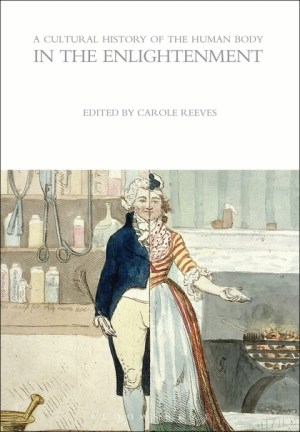 The Enlightenment, 1650–1800 was a time when people began to take stock of their intrinsic worth as individuals. Of course, slaves were still property, servants and apprentices were indentured, daughters ‘belonged’ to fathers and brothers, wives to husbands, and paupers were tethered to their parish. But change was in the air as increased population, migration and urbanization began to reshape both national and personal identity. The birth of modern society in the Enlightenment demanded a rethinking of the human body in all its forms, from conception to death and beyond. The history of midwives, medics, colonialists, cross-dressers, corpses, vampires, witches, beggars, beauties, body snatchers, incest and immaculate conceptions—all reveal how the body changed in this age of turbulence and transition.
A Cultural History of the Human Body in the Enlightenment presents an overview of the period with essays on the centrality of the human body in birth and death, health and disease, sexuality, beauty and concepts of the ideal, bodies marked by gender, race.
C O N T E N T S
Illustrations
Series Preface
Carole Reeves (University College London), Introduction: Enlightenment Bodies
1 Lisa Forman Cody (Claremont McKenna College), The Body in Birth and Death
2 Kevin Siena (Trent University), Pliable Bodies: The Moral Biology of Health and Disease
3 George Rousseau (Oxford University), Sexual Knowledge: Panspermist Jokes, Reproductive Technologies, and Virgin Births
4 Jessica Riskin (Stanford University), Medical Knowledge: The Adventures of Mr. Machine, with Morals
5 Ruth Richardson (University of Herfordshire), Popular Beliefs about the Dead Body
6 David M. Turner (Swansea University), The Body Beautiful
7 Laura Gowing (King’s College London), Marked Bodies and Social Meanings
8 Susan Staves (Brandeis University), The Puzzle of the Pox-Marked Body
9 Tim Hitchcock (University of Hertfordshire), Cultural Representations: Rogue Literature and the Reality of the Begging Body
10 Ruth Perry (Massachusetts Institute of Technology), Self and Society: Attitudes toward Incest in Popular Ballads
Notes
Bibliography
Contributors
Index
Exhibition | Checklist for Royal Spectacle

‘Cinquième journée. Feu d’artifice sur le Canal de Versailles (Fifth day. Fireworks on the canal of Versaille), engraved by Le Pautre in Les divertissemens de Versailles. Paris, de l’Imprimerie royale, 1676; Waddesdon, The Rothschild Collection (The National Trust). Bequest of James de Rothschild, 1957.
◊ ◊ ◊ ◊ ◊
A recent Enfilade posting (31 May 2014) introduced the Waddesdon Manor exhibition, Royal Spectacle. Since then, an especially impressive 45-page checklist has been added to the Waddesdon website. If notice of the exhibition at all piqued your curiosity, then it’s certainly worth returning to download the file. -CH
Royal Spectacle: Ceremonial and Festivities at the French Court
Waddesdon Manor, Buckinghamshire, 26 March — 26 October 2014
Curated by Selma Schwartz and Rachel Jacobs
The exhibition handlist for the exhibition at Waddesdon Manor, Royal Spectacle: Ceremonial and Festivities at the French Court is now available for download as a PDF file from the Waddesdon website. It includes short introductory essays for each of the sections (royal entrances, weddings, coronations, funerals, fireworks, etc.), an illustration of each of the 58 exhibited works, and their labels. The engravings, drawings, and manuscripts—many of extremely large formats, designed by celebrated artists and produced by some of the best engravers—are the only visual records of the extravagantly-staged spectacular but ephemeral events.
Lecture | Michael Twitty on The Cooking Gene
After hearing Michael Twitty at this year’s ASECS conference in Williamsburg, I’ve become a big fan. He speaks this evening at the Yale Center for British Art in conjunction with New Haven’s International Festival of Arts & Ideas (14–28 June 2014). -CH
From YCBA:
Michael Twitty | The Cooking Gene: Tracing My African Story Through Food
Yale Center for British Art, New Haven, 18 June 2014
 For African American culinary historian Michael W. Twitty, there was a hole in the history of American cooking as large as those in the stories of most African American families. Twitty traced his own family history along with that of Southern and American food using genetic research, historic interpretation, nature study, heirloom gardening, and interviews with contemporary food experts. His journey led him back to his family’s origins in West and Central Africa. Join him and grab a front-row seat in the debate over race and food in American life. This lecture is offered as part of the International Festival of Arts & Ideas.
◊ ◊ ◊ ◊ ◊
Toward the end of the month, and also in conjunction with the Festival of Arts & Ideas, YCBA will host the premiere of the film Visual Literacy: Rethinking the Role of Art in Education:
Visual Literacy: Rethinking the Role of Art in Education
Yale Center for British Art, New Haven, 28 June 2014
Please join us for the premiere screening of this thirty-five minute documentary. Produced by the Yale Center for British Art, the film focuses on the role art can play in teaching literacy and a unique partnership between the museum and local schools. The screening will be followed by a discussion with the film’s director Lisa Molomot and producer Cyra Levenson.
Visit artidea.org for more Festival information.
The Met Welcomes New Curator of The American Wing

Sylvia L. Yount,
Photo by David Stover for VMFA.
◊ ◊ ◊ ◊ ◊
Press release (11 June 2014) from The Met:
Thomas P. Campbell, Director and CEO of The Metropolitan Museum of Art, announced today that preeminent American art scholar Morrison H. Heckscher will retire on June 30, following 13 years as Lawrence A. Fleischman Chairman of The American Wing and a distinguished curatorial career at the Museum that spanned nearly five decades. He will become Curator Emeritus of The American Wing on July 1.
Mr. Campbell announced further that Sylvia L. Yount—currently Chief Curator as well as the Louise B. and J. Harwood Cochrane Curator of American Art and Department Head at the Virginia Museum of Fine Arts (VMFA)—will become the Lawrence A. Fleischman Curator in Charge of The American Wing this fall. She was elected to her new position at the June 10 meeting of the Executive Committee of the Museum’s Board of Trustees.
In making the announcement, Mr. Campbell said: “Morrie Heckscher has had a long and distinguished career at the Met with many landmark scholarly accomplishments. Perhaps the most significant has been his supervision of the decade-long renovation and reinstallation of the entire American Wing, which involved every aspect of our American art collection and every member of his superb staff. The new galleries, which opened in phases culminating with the inauguration of the American Paintings and Sculpture Galleries in 2012, have been a resounding success with millions of visitors to date. Through his exhibitions, acquisitions, lectures, and writings, Morrie has championed such important and diverse topics as architecture, landscape, and American furniture and interiors. I’m pleased that he will continue to share his expertise with the Museum as Curator Emeritus, working on various projects, including a book on the architectural and cultural history of the Met.”
Mr. Campbell continued: “I am also delighted that Sylvia Yount will join the Met to assume leadership of The American Wing this fall. She is a talented curator and energetic administrator who, for the past two decades, has applied scholarship and vision to organizing exhibitions, writing catalogues, and overseeing several important, extensive collections of American art that—like the Met’s—cover the colonial period through the early 20th century. With her wide-ranging background and special interest in 19th- and early-20th-century art, I am certain that Sylvia will lead the distinguished staff of the Wing to further accomplishments in the years to come.”
Morrison H. Heckscher
 Morrison H. Heckscher joined the Metropolitan Museum in 1966 as a Chester Dale Fellow in the Prints Department. From 1968 to 1978, he was an Assistant Curator, Associate Curator, and Curator in The American Wing; from 1978 to 1998, he was Curator of American Decorative Arts. In 1998, he was appointed the Anthony W. and Lulu C. Wang Curator of American Decorative Arts, and assumed chairmanship of The American Wing in 2001. As chairman, he conceived and initiated the redesign and reinstallation of the entire Wing.
During his first decade in The American Wing, Mr. Heckscher was involved in preparations for an extension to the Wing that opened in 1980. He planned and oversaw the rearrangement and reinstallation of the period rooms in the original 1924 American Wing. He also acquired late-19th- and early-20th-century architectural elements—notably the cast-iron staircases from Louis Sullivan’s 1893 Chicago Stock Exchange—and entire rooms (Shaker, Classic Revival, Gothic Revival, and Frank Lloyd Wright) that provide Museum visitors with an unparalleled means of experiencing and appreciating American domestic architecture and interior design.
The first two exhibitions he organized at the Metropolitan—In Quest of Comfort: The Easy Chair in America (1971) and An Architect and His Client: Frank Lloyd Wright and Francis W. Little (1973)—expressed Mr. Heckscher’s interest in both furniture and architecture. The latter exhibition was organized in conjunction with the landmark acquisition of a 1912–14 living room, including many original furnishings and accessories—designed by Wright for the Little family—that remains a cornerstone of the Museum’s collection of American period rooms. Mr. Heckscher researched and wrote the catalogue of the Museum’s late Colonial furniture, 1730–1790 (1985). He also acquired noteworthy examples of American furniture, such as a mahogany chest-on-chest made in 1778 by Thomas Townsend of Newport, Rhode Island, for the Gardiner family of Long Island, and a carved mahogany armchair made around 1765 by Thomas Affleck of Philadelphia for John Penn, one of the signers of the Declaration of Independence.

Now available digitally for free from The Met; click on the image for more information.
Mr. Heckscher has been the curator of a number of important exhibitions at the Metropolitan, including: The Architecture of Richard Morris Hunt (1986), American Rococo: Elegance in Ornament, 1750–1775 (with Leslie Greene Bowman, 1992), The Architecture of The Metropolitan Museum of Art (1995), Central Park–A Sesquicentennial Celebration (2003), and John Townsend, Newport Cabinetmaker (2005).
His recent awards include: Antique Dealers Association of America Award of Merit (2011); the Frederic E. Church Award (awarded jointly to Mr. Heckscher and Martha Stewart by The Olana Partnership, 2012); Lawrence A. Fleischman Award for Scholarly Excellence in the Field of American Art History (The Smithsonian Institution, Archives of American Art, 2012); and Iris Foundation Award for Outstanding Achievement in Scholarship (Bard Graduate Center, 2013).
He was educated at Wesleyan University (B.A.); The Winterthur Program in Early American Culture, University of Delaware (M.A.);
and Columbia University (Ph.D.).
Sylvia L. Yount
Prior to her seven-year tenure at the Virginia Museum of Fine Arts, Sylvia L. Yount was the Margaret and Terry Stent Curator of American Art and Department Head at the High Museum of Art in Atlanta from 2001 to 2007. She also served on the staff of the Pennsylvania Academy of the Fine Arts in Philadelphia as Curator of Collections (1993–99) and Chief Curator (1999–2001).
In addition to organizing landmark exhibitions on American modernism, Maxfield Parrish, and Cecilia Beaux at the Academy and the High, Ms. Yount has strengthened and diversified VMFA’s American holdings through purchases and gifts. She has also presented exhibitions of work by the Anglo-American printmaker Clare Leighton and the celebrated African American modernist Jacob Lawrence. Currently, she is organizing a reappraisal of the Colonial Revival phenomenon, Making America: Myth, Memory, Identity.
She has been the recipient of numerous grants and awards, primarily for research, exhibitions, and catalogues. In 2008, she was awarded the Victorian Society of America’s William E. Fischelis Award for the exhibition catalogue Cecilia Beaux, American Figure Painter.
Ms. Yount was educated at New York University (B.A.) and the University of Pennsylvania (M.A. and Ph.D.). Her dissertation was on the late-19th-century American Aesthetic Movement, New York art worlds, and consumer culture.
Exhibition | Making America: Myth, Memory, and Identity
Next fall at the VMFA:
Making America: Myth, Memory, and Identity
Virginia Museum of Fine Arts, Richmond, 12 September 2015 — 3 January 2016
Other venues to be announced
Making America will be the first full-scale multimedia investigation of America’s most enduring cultural phenomenon—the Colonial Revival. Featuring approximately 200 paintings, sculptures, works on paper, photographs, decorative arts, architectural and landscape designs, costumes, and popular culture ephemera—dating from the late 18th century to the present day—VMFA’s landmark exhibition expands the chronological and geographic boundaries of the regionally diverse, multicultural revival. More than just a style or movement, this ongoing hybrid impulse draws from the historical past to understand the present through the creative use of iconic forms and motifs. Making America will explore how and why this desire to revisit—and reinterpret—the past has shaped America’s visual landscapes, ideologies, and collective memories in times of celebration and crisis.
Making America, which will travel nationally, is organized by the curatorial team of University of Virginia Commonwealth Professor Dr. Richard Guy Wilson; Dr. Sylvia Yount, VMFA Chief Curator and Louise B. and J. Harwood Cochrane Curator of American Art; and her museum colleagues Dr. Susan J. Rawles, Assistant Curator of American Decorative Art, and Christopher Oliver, Assistant Curator of American Art, all of whom will contribute to the accompanying scholarly catalogue.
Exhibition | Rococo to Revolution: 18th-Century French Drawings

Jean-Baptiste Greuze, The Father’s Curse: The Ungrateful Son, ca. 1778
(Los Angeles: The J. Paul Getty Museum)
◊ ◊ ◊ ◊ ◊
From the press release (17 June 2014) for the upcoming exhibition:
Rococo to Revolution: 18th-Century French Drawings from Los Angeles Collections
J. Paul Getty Museum, Getty Center, Los Angeles, 1 July – 21 September 2014
Curated by Edouard Kopp
For nearly three-quarters of a century, from the death of Louis XIV in 1715 to the Revolution of 1789, France’s intellectual and artistic landscape flourished, reaching new levels of splendor and accomplishment. During this period, when inventiveness was greatly valued, drawing exemplified the creative impulse perhaps more than any other artistic medium. Through outstanding examples by of some of the period’s most acclaimed artists, the art of drawing is celebrated in Rococo to Revolution: 18th-century French Drawings from Los Angeles Collections, on view July 1–September 21, 2014 at the J. Paul Getty Museum, Getty Center. The exhibition includes more than 40 drawings from the J. Paul Getty Museum’s collection, complemented by works from distinguished private collections in Los Angeles.
“Drawing contributed to an aesthetic evolution in France, starting with the decorative exuberance of the Rococo, and gradually giving way to the austerity of Neoclassicism,” explains Timothy Potts, director of the J. Paul Getty Museum. “This exhibition tracks that evolution through the work of some of the finest artists of the 18th century, highlighting works in our collection alongside generous loans from local collections. We are fortunate and grateful to be able to exhibit these rarely-seen works.”
Featured in the exhibition is work by artists such as Jean-Antoine Watteau, François Boucher, Gabriel de Saint-Aubin, Henri-Pierre Danloux, Jean-Honoré Fragonard, Jean-Baptiste Greuze, and Jacques-Louis David, among others.

Jean- Antoine Watteau, Woman Seated with a Fan, c. 1717 (Los Angeles: J. P. Getty Museum)
“While drawing was most often used in preparation for paintings, prints, sculpture or architecture, many of the drawings created in that period were works of art in their own right,” explains Edouard Kopp, associate curator of drawings at the J. Paul Getty Museum. “Drawings were avidly collected at the time, as connoisseurs much appreciated the insights into the creative process that such works offered. This pursuit is continued with enthusiasm by the Getty Museum and private collectors in Los Angeles today.”
Indeed, artists during this period elevated drawing to new heights. In The Swing (late 1730s or early 1740s), François Boucher (French, 1703–1770) revives the pastoral genre, portraying figures at play on a log turned seesaw, with their elegant dress belying the country setting in typical Rococo fashion. Boucher shows a virtuosic command of black chalk, creating a wide array of marks from short flicks to zigzags. Among the most dazzling drawings in the exhibition is Two Studies of a Flutist and a Study of the Head of a Boy by Jean-Antoine Watteau (French, 1684–1721). Executed in a spontaneous yet highly sophisticated combination of red, black, and white chalk, the sheet evokes the flow of music and Watteau’s passion for it. A master of suggestion, the draftsman has captured the undulating, rhythmic motion of a flute player in two distinct poses, while a young observer appears to be listening intently, enraptured by the concert.
Some of the works in the exhibition reflect political leanings. Henri-Pierre Danloux (French, 1753–1809) was the most sought-after portraitist by the French aristocracy in the 1780s. In Portrait of a Young Lady in Profile (about 1783–85), Danloux’s skill is apparent in a remarkably lifelike depiction of a woman, her layers of soft curls and striped, ruffled dress rendered with loose black lines. Her parted lips demonstrate immediacy, rather than a static moment. An outspoken rival of the royalist Danloux, Jacques-Louis David (French, 1748–1825) created Portrait of Andre-Antoine Bernard, called Bernard de Saintes (1795) while imprisoned for revolutionary activities. The portrait is a bust-length profile in a medallion format that recalls ancient coins. However, David undermined the classical association with that genre by depicting the sitter crossing his arms defiantly and wearing a distinctive hat and an intense expression that identified him as a revolutionary.
Family drama was also a popular theme in the later 1700s. One of the greatest draftsmen of all time, Jean-Honoré Fragonard (French, 1732–1806) evokes the frenzied joy of family life in Making Beignets (about 1782). Fragonard is able to turn the simple act of making sweets into a celebration, as a roiling mound of forms and faces are imbued with energy using a flurry of rapid-fire graphite lines, a warm brown wash, and the luminous quality of the paper itself. In Jean-Baptiste Greuze’s (French, 1725–1805) The Father’s Curse: The Ungrateful Son (about 1778), a scene of violent family discord is handled with a degree of seriousness and theatricality normally reserved for grand historical subjects: the artist indeed creates dramatic figural poses and strong contrasts of light and shadow.
Conversely, the revolutionary sentiment at the time was slyly referenced in ancient scenes by David such as The Lictors Bringing Brutus the Bodies of His Sons (1787). David illustrates the story of Roman consul Lucius Junius Brutus, who, upon hearing that his sons have conspired to overthrow his government, orders them executed for treason. David chooses the moment when Brutus is presented with their bodies, his own figure placed in the dark foreground. This drawing conveys a sense of struggle between patriotic duty and familial loyalty, which David intended to be morally edifying for the public, not long before France entered years of political turmoil.
Rococo to Revolution: 18th-Century French Drawings from Los Angeles Collections, is on view July 1–September 21, 2014 at the J. Paul Getty Museum, Getty Center. The exhibition is curated by Edouard Kopp, associate curator of drawings at the J. Paul Getty Museum.
For related events see the full press release…Study Day | Josephine and the Empire of Fashion
From H-ArtHist:
Joséphine et l’Empire de la Mode
Archives Nationales Hôtel Soubise, Paris, 24 June 2014
Marie-Joseph-Rose de Tascher de la Pagerie, impératrice des Français sous le nom de Joséphine, est née aux Trois-Ilets en Martinique le 23 juin 1763, et décédée au château de Malmaison le 29 mai 1814. L’année 2014 célèbre Joséphine au titre des commémorations nationales. Deux grandes expositions lui sont consacrées, Joséphine au musée du Luxembourg à Paris, et Joséphine, la passion des fleurs et des oiseaux au musée national du château de Malmaison. L’inventaire fait après le décès de Joséphine comprend celui d’une importante garde-robe, dont le château de Malmaison conserve quelques témoignages. C’est à propos des choix textiles, du goût et du style de Joséphine que s’articule la journée d’étude Joséphine et l’Empire de la mode, initiée par l’association ART & LUXE.
Sur inscription dans la limite des places disponibles par courriel à l’adresse suivante: Art-luxe@live.fr
◊ ◊ ◊ ◊ ◊
P R O G R A M M E
13:30 Accueil
14:00 Corinne Thépaut-Cabasset (historienne de la mode, Paris), L’image de la mode dans la presse : Le ‘costume parisien’, 1800–1815
14:30 Alain Pougetoux (conservateur en chef, domaine national des châteaux de Malmaison et Bois-Préau), La boutique à paris sous le Premier empire
15:00 Céline Meunier (conservateur en chef, Domaine national des châteaux de Malmaison et Bois-Préau), Joséphine : en quête d’une garde-robe
15:30 Fiona Ffoulkes (Université de Southampton, professeur associé Université des arts de Bournemouth et université américaine, Paris) Muse, cliente et amie ? L’importance de la relation de l’impératrice Joséphine avec Leroy, marchand de modes
16:00 Marguerite Coppens (Chef de département, Musées royaux d’art et d’histoire, Bruxelles), Les commandes dentellières de la maison impériale
16:30 Carole Damour (archiviste textile, Société Tassinari & Chatel, Paris), Des palais impériaux au château de la Malmaison : Les choix textiles de Joséphine
17:00 Discussion
Conference | George I 300 Years On
From the conference website:
George I 300 Years On: Reconstructing the Succession
Bath Royal Literary and Scientific Institution, 18–20 June 2014
This interdisciplinary conference takes the theme of the accession of the first Hanoverian king, George I. It will examine not just the end of the Stuart era, but the defining characteristics, outcomes and consequences the Hanoverian succession.
W E D N E S D A Y , 1 8 J U N E 2 0 1 4
2:00 Registration and afternoon tea
Welcome from Elaine Chalus (Bath Spa University), Nichola Hayton (Mannheim Universität), and Stefano Weinberger (Cultural Attaché for the German Embassy in London)
3:45 Opening Plenary, Dominic Aidan Bellenger (Abbot of Downside Abbey), George I and the Catholics
Drinks reception; delegates may wish to visit the Georgian exhibition at the Fashion Museum or take a walking tour of Bath.
7:30 Conference Dinner
T H U R S D A Y , 1 9 J U N E 2 0 1 4
9:00 Tea and coffee
9:30 Panel I, chaired by Elaine Chalus
• Ruth Paley (History of Parliament), Seditious Libel in the Last Years of Anne
• Robin Eagles (History of Parliament), The Duke of Shrewsbury and the Politics of Succession in the Last Days of Anne
• Matthew Kilburn (History of Parliament), The Missing Queen
11:00 Tea and coffee
11:30 Panel II, charied by Kevin Grieves
• Mark Walker (University of Essex), The Bittersweet Death of Queen Anne, 1714
• Noel Cox (Aberystwyth University), The Law of Succession
• Heike Bormuth (Universität Mannheim), From Georg Ludwig to George I: An Absolutistic Elector in the English Parliamentary Monarchy. The Settling in of the Hanoverian Dynasty
• Richard Johns (University of York), ‘A New Breed of Men’: George I and his Progeny at Greenwich
1:30 Lunch
3:00 Panel III Postgraduate Panel, chaired by Georgina Moore
• James Camp (Bath Spa University), By Royal appointment: Bath and the Reception of Royalty, 1660–1714
• Kate James (Bath Spa University), Newton Park and the Country House in Transition
• Kelly Yates (University of Manchester), Jeffrey the Jacobite Poltergeist
F R I D A Y , 2 0 J U N E 2 0 1 4
9:30 Tea and coffee
10.00 Panel IV, chaired by Andrew Thompson
• James Caudle (Yale University), A Revolution in Political Broadcasting: The Political Sermon in the Hanoverian Revolution, 1714–16
• Ralph Stevens (Fitzwilliam College, University of Cambridge), ‘King George’s Religion’: The Religious Politics of the Hanoverian Succession
• James Lees, Schism, Succession: Chaplains of George Augustus and Caroline as Prince and Princess of Wales, 1714–27
11:30 Tea and coffee
12:00 Panel V, chaired by Arnd Reitemeier
• Kevin Grieves (Bath Spa University), The London Press and the Succession
• Stewart Tolley (University of London), A Popular Rail? Press and Public Interest in George I’s Ministers, 1714–27
• Benjamin Bühring (Göttingen University), An Expatriate Community: The London German Court of George I
1:30 Lunch
2:45 Panel VI, chaired by Jackie Collier
• Philip Loft (University of London), Parliament, Petitioning, and the Public, 1714–20
• Pauline Chakmakjian (Independent Scholar), A Sociable King: George I and the Rise of Speculative Freemasonry
• Nigel Aston (University of Leicester), A Mixed Ministry? The Tories in government, 1714–16
4:45 Closing Plenary, Clarissa Campbell Orr (Anglia Ruskin University), Life and Culture at Court in England and Hanover: An Anglo-German Comparison










 Enfilade
leave a comment