The Huntington Acquires Fuseli’s The Three Witches

Henry Fuseli, The Three Witches or The Weird Sisters, ca. 1782, oil on canvas, 25 x 30 inches (San Marino: The Huntington Library, Art Collections, and Botanical Gardens)
◊ ◊ ◊ ◊ ◊
Press release (7 October 2014) from The Huntington:
The Huntington Library, Art Collections, and Botanical Gardens announced today the acquisition of one of the best-known compositions by the Anglo-Swiss painter Henry Fuseli (1741–1825). In private hands since its creation around 1782, The Huntington’s version of Fuseli’s The Three Witches or The Weird Sisters appears to be a finished, full-size study, presumably made before the two other known full-size, final versions Fuseli made of the subjects. These are in the collections of the Kunsthaus Zurich, and the Royal Shakespeare Company, Stratford-upon-Avon, England. After months of conservation treatment at The Huntington, the new acquisition will go on public view for the first time on October 11 in the Huntington Art Gallery.
“Given the fame of The Huntington’s collection of 18th-century British paintings, it may come as a surprise that we did not already have a painting by Henry Fuseli—one of the most celebrated, notorious, and inventive artists of the period,” said Kevin Salatino, Hannah and Russel Kully Director of the Art Collections at The Huntington. “Finally we do, and a great one, a picture full of mystery and suspense. Its powerful composition packs an incredible punch, second in impact only to the artist’s famous painting The Nightmare at the Detroit Institute of Arts, which is from the same period. The acquisition of The Three Witches now fills a major gap in our collection.”
Acquiring a Fuseli has been a longstanding goal at The Huntington, as the finest examples of his work rarely appear for sale. Catherine Hess, chief curator of European art at The Huntington, said that Fuseli’s work has been sought not only because of his importance to the history of art, but also because of his relationships with Sir Joshua Reynolds and, especially, William Blake, both of whom are well represented in Huntington collections. Also, Fuseli’s fascination with the work of William Shakespeare dovetails with The Huntington’s stature as one of the premiere collections of early Shakespeare folios and quartos in the world. The Three Witches reveals a great deal about how the artist worked, said Hess. “Its surface is thickly textured with paint, and the strokes are varied and energetic, betraying a freedom and immediacy that shows Fuseli at his most experimental and expressive.” The painting depicts the pivotal moment in Shakespeare’s tragedy Macbeth (act 1, scene 3) when the protagonist encounters the demonic trio who foretell his fate.
“Fuseli revels in the play’s ominous mood, isolating and tripling the motif of hooded head, extended hand, and sealed lips,” said Hess. The witches’ mannish features are taken directly from the playwright’s description: “… you should be women, And yet your beards forbid me to interpret / That you are so.” They may also have been modeled on the male actors who would have played them on stage in Fuseli’s day.
The Huntington’s painting includes a gilded frame (likely added by early owners) with a quote from Aeschylus’ ancient tragedy, The Eumenides: “These are women but I call them Gorgons.” The quote also appears written on the reverse of the painting and was almost certainly provided by Fuseli, who prided himself on his erudition.
◊ ◊ ◊ ◊ ◊
R E L A T E D I N S T A L L A T I O N S
Wrestling with Demons: Fantasy and Horror in European Prints and Drawings from The Huntington’s Art Collections
The Huntington Art Gallery, San Marino, CA, 30 August — 15 December 2014
This focused exhibition explores the darker side of the imagination through a variety of works on paper depicting death, witchcraft, and the demonic in European art. In this group of 15 works spanning the 16th to the 19th centuries, artists such as Albrecht Dürer, Jan Lievens, Francisco de Goya, and William Holman Hunt tap into human fascination with the macabre in works of art that demonstrate our attempt to wrestle with the unknown.
Eccentric Visions: Drawings by Henry Fuseli, William Blake, and Their Contemporaries
The Huntington Art Gallery, San Marino, CA, 22 November 2014 — 16 March 2015
In an age of great drawing, Anglo-Swiss painter Henry Fuseli (1741–1825) and his circle in Britain helped to push the medium into new areas of expressiveness, invention, and boldness of conception. This small exhibition consists of about 30 works from The Huntington’s exceptional holdings of drawings and watercolors by Fuseli, William Blake, and the artists most closely associated with them, including George Romney, John Flaxman, Joseph Wright of Derby, James Barry, John Brown, and Richard Cosway. It complements the installation of The Huntington’s newly acquired painting by Fuseli, The Three Witches.
Exhibition | Sade: Marquis of Shadows, Prince of the Enlightenment
To the d’Orsay’s exhibition on the Marquis de Sade we can add this one now on view at the Institut des Lettres et Manuscrits:
Sade: Marquis of Shadows, Prince of the Enlightenment
The Spectrum of Libertinism from the 16th to the 20th Century
Institut des Lettres et Manuscrits, Paris, 26 September 2014 — 18 January 2015
Curated by Pascal Fulacher and Jean-Pierre Guéno
Yes, I am a libertine, I admit it freely. I have dreamed of doing everything that it is possible to dream of in that line. But I have certainly not done all the things I have dreamt of and never shall. Libertine I may be, but I am not a criminal, I am not a murderer. –Donatien Alphonse François de Sade
Sade and the Spectrum of Libertinism
Donatien Alphonse François de Sade was doubly a man of letters: a great novelist, a great letter writer, but above all a victim of the very special letters that were the lettres de cachet, often commissioned from monarchs or their ministers by the families of those who wanted to have troublesome offspring removed from the public sphere. Even more than the Marquis of Shadows, even more than his escapades and fantasies of debauchery, it was the Prince of the Enlightenment who never ceased to embarrass both his family, who continually persecuted him, his social caste, and the leading figures of his time, to the point where this troublemaker became a kind of literary man in an iron mask who spent more than half his adult life in prison before dying there. Apart from the fact that he was sentenced to life imprisonment in 1768, and twice to death in 1772 and in 1794, De Sade spent nearly twenty-eight years in prison between 1763 and 1814, between the age of 23 and his death at age 74, and this under three different regimes: the Monarchy, the Republic and the Empire. From the tower at Vincennes to Charenton insane asylum, despite the material means he had to improve his everyday life, he lived mostly in “execrable slums,” in a dozen jails including those of Saumur castle, Pierre-Encise citadel in Lyon, For-l’Eveque prison in Paris, Miolans fort in Savoy, the Bastille fortress, Sainte-Pélagie prison and Bicêtre prison in Paris, not forgetting the gaols of the Revolution. During the seventy-four years and six months of his life as in the two centuries that separate us from his death, it may seem paradoxical that we have demonised the Marquis de Sade to such an extent, and that we have for so long mixed the man with his work, to the point of confusing the man and the novelist with the criminal characters in his fiction.
 Certainly he was a libertine who indulged in licentious and dissolute sexual practices, but the man who lent his name to today’s definition of the word Sadism, “the tendency to derive pleasure from physical or emotional pain intentionally inflicted on others” would have been just one more profligate among the aristocrats of his time, had he not been primarily the eye of a kind of consciousness that managed to convey not just the pain of living, but the “pain of the century” (“mal du siècle”) as defined by Musset in the 19th century: through his escapades and provocations, then through his political writings, as through his philosophical writings, letters and novels, but also by example, or by the counterexample of his life, did Sade ever cease to express the evil that devours men, mostly from the Renaissance to modern times, that is to say, during the second half of the second millennium?
For the last four centuries, are those who call themselves libertines actually Epicureans, delinquents or hyper-aware individuals? Bon vivants, criminals or cursed existentialists? From the Marquis de Sade to Dominique Aury (aka Pauline Réage), author of Histoire d’O (The Story of O), to Théophile de Viau, Crébillon, Choderlos de Laclos and his Liaisons Dangereuses (Dangerous Liaisons), Mirabeau, Casanova, the Chevalier d’Eon, Musset, Maupassant, Baudelaire, Rimbaud, Verlaine, Pierre Louÿs and Joë Bousquet, the great figures of literature, poetry and thought have never ceased to celebrate the cannibalistic wedding of vice and virtue. Vice that feeds on virtue when it transgresses and deflowers it. Virtue that feeds on vice when it denounces and demonises it.
At the boundaries of fantasy, revolution, transgression, emancipation and moral suicide, between the realities of purgatory, the fantasised or dreaded delights of hell and the mythical nostalgia for paradise lost, between cynicism, pragmatism and hope, between Epicureanism and cruelty, between enlightenment and barbarism, between the obsession with God and its denial, do the case studies that adorn the spectrum of libertinism not illustrate the entire tragedy of the human condition, and do they not resemble in this respect all the major intellectual earthquakes of the 19th and 20th centuries, from romanticism to existentialism through surrealism?
The Exhibition
 Long before becoming a moral emancipation movement, libertinism was a terribly subversive spiritual liberation movement, since it questioned the existence of God, the legitimacy of kings’ rule by divine right, and all the dogmas of religion, morals and absolute power. From the outset, the exhibition reveals “The spectrum of libertinism,” leading the visitor from “libertinism of the spirit to libertinism of morals” through a set of subversive texts including the Decameron by Boccaccio, Pensées (Thoughts) by Pascal, Dom Juan by Molière, Contes et nouvelles (Tales and Novels) by La Fontaine, Les Lettres persanes (Persian Letters) by Montesquieu and La Nouvelle Héloïse (The New Heloise) by J.-J. Rousseau. Libertinage in the time of De Sade is also discussed in the letters and works of Crébillon, Casanova, the Chevalier d’Eon, Restif de la Bretonne, Choderlos de Laclos, Mirabeau and more.
Then, pride of place is given to the Marquis de Sade and his masterpiece, Les 120 journées de Sodome ou l’École du libertinage (The 120 Days of Sodom, of the School of Libertinism): the handwritten scroll on which this still-scandalous novel was written is on display here for the first time ever in France. Several letters by De Sade, to his wife, his mother-in-law, his lawyer, an actress, etc. are also displayed around the scroll, and give a better understanding of this enigmatic and highly controversial figure.
The last two parts of the exhibition shed light on the rehabilitation of the Marquis de Sade and his work, as well as the development of libertinism in the 19th and 20th centuries, from romanticism to surrealism through existentialism. The exhibition Sade: Marquis de l’ombre, prince des Lumières, L’éventail des libertinages du XVIe au XXe siècle also features over 120 exceptional pieces, letters and autograph manuscripts, first editions and rare, valuable illustrated books, drawings, photographs, etc.
◊ ◊ ◊ ◊ ◊
From Flammarion:
Gonzague Saint Bris and Marie-Claire Doumerg-Grellier, Sade: Marquis de L’Ombre, Prince des Lumières, L’Eventail des Libertinages (Paris: Flammarion, 2014), 176 pages, ISBN: 978-2081353817, 29€.
Consacré à l’histoire du libertinage, cet album en lien avec l’exposition du même titre, rassemble et présente lettres, manuscrits, livres rares et précieux, portraits et dessins érotiques consacrés aux «Cent vingt journées de Sodome» du marquis de Sade.
Exceptions and the Market
It’s a point I try to make with my students: art historical narratives at the introductory level (perhaps within the field generally) are built around exceptional works—pieces, for instance, that are especially well executed, can boast a remarkable provenance, or mark a shift in style (if all three, then so much the better). Quality distinctions carry important market implications, too; and as Scott Reyburn reports for The New York Times, demand for lower- and mid-level priced antiques remains low, in contrast to the market for rare items—exemplified by the September sale of a ca. 1720 writing table by André-Charles Boulle, which sold for 3.15million USD, well beyond its estimate. –CH
From the article:
Scott Reyburn, “A Shift in the Antiques Market,” The New York Times (3 October 2014).
So the question on many collectors’ minds now is just how low can the price of period English furniture go? The British-based Antique Collectors’ Club’s Annual Furniture Index (AFI), based on a mix of auction and retail prices of 1,400 typical items, fell by 6 percent to 2,238 in 2013. The index has been on a slide for more than a decade after reaching a peak of 3,575 in 2002.
“For nice furnishing things, prices are as low as I can remember,” said Paul Beedham, an early oak specialist dealer in Derbyshire. “The professional classes who used to buy just don’t have the money any more. They’re struggling to pay their mortgages and car loans.”
The full article is available here»
Journée d’étude | Madame de Pompadour et l’art de la toilette
As noted at Histoire de Mode with details from the preliminary programme:
Madame de Pompadour et l’Art de la Toilette
Archives Nationales de France, Hôtel Soubise, Paris, 7 October 2014
L’association ART & LUXE prépare le nouvel évènement consacré à l’histoire du design, de la mode et du luxe, ainsi qu’à celle de ses métiers. Mardi 7 octobre 2014, à l’hôtel Soubise, rue des Francs Bourgeois à Paris, aura lieu à partir de 14.30 une nouvelle demie-journée d’étude consacrée à Madame de Pompadour, sur le thème de l’art de la toilette. Participation aux frais : 5 euros. Inscription préalable dans la limite des places disponibles à Association ART & LUXE 38 Boulevard Henri IV 75004 Paris, Art-luxe@live.fr.
P R O G R A M M E
14.00 Accueil
14.30 Lesley Ellis Miller (Victoria and Albert Museum, Londres), Trois portraits pour trois garde-robes de la marquise de Pompadour
15.00 Corinne Thépaut-Cabasset (Paris), Objets de modes et de toilette achetés pour madame de Pompadour chez Lazare-Duvaux rue Saint-Honoré à Paris
15.30 Georgina Letourmy-Bordier (Le Cercle de l’Eventail, Paris), D’or et de vent, la mode de l’éventail sous Louis XV
16.00 HERA Fashioning the Early Modern, Object in Focus : La « mouche » ou le matin
16.30 Discussion
17.00 Arlette Vermeiren Zucoli (Tournai), Installation éphémère dans le Grand Salon Ovale de l’appartement du prince de Soubise
Conference | Neoclassical Reverberations of Discovering Antiquity
As noted at H-ArtHist; abstracts are available here.
Neoclassical Reverberations of Discovering Antiquity
Archivio di Stato, Turin, 6–9 October 2014
Twelfth Conference of the ICTM Study Group for the Iconography of the Performing Arts, Istituto per i Beni Musicali in Piemonte
M O N D A Y , 6 O C T O B E R 2 0 1 4
9.30 Registration
10.00 Welcome and Introduction
10.30 Frame Session
Chair: Cristina Santarelli (Istituto per i Beni Musicali in Piemonte, Torino)
• Christian Greco (Museo Egizio, Torino), The Role Played by Turin in the Field of Aegyptological Research
• Zdravko Blažeković (Research Center for Music Iconography, The Graduate Center, CUNY), Ancient Organology before and after Herculaneum
• Paola d’Alconzo (Università “Federico II”, Napoli), Facing Antiquity Departure and Return: Naples in the Eighteenth Century
• Michela Costantini (Torino), Common Antiquarian Interests Found in the Epistolary Exchanges between the Architect and Piedmontese Erudite Francesco Ottavio Magnocavalli and Members of the Roman Arcadia in the Middle of the Eighteenth Century: The Case of the Ancient Theater of Herculaneum
13.00 Lunch
15.00 Neoclassicism in European Painting, Sculpture and Applied Arts, Part I
Chair: Nicoletta Guidobaldi (Università di Bologna, Dipartimento di Beni Culturali, Ravenna)
• Jordi Ballester Gibert (Universitat Autònoma de Barcelona), Music and Poetics of Ancient Rome in the Work of the Spanish Painter Mariano Fortuny (1838–1874)
• Daniela Castaldo (University of Salento, Lecce), Ancient Music in Paintings of Lawrence Alma-Tadema (1836–1912)
• Cristina Santarelli (Istituto per i Beni Musicali in Piemonte, Torino), From A Musician to The Quartet: Albert Moore (1841–1893) between Classicism and Aesthetic Movement
• Alexandra Voutrya (Aristotle University, Thessaloniki), Ingres, Apollo, Mozart and Music
• María Isabel Rodríguez López (Universidad Complutense de Madrid), Chant and Enchantments: Iconography of Orpheus, from Gluck to Moreau
• Elena Le Barbier Ramos (Universidad de Oviedo), Ancient Musical Iconography in Neoclassical Painting
T U E S D A Y , 7 O C T O B E R 2 0 1 4
9.30 Neoclassicism in European Painting, Sculpture and Applied Arts, Part II
Chair: Daniela Castaldo (Università del Salento, Lecce)
• Anna Maria Ioannoni Fiore (Conservatorio Statale di Musica “L. D’Annunzio”, Pescara), Neoclassical Influences in the Depiction of Landscapes on Castelli Maioliche: The Ethical Value of Music among Myths and Ancient Ruins
• Nicoletta Guidebaldi (Università di Bologna Dipartimento di Beni Culturali, Ravenna), Rediscovering Antiquity and Musical Myths in Felice Giani’s Pictorial Cycles in Faenza
• Esma Sulejmanagic (Muzi?ka akademija, Sarajevo), Music Iconography on Numismatic Products of Antiquity and the Nineteenth Century: Antique Musical Practice and Neoclassical Musical Symbolism
11.00 Coffee
11.30 Keynote Address by Elena Barassi (Università di Pavia, sede di Cremona), Iconography of Iconography: Dance in Ancient Roman Representations, Canova’s Works and Reproductions in Engraving
1.00 Lunch
15.00 Neoclassicism in European Painting, Sculpture and Applied Arts, Part III
Chair: Jordi Ballester Gibert (Universitàt Autònoma de Barcelona)
• Licia Mari (Università Cattolica del Sacro Cuore, Brescia & Archivio Storico Diocesano, Mantova), Saints, Myths, Allegories in the Scenographic Frescos by Giorgio Anselmi
• Carlo Fiore (Conservatorio di Musica ‘Vincenzo Bellini’, Palermo) and Floriana Tessitore (Teatro Massimo, Palermo), The Teatro Massimo in Palermo between Modernism and Neoclassicism
• Luis Correia de Sousa and Luzia Valeiro Rocha (Centro de Estudos de Sociologia e Estética Musical, Universidade Nova de Lisboa), New Fashions, Old Models: The Antiquity Charm in Portuguese Musical
Neoclassicism
16.30 Coffee
17.00 Free Papers
• Emma Petrosyan (Institute of Archaeology and Ethnography, Armenian National Academy of Sciences, Yerevan), Music and Dance in Statues and Gemmes from Artashat
• Maryam Dolati Fard (Tehran), The Relationship Between Text and Music in Persian Manuscripts: Ilkhanid to Safavid Era, Images of Oud Player
W E D N E S D A Y , 8 O C T O B E R 2 0 1 4
9:30 Neoclassical Attitudes in Operatic Stage, Part I
Chair: Maria Teresa Arfini (Università della Valle d’Aosta)
• Diana Blichmann (Roma), The Temple of Jupiter Statore in La Clemenza di Tito of Pietro Metastasio and Giovanni Carlo Galli Bibiena
• Maria Ida Biggi (Fondazione Cini / Università “Ca’ Foscari”, Venezia), Borsato, Bagnara and Basoli: Archaelogical References and Reverberations on the Venetian and Bolognese Neoclassical Stage
• Gabriella Olivero (Torino), The “New” Babylon by Alessandro Sanquirico
11.00 Coffee
11.30 Keynote address by Mercedes Viale Ferrero (Torino), The Last Day of Pompeii as Imagined by Alessandro Sanquirico, or: How to Rebuild Pompeii in Order to Destroy It
13.00 Lunch
15.00 Neoclassical Attitudes in Operatic Stage, Part II
Chair: Maria Ida Biggi (Fondazione Cini /Università Ca’ Foscari, Venezia)
• Inna Naroditskaya (Northwestern University), Elizaveta of Russia – A Euro-Asian Princess and Heir of Roman Augustus: A Spectacle of Coronation and Imperial Opera
• Dario de Cicco (Conservatorio Statale di Musica “Giuseppe Verdi”, Torino / Université de Genève), Verdi and the Egyptian Culture between Anegdots, Epistolar Sources and Imagination
• Donatella Melini (Fondazione “Antonio Carlo Monzino”, Milano), “Or che i Numi son vinti, a me la cetra, A me l’altar!”: Stories and Iconographies about the Lyra Made for Arrigo Boito’s Nerone
• Timothy Flynn (Olivet College, MI), Classical Reverberations in the Music and Life of Camille Saint-Saëns (1835–1921)
T H U R S D A Y , 9 O C T O B E R 2 0 1 4
9.30 Neoclassical Attitudes in Operatic Stage, Part III
Chair: Jordi Ballester Gibert (Universitàt Autònoma de Barcelona)
• Sanna Litti (Hyvinkää, Finland), Heroism in Gasparo Spontini’s Opera La Vestale
• Maria Teresa Arfini (Università della Valle d’Aosta), Around Antigone: Reflections on Iconography and Music in the German Revival of the Classical Tragedy
• Maia Sigua (Tbilisi State Conservatory), The Concept of Tragedy after Aristotle and Daphne by Richard Strauss
11.00 Coffee
11.30 Antiquaria: Documents and Testimonies through the Ages
Chair: Maria Teresa Arfini (Università della Valle d’Aosta)
• John McKay (University of South Carolina, School of Music), Roles for Musical Curiosities in Kircher’s Antiquarian Visions
• Stefania Macioce (Università “La Sapienza”, Roma), Apollo: Figurative Variations of a Neoclassical Ideal
• Francesca Cannella (Università del Salento, Lecce), «Gli eroi della storia favolosa e le invenzioni per essi nobilitate»: The Myth of the Argonauts between Musical Iconography and Literary Invention of the Modern Age
13.00 Lunch
15.00 Musical Impressions from the Grand Tour
Chair: Alexandra Voutyra (Aristotle University, Thessaloniki)
• Siegwart Reichwald (Petrie School of Music, Converse College, Spartanburg, SC), Eyes Wide Open: The Compositional Impact of Mendelssohn’s Artistic and Religious Grand Tour Experiences
• Sylvain Perrot (French School at Athens), Musical Impressions in Views of Greece during the Nineteenth Century
• María Jesús Fernández Sinde (Universidad Complutense de Madrid), Music Dreaming: Iconographic Sources from Spanish Painters? Recreation of Identities and Grand Tours
Terra Foundation Research Travel Grants to the U.S.
Terra Foundation Research Travel Grants to the United States
Applications due by 15 January 2015
The Terra Foundation offers Research Travel Grants to enable scholars outside the United States to consult resources that are only available within the United States. These grants provide support for research on topics concerning American art and visual culture prior to 1980. Grant funding is available for short-term travel (3 months maximum) that gives scholars:
• an opportunity to discover new source material
• experience works of art first-hand in museums and private collections
• consult local archives and library collections
• establish professional networks for future research
Funds can be used for related transportation, lodging, meals, and research fees and expenses. They cannot be used for the purchase of computers or other equipment. The foundation accepts proposals from only doctoral students and postdoctoral and senior scholars outside the United States. Please visit our website for eligibility and grant requirements, application form, and information about funding.
Exhibition | Sade: Attacking the Sun
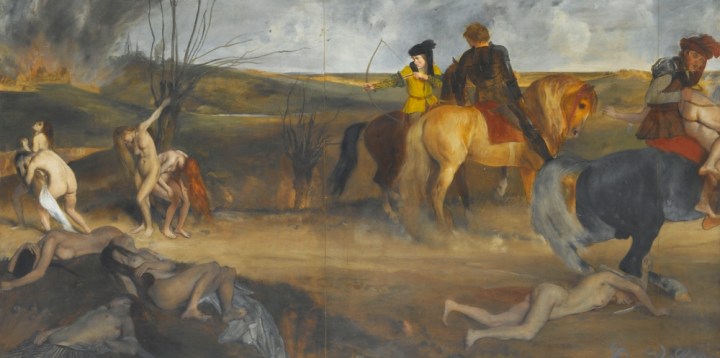
Edgar Degas, Scène de guerre au Moyen-âge, 1865
(Paris, Musée d’Orsay, RF 2208)
◊ ◊ ◊ ◊ ◊
From the d’Orsay:
Sade: Attacking the Sun / Attaquer le soleil
Musée d’Orsay, Paris, 14 October 2014 — 25 January 2015
Curated by Annie Le Brun, Laurence des Cars, and Leila Jarbouaï
Alphonse Donatien de Sade (1740–1814) completely transformed the history of both literature and the arts, first as an underground writer, and later by becoming a veritable legend in his lifetime. Following the analysis of the writer Annie Le Brun, a specialist of de Sade, the exhibition will be focusing on the revolution of representation opened up by the author’s writings. Topics addressed will be the ferocity and singularity of desire, deviation, extremes, the weird and the monstrous, desire as a principle of excess and imaginary recomposition of the world, through works by Goya, Gericault, Ingres, Rops, Rodin, Picasso…
The press release (as a PDF file in French) is available here»
◊ ◊ ◊ ◊ ◊
From Gallimard:
Annie Le Brun, Sade: Attaquer le Soleil (Paris: Éditions Gallimard, 2014), 336 pages, ISBN: 978-2070146826, 45€.
 Le propos de cet ouvrage est de montrer comment, avant d’avoir une importance majeure dans la pensée du XXe siècle, l’oeuvre du marquis de Sade a induit une part de la sensibilité du XIXe siècle, quand bien même le personnage et ses idées y auront-ils été tenus pour maudits. Car si Baudelaire, Flaubert, Huysmans, Swinburne, Mirbeau…, sans parler d’Apollinaire, s’y sont référés à titres divers, tout porte à croire que la force de cette pensée est aussi d’avoir rencontré, révélé, voire provoqué ce qui agite alors en profondeur l’expression plastique, concernant autant l’inscription du désir que son pouvoir de métamorphose. C’est l’image du corps en train d’être bouleversée de l’intérieur, annonçant une révolution de la représentation. Que ce soit évident chez Delacroix, Moreau, Böcklin…, ce qui est en jeu n’est pas sans inquiéter aussi Ingres, Degas ou Cézanne et bien sûr Picasso… Et cela tandis que Félicien Rops, Odilon Redon, Alfred Kubin se rapprochent d’une expression restée jusqu’alors marginale (curiosa ou folie), avant que le surréalisme, se réclamant de Sade, ne reconnaisse le désir comme grand inventeur de forme. A retrouver ce cheminement, il sera possible de mesurer combien à dire ce qu’on ne veut pas voir, Sade aura incité à montrer ce qu’on ne peut pas dire. Ou comment le XIXe siècle s’est fait le conducteur d’une pensée qui, incitant à découvrir l’imaginaire du corps, va amener à la première conscience physique de l’infini.
Annie Le Brun, commissaire général de l’exposition, auteur notamment, chez Gallimard, de Soudain un bloc d’abîme, Sade (1986), On n’enchaîne pas les volcans (2006), Si rien avait une forme, ce serait cela (2010), et Les arcs-en-ciel du noir : Victor Hugo (2012).
Exhibition | The Kama-Sutra: Spirituality and Eroticism in Indian Art
Though thematic rather than chronologically-based, the exhibition seems to include a substantial number of eighteenth-century objects, with some attention to the Western reception of the Kama-Sutra. From the Pinacothèque de Paris:
Le Kâma-Sûtra: Spiritualité et érotisme dans l’art indien
Pinacothèque de Paris, 2 October 2014 — 11 January 2015
Curated by Alka Pande and Marc Restellini

Acrobatic couple, Tamil Nadu; late 18th or early 19th century, carving on wood, 91 x 49 x 14.5 cm
(Collection of Michel Sabatier, La Rochelle)
For its Autumn-Winter season 2014–15, the Pinacothèque de Paris will put on an unusual exhibition: The Kama-Sutra: Spirituality and Erotism in Indian Art. Attributed to a Brahman who might have written it in the 4th century of our era, the Kama-Sutra makes up one of the major texts of medieval Hinduism and is not a pornographic book, as it is often described in the Western world. It is divided up into seven sections (adhikarana): society, social concepts, sexual union, as regards the spouse, as regards extra-marital relationships, as regards courtesans, as regards the arts of seduction.
Around 330 outstanding works including those of Shriji Arvind Singh Mewar, maharana of Udaipur and the remarkable collection of Beroze and Michel Sabatier—sculptures, paintings, miniatures, objects of daily life, and ‘pillow books’, illustrated works that were offered to the newlyweds until the 19th century in order to give them an erotic education—organized according to the seven sections of the Kama-Sutra, will be exhibited in the Pinacothèque de Paris. The exhibition, unadvised for minors, will explain the erotic aesthetics specific to the erotic aesthetics of Indian cultural life and to Hinduism. It will also attempt to understand why the Western world casts such a deformed look on that very unusual book.
From the French Embassy in New Delhi:
Alka Pande, renowned art historian and author of many books on erotic art, has been appointed as the curator for this exhibition. Dr. Alka Pande’s first book was itself an introduction to this great Sanskrit treatise, the Kama Sutra, that she wrote in 1999. Since then, she has been constantly exploring the frontier of love, desire, longing, sexuality and genders in her many books: Indian Erotica, a visual journey along the erotic art of the Indian subcontinent (2002); Ardhanarishvara: The Androgyn, an exploration of the frontiers of the genre, based upon the Hindu concept of Shiva as half-man half woman (2005); The New Age Kama Sutra for Women, her first attempt to transpose this text to the modern times (2008), Kama Sutra: The Quest for Love, a visual journey through some of the most explicit erotic works of art (2008); Leela: An Erotic Play of Verse and Art, an illustrated collection of Indian Poetry (2009); and Shringara: The Many Faces of Indian Beauty, a reflection on the Indian concept of feminine beauty (2011).
Marc Restellini is an art historian and a Modigliani scholar. He has been working in Japan for many years, and has been the artistic director of the Musée du Luxembourg in Paris, where he has exhibited masters like Rodin, Raphaël and Modigliani. In 2007, he has opened the Pinacothèque, the first private art museum in Paris, situated Place de la Madeleine. In less than a decade, it has become one of the most visited museum in Paris, close on the heels of the Louvre and the Pompidou Centre. What sets the Pinacothèque apart is the artistic vision of Marc Restellini whose ambition is to look at art history with an fresh perspective, creating bridges and transversality in the way exhibition are conceptualised, and reaching out to a wider public.
The press release (as a PDF file in French) is available here»
◊ ◊ ◊ ◊ ◊
Call for Papers | Interdisciplinary Perspectives on the Domestic Interior
Making A Home: Interdisciplinary Perspectives on the Domestic Interior
University of Sussex, Brighton, 7–8 May 2015
Proposals due by 30 November 2014
Keynote Speaker: Dr. Flora Dennis, Senior Lecturer, Art History, University of Sussex
I believe that one can never leave home. I believe that one carries the shadows, the dreams, the fears and the dragons of home under one’s skin, at the extreme corners of one’s eyes and possibly in the gristle of the earlobe.
—Maya Angelou
The late Maya Angelou once wrote, “The ache for home lives in all of us.” This nostalgia for home—be it a physical space or geographical place, a moment in time, a person / people, or a state of mind—continues to be of central interest to artists, writers, and thinkers. Crossing lines between the private and public spheres, and extending
into important explorations of nationhood and belonging, different areas of research into the home seek to expand our understanding of how physical space has been used, transformed, and conceptualised throughout history. Some aspects of this pursuit include less-tangible features: Interactions between people, objects and spaces; the complex process of memory-making; the role of sentiment; and creating a sense of belonging can transform a dwelling into a home. In turn, these interactions have the power to transform the individual and the home, and to shape a sense of identity, whether as an individual, family, or nation.
This two-day interdisciplinary conference invites proposals from doctoral students and early career researchers for 20-minute papers that explore the question of what makes a home, and how homes make us. Papers may consider homes both past and present and from a variety of perspectives such as material culture studies, art history, gender
studies, anthropology, postcolonial studies, critical race studies, and geography. Topics may include, though are not limited to:
• Historical constructions of home
• Public versus private spaces/spheres
• Domestic production and consumption
• Notions of domesticity, gender and identity
• Representations of home in art, music and literature
• Religion, ritual and belief in the home
• Institutional or non-familial homes
• Historic homes and heritage sites
• Architecture and interior design
• Sociability and sociality
• Ideas of nation / nationhood
• Diaspora and belonging
• Colonial and postcolonial histories
Please email an abstract of no more than 250 words to Michele Robinson and Emma Doubt at MakingAHome2015@gmail.com by 30 November 2014. Along with your abstract please include your name, institution, paper title and brief biography. Successful applicants will be notified by 1 February 2015. All speakers will be invited to attend a complimentary dinner in Brighton the evening of 7 May 2015.
Call for Papers | ISECS 2015 Panel—Pictures in Motion: Portraiture
Now accepting proposals for this panel for next year’s ISECS Congress in Rotterdam:
Pictures in Motion: Portraiture around the World during the Long Eighteenth Century
ISECS Congress, Rotterdam, 26–31 July 2015
Proposals due by 12 January 2015 (though earlier submissions encouraged)
Organiser: Jennifer Germann, jgermann@ithaca.edu
Portraits and portraitists moved between courts, capitals, nations, and colonies in an ebb and flow that followed the tides of imperialism, markets, and diplomacy. Indeed, while portraits were understood as emphasizing the unique individual who could be regarded as a ‘defined location’ at the heart of the image, these representations frequently gesture to the world beyond the sitter to situate and elevate him or her. Portraiture was a dynamic artistic practice throughout the long eighteenth century due, in part, to the various exchanges that portraits occasioned and pictured. This panel turns its attention to the practice of portraiture and to portraits produced during this period with an emphasis on their global circulation. What motivations, rewards, and disincentives existed for artists who traveled for their work? What artistic and cultural exchanges were occasioned by this movement? How were portraits used to facilitate other transactions, whether mercantile or diplomatic? In what sense can we understand portrait production as a global phenomenon, as opposed to an international or cosmopolitan one and distinct from national schools? How does portraiture help us understand what it meant to be global in the eighteenth century? Topics might include the exchange between distinct traditions of portraiture in terms of approaches and conventions, the use of portraits in diplomacy (as, for example, in marriage arrangements), and artists who traveled for and in search of clients. Interdisciplinary papers are welcome with an emphasis on cultural exchange through portraits and global portrait practices. Submissions concentrating on the late seventeenth and first half of the eighteenth century are particularly encouraged.










 Enfilade
leave a comment