Graduate Student Workshop | Representing Slavery
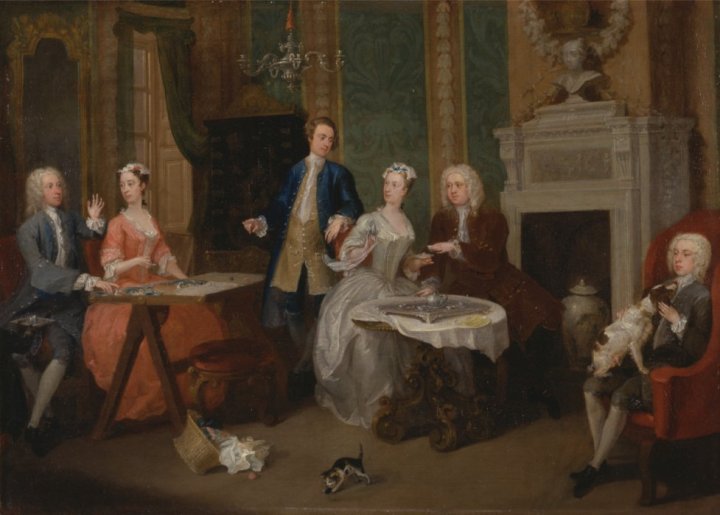
William Hogarth, Portrait of a Family (New Haven: Yale Center for British Art, Paul Mellon Collection). An interactive site includes images, a timeline of events, and audio commentaries on a selection of works included in the exhibition. Chi-ming Yang, for instance, describes some of the ways Hogarth’s painting might be understood to aestheticize race and skin color in relation to global commodities (both people and things).
◊ ◊ ◊ ◊ ◊
From the Yale University Library:
Workshop for Graduate Students | Representing Slavery in Eighteenth-Century Atlantic Britain
The Yale Center for British Art, New Haven and The Lewis Walpole Library, Farmington, 9–10 December 2014
Applications due by 1 December 2014
In December 2014, The Lewis Walpole Library and the Yale Center for British Art will jointly host a two-day workshop for graduate students focusing on two current Yale University exhibitions related to the visual culture of slavery: Figures of Empire: Slavery and Portraiture in Eighteenth-Century Atlantic Britain and Prospects of Empire: Slavery and Ecology in Eighteenth-Century Atlantic Britain. The workshop will provide an opportunity to explore these complementary exhibitions in depth and to examine additional materials related to the topic selected from the rich holdings of both institutions with curatorial and academic scholars working in the field. The workshop is open to graduate students from a variety of disciplines whose work would benefit from participation in this collaborative exploration of the topic.
Prospects of Empire is curated by Heather Vermeulen, Doctoral Candidate in African American Studies and American Studies, Yale University, and Hazel V. Carby, Charles C. & Dorathea S. Dilley Professor of African American Studies and Professor of American Studies, Yale University. The exhibition explores the notion of empire’s ‘prospects’—its gaze upon bodies and landscapes, its speculations and desires, its endeavors to capitalize upon seized land and labor, as well as its failures to manage enslaved persons and unruly colonial ecologies.
Figures of Empire is curated by Esther Chadwick and Meredith Gamer, PhD candidates in the Department of the History of Art at Yale University, and Cyra Levenson, Associate Curator of Education at the Yale Center for British Art. The exhibition explores the coincidence of slavery and portraiture in eighteenth-century Britain.
The workshop will take place at the Yale Center for British Art, New Haven, and the Lewis Walpole Library in Farmington and will offer exhibition walk-throughs with the curators of each exhibition and additional presentations and conversation in a study room setting. Lead discussants for the workshop will be Gillian Forrester, Senior Curator of Prints and Drawings, Yale Center for British Art, and Dian Kriz, Professor Emerita, Art History, Brown University. Additional participating scholars working in the field include Paul Grant Costa, Executive Editor, Yale Indian Papers Project, and Marisa Fuentes, Assistant Professor, Women’s and Gender Studies and History, Rutgers University. The program will also include a talk at 2:00 on Tuesday at the Yale Art School by artist Fred Wilson, whose groundbreaking project Mining the Museum (1992–93) at the Maryland Historical Society initiated his ongoing critique of the ways in which museums consciously or unwittingly reinforce racist beliefs and behavior, followed by a walk-through of Figures of Empire with the artist at 4:00.
Participants will be provided with accommodations at the Lewis Walpole Library guest house in Farmington, Connecticut. Shuttle transportation between Farmington and New Haven will be provided. A syllabus and list of readings will be provided in advance of the workshop.
Application Procedures
Applications must be submitted electronically. Please include a CV and a brief statement (of no more than one page) outlining how your research interests intersect with the focus of this workshop and what benefits you expect from participating. Applications and questions about content, organization or practicalities of the workshop should be emailed to Cynthia Roman, Curator of Prints, Drawings and Paintings, The Lewis Walpole Library cynthia.roman@yale.edu. Space is limited. The deadline for receipt of applications is Monday, 1 December 2014.
Call for Papers | The Many Faces of Slavery
From cfp.english.upenn.edu:
The Many Faces of Slavery: Non-Traditional Slave Experiences in the Atlantic World
University of Montpellier, 21–22 May 2015
Proposals due by 31 January 2015
Plenary speakers: Professor Jacques de Cauna (CNRS/EHESS CIRESC) and Professor Herbert S. Klein (Columbia University)
By the 18th century, racial slavery had matured into a fully-fledged, firmly established, profitable form of labour in the Atlantic World. In slave societies, the development of the plantation unit led both to the geographical concentration of the slave population and to a growing homogenization of the activities bondsmen performed. However, throughout the Atlantic World, the existence of phenomena such as urban slavery, slave self-hiring, quasi-free or nominal slaves, domestic slave concubines, slave vendors, slave sailors, slave preachers, slave overseers, and many other types of “societies with slaves,” broadens our traditional conception of slavery by complicating the slave experience. This conference does not aim to challenge the significance of the plantation system, but, by using it as a paradigm, seeks to assess the extent and nature of non-traditional forms of slavery in the context of the historical evolution of labour in the Atlantic World.
In order to do so, this conference seeks to ask the following questions:
Were certain locations, historical periods and economic conditions more favourable to the diversification of the slave experience? How does the variety of slave experience inform the essence of slavery itself? What strategies did slaves employ to negotiate or manoeuvre themselves into different relationships with their masters or with their societies? Did the privileges that certain slaves benefit from, such as geographic or social mobility, undermine the slave system by subverting the established social and racial order? At what point did slave autonomy develop from an act of the assertion of agency and become an act of rebellion? Could it be argued that the development of non-traditional forms of slavery was the result of deliberate political choices?
The themes this conference endeavours to explore include, but are not limited to:
Urban slavery
Hiring out of slaves and slave self-hire
Industrial slavery
Slave hierarchies within plantation culture
Subsistence slavery
Manumission by self-purchase or by a relative
Nominal or quasi-free slaves
Slaves owned by non-traditional owners (women, free blacks, indigenous people, institutions)
Socialising across legal or racial lines (i.e. between slaves and free people of colour or whites)
Spaces of negotiation
Slave geographic and social mobility
Slaves in the westward migration
Runaway slaves and Maroon communities
Please send proposals of no more than 300 words in English (for papers or panels) and a brief CV mentioning your institutional affiliation to manyfacesofslavery@gmail.com by January 31st, 2015. Notification of acceptance will be sent by February 20th 2015. We welcome papers that cover any region of the Atlantic World as well as proposals for round table discussions.
Conference organisers: Lawrence Aje (University of Montpellier), Catherine Armstrong (Loughborough University), and Lydia Plath (Canterbury Christ Church University).
Call for Papers | Circulations of Objects in Natural History
From the conference website:
Knowing Things: Circulations and Transitions of Objects in Natural History
Museum für Naturkunde Berlin, Germany, 23–24 March 2015
Proposals due by 1 December 2014
With this call for papers we invite researchers and young scholars from different fields—including, but not limited to, the history and theory of collections, museum studies, cultural history, art history and aesthetics—to present exemplary moments of transition in the history of natural specimens and to explore the impact of spatial and disciplinary mobility on the history and theory of natural history objects.
The goal of this conference is to contribute to the history and theory of these Wissensdinge (Objects of Knowledge) by reconstructing historical transitions and threshold areas within their institutional contexts, the collection and the museum. Can we identify different phases in the mobility of things of knowledge? How do various spaces of knowledge, such as the laboratory, the collection and the exhibition, influence the ways of handling natural history objects? How do meanings attributed to these objects vary in different contexts? Rather than constructing a ‘biography’ oriented towards the life cycle of the object, should we not instead be telling a history of fractures and shifts? Finally, to what extent does an expanded, multidisciplinary approach impact the use, meaning and presentation of Wissensdinge?
The focus of the conference will be on case studies. These will provide the basis for exploring the degree to which this fundamental characteristic of Wissensdinge—their mobility—can serve as a point of departure for better understanding natural history objects. Using the history of tangible objects within their institutional framework, we want to examine the extent to which Wissensdinge are shaped, not only by their materiality, but rather by their migration through diverse realms of knowledge, through technical settings, and through scientific, political, as well as cultural discourses. Furthermore, we want to ask how these settings and discourses are in turn shaped by things of knowledge. The conference will focus on the time period between the mid-19th century and the present.
The conference is organized by the research department PAN – Perspectives on Nature (Perspektiven auf Natur), Museum für Naturkunde Berlin in cooperation with the scientific collections of the Humboldt-Universität and with the base project “Mobile Objects” in the Cluster of Excellence “Image Knowledge Gestaltung: An interdisciplinary Laboratory.”
The event will take place from March 23rd to 24th, 2015 at the Museum für Naturkunde Berlin. The conference will be held in English. Please include in the application an abstract (max. 500 words) and a short CV. The deadline for submission is December 1st, 2014 at: pan@mfn-berlin.de
Keynote speaker: Lynn K. Nyhart
The complete Call for Papers and additional details are available here»
Charles E. Peterson Fellowship
From H-ArtHist:
Charles E. Peterson Fellowship
Applications due by 2 January 2015
In a joint program with the Athenaeum of Philadelphia, the Society of Architectural Historians is pleased to offer an annual fellowship that will support the participation of a graduate student in the research and writing for a volume in the Buildings of the United States (BUS) series and/or SAH Archipedia, the Society’s online architectural resource. This fellowship was established in 2008 in honor of Charles E. Peterson, FAIA, founder of the Historic American Buildings Survey. The recipient will research some aspect of American architecture prior to 1860, which he/she may choose from a list of topics provided by authors of forthcoming BUS books. The prize will be presented at the Society’s annual conference in April and will be announced in the SAH Newsletter following the conference.
The Award
The committee will award the fellowship by February 1, 2014, at which time the recipient will choose from the pre-defined list of available topics. The fellowship grant of $2,000 will be contingent upon the recipient’s completion of the project, which is expected to require no more than 100 hours of work. A portion of the award ($500) will be paid in early June to cover the recipient’s immediate expenses. The balance of the award ($1500) will be payable upon completion of the project. The completed project must be submitted to SAH by August 31, 2014.
Criteria for Application
The fellowship is intended for students currently enrolled in graduate programs in art or architectural history, architectural design, urban planning, historic preservation, landscape architecture, American studies, or related disciplines. Preference will be given to SAH members. The successful applicant does not need to reside in Philadelphia, although the Athenaeum will be glad to have the fellowship recipient use its collections. Applications will be reviewed by a committee composed of BUS/SAH Archipedia editors, authors, and Athenaeum staff. You do not have to be a member of SAH to apply for this fellowship, but membership is encouraged.
Application Details
Applicants must submit the following:
• Cover letter discussing their research interests and professional goals
• CV or resumé
• Brief writing sample (5–10 pages)
• Letter of recommendation from an advisor or principal professor
Applications for the 2015 award will be accepted up to January 2, 2015. Apply at the SAH website.
Call for Papers | The Allure of Rome for Joao V of Portugal
From H-ArtHist:
The Allure of Rome: João V of Portugal and His Cultural Policy in the European Context
New University, Lisbon, 15–18 July 2015
Proposals due by 19 December 2014
João V (1689–1750) is believed to be the Portuguese Sun King. He not only put Portugal into the European politics raising its prestige to unknown levels but he also developed an ambitious artistic policy supported by huge spending in art, music and luxury items. Considering João V’s transcendence, it is surprising the relatively lack of interest showed by non-Portuguese historians regarding his role in the European cultural context. This panel will deal with the King’s artistic policy in Europe with especial attention to Rome. Rome was the dreamed city of the ‘gentiluomini’ and artists who used to travel to Italy to improve their education and their training. Joao V wanted to spend some time enjoying his own Grand Tour but his political responsibilities didn’t allowed him to take that journey. This ‘viaggio mancato’ was without doubt some kind of frustration and part of his artistic policy can be better understood if we keep that in mind.
The king went through great artistic/cultural investments to display his wealth and power and to achieve a stronger position in Europe, but also because he obviously has a very particular taste. He supported lavish ambassadors entrées, made substantial donations to the Pope and became (in absentia) one of the most generous art patrons in Rome. He commissioned hundreds of masterpieces, namely the magnificent sculptures for his Royal palace in Mafra or the sumptuous San Rocco’s chapel in Lisbon, and he and his courtiers became some of the most influential collectors in the awakening of the Grand Tour. We encourage papers dealing with (but not only):
• Cultural milieu and artistic trade in the Embassies
• The print collection and the Mariettes
• Art market in Rome
• Collectors and diplomats as trade agents for the king
Contact: Pilar Diez del Corral (FCSH, Univ. Nova de Lisboa), pcorral@fcsh.unl.pt
Cumberland Art Gallery Opens at Hampton Court Palace

Cumberland Art Gallery at Hampton Court Palace
Photo from a tweet by Patrick Baty, who assisted with the project
◊ ◊ ◊ ◊ ◊
Press release (28 October 2014) from Historic Royal Palaces on the opening of the Cumberland Art Gallery:
This November, a stunning new art gallery will open at Hampton Court Palace, occupying a newly restored suite of rooms designed by William Kent for a Georgian prince. The Cumberland Suite—one of the earliest surviving examples of the Gothic Revival style—is situated at the heart of the palace, where Tudor meets Baroque and will now house changing displays of artworks, principally from the Royal Collection, reflecting the palace’s long history as a destination for the work of renowned artists.
The rooms designed by William Kent for William Augustus, the Duke of Cumberland, the youngest son of King George II, were the last major royal commission undertaken at Hampton Court. They will become a fitting backdrop for a display of treasures from the other legacy of Hampton Court’s royal residents: the Royal Collection. This winter, to mark the opening of the gallery, visitors will discover a selection of the Collection’s finest paintings: masterpieces by Holbein, Van Dyck, Rembrandt, Caravaggio, Bassano, and Gainsborough, and other artists who worked for, or were collected by, four centuries of royal patrons.
After two years of meticulous research, Kent’s Cumberland Suite has been returned as closely as possible to his original scheme. The great architect created a suite of rooms for a young prince which embraced the latest Palladian fashions but also took inspiration from the palace’s Tudor past. One of the rooms, the Duke’s large light closet, will be opened to the public for the first time in 25 years, to display the 12 smaller ‘Grand Canal’ views of Venice painted by Canaletto at the zenith of his career.
Hampton Court Palace has a long history of displaying great works of art. Over the centuries, successive monarchs filled the state apartments with splendid works of art for the private enjoyment of the royal family, or as imposing statements of regal authority. Although the palace’s life as a royal residence came to an end in the eighteenth century, thousands of artworks, now part of the Royal Collection, are still in their original locations and form part of the story of the palace today.
The Cumberland Art Gallery is a new dedicated space for artworks from the Royal Collection and will enable visitors to view and explore them in a gallery setting. The selection of paintings in our opening display broadly reflects the period of royal residency at Hampton Court, from the Tudor period to the middle years of the 1700s, when great royal collectors and connoisseurs, like King Charles I and Frederick Prince of Wales, assembled one of the largest and finest art collections of its kind in the world.
Conference | Diocletian’s Palace for Adam, Clérisseau, and Cassas
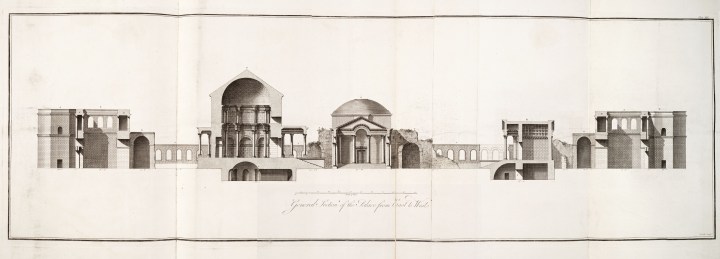
Robert Adam, Ruins of the Palace of the Emperor Diocletian at Spalatro in Dalmatia (1764), Plate XIX, general section of the palace from east to west. Image from the University of Wisconsin’s Digital Library for the Decorative Arts and Material Culture; click here for higher resolution.
◊ ◊ ◊ ◊ ◊
As noted at H-ArtHist:
Diocletian’s Palace in the Works of Adam, Clérisseau, and Cassas
Split City Museum, Split, Croatia, 27–29 November 2014
This international conference organized by the Institute of Art History at Cvito Fiskovic Centre Split arises out of the installation research project Dalmatia: A Destination of the European Grand Tour in the 18th and the 19th Centuries (2014–17) of the Institute of Art History, under the aegis of the Croatian Science Foundation. The conference is financed by the Croatian Ministry of Science, Education and Sports, and the City of Split. Researchers from several countries responded to the invitation to explore the role of Diocletian’s Palace in the work of Robert Adam, Charles-Louis Clérisseau, and Louis-François Cassas, as well as the influence of Diocletian’s Palace on the development of European neo-classicism.
The papers are divided into four groups. The section Reading the Place brings together papers devoted primarily to the ways in which the space is understood and recorded in image and word, based on the direct observation of the monuments and their surroundings. Representing the Past collects works in which the emphasis is placed on depictions of Diocletian’s Palace as sources for scholarship. From today’s perspective, they are important documents for the state of the monument of that time. Here there is also a contribution about the only extant specimen of the Livorno edition of Adam’s Diocletian’s Palace. The third section Diocletian’s Palace and the Adam Style presents works in which there is discussion of the direct influence of Diocletian’s Palace on the work of Robert Adam, while Lessons of Diocletian’s Palace focuses on the later influences of the works of Adam, Clérisseau, and Cassas about the Palace on neo-classicist architecture and culture, as well as on later periods and on the conservation of the palace itself.
Scientific Committee
Josko Belamaric (Institute of Art History – Centre Cvito Fiskovic Split)
Milan Pelc (Institute of Art History Zagreb)
Pierre Pinon (ENSA de Paris-Belleville, École de Chaillot, Institut national d’Histoire de l’Art Paris)
John A. Pinto (Princeton University)
Ana Sverko (Institute of Art History – Centre Cvito Fiskovic Split)
Organizing Committee
Josko Belamaric, Milan Pelc, Ana Sverko
Assistants
Marina Horvat, Ivana Tadic
◊ ◊ ◊ ◊ ◊
T H U R S D A Y , 2 7 N O V E M B E R 2 0 1 4
9.00 Registration
10.00 Welcome
10.30 I: Reading the Place (Moderators: Frances Sands and Milan Pelc)
• Heather Hyde Minor, Robert Adam as Author
• Angelo Lorenzi, The Adam Point of View
• Ana Sverko, ‘The View from the Palace Is No Less Beautiful’: The Context of Diocletian’s Palace in Ruins of the Palace of the Emperor Diocletian at Spalatro in Dalmatia
• Isabelle Warin, The Ornamentation of Diocletian’s Palace in the Work of Louis-François Cassas (1756–1827)
12.10 Coffee
12.40 Discussion
13.30 Lunch
16.00 II: Representing the Past (Moderators: Flora Turner-Vucetic and John Pinto)
• Josko Belamaric, The Split Peristyle as Interpreted by Robert Adam
• Krasanka Majer Jurisic, The Eighteenth-Century Graphics of the Porta Ferrea and the Communal Square In
• Ivan Mirnik, Ante Rendic-Miocevic, Another Look at the Livorno Edition of Adam’s Diocletian’s Palace
17.15 Discussion
17.45 Coffee
18.30 Lecture by John Pinto, ‘The Most Glorious Place in the Universal World’: Rome in the Age of the Grand Tour
F R I D A Y , 2 8 N O V E M B E R 2 0 1 4
9.30 III: Diocletian’s Palace and the Adam Style (Moderators: Heather Hyde Minor, Ante Rendic-Miocevic)
• Frances Sands, Reconstructed and in Ruins: The Influence of Diocletian’s Palace within the Drawings of Robert Adam
• John Pinto, ‘The Beautiful Spirit of Antiquity’: Robert Adam and Diocletian’s Palace
• Colin Thom, ‘Spalatro’ on Thames: Or How Diocletian’s Palace Inspired Robert Adam’s Most Audacious Development – the Adelphi
• Elke Katharina Wittich, Variety and Elegance: Details of Diocletian’s Palace in Architectural Decorations
11.15 Coffee
12.15 IV: Lessons of Diocletian’s Palace (Moderators: Barbara Vujanovic, Fabien Bellat)
• Annie Gilet, Dessins et gravures du Palais de Dioclétien à Split par Louis-François Cassas, un exercice préparatoire aux relevés des grands sites archéologiques du Levant en 1785
• Amanda Green, Experiential Neoclassicism and the Adam ‘Revolution’ in English Architecture
• Stephen Caffey, Imperial Capriccio: The Palace of Diocletian and England’s Visual Cultures of Empire
14.30 Lunch
16.30 IV: Lessons of Diocletian’s Palace (Moderators: Elke Katharina Wittich, Josko Belamaric)
• Viktor Lorincz, Local Antiquities and Architecture in Eighteenth-Century Central-Europe: The Case of Cardinal Migazzi and I.M.A. Ganneval
• Olivia Sara Carli, The Influence of Adam, Clérisseau, and Cassas on Diocletian’s Palace Restoration
• Fabien Bellat, Stalinists Avatars of Diocletian Palace
18.15 Coffee
18.45 Lecture by Ivan Mirnik, Ante Rendic-Miocevic, Sheila Mc Nally and Excavations of Diocletian’s Palace, 1968–75
S A T U R D A Y , 2 9 N O V E M B E R 2 0 1 4
9.30 Walking Tour of Diocletian’s Palace
12.30 Conference Summary
◊ ◊ ◊ ◊ ◊
Note (added 23 November 2014) — The full conference programme with abstracts is available here. More information is available here regarding the larger research project Dalmatia: A Destination of the European Grand Tour in the 18th and the 19th Centuries (2014–17).
New Book | The Manufacture des Gobelins under Louis XIV
From ArtBooks.com:
Florian Knothe, The Manufacture des meubles de la couronne aux Gobelins under Louis XIV: A Social, Political, and Cultural History (Turnhout: Brepols, 2014), 350 pages, ISBN: 978-2503553207, $150 / 100€.
 The cultural importance, dependencies and mechanics of manufacture in Europe prior to the Industrial Revolution are understudied areas of research. In the case of French royal manufacture during the ancien régime, art-historical interest first awakened in the latter half of the nineteenth century with the publication of several descriptive texts that made archival sources available to a wider public. This volume on the Manufacture royale des meubles de la couronne aux Gobelins examines the current state of research on the royal workshops and indicates the manner by which this research can both extend and challenge the prevailing trends in the historiography of the Gobelins (Studies in Western Tapestry 8).
Florian Knothe is Director of the University Museum and Art Gallery at the University of Hong Kong, where he also occupies a part-time appointment as Honorary Associate Professor.
Conference | Memoria and Souvenir, 1700–1800
From H-ArtHist:
Memoria and Souvenir: Mediality and Materiality of Remembering in the Arts, 1700–1800
Memoria und Souvenir: Medialität und Materialität des Erinnerns in den Künsten, 1700–1800
Universität Zürich, 5–6 December 2014
This conference aims at discussing historical concepts of memory and remembering with a focus on seventeenth- and eighteenth-century painting, art theory, and science. In suggesting that a fundamental shift in traditional concepts of human memory in relation to changing information management systems took place in the long eighteenth century, focus will be placed upon questions of how changing theories of remembering and forgetting were reflected within new artistic topics and media as well as in art theoretical discourses. Our intention is to explore the pictorial modes of displaying souvenirs, personal memories, and knowledge management by taking into account both eighteenth-century memory theories and the cultural role and development of external memory storage systems. Key issues include the interrelationship of the history of memory and the culture of seeing, the role of memoria within the context of rhetoric and art theory, scientific and artistic reflections on new paradigms of systematization and on the problem of dealing with large quantities of information, and the role of portrait genres and personal souvenirs.
Concept and Organisation: Bettina Gockel and Miriam Volmert (Kunsthistorisches Institut, Universität Zürich)
◊ ◊ ◊ ◊ ◊
F R I D A Y , 5 D E C E M B E R 2 0 1 4
19.00 Abendvortrag, Katia Saporiti, Universität Zürich, “Erinnerung und Repräsentation”
S A T U R D A Y , 6 D E C E M B E R 2 0 1 4
9.00 Bettina Gockel und Miriam Volmert, Begrüssung und Eröffnung der Tagung
9.15 Miriam Volmert, “Introduction: Art, Memory and Knowledge in the Seventeenth and Eighteenth Centuries”
9.30 I: Concepts of Memory and Knowledge Transfer, 1600–1800
• David Allan, University of St Andrews, “Remembering Reading: The British Commonplace Book in the Long Eighteenth Century”
• Valeska von Rosen, Ruhr-Universität Bochum: “Historiographie und Wissensspeicherung: Überlegungen zu Giovanni Pietro Belloris Viten”
11.00 Coffee
11.30 II: Memoria in Art Theory and Science around 1700
• Jan Blanc, Université de Genève: “Mémoire volontaire ou involontaire? Pratiques et débats autour de l’emprunt (borrowing) dans les arts en France et en Grande-Bretagne au XVIIIe siècle”
• Reinhard Wegner, Friedrich-Schiller-Universität Jena: “Strategien visueller Erinnerung: Karl Philipp Moritz und das Bildgedächtnis”
13.00 Lunch
14.30 III: Eighteenth-Century Concepts of Memory and Remembrance in the Arts
• Andreas Gormans, RWTH Aachen: “Vergessene Bilder, erinnerte Metaphern: Mediengeschichtliche Kontinuitäten und Brüche zwischen memoria passionis und encyclopédie”
• Michael Thimann, Georg-August-Universität Göttingen: “Religiöse Empfindung: Bilderbibelprojekte um 1800 und ihr wissensgeschichtlicher Kontext”
16.00 Coffee
4.30 IV: Between Memory and Souvenir: Visual Memories around 1800
• Allison Goudie, The National Gallery, London: “Wax and the Materiality of Memory in Royal Portraiture of the French Revolutionary Period”
• Patrizia Munforte, Universität Zürich: “Remembered by the Pose: Nineteenth-Century Mourning Portraits”
New Book | Scottish Pewter, 1600–1850
From Birlinn Limited:
Peter Spencer Davies, Scottish Pewter, 1600–1850 (Edinburgh: John Donald, 2014), 304 pages, ISBN: 978-1906566722, £55.
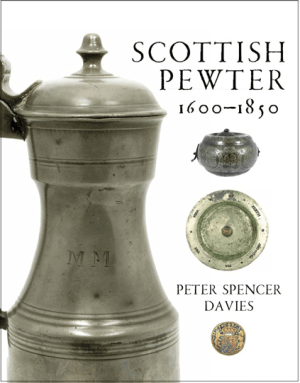 Pewter was in common use in most households, churches and places of commerce in Europe for hundreds of years before it gradually fell out of favour as more modern materials became available. Scottish pewter wares have an intrinsic interest, being quite different from those of England. In particular, they have a simple beauty arising from the plain functionality of form, reflective of the Protestant culture of Scotland at the time. However, despite its historical importance Scottish pewter has remained one of the least understood areas of the country’s material heritage.
Now, expert Peter Spencer Davies has produced what will be the definitive guide to the subject. This engaging book takes the reader through the development of the craft from its sixteenth-century beginnings, and making extensive use of otherwise inaccessible archival material, brings to life the role of the pewterers and their wares in the socio-economic history of the country. Lavishly illustrated throughout, the book offers a comprehensive guide to the metal, the manufacturing procedures of the pewterers, and provides examples of all known types of object that they made. One of the objectives has been to facilitate the identification of any item, together with the name of the maker, date, and place of manufacture. To this end, the book has detailed appendices, which include illustrations of all known makers’ marks.
Peter Spencer Davies, PhD, FSA Scot, had a professional life as an academic (biologist) at the University of Glasgow. Now retired, he pursues a lifelong interest in English and Scottish pewter. He is a Past-President of the Pewter Society, and has had articles published in the Proceedings of the Society of Antiquities of Scotland, Journal of the Pewter Society, and Connoisseur magazine. He is an expert in the conservation and restoration of old pewter.










 Enfilade
leave a comment