Lecture | Basile Baudez on Saint Petersburg’s Panorama

◊ ◊ ◊ ◊ ◊
From Penn’s Humanities+Urbanism+Design Initiative:
Basile Baudez | ‘The Décor of an Opera Built Yesterday’, Saint Petersburg’s Panorama
Penn School of Design, University of Pennsylvania, Philadelphia, 20 November 2014
Founded in 1703 on the Neva River Delta to provide Russia with a port to serve its Baltic ambitions, Saint Petersburg was aggressive in its bid to be read as a modern, European capital. The first prints representing the city adopted a panoramic format that focused on the Neva, its sublime width, and the magnificent new façades erected along its shores. Visitors understood the river landscape, however, as an insurmountable obstacle to proper urban development. For them, the Neva conveyed the hostility of nature, while the buildings—forever to be seen from too great a distance—appeared unreal, ready to vanish into the flat horizon.
Basile Baudez is Assistant Professor at the University Paris-Sorbonne (Paris IV).
Thursday, 20th November 2014, 6:15pm
Meyerson Hall, Lower Level, B3
210 S. 34th Street
Philadelphia, PA
Exhibition | Glitterati: Portraits & Jewelry from Colonial Latin America
From the DAM:
Glitterati: Portraits & Jewelry from Colonial Latin America
Denver Art Museum, 7 December 2014 — 27 November 2016

Young Woman with a Harpsichord (detail), Mexico, 1735–50 (Denver Art Museum).
During the Spanish Colonial period in Latin America (1521–1850), precious gold and silver were crafted into elegant jewelry then embellished with emeralds from Colombia, coral from Mexico, and pearls from Venezuela. Wanting to demonstrate their wealth and status, people were painted wearing their finest dress and elaborate jewelry.
Women were adorned with tiaras, necklaces with pendants, and prominent earrings. Men proudly displayed hat ornaments, rings, watch fobs, and chatelaines (decorative belt hooks) with small tools similar to the modern Swiss Army knife. Priests wore gold crucifixes and rosaries while nuns had miniature paintings of the Virgin Mary and saints crafted into brooches, called nun’s badges. Inlaid and lacquered chests and boxes were used to store these luxury goods.
The portraits, furniture, and jewelry that are exhibited in Glitterati, drawn from the DAM’s world-renowned Spanish Colonial collection, tell the fascinating story of people and luxury possessions in the New World.
◊ ◊ ◊ ◊ ◊
From the conference page:
New England / New Spain: Portraiture in the Colonial Americas, 1492–1850
Denver Art Museum, 23–24 January 2015
The 14th Annual Mayer Center Symposium is organized by Dr. Donna Pierce, Mayer Curator of Spanish Colonial Art, Denver Art Museum, and Dr. Emily Ballew Neff, Saxon Director & Chief Curator, Fred Jones Jr. Museum of Art, University of Oklahoma.
Portraiture was an important art form in the Spanish colony of New Spain (Mexico) and in the British colonies of North America. Today, details in portraits—such as clothing, jewelry, and decorative arts—often reveal clues to the lives of both artists and sitters. At the symposium, scholars from both fields of study will present tandem talks addressing the evolution of portraiture as well as the similarities and differences in the colonial experience of the two regions.
S P E A K E R S
• Michael A. Brown (San Diego Museum of Art | San Diego) — Pieces of Home? How ‘Colonial’ Portraiture Developed in the Spanish and British Americas
• Elizabeth Mankin Kornhauser (The Metropolitan Museum of Art | New York) — The New England Portraits of Ralph Earl: Fashioning a Style for the New Citizens of the Young Republic
• Clare Kunny (Director, Art Muse | Los Angeles) — In His Own Image: A Humanist Portrait of Antonio de Mendoza
• Karl Kusserow (Princeton University Art Museum | Princeton) — Pride of Place: Selfhood and Surroundings in Early American Art
• James Middleton (Independent Scholar | New York) — Reading Dress in New Spanish Portraiture
• Paula Mues Orts (National School of Conservation, Restoration and Museography | Mexico City) — Corporate Portrait in New Spain: Social Bodies, the Individual, and their Spaces of Display
• Susan Rather (University of Texas | Austin) — Copies or Resemblances of Nature: The Limitations of Portrait Painting in Colonial British America
• Michael J. Schreffler (Virginia Commonwealth University | Richmond) — Cortes and Moctezuma: Words, Pictures, and Likeness in Sixteenth-Century New Spain
• Jennifer Van Horn (George Mason University | Fairfax) — Regional Tastes in a Transatlantic Market: Joseph Blackburn in New England and Bermuda
• Kaylin Haverstock Weber (Museum of Fine Arts, Houston | Houston) — Colonial Ambition Abroad: Benjamin West’s Portraits, 1763–1783
◊ ◊ ◊ ◊ ◊
Note (added 1 February 2016) — The catalogue has just been published by the University of Oklahoma Press:
Donna Pierce and Julie Wilson Frick, Companion to Glitterati: Portraits and Jewelry from Colonial Latin America at the Denver Art Museum (Norman: University of Oklahoma Press, 2016), 96 pages, ISBN: 978-0914738756, $15.
New Book | Owning the Past
Now available in the UK from the Paul Mellon Centre with US publication scheduled for January:
Ruth Guilding, Owning the Past: Why the English Collected Antique Sculpture, 1640–1840 (London: The Paul Mellon Centre for Studies in British Art, 2014), 412 pages, ISBN: 978-0300208191, £55 / $85.
 In a lively re-examination of the British collectors who bank- rupted themselves to possess antique marble statues, Owning the Past chronicles a story of pride, rivalry, snobbery, and myopic obsession with posterity and possession. Analyzing the motives that drove ‘Marble Mania’ in England from the 17th through the early 19th century, Ruth Guilding examines how the trend of collecting antique sculpture entrenches the ideals of connoisseurship and taste, exacerbates socioeconomic inequities, and serves nationalist propaganda. Even today, for the individuals or regimes that possess them, classical statuary performs as a symbol of authority or as the trophies of a ‘civilized’ power. From Adolf Hitler posing for the press beside an ancient copy of Myron’s Discobolus to the 2002 sale of the Newby Venus for a record price of about $13 million to the Emir of Qatar, marble mania remains unabated. With insider access to private collections, Guilding writes with verve and searing insight into
this absorbing fixation.
Ruth Guilding is an independent scholar and critic.
Call for Papers | Scientiae, Toronto 2015
From the conference website:
Scientiae, Toronto 2015
Victoria College, University of Toronto, 27–29 May 2015
Proposals due by 17 November 2014
Keynotes by Anthony Grafton (Princeton) & Peter Dear (Cornell)
 Paper, panel, and round-table proposals are invited for the fourth annual international conference on the emergent knowledge practices of the early-modern period (1450–1750). The major premise of this conference is that knowledge during the period of the Scientific Revolution was inherently interdisciplinary, involving complex mixtures of practices and objects which had yet to be separated into their modern ‘scientific’ hierarchies. Our approach, therefore, needs to be equally wide-ranging, involving Biblical exegesis, art theory, logic, and literary humanism; as well as natural philosophy, alchemy, occult practices, and trade knowledge. Attention is also given to mapping intellectual geographies through the tools of the digital humanities. Always, our focus must be on the subject-matter at hand, rather than on the disciplinary performances by which we access it. Although centred around the emergence of modern natural science, Scientiae is intended for scholars working in any area of early-modern intellectual culture.
Abstracts for individual papers of 20 minutes should be between 250 and 350 words in length. For panel sessions of 1 hour and 30 minutes, a list of speakers and chair (with affiliations), a 500-word panel abstract, and individual abstracts from each speaker are required. Newly at Scientiae 2015, we also invite proposals for a limited number of topic-based roundtable sessions. These should feature brief presentations from 2 or 3 knowledgeable speakers on a defined but broad issue in early-modern intellectual history, with the intention of opening up multilateral discussion from the floor—the main business of the session. All submissions should be made by 17 November 2014 using the online form here.
We are also pleased to announce that Mario Biagioli (UC Davis), Stephen Clucas (Birkbeck), Peter Dear (Cornell), Anthony Grafton (Princeton), and Jonathan Sawday (SLU) have joined the Advisory Board of the Scientiae conferences.
Exhibition | Masterpieces from the National Galleries of Scotland

Thomas Gainsborough, River Landscape with a View of a Distant Village, ca. 1748–50, oil on canvas, 30 x 60 inches (Edinburgh: Scottish National Gallery)
◊ ◊ ◊ ◊ ◊
Press release from Art Daily:
Masterpieces from the National Galleries of Scotland
The Frick Collection, New York, 5 November 2014 — 1 February 2015 (10 paintings)
de Young, Fine Arts Museums of San Francisco, 7 March — 31 May 2015
Kimbell Art Museum, Fort Worth, Texas, 28 June — 20 September 2015
The National Galleries of Scotland will send a selection of major works from the national collection to the United States over the next year. This touring show will raise the international profile of the Galleries and draw attention to the superb quality and range of works held within Scotland’s national collections. It is also hoped that the exhibitions will help attract interest and financial support for the proposed redevelopment of the Scottish National Gallery. The project plans to radically overhaul and significantly expand galleries devoted to the national collection of historic Scottish art whilst also greatly improving visitor circulation and facilities.
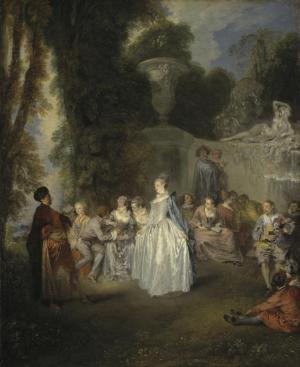
Jean-Antoine Watteau, Fêtes Vénitiennes, 1718–19, oil on canvas, 22 x 18 inches (Edinburgh: Scottish National Gallery)
In November 2014, ten masterpieces will go on display at The Frick Collection in New York. Masterpieces from the Scottish National Gallery will then travel with a further forty-five works to the de Young, Fine Arts Museums of San Francisco, to the Kimbell Art Museum in Fort Worth, Texas. The NGS has always maintained excellent relationships with partners all over the world and this tour will enable the NGS to strengthen these ties. The exhibition will include works by Raeburn, Ramsay, Constable, El Greco, Gainsborough, Reynolds, Velazquez, and Watteau. The Virgin Adoring the Sleeping Christ Child by Sandro Botticelli will also be included. This work has never before been on public view in the United States.
Sir John Leighton, Director-General of the National Galleries of Scotland commented: “At a time of intense international interest in Scotland, this tour to some of the most prestigious venues in the world will be a significant boost to the profile of the Galleries, highlighting the outstanding quality of the national collections and encouraging more visitors to discover the extraordinarily rich heritage and culture of our country.” Michael Clarke, Director of the Scottish National Gallery, said: “The excellence of our collections will achieve wider recognition through this tour. It will enable us to fly the flag for Scotland in a country whose history has been greatly enriched by Scots over the centuries.”
Ruling on the Warburg Institute
Press release (6 November 2014) from Bates Wells Braithwaite and the Warburg Institute:
To the benefit and relief of scholars worldwide, the High Court has rejected the University of London’s claims that all additions to the Warburg Institute since 1944 belong to the University, and instead agreed that they form part of the Institute. Furthermore, the judge, Mrs Justice Proudman, held that the University is obliged to provide funding for the activities of the Warburg Institute.
Leticia Jennings of Bates Wells Braithwaite, who advised the Advisory Council of the Warburg Institute, commented: “This decision ensures that the wealth of important material housed within the Institute will remain available, as before, in its entirety, and that the University will not be free to in any way restrict the access of the many scholars who use and rely on the Institute’s outstanding resources.”
The Institute grew out of the private library of the art historian Aby Warburg (1866–1929), who collected books in art history, literature, intellectual history, religion and the history of science and magic. As a Jewish institution based in Germany, the Institute was forced to close, and its very existence was threatened by the Nazi-organised book-burnings of April 1933. To escape destruction, the entire library of 60,000 books, as well as photographs, papers and furniture, were shipped to the safe-haven of London in December 1933. Many of the Institute’s staff also transferred to London.
After years of negotiation involving members of the Warburg Family, the University of London, distinguished scholars and philanthropists, the University of London became trustee of the Warburg Institute, to hold it on charitable trust pursuant to the terms of a 1944 Trust Deed*. The Institute has since grown into a world class teaching and research institute, much respected and sought after by academics worldwide.
The Trust Deed obliges the University to maintain and preserve the Warburg library in perpetuity, to house it, and to keep it adequately equipped and staffed as an independent unit. Leticia Jennings stated: “The contemporaneous evidence leading up to the signing of the Trust Deed shows that the transfer to the University of London was on the condition that the University accepted these obligations. This judgment has confirmed that the University must maintain the Institute as ‘an independent unit’, and that the University is not entitled to use the name and prestige associated with the Warburg Institute to obtain funds, but to then apply those funds to the University’s general purposes.”
In recent years the University had charged a proportion of its total estate expenditure to the Warburg Institute, meaning that the once solvent Institute was left with a significant deficit as it was used, in effect, to subsidise the University’s corporate property. The judge held that the University’s conduct in this regard is not permissible and “flies in the face” of the terms of Trust Deed.
Exhibition | Treasures of British Art 1400–2000: The Berger Collection

George Stubbs, A Saddled Bay Hunter, detail, oil on panel, 22 x 28 inches (The Berger Collection at the Denver Art Museum)
◊ ◊ ◊ ◊ ◊
From the PMA:
Treasures of British Art, 1400–2000: The Berger Collection
Portland Museum of Art, Portland, Maine, 2 October 2014 — 4 January 2015
Dixon Gallery & Gardens, Memphis, Tennessee, 25 January — 19 April 2015
Brigham Young University Museum of Art, Provo, Utah, 14 August 2015 — 5 January 2016
Taft Museum of Art, Cincinnati, Ohio, 10 June — 1 October 2017
Joslyn Art Museum, Omaha, Nebraska 2 June — 9 September 2018
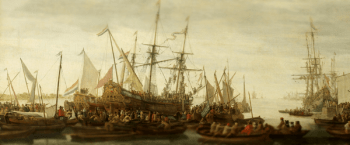
This fall, the Portland Museum of Art (PMA) will showcase a rich survey of British art spanning six centuries in the exhibition Treasures of British Art 1400–2000: The Berger Collection. Organized by the Denver Art Museum, the exhibition will feature 50 masterworks of British art by luminaries including Hans Holbein the Younger, Sir Anthony van Dyck, Thomas Gainsborough, Sir Thomas Lawrence, John Constable, Angelica Kauffman, and George Stubbs. The Berger Collection is one of the most impressive collections of British art in America, and this exhibition provides audiences the rare opportunity to see such a significant body of paintings in this region. The PMA is the first venue in this traveling show, which will be on view in Portland October 2, 2014 through January 4, 2015.
![00 3095 Berger Collection jacket [JW 5-29].indd](https://enfilade18thc.com/wp-content/uploads/2014/11/loadlarge-aspx.jpeg?w=310&h=378) With its diverse array of subjects and styles spanning six centuries of artistic practice, Treasures of British Art traces key developments in British art and culture through a chronological presentation of works. The earliest picture, a gilded altarpiece with a Crucifixion scene from circa 1395, is also an extremely rare surviving example of late Medieval religious painting—the type of object that was systematically destroyed in England when King Henry VIII broke away from the Roman Catholic Church. Portraiture has long been an important genre in British art, and this tradition is well-represented in the exhibition from the linear, decorative style of 16th-century portraits of Tudor royals and nobility, to the loosely brushed naturalism ushered in by Sir Anthony van Dyck and found in 17th- and 18th-century portraiture, to the expressionistic 21st-century image of the artist David Hockney by Adam Birtwistle. Marine paintings and landscapes of faraway places—including a monumental naval battle painting by Adriaen van Diest and a luminous harbor scene by John Constable—reflect not only shifting aesthetic approaches to the natural world, but also the importance of maritime life and overseas exchange in the history of the British Isles. History paintings, equestrian subjects, and other important genres of the British school in styles ranging from the traditional to modern round out the expansive breadth of the exhibition.
With its diverse array of subjects and styles spanning six centuries of artistic practice, Treasures of British Art traces key developments in British art and culture through a chronological presentation of works. The earliest picture, a gilded altarpiece with a Crucifixion scene from circa 1395, is also an extremely rare surviving example of late Medieval religious painting—the type of object that was systematically destroyed in England when King Henry VIII broke away from the Roman Catholic Church. Portraiture has long been an important genre in British art, and this tradition is well-represented in the exhibition from the linear, decorative style of 16th-century portraits of Tudor royals and nobility, to the loosely brushed naturalism ushered in by Sir Anthony van Dyck and found in 17th- and 18th-century portraiture, to the expressionistic 21st-century image of the artist David Hockney by Adam Birtwistle. Marine paintings and landscapes of faraway places—including a monumental naval battle painting by Adriaen van Diest and a luminous harbor scene by John Constable—reflect not only shifting aesthetic approaches to the natural world, but also the importance of maritime life and overseas exchange in the history of the British Isles. History paintings, equestrian subjects, and other important genres of the British school in styles ranging from the traditional to modern round out the expansive breadth of the exhibition.
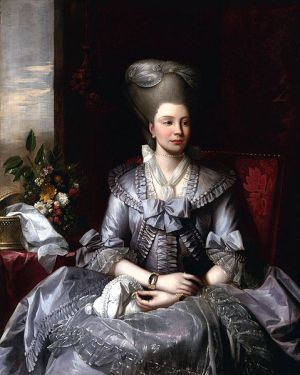
Benjamin West, Queen Charlotte, oil on canvas, 50 x 40 inches (The Berger Collection at the Denver Art Museum)
The Berger Collection is a major private collection largely of British art with a small but significant group of works by artists of other schools, including the French artist François Boucher and the American Winslow Homer. The late William M. B. Berger and his wife Bernadette Johnson Berger began amassing this collection in the mid-1990s out of their dual passion for British culture and for art’s potential to educate. Now owned by the Berger Collection Educational Trust and placed on long-term loan at the Denver Art Museum, the collection continues to expand through new acquisitions. The British paintings, drawings, and art objects number approximately 200 works and span more than six centuries—from the 14th to the 21st century. The very best paintings from this extraordinary collection have been selected for the traveling exhibition to fulfill the Berger family’s mission of sharing these masterpieces with a wide public audience.
The catalogue is available from ArtBooks.com:
Kathleen Stuart, Treasures of British Art, 1400–2000: The Berger Collection (Denver: Denver Art Museum, 2014), 120 pages, ISBN: 9780914738923, $50.
The exhibition is accompanied by a catalogue authored by Kathleen Stuart, Curator of the Berger Collection, with full-color plates and detailed entries on each of the works in the exhibition.
◊ ◊ ◊ ◊ ◊
Note (added 18 December 2014) — The original posting failed to include the Memphis and Provo venues.
Note (added 3 June 2018) — Earlier versions of the posting failed to include the Cincinnati and Omaha venues.
Exhibition and Symposium | Portrait of a Lady?
From One Royal Crescent in Bath:
Portrait of a Lady? Ruin & Reputation in the Georgian Era
One Royal Crescent, Bath, 16 May — 14 December 2014
Curated by Hallie Rubenhold
This exhibition features a private collection of mezzotints of Georgian women from different levels of society including actresses, courtesans and duchesses. The theme of the exhibition is to look at the status of different women in the 18th century, how they viewed themselves and were viewed by society. It also looks at the social fluidity of the 18th century, where a prostitute or actress might rise through the ranks to become a celebrated courtesan and then marry into nobility, or conversely where a woman born into wealth and status might be damned as a ‘whore’ for having a relationship outside of marriage.
◊ ◊ ◊ ◊ ◊
From the symposium programme:
Portrait of a Lady? Symposium
Bath Royal Literary and Scientific Institution, Queen Square, Bath, 14 November 2014
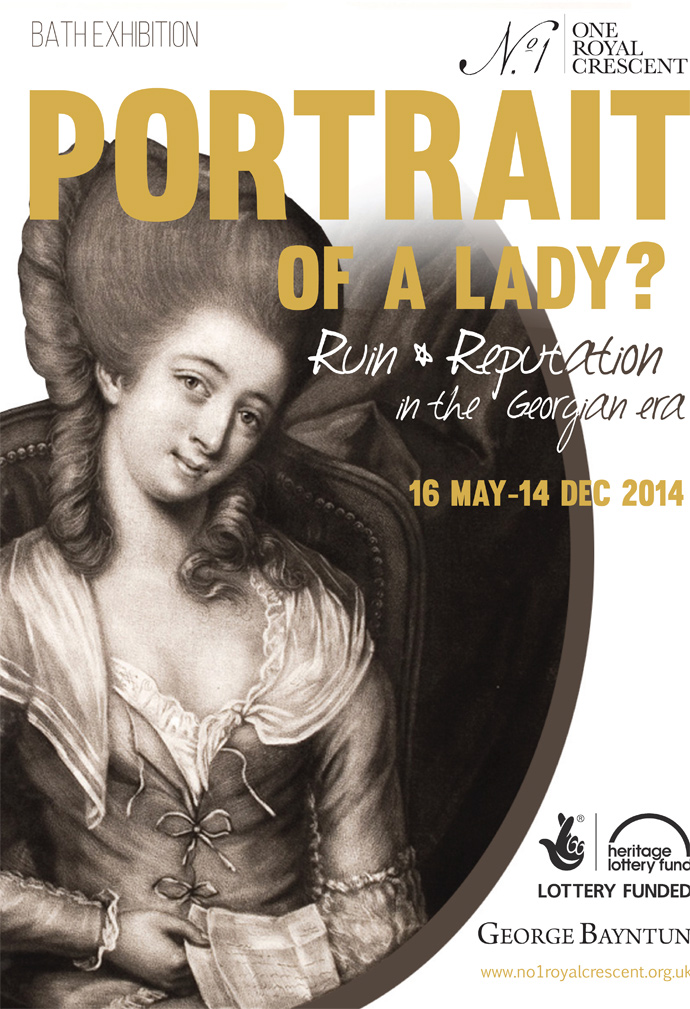 To coincide with the current exhibition at No.1 Royal Crescent this symposium brings together academics, curators and writers to consider how women were viewed, adored or condemned in the 18th century, in particular through the medium of the mezzotint. Speakers include: writer and broadcaster Dan Cruickshank, Exhibition Curator Hallie Rubenhold, and Professor Emeritus at the Courtauld Institute of Art Aileen Ribeiro. The symposium will be followed by an open invitation to delegates to visit the exhibition at No. 1 Royal Crescent for a drinks reception.
P R O G R A M M E
9.15 Registration
9.30 Welcome by Adrian Tinniswood, writer and historian and Edward Bayntun-Coward, chairman of Bath Preservation Trust
9.40 Portrait of a Lady? by Hallie Rubenhold, curator, writer and broadcaster
10.25 ‘Miss Macaroni and Her Gallant at a Print Shop’: A New Market for Mezzotints by Sheila O’Connell, Assistant
Keeper, British Prints before 1800, British Museum
11.10 Coffee
11.25 The Secret History of Georgian London by Dan Cruickshank, writer and broadcaster
11.55 Queen of the Courtesans: Fanny Murray by Barbara White, former Dean and Director of Advanced Studies in England
12.40 Lunch (provided)
2.00 Behind the Mask: Women and Cosmetics in the Georgian Era by Aileen Ribeiro, Professor Emeritus at the Courtauld Institute of Art
2.30 The First Actresses by Gill Perry, Open University
3.00 Portrait of a Parricide in the Eighteenth Century: Unveiling Miss Blandy’s Image by Garthine Walker, University of Cardiff
3.45 Tea
4.00 Elections and Entertainments: Elite Women and Politics in the Eighteenth Century by Elaine Chalus, Bath Spa University
4.30 The First Sexual Revolution and the Birth of Sexual Celebrity by Faramerz Dabhoiwala, Exeter College, Oxford
5.30 Summing up by Adrian Tinniswood
6.00 Drinks reception and exhibition at No.1 Royal Crescent
Exhibition | Gold

Gold tiger’s head ornament from Tipu Sultan’s throne, 1785–93; made from gold sheet over a wooden core with finely chased and punched decoration, set with rock crystal eyes, rock crystal teeth, and a hinged gold tongue, the mouth open as if roaring. Presented to William IV by the East India Company in 1831 (Royal Collection, inventory 67212)
◊ ◊ ◊ ◊ ◊
Press release (8 August 2014) from The Royal Collection:
Gold
The Queen’s Gallery, Buckingham Palace, London, 7 November 2014 — 22 February 2015
The beauty and symbolism of gold, from the Early Bronze Age to the 20th century, is celebrated in an exhibition opening at The Queen’s Gallery, Buckingham Palace in November. Through 50 items drawn from across the entire breadth of the Royal Collection, Gold explores the distinctive qualities that make this rare and precious metal an enduring expression of the highest status, both earthly and divine.
Over millennia and across diverse cultures, gold has been used to represent and reflect royal wealth and power. Among the most striking examples in the exhibition are the Rillaton gold cup, from a Bronze Age burial around 1700–1500 BC, a gold crown from Ecuador that pre-dates the Inca invasion, and a tiger’s head in gold and rock crystal from the throne of Tipu Sultan (1785–93), ruler of Mysore in India.
Many of the sacred and ceremonial items associated with the coronations of British monarchs incorporate gold. The exhibition includes a design from 1760 by Sir William Chambers and Giovanni Battista Cipriani for the Gold State Coach, the most expensive coach ever made, which has been used at every coronation since that of George IV. John Whittaker’s illustrated account of the Ceremonial of the Coronation of King George IV in the Abbey of St. Peter’s Westminster, 1823, is printed entirely in gold. Only six copies of the book were ever produced, and the project bankrupted the author. The painting Queen Victoria Receiving the Sacrament at her Coronation, 28 June 1838 by Charles Robert Leslie shows the Queen dressed in the shimmering Dalmatic Robe standing in a pool of golden sunlight.
Highly malleable and versatile, gold has been used to decorate every possible surface, from paper and silk to wood and silver. The exhibition shows gold incorporated into lacquer on a pair of 18th-century Japanese bowls and applied over carved gesso on a table by James Moore, who created furniture for Queen Anne and George I. A cigarette case by Carl Fabergé, presented to King Edward VII by the Dowager Tsarina of Russia in 1903, is made from three colours of gold that have been produced by mixing gold with other metals for a spectacular decorative effect.
The Padshahnama (Chronicle of the King of the World), 1656–57, is the finest Islamic manuscript in the Royal Collection. Written on paper flecked with gold, it forms an official record of the first ten years of the reign of Shah-Jahan, fifth Mughal emperor and builder of the Taj Mahal. Every year an amount equal to the Emperor’s weight in gold, silver and other precious items was distributed as alms, to prevent him suffering any corporeal or spiritual catastrophes. In a page from the manuscript in the exhibition, Shah-Jahan sits cross-legged in the pan of a set of golden scales.
Among other highlights of the exhibition are an early 16th-century Book of Hours illustrated with gilded miniatures by Jean Pichore, Simon van de Passe’s engraved gold portrait medallion of Elizabeth I, and two landscapes by the 17th-century artist Pier Francesco Cittadini which are drawn in pen and ink on paper covered in gold leaf. William Nicholson’s still life Gold Jug, 1937, is from the artist’s small series of works looking at the play of light on metallic surfaces.

Sir William Chambers, Pen and ink and watercolour design for the King’s State Coach, 1760; made for George III, bought from Colnaghi by the Prince Regent (later George IV), 12 June 1811 (Royal Collection, Inventory 917942)
◊ ◊ ◊ ◊ ◊
From the Royal Collection Trust and distributed by The University of Chicago Press:
Kathryn Jones, Lauren Porter, and Jennifer Scott, Gold (London: Royal Collection Trust, 2014), 120 pages, ISBN 978-1909741102, £25 / $40.
 Gold is the most coveted of metals, its rarity and radiant natural beauty making imbuing it with rich meaning throughout human history. For artists, gold has long been associated with the divine. For monarchs, it has been a means of symbolizing status and wealth. With Gold, Kathryn Jones, Lauren Porter, and Jennifer Scott have written a lively and highly informative cultural history of gold in the Royal Collection, one that explores its many manifestations throughout history and its use in promoting messages of power and wealth.
Drawing on the Royal Collection’s unparalleled collection of paintings, miniatures, jewelry, gold boxes, and drawings in and on gold, the book takes readers through the possibilities of this noble metal. Organized thematically, chapters include ‘Divinity’, which covers gold in devotional art; ‘Power’, which explores the role of gold as a symbol of status and wealth; and ‘Art’, which presents the craftsmanship and indestructible quality of gold objects. From Fabergé’s astonishing gold-mounted boxes to the nearly-four-thousand-year-old Rillaton Gold Cup and drawings in gold paint by Edward Burne-Jones, this lavish book—in its own gold binding—presents this most precious substance throughout history in one hundred full-color illustrations.
Saving Mr. Turner’s Country Retreat
◊ ◊ ◊ ◊ ◊
With the UK release of Mike Leigh’s Mr Turner, the Turner House Trust hopes to raise the profile of the painter’s house in Twickenham, which badly needs restoration. From the press release (14 October 2014) . . .
There cannot be many people who are unaware of the imminent general release of Mike Leigh’s award-winning Mr Turner, the biographical film of one of the supreme masters of landscape, England’s JMW Turner. What is less widely known is that Turner might have pursued a different career as an architect and that he designed and built a country villa for use by himself and his father. Completed in 1813, Sandycombe Lodge near the Thames between Richmond and Twickenham, was Turner’s retreat to escape the hectic London art world and the hurly-burly of his own household.
Mike Leigh together with actors Timothy Spall, highly praised for his portrayal of Turner, Paul Jesson as Turner’s father and Nick Jones as Sir John Soane, visited this three-dimensional Turner creation in the early stages of their work on the film.
Although the film is set later in Turner’s life, the director and actors wanted to learn as much as possible about the man behind the pictures. From here he would sketch along the Thames on foot, fish on the river and occasionally entertain his friends including Sir John Soane, architect and fellow-fisherman, whose influence is apparent throughout Sandycombe.
Grade 2* listed Turner’s House is largely unspoilt apart from some later additions, but seriously threatened by damp and long neglect it is now on English Heritage’s Heritage at Risk Register and badly in need of restoration.
Turner’s House Trust is appealing to the nation for help to save it from dereliction. “With additional damage caused by extreme weather conditions in recent years, this is now urgent. We have generous promises of grants and funding, which we must match in order to proceed,” said Catherine Parry-Wingfield, chairman of Turner’s House Trust. “With every pound we are closer to saving this Turner ‘treasure’ for future generations, but we still have a long way to go. We hope that, as this new film will no doubt inspire people to visit the artist’s wonderful masterpieces in our galleries, they will also support a lasting legacy for his country home to be enjoyed by future generations.”
◊ ◊ ◊ ◊ ◊
Note (added 7 January 2016) — An update on the project is available here: Farah Nayerijan, “An Effort to Save J.M.W. Turner’s Country House,” The New York Times (4 January 2016).










 Enfilade
leave a comment